North Atlantic Crossing Guide
North atlantic crossing guide. The Northern Route is the most demanding of the three Atlantic passage structures, linking Scotland → Faroes → Iceland → Greenland → Newfoundland through a chain of high‑latitude ports shaped by polar lows, ice concentration, fog, and narrow summer windows. Unlike the Central Route, which relies on broad, stable seasonal patterns, or the Southern Route, which is a one‑way west‑to‑east system, the Northern Route is a seasonal, bi‑directional high‑latitude corridor. Westbound passages (Europe → North America) and eastbound passages (North America → Europe) are both viable, but only within a narrow summer window when ice retreats and the Icelandic Low weakens.
The route is defined by the interaction between the Icelandic Low, Greenland High, and the polar front, with rapid frontal passages, steep seas, and visibility collapse common even in peak season. Icebergs, growlers, and cold‑water hazards remain present throughout the summer, and the region demands conservative timing, disciplined weather routing, and high‑latitude‑capable yachts. This page outlines the full structure of the Northern Route: start‑point logic, intermediate ports, weather systems, seasonal timing, weather‑information sources, routing behaviour, and port‑to‑port operational notes.
North Atlantic Crossing Guide Route
Orientation
Unlike the Southern Route, which is a one‑way west‑to‑east passage dictated by the South Atlantic High and the Agulhas Current, the Northern Route is seasonally reversible. Both directions are viable:
- East → West: Scotland → Faroes → Iceland → Greenland → Newfoundland
- West → East: Newfoundland → Greenland → Iceland → Faroes → Scotland
The determining factors are ice concentration, frontal spacing, and the position of the Icelandic Low, not a fixed wind‑driven corridor. This makes the Northern Route fundamentally different from the Southern Route and more similar to the Central Route in terms of directional flexibility — but with far narrower windows and far higher operational demands.
North Atlantic Crossing Guide - The Wind Systems
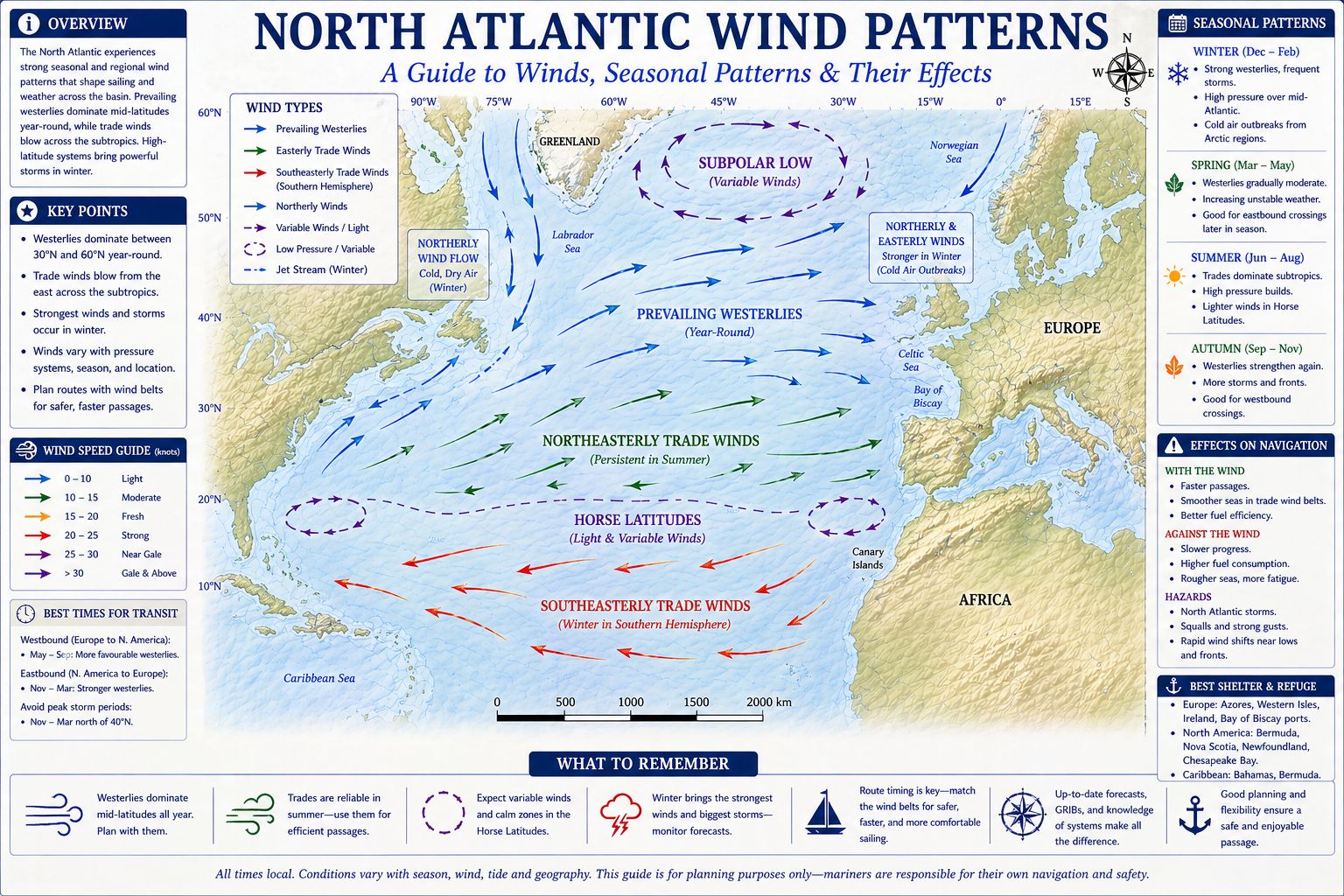
North Atlantic wind systems are structured around three dominant belts that dictate crossing strategy: the northeasterly trade winds, the subtropical high (Azores High), and the mid-latitude westerlies. For westbound passages from Europe to the Caribbean, sailors typically drop south to pick up the reliable NE trades (15–25 knots), which provide consistent following winds and manageable seas. Eastbound crossings from North America to Europe favour routing north into the westerlies (20–35 knots), often assisted by passing low-pressure systems that bring stronger but faster-moving conditions. Between these zones lie the horse latitudes, where the Azores High can create light, variable winds and calms—something to avoid or transit quickly. Seasonal shifts are critical: winter brings stronger westerlies, deeper lows, and more frequent gales, while summer offers a more stable high-pressure regime but increased risk of tropical systems in lower latitudes. Successful crossings depend on positioning relative to these wind belts and adjusting route and timing to stay in favourable flow while avoiding calms and storms.
North Atlantic Crossing Guide - Ocean Currents
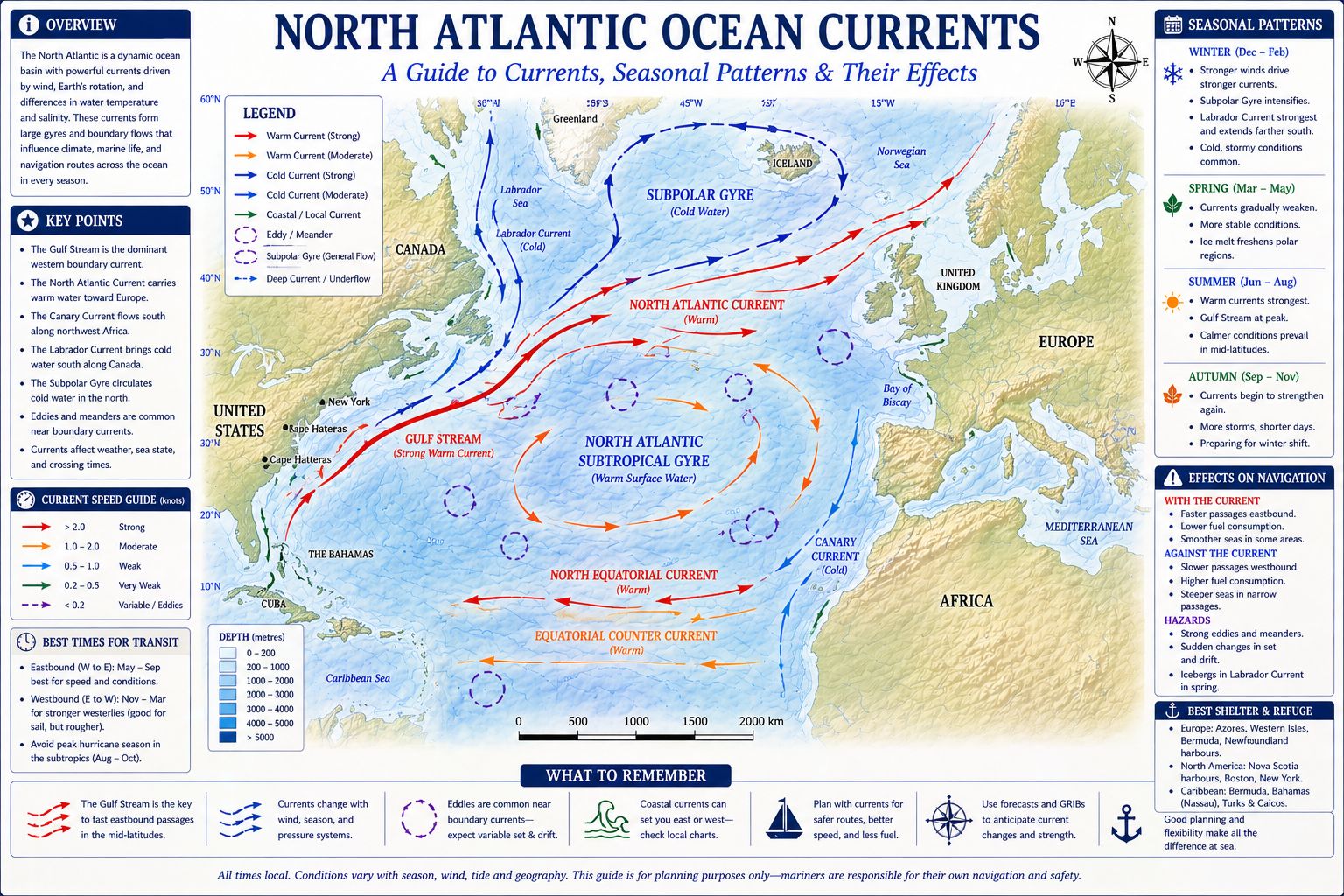
North Atlantic ocean circulation is dominated by a clockwise subtropical gyre, with the Gulf Stream forming the primary western boundary current. Flowing north from the Caribbean along the U.S. east coast at 2–4 knots, it then turns east as the North Atlantic Current, carrying warm water toward Europe and moderating its climate. South of this, the North Equatorial Current moves westward across the tropics, feeding the Caribbean system, while the Canary Current returns cooler water south along northwest Africa, typically at 0.5–2 knots. In the northwest, the cold Labrador Current flows south from Arctic regions, bringing colder water and occasional ice into the North Atlantic shipping lanes. The interaction of these currents creates eddies, fronts, and convergence zones, especially near the Gulf Stream, which can significantly affect sea state, weather, and passage times. For ocean crossings, understanding how to position relative to these flows using favourable set and avoiding adverse current is a key element of efficient route planning.
North Atlantic Crossing Guide - Scotland
(Primary Start)
Most yachts begin in Lerwick, Oban, Stornoway, or Kirkwall, depending on their preferred departure angle. Scotland offers the strongest combination of provisioning, repairs, haul‑out, and weather routing support. Departures are timed around stable high‑pressure ridges and reduced frontal activity, typically late June–mid July. The Scottish departure points used for northern North Atlantic crossings fall into three functional categories:
- Lerwick (Shetland): On the east coast of Shetland is the primary Scottish departure port for yachts headed toward the Faroe Islands, Iceland and Greenland
- Kirkwall (Orkney): Is the primary Orkney harbour and the secondary Scottish departure point for yachts routing toward the Faroes, Iceland and Greenland
- Scrabster (Caithness): The primary mainland Scottish harbour for yachts routing toward the Pentland Firth and onward to the Faroes, Iceland or Shetland
- Wick: Wick on the Caithness east coast is a secondary mainland harbour used by yachts repositioning from the Moray Firth or North Sea before continuing to Scrabster, Kirkwall or Lerwick for North Atlantic departures
- Stornaway (Outer Hebrides): On the east side of Lewis and is the primary west‑coast Scottish departure port for yachts routing directly into the North Atlantic toward Iceland, the Faroes or Greenland.
- Ullapool: On the eastern shore of Loch Broom is a secondary west‑coast Scottish departure point for yachts routing toward Stornoway and onward into the North Atlantic
- Oban: On the west coast, a secondary staging harbour used by yachts operating in the Inner Hebrides before repositioning north toward Stornoway or Ullapool for North Atlantic departures
Norway (Alternative Start). Some yachts begin from Bergen or Ålesund, joining the route at the Faroes. Norway offers excellent technical support and provisioning but adds distance and exposure.
North Atlantic Crossing Guide - Intermediate
Ports / Landfalls
Tórshavn is the Faroes’ only full‑service harbour, providing complete provisioning, fuel, water and protected berthing for yachts crossing the North Atlantic. It functions as the region’s operational reset point, with all onward passages to Iceland, Scotland or Greenland planned from its reliable shelter and infrastructure. Fog and strong tidal streams are common.
Iceland — Seyðisfjörður / Reykjavik / Ísafjörður
Iceland is the central decision node and whether to go North around the island or go South.
- North Coast: Akureyri, Sauðárkrókur, Hofsós, Siglufjörður, Dalvík, Húsavík
- East Coast: Seydisfjordur; Eskifjörður, Neskaupstaður
- South Coast: Höfn
- West Coast: Ísafjörður, Patreksfjörður, Bolungarvík, Stykkishólmur, Grundarfjörður, Akranes
Major Icelandic ports are Akureyri, Sauðárkrókur, Ísafjörður, Seyðisfjörður and Höfn.
- Seydisfjordur: The east coast’s primary sheltered fjord harbour, providing reliable access, provisioning and fuel for yachts transiting the exposed eastern approaches
- Djupivogur: A sheltered harbour on the western side of Berufjordur and functions as the first reliable stop when transiting west from Seydisfjordur.
- Höfn: The south coast’s only practical yacht harbour, providing fuel, water and provisioning with access controlled by swell at the entrance.
- Vestmannaeyjar: A primary harbour on Iceland’s south coast and the only reliable refuge between Höfn and the approaches to Reykjavík
- Reykjavik: Iceland’s main commercial harbour and largest service centre, providing full provisioning, fuel, technical support and reliable alongside berthing for yachts transiting the southwest coast.
- Isafjordur: The west coast’s main service base, providing provisioning, fuel and technical support for yachts heading toward the Denmark Strait or Greenland.
- Akureyri: The north coast’s primary service port, providing full provisioning, fuel and technical support for fjord‑to‑fjord yacht movements.
- Sauðárkrókur: A regional north‑coast service port providing fuel, water, provisioning and yard support for maintenance and repairs along Skagafjörður.
Greenland — Qaqortoq / Nuuk / Ilulissat
Greenland sits on the western edge of the North Atlantic route, with deep fjords, katabatic winds and long distances between service points defining every yacht movement. Its harbours provide functional shelter rather than full facilities, and all passages are planned around weather windows, ice behaviour and the limited availability of fuel, water and provisioning. Greenland is the most ice‑dependent segment.
- Scoresby Sund: The primary high‑latitude fjord system on the East Greenland coast and the most substantial landfall available to yachts arriving from Iceland in a summer ice window.
- Ammassalik / Tasiilaq: Centred on the town of Tasiilaq, is the most accessible and most consistently reachable port on the East Greenland coast.
- Kulusuk: Kulusuk sits on the outer edge of the Ammassalik archipelago,
- Qaqortoq: Qaqortoq is the primary harbour on the Southwest Greenland coast and the first substantial port after rounding Cape Farewell.
- Nuuk: Nuuk is the primary port and administrative centre of Greenland and the most capable harbour on the West Coast for yachts.
- Sisimat: Sisimiut is the primary harbour north of Nuuk and the most important service port on the West Coast for yachts heading toward Disko Bay
- Ilulissat: The northern extension for experienced expedition yachts. It is not used as a standard departure point for the Greenland – Canada crossing as it sits deep inside Disko Bay, far from the open Davis Strait, an area heavily influenced by icebergs from Sermeq Kujalleq (Jakobshavn Glacier).
Canada — Newfoundland (St. John’s / St. Anthony)
The final landfall from Greenland. These are the practical arrival ports for yachts coming from Greenland:
- St. John’s (Newfoundland): The primary Canadian arrival port for yachts completing a North Atlantic crossing from Greenland, Iceland or the Faroe Islands
- St. Anthony (Newfoundland): The primary landfall for yachts routing toward the Labrador coast or repositioning between Greenland and eastern Canad
- Cartwright (Labrador): The primary mid‑Labrador harbour for yachts routing north toward Hopedale, Nain and the Torngat region, or south toward St. Anthony and Newfoundland
- Hopedale (Labrador): The primary central Labrador harbour for yachts routing north toward Nain and the Torngat region or south toward Cartwright and Newfoundland
- Nain (Labrador): The primary northern Labrador harbour for yachts routing toward the Torngat Mountains, Saglek Fjord and the high‑latitude passages along the Labrador coast
For Northwest Passage expeditions the following may apply:
- Pond Inlet. Primary Northwest Passage entry
- Arctic Bay. Secondary entry / fallback
- Clyde River. Mid‑Baffin arrival
- Iqaluit. Southern Baffin arrival
- Qikiqtarjuaq. East‑coast diversion
- Resolute Bay. High‑Arctic arrival from North Greenland
Weather Systems (Route‑Specific)
- Icelandic Low. Rapid‑moving depressions with SW–NW winds, steep seas, and frequent fog.
- Greenland High. Unreliable but stabilising when present. Defines safe Iceland → Greenland windows.
- Polar Front. Produces sudden wind shifts, squalls, and visibility collapse.
- Fog. Persistent where cold Labrador water meets warmer Atlantic water.
- Sea Ice. Icebergs and growlers remain present even in peak summer
- Katabatic Winds. Common, frequent and strong and to prepare for.
North Atlantic Crossing Guide - Seasonal
Timing
The Northern Route has the narrowest window of any Atlantic passage:
- Earliest departures: late June
- Peak window: early July–early August
- Latest safe arrivals: late August
Outside this window, ice concentration increases and frontal activity intensifies.
Weather Information Sources
High‑latitude routing requires multi‑source weather intelligence.
- GRIB Models. Downloaded via Iridium, Starlink, or HF email; GFS; ECMWF, ICON Used through PredictWind Offshore, Expedition, or OpenCPN.
- Synoptic Charts. Essential for frontal timing: UK Met Office, NOAA OPC, DMI (Greenland), Icelandic Met Office,
- Ice Charts. Critical for Greenland legs: DMI Greenland Ice Charts. Canadian Ice Service. Sentinel‑1 radar. MODIS / VIIRS imagery
- Satellite Imagery. For fog, cloud bands, and ice: GOES‑East. EUMETSAT. Sentinel‑1 radar
- Local Forecasting Agencies. Icelandic Met Office. DMI. Environment Canada
- HF Weatherfax (Backup). Surface analysis and 24–96 hr forecasts.
North Atlantic Crossing Guide - Routing
Logic
- Scotland → Faroes. Depart on a stable ridge with light–moderate winds.
- Faroes → Iceland. Fog and frontal timing dominate; synoptic charts essential.
- Iceland → Greenland. Ice charts and satellite imagery are the primary decision drivers.
- Greenland → Newfoundland. Depart behind a passing low to ride NW–W winds; iceberg drift is the main hazard.
North Atlantic Crossing Guide - Port‑to‑Port
Operational Notes
- Scotland → Faroes. Strong tidal streams, rapid weather changes, persistent fog.
- Faroes → Iceland. Expect 20–40 kn winds near frontal boundaries; swell interaction near headlands.
- Iceland → Greenland. Icebergs, growlers, katabatic winds, sudden visibility collapse.
- Greenland → Newfoundland. Icebergs remain a hazard; fog common; lows track quickly.
Mechanical
and Electrical Repairs Resource
If you are headed somewhere remote consider the need to expand your knowledge base or have an information resource on board. Why not get a copy of my book The Marine and Electrical and Electronics Bible 4th Edition. By and for yachties, with everything from batteries and charging, solar and wind, diesel engines and marine electronics and so much more. Your complete systems guide. 650 pages of practical advice. In Australia and New Zealand order a copy through Boat Books. UK and European boats can buy the UK Edition Here. US and Canadian boats can get the US Edition Order Here. Marine systems are my profession so let me help you. By a liveaboard boat owner for other boat owners


North Atlantic Crossing Guide - Summary
The Northern Route is a high‑latitude, weather‑driven crossing requiring disciplined timing, strong technical preparation, and a yacht capable of handling cold water, fog, and rapid frontal passages. It is seasonally reversible but only within a narrow summer window. Each landfall acts as a decision node, and success depends on conservative routing and reliable weather intelligence. For well‑prepared yachts, the Northern Route is one of the most demanding and rewarding passages in the Atlantic. North Atlantic Crossing Guide for all you need to know.