St Johns Canada Sailing Guide
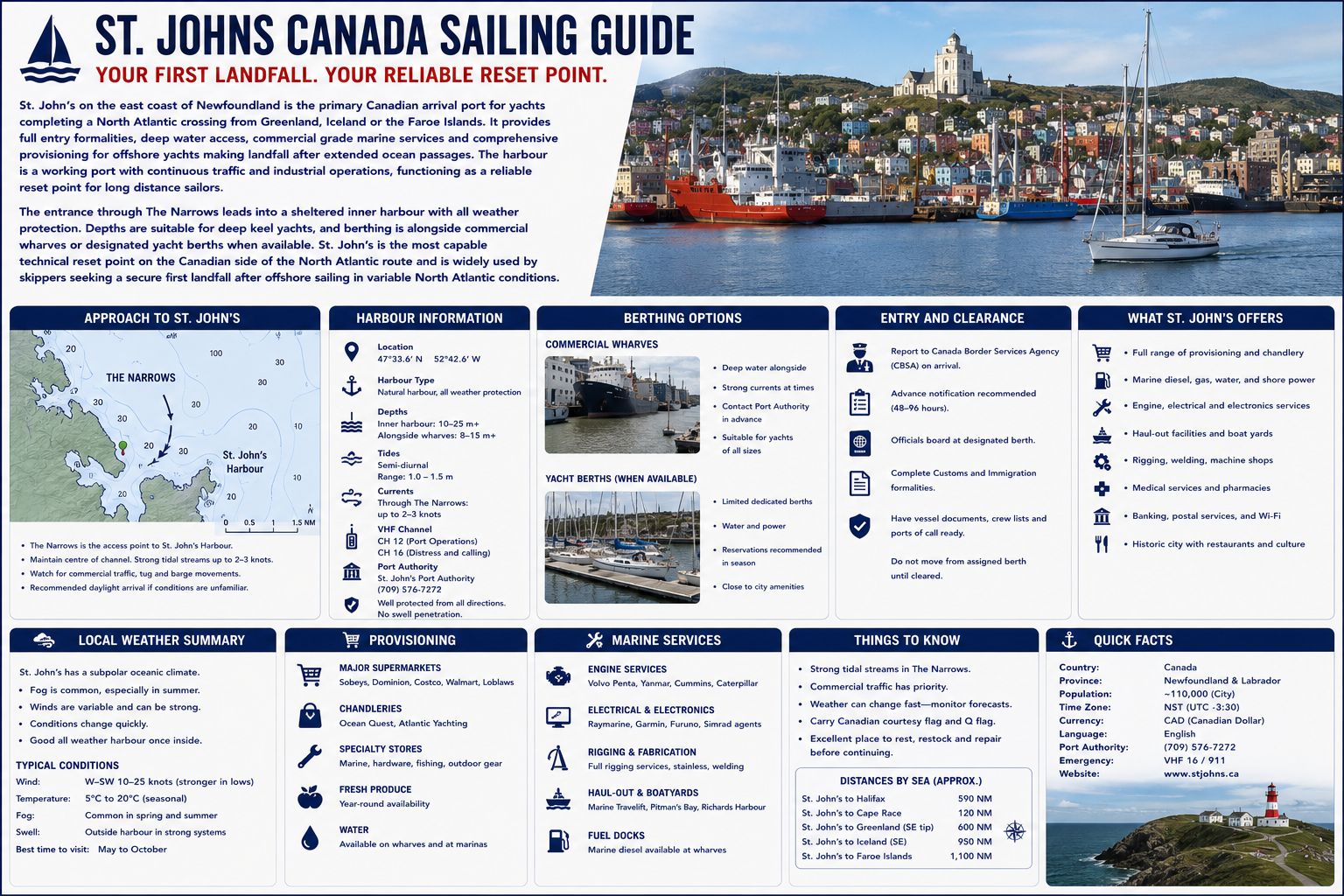
St Johns Canada Sailing Guide. St. John’s on the east coast of Newfoundland is the primary Canadian arrival port for yachts completing a North Atlantic crossing from Greenland, Iceland or the Faroe Islands. It provides full entry formalities, deep‑water access, commercial‑grade marine services and comprehensive provisioning for offshore yachts making landfall after extended ocean passages. The harbour is a working port with continuous traffic and industrial operations, functioning as a reliable reset point for long‑distance sailors.
The entrance through The Narrows leads into a sheltered inner harbour with all‑weather protection. Depths are suitable for deep‑keel yachts, and berthing is alongside commercial wharves or designated yacht berths when available. St. John’s is the most capable technical reset point on the Canadian side of the North Atlantic route and is widely used by skippers seeking a secure first landfall after offshore sailing in variable North Atlantic conditions.
St Johns Canada Sailing Guide - Routing
Logic
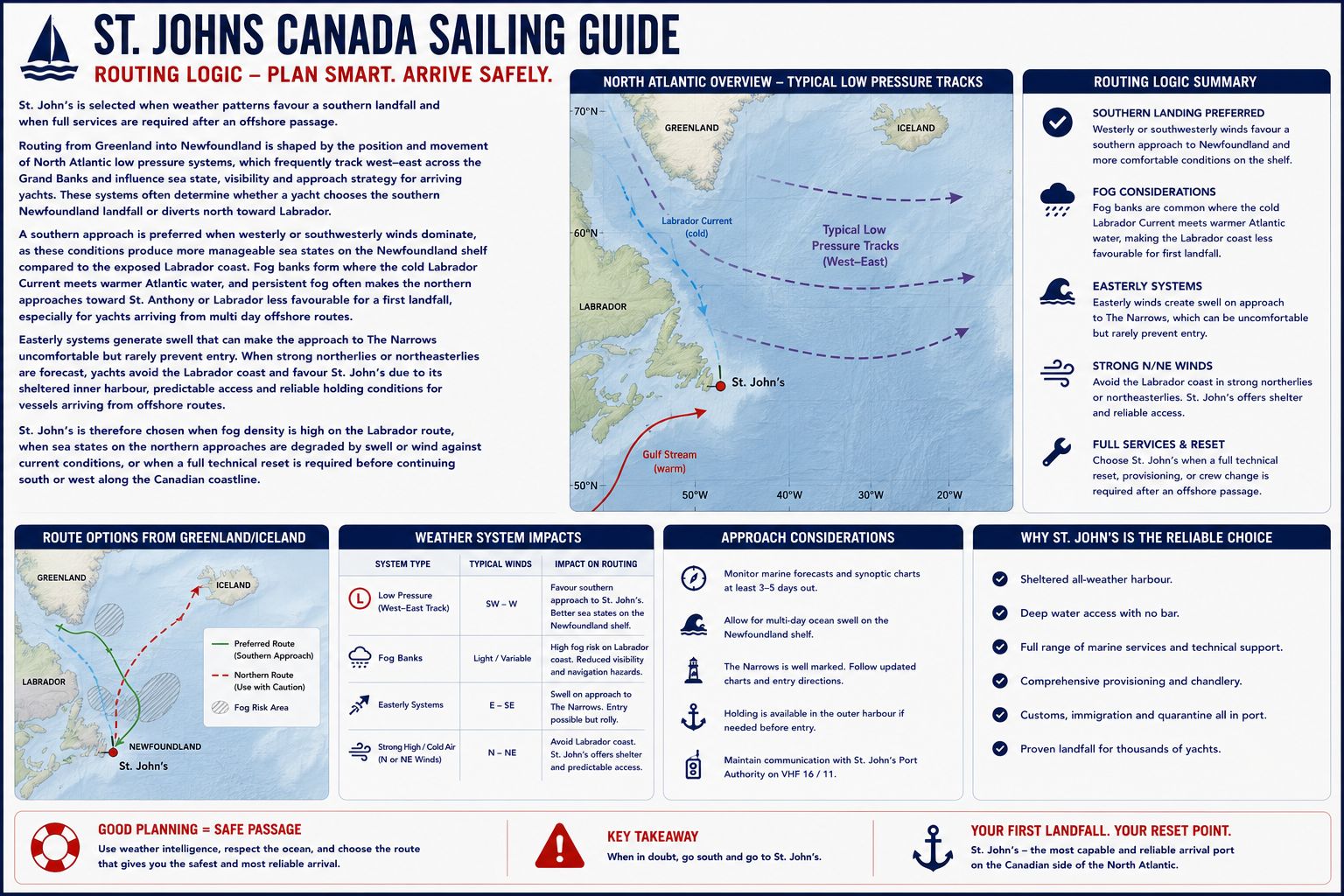
St. John’s is selected when weather patterns favour a southern landfall and when full services are required after an offshore passage. Routing from Greenland into Newfoundland is shaped by the position and movement of North Atlantic low‑pressure systems, which frequently track west–east across the Grand Banks and influence sea state, visibility and approach strategy for arriving yachts. These systems often determine whether a yacht chooses the southern Newfoundland landfall or diverts north toward Labrador.
A southern approach is preferred when westerly or southwesterly winds dominate, as these conditions produce more manageable sea states on the Newfoundland shelf compared to the exposed Labrador coast. Fog banks form where the cold Labrador Current meets warmer Atlantic water, and persistent fog often makes the northern approaches toward St. Anthony or Labrador less favourable for a first landfall, especially for yachts arriving from multi‑day offshore routes.
Easterly systems generate swell that can make the approach to The Narrows uncomfortable but rarely prevent entry. When strong northerlies or northeasterlies are forecast, yachts avoid the Labrador coast and favour St. John’s due to its sheltered inner harbour, predictable access and reliable holding conditions for vessels arriving from offshore routes.
St. John’s is therefore chosen when fog density is high on the Labrador route, when sea states on the northern approaches are degraded by swell or wind‑against‑current conditions, or when a full technical reset is required before continuing south or west along the Canadian coastline.
St Johns Canada Sailing Guide - Approaches
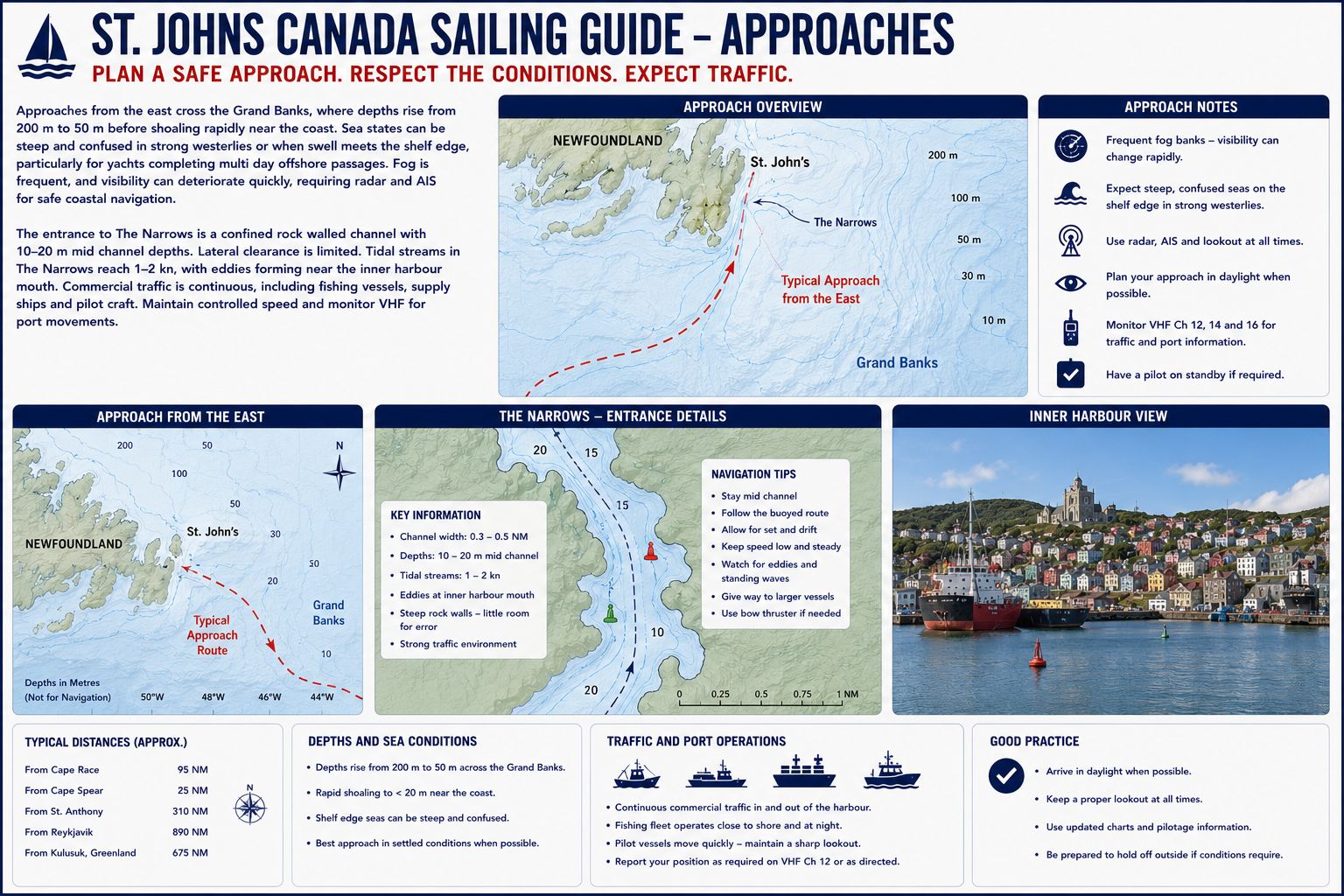
Approaches from the east cross the Grand Banks, where depths rise from 200 m to 50 m before shoaling rapidly near the coast. Sea states can be steep and confused in strong westerlies or when swell meets the shelf edge, particularly for yachts completing multi‑day offshore passages. Fog is frequent, and visibility can deteriorate quickly, requiring radar and AIS for safe coastal navigation.
The entrance to The Narrows is a confined rock‑walled channel with 10–20 m mid‑channel depths. Lateral clearance is limited. Tidal streams in The Narrows reach 1–2 kn, with eddies forming near the inner harbour mouth. Commercial traffic is continuous, including fishing vessels, supply ships and pilot craft. Maintain controlled speed and monitor VHF for port movements.
St Johns Canada Sailing Guide - Anchorage
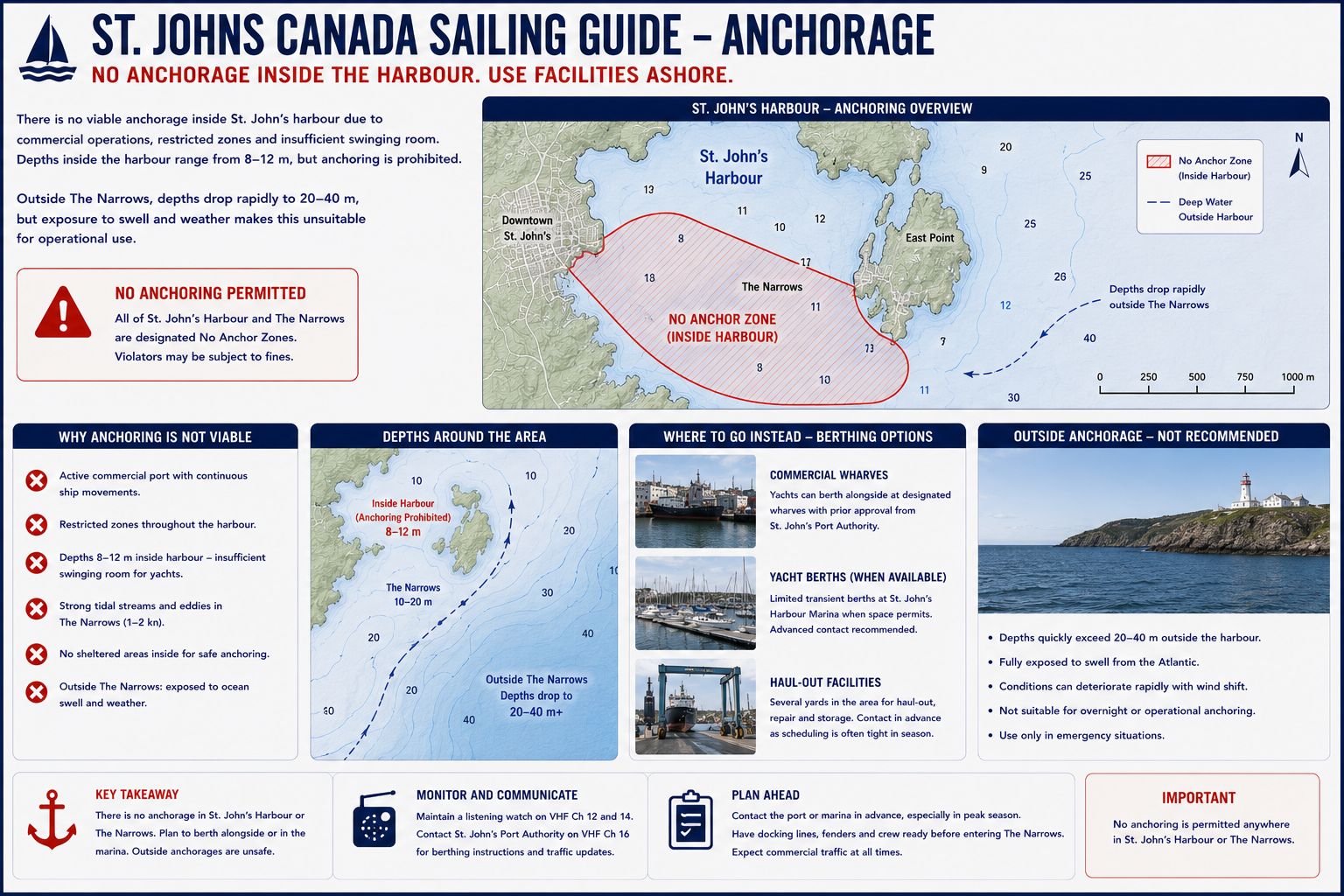
There is no viable anchorage inside St. John’s harbour due to commercial operations, restricted zones and insufficient swinging room. Depths inside the harbour range from 8–12 m, but anchoring is prohibited. Outside The Narrows, depths drop rapidly to 20–40 m, but exposure to swell and weather makes this unsuitable for operational use.
St Johns Canada Sailing Guide - Entry Formalities
St. John’s is a full port of entry. Canada Border Services Agency (CBSA) handles customs and immigration. Skippers must report arrival, provide vessel documentation, crew lists and voyage details, and await clearance instructions. Quarantine requirements follow Canadian regulations; all foodstuffs, plants and animal products must be declared.
Firearms must be declared and are subject to Canadian storage and permit rules. Communications equipment such as satellite phones and Starlink is generally permitted under Canadian spectrum regulations. Harbour inspections may occur depending on vessel type and recent ports of call.
St Johns Canada Sailing Guide - Marina
Facilities
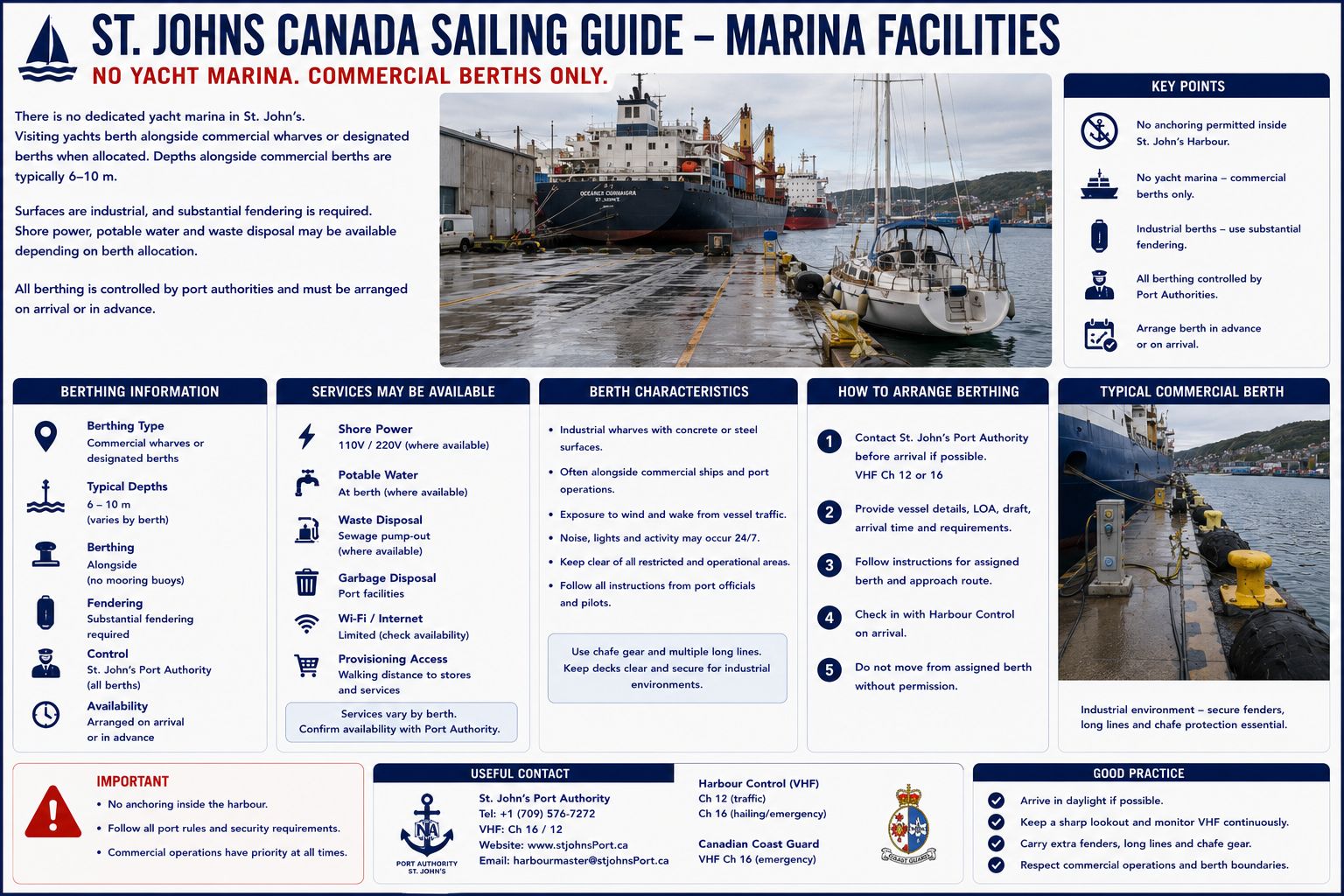
There is no dedicated yacht marina. Visiting yachts berth alongside commercial wharves or designated berths when allocated. Depths alongside commercial berths are typically 6–10 m. Surfaces are industrial, and substantial fendering is required. Shore power, potable water and waste disposal may be available depending on berth allocation. All berthing is controlled by port authorities and must be arranged on arrival or in advance.
St Johns Canada Sailing Guide - Local
Weather
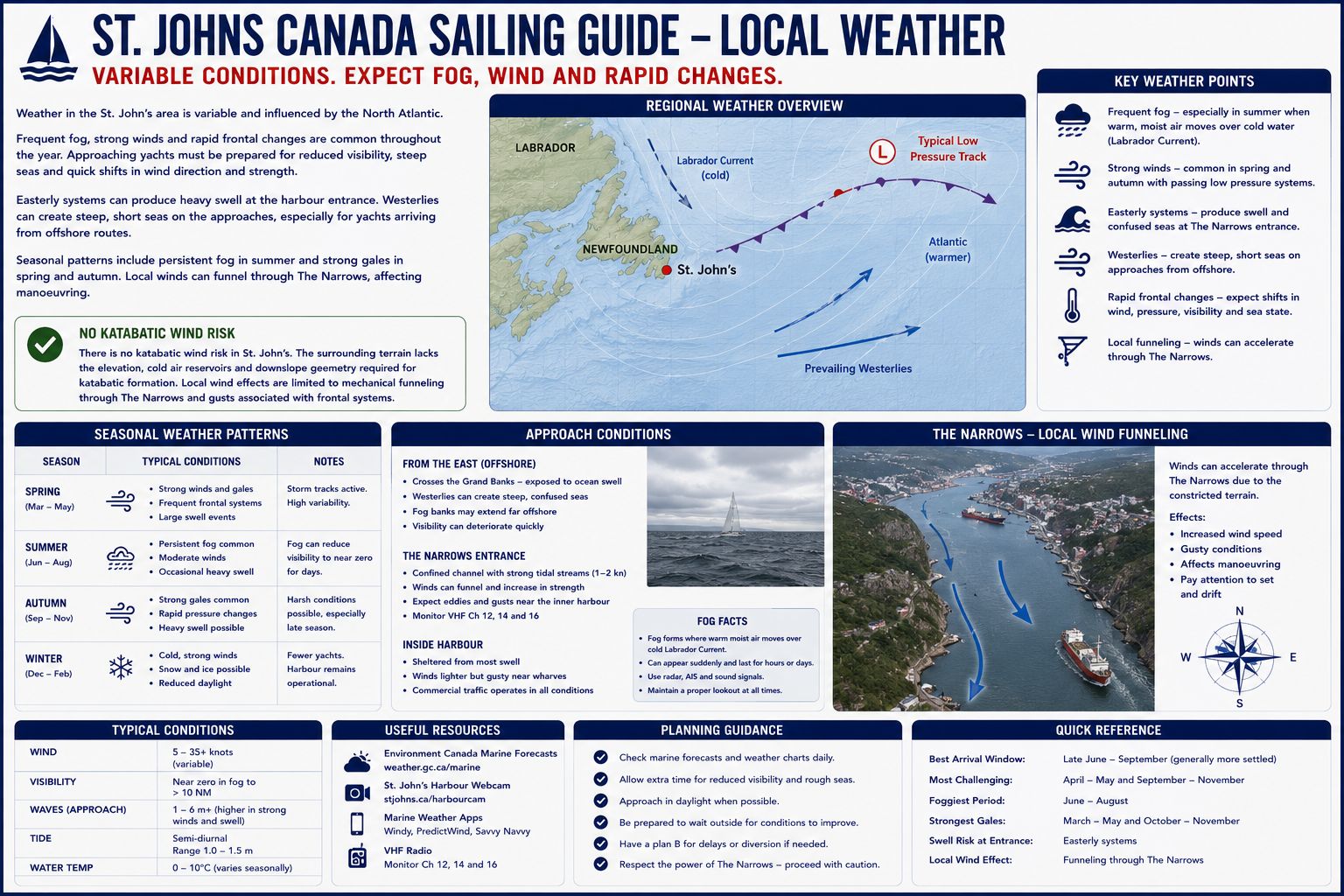
Weather is variable with frequent fog, strong winds and rapid frontal changes. Easterly systems can produce heavy swell at the harbour entrance. Westerlies can create steep seas on the approaches, especially for yachts arriving from offshore routes. Seasonal patterns include persistent fog in summer and strong gales in spring and autumn. Local winds can funnel through The Narrows, affecting manoeuvring.
There is no katabatic wind risk in St. John’s. The surrounding terrain lacks the elevation, cold‑air reservoirs and downslope geometry required for katabatic formation. Local wind effects are limited to mechanical funneling through The Narrows and gusts associated with frontal systems.
St Johns Canada Sailing Guide - Provisioning
Supermarkets. St. John’s has two full‑scale supermarkets suitable for complete yacht reprovisioning: Sobeys (Torbay Road) for full fresh produce, meat, dairy, bakery, frozen goods, dry stores, cleaning products. Dominion (Blackmarsh Road) for full fresh produce, meat, dairy, bakery, frozen goods, dry stores, household supplies.
Markets: St. John’s Farmers’ Market (Freshwater Road) has seasonal June–October operation with local vegetables, herbs, bakery items and small‑batch produce. Suitable for fresh top‑ups only. Not a full provisioning source.
Fish Markets: Fish and seafood are
obtained through commercial retail outlets. Local seafood shops supply cod, crab, mussels, scallops and other North
Atlantic species depending on season and quota.
No dedicated public fish market exists.
St Johns Canada Sailing Guide - Local
Cuisine
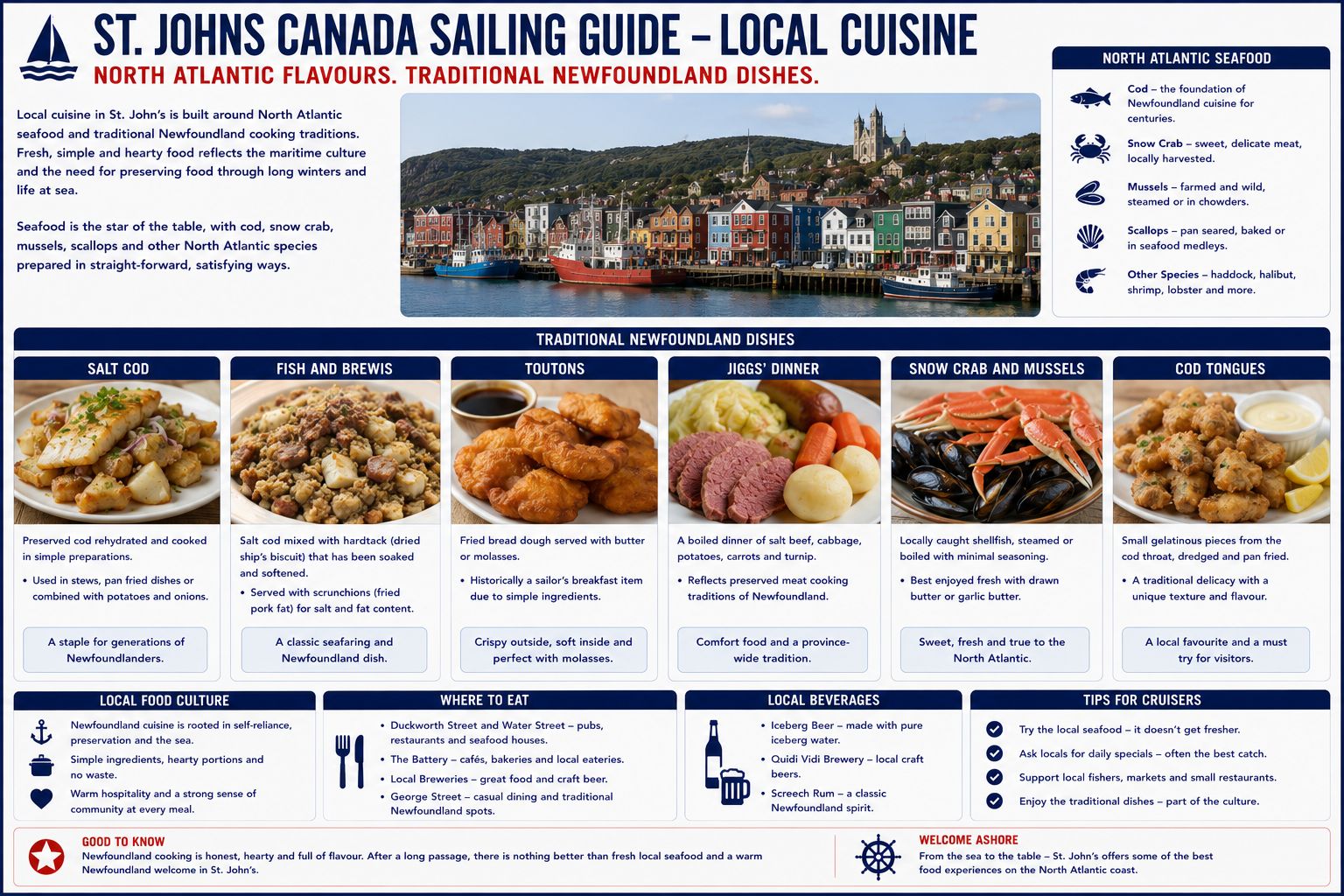
Local cuisine in St. John’s is built around North Atlantic species cuisine that includes cod, snow crab, mussels, scallops and other North Atlantic species. and traditional Newfoundland dishes. Salt Cod is preserved cod rehydrated and cooked in simple preparations; used in stews, pan‑fried dishes or combined with potatoes and onions. Fish and Brewis is salt cod mixed with hardtack (dried ship’s biscuit) that has been soaked and softened; served with scrunchions (fried pork fat) for salt and fat content. Toutons is fried bread dough served with butter or molasses; historically a sailor’s breakfast item due to simple ingredients. Jiggs’ Dinner is a boiled dinner of salt beef, cabbage, potatoes, carrots and turnip; reflects preserved‑meat cooking traditions. Snow Crab and Mussels is locally caught shellfish, steamed or boiled with minimal seasoning. Cod Tongues are small gelatinous pieces from the cod throat, dredged and pan‑fried.
St Johns Canada Sailing Guide Fuel
Supplies
Diesel is available at commercial fuel docks with 6–10 m depths alongside. Dispensing is via hose directly to deck. Advance coordination may be required depending on berth allocation and commercial traffic. Fuel quality meets Canadian commercial standards.
St Johns Canada Sailing Guide Water
Supplies
Potable water is available at most commercial berths via shore taps. Pressure and hose compatibility vary by location. Water is municipal‑grade and suitable for direct tank filling.
Mechanical and Electrical Repairs Resource
Why not get a copy of my book The Marine and Electrical and Electronics Bible 4th Edition. In Australia and New Zealand order a copy through Boat Books. UK and European boats can buy the UK Edition Here. US and Canadian boats can get the US Edition Order Here. Marine systems are my profession so let me help you.


St Johns Canada Sailing Guide Marine
Services
St. John’s has extensive marine services including diesel mechanics, electrical technicians, welding and fabrication workshops and electronics specialists. Commercial shipyards and repair facilities operate in the port. Availability of Volvo, Yanmar or other authorised agents varies; generic diesel support is reliable. Chandlery supplies are available through marine hardware stores.
St Johns Canada Sailing Guide Local
Customs
Local customs reflect a working maritime city. Yachts must avoid obstructing commercial operations and maintain clear communication with port authorities. Photography of industrial areas should be discreet. Behaviour is expected to be practical and respectful. There is no specific Indigenous protocol relevant to St. John’s harbour operations.
St Johns Canada Sailing Guide Summary
St. John’s is the primary Canadian arrival port for North Atlantic crossings, offering full formalities, deep‑water berthing, comprehensive provisioning and extensive marine services. It is a functional technical hub for resetting a yacht before onward routing south or west. St Johns Canada Sailing Guide for all you need to know.