Kulusuk Greenland Sailing Guide
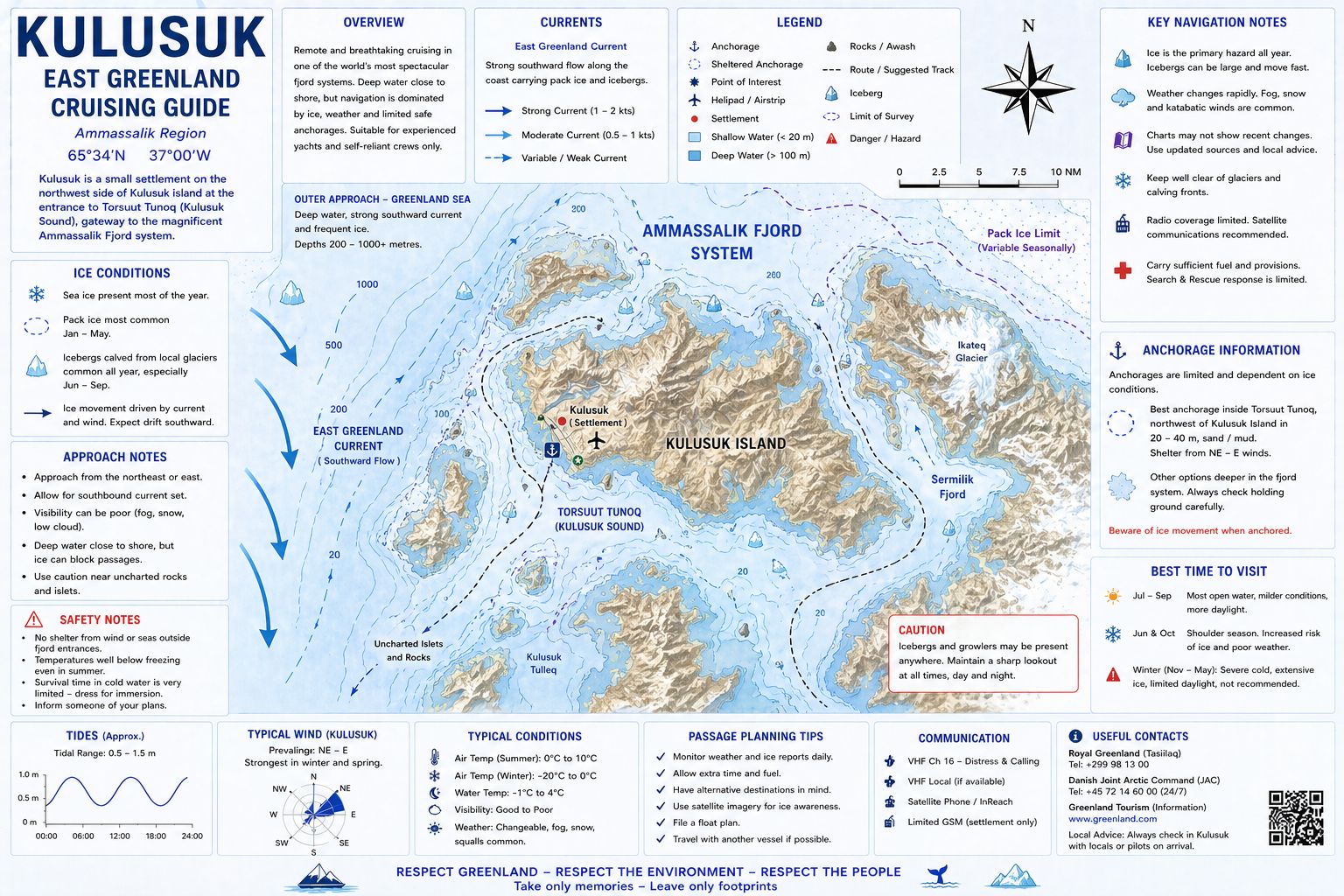
Kulusuk Greenland sailing guide. Kulusuk sits on the outer edge of the Ammassalik archipelago and provides the most reliable air access on the East Greenland coast. The settlement lies close to open water, with a short approach channel that remains navigable in most summer ice windows. Ice concentration varies daily due to drift from the East Greenland Current, but the area typically has lower pack‑ice density than the sectors north toward Scoresby Sund. The anchorage is exposed to ice movement and requires continuous monitoring.
Kulusuk is used operationally as a crew‑change point due to its airport and as a secondary landfall for yachts arriving from Iceland. It is also used as a staging point for movements toward Ammassalik or for southbound routing toward Cape Farewell. Services are limited, and all movements are shaped by ice concentration, visibility and the timing of Denmark Strait lows.
Routing Logic – Ísafjörður → Kulusuk
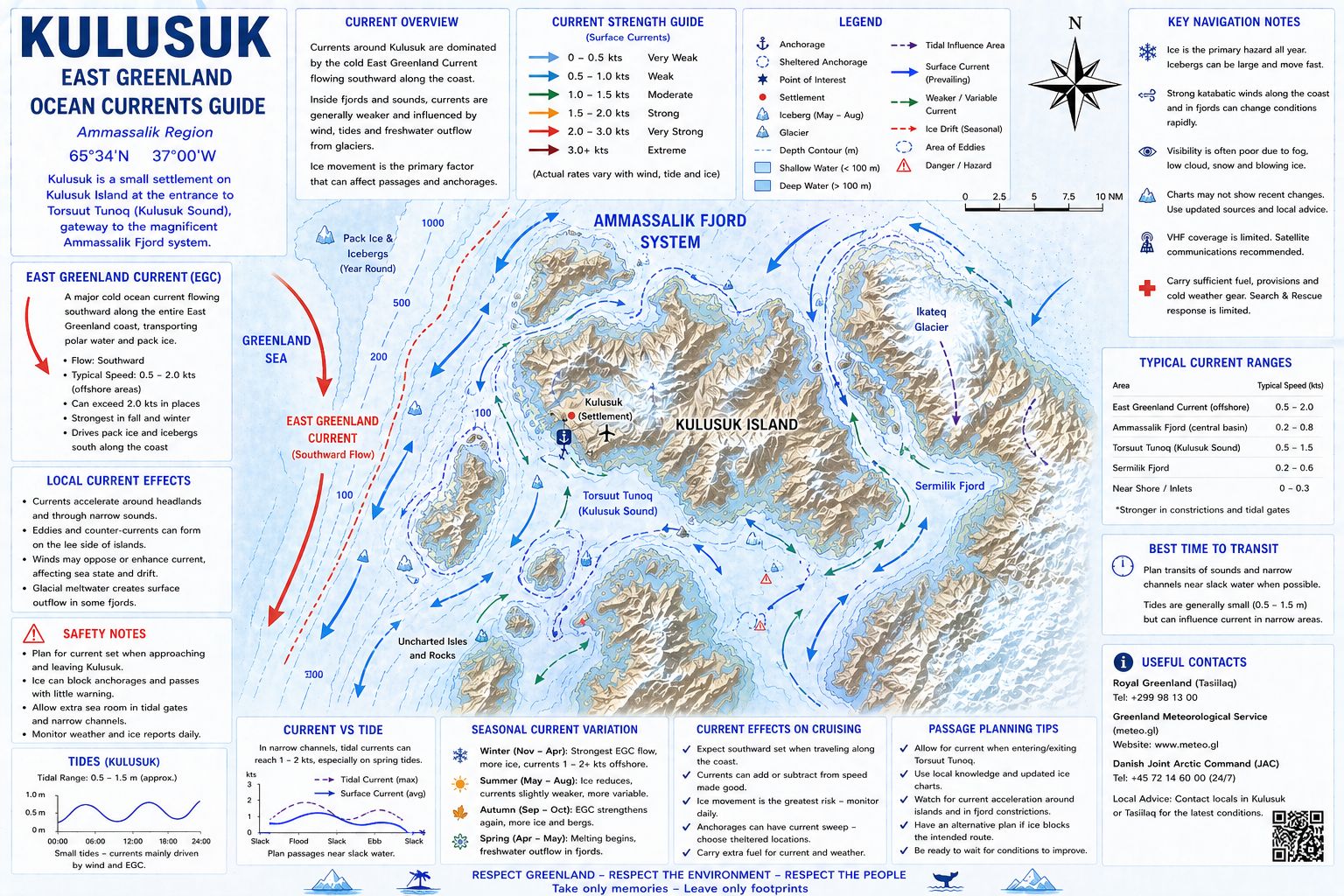
Departures from Ísafjörður toward Kulusuk are taken in post‑frontal easing northerlies or northwesterlies after a low has passed east or southeast. The Denmark Strait produces steep seas when gradients tighten, and yachts wait for a clean gradient with stable visibility. Ice charts and satellite imagery are monitored to identify the pack‑ice edge and drift lanes. The East Greenland Current carries heavy ice south, and yachts shape a west or west‑southwest track that avoids the densest concentrations while maintaining a safe offset from the main ice stream.
Fog is common in light‑wind regimes and reduces visual range on bergs and growlers. Residual northwest swell persists even in lighter gradients and must be factored into approach timing. Landfall is planned for daylight with manageable sea state and visibility. The coastal approach to Kulusuk often contains scattered ice even when charts show low concentration, and yachts maintain conservative speeds until inside the island group
Kulusuk Greenland
Sailing Guide - Approaches
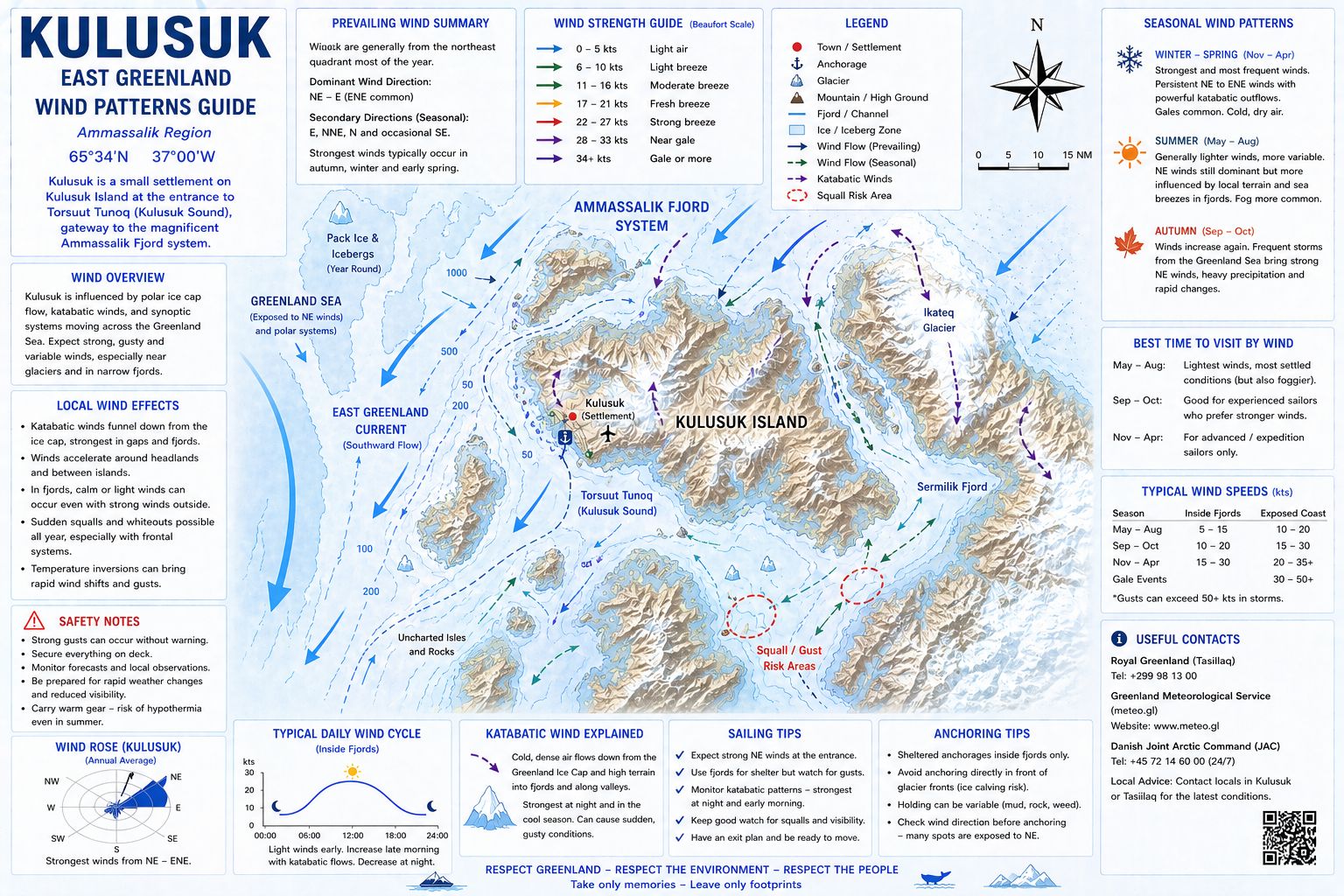
Approaches to Kulusuk are shaped by drift ice from the East Greenland Current. The outer approaches are deep, with depths exceeding 40–50 m, but ice concentration varies daily. Visibility is critical due to unlit ice and the need to maintain separation from bergy bits and growlers. The approach channel between islands is straightforward in good visibility. Katabatic winds can descend from surrounding mountains, particularly near glacier fronts. Tidal range is modest, but tidal streams near constrictions can influence drift ice behaviour.
Kulusuk Greenland Sailing Guide - Ocean Currents Guide
Kulusuk Greenland
Sailing Guide - Anchorage
Anchoring off Kulusuk is possible in settled conditions but is exposed to ice drift and wind shifts. Depths are typically 10–20 m with mixed holding. Ice movement can change rapidly, and anchorages must be selected with clear escape routes. The anchorage is not suitable in strong gradients or when drift ice is entering the bay. Yachts often anchor only long enough for crew movements or short operational stops.
Kulusuk Greenland
Sailing Guide - Entry
Kulusuk is not a designated port of entry. Yachts must clear into Greenland at a recognised port such as Tasiilaq (Ammassalik) before proceeding. Kulusuk does not conduct Customs or Immigration. Domestic movements require only local notification. There are no known restrictions on communications equipment such as Starlink. Firearms must be declared at the port of entry and secured according to Greenlandic regulations.
Kulusuk Greenland
Sailing Guide - Marinas
There is no marina infrastructure in Kulusuk. The small harbour is used by local boats and supply vessels. Depths alongside vary between 3–5 m. Visiting yachts typically anchor off and use tenders for shore access. There is no shore power, water supply or yacht‑specific facilities. Waste disposal is limited. All movements are shaped by ice drift and local vessel operations.
Kulusuk Greenland
Sailing Guide - Local Weather
The East Greenland coast experiences frequent low‑pressure systems crossing the Denmark Strait, producing shifting gradients, fog and long‑period swell. Inside the island group, conditions are calmer, but katabatic winds can descend from surrounding mountains. Fog forms in light‑wind regimes and can persist for extended periods. Weather windows for movements north or south are selected based on low‑track timing, ice drift and visibility.
Kulusuk Greenland
Sailing Guide - Provisioning
Supermarkets. Kulusuk has a small general store supplying dry goods, basic dairy, bread, limited fresh produce, frozen foods and packaged items. Stock levels depend on supply shipments and are not suitable for full reprovisioning. Specialty items are minimal.
Markets. There is no municipal market. Local produce is limited to seasonal items and occasional small‑scale sales. Availability is inconsistent and not relied upon for provisioning.
Fish Markets. Fresh fish availability varies with local landings and is not consistent. Frozen fish and seafood products are stocked in the general store. There is no wholesale fish market accessible to yachts.
Kulusuk Greenland
Sailing Guide - Local Cuisine
Local cuisine reflects East Greenland patterns with emphasis on fish, seal, muskox and simple preparations using available ingredients. Dried fish products are common. Imported goods supplement local diets. Variety is limited due to the small population and supply constraints.
Kulusuk Greenland
Sailing Guide - Fuel
There is no dedicated marine fuel point. Limited diesel may be available through local suppliers, but availability is inconsistent and must be confirmed in advance. Yachts should not rely on Kulusuk for refuelling. Petrol availability is minimal.
Kulusuk Greenland
Sailing Guide - Water
There is no quay‑side potable water supply for yachts. Water must be jerry‑canned from local sources or collected from meltwater streams where safe and practical. Quality varies and may require filtration.
Mechanical and Electrical Repairs
Resource
If you are headed somewhere remote consider the need to expand your knowledge base or have an information resource on board. Why not get a copy of my book The Marine and Electrical and Electronics Bible 4th Edition. By and for yachties, with everything from batteries and charging, solar and wind, diesel engines and marine electronics and so much more. Your complete systems guide. 650 pages of practical advice. In Australia and New Zealand order a copy through Boat Books. UK and European boats can buy the UK Edition Here. US and Canadian boats can get the US Edition Order Here. Marine systems are my profession so let me help you. By a liveaboard boat owner for other boat owners



Kulusuk Greenland
Sailing Guide - Marine Services
There are no marine services in Kulusuk. No mechanical, electrical or electronics support is available. No Volvo or Yanmar agents operate in the region. All repairs must be carried out with onboard resources. The nearest full‑service facilities are in Nuuk or Reykjavík.
Kulusuk Greenland
Sailing Guide - Local Customs
Local customs follow Greenlandic norms with emphasis on respect for small communities and working harbours. Hunting activities are part of local life, and firearms are common. Yachts are expected to avoid interfering with local operations and to follow guidance from community representatives.
Greenland’s Indigenous population is Kalaallit Inuit, and most coastal towns operate on close community networks where interactions are practical and low‑key. Skippers should expect direct, unembellished communication, with no pressure for small talk. Respect for shared spaces, working quays, and hunting activity is essential; these are functional environments, not visitor areas. Local norms favour patience, calm behaviour, and giving people physical space, especially around families and elders. Photography of people, hunting gear or working areas should only occur with clear permission. Community schedules follow weather, hunting and supply‑ship cycles, so flexibility from visiting crews is expected
Kulusuk Greenland
Sailing Guide - Summary
Kulusuk is a practical East Greenland landfall with reliable air access and limited services. It provides anchorage in settled conditions and functions as a crew‑change and staging point, but all movements are shaped by ice concentration, visibility and the timing of Denmark Strait lows. The Kulusuk Greenland Sailing Guide for all you need to know.