Southern Atlantic Crossing
Guide
Southern Atlantic crossing guide. The Southern Route is the long‑range, oceanic passage structure linking Brazil → Saint Helena → Namibia → South Africa, following the western and eastern flanks of the South Atlantic High. Unlike the Central Route, which relies on the NE trades and the Azores High, or the Northern Route, which depends on narrow summer windows, the Southern Route is defined by long, stable SE trade‑wind corridors, large oceanic distances, and frontal systems sweeping off the Southern Ocean. It is the least sheltered of the three Atlantic routes, with the fewest landfall options and the longest legs between ports.
This route is used by yachts transiting between the South Atlantic, South America, and the Indian Ocean. It demands disciplined weather routing, long‑range provisioning, and conservative timing around the southern capes. The Southern Route is not a single passage but a sequence of long ocean legs, each shaped by the position of the South Atlantic High, the strength of the SE trades, and the timing of frontal systems approaching southern Africa. This page outlines the full operational logic of the Southern Route: start points, intermediate ports, weather systems, seasonal timing, weather‑information sources, routing behaviour, and port‑to‑port operational notes.
Note on Route Orientation
Unlike the Northern and Central Atlantic routes, which can be sailed in both directions depending on season, the Southern Route is a one‑way west‑to‑east passage. This is dictated by the structure of the South Atlantic High, the direction of the SE trade‑wind belt, and the hazards created when SW fronts oppose the Agulhas Current. As a result, the operational flow of the Southern Route is always Brazil → Saint Helena → Namibia → South Africa, with no practical or safe east‑to‑west equivalent.
Southern Atlantic Crossing
Guide - Brazil (Primary
Start)
Most yachts begin in Salvador, Recife, or Cabedelo, depending on their preferred departure angle. Brazil offers strong provisioning, repairs, haul‑out, and fuel availability. Departures are timed around stable SE trades and the position of the South Atlantic High. The goal is to leave Brazil with a clean exit into the long, predictable trade‑wind corridor toward Saint Helena.
Optional South
American Starts
Some yachts depart from Rio de Janeiro or Itajaí, but these starts add distance and increase exposure to frontal systems sweeping north from the Southern Ocean. They are used primarily by yachts already cruising southern Brazil.
Southern Atlantic Crossing
Guide - Saint Helena
St Helena is the only mid‑ocean staging point in the South Atlantic. Saint Helena provides fuel, water, provisioning, and limited technical support. It is a critical rest point after the long Brazil–Saint Helena leg. Departures from Saint Helena are timed around the position of the South Atlantic High and the approach of frontal systems toward southern Africa. as a note this is where Napoleon spent the final years of his life (1815–1821) under British custody.
Southern Atlantic Crossing Guide - Islands
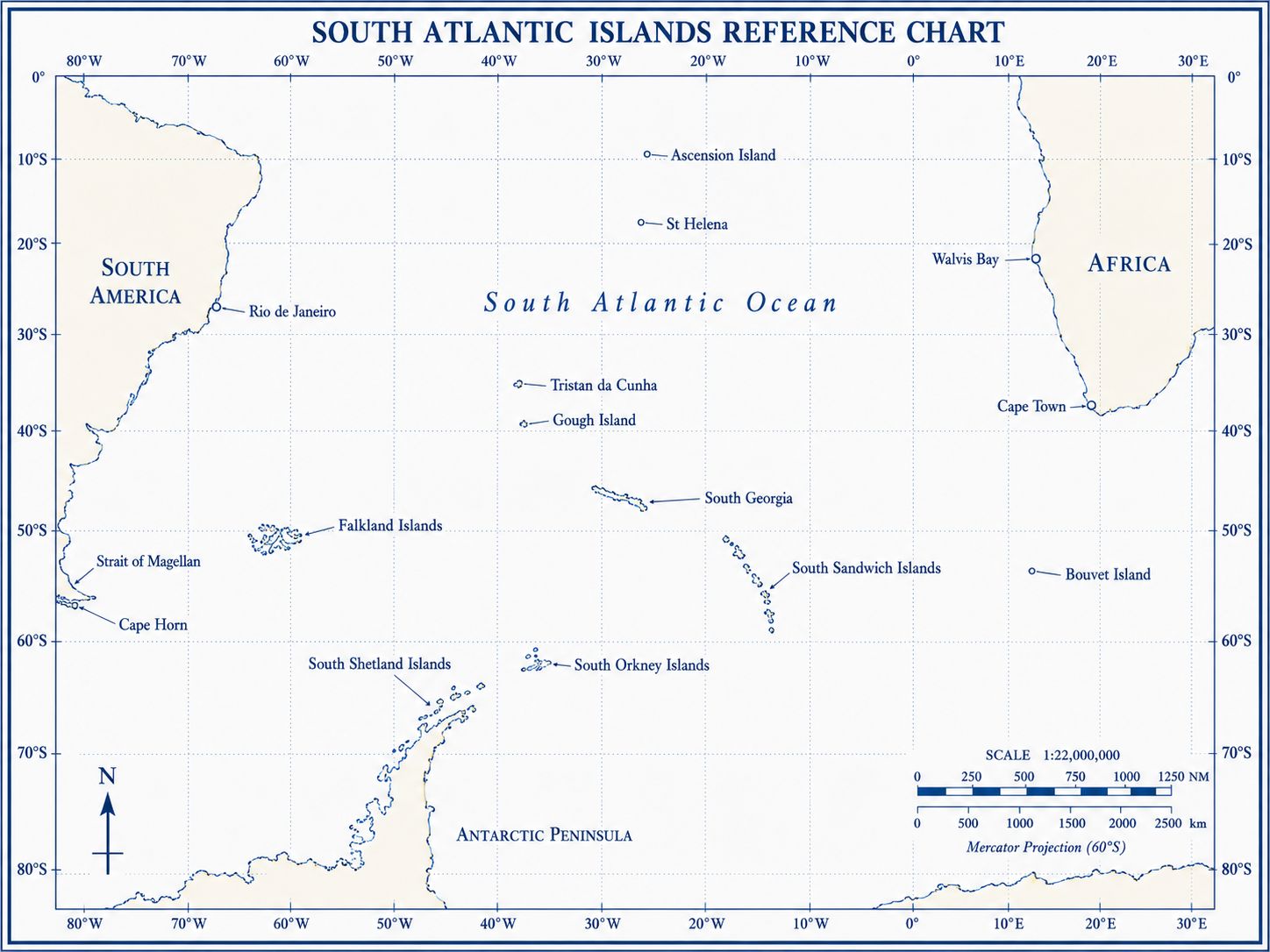
The South Atlantic contains a scattered chain of remote islands that, while not forming a continuous passage route, are visited by expedition yachts for their unique operational challenges, isolation, and limited but essential support points. These islands, Ascension Island, Falkland Islands, Tristan da Cunha, South Georgia, South Orkney Islands, South Shetland Islands, and Gough Island, each sit within distinct weather regimes shaped by the South Atlantic High, the circumpolar westerlies, and the Southern Ocean frontal systems. They offer anchorages of varying reliability, tightly controlled landing procedures, and minimal services, requiring yachts to arrive fully self‑sufficient and prepared for rapid weather changes. This section provides a concise operational overview of each island, with dedicated pages to follow for detailed provisioning, marine services, approach behaviour, anchorage notes, and environmental requirements.
São Tomé and Príncipe sits outside the main Cape Town–St Helena–Ascension–Cape Verde corridor and belongs to the separate West African coastal route, not the oceanic northbound chain. It is used only when yachts deliberately choose the West African coastal track, which is a completely different operational profile: Cape Town; Namibia (Lüderitz, Walvis Bay); Angola (Luanda); Gabon; São Tomé and Príncipe; Cameroon / Nigeria / Benin / Togo / Ghana; Senegal / Gambia and Cape Verde
South Atlantic Islands
- Ascension Island. Ascension Island is a remote volcanic outpost in the central South Atlantic, offering a rare mid‑ocean anchorage with tightly controlled landing procedures and minimal services. Yachts use it as a rest point on long west–east or southbound passages when conditions allow.
- Falkland Islands. The Falkland Islands provide a network of deep, well‑protected anchorages but sit directly in the path of Southern Ocean systems, demanding disciplined weather timing and self‑sufficiency. Stanley offers the only meaningful marine support in the region.
- Tristan da Cunha. Tristan da Cunha is the world’s most isolated inhabited island, with exposed anchorages and strict landing protocols. Yachts call here only in settled weather and must be fully independent, as no marine services are available.
- Nightingale Island (Tristan Group). Nightingale Island is the southern volcanic outlier of the Tristan da Cunha group. or yachts, Nightingale is a no‑anchoring, no‑landing zone.
- Inaccessible Island (Tristan Group). For yachts, Inaccessible is a no‑anchoring, no‑landing zone.
- South Georgia. South Georgia is a high‑latitude expedition destination with katabatic winds, ice hazards, and rapidly changing weather driven by the circumpolar westerlies. Landings and movements are tightly regulated, and only well‑prepared yachts attempt the approach.
- South Orkney Islands. The South Orkneys are uninhabited, ice‑influenced islands lying deep within the Antarctic convergence, offering no services and only temporary anchorages in rare settled conditions. They are visited exclusively by expedition‑grade yachts.
- South Shetland Islands. The South Shetlands form the northern gateway to the Antarctic Peninsula, with anchorages exposed to swell, ice drift, and sudden weather shifts. Yachts must operate under Antarctic regulations and maintain full self‑reliance.
- Gough Island. Gough Island is a remote wildlife reserve with no public landing access and only one marginal anchorage usable in calm conditions. Yachts typically stop offshore for shelter or scientific liaison but cannot rely on any support.
- South Sandwich Islands. South Sandwich Islands form one of the most remote, volatile and environmentally protected island arcs on earth, stretching in a north–south chain east of South Georgia and deep within the Antarctic convergence
- Bouvet Island. Bouvet Island is one of the most remote and inaccessible islands on earth, a near‑vertical volcanic cone rising from the South Atlantic.
Southern Atlantic Crossing
Guide - Namibia — Walvis Bay
A reliable, sheltered landfall with fuel, water, repairs, and haul‑out capability. Walvis Bay sits on the eastern flank of the South Atlantic High, where cool, stable conditions dominate due to the Benguela Current. It is the final staging point before rounding the southern capes.
Southern Atlantic Crossing
Guide - South Africa — Cape Town
The primary service centre for yachts entering the Indian Ocean. Cape Town offers full provisioning, repairs, rigging, haul‑out, and weather routing. It is the operational gateway to the Indian Ocean and the final node of the Southern Route.
Southern Atlantic Crossing
Guide - Weather Systems
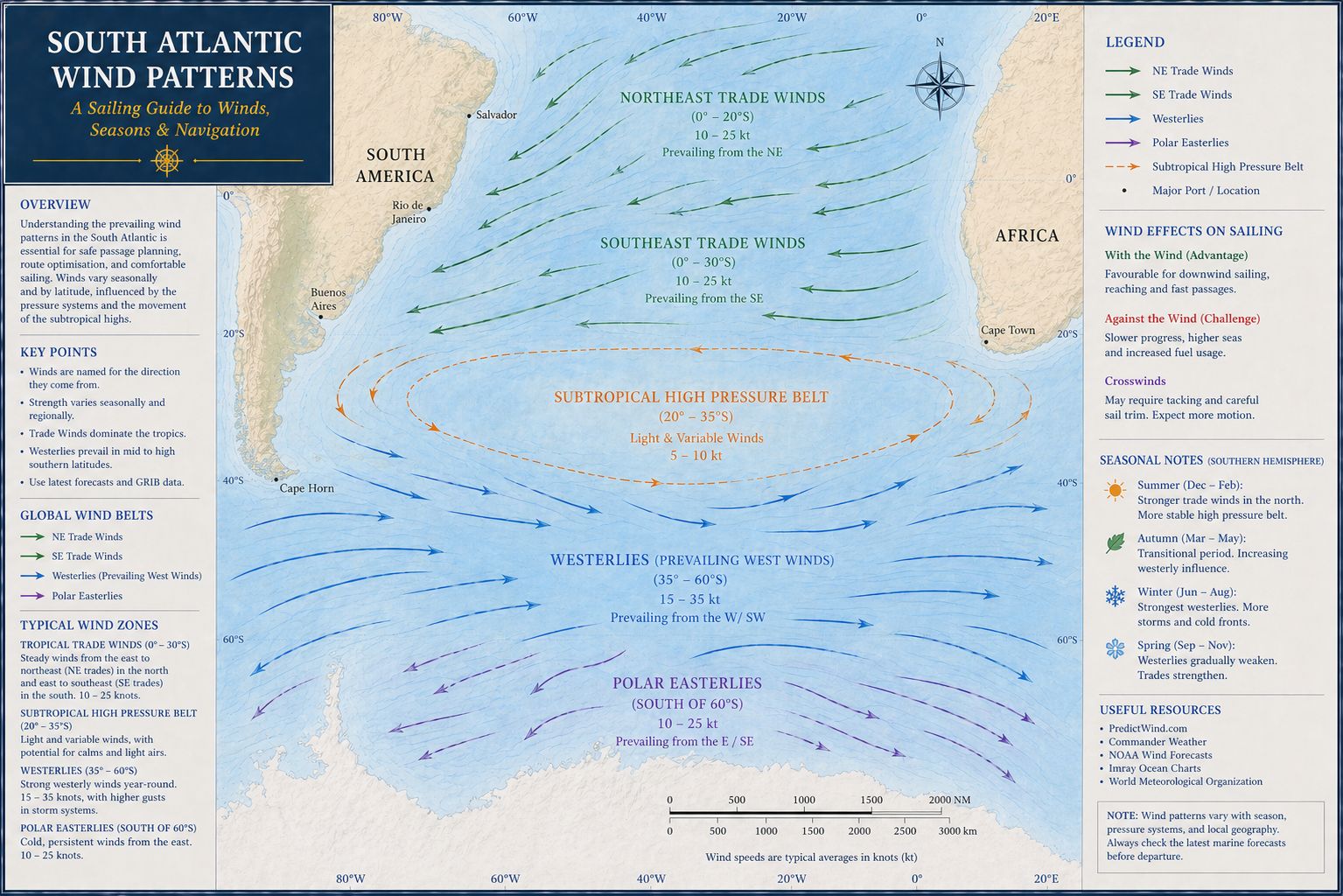
South Atlantic High. The dominant feature of the Southern Route.
- Brazil → Saint Helena: yachts ride the western flank of the High in stable SE trades.
- Saint Helena → Namibia: yachts follow the eastern flank, shaped by the Benguela Current.
- Namibia → Cape Town: yachts must time departures to avoid frontal systems interacting with the Agulhas Current.
The High’s position determines all viable windows.
Southern Atlantic Crossing Guide - SE Trade‑Wind Belt
The most stable wind regime in the South Atlantic. Consistent 15–25 kn SE winds; Long‑period swell; Minimal squall activity; Predictable drift patterns. This belt defines the classic long‑range South Atlantic sailing route.
Southern Atlantic Crossing
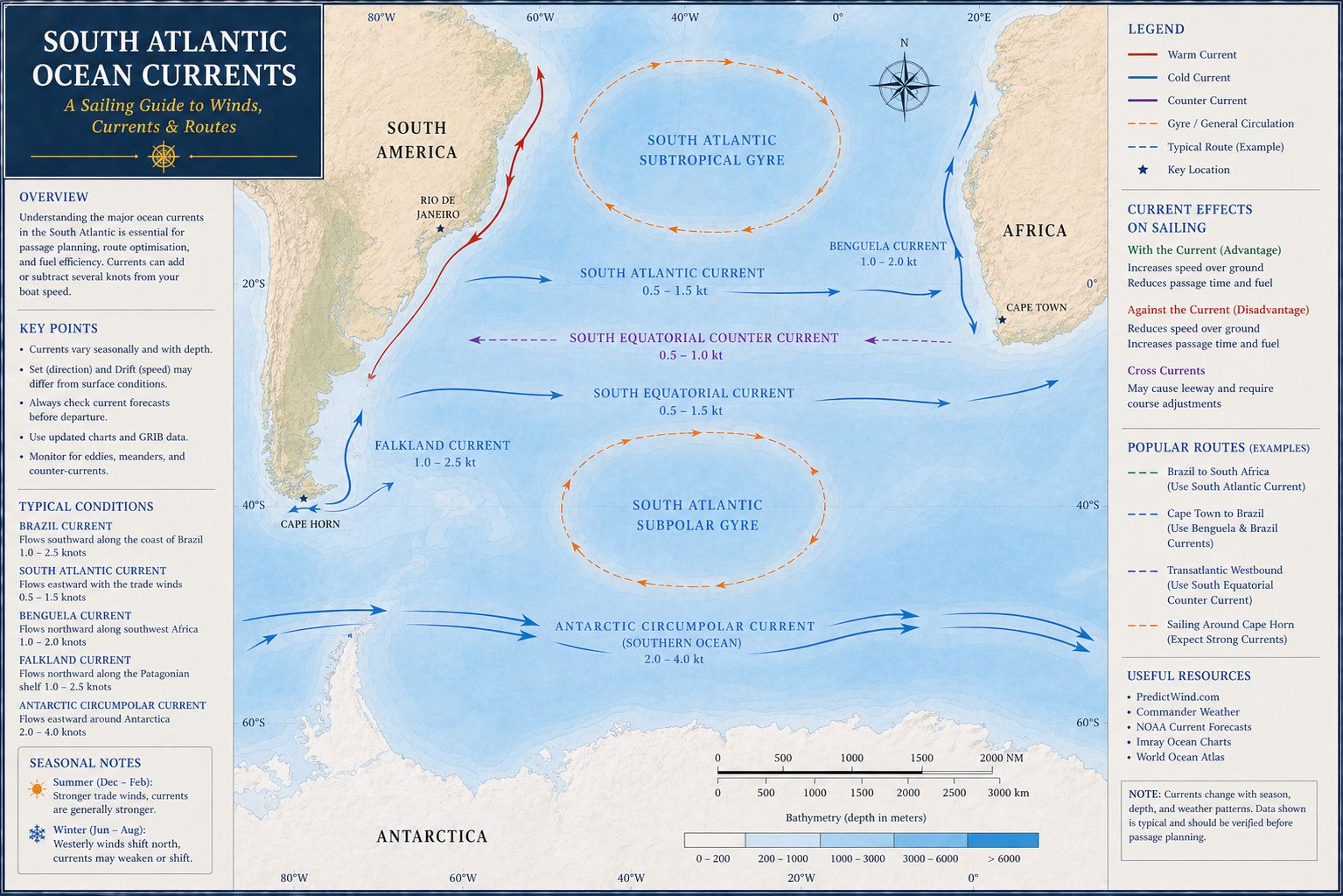
Guide - Benguela Current
A cool, north‑flowing current along the Namibian coast. Stabilises weather. Reduces sea temperatures; Can amplify swell near headlands
Southern Atlantic Crossing
Guide - Southern Ocean Fronts
The primary hazard of the Namibia → Cape Town leg. Strong SW fronts; Rapid barometric drops; Dangerous sea states when opposing the Agulhas Current; Timing is critical.
Southern Atlantic Crossing
Guide - Seasonal Timing
Brazil → Saint Helena. Viable year‑round
- Best conditions: May–October (stronger SE trades)
- Avoid late‑season ITCZ expansion north of the equator
Saint Helena → Namibia. Viable year‑round
- Best conditions: April–November
- Cool, stable weather due to Benguela Current
Namibia → Cape Town.
- Best window: November–February
- Avoid strong SW fronts
- Avoid Agulhas Current interactions
- Depart only on a clean ridge with no frontal activity approaching
Weather Information Sources
The Southern Route relies on GRIB models, synoptic charts, satellite imagery, and frontal system monitoring.
- GRIB Models downloaded via Iridium, Starlink, or HF email
- GFS, ECMWF, ICON. Used to track SE trade strength, High position, and frontal timing.
- Synoptic Charts. South African Weather Service (SAWS); MetOffice South Atlantic charts
- NOAA OPC; Essential for identifying frontal boundaries and Agulhas interactions.
- Satellite Imagery; EUMETSAT; GOES‑East; ASCAT scatterometer. Used to confirm wind fields and frontal structure.
Local Forecasting Agencies
- SAWS (critical for Cape Town
approaches); Namibian Meteorological Service; Brazilian Navy Hydrographic
Center; HF Weatherfax (Backup). Provides surface analysis and
24–96 hr forecasts.
Routing Logic
Brazil → Saint Helena
- A long, stable trade‑wind leg.
- Depart with SE trades established
- Maintain conservative downwind sail plans
- Monitor ITCZ position if departing from northern Brazil
Saint Helena → Namibia
- Follow the eastern flank of the High.
- Expect cool, stable conditions
- Monitor swell amplification near the Namibian coast
- Maintain fuel reserves for calms near the High’s centre
Namibia → Cape Town
The most tactical leg.
- Depart only on a stable ridge
- Avoid SW fronts
- Avoid Agulhas Current interactions
- Maintain conservative sail plans near headlands
Port‑to‑Port Operational Notes
Brazil → Saint Helena
- Long, predictable SE trades. Chafe management essential.
- Saint Helena → Namibia
- Cool, stable weather. Expect fog patches near the Benguela Current.
Namibia → Cape Town
- Frontal timing is everything. Avoid wind‑against‑current conditions.
Mechanical
and Electrical Repairs Resource
If you are headed somewhere remote consider the need to expand your knowledge base or have an information resource on board. Why not get a copy of my book The Marine and Electrical and Electronics Bible 4th Edition. By and for yachties, with everything from batteries and charging, solar and wind, diesel engines and marine electronics and so much more. Your complete systems guide. 650 pages of practical advice. In Australia and New Zealand order a copy through Boat Books. UK and European boats can buy the UK Edition Here. US and Canadian boats can get the US Edition Order Here. Marine systems are my profession so let me help you. By a liveaboard boat owner for other boat owners


Southern Atlantic Crossing
Guide - Summary
The Southern Route is a long‑range, oceanic passage shaped by the South Atlantic High, SE trades, and Southern Ocean fronts. It offers predictable trade‑wind sailing but demands disciplined timing around the southern capes. Success on this route depends on conservative routing, long‑range provisioning, and strict avoidance of frontal interactions with the Agulhas Current. For well‑prepared yachts, the Southern Route is the most stable and reliable south‑Atlantic sailing corridor. Southern Atlantic Crossing Guide for all you need to know.