Bouvet Island Sailing Guide
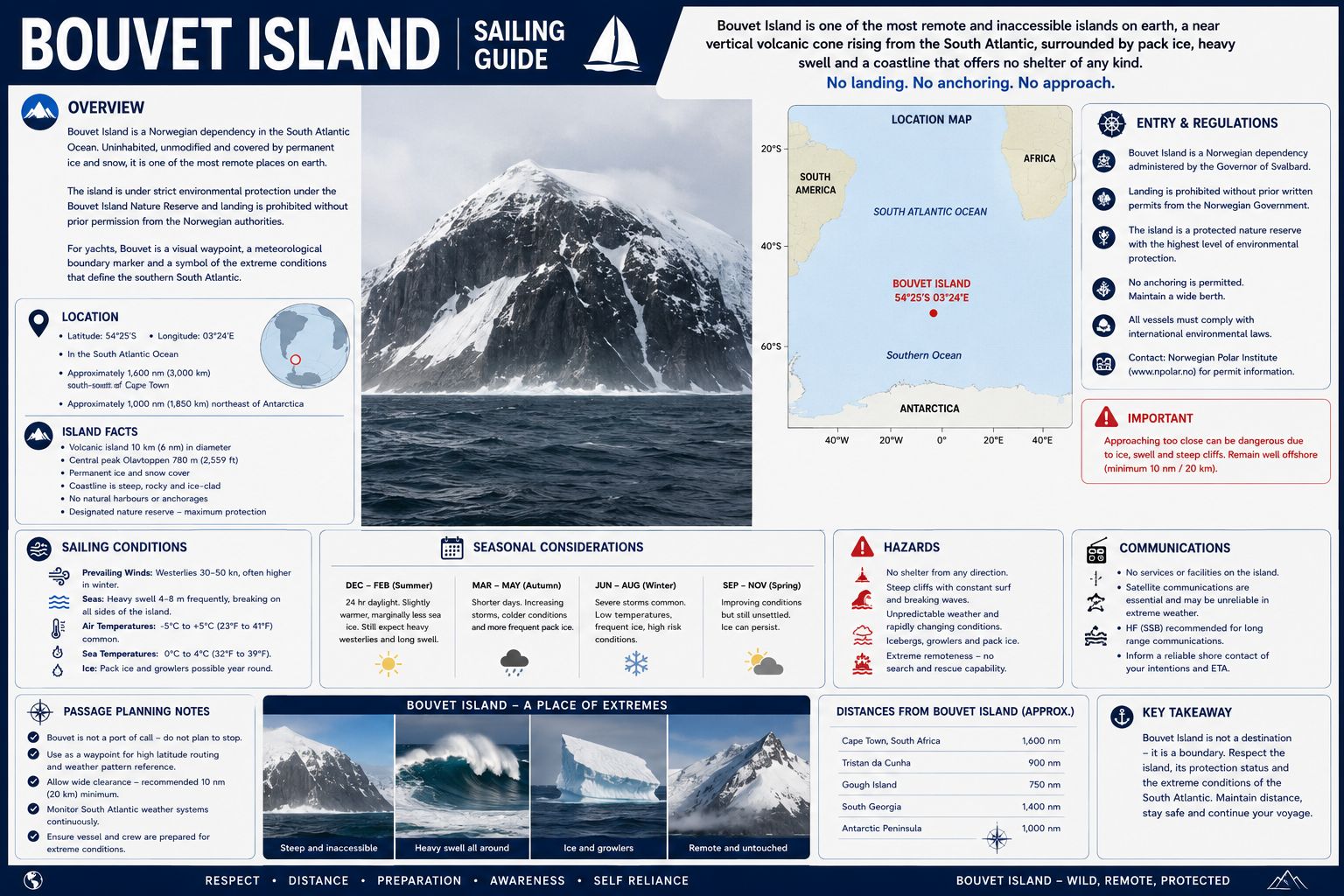
Bouvet Island Sailing Guide Bouvet Island is one of the most remote and inaccessible islands on earth, a near‑vertical volcanic cone rising from the South Atlantic, surrounded by pack ice, heavy swell and a coastline that offers no shelter of any kind. It is a Norwegian dependency, uninhabited, unmodified and governed under a strict environmental protection regime.
For yachts, Bouvet is not a destination but a visual waypoint, a meteorological boundary marker and a symbol of the extreme conditions that define the southern South Atlantic. No landings are permitted without Norwegian approval, and in practice the island is treated as a no‑landing, no‑anchoring, no‑approach zone.
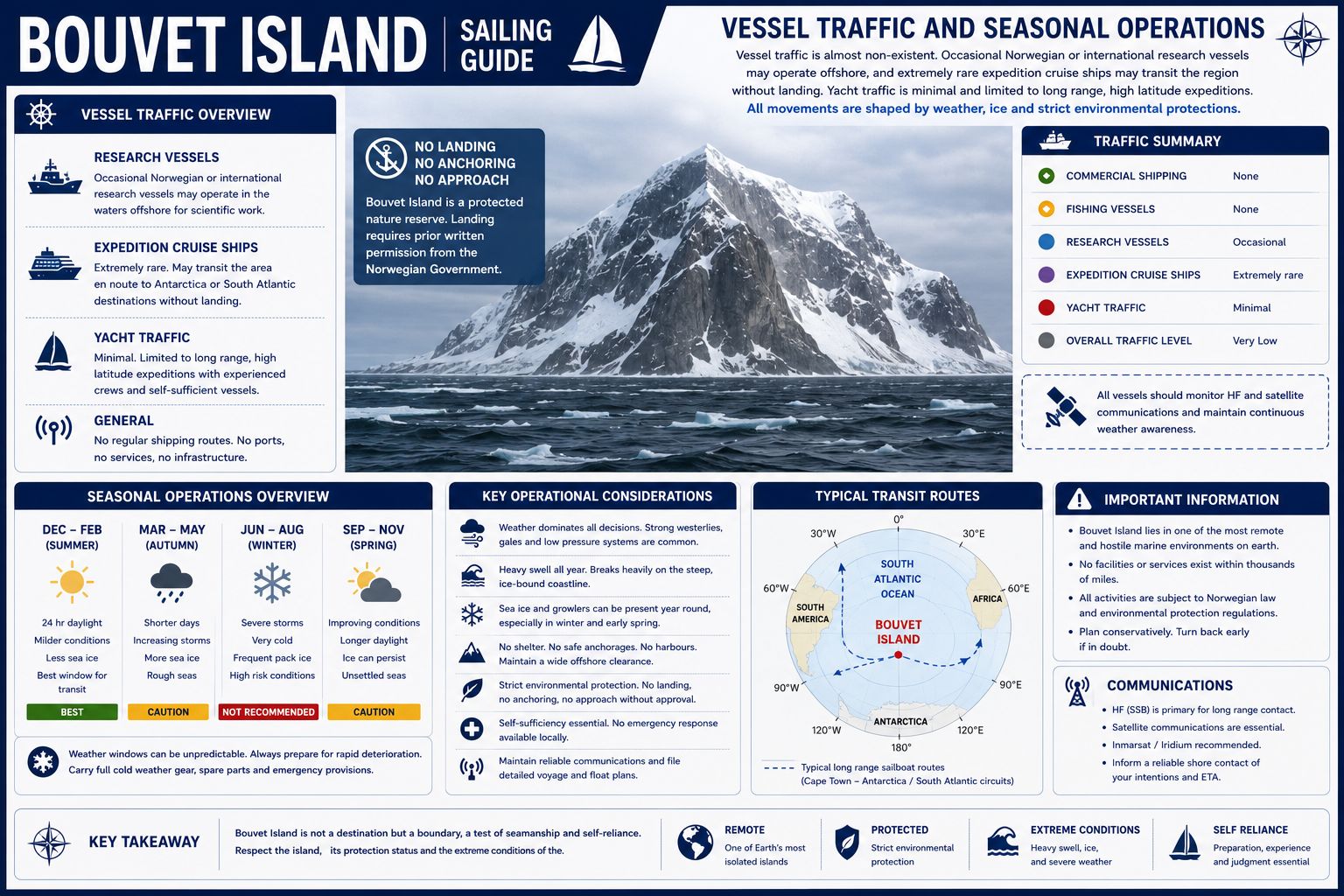
Vessel Traffic and Seasonal
Operations
Vessel traffic is almost non-existent. Occasional Norwegian or international research vessels may operate offshore, and extremely rare expedition cruise ships may transit the region without landing. Yacht traffic is minimal and limited to long‑range, high‑latitude expeditions. All movements are shaped by weather, ice and strict environmental protections.
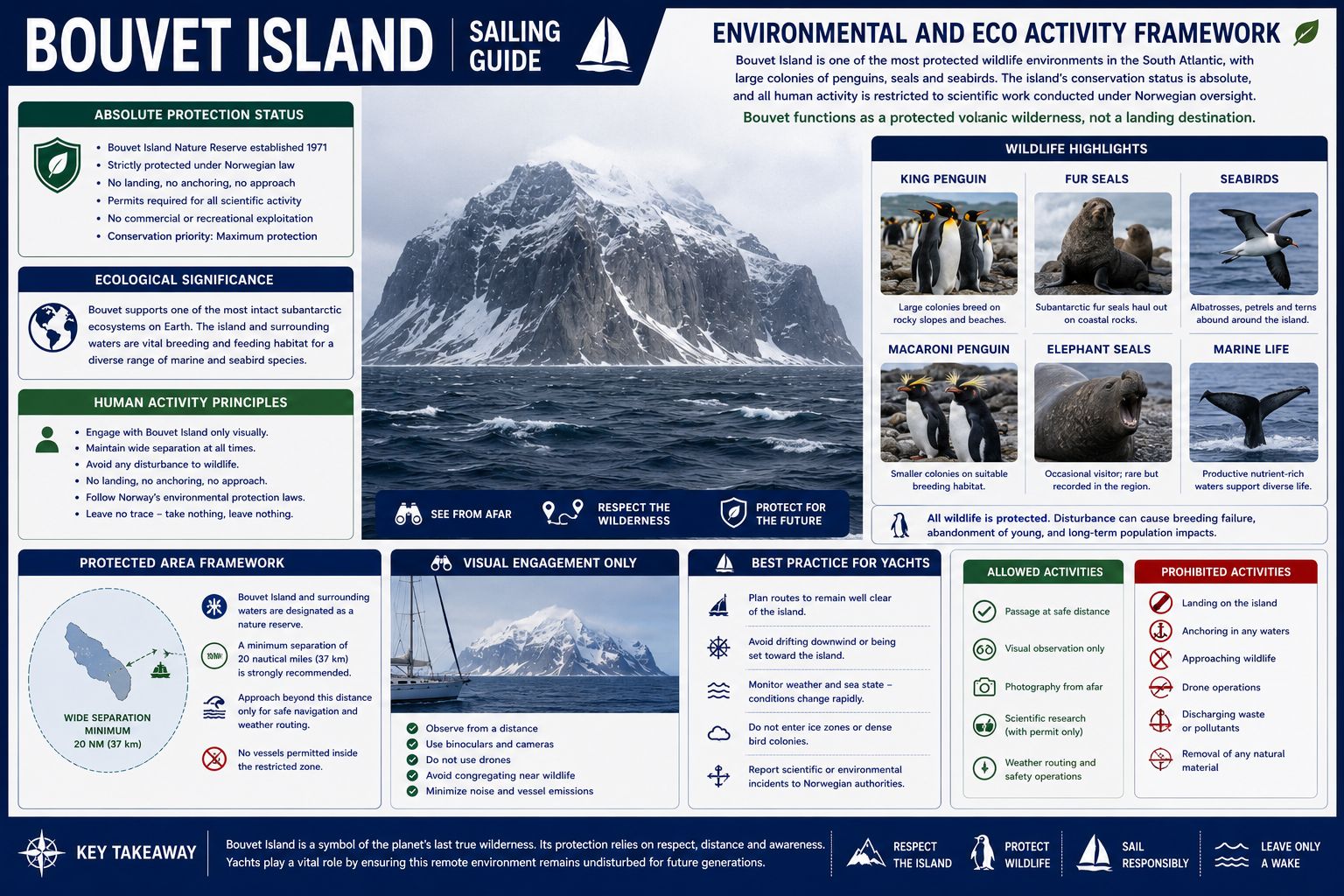
Environmental and Eco‑Activity
Framework
Bouvet Island is one of the most protected wildlife environments in the South Atlantic, with large colonies of penguins, seals and seabirds. The island’s conservation status is absolute, and all human activity is restricted to scientific work conducted under Norwegian oversight. Yachts engage with the island only visually, maintaining wide separation and avoiding any disturbance to wildlife. Bouvet functions as a protected volcanic wilderness, not a landing destination.
Historical and Present Human
Presence
Bouvet Island has never supported a permanent population and has no history of settlement or industry. Early sealers visited the region but did not establish camps due to the island’s extreme exposure and lack of landing sites. Modern scientific work is rare and conducted via helicopter from offshore vessels. Beyond these occasional expeditions, the island remains entirely uninhabited.
Bouvet Island Sailing Guide - Routing
Logic
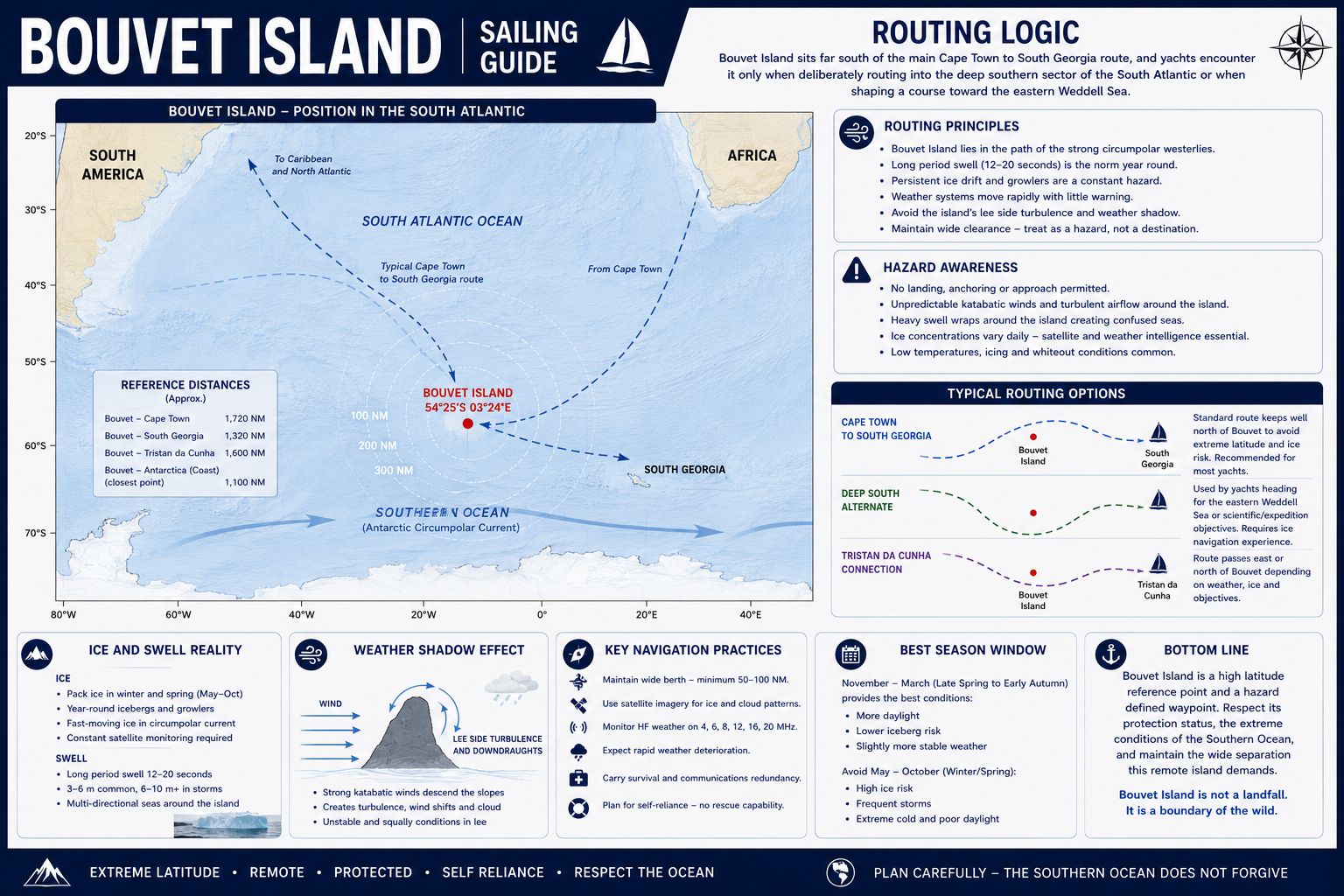
Bouvet Island sits far south of the main Cape Town → South Georgia route, and yachts encounter it only when deliberately routing into the deep southern sector of the South Atlantic or when shaping a course toward the eastern Weddell Sea. Its position places it in the path of strong circumpolar westerlies, long‑period swell and persistent ice drift. Yachts use Bouvet as a high‑latitude reference point, adjusting course to avoid ice concentrations, lee‑side turbulence and the island’s unpredictable weather shadow. It functions as a hazard‑defined waypoint, not a landfall.
Bouvet Island Sailing Guide - Approaches
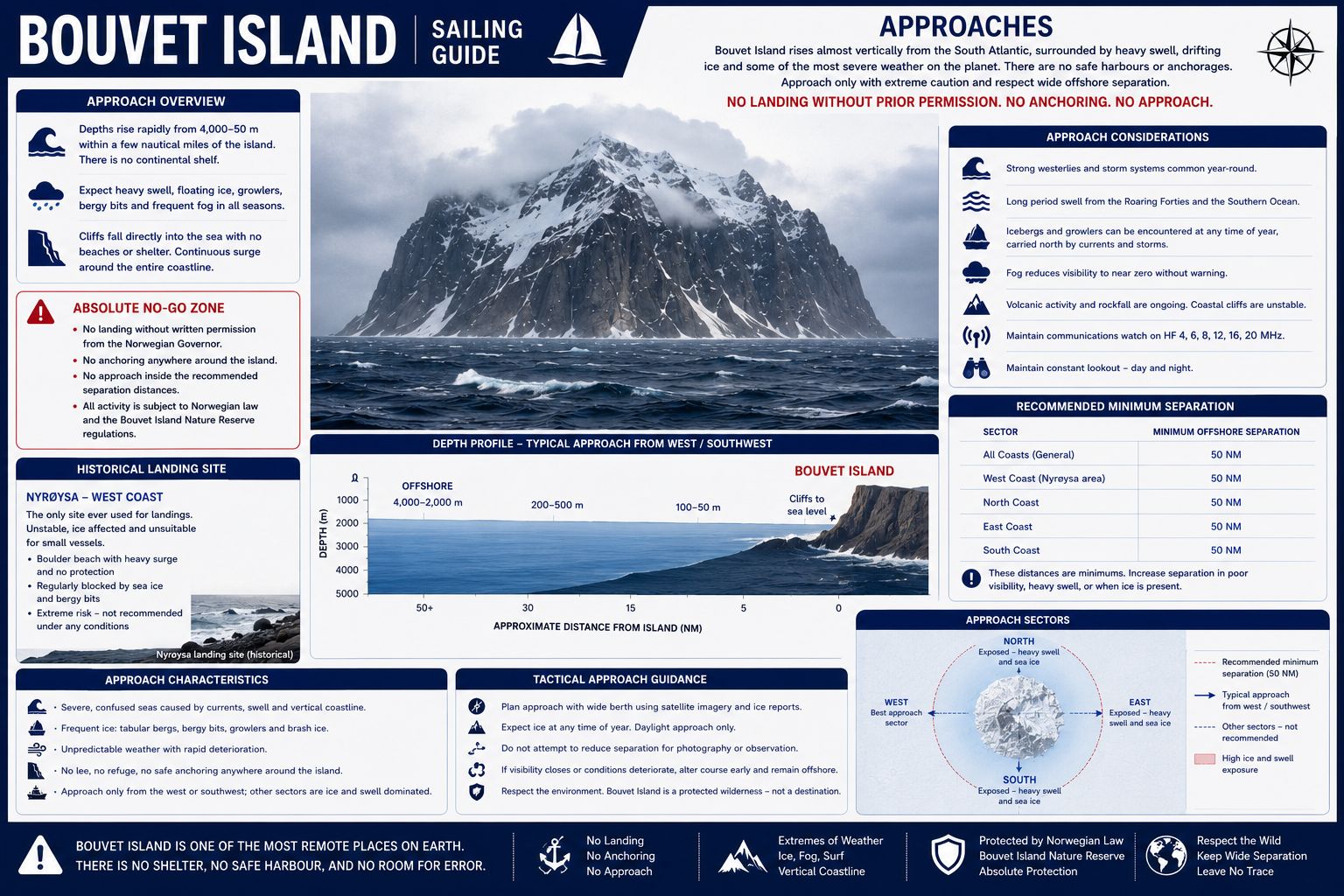
Approaches to Bouvet encounter depths rising from 4000–50 m, with heavy swell, icebergs and frequent fog. The island’s cliffs fall directly into the sea, creating a continuous surge zone with no break in the coastline. The only historically workable landing site, Nyrøysa on the west coast is unstable, ice‑affected and unsuitable for small vessels. All approaches require wide offshore separation, with yachts maintaining conservative distances to avoid surge, ice and volcanic debris.
Bouvet Island Sailing Guide - Anchorages
Bouvet Island has no anchorages. The coastline is universally steep‑to, exposed and dominated by surf, ice and rockfall. Even research and military vessels do not anchor here; all operations are conducted offshore or via helicopter when conditions allow. For yachts, Bouvet is a no‑anchoring zone under all conditions.
Bouvet Island Sailing Guide - Entry
Formalities
Bouvet is a Norwegian dependency, and all landings require explicit authorisation from the Norwegian Polar Institute. In practice, permission is rarely granted, and the island is treated as a closed conservation area. Yachts transiting the region operate under a no‑landing, no‑contact framework, with strict environmental expectations identical to those applied in the Antarctic Treaty area.
Bouvet Island Sailing Guide - Marina
and Harbour Facilities
There are no facilities of any kind. No harbour, no station, no infrastructure. The island is uninhabited and unmodified.
Bouvet Island Sailing Guide - Local
Weather
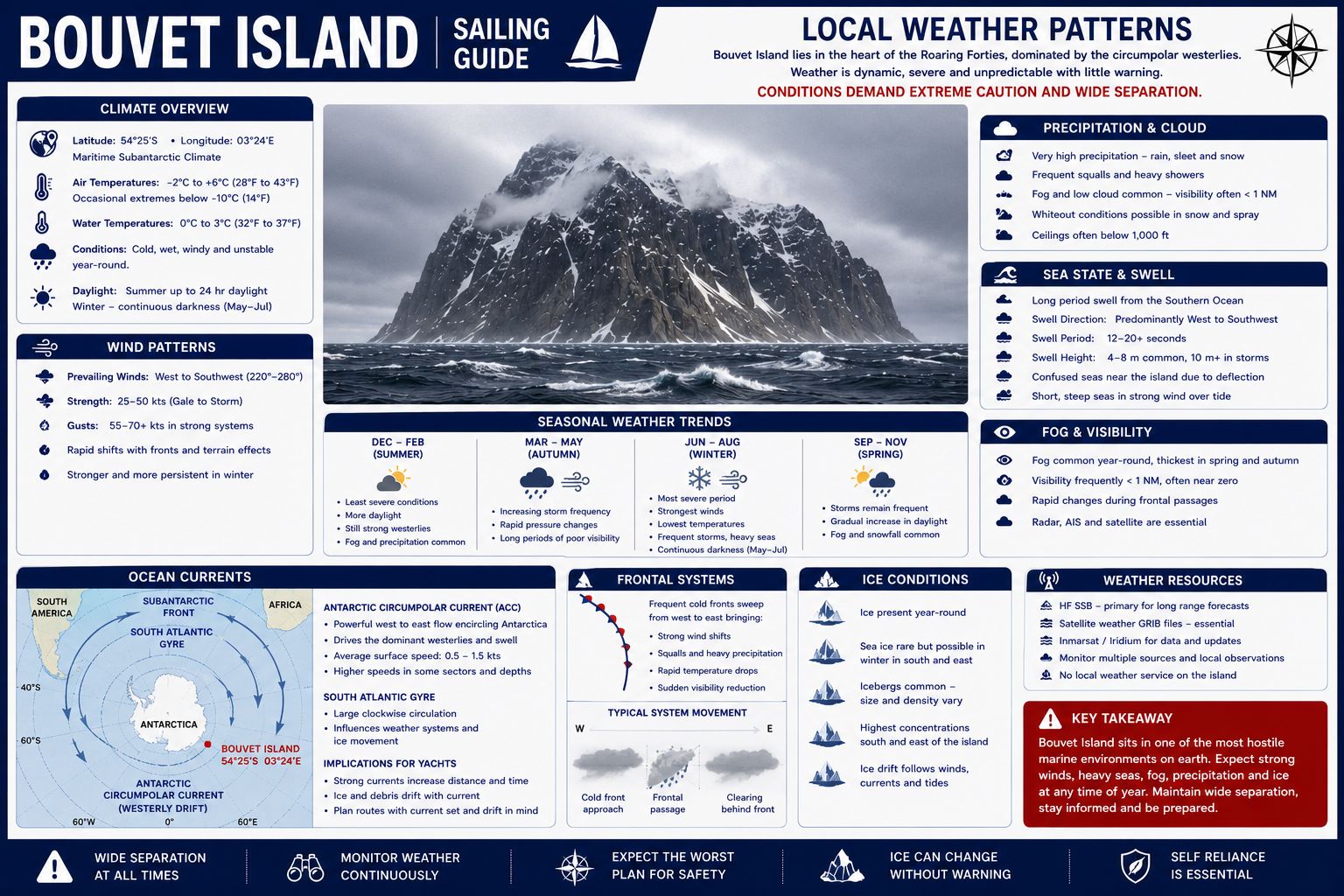
Weather is dominated by the circumpolar westerlies, with strong winds, rapid shifts, heavy precipitation and long‑period swell. Fog and low cloud are common, especially during frontal transitions. Ice drift varies with season, with concentrations increasing toward the southern and eastern sectors. Conditions demand extreme caution and wide separation.
Bouvet Island Sailing Guide - Provisioning
There is no provisioning. No food, no water, no fuel, no access. You ate very much on your own so plan and provision well
Bouvet Island Sailing Guide - Local
Cuisine
There is no local cuisine and no historical food culture. Bouvet has never been inhabited and has no history of sealing stations, whaling bases or temporary camps.
Bouvet Island Sailing Guide - Fuel
Supplies
Fuel is not available. Yachts must carry sufficient reserves for the entire high‑latitude passage.
Bouvet Island Sailing Guide - Water
Supplies
Water is not supplied to visiting vessels. Glacial meltwater exists but is inaccessible due to cliffs, surf and ice.
Mechanical and Electrical Repairs
Resource
If you are headed somewhere remote consider the need to expand your knowledge base or have an information resource on board. Why not get a copy of my book The Marine and Electrical and Electronics Bible 4th Edition. By and for yachties, with everything from batteries and charging, solar and wind, diesel engines and marine electronics and so much more. Your complete systems guide. 650 pages of practical advice. In Australia and New Zealand order a copy through Boat Books. UK and European boats can buy the UK Edition Here. US and Canadian boats can get the US Edition Order Here. Marine systems are my profession so let me help you. By a liveaboard boat owner for other boat owners


Bouvet Island Sailing Guide - Marine
Services
There are no marine services, no repair facilities and no technical support. Any issue requires routing back to Cape Town or South Georgia.
Bouvet Island Sailing Guide - Summary
Bouvet Island is a remote, volatile and strictly protected volcanic island in the southern South Atlantic, providing no anchorage, no services and no landing opportunities for yachts. Its Norwegian governance, extreme exposure and environmental significance define its operational character. It is a waypoint for well‑prepared, self‑sufficient vessels only, with all movements dictated by weather, ice and conservation rules. The Bouvet Island Sailing Guide for all you need to know.