Ascension Island Sailing Guide
Ascension Island Sailing Guide. Georgetown on the west coast of Ascension Island is the northern operational node of the South Atlantic, used by yachts routing between St Helena and the equator before committing to Cape Verde, Brazil or the Caribbean. The island forms part of the British Overseas Territory of St Helena, Ascension and Tristan da Cunha, with overall governance based in St Helena and day‑to‑day administration handled locally by an Administrator acting on behalf of the Governor. Much of the island’s infrastructure, including the harbour environment, is shaped by the long‑standing UK–US military presence, which explains the controlled landing procedures, regulated movements ashore and structured access to fuel and water. Ascension functions as a practical, strategically managed stop rather than a yachting destination, and its operational character reflects this.
Ascension is chosen when yachts require a secure northern reset after departing St Helena or when the South Atlantic High produces wind angles that favour a staged approach to the equator. The island sits at the transition between the southeast trades and the equatorial convergence zone, making it the natural stepping stone before yachts commit to the long, uninterrupted leg toward Cape Verde or Brazil. Northbound vessels use Ascension to stabilise fuel and water reserves before entering the light‑air belt near the equator, while southbound yachts arriving from the northern hemisphere treat it as the final reliable stop before the stronger trades and the longer passage to St Helena. Ascension therefore functions as the hinge point between the structured trade‑wind regime of the South Atlantic and the variable conditions of the equatorial zone, with its BOT governance ensuring predictable procedures for transiting yachts.
Ascension Island
Sailing Guide - Approaches
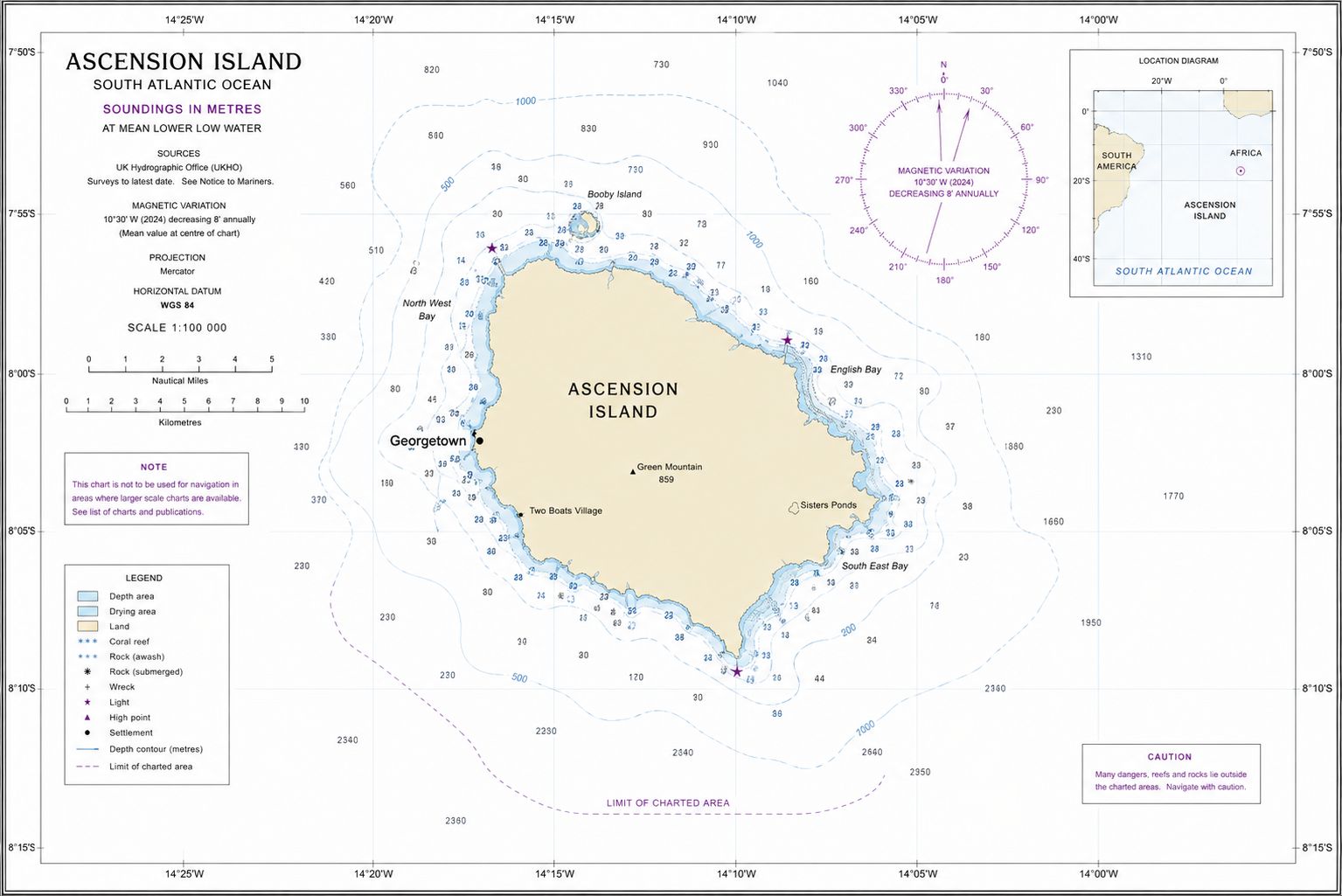
Approaches to Ascension encounter depths rising abruptly from 2000–50 m, with swell often wrapping around the island’s exposed volcanic slopes. The coastline is steep‑to, and Georgetown is the only practical landing point. Swell from the south and southwest can make the approach lively, and yachts maintain controlled speed while assessing conditions near the pier. Visibility is generally good, although haze is common in settled weather. The anchorage lies in 15–25 m depths, with a firm volcanic sand bottom and predictable holding.
Ascension Island
Sailing Guide - Anchorage
The Georgetown anchorage provides workable shelter in 15–25 m depths, with reliable holding and moderate exposure to long‑period swell. Conditions remain safe in most wind directions, although swell can make dinghy landings challenging and requires careful timing at the pier. The anchorage is functional rather than comfortable, but it is predictable and designed to support transiting yachts under the island’s controlled operational framework.
Ascension Island
Sailing Guide - Entry Formalities
Ascension’s status as a British Overseas Territory with a significant UK–US military footprint shapes its formalities. Yachts anchor, report to the harbour authority and complete immigration and customs ashore under a structured, regulated process. Permissions are clear and well‑defined, and movements on the island are controlled in accordance with its strategic role. Procedures are efficient but formal, reflecting the island’s administrative and military environment rather than its size.
Ascension Island
Sailing Guide - Marina Facilities
There is no marina. All yachts anchor off Georgetown and access shore facilities via the pier. Water and fuel are arranged through the harbour authority, with transfers made either at the pier or by container depending on sea state. The island functions as a controlled working harbour, and all movements are coordinated with local staff operating within the BOT and military framework.
Ascension Island
Sailing Guide - Local Weather
Weather is shaped by the southeast trades, which dominate much of the year and provide predictable conditions for arrival and departure. Swell from the south and southwest can affect landing conditions, and the equatorial convergence zone to the north produces occasional squalls and reduced visibility. The island’s steep volcanic terrain creates gusts and turbulence near the anchorage but does not generate katabatic winds. Conditions remain workable year‑round, with seasonal variation driven more by swell than by wind.
Ascension Island
Sailing Guide - Provisioning
Provisioning on Ascension is shaped entirely by the island’s isolation and its UK–US military supply chain. Georgetown has a small cluster of general stores rather than named markets, and stock levels rise and fall with the arrival of supply ships serving the military base and the civilian population. Fresh produce is limited and often sells through quickly after a shipment, leaving yachts reliant on frozen goods, long‑life staples and whatever dry stores remain on the shelves. There is no public produce market and no fish market; fresh fish is available only when local fishermen land tuna or wahoo, and this depends on weather, catch success and season. Ascension is therefore used strictly as a top‑up port, not a full reprovisioning point, with yachts relying on St Helena or Cape Town for bulk provisioning and using Ascension only to stabilise essentials before entering the equatorial belt.
Ascension Island
Sailing Guide - Local Cuisine
Local food reflects the island’s mixed civilian and military population, with simple preparations based on imported ingredients and locally caught fish. Tuna and wahoo are common, and meals rely on rice, vegetables and preserved goods. The cuisine is functional and consistent, providing reliable options for visiting crews.
Ascension Island
Sailing Guide - Fuel Supplies
Diesel is available through the harbour authority, with transfers made at the pier when conditions allow. Depths alongside are typically 5–7 m, and fuel quality meets commercial standards. When swell limits direct access, fuel is transferred by container or jerry can. Availability is reliable but should be confirmed on arrival due to the island’s supply‑ship cycle.
Ascension Island
Sailing Guide - Water Supplies
Potable water is available at the pier or delivered by container. Pressure and hose compatibility vary, and yachts often combine direct filling with jerry‑can transfers to manage landing conditions.
Mechanical
and Electrical Repairs Resource
If you are headed somewhere remote consider the need to expand your knowledge base or have an information resource on board. Why not get a copy of my book The Marine and Electrical and Electronics Bible 4th Edition. By and for yachties, with everything from batteries and charging, solar and wind, diesel engines and marine electronics and so much more. Your complete systems guide. 650 pages of practical advice. In Australia and New Zealand order a copy through Boat Books. UK and European boats can buy the UK Edition Here. US and Canadian boats can get the US Edition Order Here. Marine systems are my profession so let me help you. By a liveaboard boat owner for other boat owners


Ascension Island
Sailing Guide - Marine Services
Ascension offers essential but limited marine services, including diesel mechanics, electrical technicians and small‑scale fabrication. Chandlery items are minimal and sourced through hardware stores or fishing‑industry suppliers. Major repairs require routing to Cape Town or the Canary Islands depending on the vessel’s onward route.
Ascension Island
Sailing Guide - Local Customs
Georgetown operates as a controlled harbour with regulated landing procedures shaped by its BOT governance and military presence. Yachts follow anchoring and landing instructions, avoid obstructing supply‑ship operations and maintain clear communication with harbour staff. The environment is orderly and practical, reflecting the island’s strategic role.
Ascension Island
Sailing Guide - Summary
Ascension Island is the northern operational node of the South Atlantic, providing secure anchorage, controlled landing, essential provisioning, fuel, water and limited marine services for yachts routing between St Helena and the equator. Its status as a British Overseas Territory with a UK–US military presence defines its procedures and ensures predictable, regulated operations for transiting vessels. The Ascension Island Sailing Guide is here to help.