Mallorca Balearic
Islands Sailing Guide
Mallorca Balearic Islands Sailing Guide. Mallorca is the principal sailing and service hub of the Balearic Islands, with Palma Bay forming the main marina, repair, provisioning and crew-change centre for yachts cruising the western Mediterranean. The island sits between Menorca, Ibiza, mainland Spain, Sardinia and southern France, making it both a destination and a staging point for longer Mediterranean passages. For yachts, Mallorca must be planned coast by coast: the north-west coast is steep and exposed with few practical bolt-holes, the north coast is shaped by Alcudia and Pollensa bays, the east coast has numerous calas but limited all-weather shelter, and the south coast gives access to Palma Bay, Colònia de Sant Jordi and Cabrera.
For skippers, Mallorca is not just a convenient stop between Ibiza and Menorca. It is a complete cruising ground with strong technical infrastructure, high summer berth demand, regulated anchoring areas, exposed headlands, ferry traffic, seasonal sea breezes and weather systems that affect each coast differently. A safe Mallorca passage plan needs fallback harbours, clear anchorage choices by wind direction, confirmed marina arrangements in peak season, and strict avoidance of anchoring over Posidonia oceanica seagrass, which is legally protected in the Balearics.
Mallorca Balearic
Islands Sailing Guide - History
Mallorca has been used as a western Mediterranean harbour, trading and naval island since antiquity. Phoenician, Carthaginian, Roman, Byzantine, Moorish, Catalan and Spanish control all shaped the island’s ports, coastal settlements and maritime trade routes. Palma became the dominant harbour because of its large sheltered bay, while Alcudia, Sóller, Pollensa, Portocolom and other coastal towns developed around fishing, coastal trade, shelter, local agriculture and later ferry and yacht traffic. For a modern cruising skipper, the historic pattern remains practical: the main harbours are still located where the island offers workable shelter, landing, freshwater access, provisioning routes and control of the surrounding sea lanes.
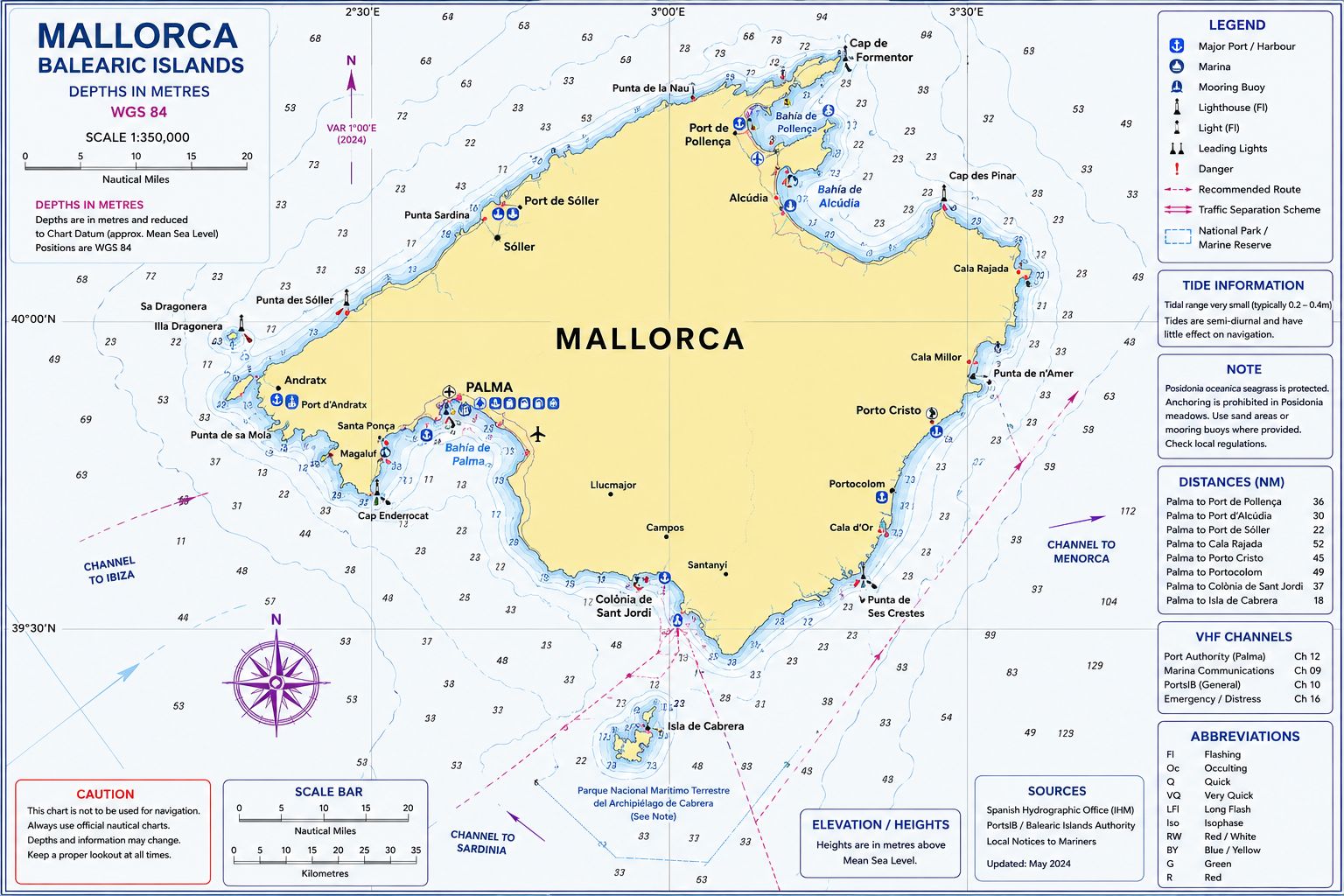
Chart Disclaimer. This chart is a schematic representation for illustrative purposes only and must not be used for navigation. Refer to official hydrographic charts for safe navigation. Be aware ENC charts may differ from official hydrographic charts. Both should be corrected and updated regularly.
Mallorca Balearic
Islands Sailing Guide - Ocean Currents and Tidal Flow
Tidal range around Mallorca is small and has limited effect on normal yacht navigation. Tidal streams are generally weak, and most current experienced by yachts is wind-driven, pressure-driven, or caused by local acceleration around headlands, capes and harbour entrances. Skippers should not plan Mallorca as a tidal-gate cruising area, but they should allow for surface set, residual drift and wind-opposed chop around exposed capes.
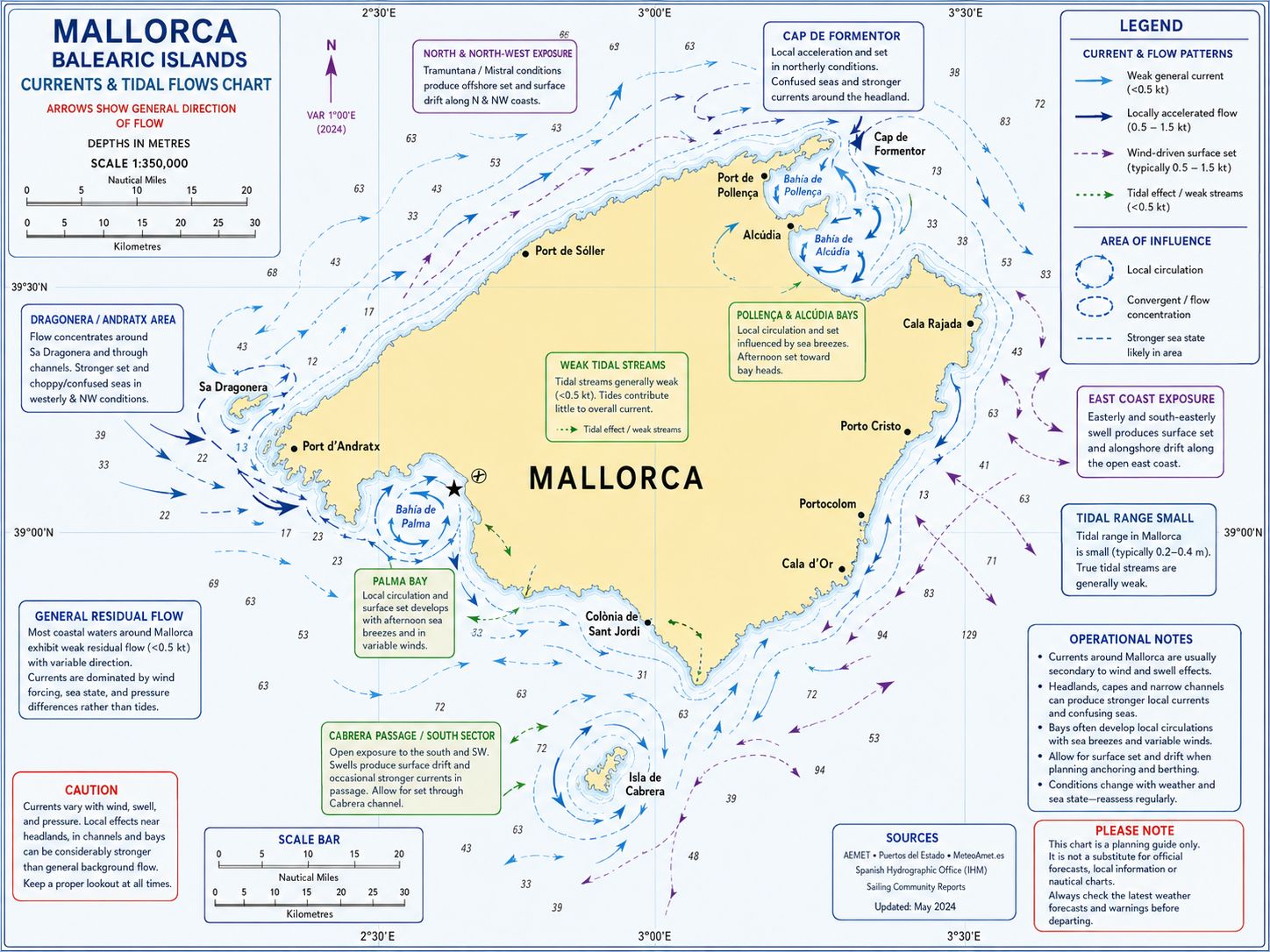
Current effects are most noticeable around Cap de Formentor, the Dragonera/Andratx area, the approaches to Palma Bay, Alcudia Bay, east-coast headlands, and the passage toward Cabrera. In strong northerly or north-westerly weather, the north and north-west coasts can produce rough, confused seas where wind, swell and coastal rebound combine. Easterly and south-easterly weather can drive swell into east-coast calas and across the south-east approaches. Tidal height is usually minor; wind direction and fetch are the controlling factors.
Mallorca Balearic
Islands Sailing Guide - Weather
Mallorca has a western Mediterranean climate with hot dry summers, mild wetter winters and a long cruising season from spring through autumn. Summer brings regular sea-breeze development, strong sun, high marina demand and heavy anchorage use. Daytime temperatures commonly sit in the high 20s to mid 30s Celsius in July and August. Visibility is often good, although heat haze can reduce long-range coastal definition.
The main weather risks are not tidal but directional. North and north-west systems affect the exposed north and north-west coasts. Easterlies and south-easterlies can make the east coast uncomfortable, especially in narrow calas where swell enters and reflects. Southerly weather can affect Palma Bay, Cabrera approaches and south-facing anchorages. Autumn depressions and thunderstorms can bring rapid wind shifts, heavy rain, squalls and short steep seas. Shoulder-season sailing should be planned with more conservative fallback harbours than settled summer cruising.
The Marine Electrical and Electronics Bible has a complete list of Spanish VHF Radio Channel information and weather forecast times along with NAVTEX UK and Europe and NAVTEX Mediterranean for 490kHz and 518kHz.
Mallorca Balearic
Islands Sailing Guide - Local Winds
Summer local winds around Mallorca are shaped by sea-breeze cycles, coastal heating, high ground and exposed headlands. Mornings are often lighter, with afternoon breeze building along open coasts and across the larger bays. Palma Bay, Alcudia Bay and Pollensa Bay can all develop local afternoon breeze and chop, with wind direction influenced by the surrounding land.
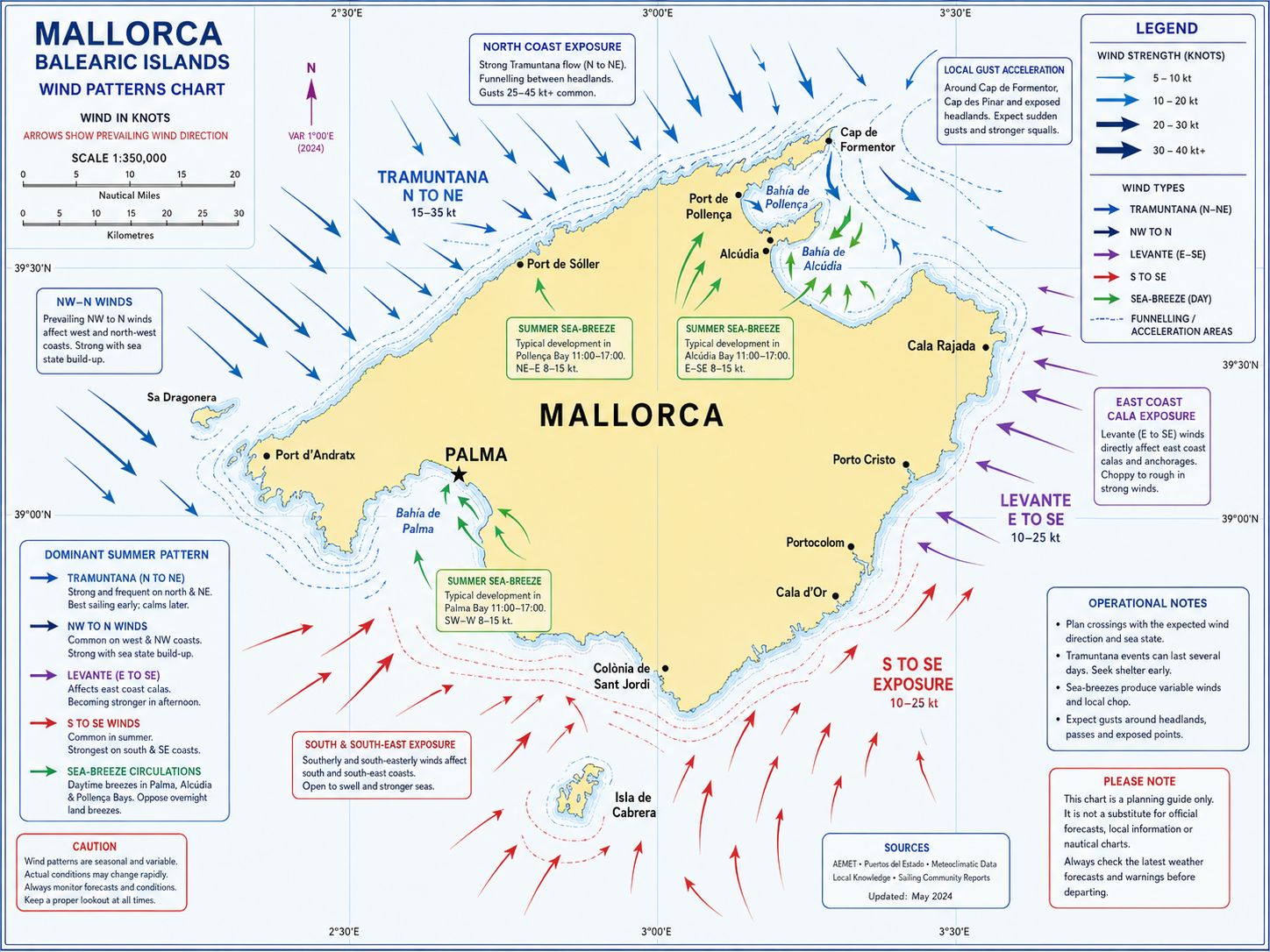
The tramontana affects the north coast and Menorca-facing side of Mallorca, especially around Cap de Formentor and Alcudia Bay. North-westerly systems can affect the west and north-west coast, including the Dragonera and Sóller sectors. Easterlies affect the east coast calas and can make otherwise attractive anchorages untenable. Local gusts are common near cliffs, headlands and valley exits, especially along the Tramuntana coast.
Mallorca Balearic
Islands Sailing Guide - Approaches
Approaches to Mallorca are made from mainland Spain, Menorca, Ibiza, Cabrera, Sardinia, southern France and the wider western Mediterranean. From the west and north-west, the island presents a steep mountainous coast with deep water close inshore and limited shelter until Port de Sóller or the south-west coast near Andratx. From the south-west, yachts approach Palma Bay through busy traffic areas with ferries, commercial vessels, marina traffic, day boats and anchored yachts.
From the north-east, approaches from Menorca usually make for Pollensa, Alcudia, or around Cap de Formentor depending on weather. This area requires caution in northerly systems because sea state can build quickly off the capes. From the east, approaches from the open Balearic Sea lead toward Cala Rajada, Porto Cristo, Portocolom and the east-coast calas. From the south, the Cabrera and Colònia de Sant Jordi sector has shallow areas, protected zones, traffic, and weather exposure that must be checked before closing the coast.
Mallorca Balearic
Islands Sailing Guide - Navigation
Navigation around Mallorca is straightforward in settled weather but should not be treated casually. The island has deep water close to much of the coast, especially along the west and north-west sides, but harbours, calas and beach approaches can shoal quickly. Many anchorages require daylight visual pilotage because sand, weed and rock patches must be distinguished before anchoring. Posidonia meadows must be avoided, and both anchor and chain should lie on sand where anchoring is permitted.
Palma Bay is the busiest navigation area, with commercial shipping, ferries, cruise traffic, marina movements, racing fleets, local motorboats, charter yachts and harbour controls. AIS and radar are essential. Alcudia and Pollensa are important north-coast harbours, while Sóller is the key harbour on the north-west coast. The east coast has many narrow calas, but several are unsuitable in swell, crowded in summer, and difficult to use in poor light. Cabrera requires separate permit and mooring planning through the official Balearic Government system.
Mallorca Balearic Islands Sailing Guide - Lighthouses
I really value lighthouses, both operational and not. The are useful for practicing coastal navigations skills and at night there is something strangely comforting about them, but that’s just me! The principal coastal lights and lighthouse landmarks around Mallorca are Formentor, Capdepera, Portocolom, Cap de Ses Salines, Cap Blanc, Cala Figuera, Porto Pi, Cap Gros / Muleta, Bufador, Sa Mola at Andratx, Alcanada, the Cabrera lights including n’Ensiola, and the Dragonera lights including Tramuntana and Llebeig; these are useful for coastal recognition and sector identification. Mallorca has a large number of lighthouse landmarks, including active coastal lights, harbour lights and some former/disused lights. The main coastal lighthouse landmarks by name are:
- Formentor Lighthouse. Located at Cap de Formentor on Mallorca’s northern extremity; major north-coast landfall mark. Fars de Balears lists a white tower and cottages, tower height 22 m, focal height 210 m, nominal range 24 NM, and light pattern group of 4 flashes every 20 seconds.
- Capdepera Lighthouse. Located on eastern Mallorca, marking the eastern side of the island and the Menorca Channel sector.
- Cap Blanc/Cabo Blanco Lighthouse. Located on the south coast, on the cliffs between Palma Bay and the southeast coast.
- Cap de Ses Salines Lighthouse. Located on the southern tip of Mallorca, relevant for the Cabrera and south-coast approach sectors.
- Cala Figuera Lighthouse. Located on southwest Mallorca, near the approaches to Palma Bay and the Calvià coast.
- Porto Pi Lighthouse. Located in the Palma harbour area; historically important and relevant as a harbour/approach landmark.
- Cap Gros / Muleta Lighthouse. Located at the Port de Sóller entrance area, on the northwest coast.
- Bufador Lighthouse. This is associated with Port de Sóller approaches.
- Sa Mola Lighthouse/Andratx. Located on the west coast near Port d’Andratx.
- Portocolom Lighthouse. This is an east coast harbour landmark.
- Alcanada Lighthouse. Located on Illa d’Alcanada near Alcúdia Bay.
- Cabrera lighthouses. In particular n’Ensiola, are useful for passages south of Mallorca and Cabrera National Park waters.
- Dragonera lighthouses. These include Tramuntana and Llebeig, which are relevant off the southwest coast near Sant Elm and Andratx. The older na Pòpia light is disused. Fars de Balears lists Mallorca lights including Cap Blanc, Cap Gros, Capdepera, Cala Figuera, Sa Mola, n’Ensiola, na Foradada, na Pòpia out of use, and also Tramuntana.
Mallorca Balearic
Islands Sailing Guide - Anchorages
Mallorca has many anchorages, but most are weather-dependent calas rather than all-weather shelters. The key operating rule is to select anchorage by wind and swell direction, not by distance or popularity. East-coast calas can be excellent in settled weather but poor in easterly swell. North-coast anchorages can be exposed to tramontana and northerly systems. South-coast anchorages can be affected by southerly weather and summer crowding. West-coast anchorages are fewer, deeper, and more exposed because the coast is steep and mountainous.
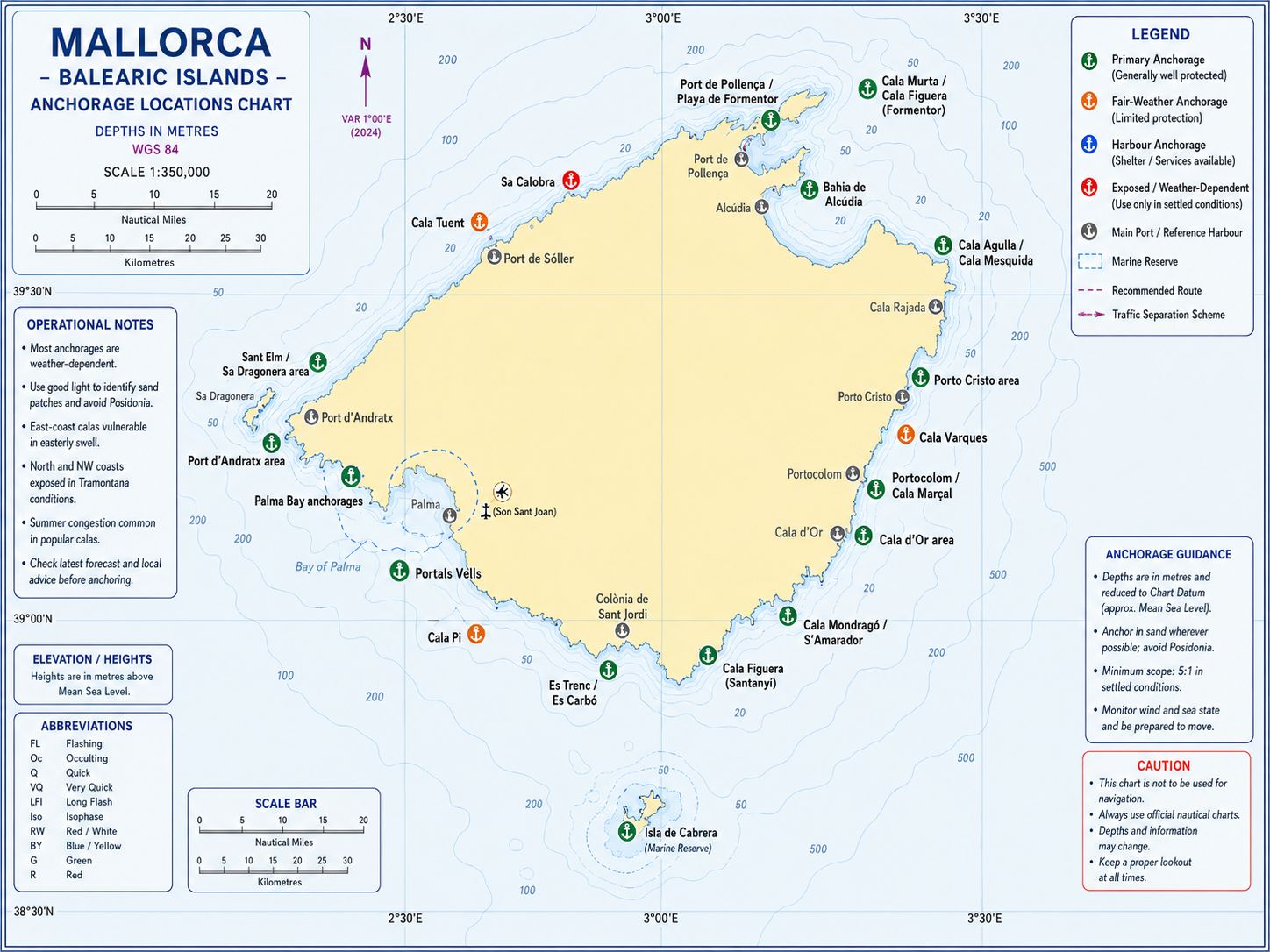
Anchoring must be planned around Posidonia oceanica. The Balearic Government’s Posidonia protection framework prohibits uncontrolled anchoring on Posidonia meadows, and official systems provide Posidonia mapping and buoy-field information for skippers. The practical method is to enter in good light, identify clean sand, drop the anchor only on sand, and confirm that the chain also remains clear of seagrass. Where buoy fields exist, they are for limited use in suitable conditions and are not heavy-weather refuges.
Mallorca Balearic Islands Sailing Guide - Entry Formalities
Spain and the Balearic Islands are within the Schengen Area and the EU customs territory, so yachts arriving from another Spanish or Schengen/EU port normally do not complete full border clearance again. Yachts arriving from a non-Schengen port must clear through an authorised port of entry, for practical yacht clearance, the main Balearic entry ports include Palma, Alcudia, Ibiza, Mahon and La Savina. The usual formalities include crew passports handled by the Frontier Police and vessel/customs formalities handled through the appropriate Spanish authorities. Since 10 April 2026, the EU Entry/Exit System records non-EU short-stay entries and exits electronically rather than by passport stamping. Non-EU visitors remain subject to Schengen short-stay limits, normally 90 days in any 180-day period, unless they hold a visa or residence status allowing longer stay. Non-EU flagged yachts may also need to consider Temporary Admission rules for EU waters, commonly allowing private non-EU yachts used by non-EU residents to remain in EU customs territory for up to 18 months without VAT/import duty being due, provided the conditions are met.
Mallorca Balearic
Islands Sailing Guide - Marina and Berthing Facilities
Mallorca has the strongest marina and berthing network in the Balearic Islands. The main centres are Palma, Alcudia, Port de Pollença, Port de Sóller, Portocolom, Porto Cristo, Cala d’Or, Cala Rajada, Andratx, Cala Figuera, Cala Bona and Colònia de Sant Jordi. PortsIB lists Mallorca harbour reservation locations including Andratx, Cala Bona, Cala Figuera, Cala Rajada, Colònia de Sant Jordi, Pollença, Porto Cristo, Portocolom and Sóller.
Berthing demand is high in summer. Palma has the largest concentration of yacht berths and technical services, but also the highest level of traffic and demand. Alcudia and Pollensa are useful north-coast bases. Sóller is strategically important on the north-west coast because there are few alternative shelters nearby. Portocolom, Porto Cristo and Cala d’Or are useful east-coast options. Berths should be reserved in advance in peak season, and skippers should maintain a fallback harbour or anchorage plan.
Mallorca Balearic
Islands Sailing Guide - Provisioning
Provisioning is strongest in Palma, where supermarkets, marine suppliers, chandlers, markets, bakeries, butchers, hardware stores and technical suppliers are concentrated. Other practical provisioning centres include Alcudia, Port de Pollença, Sóller, Manacor, Portocolom, Porto Cristo, Cala d’Or, Andratx and Cala Rajada.
For yacht provisioning, Palma is the best location for large stock-ups, spares, gas, cleaning products, specialist food, chandlery and crew-change logistics. Smaller ports and calas can support routine supplies but should not be treated as full technical resupply points unless confirmed locally. Remote anchorages and beach calas normally have no provisioning, water, fuel or rubbish facilities.
Mallorca Balearic
Islands Sailing Guide - Produce and Markets
Mallorca has strong fresh produce supply through municipal markets, town markets, greengrocers and supermarket produce sections. Common produce includes tomatoes, peppers, onions, potatoes, citrus, almonds, figs, grapes, melons, olives, herbs, leafy greens and seasonal vegetables. Palma has the widest market choice, while inland and coastal towns provide useful local supply depending on market days.
For cruising yachts, produce supply is practical in Palma, Alcudia, Pollensa, Sóller, Andratx, Manacor and the larger east-coast towns. Small cala anchorages should be treated as no-market stops. Local products include Mallorcan almonds, olive oil, citrus, sobrasada, cheeses, honey, olives and local wines.
Mallorca Balearic
Islands Sailing Guide - Fish Supplies
Fish supplies are available through fish markets, seafood retailers, harbour fishers and restaurants in the larger ports. Palma and Alcudia are the strongest supply points, with additional fishing activity and seafood supply around Sóller, Portocolom, Cala Rajada, Porto Cristo and other working harbours.
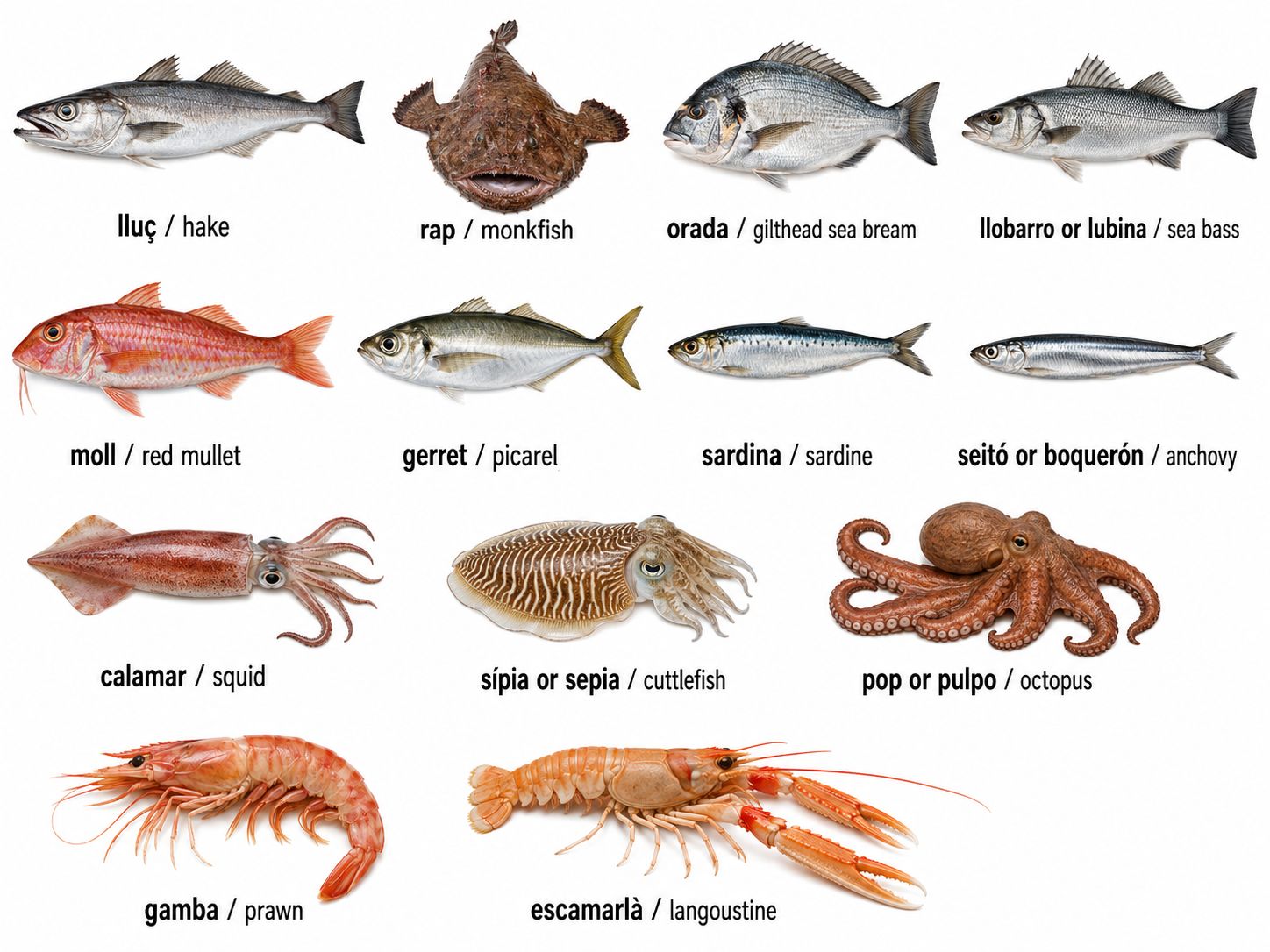
Common local seafood includes sea bream, sea bass, red mullet, hake, monkfish, sardines, anchovies, squid, cuttlefish, octopus and prawns. Availability depends on weather, season, landings and local demand. In small anchorages, fish should not be assumed available unless bought directly from local boats or arranged through restaurants.
Mallorca Balearic
Islands Sailing Guide - Local Cuisine
Mallorcan cuisine is based on seafood, pork, lamb, vegetables, pulses, bread, olive oil, almonds and local produce. Common dishes include tumbet, frito mallorquin, sopas mallorquinas, arròs brut, pa amb oli, sobrasada, grilled fish, seafood rice, calamari, octopus, lamb, pork dishes, vegetable stews and local cheeses.
Regional products include Mallorcan olive oil, almonds, citrus, figs, tomatoes, olives, honey, sobrasada, ensaimada and local wine. Harbour towns and inland markets both matter for provisioning because Mallorca’s food supply is not only coastal; much of the island’s produce comes from inland agricultural areas.
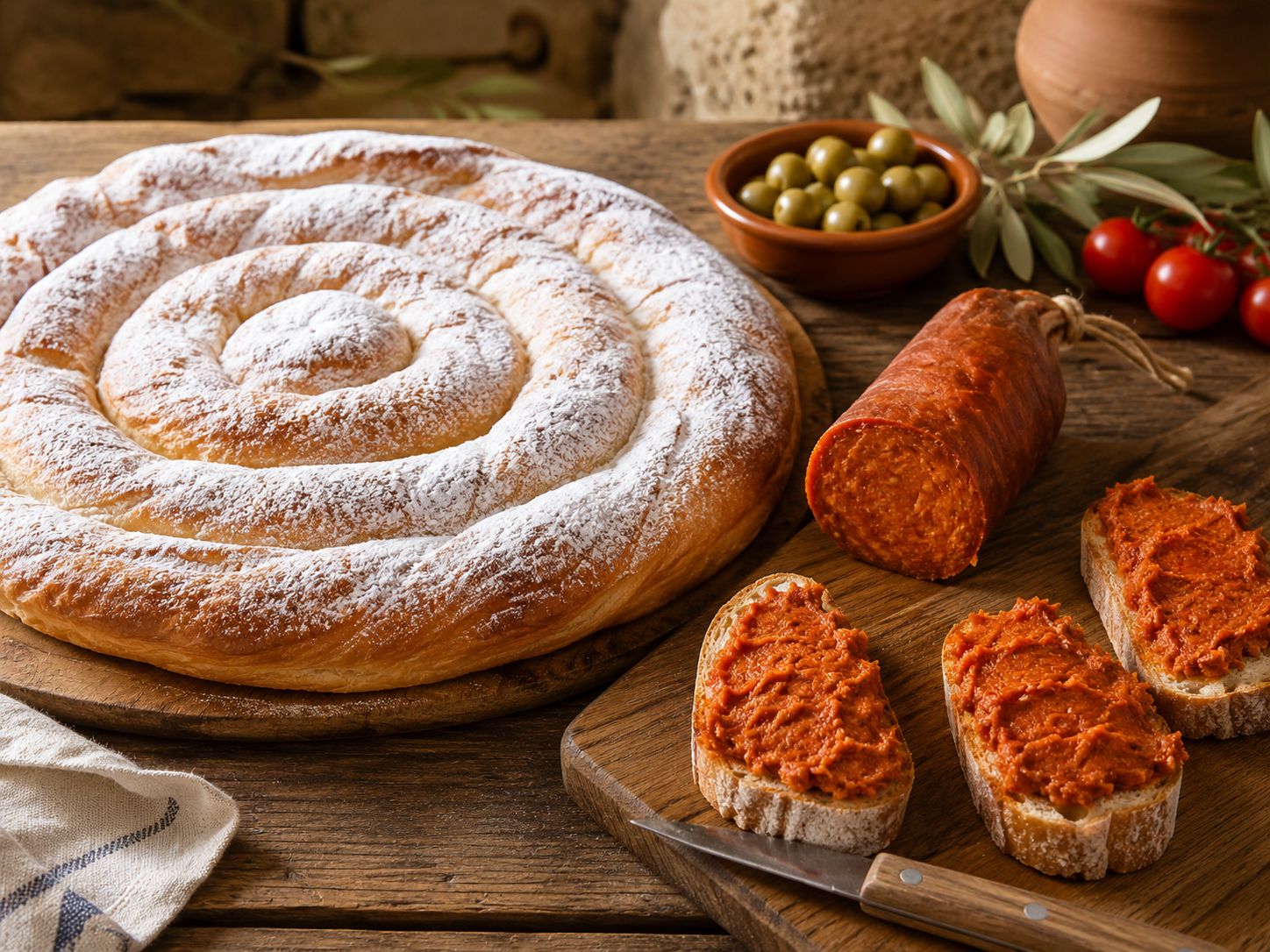
Sobrasada is a traditional cured sausage from Mallorca and the Balearic Islands, made mainly from pork, pork fat, paprika, salt and spices. Unlike a firm slicing chorizo, sobrasada is soft and spreadable, with a red-orange colour from paprika and a rich, lightly smoky, mildly spicy flavour. It is commonly eaten spread on bread, served with pa amb oli, used in cooked dishes, or paired with honey, cheese, eggs or vegetables. For a cruising-yacht galley, it is useful because it keeps well, is easy to serve without cooking, and adds strong local flavour to simple meals.
Ensaimada is a traditional Mallorcan spiral pastry made from a soft enriched dough, usually with flour, water, sugar, eggs, yeast and pork lard, called saïm in Catalan/Mallorcan. The dough is rolled thin, coiled into a flat spiral, baked until light and golden, then normally dusted with icing sugar. It can be plain or filled, with common versions including cabell d’àngel pumpkin preserve, cream, custard, chocolate or sobrasada. It is widely available in bakeries, cafés, markets and supermarkets across Mallorca, and is a practical sweet item to bring aboard for breakfast, coffee stops or those passagemaking snacks.
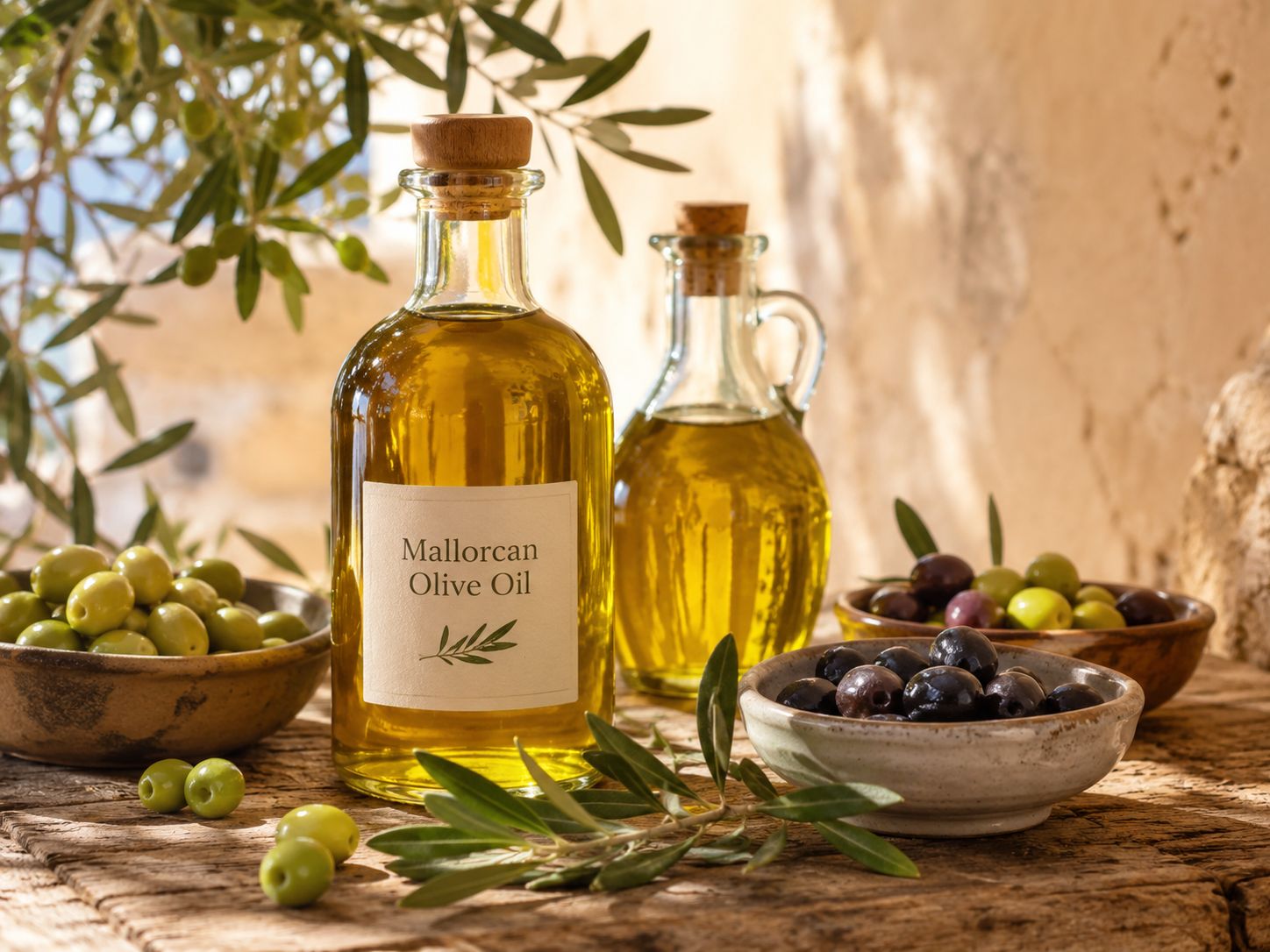
Mallorcan olive oil is one of the island’s main local produce items and is used widely in simple harbour food, market cooking and preserved products. The island produces extra virgin olive oil from traditional varieties such as Mallorquina, Arbequina and Picual, with groves concentrated in areas including the Serra de Tramuntana, where dry-stone terraces, limestone soils and low rainfall shape the oil’s character. For provisioning, Mallorcan olive oil is readily found in Palma markets, island supermarkets, delicatessens and inland produce shops, and is useful aboard for cooking fish, vegetables, pa amb oli, salads and long-life galley stores
Mallorca Balearic
Islands Sailing Guide - Local Beverages
Local beverages include Mallorcan wines, hierbas mallorquinas, vermouth, local spirits, coffee, soft drinks, bottled water and island-brewed beers. Mallorca has a small but active beer scene, including local labels such as Rosa Blanca, Sullerica, Beer Lovers, Ralf, Toutatis, Cas Cerveser, 4 Alqueries and Forastera. These are most commonly found in larger supermarkets, bottle shops, restaurants, marina bars and island food markets.
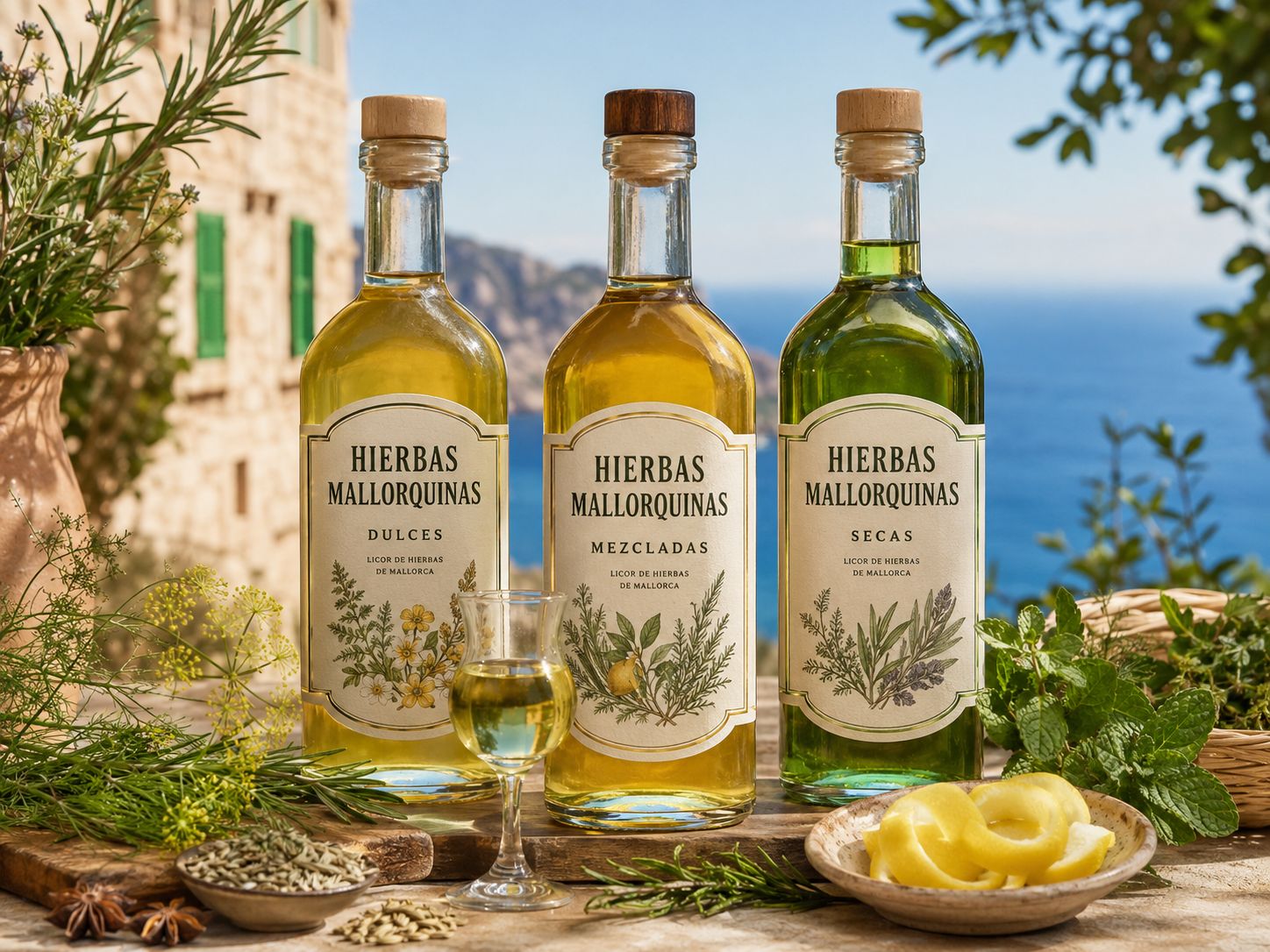
Hierbas Mallorquinas or Hierbas de Mallorca is a traditional Mallorcan herbal liqueur, usually served after a meal as a digestif. It is an aniseed-based spirit flavoured with local aromatic plants such as fennel, rosemary, lemon verbena, chamomile, mint, orange, lemon and other Mediterranean herbs. It has medicinal origins, traditionally linked to monastery and pharmacy preparations, and the protected Hierbas de Mallorca designation applies to liqueur made in Mallorca. It is normally sold in three styles: dulces or sweet, mezcladas or mixed, and secas or dry, with the dry version stronger and less sweet.
Mallorca Balearic
Islands Sailing Guide - Diesel Fuel
Diesel fuel is available at major marinas and harbours rather than at remote anchorages. The most reliable fuel planning points are Palma, Alcudia, Port de Pollença, Port de Sóller, Portocolom, Porto Cristo, Cala d’Or, Cala Rajada, Andratx and other serviced harbour locations. Fuel availability, berth access, payment method, opening hours and draught should be checked locally.
There is no fuel supply in ordinary calas. A yacht moving around the east coast, north-west coast or Cabrera sector should not assume fuel can be obtained without entering a harbour. For longer passages from Mallorca to Menorca, Ibiza, Sardinia or mainland Spain, fuel should be topped up at a major port before departure.
Mallorca Balearic
Islands Sailing Guide - Water Supplies
Water is normally available at marinas and serviced harbour berths, not at anchorages. Palma has the strongest water and marina utility infrastructure. Other useful water points are found at serviced berths in Alcudia, Pollença, Sóller, Portocolom, Porto Cristo, Cala d’Or, Cala Rajada, Andratx and Colònia de Sant Jordi.
Remote calas should be treated as no-water stops. Water pressure, charging arrangements and berth access vary by harbour. In summer, yachts should manage tank levels conservatively because marina access may be limited by berth availability and anchorage-only cruising can quickly reduce freshwater reserves.
Mechanical and Electrical Repairs
Resource
If you are headed somewhere in the Mediterranean or Spain or somewhere more remote consider the need to expand your knowledge base or have an information resource on board. Why not get a copy of my book The Marine and Electrical and Electronics Bible 4th Edition. with everything from batteries and charging, solar and wind, diesel engines and marine electronics and so much more. Your complete systems guide. 650 pages of practical advice. In Australia and New Zealand order a copy through Boat Books. UK and European boats can buy the UK Edition Here. US and Canadian boats can get the US Edition Order Here. Marine systems are my profession so let me help you DIY and save some valuable technician callout rates. This is by a cruising yachtsman and liveaboard boat owner for other boat owners.


Mallorca Balearic
Islands Sailing Guide - Marine Services
Palma is the main marine-service centre for Mallorca and the wider Balearic Islands. Services include haul-out, hardstanding, engineering, diesel repairs, rigging, sailmaking, electronics, hydraulics, refrigeration, GRP repair, painting, stainless fabrication, upholstery, chandlery, diving services, antifouling and yacht management.
Secondary service areas include Alcudia, Port de Sóller, Porto Cristo, Cala d’Or, Andratx and other established harbours. The level of service outside Palma varies. Larger repairs, specialist diagnostics, major engine work, rig work and ordered parts are normally easier to manage through Palma.
Mallorca Balearic
Islands Sailing Guide - Entry Formalities
Spain and the Balearic Islands are within the Schengen Area and the EU customs territory, so yachts arriving from another Spanish or Schengen/EU port normally do not complete full border clearance again. Yachts arriving from a non-Schengen port must clear through an authorised port of entry, for practical yacht clearance, the main Balearic entry ports include Palma, Alcudia, Ibiza, Mahon and La Savina. The usual formalities include crew passports handled by the Frontier Police and vessel/customs formalities handled through the appropriate Spanish authorities. Since 10 April 2026, the EU Entry/Exit System records non-EU short-stay entries and exits electronically rather than by passport stamping. Non-EU visitors remain subject to Schengen short-stay limits, normally 90 days in any 180-day period, unless they hold a visa or residence status allowing longer stay. Non-EU flagged yachts may also need to consider Temporary Admission rules for EU waters, commonly allowing private non-EU yachts used by non-EU residents to remain in EU customs territory for up to 18 months without VAT/import duty being due, provided the conditions are met.
Mallorca Balearic
Islands Sailing Guide - Local Interpersonal Etiquette
Interpersonal etiquette in Mallorca is informal but practical. Use basic greetings in harbour offices, shops, fuel stations, cafés, markets and boatyards. Spanish and Catalan are both used; polite Spanish is widely understood, while local place names may appear in Catalan forms. Keep communication with marina staff, port police, fuel dock operators, market sellers and repair contractors clear and patient, especially during peak summer demand.
Dress is casual around harbours, but swimwear is not normal in shops, offices, markets or town streets. Do not treat fishing quays, small harbour walls or local moorings as free yacht infrastructure. In calas, keep noise down, avoid running generators close to other yachts, respect buoy fields and beach zones, and follow Posidonia anchoring rules without argument.
Mallorca Balearic
Islands Sailing Guide - Summary
Mallorca is the main Balearic service hub and one of the most complete cruising areas in the western Mediterranean. The island offers strong marina infrastructure, technical services, provisioning, harbour options and access to Cabrera, but it also requires careful planning because each coast responds differently to wind and swell. Skippers should plan berth reservations, fuel, water, anchoring legality, fallback harbours and daylight entries before moving between coasts. This page is the regional island hub for the Mallorca Balearic Islands sailing guide for all you need to know.