Cala Bona Mallorca Sailing Guide
Cala Bona Mallorca Sailing Guide. Cala Bona sits on the north-east coast of Mallorca inside the broad sweep of the Badia d’Artà, between the longer resort frontage of Cala Millor and the smaller coastal settlements to the north. The harbour developed from a local fishing base and still has the scale and layout of a small working port rather than a yacht harbour built for larger cruising vessels. For a skipper, Cala Bona is a close-coast harbour where visual identification, local traffic, harbour layout and weather exposure matter more than long-distance landfall planning. The port is used by local boats, fishing craft, excursion vessels and small leisure craft, so any arrival should be treated as a controlled small-harbour entry rather than an open marina arrival. It is a useful stop only where the vessel, conditions and available space suit the limitations of the harbour.
The surrounding coast is low, developed and visually repetitive from seaward, with beach structures, short breakwaters and waterfront buildings that can reduce the clarity of the approach until the harbour is close. The port does not provide the same margin for error as deeper harbours on the east coast, and decisions should be made before closing the entrance rather than after the vessel is committed. Cala Bona is best considered in relation to nearby alternatives, particularly Cala Rajada to the north and Porto Cristo to the south, both of which may be more appropriate for larger yachts or deteriorating weather. Provisioning and shore services are shared with Cala Millor and Son Servera rather than concentrated wholly at the harbour. The practical value of Cala Bona is as a small-craft coastal stop when pilotage, draft, sea state and berth availability have all been checked in advance.
Cala Bona Mallorca
Sailing Guide - History
Cala Bona’s maritime history is based on fishing, not commercial shipping. PortsIB states that the port’s background begins in 1934, when a fishing colony used modest facilities on this coast. The initial reason for the harbour works was to serve that fishing activity, and the harbour later changed function as fishing traffic became minor and leisure craft became the main port use. This history matters operationally because the harbour was not designed around modern cruising-yacht dimensions.
The older fishing function is still evident in the basin layout and in the mix of local craft, small fishing boats and excursion vessels. The port retains a working-port arrangement rather than a marina layout with wide fairways and deep berths. The surrounding coast has low settlement and beach development rather than high cliffs or major commercial port marks. No major harbour-front archaeological site affects pilotage into Cala Bona itself, but the wider Son Servera and northeast Mallorca coast has older defensive and rural sites inland and along nearby headlands; these do not provide primary navigation marks for harbour entry.
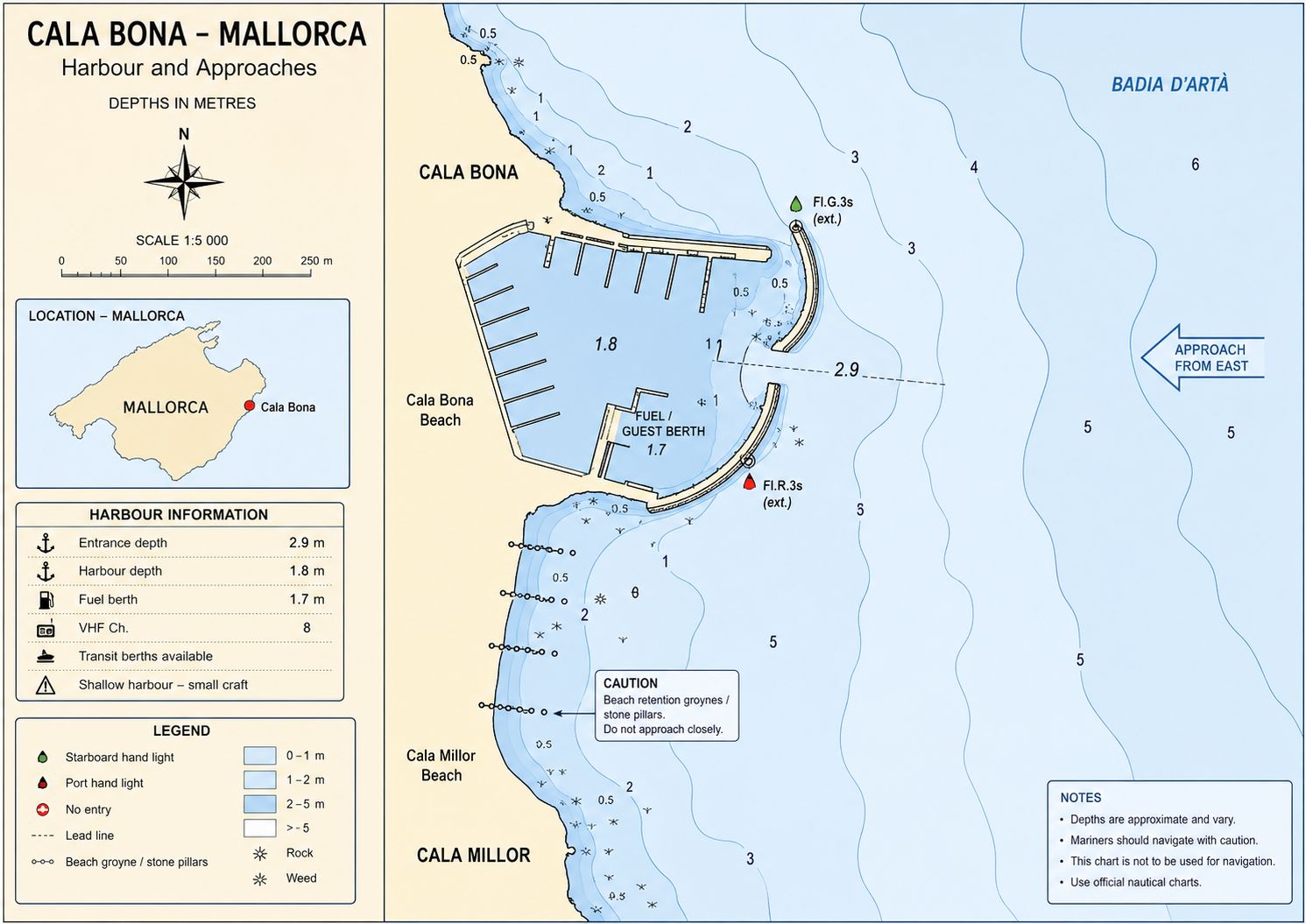
Chart Disclaimer. This chart is a schematic representation for illustrative purposes only and must not be used for navigation. Refer to official hydrographic charts for safe navigation. Be aware ENC charts may differ from official hydrographic charts. Both should be corrected and updated regularly.
Cala Bona Mallorca
Sailing Guide - Currents and
Tidal Flow
Tidal range around Mallorca is small, and Cala Bona is not a tidal harbour in the Atlantic sense. Tidal height should not be relied on to compensate for draft in the harbour because the reported depths are already limiting and the margin for a yacht drawing near 1.8–2.0 m is small. Local flow at the entrance will normally be governed more by wind, residual swell and harbour traffic wash than by tidal stream. A skipper should treat the sounder reading as the controlling data point rather than tide-table height.
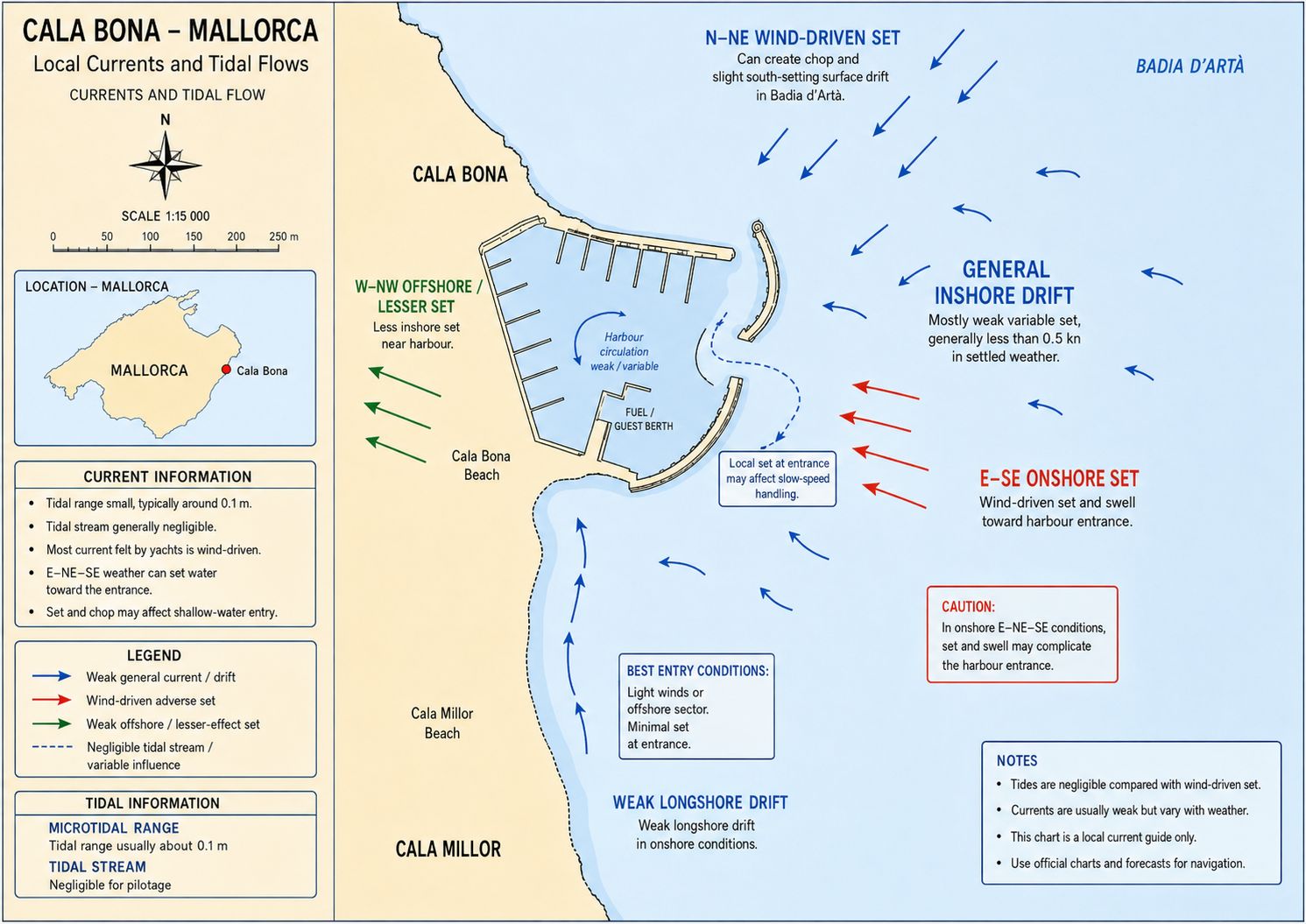
In the Badia d’Artà, wind-driven surface set can develop after sustained easterly or northeasterly weather. This is relevant because Cala Bona opens to the east and northeast sector and the approach is shallow near the shore. Residual swell may persist after the wind has eased, and that swell can affect the entrance and the beach margins. Current should not normally create a strong cross-set in the harbour entrance, but a vessel entering slowly in shallow water can be set by windage and sea state toward the breakwater heads.
Cala Bona Mallorca
Sailing Guide - Weather
Cala Bona is exposed to the Badia d’Artà and should be considered vulnerable to E, NE and SE weather. The harbour is protected by breakwaters, but the approach and entrance remain exposed to onshore sea. A pilotage source specifically cautions against attempting entry in strong onshore winds. The combination of shallow water, narrow manoeuvring space and onshore swell is the main weather limitation for entry.
In settled summer weather, the usual operating pattern is calmer conditions early in the day and more local chop as the sea breeze builds. This affects both the approach and the harbour basin because the entrance faces the open bay. After a period of easterly weather, a skipper should expect leftover swell on the beach line and around the breakwater heads. In unsettled autumn and winter conditions, fronts can create short-period seas in the bay that make Cala Bona unsuitable for entry by a yacht with limited under-keel clearance.
Cala Bona Mallorca
Sailing Guide - Local Winds
The main local wind issue is onshore wind from the E through NE to SE sector. These directions send sea toward the harbour and can reduce control in the entrance. A shallow-draft yacht may still be able to enter in light onshore conditions, but the limiting factor is not only depth; it is also the ability to hold the centre of the entrance while avoiding breakwater ends and traffic. Strong onshore wind should be treated as a no-entry condition.
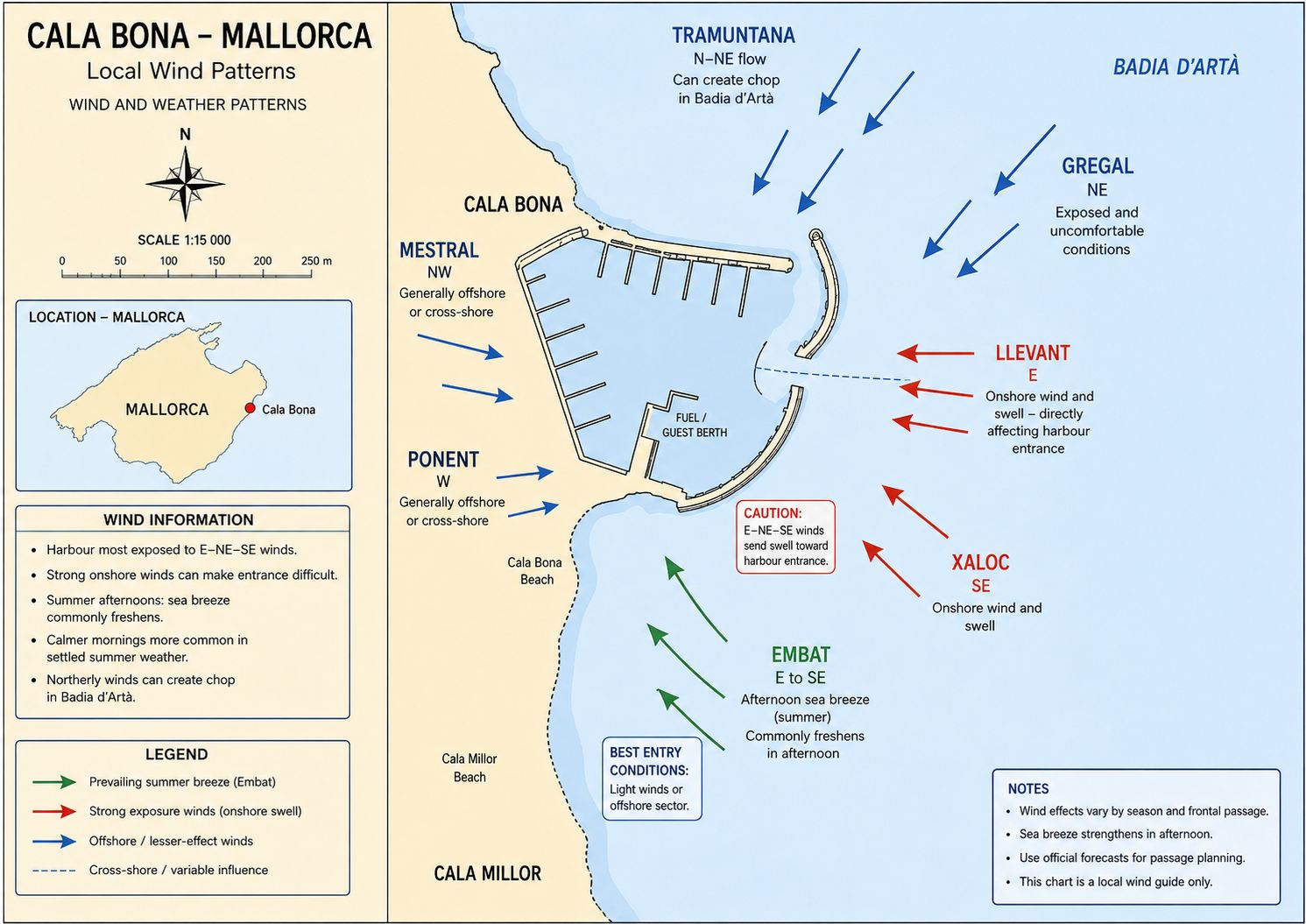
Regional winds affecting Mallorca include the Tramuntana from the north and northwest, mistral-type northwesterlies in the western Mediterranean, and summer thermal sea breezes. In Cala Bona, the practical result of these systems depends on their direction after they reach the Badia d’Artà. Northerly conditions can send sea across the bay, while easterly gradient wind or a strong afternoon sea breeze creates the most direct problem at the harbour entrance. Offshore westerly winds may flatten the immediate approach but can create gusts close to land.
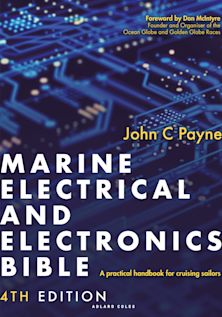
The Marine Electrical and Electronics Bible has a complete list of Spanish VHF Radio Channel information and weather forecast times along with NAVTEX UK and Europe and NAVTEX Mediterranean for 490kHz and 518kHz.
Cala Bona Mallorca
Sailing Guide - Approaches
Cala Bona lies in the middle section of the Badia d’Artà, north of Cala Millor. From seaward the harbour is low-profile and can be confused with adjacent resort waterfront structures, beach works and breakwaters. The approach should be made from the east, keeping off the shore until the harbour breakwater layout is positively identified. South of the harbour there is a series of stone pillars used to retain beach sand, and these can be mistaken for the entrance and they must be identified before closing the harbour.
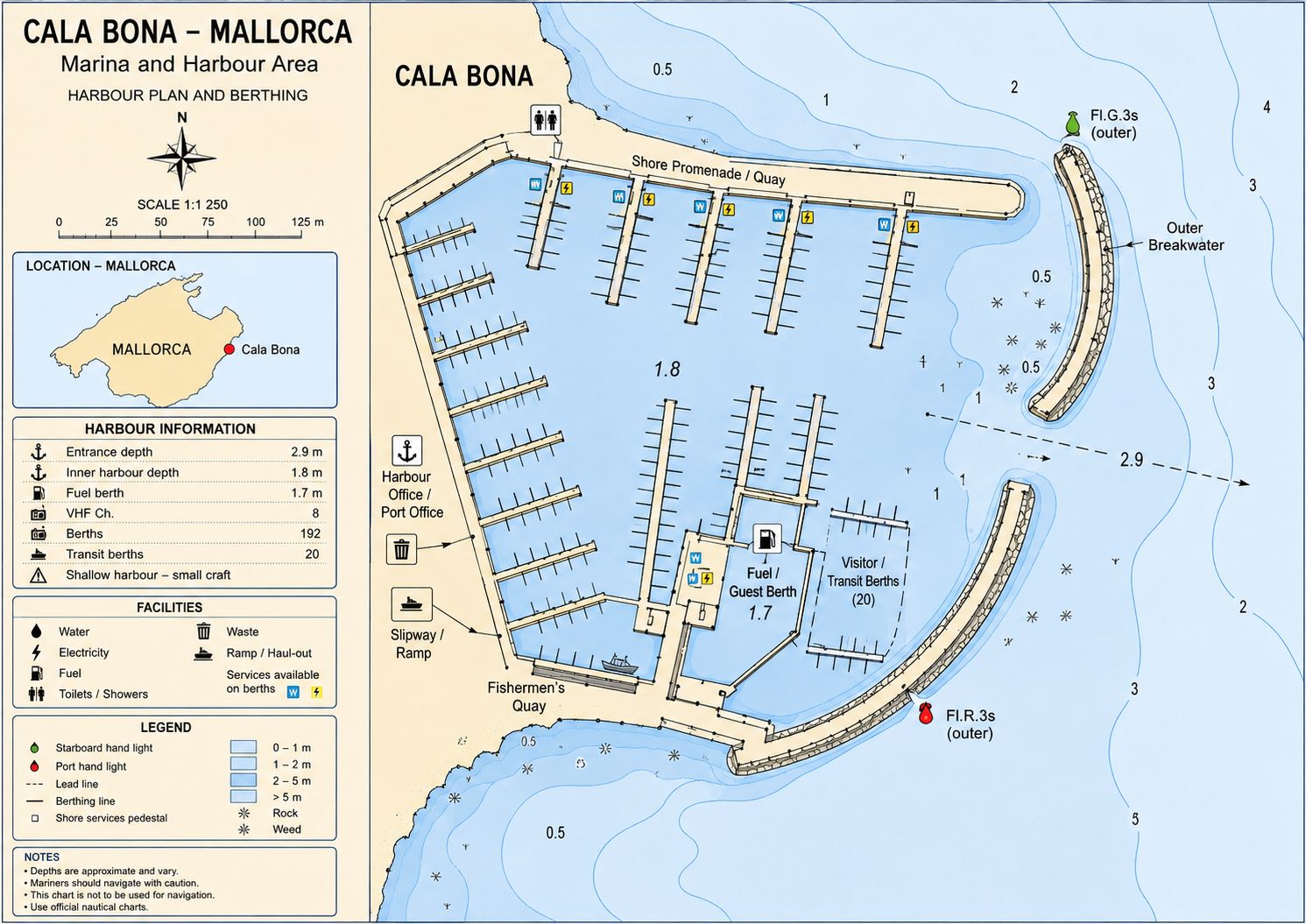
Depths in the immediate coastal approach are modest rather than deep-ocean margins. The harbour entrance is reported at 2.9 m, while the harbour itself is reported at 1.8 m, and the fuel/guest-berth area at 1.7 m. Outside the harbour, nearby beach and anchoring areas are shallow and include sand, rock and weed. Cala Millor, immediately south, is reported as a sandy beach anchorage with about 4 m near the swimming buoys, which gives useful context for the shoal nature of this coast. Approach in good light and do not close the beach line expecting deep water.
Cala Bona Mallorca
Sailing Guide - Navigation
Entry into Cala Bona is made slowly in a southwesterly direction after the correct harbour entrance has been identified. The entrance depth is reported at 2.9 m, but this does not represent the usable harbour depth once inside. Inside, the reported depth is about 1.8 m, and the fuel and visitor berth area is about 1.7 m. A yacht drawing close to these figures has no meaningful margin and should not enter without current local confirmation.
Keep to the centre of the entrance and do not cut close to the breakwater ends. The harbour has little room to manoeuvre, so speed should be minimum steerage speed before the vessel is committed. Expect local fishing craft, excursion boats, tenders and small leisure craft in confined water. The transit mooring is reported as marked by a “Moll Transit” sign in the middle of the harbour basin, with a small number of moorings with mooring lines on the outside of the dock. This is not a harbour for entering speculatively in marginal weather or marginal draft.
Cala Bona Mallorca
Sailing Guide - Chart Accuracy
Use current official charts and the latest electronic chart updates, but do not rely on charted soundings alone inside Cala Bona. The harbour is shallow, small and operationally constrained, and local dredging, silting, harbour works and berth allocation can alter the useful depth for a visiting yacht. The difference between a reported 2.9 m at the entrance and 1.7–1.8 m inside is material, so entry decisions should be made on the shallowest operational figure, not the entrance figure.
Electronic charts may show the outline clearly but can understate practical hazards such as beach-retention structures, swimmers’ zones, seasonal buoyage and moored small craft. The stone pillars south of the harbour are specifically noted as a possible source of confusion on approach. A skipper should confirm the harbour visually, use the sounder continuously, and cross-check the electronic chart against the actual breakwater alignment before turning into the entrance.
Cala Bona Mallorca
Sailing Guide - Anchorages
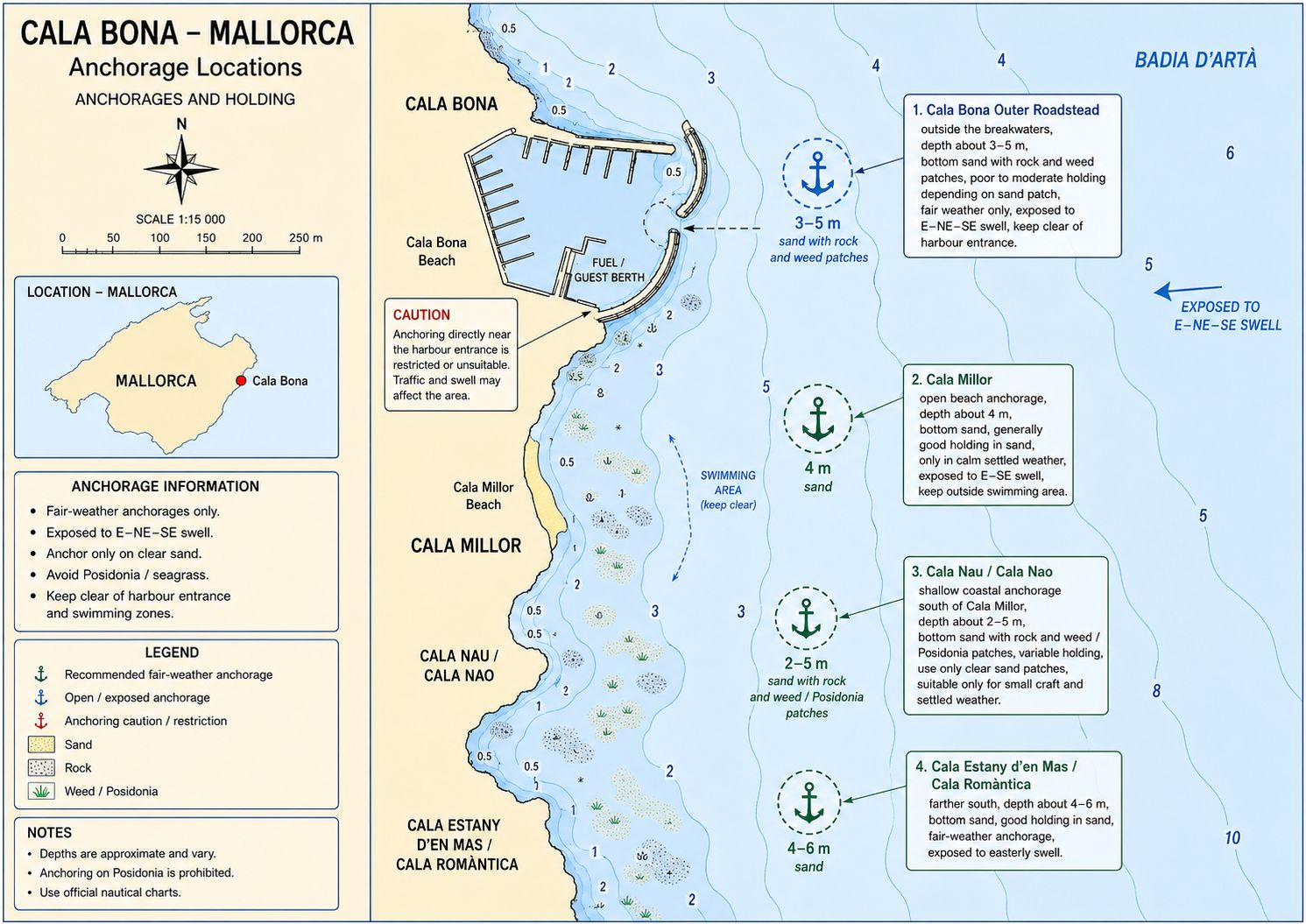
Cala Bona outside the breakwaters. This is not a primary cruising anchorage. The Cala Bona anchorage area comprises sand and rock seabed and marks anchoring as forbidden, so it should not be used without confirming the current local restriction and exact boundary. Depths close to the harbour approach are shallow and irregular, and the area is exposed to easterly swell. Holding will depend on finding sand clear of rock and protected seagrass, and the harbour entrance must be kept clear.
- Cala Millor. Cala Millor lies immediately south of Cala Bona and is an open beach anchorage, not a sheltered harbour anchorage. The reported depth is about 4 m near the swimming buoys, with a sand bottom. It is exposed to easterly swell and should be used only in settled offshore or light-weather conditions. Keep outside the swimming area and account for trip-boat and beach traffic.
- Cala Nau/Cala Nao area. This is a shallow coastal anchoring area south of Cala Bona and Cala Millor. Reported anchoring depths are generally in the 2–5 m range, with mixed sand, rock and weed/Posidonia. It is suitable only for settled weather and shallow-draft craft. Use clear light to place the anchor on sand and keep chain off seagrass.
- Cala Estany d’en Mas/Cala Romàntica. This anchorage is farther south and is operationally separate from Cala Bona, but it is one of the better-known fair-weather stops on this coast. Typical anchoring depths are about 4–6 m over sand. It is exposed to easterly swell and should not be treated as shelter in onshore conditions.
Anchoring on Posidonia in the Balearics is controlled and the Balearic Posidonia regulation prohibits uncontrolled anchoring on Posidonia, and skippers should place both anchor and chain on clear sand.
Cala Bona Mallorca
Sailing Guide - Entry Formalities
Spain and the Balearic Islands are within the Schengen Area and the EU customs territory, so yachts arriving from another Spanish or Schengen/EU port normally do not complete full border clearance again. Yachts arriving from a non-Schengen port must clear through an authorised port of entry, for practical yacht clearance, the main Balearic entry ports include Palma, Alcudia, Ibiza, Mahon and La Savina. The usual formalities include crew passports handled by the Frontier Police and vessel/customs formalities handled through the appropriate Spanish authorities. Since 10 April 2026, the EU Entry/Exit System records non-EU short-stay entries and exits electronically rather than by passport stamping. Non-EU visitors remain subject to Schengen short-stay limits, normally 90 days in any 180-day period, unless they hold a visa or residence status allowing longer stay. Non-EU flagged yachts may also need to consider Temporary Admission rules for EU waters, commonly allowing private non-EU yachts used by non-EU residents to remain in EU customs territory for up to 18 months without VAT/import duty being due, provided the conditions are met.
Communications equipment normally used on cruising yachts does not require harbour-specific clearance at Cala Bona, but drone use is regulated under Spanish and EU UAS rules. AESA states that drone operators must register in the member state of residence or activity and that the operator registration number must be included on the operator’s drones. Starlink use should be checked against the service plan and local availability; Starlink states that in-motion use in territorial waters requires local government approval and may not be available in all regions.
Cala Bona Mallorca
Sailing Guide - Marina Facilities
Port de Cala Bona is the only harbour facility at Cala Bona. PortsIB lists 192 berths, with 20 transit berths and contact on VHF radio channel 8 or 9. Depth is the main berth limitation. Pilotage information gives 1.8 m maximum depth in the harbour and 1.7 m at the fuel and visitor berth area
Cala Bona Mallorca
Sailing Guide - Provisioning
Supermarkets. Cala Bona has small local food shops and minimarkets, but the larger provisioning area is Cala Millor, immediately south and connected by road and promenade. These include Mercadona, Lidl, ALDI, Carrefour, EROSKI, Hiper Centro and SPAR/Bip-type local shops. These supermarkets operate Monday to Saturday, commonly around 09:00–21:30, with some Sunday opening in high season. For a yacht provisioning run, Cala Millor is the practical shore-side supply point. Cala Bona’s local stores are suitable for short top-ups; Cala Millor’s chain supermarkets are the better source for a full shop. Transport is by foot for light supplies, taxi for water and bulk goods, or vehicle for a full load. Opening hours should be checked on the day because Sunday and seasonal hours change.
Markets. Son Servera Friday Market is held in the town centre on Fridays, 09:00–14:00, extending along Pere Antoni Servera street and around Sant Joan square. The market includes fruit and vegetables and is the nearest useful traditional market for produce provisioning from Cala Bona. Arrive before the final hour if using it for provisioning, as food stalls may reduce stock before the listed close.
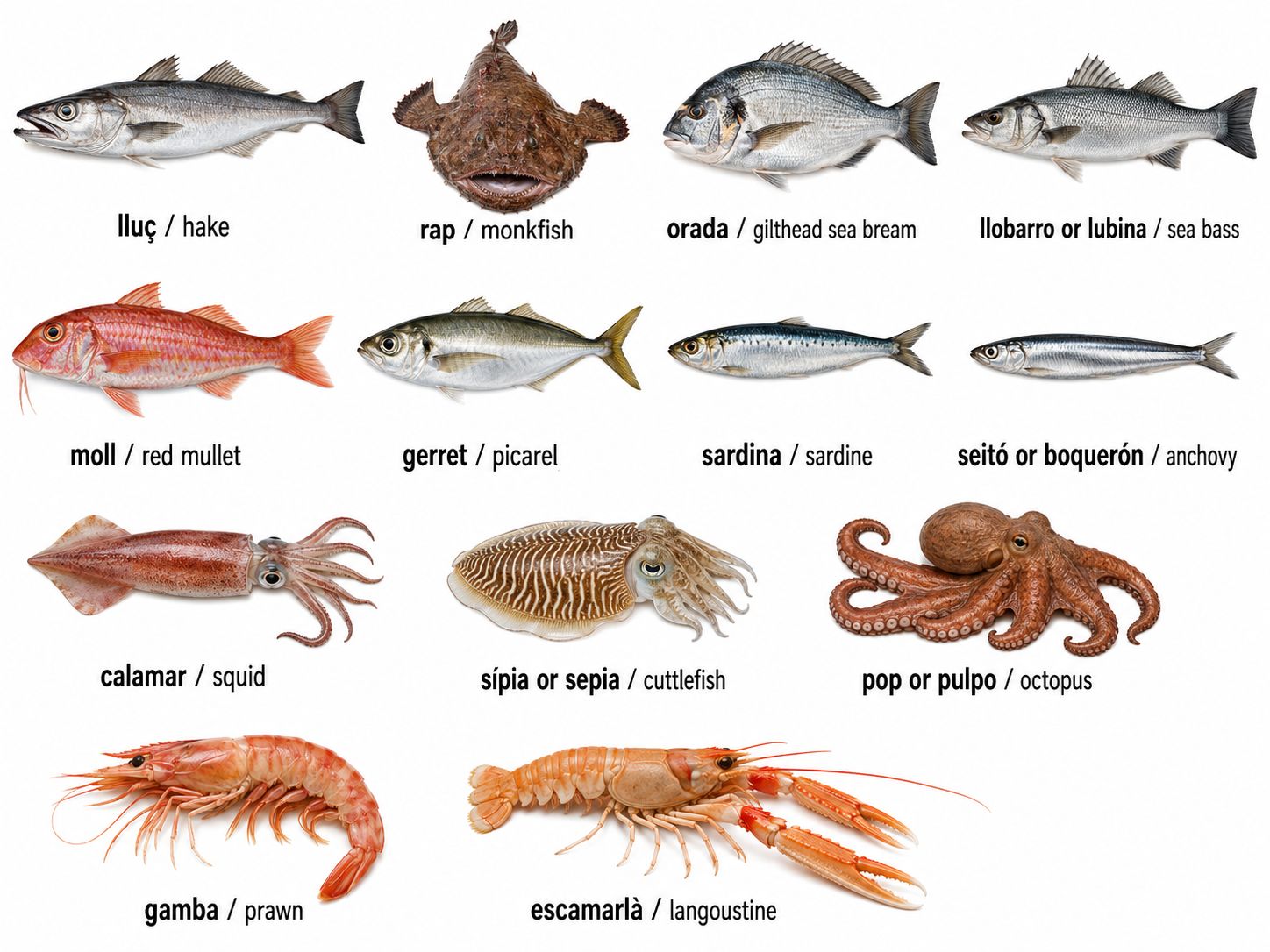
Fish Markets. Cala Bona is a former fishing harbour, but there is no reliable public fish market listing suitable for planned yacht provisioning. Fish supply should be treated as opportunistic through local fish counters, restaurants, or any harbour-side contacts on the day. Hiper Centro in nearby Cala Millor is locally noted as useful for fresh fish, and supermarket fish counters in Cala Millor are more reliable for planned purchases than informal harbour supply. Local species commonly seen in Mallorca include llampuga in season, the local name for mahi-mahi or dolphinfish; dorada or gilt-head bream; lubina or sea bass; calamar or squid; sepia or cuttlefish; gamba roja or red prawn; and rape or monkfish. Availability depends on season, fishing conditions and market supply.
Cala Bona Mallorca
Sailing Guide - Local Cuisine
Cala Bona’s local food is based on Mallorca’s east-coast fishing and agricultural supply rather than a port-specific cuisine. Dishes include pa amb oli, bread with olive oil and tomato often served with cheese, cured meats or fish; tumbet, a vegetable dish of potato, aubergine and pepper; frit de marisc, a seafood fry; arròs brut, rice cooked with meat or fish stock and spices; and grilled local fish. These are regional Mallorcan dishes and are available in varying forms along the east coast.
Seasonal fish matters more than fixed menu names. Llampuga amb pebres is a Mallorcan seasonal fish dish using llampuga and peppers, usually associated with late summer and autumn catches. Seafood rice, squid, cuttlefish, prawns and grilled fish are operationally relevant for crews because they match the harbour’s fishing background and the nearby supermarket and fish-counter supply chain. Local bread, olives, almonds, sobrassada and ensaïmada are standard Mallorcan provisions rather than harbour-specific products.
Cala Bona Mallorca
Sailing Guide - Local Beverages
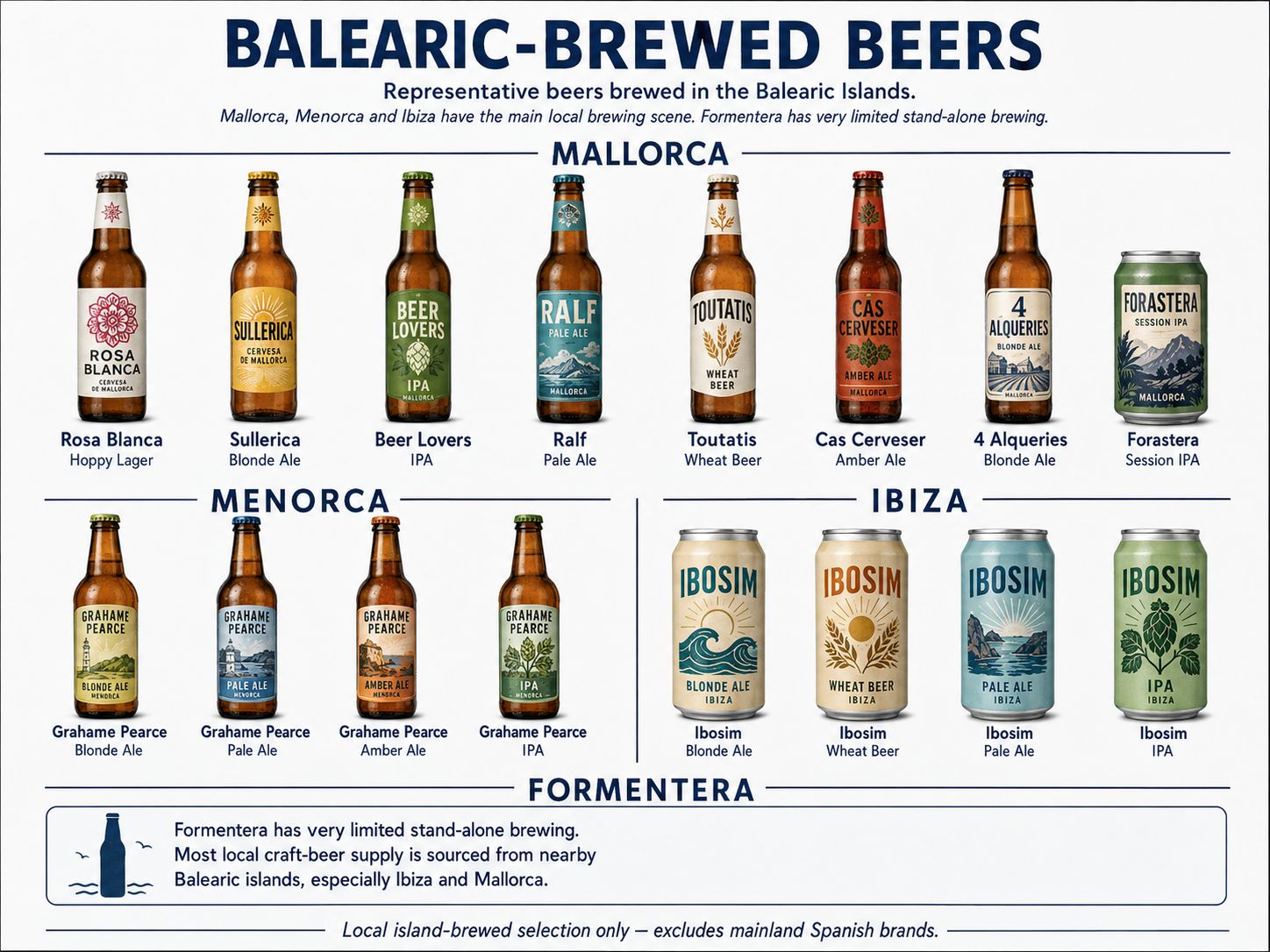
Local alcoholic beverages on Mallorca include Palo de Mallorca and Herbes de Mallorca. The Balearic tourism authority describes Palo de Mallorca as a protected geographical-designation spirit made from cinchona and gentian roots, sugar, caramelised sugar and ethyl alcohol. The same official source identifies Mallorcan beers, lemon soft drinks, Palo and herb liqueurs as island-made beverages, with Herbes de Mallorca produced by macerating aromatic herbs in anisette. Beer supply in Cala Bona and Cala Millor is mostly through supermarkets, bars and restaurants.
Cala Bona Mallorca
Sailing Guide - Diesel Fuel
Diesel is available in Cala Bona harbour, but access is shallow. PortsIB lists a fuel station and gives published fuel-station hours: low season, 1 January–31 May and 1 October–31 December, Monday to Friday 09:00–12:30; high season, 1 June–30 September, Monday to Saturday 09:00–13:00 and 14:00–18:00, Sunday 09:00–13:00. The fuel facility is therefore a harbour fuel stop, not a deep-water bunker berth. Depth controls use of the fuel berth. Pilotage information gives 1.7 m at the gas station/guest berth area and notes sewage pumping there.
Cala Bona Mallorca
Sailing Guide - Water Supplies
Water supply is berth-based, so a yacht should not assume it can take water without an allocated berth or specific harbour instruction. Potable-water quality should be treated as normal municipal marina supply unless the harbour office advises otherwise. Use the vessel’s own hose, flush the tap before filling, and avoid dragging hose ends across the quay. Because visitor berths are limited and depth is shallow, Cala Bona is not a dependable water stop for larger yachts.
Mechanical and Electrical Repairs
Resource
If you are headed somewhere in the Mediterranean or Spain or somewhere more remote consider the need to expand your knowledge base or have an information resource on board. Why not get a copy of my book The Marine and Electrical and Electronics Bible 4th Edition. with everything from batteries and charging, solar and wind, diesel engines and marine electronics and so much more. Your complete systems guide. 650 pages of practical advice. In Australia and New Zealand order a copy through Boat Books. UK and European boats can buy the UK Edition Here. US and Canadian boats can get the US Edition Order Here. Marine systems are my profession so let me help you DIY and save some valuable technician callout rates. This is by a cruising yachtsman and liveaboard boat owner for other boat owners.


Cala Bona Mallorca
Sailing Guide - Marine Services
Cala Bona has limited marine service capacity. No verified main-brand engine or electronics dealer is identified inside Cala Bona itself.
Cala Bona Mallorca
Sailing Guide - Local Etiquette
Cala Bona is a small local harbour with working craft, transit berths and excursion traffic in confined water. Enter at minimum speed, keep wash down, and do not obstruct the entrance, fuel berth, fishermen’s quay or excursion-boat movements. PortsIB requires transit users to complete and return the harbour form promptly to the port office and comply with harbour-use rules. Use the harbour office or marinero instructions for berth allocation and do not occupy local moorings without permission. Drone use around the harbour should comply with AESA operator registration and local restrictions, and flights over people, port operations or private areas should be avoided unless properly authorised.
Cala Bona Mallorca
Sailing Guide - Summary
Cala Bona is a shallow local harbour suitable mainly for small yachts and shallow-draft craft. The controlling figures are 2.9 m at the entrance, about 1.8 m inside the harbour, and 1.7 m at the fuel/guest-berth area. Entry should be made only in settled conditions after the harbour entrance and nearby beach-retention structures have been positively identified. For pilotage, berthing, fuel, water and provisioning decisions, the correct reference is Cala Bona Mallorca Sailing Guide for all you need to know.