Porto Cristo
Mallorca Sailing Guide
Porto Cristo Mallorca Sailing Guide. Porto Cristo is one of the main east-coast harbours of Mallorca and a logical next port page after Portocolom. It lies in a narrow inlet on Mallorca’s eastern coast, south of Cala Millor and north of Portocolom, and is useful for yachts moving along the east coast between Cala Rajada, Porto Cristo, Portocolom, Cala d’Or and Cala Figuera. The harbour gives better protection than the open east-coast calas, but it is not a deep-water marina for larger cruising yachts.
For cruising yachts, Porto Cristo is a practical harbour for marina berthing, fuel, water, limited marine services, routine provisioning and a sheltered stop when easterly swell makes nearby calas uncomfortable. It is also shallow by comparison with Palma or Alcúdia. Marina and harbour sources commonly place usable harbour depths around 2.8–3 m, with berths generally suited to yachts up to about 15–20 m, depending on allocation and current depths.
Porto Cristo
Mallorca Sailing Guide - History
Porto Cristo developed around a sheltered natural inlet on Mallorca’s east coast, serving fishing craft, coastal trade and local settlement before modern tourism and yacht use expanded around the harbour. The surrounding area is also known for its cave systems, including the Coves del Drach, but for a skipper the practical importance of Porto Cristo is its harbour geography: it provides a protected break in a coast otherwise dominated by calas, beaches, low headlands and limited all-weather shelter. The harbour still combines fishing, local craft, yacht berthing, visitor traffic and town services.
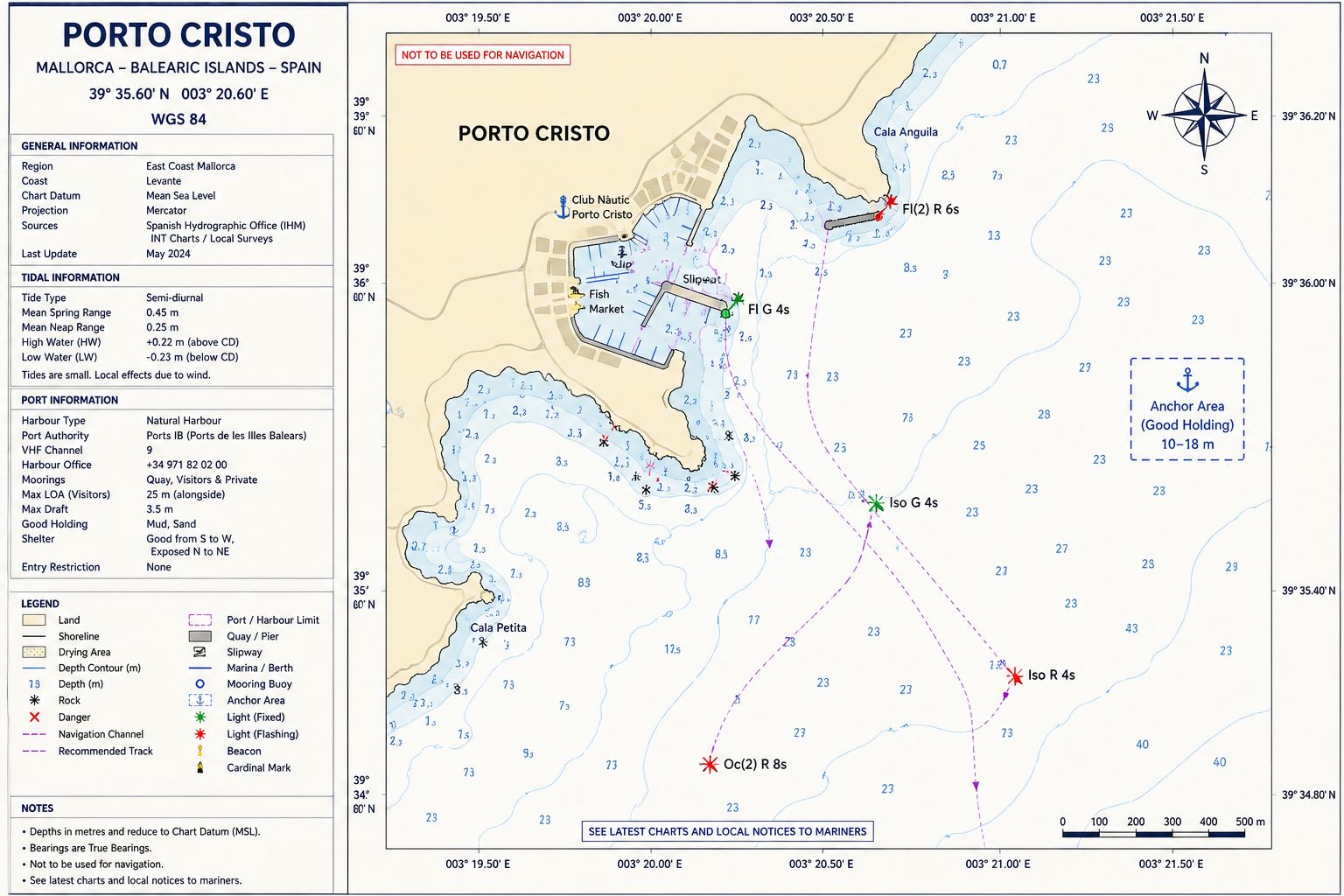
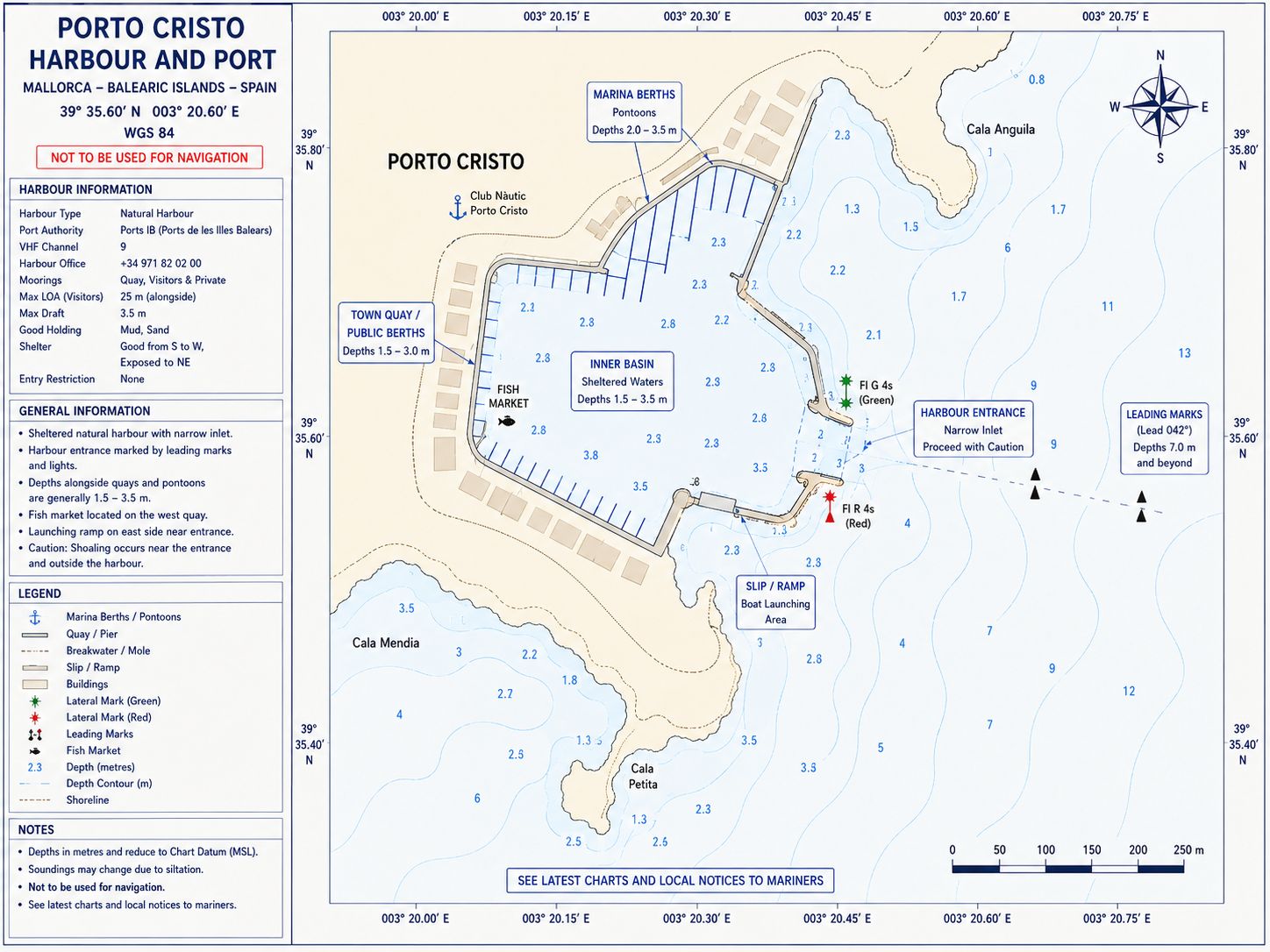
Chart Disclaimer. This chart is a schematic representation for illustrative purposes only and must not be used for navigation. Refer to official hydrographic charts for safe navigation. Be aware ENC charts may differ from official hydrographic charts. Both should be corrected and updated regularly.
Porto Cristo
Mallorca Sailing Guide - Currents & Tidal Flow
Tidal range at Porto Cristo is small and has little effect on ordinary yacht navigation. Tidal streams are weak, and most water movement in the harbour is caused by wind-driven set, local circulation, vessel wash and swell conditions outside the entrance. Inside the inlet, current is normally minor, but shallow water, moorings and confined manoeuvring space make speed control and depth monitoring important.
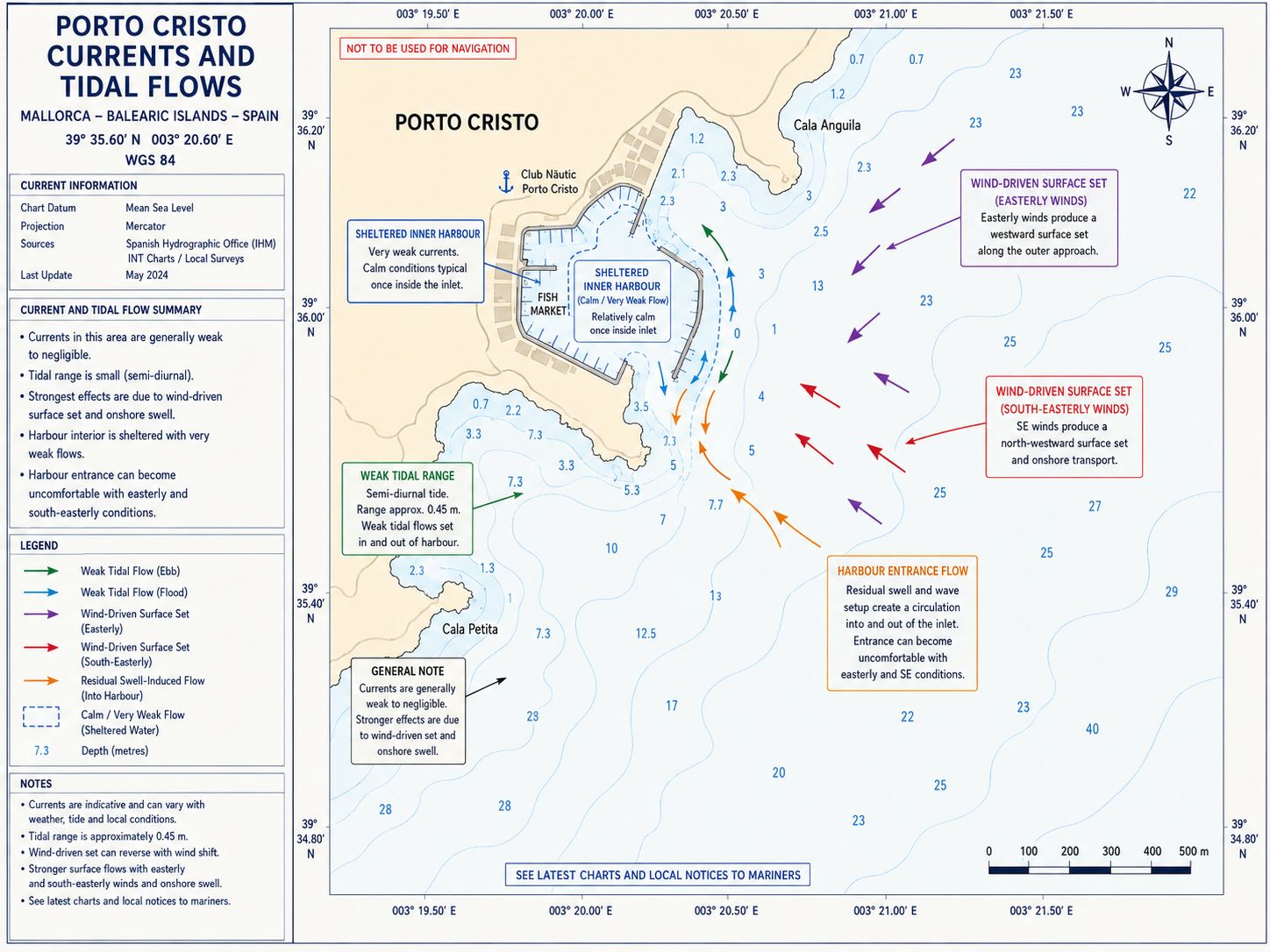
The main operational sea-state issue is east-coast swell. Easterly and south-easterly weather can affect the harbour entrance and make the approach uncomfortable. Once inside, protection is good, but the harbour is narrow and shallow, so strong crosswind or wash can affect berthing. Outside the harbour, wind-against-swell conditions can create short steep seas along the east coast.
Porto Cristo
Mallorca Sailing Guide - Weather
Porto Cristo is influenced by Mallorca’s east-coast weather pattern. In settled summer conditions, the harbour is straightforward and provides a useful overnight or service stop. Mornings may be light, with sea breeze building through the afternoon. The approach and nearby coast are more exposed when wind or swell comes from the east or south-east.
The main weather cautions are easterly swell, north-easterly or south-easterly wind, thunderstorms and autumn depressions. East-coast calas that are comfortable in settled weather can quickly become unsuitable in onshore swell, making Porto Cristo a practical fallback if a berth is available. In stronger easterly conditions, entry should be made before the approach becomes rough.
The Marine Electrical and Electronics Bible has a complete list of Spanish VHF Radio Channel information and weather forecast times along with NAVTEX UK and Europe and NAVTEX Mediterranean for 490kHz and 518kHz.
Porto Cristo
Mallorca Sailing Guide - Local Winds
Local winds are shaped by the open east coast and the narrow harbour inlet. Summer sea breeze commonly builds from late morning into the afternoon and can create chop outside the entrance. Inside the harbour the wind is reduced, but it may funnel along the inlet and affect close-quarters manoeuvring.
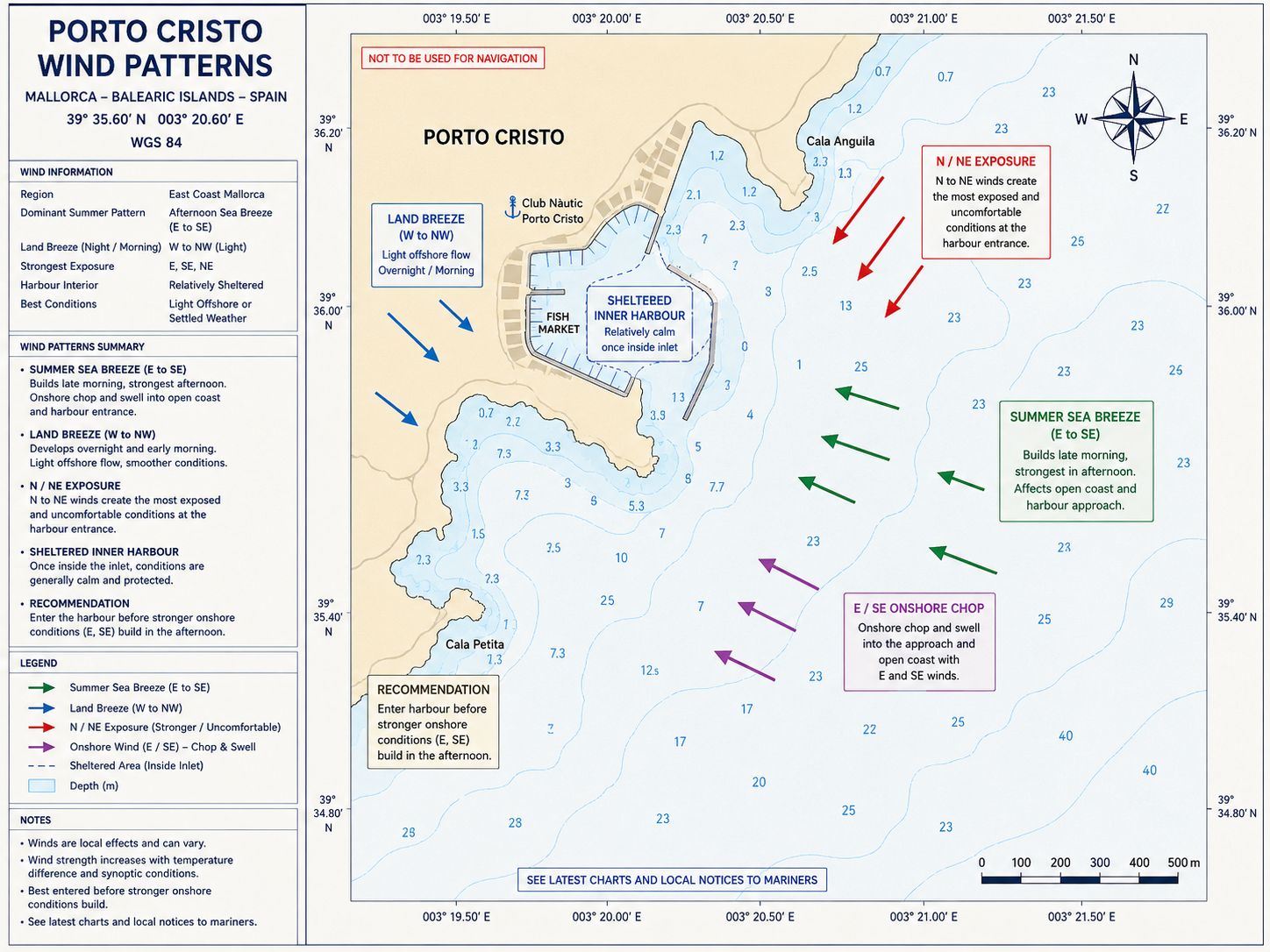
Easterly and south-easterly winds are the main concern because they affect the approach directly. Northerly and north-westerly winds are generally less problematic inside the harbour, though they can still produce gusts and shifting wind direction in the marina. In unsettled weather, treat Porto Cristo as a harbour to enter early, not as a place to approach late after sea state has already built.
Porto Cristo
Mallorca Sailing Guide - Approaches
The approach to Porto Cristo is from the east coast of Mallorca. From the north, yachts normally approach from Cala Millor, Cala Bona, Cala Rajada or nearby east-coast calas. From the south, the approach is from Cala Murada, Portocolom, Cala d’Or and the south-east coast. The entrance leads into a narrow sheltered inlet, with the marina and harbour facilities inside.
Approach should be made with the harbour entrance positively identified, especially at night or in poor visibility. The coastline has multiple coves and resort lights, so visual references can be confusing after dark. Maintain a safe offing until lined up for entry, keep clear of local traffic, and enter slowly because the inner harbour is confined and relatively shallow.
Porto Cristo
Mallorca Sailing Guide - Navigation
Navigation into Porto Cristo requires depth awareness. The harbour is protected but shallow, with current harbour information noting depths around 2.80 m. Other marina references describe Porto Cristo as generally suitable for yachts up to around 15 m, with maximum marina depths often around 2.8–3 m.
The principal yacht berths are at Club Nàutic Porto Cristo on the south-west side of the inlet, with additional PortsIB and public harbour berths on the opposite side. There are Club Nàutic visitor berths on the inside of the first two jetties, with PortsIB berths on the north-west town quay for yachts up to 15 m. It lists Club Nàutic contact on VHF 9 and PortsIB on VHF 8.
Deep-draught yachts should be cautious. Any yacht drawing more than about 2.5 m should confirm berth depth before entering. Harbour depths may vary with silting, berth location and local works. Enter on the correct line, keep speed low, and avoid cutting across mooring lines or ferry or local-boat movements.
Porto Cristo
Mallorca Sailing Guide - Entry Formalities
Spain and the Balearic Islands are within the Schengen Area and the EU customs territory, so yachts arriving from another Spanish or Schengen/EU port normally do not complete full border clearance again. Yachts arriving from a non-Schengen port must clear through an authorised port of entry, for practical yacht clearance, the main Balearic entry ports include Palma, Alcudia, Ibiza, Mahon and La Savina. The usual formalities include crew passports handled by the Frontier Police and vessel/customs formalities handled through the appropriate Spanish authorities. Since 10 April 2026, the EU Entry/Exit System records non-EU short-stay entries and exits electronically rather than by passport stamping. Non-EU visitors remain subject to Schengen short-stay limits, normally 90 days in any 180-day period, unless they hold a visa or residence status allowing longer stay. Non-EU flagged yachts may also need to consider Temporary Admission rules for EU waters, commonly allowing private non-EU yachts used by non-EU residents to remain in EU customs territory for up to 18 months without VAT/import duty being due, provided the conditions are met
Porto Cristo
Mallorca Sailing Guide - Chart Accuracy
Navigation should be based on current official hydrographic charts, updated electronic charts, local notices to mariners, harbour instructions and the vessel’s own depth sounder. Electronic charting is useful for route planning and position awareness, but it should not be treated as exact at harbour, quay, reef, marina or anchorage scale.
Porto Cristo requires caution because the entrance is narrow, the harbour is shallow, and published marina depths vary by source and berth. Chart plotters may not show recent silting, berth changes, PortsIB berthing arrangements, service-pontoon restrictions, dredging limits, mooring lines or the exact boundary between sand, mud, weed and protected seagrass. Use visual pilotage in good light where possible, confirm depths continuously, and check harbour or marina instructions before entering confined water.
Porto Cristo
Mallorca Sailing Guide - Anchorages
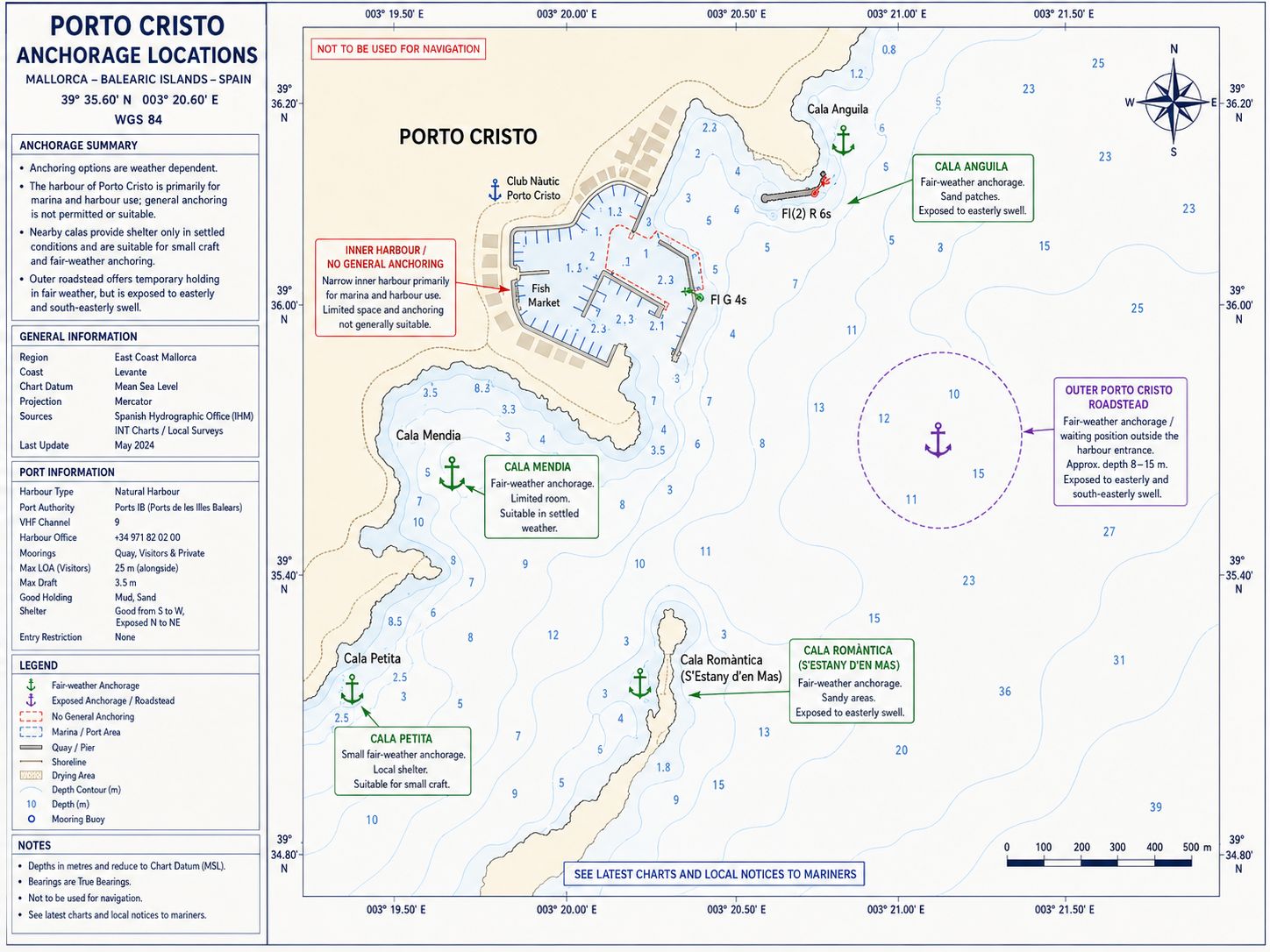
Porto Cristo should be treated primarily as a harbour and marina stop rather than an anchorage destination. The inlet is narrow, shallow and occupied by berths, local craft, moorings and harbour traffic. Free anchoring inside the harbour is limited and should not be assumed.
- Outer Porto Cristo roadstead. This may be used only in settled weather, clear of the harbour entrance and local traffic. Depths outside the entrance increase quickly, but exposure to easterly and south-easterly swell makes this unsuitable in unsettled conditions. It is a waiting position only, not a refuge.
- Inner harbour waiting area. This should only be used if directed by harbour or marina staff. Depths are generally around 2.8–3 m, and swinging room is constrained by moorings, pontoons, town quay traffic and fishing craft. Do not anchor where it obstructs marina access or the fairway.
- Nearby east-coast calas. These are Cala Anguila, Cala Mendia and Cala Romantica and are fair-weather anchorages only. They are exposed to easterly swell and are not practical alternatives if Porto Cristo entrance conditions are poor. In settled weather they may be suitable for lunch stops, but they are not all-weather shelters.
Porto Cristo
Mallorca Sailing Guide - Marina Facilities
The main facility is Club Nàutic Porto Cristo. Berth numbers about 222, with 59 intended for daily-traffic boats, suitable for vessels up to 15 m and 3 m draught with power, water, fuel dock, security, showers, shipyard, maintenance services and contact on VHF 09. There is a fuel station, nearby supermarket, bars and restaurants, hard standing and a 12-tonne travel lift. Because published draft figures vary, visiting yachts should treat 3 m as the practical planning figure unless the marina confirms otherwise.
PortsIB berths & town quay are on the opposite side of the harbour from Club Nàutic for yachts up to 15 m, with mooring lines, and PortsIB contact on VHF 8. These berths should be confirmed through PortsIB or the local harbour office before arrival. Porto Cristo is useful for ordinary cruising yachts, but it is not suitable for all deeper or larger vessels. Berth availability is limited in summer, and yachts should confirm LOA, beam, draught, berth depth, fuel access and arrival instructions before entering.
Porto Cristo
Mallorca Sailing Guide - Provisioning
Supermarkets. Eroski is one of the main supermarket options in the Porto Cristo area. Mercadona is also relevant for the wider Manacor and Porto Cristo provisioning area. Mercadona’s standard Spanish opening pattern is commonly Monday to Saturday, with Sunday closure common outside tourist-season exceptions. Small local supermarkets, bakeries, butchers, greengrocers and convenience stores operate in the town around the harbour. Manacor is the stronger inland supply tow
Markets. Porto Cristo weekly market is held on Sunday from 09:00 to 14:00 at Passeig de sa Sirena, near the marina and beach. It is a small market with fruit, vegetables, textiles and Mallorcan artisan products. For yacht provisioning, the Porto Cristo market is useful for fresh produce top-ups rather than a full passage stock-up. Typical produce includes tomatoes, peppers, onions, potatoes, citrus, seasonal fruit, herbs and vegetables. Local products may include olives, Mallorcan olive oil, cheese, sobrasada, bakery items and seasonal island produce, depending on stalls. Manacor markets and shops provide a broader provisioning fallback inland. Manacor is useful for larger supermarkets, hardware, pharmacies, butchers and general supply if the yacht needs more than harbour-side shops can provide.
Fish Markets. Porto Cristo has local fish supply through fishmongers, supermarket fish counters, restaurants and harbour-related sources. The harbour retains fishing activity, but direct purchase from boats should be treated as opportunistic and dependent on landing times, weather and local practice.
Porto Cristo
Mallorca Sailing Guide - Local Cuisine
Porto Cristo food reflects east-coast Mallorcan harbour cooking, with fish and seafood common because of the harbour setting. Local dishes suitable for this page include pa amb oli, tumbet, frito mallorquin, sopas mallorquinas, arròs brut, grilled fish, seafood rice, squid, cuttlefish, octopus, prawns and seasonal fish. Sobrasada, ensaimada, Mallorcan cheeses, olives, almonds and local olive oil are widely available on the island and are practical to carry aboard. For a yacht galley, Porto Cristo is useful for bread, fish, produce, bottled water, simple supermarket supplies and local cured products.
Porto Cristo
Mallorca Sailing Guide - Local Beverages
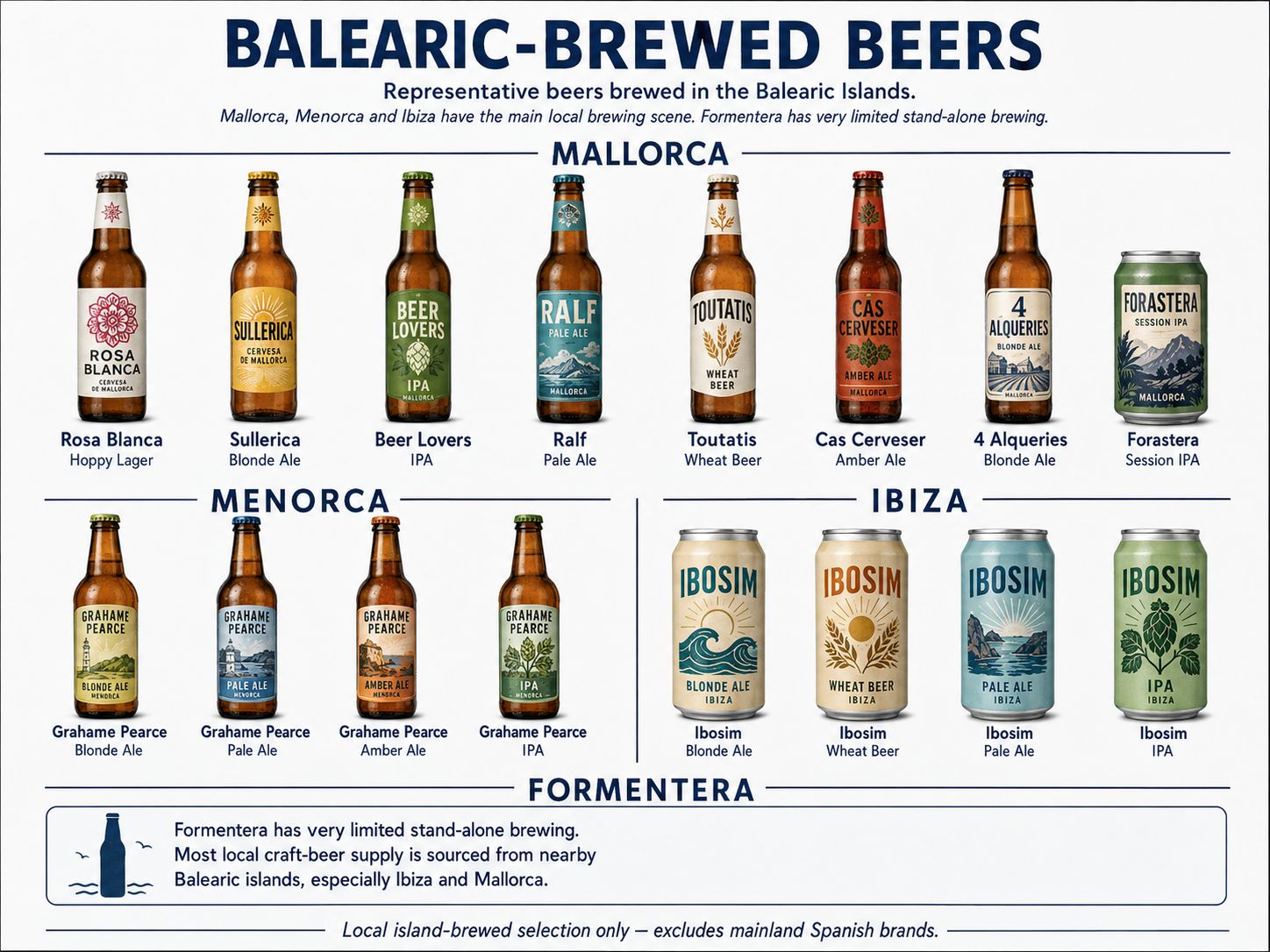
Local beverages include Mallorcan wines, hierbas mallorquinas, local vermouth, coffee, bottled water, soft drinks and island-brewed beers. Mallorcan beers that may be found in supermarkets, bottle shops or restaurants include Rosa Blanca, Sullerica, Beer Lovers, Ralf, Toutatis, Cas Cerveser, 4 Alqueries and Forastera, depending on stockist and season.
Porto Cristo
Mallorca Sailing Guide - Diesel Fuel Supplies
Diesel fuel is available at Club Nàutic Porto Cristo. Marina sources list a fuel station among the services. Fuel access should be confirmed before arrival because the harbour is shallow and manoeuvring space is limited. Larger or deeper yachts should confirm fuel-berth depth, opening hours, payment method and whether assistance is available. Remote east-coast calas should be treated as no-fuel stops.
Porto Cristo
Mallorca Sailing Guide - Water Supplies
Water is available at the berths in Club Nàutic Porto Cristo. Marina sources list fresh water at berths among the standard services. Yachts using public berths or temporary moorings should confirm water availability with the harbour office or PortsIB. Yachts outside the harbour should treat the roadstead as a no-water stop unless they enter the marina or arrange shore supply.
Mechanical and Electrical Repairs
Resource
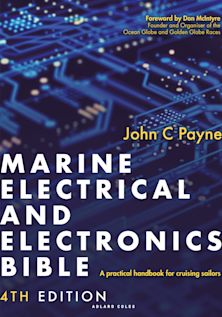
If you are headed somewhere in the Mediterranean or Spain or somewhere more remote consider the need to expand your knowledge base or have an information resource on board. Why not get a copy of my book The Marine and Electrical and Electronics Bible 4th Edition. with everything from batteries and charging, solar and wind, diesel engines and marine electronics and so much more. Your complete systems guide. 650 pages of practical advice. In Australia and New Zealand order a copy through Boat Books. UK and European boats can buy the UK Edition Here. US and Canadian boats can get the US Edition Order Here. Marine systems are my profession so let me help you DIY and save some valuable technician callout rates. This is by a cruising yachtsman and liveaboard boat owner for other boat owners.


Porto Cristo
Mallorca Sailing Guide - Marine Services
Porto Cristo has useful local marine services for routine work, but major engine, electrical and electronics work is better planned through Palma or a confirmed mobile contractor. Club Nàutic Porto Cristo is listed with maintenance services, shipyard support, fuel, a crane, fresh water, electricity, security, showers and berthing services and a 12-tonne travel lift. Palma remains the main verified service base for Yanmar and Volvo Penta support.
Porto Cristo
Mallorca Sailing Guide - Etiquette
Porto Cristo is informal but operates as a yacht harbour, fishing harbour and local waterfront town. Use basic greetings in harbour offices, shops, markets, cafés, fuel stations and service areas. Spanish and Catalan are both used locally; buenos días, bon dia, gracias and gràcies are appropriate. Keep communication with marina staff, fishers, fuel-dock staff, market sellers and repair contractors clear and patient, especially in summer when berths and services are under pressure. Dress is casual around the waterfront, but swimwear is not normal in supermarkets, markets, harbour offices, town streets or restaurants away from the beach. Do not treat fishing quays, local moorings, town quay space or private berths as available yacht space. In the harbour, avoid blocking fairways, fuel access, service areas and visitor berths. At anchor or waiting outside the entrance, keep clear of the approach, leave proper swinging room, avoid generator nuisance and follow Posidonia anchoring rules without argument.
Porto Cristo
Mallorca Sailing Guide - Summary
Porto Cristo is a useful east-coast Mallorca harbour for yachts needing shelter, marina berthing, fuel, water, local provisioning and routine services between Cala Rajada, Portocolom and Cala d’Or. The harbour is protected but shallow, with typical operating depths around 2.8–3 m, so draught and berth depth must be checked before entry. It is best suited to ordinary cruising yachts rather than larger deep-draught vessels. This page is the harbour-level guide for the Porto Cristo Mallorca sailing guide for all you need to know.