Balearic Islands Sailing Guide
The Balearic Islands sailing guide is a regional hub for skippers planning passages, anchorages, marina stops, provisioning and weather routing around Mallorca, Menorca, Ibiza and Formentera. The islands sit off the eastern coast of Spain and form one of the main western Mediterranean cruising areas between mainland Spain, southern France, Sardinia and the wider Mediterranean. For passage planning, the Balearics should not be treated as one uniform cruising ground. Mallorca is the main service and passage hub, Menorca is more exposed to northern systems, Ibiza carries heavy summer yacht and ferry traffic, and Formentera is a low-lying fair-weather anchorage area with strict seabed protection controls.
Cruising the Balearic Islands requires more planning than the short inter-island distances suggest. Tidal range is small, but wind direction, swell, marina pressure, ferry routes, regulated anchorages, summer crowding and environmental controls all affect where a yacht can safely stop. Skippers should plan the Balearics around weather windows, legal anchoring over sand rather than Posidonia oceanica seagrass, early marina reservations in peak season, and fallback harbours when exposed calas become untenable. The official Balearic port network includes the general-interest ports of Palma, Alcudia, Ibiza, Mahon and La Savina, making those harbours central to any regional passage plan.
Balearic Islands Sailing Guide - History
The Balearic Islands have been used as a western Mediterranean sailing, trading and naval waypoint since antiquity, with successive Phoenician, Carthaginian, Roman, Byzantine, Moorish, Catalan and Spanish control shaping the ports and settlements around the islands. Their position between mainland Spain, southern France, Sardinia and North Africa made Mallorca, Menorca, Ibiza and Formentera useful for coastal trade, military staging, fishing and shelter on longer Mediterranean passages. For today’s cruising yacht skipper, the historic pattern is still visible in the main harbour towns: Palma, Mahon, Ciutadella, Ibiza Town and La Savina developed around protected water, ferry access, naval use, fishing activity and control of the surrounding sea routes.
Balearic Islands Sailing Guide - Cruising Area
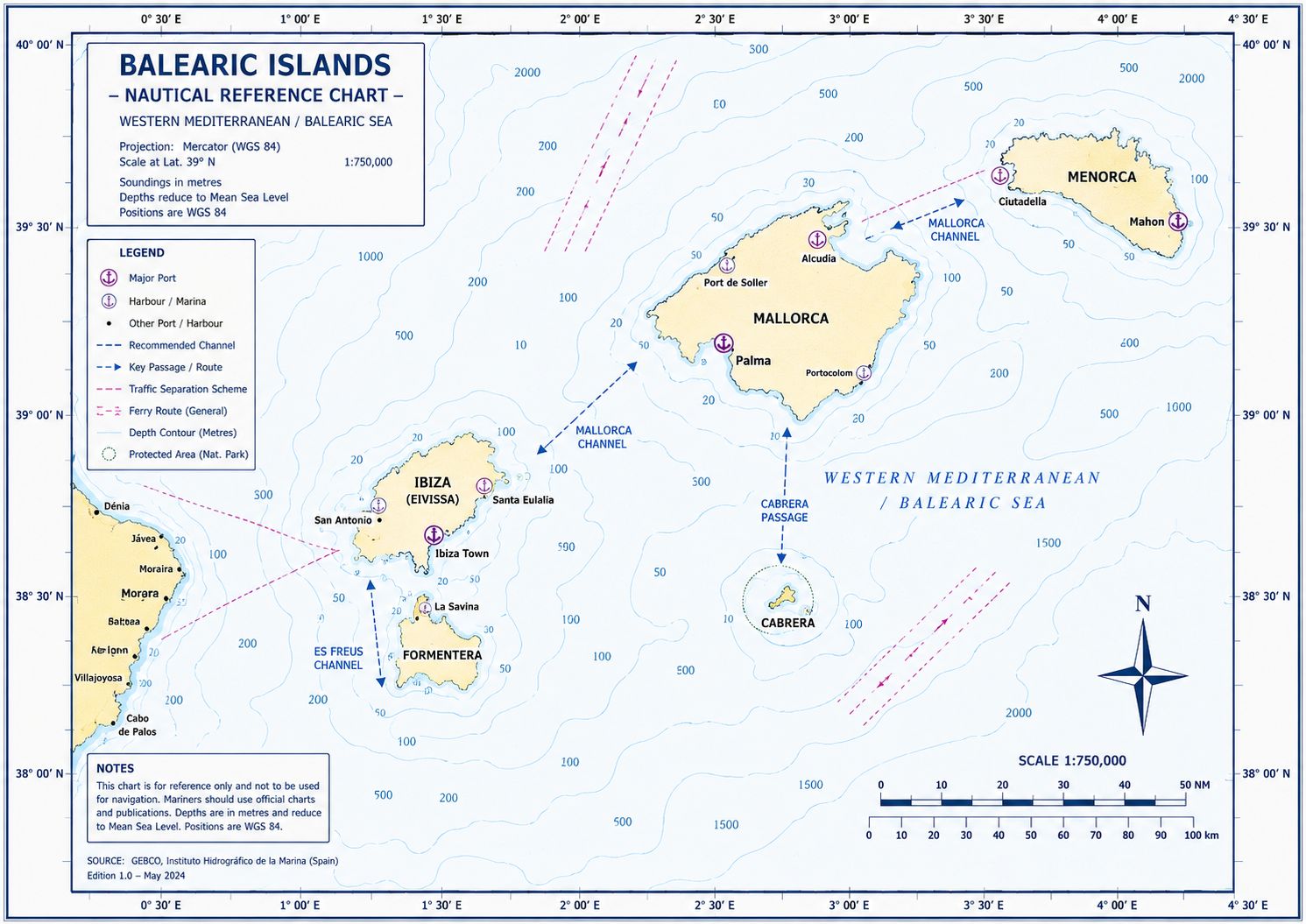
The Balearic Islands are divided into two practical cruising zones. The northern and central zone is formed by Mallorca and Menorca. Mallorca is the largest island, with Palma Bay as the main marina and repair hub, Alcudia and Pollensa on the north side, Port de Sóller on the north-west coast, and a long chain of east-coast calas. Menorca lies to the north-east of Mallorca and has two important harbour areas: Mahon on the east coast and Ciutadella on the west coast. Its north coast is more exposed and requires care in tramontana and northerly systems.
The southern and south-western zone is formed by Ibiza and Formentera. Ibiza has several useful harbours and marina bases, including Ibiza Town, Santa Eulalia and San Antonio, but summer demand is high and prices are often significantly higher than on less visited coasts. Formentera has fewer harbour options and is best treated as a controlled anchorage and short-stay cruising area rather than a full-service base. La Savina is the main port for Formentera and is one of the Balearic ports under the Port Authority network.
Balearic Islands Sailing Guide - Mallorca
Mallorca should be the primary service base for the Balearics. Palma has the strongest concentration of yacht services, marinas, chandlery, rigging support, mechanical trades, electronics, sailmakers, haul-out options and provisioning. It is the logical hub for boats arriving from mainland Spain, Sardinia, southern France or Gibraltar. The south coast around Palma Bay offers marina access and shelter, but it is busy with commercial, ferry, charter and local traffic. The north-west coast is steep, with fewer bolt-holes and significant exposure when swell runs in from the north-west. The east coast has many calas, but several are narrow, crowded in summer, and vulnerable when swell enters from the east or south-east.
Mallorca also gives access to Cabrera, which must be planned separately. Cabrera is a maritime-terrestrial national park and private boats require authorisation for navigation and anchoring or overnight mooring. The Balearic Government has an online reservation system for overnight mooring buoys in Cabrera National Park.
Balearic Islands Sailing Guide – Menorca
Menorca is a more compact cruising island but requires careful shelter selection. Mahon is one of the best natural harbours in the western Mediterranean and is the main eastern harbour for the island. Ciutadella is the key western harbour, useful for passages to or from Mallorca. The north coast is more exposed to tramontana and northerly weather, while the south coast has many calas that provide useful shelter in settled northerly conditions. Skippers should not assume that a cala shown as protected on a chart is usable in all conditions; swell wraps into many entrances, and gusts can accelerate down valleys and headlands.
Menorca is also useful for staging passages eastward or north-eastward, but harbour space is limited in peak season. Fornells has moorings and harbour infrastructure, and PortsIB’s reservation system lists Fornells among ports with moorings for vessels up to specified length and beam limits.
Balearic Islands Sailing Guide – Ibiza
Ibiza is a high-demand summer cruising island. It has useful yacht infrastructure, but the operational issues are marina pressure, anchorage density, ferry movement, wash, beach traffic and environmental enforcement. Ibiza Town is the principal harbour and ferry port. Santa Eulalia and San Antonio are important yacht bases. Anchorages on the east, south and west coasts can be excellent in settled weather, but many become crowded, and several are affected by ferry wash, day boats, jet skis and shore activity.
Ibiza should be planned with early berth enquiries in summer. Do not rely on arriving late in the day and finding a practical berth. If anchoring, the skipper must identify sand patches and avoid Posidonia. This is not just an environmental recommendation; anchoring on Posidonia is prohibited in protected areas and is actively controlled in the Balearics.
Balearic Islands Sailing Guide – Formentera
Formentera is low, exposed and highly regulated. It is attractive to yachts because of its clear water and sand patches, but the same shallow-water clarity also means Posidonia meadows are widespread and closely monitored. La Savina is the main harbour and ferry port. Anchorages around Illetes, Espalmador and the north side of Formentera require careful seabed selection and attention to buoy fields and local rules. Formentera is not a place to drag chain across mixed weed and sand until the anchor sets. The correct method is to approach in good light, identify clear sand, drop the anchor only on sand, and verify that the chain also lies clear of seagrass.
Balearic Islands Sailing Guide – Weather
and Wind Patterns
The Balearics are a western Mediterranean cruising ground where local summer breezes can be benign, but regional weather systems must be respected. In settled summer weather, sea-breeze patterns build through the day and often ease overnight. Around headlands and between islands, afternoon winds can be stronger than open-water forecasts suggest. The tramontana affects Menorca and the north side of Mallorca, while mistral-influenced north-westerly systems can create hard conditions in the Gulf of Lyon and adjacent western Mediterranean waters. Easterly and south-easterly weather can make normally attractive east-facing calas uncomfortable or unsafe.
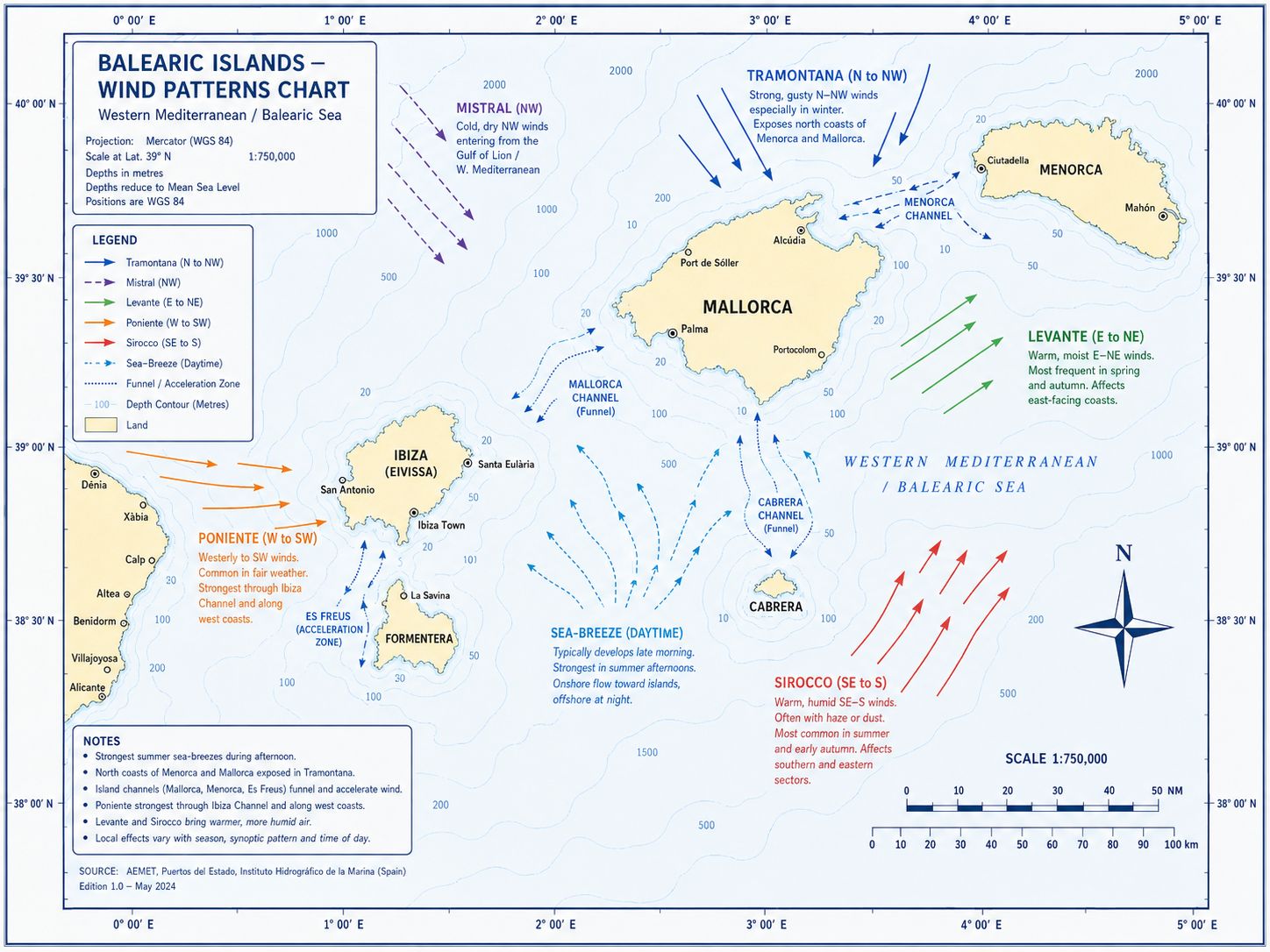
The practical sailing season is generally spring through autumn, but the operating character changes by month. Early and late season bring more unsettled systems, stronger frontal activity and lower marina pressure. July and August bring heat, crowding, berth scarcity and more anchorage pressure. September can be excellent but needs thunderstorm and depression monitoring. Skippers should choose anchorages by wind and swell direction, not by distance from the next destination.
Balearic Islands Sailing Guide – Currents
and Tidal Flow
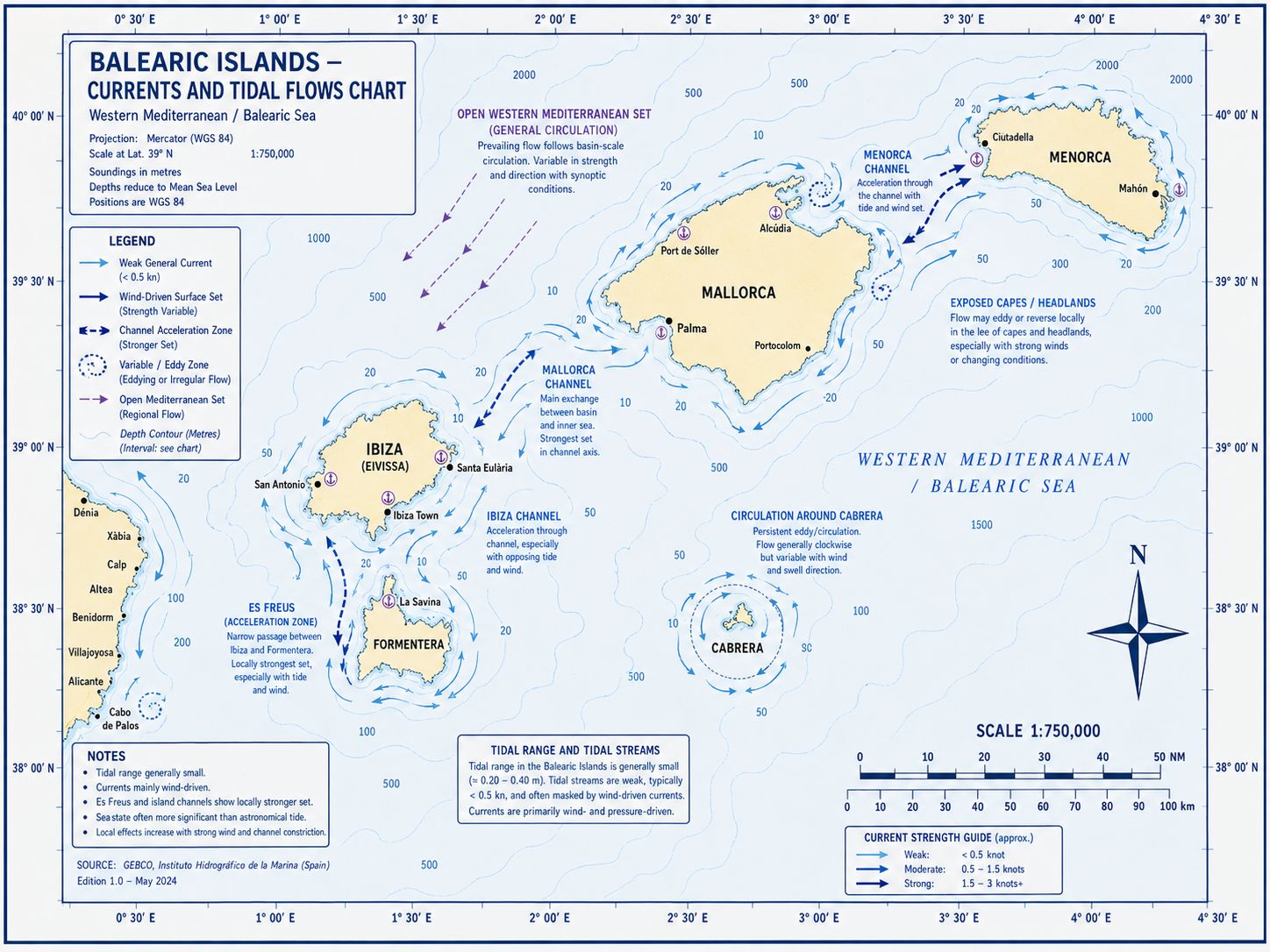
Tidal range in the Balearics is generally small compared with Atlantic cruising grounds. Current planning is therefore less about tidal gates and more about wind-driven surface movement, residual flow, swell, and sea state around headlands, capes and island passages. Strong wind over several hours can create uncomfortable short seas, especially where breeze opposes residual movement or where fetch is long. Channels between Mallorca and Menorca, Ibiza and Formentera, and exposed headlands around Mallorca and Menorca should be treated as open-water passage areas rather than sheltered coastal hops.
Balearic Islands Sailing Guide –
Interisland Passage Planning
Regional passage planning should be built around conservative daylight arrivals unless entering known harbours. Useful information and advice includes the following:
- Mallorca to Menorca Passage Plan
- Mallorca to Ibiza Passage Plan
- Ibiza to Formentera Passage Plan
- Mallorca to Cabrera Passage Plan
- Mainland Spain to the Balearic Islands Passage Plan
The main planning issue is not distance alone. A 35–60 NM leg can be simple in settled weather and poor in a building northerly, easterly swell or post-frontal sea. Departure time should allow for afternoon sea-breeze development, harbour approach in daylight, and a fallback plan if the intended anchorage is crowded (which they ofet are!) or untenable due to weather conditions.
Balearic Islands Sailing Guide – Anchorages
Balearic anchorages are often calas, sand patches, roadsteads or regulated buoy areas. Many are attractive but not all-weather. A cala that is secure in northerlies may be untenable in easterly swell. A beach anchorage that is quiet in May may be crowded and noisy in August. The main anchoring rule is simple: anchor only where it is legal, where the seabed is sand or suitable holding ground, and where the boat has adequate swinging room clear of swimmers, ferries, moorings, rocks and other vessels.
The most important environmental issue is Posidonia oceanica. The Balearic Islands have specific conservation controls for Posidonia, and marinas and official guidance warn skippers not to anchor in protected zones or over Posidonia meadows.
Balearic Islands Sailing Guide – Entry Formalities
Spain and the Balearic Islands are within the Schengen Area and the EU customs territory, so yachts arriving from another Spanish or Schengen/EU port normally do not complete full border clearance again. Yachts arriving from a non-Schengen port must clear through an authorised port of entry, with crew passports handled by the Frontier Police and vessel/customs formalities handled through the appropriate Spanish authorities. Since 10 April 2026, the EU Entry/Exit System records non-EU short-stay entries and exits electronically rather than by passport stamping. Non-EU visitors remain subject to Schengen short-stay limits, normally 90 days in any 180-day period, unless they hold a visa or residence status allowing longer stay. Non-EU flagged yachts may also need to consider Temporary Admission rules for EU waters, commonly allowing private non-EU yachts used by non-EU residents to remain in EU customs territory for up to 18 months without VAT/import duty being due, provided the conditions are met. For practical yacht clearance, the main Balearic entry ports include Palma, Alcudia, Ibiza, Mahon and La Savina.
Balearic Islands Sailing Guide – Marinas
and Berthing
Marina berthing is available across the Balearics, but it should not be treated as casual in high season. Palma, Alcudia, Mahon, Ibiza and La Savina are the major strategic ports. PortsIB also manages reservations for several smaller ports and lists vessel size limits for public moorings, including ports such as Andratx, Cala Figuera, Pollença, Portocolom, Porto Cristo, Cala Rajada, Sóller, Sant Antoni de Portmany, Cala Bona, Colònia de Sant Jordi, Ciutadella and Fornells.
A skipper should book early for July and August, carry realistic fallback plans, and avoid arriving at dusk expecting easy berthing. Stern-to berthing, lazy lines, harbour wash, ferry movement and limited manoeuvring space are common considerations.
Balearic Islands Sailing Guide – Provisioning
Provisioning is strongest in Mallorca and Ibiza, good in Menorca, and more limited in Formentera. Palma is the best full resupply point for food, marine spares, chandlery, gas, tools, technical supplies and repair logistics. Ibiza Town and Santa Eulalia are useful but busy. Mahon and Ciutadella are practical Menorca provisioning bases. La Savina can support basic provisioning but should not be treated as a technical supply hub.
Obviously being Spanish there is a strong influence in eating styles. Tourism has ensured a ready supply of local and imported produce and stores, although local dishes are harder to find when dining ashore. Try and taste or purchase some of the excellent local sausages from markets or butchers, in particular "llonganisa" and "botifarro". Pork is the feature in local cuisine.

Balearic Brewed Beers
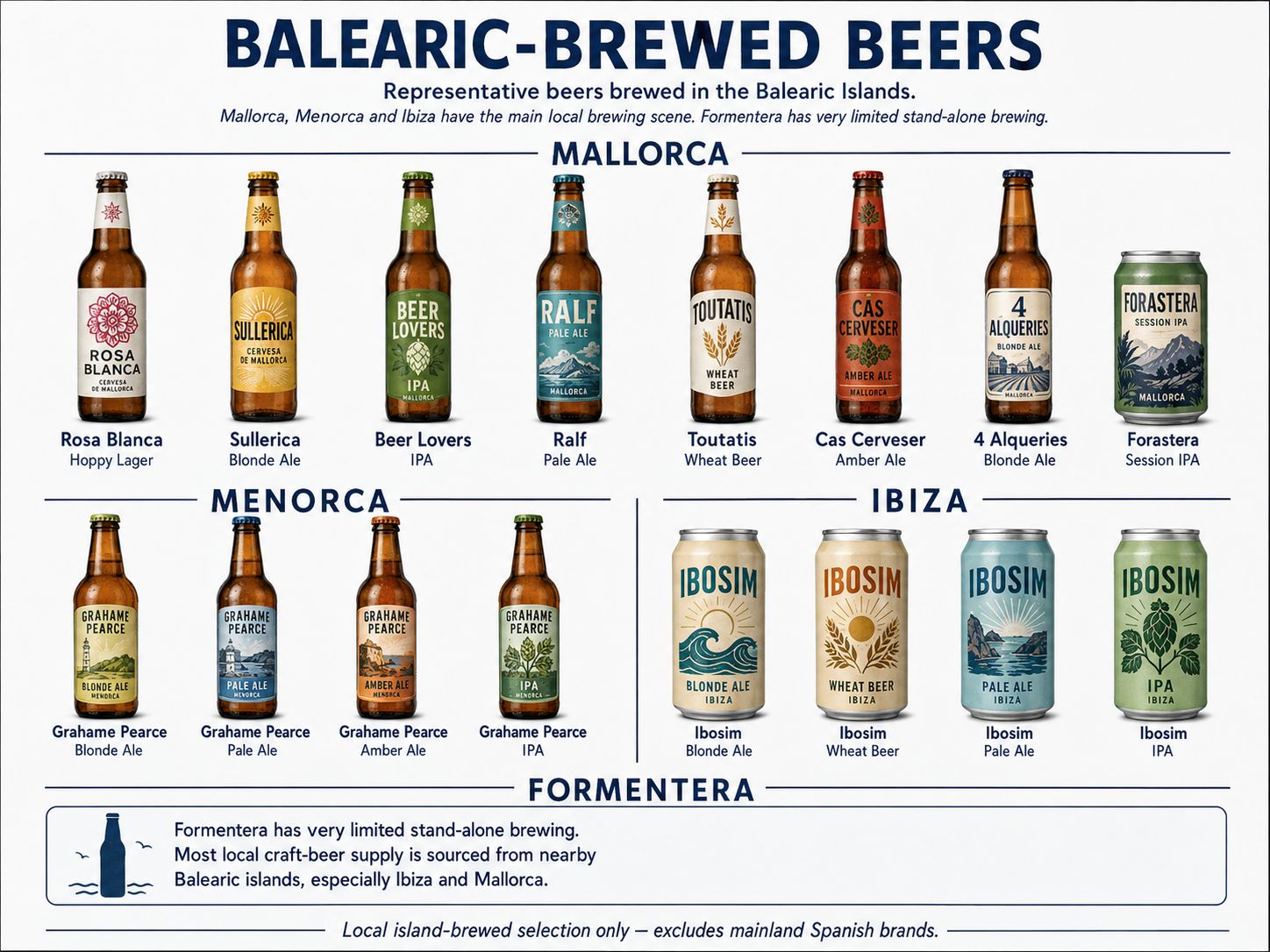
Hot summers and cruising in Spain usually mean boat drinks and sundowners, and the Balearics have a lot of great local brews to savour. The Balearic Islands have a small but active local beer scene, with most island-brewed beers produced in Mallorca, Menorca and Ibiza, while Formentera has little stand-alone brewing and is usually supplied from the neighbouring islands. Mallorca has the broadest range, including craft and local labels such as Rosa Blanca, Sullerica, Beer Lovers, Ralf, Toutatis, Cas Cerveser, 4 Alqueries and Forastera, with styles ranging from lager and blonde ale to IPA, wheat beer and amber ale. Menorca is more limited but has recognised local craft beer, including Grahame Pearce and other small-batch beers tied to the island’s food and drink scene. Ibiza’s main local brewing name is Ibosim, brewed on the island and commonly associated with blonde ale, pale ale, wheat beer and IPA styles. For a cruising yacht, local beers are most easily found in larger supermarkets, bottle shops, restaurants, marina bars and island food markets, with the best selection in Palma, Mahon, Ciutadella, Ibiza Town, Santa Eulalia and San Antonio.
Mechanical
and Electrical Repairs Resource
If you are headed somewhere remote consider the need to expand your knowledge base or have an information resource on board. Why not get a copy of my book The Marine and Electrical and Electronics Bible 4th Edition. By and for yachties, with everything from batteries and charging, solar and wind, diesel engines and marine electronics and so much more. Your complete systems guide. 650 pages of practical advice. In Australia and New Zealand order a copy through Boat Books. UK and European boats can buy the UK Edition Here. US and Canadian boats can get the US Edition Order Here. Marine systems are my profession so let me help you. By a liveaboard boat owner for other boat owners.


Balearic Islands Sailing Guide – Fuel,
Water and Marine Services
Fuel and water should be planned around marinas and harbours, not anchorages. Many calas have no services, no rubbish disposal, no potable water, no fuel, no repair support and no landing suitable in swell. Palma is the main marine-service centre. Secondary support is available in Alcudia, Mahon, Ciutadella, Ibiza Town, Santa Eulalia and San Antonio. Formentera is limited and should be treated as a short-stay service stop unless a berth and required services have been confirmed.
Balearic Islands Sailing Guide – Regulations and Environmental Controls
The Balearics require very careful if not strict adherence to anchoring restrictions, marine reserves, Cabrera permits, Posidonia controls, harbour rules, speed limits near swimmers and beaches, holding tank discipline, and local port-authority instructions. Cabrera requires permits for private boat access and overnight mooring, and official booking is through the Balearic Government system.
Balearic Islands Sailing Guide – Summary
The Balearic Islands sailing guide gives skippers a practical regional overview of cruising Mallorca, Menorca, Ibiza and Formentera, with emphasis on weather planning, marina demand, anchorages, passage distances, provisioning, fuel, water and marine services. The islands require careful routing because shelter varies sharply by wind direction, tidal effects are small but wind-driven sea state can be significant, and many popular anchorages are restricted by Posidonia seagrass protection rules. This hub page links through to detailed island, harbour, anchorage and passage-planning guides for safe cruising in the Balearic Islands. The Balearic Islands Sailing Guide for all you need.