Port de Soller Mallorca Sailing Guide
Port de Soller Mallorca Sailing Guide. Practical Port de Soller Mallorca. Port de Sóller is the key harbour on Mallorca’s exposed north-west coast and the next logical port page after Palma, Port d’Alcúdia and Port de Pollença. It lies in a deep horseshoe-shaped bay backed by the Serra de Tramuntana, and is the only practical harbour refuge on the long north-west coast between the Dragonera and Andratx sector and the north coast around Pollença and Formentor. For yachts moving along this coast, Sóller is not just a local stop; it is the main bolt-hole in a section of Mallorca where alternative shelter is limited.
For cruising yachts, Port de Sóller is useful for weather waiting, fuel, water, provisioning, limited repairs, and passage staging before running north-east toward Cala Tuent, Sa Calobra, Cap de Formentor and Port de Pollença, or south-west toward Deià, Banyalbufar, Sant Elm and Port d’Andratx. The harbour gives better protection than most north-west coast bays, but entry should still be treated carefully in strong north, north-west or north-east weather because swell can stand up in the entrance and rebound from the steep coast. Marina space is limited, depths are moderate, and the bay anchorage is useful but not a substitute for heavy-weather harbour berthing.
Port de Soller
Mallorca Sailing Guide - History
Port de Sóller developed as the maritime outlet for Sóller town, which sits inland in the fertile valley behind the harbour. The port was historically important for fishing, coastal trade, citrus export, local boatbuilding and communication with the rest of Mallorca before modern road access improved through the mountains. The watchtower at Torre Picada reflects the area’s past exposure to raids and the need to control the harbour approaches. For skippers, the historical function remains clear: Port de Sóller exists where the north-west coast gives a rare natural harbour, landing place, provisioning route and refuge in an otherwise steep and exposed coastline.
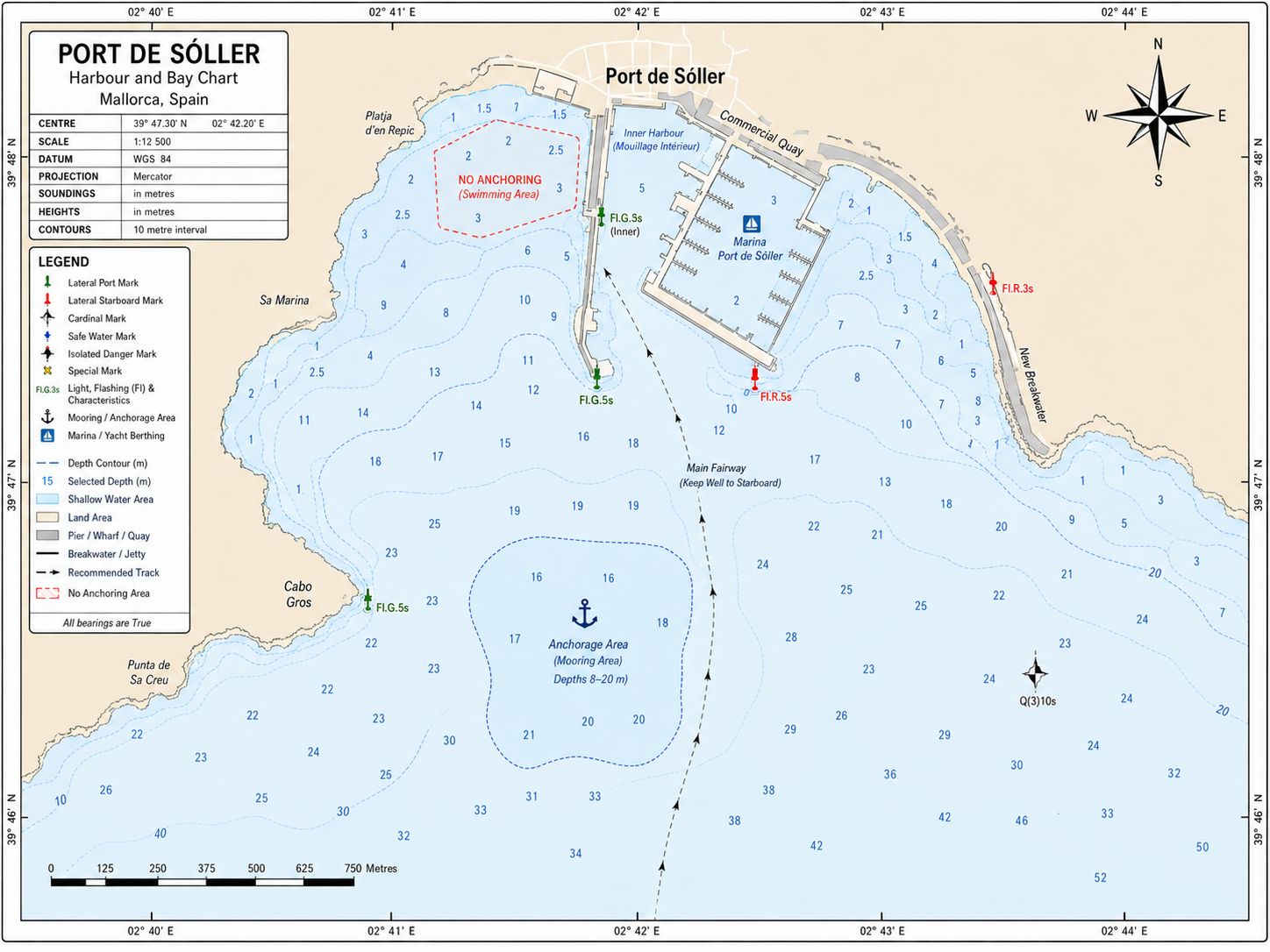
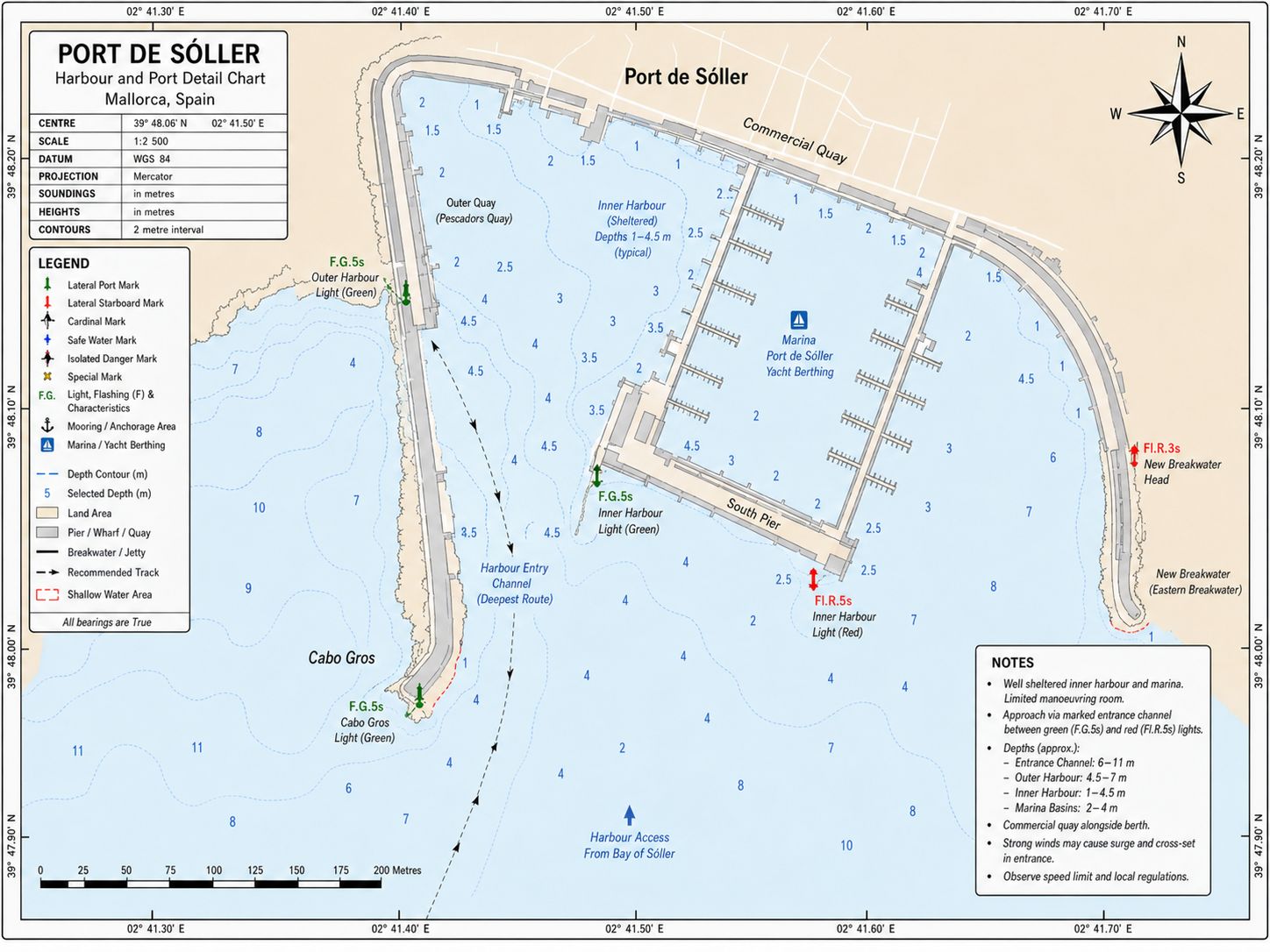
Chart Disclaimer. This chart is a schematic representation for illustrative purposes only and must not be used for navigation. Refer to official hydrographic charts for safe navigation. Be aware ENC charts may differ from official hydrographic charts. Both should be corrected and updated regularly.
Port de Soller
Mallorca Sailing Guide - Currents
and Tidal Flow
Tidal range at Port de Sóller is small and has little effect on ordinary yacht navigation. Tidal streams are weak, and most water movement experienced by yachts is caused by wind-driven surface set, pressure changes, swell entering the bay, and local harbour circulation. Inside the harbour, current is normally minor, but wash, gusts and crosswind can matter when manoeuvring near pontoons, the town quay or fuel berth.
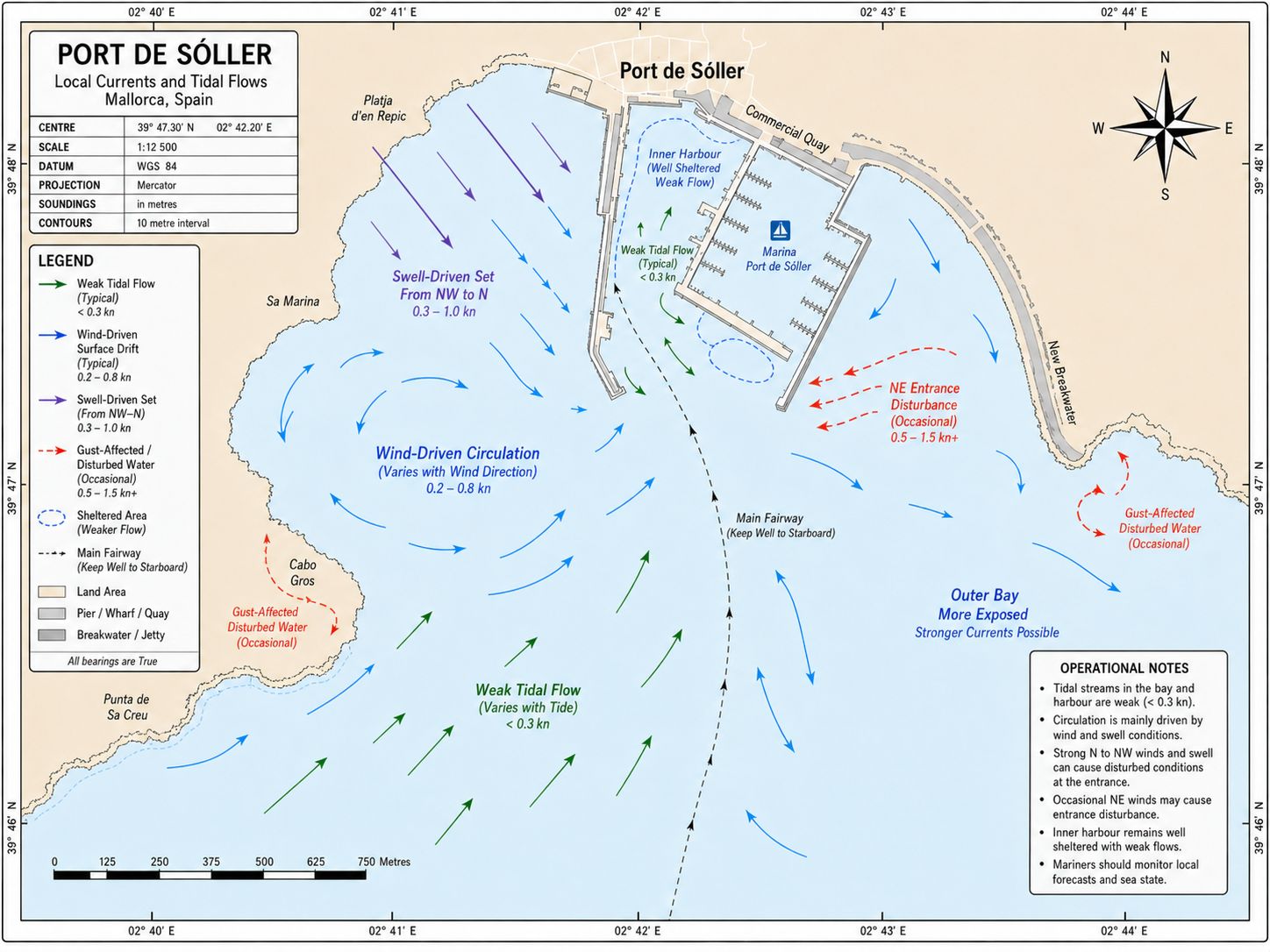
The more important sea-state issue is swell entering the bay from the north and north-west. In settled weather the bay is straightforward, but in strong northerly or north-easterly conditions the entrance can become uncomfortable and should be approached with care. Cruising berth listings specifically caution that Sóller is the only real bolt-hole on this coast, but that care is needed entering in strong N or NE winds.
Port de Soller
Mallorca Sailing Guide - Weather
Port de Sóller is controlled by north-west coast weather rather than the more protected south-coast pattern around Palma. The surrounding mountains give shelter from some landward winds but also create gust effects, down-draughts and local wind shifts. In summer, the harbour is often settled, with lighter mornings and afternoon breeze across the bay, but the exposed coast outside the entrance can be very different from the water inside the harbour.
The main weather risks are tramontana, north-westerly swell, northerly or north-easterly winds in the entrance, and autumn or winter frontal systems. Westerly and north-westerly weather can send swell into the bay, while northerlies can make the approach rough. Southerly and south-easterly weather is usually less problematic for the harbour itself, though local gusts and reflected sea can still affect anchoring and manoeuvring. A yacht using Port de Sóller as a refuge should enter before conditions deteriorate rather than waiting until the north-west coast is already running hard.
The Marine Electrical and Electronics Bible has a complete list of Spanish VHF Radio Channel information and weather forecast times along with NAVTEX UK and Europe and NAVTEX Mediterranean for 490kHz and 518kHz.
Port de Soller
Mallorca Sailing Guide - Local
Winds
Local winds at Port de Sóller are shaped by the Serra de Tramuntana, the harbour’s steep enclosing land, and the open north-west coast. Summer sea breeze can build into the bay during the afternoon, while nights and mornings may be quieter. Wind direction inside the harbour can differ from the offshore wind because the surrounding cliffs and valley system bend, block or accelerate the airflow.
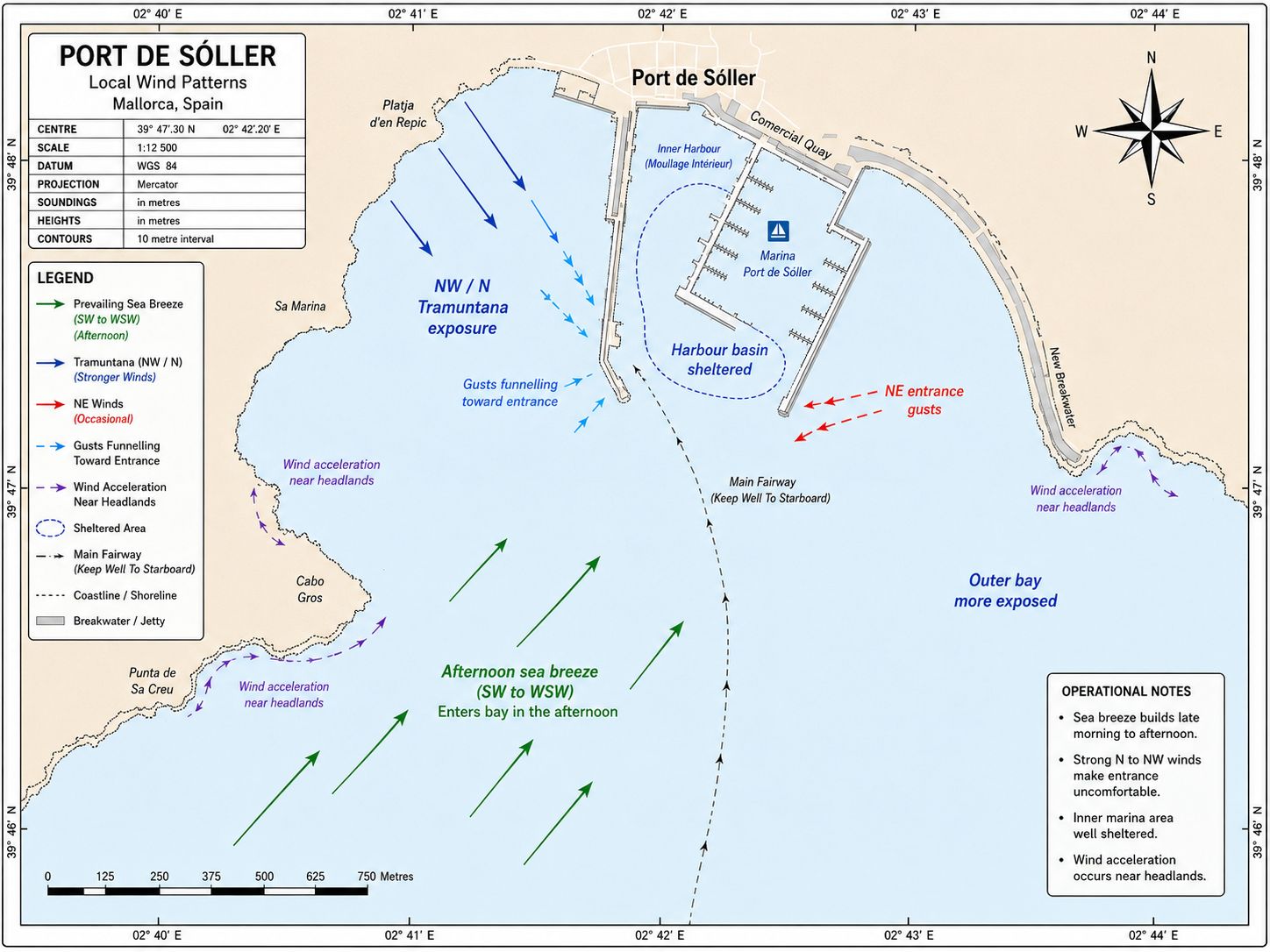
North-westerly and northerly winds are the main operational concern. Gusts can descend from the high ground, especially in stronger regional systems. In northerlies and north-easterlies, the entrance can be affected by short steep seas and confused water. In light summer conditions, the bay anchorage can be comfortable, but the same anchorage may become uncomfortable if swell enters from the north-west.
Port de Soller
Mallorca Sailing Guide - Approaches
The approach to Port de Sóller is from the open north-west coast of Mallorca. The harbour is identifiable by the broad bay, the surrounding mountain backdrop, and the entrance between the headlands. The entrance is marked by the lights at Cabo Gros and Punta de Sa Creu, which are commonly cited as the principal approach marks for the port.
From the south-west, yachts approach after passing the Dragonera, Andratx, Banyalbufar and Deià coast. This is a steep coast with few safe refuge fallbacks, so weather should be checked before committing. From the north-east, yachts approach from Cala Tuent, Sa Calobra and the Formentor sector; this coast is also steep, exposed and short of reliable harbour shelter. In strong northerly or north-westerly weather, keep an adequate offing until the entrance is positively identified, then close only when the sea state allows safe control.
Port de Soller
Mallorca Sailing Guide - Navigation
Navigation into Port de Sóller is straightforward in settled weather but should be treated as confined-water pilotage once inside the bay. The entrance opens into a wide, sheltered harbour basin, but yacht traffic, local boats, moorings, excursion craft, anchorage areas and marina pontoons make the inner harbour busy in season. Enter slowly, identify the allocated berth or anchoring area, and keep clear of commercial, fishing and trip-boat movements.
Depths in the outer bay are generally adequate for cruising yachts, but the marina and harbour berths are depth-limited. The published information quotes a maximum draught of about 2 m for the main government-managed berths, with a maximum LOA of about 20 m. Marina Tramontana is a smaller private marina facility inside the harbour, with berths and linear moorings supplying water and electricity, but berth depth and vessel size should be confirmed directly before arrival. For deeper draft yachts, anchoring in the bay may be more practical than entering the inner berth areas, provided conditions are settled and anchoring is permitted clear of moorings and traffic.
Port de Soller Mallorca Sailing Guide - Entry Formalities
Spain and the Balearic Islands are within the Schengen Area and the EU customs territory, so yachts arriving from another Spanish or Schengen/EU port normally do not complete full border clearance again. Yachts arriving from a non-Schengen port must clear through an authorised port of entry, for practical yacht clearance, the main Balearic entry ports include Palma, Alcudia, Ibiza, Mahon and La Savina. The usual formalities include crew passports handled by the Frontier Police and vessel/customs formalities handled through the appropriate Spanish authorities. Since 10 April 2026, the EU Entry/Exit System records non-EU short-stay entries and exits electronically rather than by passport stamping. Non-EU visitors remain subject to Schengen short-stay limits, normally 90 days in any 180-day period, unless they hold a visa or residence status allowing longer stay. Non-EU flagged yachts may also need to consider Temporary Admission rules for EU waters, commonly allowing private non-EU yachts used by non-EU residents to remain in EU customs territory for up to 18 months without VAT/import duty being due, provided the conditions are met.
Port de Soller
Mallorca Sailing Guide - Chart
Accuracy
Navigation should be based on current official hydrographic charts, updated electronic charts, local notices to mariners, harbour instructions and the vessel’s own depth sounder. Electronic charting is useful for route planning and position awareness, but it should not be treated as exact at harbour, quay, reef, marina or anchorage scale. Port de Sóller requires caution because it is a small harbour with limited berthing depth, local moorings, marina pontoons, anchoring zones, beach areas and a swell-affected entrance. Chartplotters may not show recent berth changes, mooring-field adjustments, fuel-dock restrictions, works, or the exact boundary between sand, mud, weed and protected seagrass. Use visual pilotage in good light where possible, confirm depths continuously, and check harbour or marina instructions before entering confined water.
Port de Soller
Mallorca Sailing Guide - Anchorages
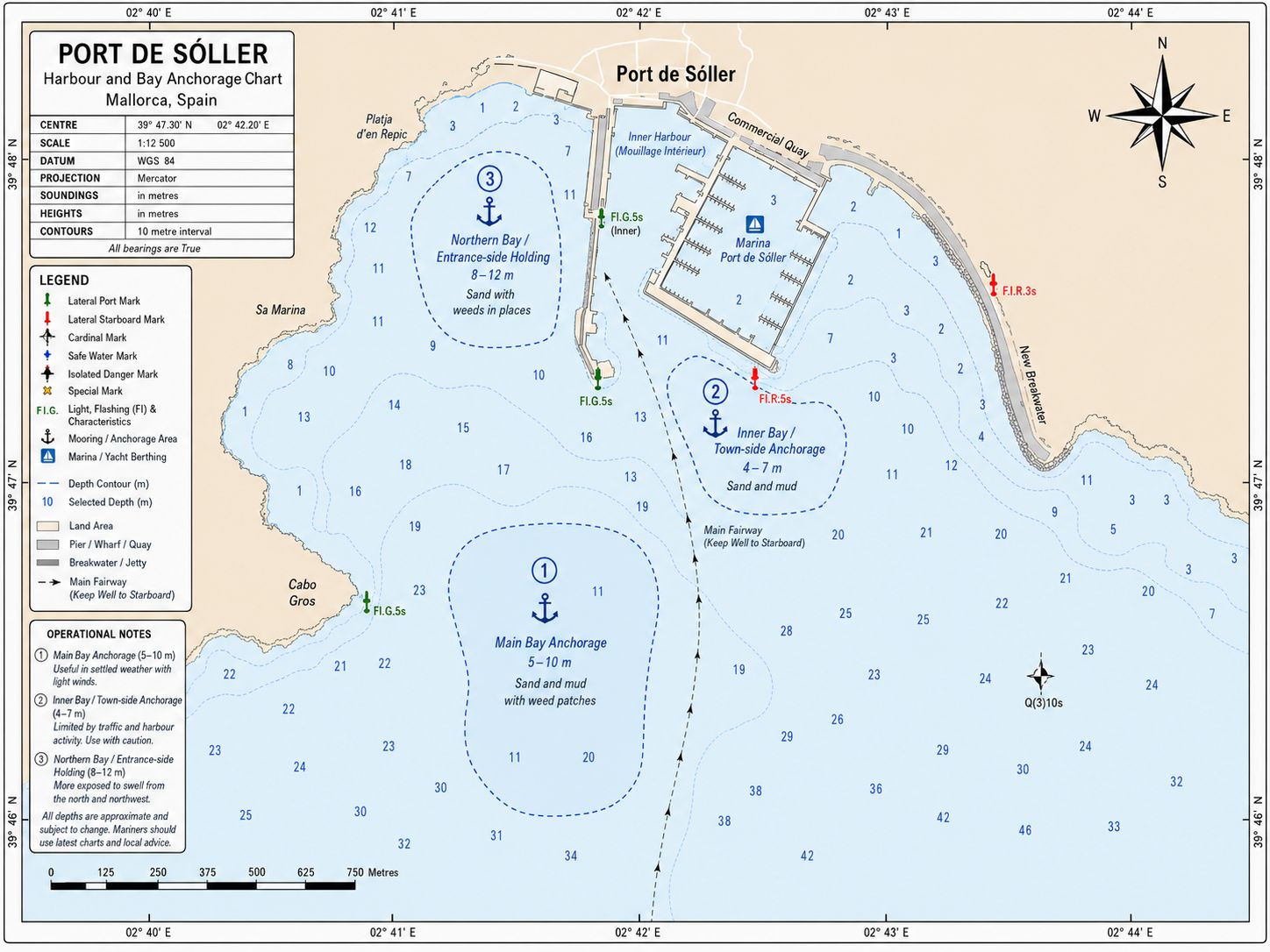
Port de Sóller has one of the more useful anchorages on the north-west coast of Mallorca, but it must be treated as weather-dependent. The bay gives shelter from many directions, yet it is open enough for swell and chop to enter in northerly and north-westerly conditions. Anchoring should be clear of marina traffic, moorings, swimming zones, trip boats and harbour manoeuvring areas.
- Port de Sóller Bay Anchorage. This lies inside the main bay, outside the marina and mooring areas. Anchor in about 5–10 m where sand and mud can be found. Holding is generally acceptable where the anchor is properly set in sand or mud but weed patches should be avoided. This is the principal waiting and fair-weather anchorage for yachts unable to obtain a berth. It is useful in settled weather and moderate offshore conditions, but exposed to swell entering from the north-west.
- Inner Bay/Town-side Anchorage. This may be possible in settled conditions where space and restrictions allow. Depths are generally shallower, commonly around 4–7 m, but the area is busy and must be kept clear of ferry, excursion, marina and local boat traffic. Use only if there is clear swinging room and no conflict with marked areas or moorings.
- Northern Bay/Entrance-side Holding. This gives more room but more exposure. Depths are commonly around 8–12 m, with sand, mud and weed patches. This area is more affected by swell entering the bay and should be avoided if the wind or sea is from the north, north-west or north-east.
- Cala Deià and Cala Tuent. These are nearby coast anchorages rather than Port de Sóller anchorages. Both are useful only in settled conditions and should not be treated as secure alternatives if Port de Sóller itself is unsafe or unavailable.
Older cruising references describe anchoring in sand and mud in the bay itself, with limited stern-to options at the town quay in some circumstances. Current local restrictions and marina instructions should always override older cruising notes.
Port de Soller
Mallorca Sailing Guide - Marinas
The main berthing areas are the government-managed harbour berths and Marina Tramontana. One information source quotes 465 total berths, visitor berths, fixed concrete piers and pontoons, maximum LOA about 20 m, maximum draught about 2 m, power, water, showers, fuel dock, a 20-tonne crane and contacted on VHF 09. There is also 164 designated visitor berths, although in practice availability can be very limited.
Marina Tramontana is the principal private marina operator in Port de Sóller. They have safe moorings, water and electricity, and space for boats over 12 m, with linear moorings inside the harbour. Because published depth details are inconsistent across sources, yachts should confirm maximum draught, berth depth, approach instructions and arrival channel directly with the marina before entering.
Town quay and harbour berths may be available in limited circumstances, but they should not be assumed. Older berth-market descriptions note that a few boats can go stern-to at the town quay and may obtain water in the mornings and fuel, but berth allocation and current local practice must be confirmed on arrival. Port de Sóller is a small harbour for its strategic importance, so arriving yachts should expect berth pressure during summer and poor weather windows.
Port de Soller
Mallorca Sailing Guide - Provisioning
Supermarkets. Useful supermarket options in the Port de Sóller and Sóller area include local Eroski outlets, Hiper Centro or similar island supermarket, smaller Spar-style or independent grocery stores, bakeries, butchers and fruit shops. Opening hours vary by season, with many food shops operating normal daytime and evening hours in summer and shorter hours in winter. For heavy provisioning from the port, use a taxi or delivery rather than walking large loads back to the marina.
Markets. Mercat Municipal de Sóller is the main covered market for the area. It is located at Plaça des Mercat, in the inland town. Opening hours are Monday to Saturday, 08:00–14:00. It is useful for fruit, vegetables, meat, fish, local produce, cheese, olives, bakery goods. From Port de Sóller, it requires a tram, taxi, bus, bicycle or road transfer rather than a short marina walk. The Sóller weekly market is held on Saturday, commonly from 09:00 to 14:00, in Plaça de Sa Constitució, Plaça des Mercat and adjacent streets in Sóller town. It is the main local market day and is useful for fresh produce, seasonal fruit, vegetables, local foods. Port de Sóller weekly market operates on Thursday from 09:00 to 14:00 at Carrer d’Antoni Montis, Port de Sóller, and runs year-round. This is the most convenient market for yachts already berthed or anchored in the port. Local specialty produce includes Sóller oranges and lemons, Mallorcan olive oil, almonds, tomatoes, peppers, potatoes, onions, figs, herbs, olives, local cheeses, sobrasada, ensaimada and seasonal mountain-valley produce from the Tramuntana area.
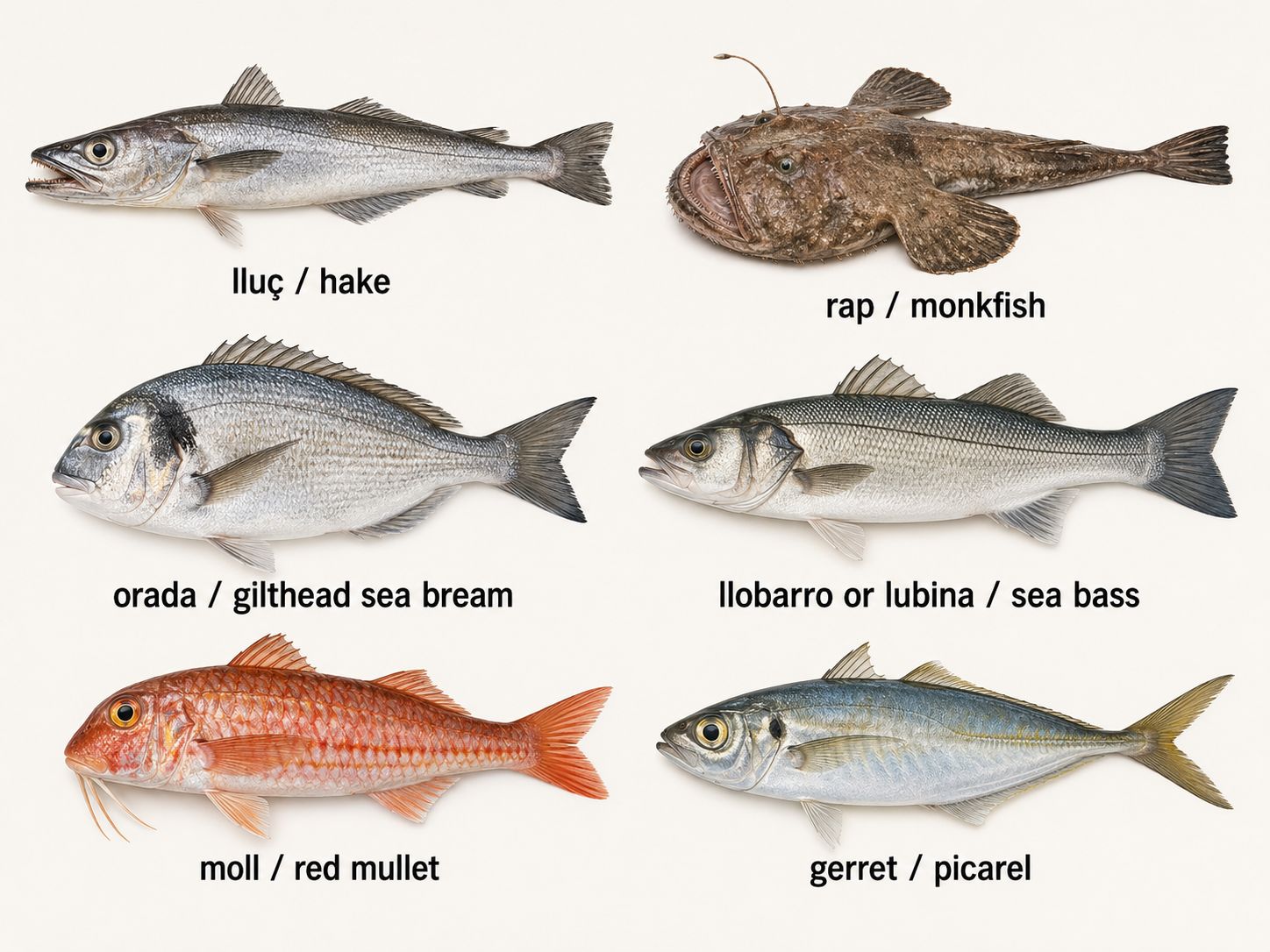
Fish Markets. Mercat Municipal de Sóller includes fish supply as part of the covered market. It is the main structured fish-market source for yachts using Port de Sóller. Alternative fish supply may come from harbour fishermen, waterfront restaurants, supermarket fish counters and local fishmongers in Sóller or Port de Sóller. Direct harbour purchase depends on landings, season and local practice and should be treated as opportunistic rather than guaranteed.
Port de Soller
Mallorca Sailing Guide - Local
Cuisine
Port de Sóller food reflects both the harbour and the Sóller valley. Local dishes suitable for this page include pa amb oli, tumbet, frito mallorquin, sopas mallorquinas, arròs brut, grilled fish, seafood rice, calamari, octopus, prawns and seasonal fish. The Sóller valley is strongly associated with citrus, so oranges and lemons are more locally specific here than in many other Mallorca harbour pages.
Practical yacht-galley products include Sóller oranges, Mallorcan olive oil, tomatoes, bread, olives, almonds, cheese, sobrasada, ensaimada, fish and market vegetables. Waterfront restaurants often serve fish and seafood, but for a cruising guide the important point is that provisioning can be done locally at port shops and more fully in Sóller town.
Port de Soller
Mallorca Sailing Guide - Local
Beverages
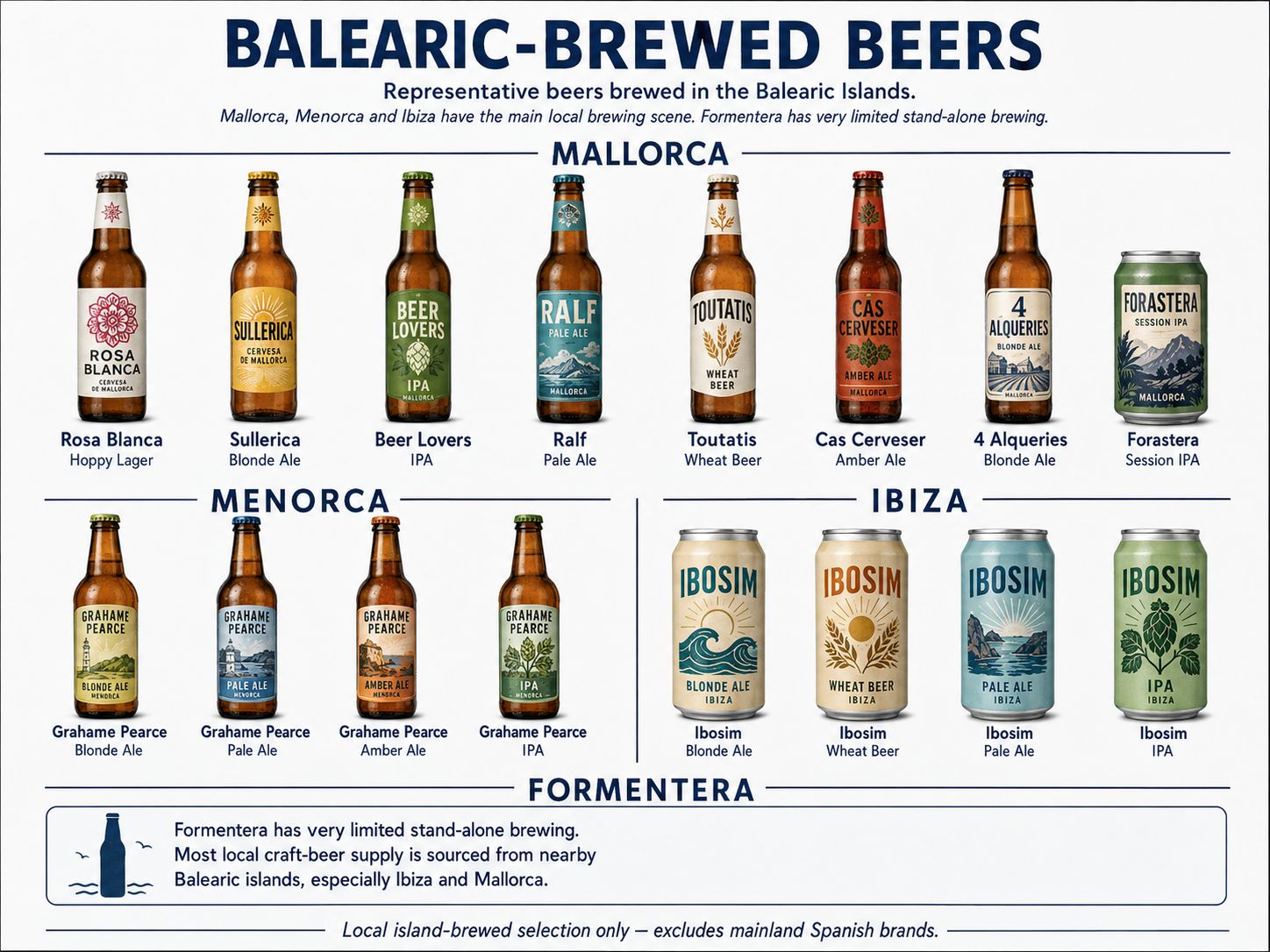
Local beverages include Mallorcan wines, hierbas mallorquinas, local vermouth, island spirits, coffee, bottled water, soft drinks and island-brewed beers. Mallorcan beers that may be found in shops or bars include Rosa Blanca, Sullerica, Beer Lovers, Ralf, Toutatis, Cas Cerveser, 4 Alqueries and Forastera, depending on outlet and season. Fresh orange juice from Sóller oranges is a local non-alcoholic option and is common in cafés and market settings.
Port de Soller
Mallorca Sailing Guide - Diesel
Fuel
Diesel is available in Port de Sóller. The harbour fuel station hours are 09:00–13:00 and 16:00–19:00, though current hours should be confirmed locally because seasonal changes are likely. Port de Sóller is an important fuel stop because there are few alternatives on the north-west coast. Yachts heading toward Formentor, Pollença, Andratx or Cabrera should top up if range is limited. Confirm fuel-dock access, draught, opening hours, payment and manoeuvring room before relying on arrival fuelling.
Port de Soller
Mallorca Sailing Guide - Water
Supplies
Water is available at harbour berths and marina moorings. Marina Tramontana states that its moorings provide water and electricity. Older berth information also notes water availability at the town quay in the mornings, but current access should be checked locally. Anchored yachts should not assume water is available without entering the marina, using an allocated berth, or arranging shore supply. Because the north-west coast has few harbours, yachts leaving Sóller should depart with full tanks.
Mechanical and Electrical Repairs
Resource
If you are headed somewhere in the Mediterranean or Spain or somewhere more remote consider the need to expand your knowledge base or have an information resource on board. Why not get a copy of my book The Marine and Electrical and Electronics Bible 4th Edition. with everything from batteries and charging, solar and wind, diesel engines and marine electronics and so much more. Your complete systems guide. 650 pages of practical advice. In Australia and New Zealand order a copy through Boat Books. UK and European boats can buy the UK Edition Here. US and Canadian boats can get the US Edition Order Here. Marine systems are my profession so let me help you DIY and save some valuable technician callout rates. This is by a cruising yachtsman and liveaboard boat owner for other boat owners.


Port de Soller
Mallorca Sailing Guide - Marine
Services
Port de Sóller has basic and moderate marine services but is not a Palma-level technical centre. Harbour facilities include water, electricity, showers, fuel, a 20-tonne crane and local boat-maintenance support according to yacht-service listings. Marina Tramontana provides berthing support, water and electricity, and local marina assistance. For diesel engines, electrical faults and marine electronics, Port de Sóller should be treated as a routine-support harbour rather than a manufacturer-service base. For urgent work best use Palma-based contractors or arrange mobile attendance from Palma.
Port de Soller
Mallorca Sailing Guide - Local Etiquette
Port de Sóller is informal but operates as a working harbour, marina, fishing port and waterfront town. Use basic greetings in harbour offices, shops, markets, cafés, fuel stations and service areas. Spanish and Catalan are both used locally; buenos días, bon dia, gracias and gràcies are appropriate. Keep communication with marina staff, fishers, fuel-dock staff, market sellers and repair contractors clear and patient, especially in summer when berths and services are under pressure. Dress is casual around the waterfront, but swimwear is not normal in supermarkets, markets, harbour offices, town streets or restaurants away from the beach. Do not treat fishing quays, local moorings, town quay space or private berths as available yacht space. In the marina, avoid blocking fairways, fuel access and service areas. At anchor in the bay, keep noise down, avoid generator nuisance, leave proper swinging room, keep clear of swimming zones and follow Posidonia anchoring rules without argument.
Port de Soller
Mallorca Sailing Guide - Summary
Port de Sóller is the principal refuge and service stop on Mallorca’s north-west coast. It offers marina berthing, anchoring, fuel, water, local provisioning, markets and basic marine support, but depths and berth availability are limited and the entrance needs care in northerly weather. It is a strategic harbour for yachts moving between Andratx, Formentor, Pollença and the exposed Tramuntana coast. This page is the harbour-level guide for the Port de Sóller Mallorca sailing guide and all you need to know.