Queensland Coastal Navigation Guide – Bar Crossings and Anchorages
Queensland Coastal Navigation Guide. Ports of Entry, Bar Crossings, Anchorages & Great Barrier Reef Routes. The total length of the Queensland mainland coastline is 6,973 km (4,333 miles) with another 6,374 km (3,961 miles) of island coastline. It is also one of the most varied and navigationally demanding in Australia, stretching from the engineered entrances of the Gold Coast to the tidal channels of Torres Strait and the shallow estuaries of the Gulf of Carpentaria. Each region behaves differently, with its own bar crossings, tidal patterns, reef structures, anchorages, and weather influences. This guide provides a practical overview of the entire coast, linking to detailed destination pages that focus on real‑world navigation, ports of entry, anchorage characteristics, and the operational realities of sailing in Queensland waters. I have cruised this coast on several boats and currently my own 36 foot ketch is located there.
The coast transitions gradually from shallow, tide‑affected waterways in the south to reef‑fringed headlands and remote anchorages in the far north. Skippers will encounter dynamic river bars, shifting shoals, strong southeasterly trade winds, monsoonal weather patterns, and the complex tidal systems of Torres Strait. This overview is designed to help skippers understand the navigational character of each region before committing to passages, and to support safe planning for both domestic and foreign yachts entering Australian waters.
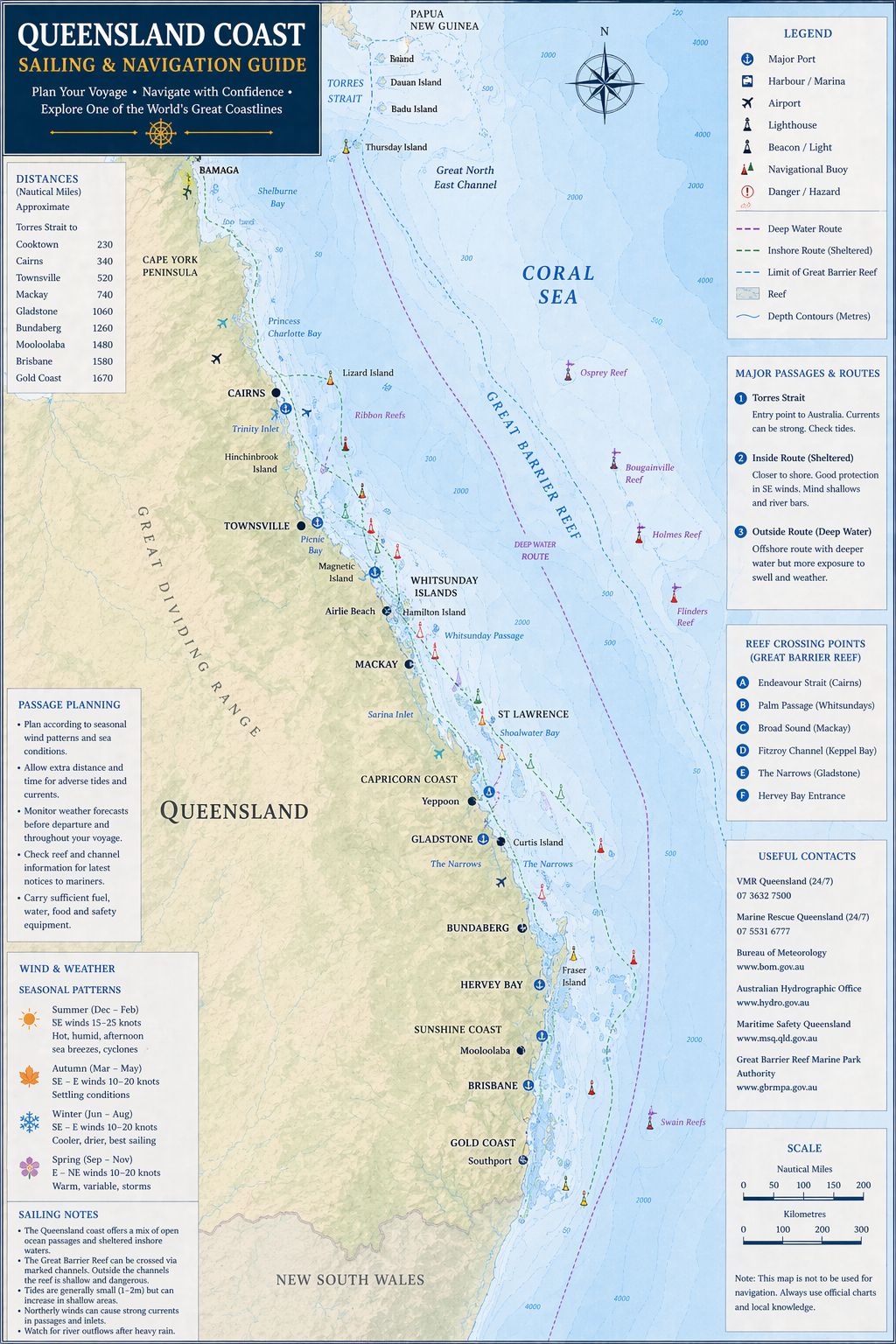
East Australian Current
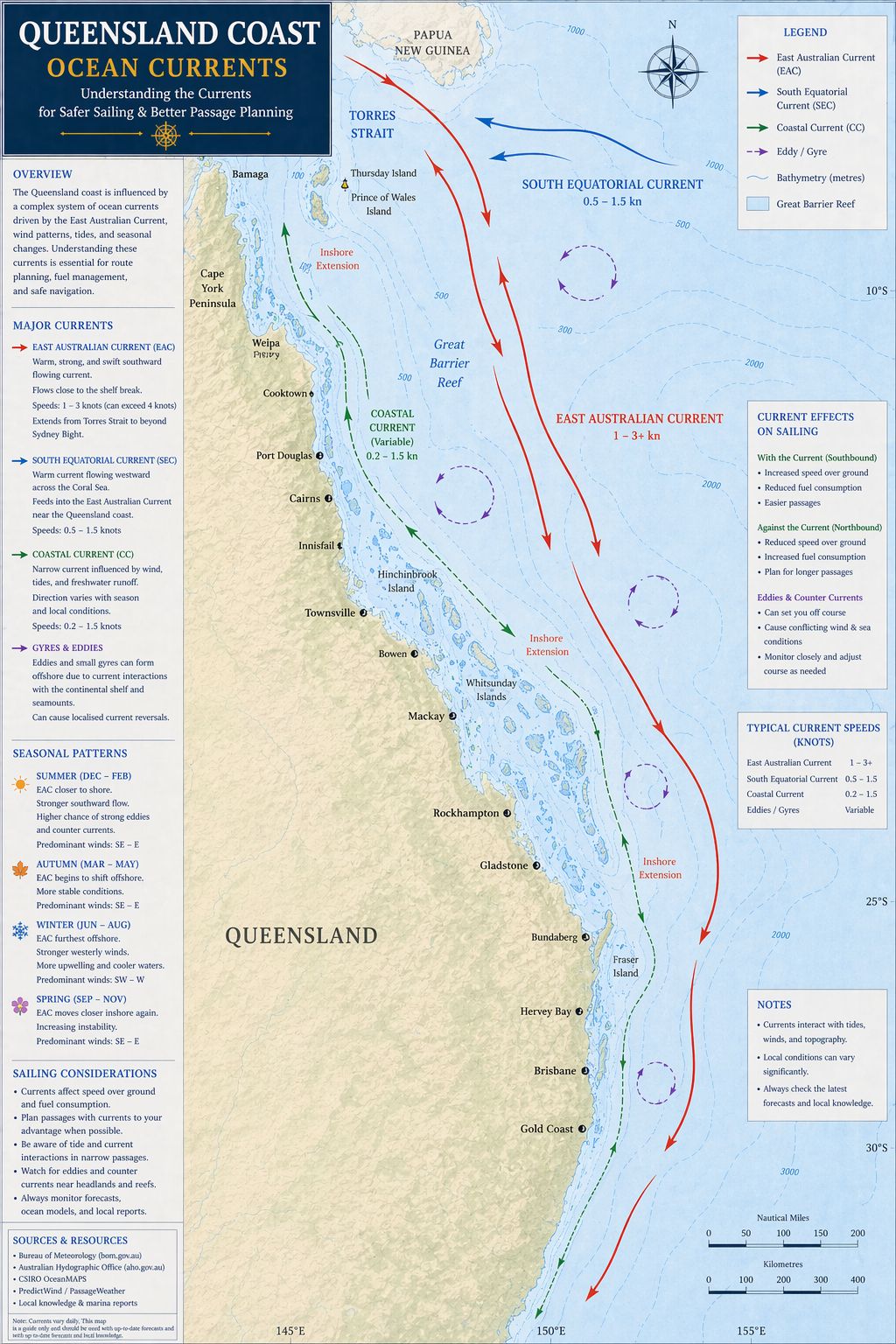
Queensland’s offshore sailing is shaped by the early formation of the East Australian Current, where the flow is strongest, most coherent, and closest to the coast, often accelerating southbound yachts and sharpening sea‑state transitions near the shelf edge. Northbound sailors must account for this fast south‑setting current, as even moderate opposing winds can create steep, uncomfortable seas, particularly off Fraser Island, Cape Moreton, and the wide continental shelf of the southern Queensland coast. Read about the East Australian Current in Queensland here.
Queensland Coastal Navigation Guide - Weather Patterns
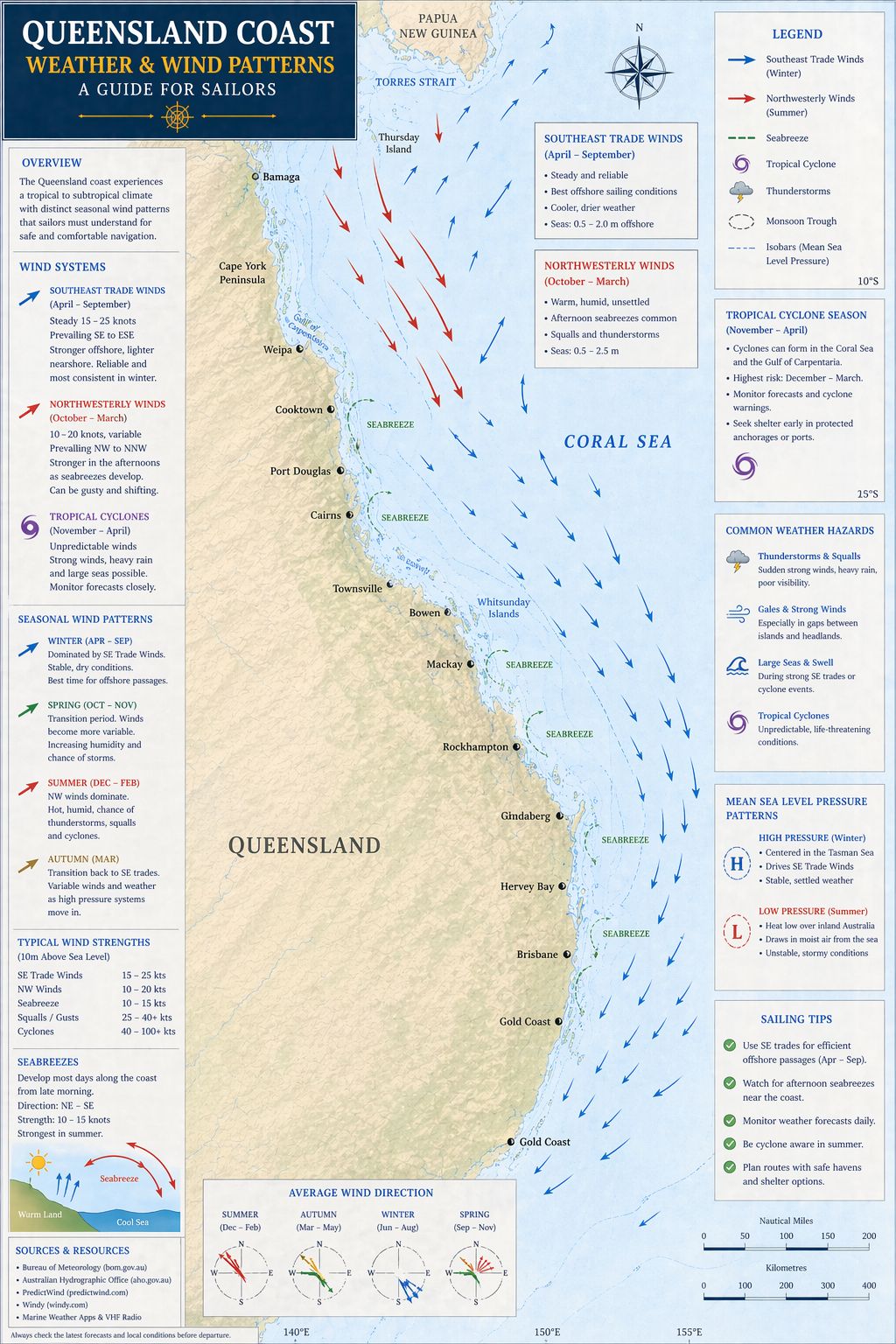
Weather along the Queensland Coast is dominated by south-east trade winds, particularly from autumn through spring, typically 10–20 knots and strongest during the afternoon due to thermal sea-breeze effects. In summer, conditions shift to a more variable pattern, with north-east sea breezes developing most days and frequent thunderstorms and squalls, often associated with high humidity and unstable air masses. The region is also subject to tropical lows and cyclones between November and April, which can bring severe winds, heavy rain, and rapidly changing sea state.
During winter, more stable high-pressure systems prevail, producing clear skies, lower humidity, and consistent south to south-east winds, though occasional westerly offshore winds can occur with passing fronts, particularly in southern Queensland. Sea conditions are strongly influenced by the interaction of wind and current, with shallow coastal areas such as Moreton Bay developing short, steep seas when wind opposes tidal flow. Overall, the Queensland coast experiences predictable trade wind patterns combined with seasonal tropical variability, requiring awareness of both daily sea-breeze cycles and larger weather systems.
Queensland Coastal Navigation Guide - Ports of Entry
Queensland’s Ports of Entry for cruising yachts are spread along the coast and offer reliable clearance points for vessels arriving from overseas. Major ports such as Brisbane, Bundaberg, Gladstone, Mackay, Townsville and Cairns provide full Customs, Immigration and Biosecurity services, with deep‑water access and facilities suited to international arrivals. Smaller northern ports including Cooktown, Thursday Island and Weipa serve as essential clearance options for yachts arriving via the Coral Sea, Torres Strait or the Gulf of Carpentaria. All require advance reporting, adherence to designated arrival procedures and entry during approved operating hours. Clearance is only permitted at these official Ports of Entry, and yachts must remain in quarantine until officers complete their inspections. If entering Australia please read and understand Australia Customs and Biosecurity for Yachts and make your life much easier.
South
East Queensland (SEQ) – Coastal Navigation
Gold Coast – Southport. Southport is a designated Australian Port of Entry and a common arrival point for foreign yachts beginning their Queensland cruising route or sailing south to NSW and beyond. The Gold Coast Seaway is a dredged entrance with strong tidal flow and breaking seas during moderate swell. The outer bar can stand up quickly when swell meets the ebb, making this one of the more dynamic Queensland bar crossings. Inside, the Broadwater offers sheltered but shallow navigation with shifting shoals and heavy traffic. Cruising Guide for Southport is here.
Queensland Coastal Navigation Guide - Moreton Bay
Moreton Bay – South Stradbroke, Peel Island, Scarborough, Bribie Island. Brisbane is the Port of Entry for this region. Moreton Bay is a shallow, tide‑sensitive system with extensive banks and narrow buoyed channels. Strong southeasterlies create short, steep seas across the banks, a defining feature of Moreton Bay navigation. Peel Island is a fair‑weather anchorage. Scarborough offers deep, all‑weather access. Pumicestone Passage is extremely shallow and tide‑dependent. Cruising Guide for Moreton Bay is here. The Queensland Coastal Navigation Guide has a lot of useful information.
Queensland Coastal Navigation Guide - The Sunshine Coast
Mooloolaba’s entrance is a dynamic
coastal bar and one of the more challenging Sunshine Coast bar crossings,
with frequent shoaling and breaking seas in moderate swell. Conditions change
rapidly and require bar‑crossing experience and updated local advice. Reference
website and bar camera. This is also the base for Brisbane Port Pilots who have
their vessels based here. The fishing
fleet here ensure really great fresh seafood. Noosa’s bar is highly unstable
and generally unsuitable for cruising yachts.
The Cruising Guide for Mooloolaba and Noosa is here.
Queensland Coastal Navigation Guide - Central
Queensland
The Fraser Coast forms the sheltered gateway to the Great Sandy Strait, with Hervey Bay, K’gari (Fraser Island), Tin Can Bay and the approaches to the Wide Bay Bar shaping how yachts move through this section of the Queensland coast.
Moving north, the Fraser Coast becomes the first major transition zone, with Hervey Bay acting as a natural holding area before committing to the tide‑timed navigation through the Great Sandy Strait. The Strait itself is a shallow, technical waterway where depth gates, tidal flow and careful planning matter as much as they do on any coastal bar. The Wide Bay Bar sits at its southern entrance, demanding the same patience, observation and commitment that define safe bar‑crossing technique. The region offers a mix of open‑bay passages and protected waterways, where shoaling banks, shifting channels and tidal flow require careful planning, particularly when entering or exiting via the Wide Bay Bar. Weather is moderated by the shelter of Hervey Bay, giving more predictable conditions than the exposed Discovery Coast to the north, while the Great Sandy Strait provides one of the most protected cruising corridors on the east coast. Skippers use the Fraser Coast as a staging area for movements south toward the bar or north toward Bundaberg, taking advantage of its combination of deep all‑weather harbours, mainland anchorages and the extensive sheltered waters behind K’gari.
Breaksea Spit -Hazard and Navigation Considerations
Breaksea Spit marks the point where swell from the Coral Sea and Tasman Sea begins to interact with the shallow shelf, producing refracted and reflected wave patterns that can confuse the sea state. Yachts approaching from the west or south‑west may encounter a sudden increase in wave steepness as they near the spit, particularly during spring tides or when residual East Australian Current flow is present offshore. Maintaining a wide safety margin, monitoring depth trends closely, and avoiding wind‑against‑tide scenarios are the most effective strategies for managing risk in this area.
Breaksea Spit is one of the most dynamic and potentially hazardous areas on the Queensland coast, and yachts rounding the top of Fraser Island must treat it with caution. The spit forms a long, shallow extension of Fraser Island’s northern tip, with rapidly changing sandbanks, tidal overfalls, and abrupt depth transitions that can turn otherwise moderate conditions into steep, confused seas. Even in calm weather, the combination of shallow water and strong tidal flow produces turbulence, and the sea state deteriorates quickly when a southerly wind blows north against the south‑setting flow offshore. This wind–current opposition is amplified by the shoaling effect of the banks, creating short, breaking seas that can extend well beyond the charted shallow areas.
The inner routes across Breaksea Spit, sometimes used by smaller vessels, are unsuitable for most yachts due to shifting channels, unmarked hazards, and unreliable depths. The banks migrate frequently, and the seabed can change significantly after strong weather, making older local knowledge or historic tracks unreliable. For this reason, most yachts adopt a conservative offshore arc north of the spit, remaining in deeper water where the sea state is more predictable and the influence of tidal overfalls is reduced. This offshore route still requires careful timing, as fresh southerlies can create uncomfortable conditions even in deeper water, and the transition from Hervey Bay’s sheltered environment to the open Tasman Sea can be abrupt.
Queensland Coastal Navigation Guide - The Discovery Coast
The Discovery Coast forms the transition zone between the exposed Capricorn Coast and the protected waters of Hervey Bay, with Gladstone, 1770 / Agnes Water, Bustard Head, Pancake Creek and Bundaberg providing the main access points for fuel, water, provisioning and marine services. This section of coastline sits under the SE trade‑wind regime and is exposed to swell from offshore lows, so weather windows and tidal planning are critical for movements between the mainland and the offshore reefs of the Bunker Group, including Lady Musgrave Island, Lady Elliot Island, Fitzroy Reef and neighbouring coral cays. The Great Barrier Reef rises close to the surface here, giving yachts a mix of open‑water passages, river entrances and highly weather‑dependent coral‑cay anchorages. Skippers use the Discovery Coast as a staging area for passages north toward the Capricorn Coast or south toward Hervey Bay and the Great Sandy Strait, taking advantage of its combination of sheltered bays, bar entrances and offshore reef systems.
Queensland Coastal Navigation Guide - The Capricorn Coast
The Capricorn Coast marks the transition between the protected southern cruising grounds and the more exposed central Queensland coastline, with Yeppoon, Rosslyn Bay, Great Keppel Island and the surrounding mainland bays forming the primary access points for Capricorn Coast sailing. This region sits under the influence of the SE trade‑wind pattern but remains more variable than the Whitsundays, with frontal systems, swell from offshore lows and tidal flow shaping movements along the coast. The Great Barrier Reef lies further offshore here, giving yachts a mix of open‑water passages and partially sheltered approaches, where reef awareness, weather windows and tidal planning remain essential. Provisioning, fuel, water and marine services are concentrated around Yeppoon and Rosslyn Bay, making the Capricorn Coast a practical staging area for passages north toward the Whitsundays or south toward Bustard Head, Agnes Water and the protected waters of the Great Sandy Strait.
The Whitsunday
Coast – Mainland Ports
The Whitsunday Coast forms the mainland gateway to the wider Whitsunday Islands cruising region, with Airlie Beach, Shute Harbour and the surrounding bays providing the primary access points for provisioning, fuel, water and marine services. This section of coast sits directly under the influence of the SE trade‑wind regime and the Great Barrier Reef’s protective arc, giving yachts a mix of sheltered mainland anchorages and exposed approaches where tidal planning, reef awareness and weather windows still shape daily movements. The coastline offers reliable staging areas for passages north toward Bowen and Cape Upstart or south toward Mackay and the Cumberland Islands, and skippers use the Whitsunday Coast as a practical base for both short inter‑island hops and longer transitions along the central Queensland seaboard.
Sailing the Whitsunday
Islands
The Whitsunday Islands form the most concentrated network of sheltered cruising waters on the Queensland coast, with deep anchorages, short inter‑island passages and predictable SE trade‑wind patterns that support consistent Whitsunday sailing throughout the season. The region sits behind the Great Barrier Reef, giving yachts a mix of protected channels and exposed outer‑reef approaches, where tidal planning, reef awareness and weather windows still influence daily movements. Approaches from Airlie Beach, Shute Harbour and Hamilton Island provide access to fuel, water, provisioning and marine services, making the Whitsundays a practical base for both short passages and extended Whitsunday Islands cruising. Despite the sheltered nature of the group, anchorage choice remains dependent on wind direction, swell wrap and seasonal conditions, and skippers use the region’s reliable patterns to move efficiently between the islands and onward along the wider Queensland coast.
Sailing to Outer
Great Barrier Reef
Fair‑weather reef anchorages requiring good light and updated charts. Hardy Reef and Bait Reef sit within easy striking distance from Hamilton Island, offering reliable moorings and some of the most accessible outer‑reef snorkelling and diving in the Whitsundays. The Cruising Guide for Hardy Reef and Bait Reef are here.
Queensland Coastal Navigation Guide - Fishing
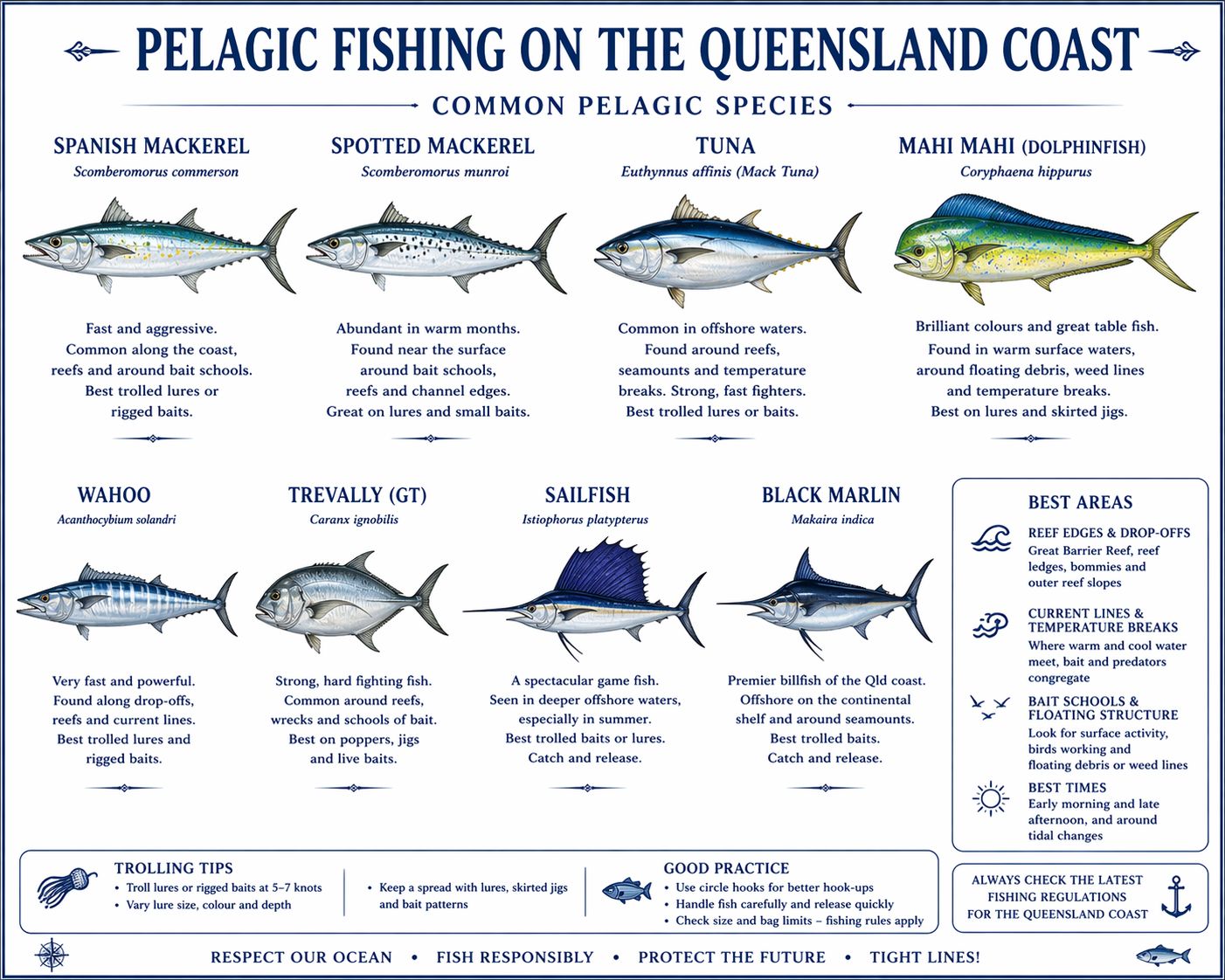
Fishing while sailing the Queensland Coast is particularly productive for pelagic species along the open coastline, reef edges, and current lines. Common targets include mackerel (spotted and Spanish), tuna (mack tuna, longtail), mahi mahi (dolphinfish), wahoo, and trevally, with sailfish and marlin encountered further offshore. These species are typically found along bait schools, reef drop-offs, headlands, and pressure edges, often where tidal flow and current interact. Trolling lures or rigged baits while underway is effective, especially at speeds of 5–7 knots, with activity peaking around dawn and dusk or during tidal changes when predators are actively feeding
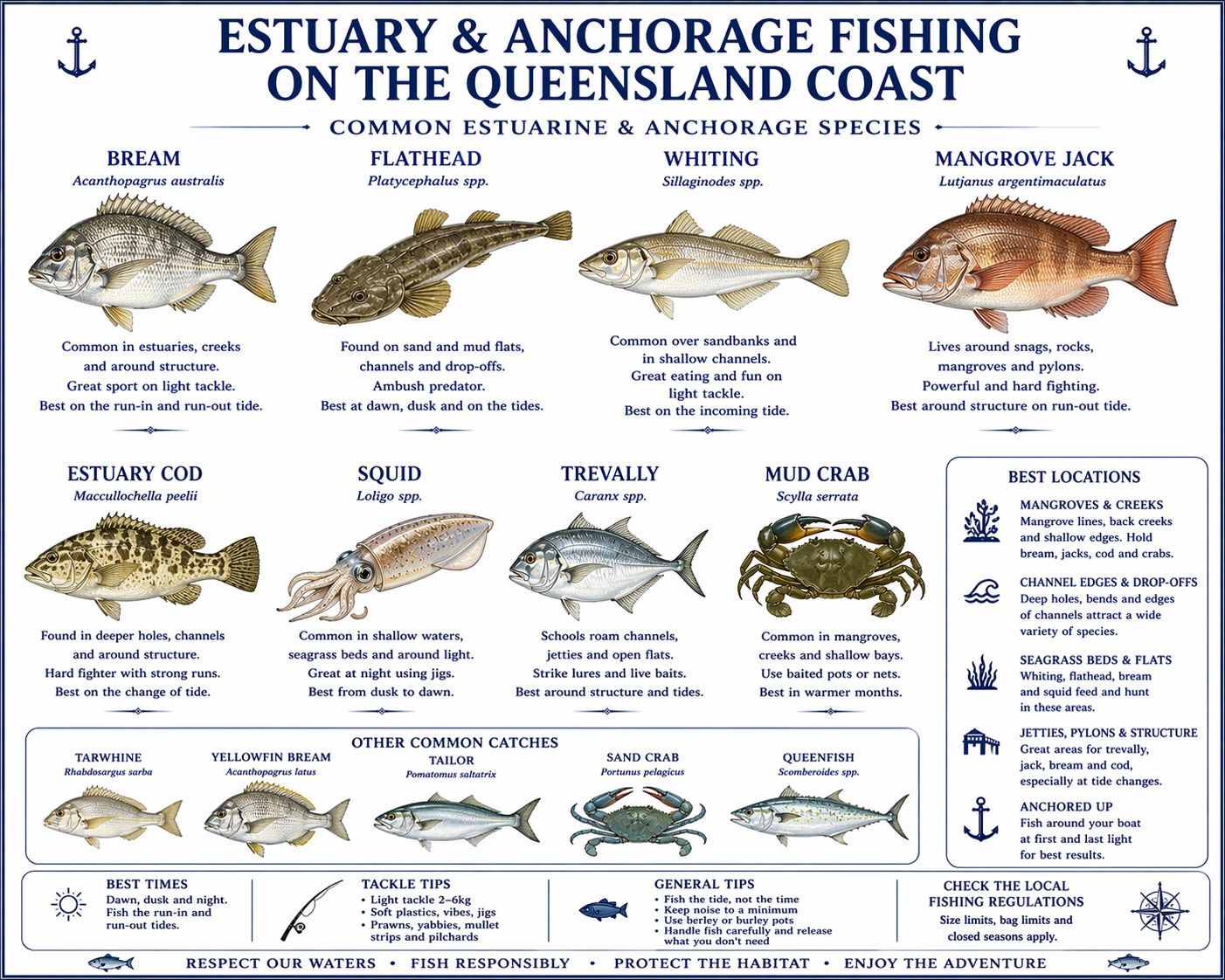
Within estuaries, anchorages, and sheltered waters such as Moreton Bay, fishing shifts to bottom and structure-based species. Key catches include bream, flathead, whiting, mangrove jack, estuary cod, and squid, with mud crabs also common in mangrove-lined areas. These species are typically found around sandbanks, seagrass beds, channel edges, mangroves, and jetties, with best results on the run-in and run-out tides when water movement concentrates bait and feeding activity. Light tackle, soft plastics, and natural baits such as prawns or yabbies are commonly used, making these areas well suited for fishing at anchor or during short stops.
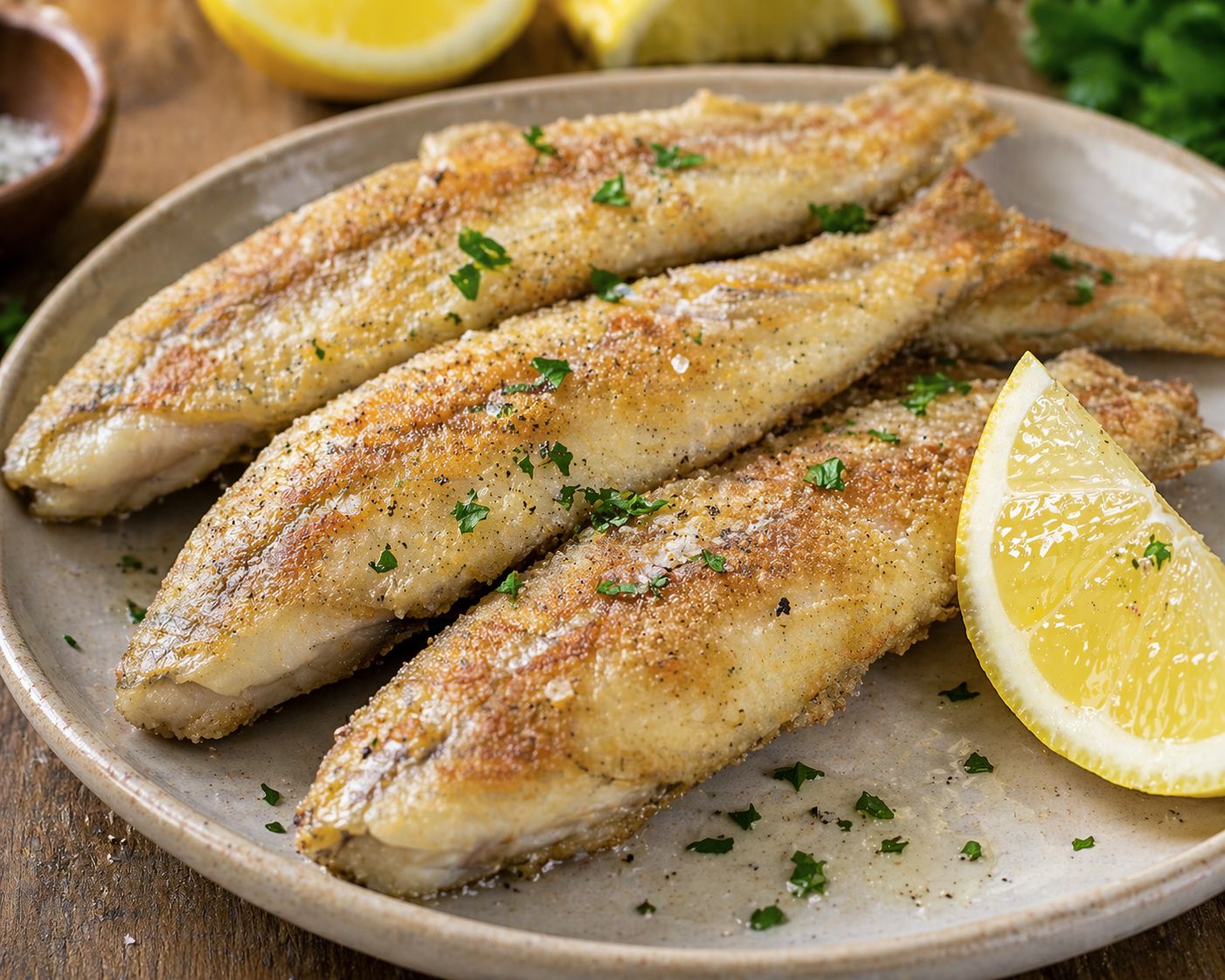
Simple Pan-Fried Sand Whiting
These are my favorite eating fish. They are simply lightly dusted and quickly cooked to preserve its delicate flavour.
- Start by rinsing and patting dry whole butterflied whiting or fillets. Season lightly with salt and pepper, then dust with a thin coating of plain flour, shaking off any excess. Heat a pan over medium heat with a small amount of olive oil or butter until hot but not smoking.
- Place the fish in the pan and cook for 2–3 minutes per side, depending on size, until golden and just cooked through. Avoid overcooking, as the flesh is fine and can dry quickly.
- Remove from the pan, place on a warm plate, and finish immediately with a fresh squeeze of lemon juice. Serve simply, optionally with a sprinkle of chopped parsley if you have it and a side of salad or crusty bread and an ice cold beer.
Mechanical and Electrical Repairs
Resource
If you are headed somewhere remote consider the need to expand your knowledge base or have an information resource on board. Why not get a copy of my book The Marine and Electrical and Electronics Bible 4th Edition. By and for yachties, with everything from batteries and charging, solar and wind, diesel engines and marine electronics and so much more. Your complete systems guide. 650 pages of practical advice. In Australia and New Zealand order a copy through Boat Books. UK and European boats can buy the UK Edition Here. US and Canadian boats can get the US Edition Order Here. Marine systems are my profession so let me help you. By a liveaboard boat owner for other boat owners


Sailing in North
Queensland
North Queensland offers a diverse stretch of cruising water shaped by the Great Barrier Reef, the SE trade‑wind regime and a coastline that shifts from sheltered mainland bays to exposed island anchorages as you move between Townsville, Magnetic Island, Hinchinbrook Channel and Mission Beach. It is a region where reef navigation, tidal planning and clear weather windows matter, with the inner route providing a protected but intricate path behind the reef while the offshore route remains fully exposed to Coral Sea swell. Townsville and Magnetic Island form the main service and provisioning centres, with additional support available in Cardwell and Mission Beach before the coastline transitions toward the more remote waters leading to Cairns. North Queensland sailing rewards skippers who plan conservatively, understand the influence of the trades and use the region’s mix of all‑weather harbours and fair‑weather anchorages to move efficiently along this central section of the Queensland coast
Cruising Far North Queensland
Cruising Far North Queensland is one of Australia’s most distinctive blue‑water cruising regions, defined by long distances, strong SE trade winds and the constant presence of the Great Barrier Reef, where reef passes, tidal gates and exposed coastal stretches shape every decision a skipper makes. The coastline transitions from well‑serviced centres such as Cairns, Port Douglas and Cooktown into increasingly remote anchorages as you move north toward Cape Melville, Princess Charlotte Bay and Cape York, with each section offering a different mix of mainland bays, coral cays and island groups. Cruising yachts treat FNQ as a region that demands conservative planning, reliable weather windows and self‑sufficiency, with provisioning, water, diesel and marine services concentrated in only a handful of ports before the coastline becomes wild, isolated and fully exposed to Coral Sea swell. This guide provides a structured overview of the major FNQ sailing regions, anchorages and navigation considerations, supporting skippers planning extended passages through one of Australia’s most challenging and rewarding cruising grounds.
Gulf of
Carpentaria – Weipa (Port of Entry), Karumba, Burketown, Bamaga, Lockhart River
Queensland Coastal Navigation Guide and the Gulf of Carpentaria, including Weipa (Port of Entry), Karumba, Burketown, Bamaga and Lockhart River requires careful tidal planning, attention to shallow bars and shifting mudbanks, and conservative approaches to river entrances, with most anchorages exposed and best used in settled conditions. Shallow, exposed coastline is dominated by tidal flats. River entrances are tide‑dependent. The Cruising Guide for Weipa and Karumba are here.
Queensland Coastal Navigation Guide - Summary
Queensland offers a long, continuous coastline with no single navigational pattern, and safe passage depends on understanding how each region behaves. From bar entrances and shallow channels to reef passes, tidal streams, and remote anchorages, the coast demands conservative decision‑making and accurate local information. The linked destination guides provide the detail needed for planning, while this overview gives skippers a clear sense of the broader route and the operational considerations that define each section of the Queensland coast. The Queensland Coastal Navigation Guide is here to assist in passage planning.