The Japan Yacht Cruising Guide
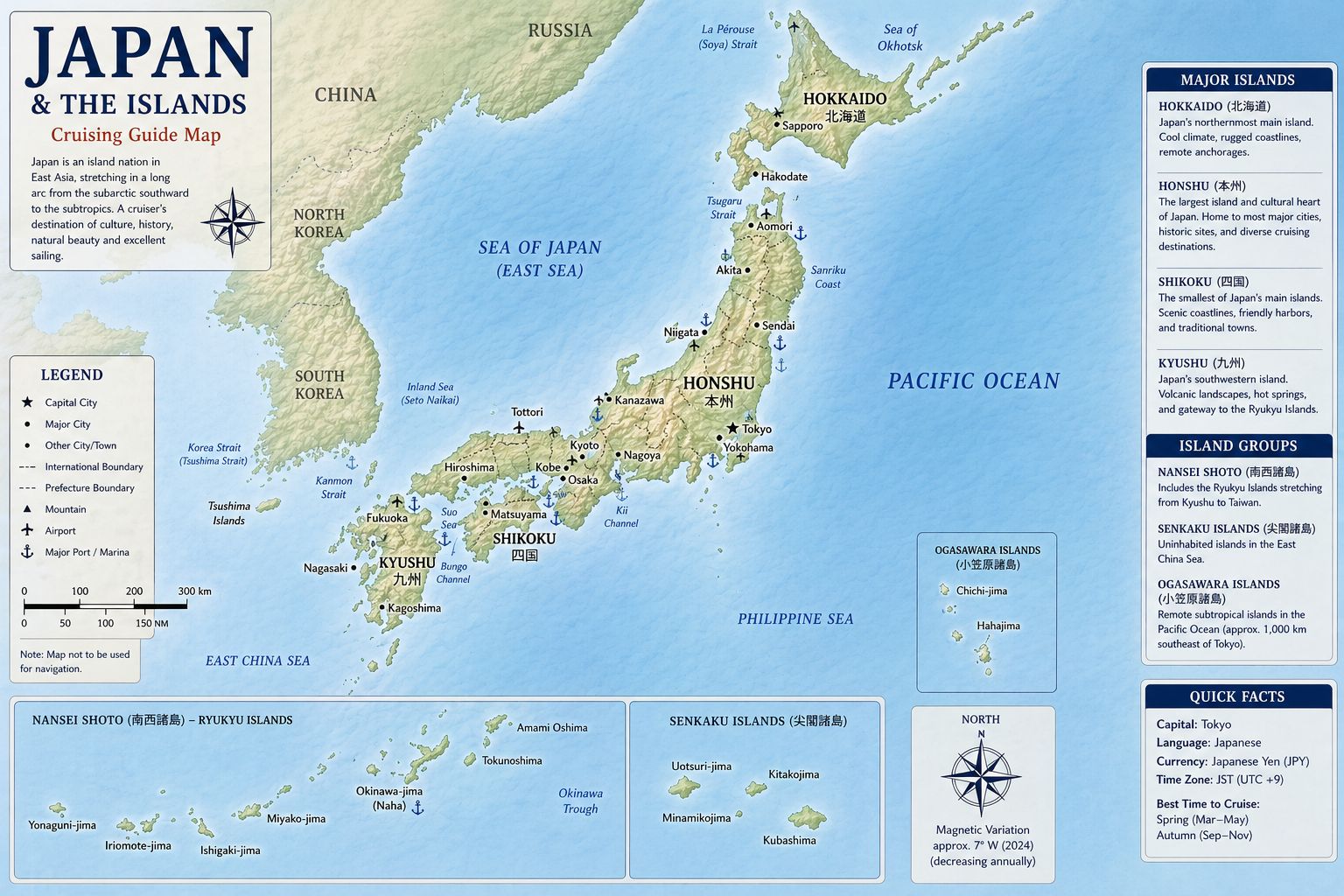
The Japan yacht cruising guide. Japan offers one of the most varied and technically interesting cruising grounds in the world, with more than 34,000 kilometres of coastline and over 14,000 islands spread across a north–south arc of more than 3,000 kilometres. Conditions range from cold‑water sailing in Hokkaido to subtropical cruising in Okinawa, with sheltered inland routes, exposed Pacific coasts, deep bays, and complex tidal systems. For yachts, Japan is not a single cruising region but a chain of distinct maritime environments, each with its own ports, weather patterns, and operational considerations. This overview provides a practical starting point for planning voyages across the country, linking the major regions into a coherent national cruising framework.
Most visiting yachts follow a broad coastal route that connects the country’s key maritime hubs: Hokkaido, the Tohoku coast, Tokyo Bay, the Izu Islands, Suruga Bay, Ise Bay, the Kii Peninsula, Osaka Bay, the Seto Inland Sea, Shikoku’s Pacific coast, Kyushu, and the Ryukyu Islands including Okinawa. Each region offers different levels of infrastructure, shelter, and navigational complexity. The Seto Inland Sea (Seto Naikai) is the most protected and yacht‑friendly area, but the rest of Japan provides extensive opportunities for coastal cruising, long‑distance passages, and seasonal exploration. It is important to understand the cultural norms and etiquette requirements that make Japan such a great place to cruise. For best practices for yacht operations in Japan and how to navigate Japanese port etiquette, the core message is simple: professionalism expressed quietly will always be welcomed.
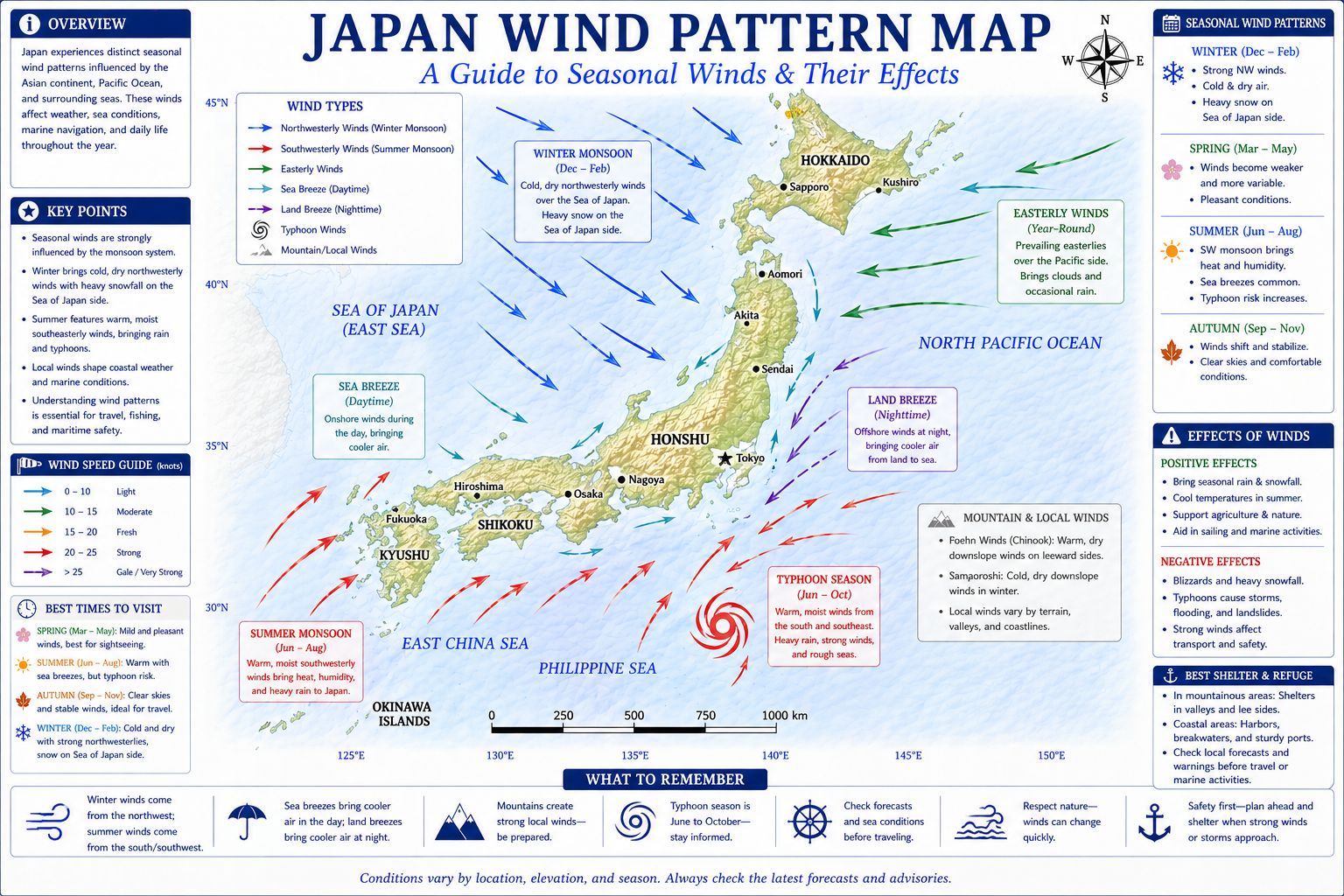
Japan Yacht Cruising Guide - Winds
Winds around Japan are strongly shaped by the East Asian monsoon system, producing distinct seasonal patterns that directly affect sailing conditions. In winter (Dec–Feb), cold, dry northwesterly winds flow off the Asian continent across the Sea of Japan, often strengthening to 20–30 knots and generating steep seas, frequent squalls, and heavy snowfall on the western coasts. In summer (Jun–Aug), the pattern reverses, with warm, moist southeasterly winds from the Pacific bringing higher humidity, rain bands, and generally lighter but more variable conditions. The spring and autumn transition periods are marked by shifting winds, passing low-pressure systems, and occasional strong fronts. From June to October, typhoons can significantly disrupt normal patterns, bringing gale-force winds, heavy seas, and rapid changes in direction. Local effects—such as coastal funneling, mountain-induced acceleration, and land/sea breezes—further modify wind strength and direction, particularly in narrow straits and along rugged coastlines.
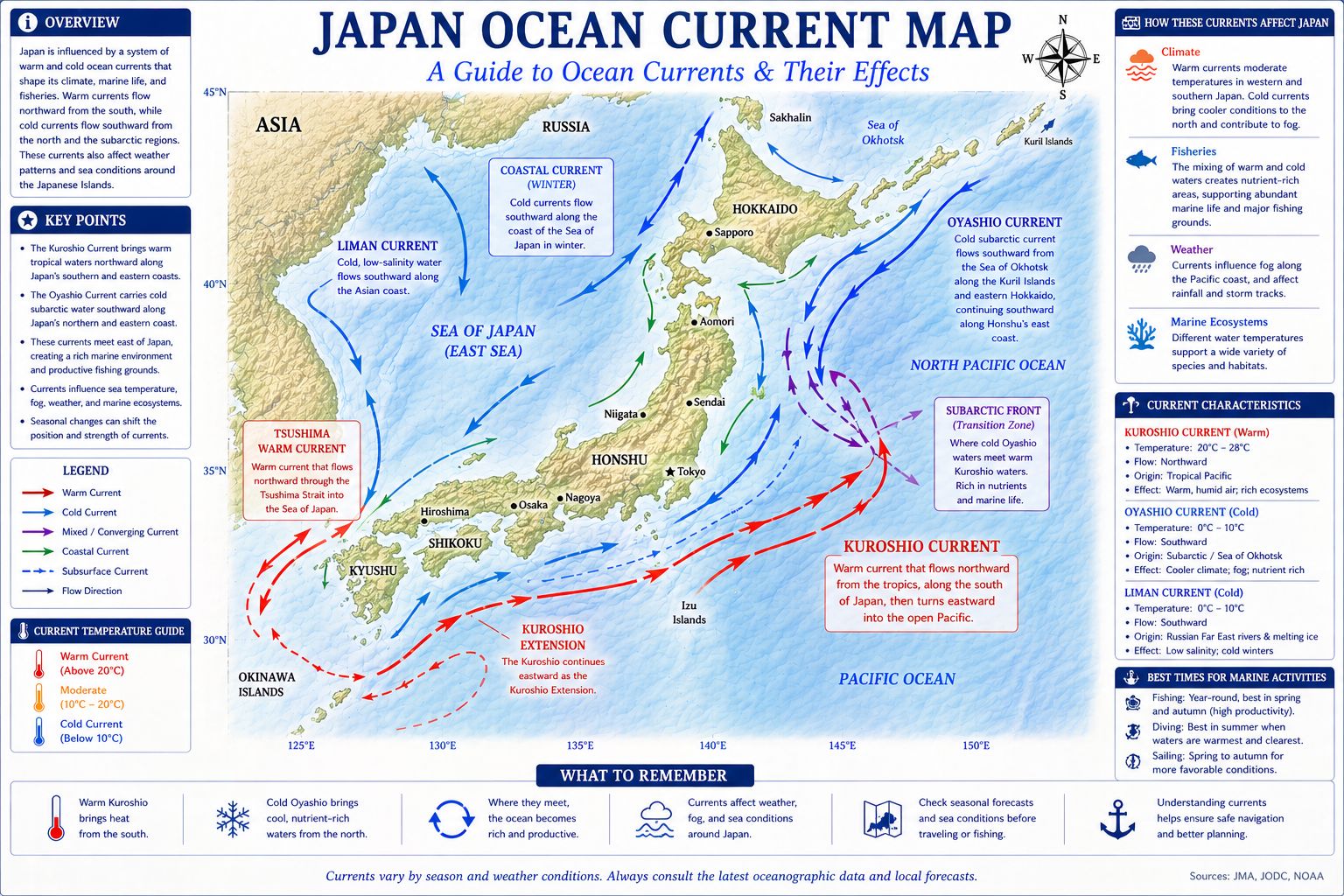
Japan Yacht Cruising Guide - Ocean Currents
Ocean currents around Japan are dominated by the interaction of two major systems: the warm Kuroshio Current and the cold Oyashio Current. The Kuroshio flows northeastward along Japan’s Pacific coast, often at 1–3 knots, carrying warm tropical water that moderates climate and can produce strong set and eddies, particularly off Honshu and through constricted passages. From the north, the Oyashio brings cold, nutrient-rich water southward along Hokkaido and the Kuril Islands. Where these currents meet east of Japan, they create a highly dynamic convergence zone with fog, sharp temperature gradients, and complex eddy fields. Seasonal shifts influence strength and position, while local currents—such as the Tsushima Current in the Sea of Japan and numerous coastal and tidal streams—add further variability. For navigation, the combination of strong offshore flow, countercurrents, and localized acceleration near headlands and straits requires careful allowance for set and drift, especially on longer coastal passages.
Japan Yacht Cruising Guide - Seto Inland Sea (Seto Naikai)
The Seto Inland Sea (Seto Naikai) is Japan’s most sheltered and consistently navigable cruising region. Enclosed by Honshu, Shikoku, and Kyushu, it forms a protected waterway stretching roughly 400 kilometres, with more than 700 islands, short inter‑port distances, and reliable access to marinas and fishing harbours. For yachts, it offers predictable passages, manageable tidal planning, and a concentration of practical anchorages rarely found elsewhere in Japan. Most cruising routes link the region’s major ports and island groups. Yachts commonly enter from Kobe, Osaka, or Wakayama, then move west through Takamatsu, Shodoshima, and the art islands of Naoshima and Teshima. The central section around Onomichi, Ikuchi‑jima, and the Shimanami Kaidō is frequently visited for its protected channels and dependable moorings. Further west, Imabari, Kure, and Hiroshima provide strong service access and sheltered bays. With short legs and consistent infrastructure, the Seto Naikai is the most practical and yacht‑friendly cruising environment in Japan.
Japan Yacht Cruising Guide -Hokkaido
Hokkaido forms Japan’s northernmost cruising region and offers cold‑water sailing with a short operational season. The coastline is rugged, with deep bays, fishing ports, and limited marina infrastructure. The main ports for yachts are Hakodate, Otaru, Muroran, Kushiro, and Wakkanai. These ports provide fuel, water, and basic supplies, though chandlery access is limited. Weather systems in Hokkaido are stronger and less predictable than in southern Japan, with low‑pressure systems moving rapidly across the Sea of Japan and the North Pacific. Summer provides the most stable conditions, but fog is common, and visibility can be poor. Hokkaido is best suited to experienced crews comfortable with colder climates, exposed coasts, and longer distances between sheltered harbours.
Japan Yacht Cruising Guide -Tohoku Coast (Northern Honshu)
South of Hokkaido, the Tohoku region offers a long stretch of coastline with deep bays and fjord‑like inlets. Ports such as Aomori, Hachinohe, Miyako, Kamaishi, Ofunato, Sendai, and Ishinomaki provide access to sheltered anchorages and fishing harbours. The region is sparsely populated, and facilities vary widely. Many harbours are functional rather than recreational, but they offer reliable shelter and access to fuel and water. The Pacific coast of Tohoku is exposed to ocean swell, and weather systems can move quickly. Summer is the most suitable season for cruising, with calmer seas and more predictable winds. The region is well suited to yachts undertaking north–south coastal passages or those seeking quieter, less‑visited cruising grounds.
Japan Yacht Cruising Guide -Tokyo Bay and the Greater Kanto Region
Tokyo Bay is one of Japan’s most accessible and infrastructure‑rich cruising areas. The bay is sheltered, with numerous marinas, yacht clubs, and service facilities. Key ports include Yokohama, Tokyo, Chiba, and Kawasaki. These ports provide full provisioning, fuel, water, repairs, and haul‑out options. Tokyo Bay is a major commercial zone, and traffic density is high, requiring careful navigation and AIS monitoring. The bay serves as a staging point for yachts heading north toward Tohoku or south toward the Izu Peninsula and the Pacific coast. Weather is generally moderate, though winter can bring strong northerlies and summer haze can reduce visibility. Tokyo Bay is the most practical entry point for yachts arriving from the east or from the Pacific.
Japan Yacht Cruising Guide -Izu Peninsula and the Izu Islands
South of Tokyo Bay, the Izu Peninsula and the offshore Izu Islands provide a transition from sheltered waters to more exposed Pacific cruising. Ports such as Shimoda, Ito, and Numazu offer marina access and provisioning. The offshore islands, Oshima, Niijima, Shikinejima, Kozushima, and Hachijojima all provide deep anchorages, volcanic landscapes, and clear water. Facilities on the islands vary, with some offering fuel and water and others limited to basic fishing harbours. The region is exposed to Pacific swell, and conditions can change quickly. Summer offers the most stable weather, though typhoons can affect the area. The Izu region is well suited to yachts seeking coastal passages with a mix of sheltered and open‑water conditions.
Japan Yacht Cruising Guide -Suruga Bay and the Mt. Fuji Coast
Suruga Bay lies west of the Izu Peninsula and offers deep water, fishing ports, and views of Mt. Fuji. The main ports for yachts are Shimizu and Numazu, both of which provide provisioning, fuel, and marina access. The bay is sheltered from the east but open to the south, and swell can enter during periods of strong wind. Suruga Bay is a practical stop for yachts transiting between Tokyo Bay and Ise Bay or for those seeking sheltered anchorages near major transport links. Weather is generally moderate, though winter winds can be strong. The region is suitable for coastal cruising and as a staging point for longer passages.
Japan Yacht Cruising Guide -Ise Bay and the Chubu Region
Ise Bay is a large, semi‑protected body of water with access to Nagoya, Toba, and Yokkaichi. The bay offers marinas, fuel, water, and provisioning, though the coastline is heavily industrial in some areas. The region is sheltered compared to the Pacific coast, making it suitable for yachts seeking calmer waters. Ise Bay provides access to cultural sites such as the Ise Grand Shrine and serves as a link between the Kanto region and the Kii Peninsula. Weather is generally stable, though summer thunderstorms can occur. The bay is a practical cruising area for yachts moving between eastern and western Japan.
Japan Yacht Cruising Guide -Kii Peninsula
The Kii Peninsula marks the transition between the Pacific Ocean and the Seto Inland Sea. The coastline is exposed, with strong currents and limited shelter. Key ports include Wakayama, Shingu, Kushimoto, and Owase. The Kii Channel, between Wakayama and Awaji Island, is a major entry point to the Inland Sea and carries strong tidal streams. The Pacific side of the peninsula is rugged and best suited to experienced crews comfortable with open‑ocean conditions. Weather can be variable, and swell is common. The region is an important link for yachts moving between the Pacific coast and the Inland Sea.
Japan Yacht Cruising Guide - Osaka Bay and the Kansai Coast
Osaka Bay provides a mix of urban marinas and industrial ports. Key ports include Osaka, Kobe, and Wakayama. The bay is sheltered and offers full provisioning, fuel, water, and repair facilities. Kobe is one of the best‑equipped yacht ports in Japan, with reliable services and easy access to transport. Osaka Bay serves as a gateway to the eastern Seto Inland Sea and is a practical staging point for yachts preparing to enter the region. Weather is generally moderate, though winter winds can be strong. The bay is suitable for yachts seeking reliable infrastructure and sheltered cruising.
Japan Yacht Cruising Guide - Shikoku Pacific Coast
The Pacific coast of Shikoku is remote and exposed, with fewer marinas and more fishing ports. Key ports include Kochi, Muroto, Tosashimizu, and Anan. The coastline is rugged, with long stretches between sheltered harbours. Swell is common, and weather systems can move quickly. The region is best suited to experienced crews undertaking coastal passages or preparing for longer offshore routes. Facilities vary, with some ports offering fuel and water and others limited to basic services. The Shikoku Pacific coast is a challenging but rewarding cruising area for yachts comfortable with open‑ocean conditions. Sailing Western Japan Chugoku Shikoku has a lot to offer.
Japan Yacht Cruising Guide -Kyushu North and West Coasts
Kyushu’s northern and western coasts offer a mix of sheltered bays, historic ports, and reliable infrastructure. Key ports include Fukuoka, Sasebo, Nagasaki, and Karatsu. The region provides fuel, water, provisioning, and repair services, with several marinas and fishing ports suitable for yachts. Weather is generally moderate, though winter winds can be strong in the Sea of Japan. The region is well suited to coastal cruising and serves as a link between Japan and Korea or China for yachts arriving from overseas. The coastline offers a mix of urban and rural cruising environments.
Japan Yacht Cruising Guide -Kyushu South and Kagoshima Bay
Southern Kyushu offers warmer weather and a large, sheltered cruising area in Kagoshima Bay, a volcanic caldera with reliable anchorages and marina access. Ports such as Kagoshima, Makurazaki, and Shibushi provide fuel, water, and provisioning. The region is suitable for yachts preparing to head toward Okinawa or returning north along the Pacific coast. Weather is generally mild, though summer brings the possibility of typhoons. The coastline offers a mix of sheltered bays and exposed headlands.
Mechanical
and Electrical Repairs Resource
If you are headed somewhere remote consider the need to expand your knowledge base or have an information resource on board. Why not get a copy of my book The Marine and Electrical and Electronics Bible 4th Edition. By and for yachties, with everything from batteries and charging, solar and wind, diesel engines and marine electronics and so much more. Your complete systems guide. 650 pages of practical advice. In Australia and New Zealand order a copy through Boat Books. UK and European boats can buy the UK Edition Here. US and Canadian boats can get the US Edition Order Here. Marine systems are my profession so let me help you. By a liveaboard boat owner for other boat owners


Japan Yacht Cruising Guide -Okinawa and the Ryukyu Islands
The Ryukyu Islands form Japan’s southernmost cruising region and offer subtropical conditions, coral reefs, and clear water. Key ports include Naha, Zamami, Miyakojima, and Ishigaki. Facilities vary, with Naha offering full services and the outer islands providing basic supplies. The region is exposed to ocean swell and requires careful navigation around reefs. Weather is warm year‑round, though typhoons are a significant seasonal consideration. The Ryukyu Islands are well suited to yachts seeking warm‑water cruising and longer passages between islands.
Japan Yacht Cruising Guide - Summary
Japan offers a wide range of cruising environments, from sheltered inland seas to exposed Pacific coasts and subtropical island chains. The country provides reliable infrastructure in major ports, though facilities vary in remote areas. Weather patterns differ significantly between regions, and seasonal planning is essential. Navigation ranges from straightforward coastal passages to complex tidal systems and open‑ocean conditions. For yachts seeking a diverse and technically interesting cruising destination, Japan provides extensive opportunities for exploration, with each region offering its own operational considerations and maritime character. Japan Yacht Cruising Guide, so much to see and experience and it will take more than one season to do it justice.