Ryukyu Islands Cruising Guide: Ports,
Provisioning & Destinations
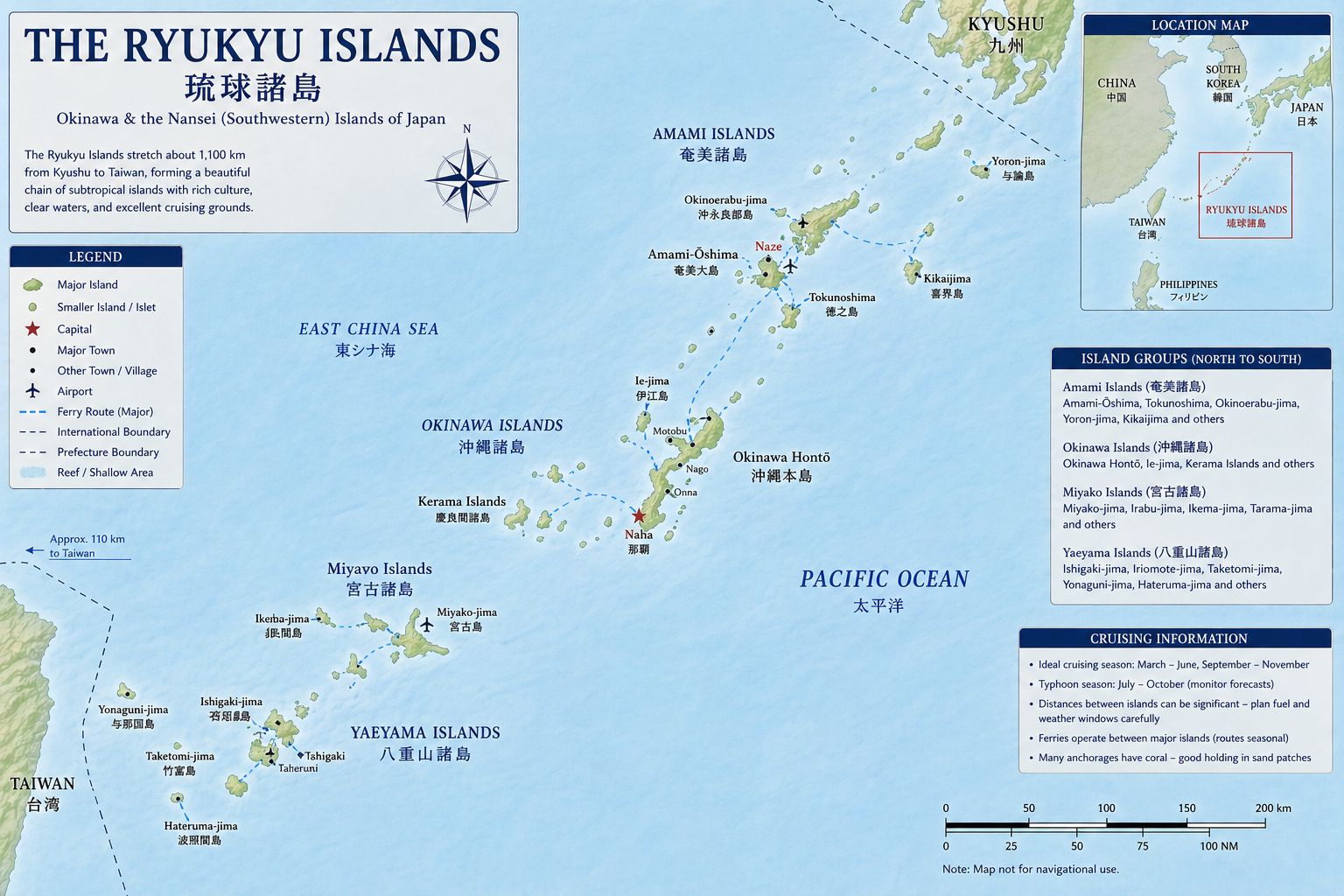
Ryukyu Islands cruising guide. Stretching more than a thousand kilometres from Kyushu to Taiwan, the Ryukyu Islands form one of the most distinctive maritime regions in Japan, a warm, coral‑fringed arc of ports, fishing towns, anchorages, and remote island communities that feel worlds apart from the colder, rugged coasts of Hokkaido. This hub page serves as the central starting point for exploring every major destination in the chain, linking you to detailed guides for each port and island. Whether you’re planning a yacht passage, a provisioning run, or a cultural exploration of the Ryukyus, this page gives you the regional context you need before diving into the individual destination pages.
The Ryukyus are traditionally divided into three broad groups: the Okinawa Islands, the Miyako Islands, and the Yaeyama Islands, with the Kerama Islands, Kumejima, Aguni, and Tonaki forming important mid‑chain stepping stones. Each group has its own provisioning profile, harbour characteristics, cultural identity, and operational considerations. Naha, the capital of Okinawa Prefecture, is the logistical heart of the entire chain, dense, well supplied, and connected to every island by ferry, cargo, and air routes. As you move outward from Naha, the rhythm of the islands changes: ports become smaller, provisioning becomes more local, and the cultural texture deepens into the distinct Ryukyuan traditions that define the region.
The Okinawa Main Island – Urban Centres and Marinas
The northern half of the chain begins with Naha, Ginowan, Itoman, and Chatan, the four major ports on Okinawa’s main island. These destinations form the operational backbone of the region, offering the deepest provisioning, the most reliable marine services, and the broadest range of supermarkets, traditional markets, and specialty stores. Naha’s Makishi Market and Tomari Fish Market anchor the island’s food culture, while Ginowan Marina and Chatan’s American‑influenced waterfront provide modern facilities for yachts and visiting vessels. Itoman, with its large fishing fleet, offers a working‑harbour atmosphere and some of the freshest seafood in the prefecture.
Beyond the urban belt, the main island’s east and north coasts open into quieter towns and anchorages, each with its own character. While these smaller communities are not covered in the same depth as the major ports, they form part of the broader navigational landscape and can be used as staging points for passages toward the Kerama Islands or the mid‑chain islands to the west.
The Kerama Islands – Clear
Water, Quiet Anchorages
Just west of Okinawa’s main island lie the Kerama Islands, a cluster of steep, forested islands surrounded by some of the clearest water in Japan. Zamami, Aka, and Tokashiki are the primary destinations here, each offering small harbours, limited provisioning, and a relaxed, village‑scale rhythm. These islands are ideal for crews seeking quiet anchorages, diving, and short‑range cruising. Provisioning is modest, small supermarkets, local shops, and occasional fish stalls, but the proximity to Naha makes resupply straightforward. The Keramas serve as a natural extension of the Okinawa main island, offering a change of pace without requiring long passages.
The Mid‑Chain Islands –
Kumejima, Aguni, Tonaki
Further west, the mid‑chain islands of Kumejima, Aguni, and Tonaki form a transitional zone between the urban centres of Okinawa and the more remote island groups to the south. Kumejima is the largest and best supplied of the three, with supermarkets, fuel, and a working harbour that supports both fishing and inter‑island transport. Aguni and Tonaki are smaller and quieter, with provisioning limited to local shops and small markets. These islands are important stepping stones for crews heading toward the Miyako Islands or returning north toward Naha, offering safe harbours and a glimpse into the slower, more traditional side of Ryukyuan life.
The Miyako Islands – Coral
Lagoons, Modern Facilities
South of the mid‑chain lies the Miyako Islands, centred on Miyakojima, with satellite islands including Ikema, Irabu, Shimoji, Kurima, and Tarama. Miyakojima is the primary provisioning hub of the group, with supermarkets, fish markets, fuel, and a growing marina infrastructure. The surrounding islands offer spectacular coral lagoons, shallow anchorages, and quiet villages, but provisioning becomes increasingly limited as you move away from Miyakojima itself. The Miyako group is a natural midpoint in the Ryukyu chain, remote enough to feel distinct, yet still connected enough to support extended cruising.
The Yaeyama Islands – Remote,
Tropical
At the southern end of the chain lie the Yaeyama Islands, the most remote and culturally unique part of the Ryukyus. Ishigaki is the central hub here, offering strong provisioning, a major fish market, supermarkets, fuel, and a busy port that connects the entire island group. From Ishigaki, the chain spreads outward to Taketomi, Kohama, Kuroshima, Iriomote, Hateruma, and finally Yonaguni, Japan’s westernmost inhabited island. Provisioning becomes progressively more limited as you move away from Ishigaki, with most outer islands relying on small shops, local produce, and daily deliveries from the main hub. The Yaeyamas offer some of the most dramatic landscapes in Japan—dense jungle, mangrove rivers, coral reefs, and quiet fishing villages, making them a highlight for crews willing to travel the full length of the chain.
Ryukyu
Islands Cruising Guide - Weather
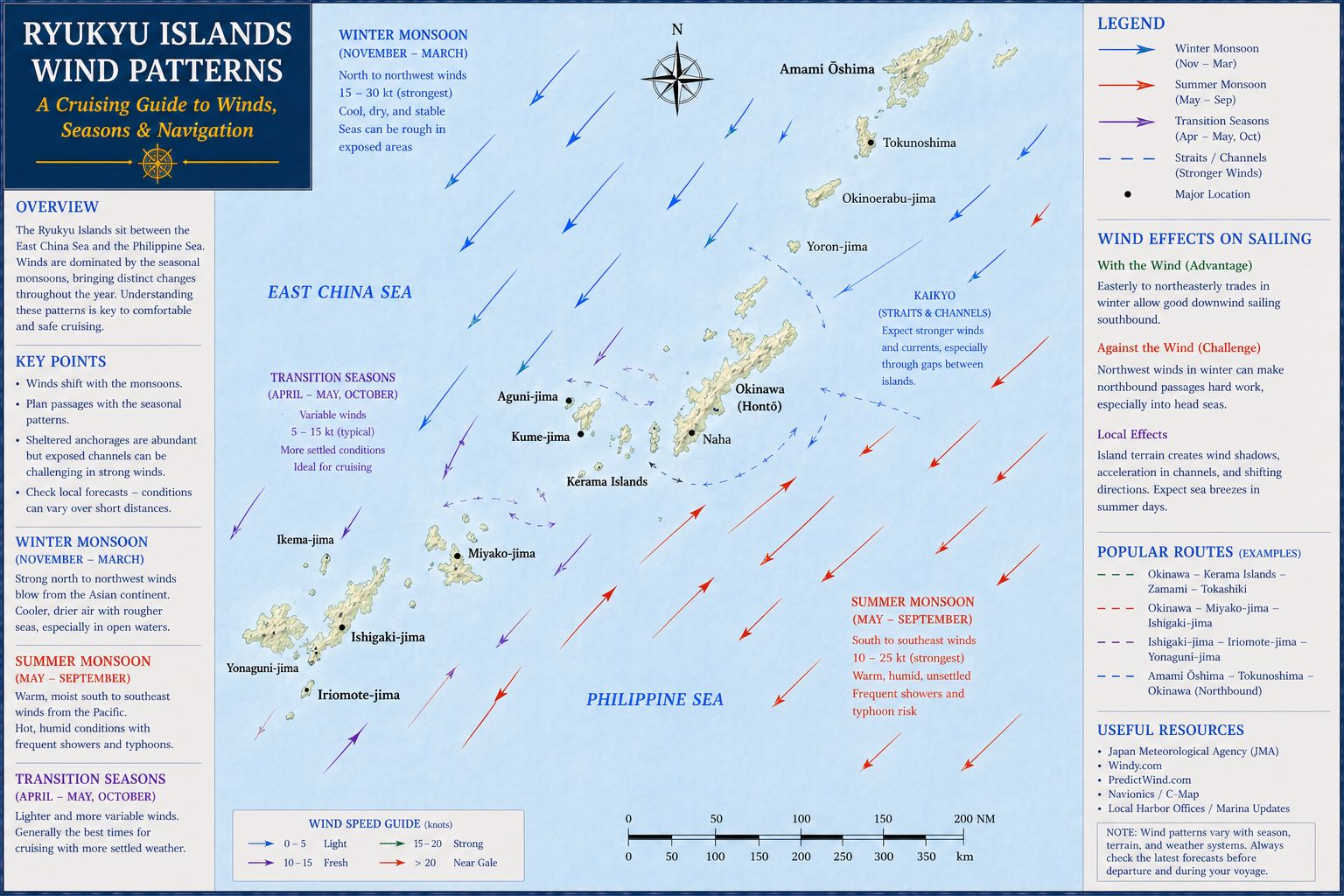
Weather in the Ryukyu Islands is shaped by warm ocean currents, seasonal winds, and a tropical–subtropical climate that feels very different from mainland Japan. Winters are mild, with steady northeasterlies and relatively calm seas, while spring brings shifting winds, early humidity, and the first signs of the rainy season. Summer is dominated by high heat, strong sunlight, and the possibility of typhoons, large, slow‑moving systems that can affect the entire chain from Okinawa to Yonaguni. Autumn is often the most settled season, with warm water, lighter winds, and clear visibility. Across the year, localised squalls, fast‑moving showers, and strong tidal currents can influence short‑range passages, especially around reef systems and narrow channels. Understanding these seasonal patterns is essential for planning safe movements between islands, choosing anchorages, and timing longer passages through the chain.
Ryukyu
Islands Cruising Guide - Navigation
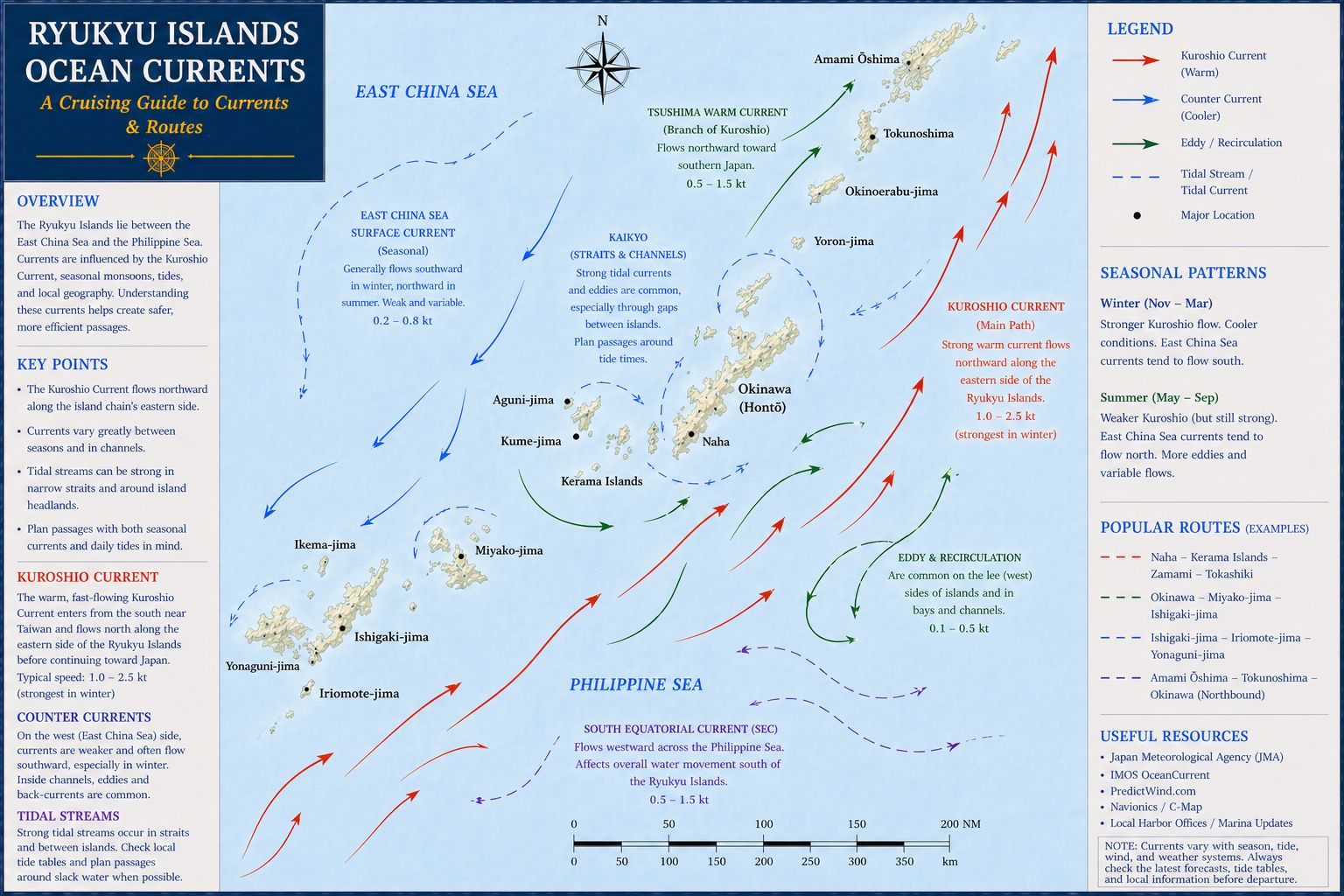
Navigation in the Ryukyus blends open‑water passages with reef‑fringed approaches, narrow channels, and harbours shaped by coral shelves rather than deep volcanic basins. The main routes between Okinawa, the Keramas, Miyako, and the Yaeyamas are straightforward in settled weather, but coastal navigation demands attention to charted reefs, shoals, and rapidly changing depths. Many harbours have well‑marked entrances, yet some smaller island ports rely on local knowledge, visual navigation, and careful timing with tides and light. The region’s clear water can be both a blessing and a trap, reefs appear close beneath the surface, but their edges can be difficult to judge at low sun angles. Night approaches to unfamiliar islands are generally avoided. With good planning, daylight arrivals, and respect for the coral environment, the Ryukyus offer rewarding, scenic navigation with a rhythm entirely different from Japan’s northern coasts.
Ryukyu Islands Cruising Guide - Provisioning
Provisioning across the Ryukyu chain ranges from the deep, urban supply of Naha to the small‑shop simplicity of the outer islands. The main island of Okinawa offers everything crews might need, large supermarkets, traditional markets, fish markets, hardware stores, marine suppliers, and international goods, making it the ideal place for full restocking before heading south. The Kerama Islands, Kumejima, and the mid‑chain islands offer modest but reliable provisioning through village supermarkets and local shops. In the Miyako and Yaeyama groups, provisioning becomes increasingly dependent on the main hubs of Miyakojima and Ishigaki, with the outer islands relying on small stores, local produce, and daily deliveries. Fresh seafood, tropical fruit, and island vegetables are widely available, but imported goods and specialty items should be sourced in Naha or Ishigaki. With thoughtful planning, crews can move through the entire chain with confidence, using the larger hubs to support extended cruising among the smaller islands.
Ryukyu Islands Cruising Guide - Culture
Culture in the Ryukyu Islands is shaped by centuries of maritime exchange, indigenous Ryukyuan traditions, and a warm, open island character that feels distinct from mainland Japan. The region’s history as an independent kingdom still echoes through its music, food, architecture, and language, with each island expressing its own variation of the broader Ryukyuan identity. Festivals, sanshin music, and local crafts remain central to daily life, while the influence of Southeast Asia, China, and Japan blends into a cultural landscape that is both familiar and entirely its own. Visitors quickly notice the slower pace, the emphasis on hospitality, and the deep connection between communities and the sea. As you move south through the chain, these cultural threads become even more pronounced, offering a sense of continuity that ties the islands together while highlighting the individuality of each port and village.
Ryukyu Islands Cruising Guide - Harbours &
Anchorages
Harbours and anchorages across the Ryukyu chain range from modern marinas on Okinawa’s main island to small, functional fishing ports and quiet coral‑sheltered bays on the outer islands. Naha, Ginowan, Chatan, and Itoman offer the most developed facilities, with secure berths, fuel, and easy access to provisioning. The Kerama Islands provide a mix of small harbours and scenic anchorages, often surrounded by steep hills and clear water ideal for diving and swimming. Further south, the Miyako and Yaeyama groups offer a blend of protected ports, reef‑fringed anchorages, and lagoon‑style bays that require careful daylight navigation. Many smaller islands rely on simple breakwater harbours designed for local fishing fleets, and while they can be welcoming to visiting vessels, space and depth may be limited. Across the chain, the key to safe harbour use is timing, arriving in daylight, respecting local traffic, and understanding how wind, swell, and tide interact with coral shelves and narrow entrances.
Ryukyu Islands Cruising Guide - Marine Services
Marine services in the Ryukyus are concentrated around the main island of Okinawa, with Naha, Ginowan, Chatan, and Itoman offering the broadest range of support for visiting vessels. These hubs provide haul‑out facilities, engine servicing, chandlery supplies, fiberglass and hull repair, and access to technicians familiar with both Japanese and international systems. As you move outward from the main island, services become more limited and more closely tied to local fishing cooperatives, small boatyards, and island‑scale workshops. Miyakojima and Ishigaki serve as the secondary service centres for the southern islands, offering reliable engine support, basic parts, and repair capabilities. On the smaller islands, assistance is often informal, local fishermen, harbour staff, or small machine shops may be able to help with minor issues, but major repairs should be planned for the larger hubs. With thoughtful preparation and periodic returns to the main service centres, crews can comfortably maintain their vessels throughout the entire chain.
Ryukyu Islands Cruising Guide - Fuel & Water
Fuel and water availability across the Ryukyu Islands follows a clear pattern: abundant on the main island of Okinawa, reliable in the larger mid‑chain and southern hubs, and increasingly limited on the smaller outer islands. Naha, Ginowan, Chatan, and Itoman offer the most convenient access to diesel, petrol, and potable water, with fuel stations near the harbours and marina staff accustomed to supporting visiting vessels. In the Kerama Islands and mid‑chain islands such as Kumejima, fuel is available but often requires coordination with local service stations or fishing cooperatives, and water may be limited to designated taps at the harbour. In the Miyako and Yaeyama groups, Miyakojima and Ishigaki serve as the primary refuelling and water‑loading points, while the outer islands rely on small‑scale infrastructure and occasional deliveries. Across the chain, planning ahead is essential, top up in the major hubs, confirm availability before arrival on smaller islands, and expect slower, more manual processes in the remote communities.
Ryukyu Islands Cruising Guide - Communications
Communications throughout the Ryukyu Islands are generally reliable, with strong mobile coverage on the main island of Okinawa and solid service across most populated islands in the Kerama, Miyako, and Yaeyama groups. Naha, Ginowan, Chatan, and Itoman offer fast data speeds and full network redundancy, making them ideal for route planning, weather downloads, and remote work. As you move outward, coverage remains good in towns and harbours but may weaken in remote anchorages, reef‑fringed bays, and the outer edges of the smaller islands. Offshore passages between island groups typically maintain usable signal within 10–20 nautical miles of land, though dead zones do exist. Public Wi‑Fi is common in marinas, ferry terminals, and tourist areas, but less reliable in rural villages. For crews moving through the entire chain, a local SIM or eSIM provides the most consistent connectivity, with satellite backup recommended for extended offshore legs or remote anchorages. Starlink provides fast, reliable connectivity across the Ryukyu Islands, maintaining stable internet during passages and in remote anchorages where mobile coverage weakens, supporting weather updates, navigation tools, and essential communications for cruising crews.
Local Food Culture
Food culture in the Ryukyus is a vivid expression of the islands’ history, climate, and agricultural traditions. Okinawan cuisine blends influences from China, Southeast Asia, and mainland Japan with local ingredients such as bitter melon, pork, seaweed, tropical fruit, and island vegetables. Markets across the chain, especially in Naha, Miyakojima, and Ishigaki showcase this diversity through fresh seafood, handmade tofu, local noodles, and preserved foods unique to the region. Each island has its own specialties: Kerama fish dishes, Miyako soba, Yaeyama noodles, Iriomote wild herbs, and Hateruma’s distinctive sugarcane products. For crews provisioning along the chain, these local flavours offer both practical staples and memorable culinary experiences, grounding each stop in the character of its island community.
Electrical and Mechanical
Repairs
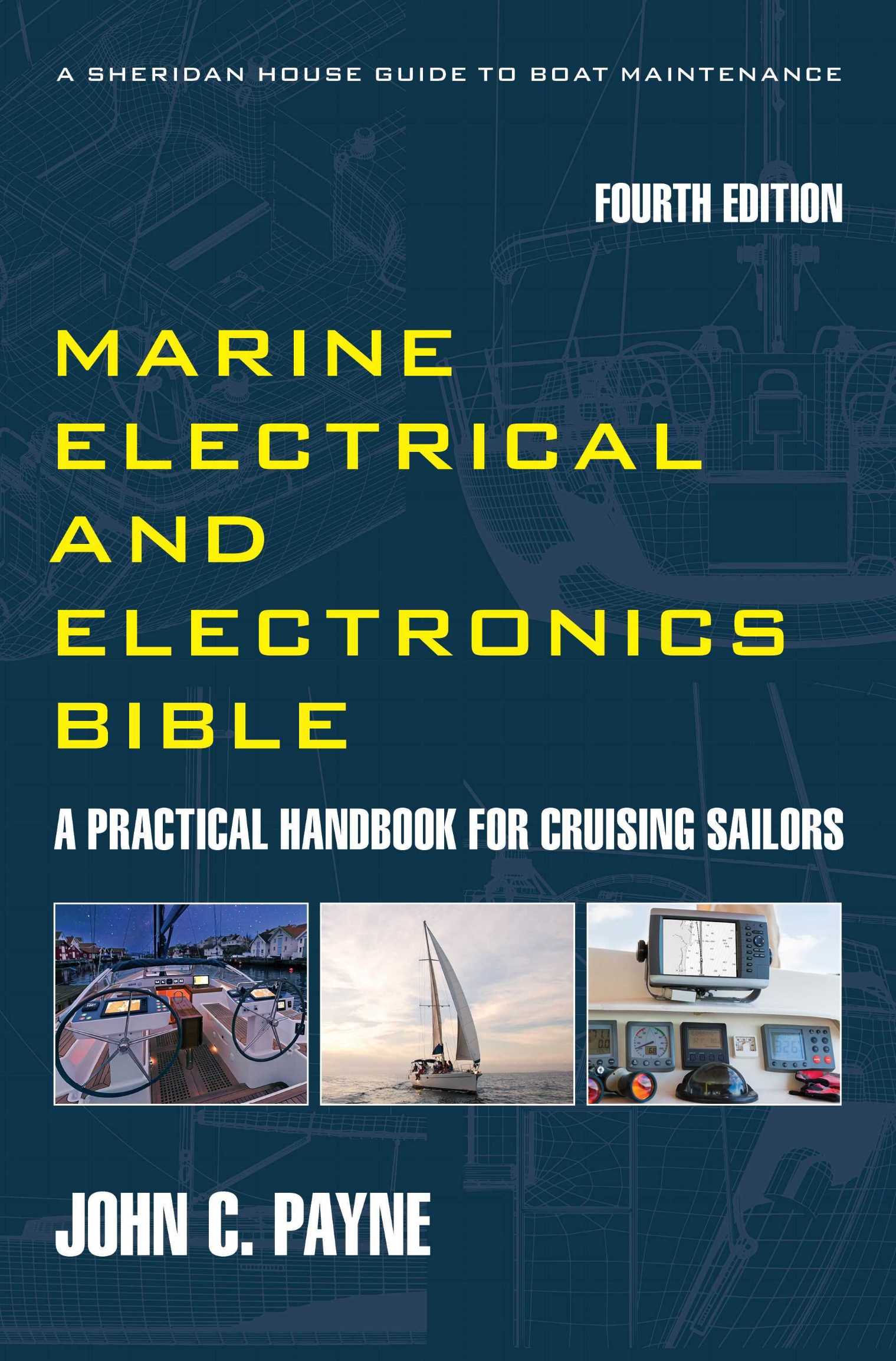
If you are headed somewhere remote consider the need to expand your knowledge base or have an information resource on board. Why not get a copy of my book The Marine and Electrical and Electronics Bible 4th Edition. By and for yachties, with everything from batteries and charging, solar and wind, diesel engines and marine electronics and so much more. Your complete systems guide. 650 pages of practical advice. In Australia and New Zealand order a copy through Boat Books. UK and European boats can buy the UK Edition Here. US and Canadian boats can get the US Edition Order Here. Marine systems are my profession so let me help you. By a liveaboard boat owner for other boat owners


Environmental Considerations
The Ryukyu Islands are home to some of Japan’s most fragile marine and terrestrial ecosystems, from coral reefs and mangrove forests to sea turtle nesting beaches and rare island wildlife. Navigating and anchoring in this region requires a thoughtful approach: many bays have designated mooring buoys to protect coral, and anchoring on reef structures is prohibited or strongly discouraged. Waste management varies between islands, with larger hubs offering proper disposal facilities and smaller communities relying on limited infrastructure. Freshwater is a precious resource on many islands, especially during the dry season, and crews are encouraged to conserve water and refill only at designated points. Respecting local guidelines, avoiding damage to coral and seagrass, and minimising environmental impact ensures that the Ryukyus remain healthy, vibrant, and welcoming for future visitors.
Ryukyu Islands Cruising Guide Summary
The Ryukyu Islands form a warm, coral‑fringed cruising region shaped by steady inter‑island transport, rich local food culture, and strong environmental stewardship. Weather patterns, seasonal strategy, and reef‑based navigation define movement through the chain, while harbours range from modern marinas to small fishing ports with simple protocols. Provisioning, fuel, water, and marine services concentrate in the main hubs, supporting safe, flexible cruising from Okinawa to the remote Yaeyamas.