Brazil Coast Sailing
Guide
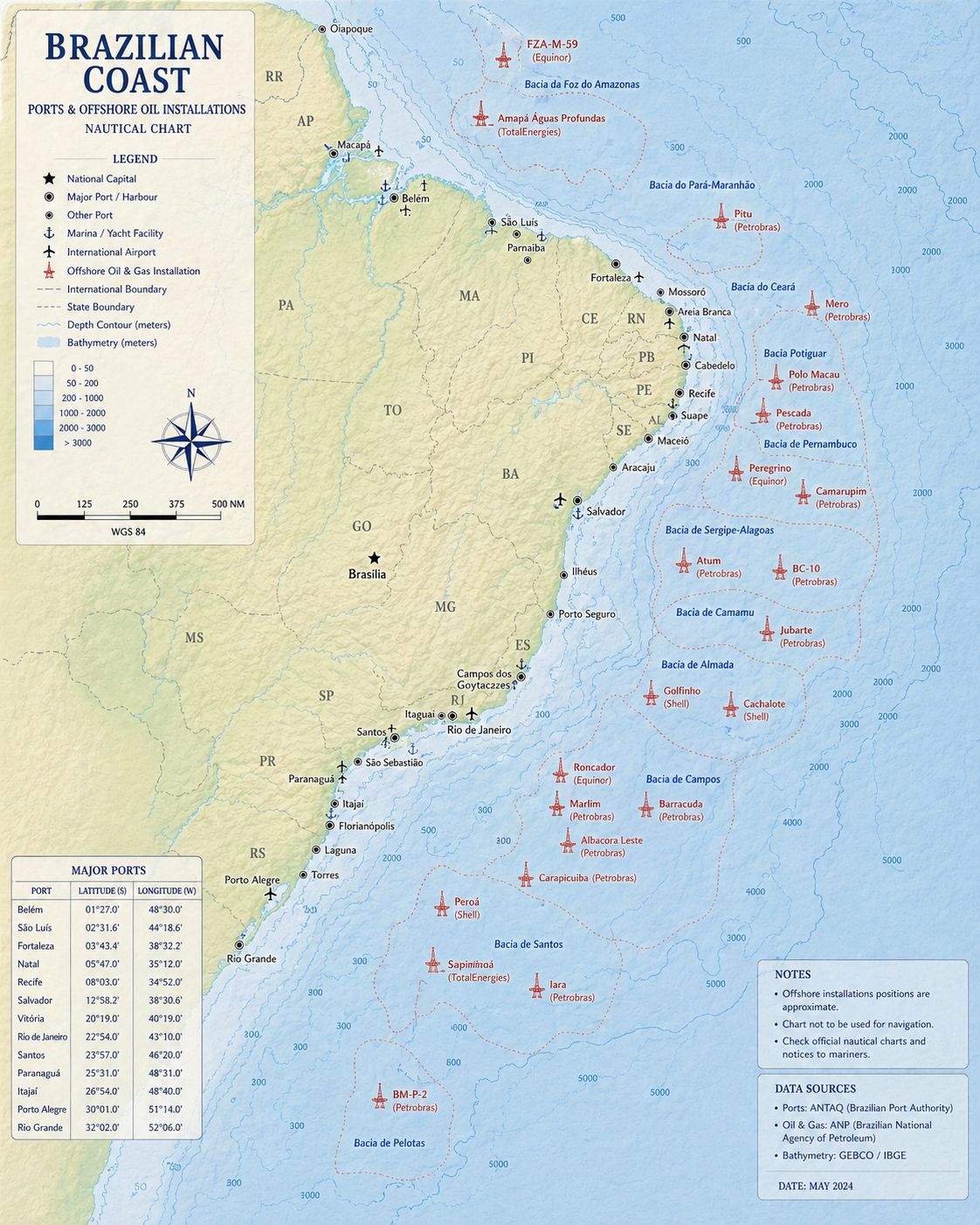
Brazil coast sailing guide. Brazil’s coastline forms one of the longest continuous cruising corridors in the Atlantic, running from the Amazon Basin to the Uruguay border. Conditions shift from river‑dominated outflow in the north to trade‑wind exposure in the northeast, then to frontal systems and swell‑driven weather in the southeast and south. The coast is defined by long distances, limited all‑weather harbours in several regions and a small number of reliable yacht centres spaced far apart. Movement requires conservative planning, attention to seasonal patterns and a clear understanding of the operational ports.
For yachts arriving from the Caribbean, Brazil marks the transition from open‑ocean passages to a continental coastline with predictable shelter and full provisioning in key cities. For yachts heading south toward Uruguay or west toward the River Plate, Brazil provides the final structured reset before entering the southern weather systems. This hub page outlines the operational structure of the Brazilian coast and provides link‑out stubs for the primary ports in each region.
Brazil Coast Sailing
Guide Explainer
I lived, worked and sailed in Brazil for several years. These pages are extracted from an unpublished cruising guide I wrote several years ago and have since updated. As this guide started before electronic charting became mainstream, I have included a lot of the GPS waypoint data, Chart numbers and other navigational information that remains useful. Navigators should ensure they have up to date charts on board, and the accuracy of electronic charts is uncertain. It is a challenging coast to sail, but rewarding with great people, food, music and so on and while there are security challenges, with proper precautions will be manageable.
Brazil Coast Sailing
Guide - Amazon Basin & Far North (Amapá &
Pará)
The far north is shaped by river outflow, sediment, shallow bars and strong tidal ranges. Visibility is often reduced by haze and humidity. Navigation is dominated by the Amazon River system, with limited coastal anchorages and long distances between operational ports. Most yachts use this region only when entering or exiting via the Amazon.
- Macapá / Santana. Amazon River mouth. Primary maritime access to the Amazon Basin with deep water and predictable commercial traffic patterns.
- Belém. Pará capital. Major provisioning and services hub with reliable shelter and structured harbour access.
- Soure (Ilha do Marajó). Riverine access with sheltered anchorages and limited services.
- Bragança. Coastal access point with river‑influenced approaches and limited facilities. →
- Salinópolis. First true coastal anchorage east of the Amazon system.
Brazil Coast Sailing Guide - North Coast (Maranhão, Piauí, Ceará)
This region is shaped by strong trades, shallow coastal shelves, tidal flats and river deltas. The Delta do Parnaíba requires careful timing and local knowledge. Ceará becomes the first region with predictable coastal movement and reliable shelter.
- São Luís. Maranhão capital. Major northern port with structured harbour access and provisioning.
- Tutóia. Delta do Parnaíba. Access to the delta system; tidal and shallow‑water navigation.
- Parnaíba. River port with limited services; staging point for delta movement
- Camocim. Coastal stop with tidal influence and limited shelter.
- Fortaleza. Ceará capital. First major yacht centre south of the Amazon; full provisioning and services.
Brazil Coast Sailing Guide - Northeast
Coast (Rio Grande do Norte → Bahia)
The northeast is the most wind‑reliable section of the Brazilian coast, shaped by steady trades, moderate swell and predictable movement windows. Harbours are spaced far apart, and several river bars require settled conditions. Salvador forms the primary yacht hub for the entire region.
- Natal. Rio Grande do Norte. Major port with reliable shelter and provisioning.
- Cabedelo / João Pessoa. Paraíba. Structured harbour with good access and predictable approaches.
- Recife. Pernambuco. Large commercial port with protected inner harbour and full services.
- Maceió. Alagoas. Sheltered anchorage and provisioning access.
- Salvador. Bahia. Primary yacht hub of the northeast with full services, marinas and provisioning
Brazil Coast Sailing Guide - Southeast Coast (Espírito Santo → Rio de Janeiro → São Paulo)
The southeast is shaped by frontal systems, swell, coastal currents and complex headlands. This region contains Brazil’s strongest yacht infrastructure, with multiple marinas, repair yards and provisioning centres. Ilha Grande and Angra dos Reis form the core cruising ground.
- Vitória. Espírito Santo. Major port with reliable shelter and provisioning
- Rio de Janeiro. Large yacht centre with full services, marinas and marine industries.
- Niterói. Sheltered alternative to Rio with strong marine services.
- Ilha Grande / Angra dos Reis/ Paraty. Primary cruising grounds with multiple anchorages and marinas.
- São Sebastião / Ilhabela. São Paulo. Major yacht hub with marinas, repairs and provisioning.
Brazil Coast Sailing Guide - South Coast (Paraná → Santa Catarina → Rio Grande do Sul)
The south coast is shaped by strong frontal systems, swell, river bars and rapidly changing conditions. It contains some of Brazil’s best‑equipped yacht ports, particularly in Santa Catarina. The region transitions into the River Plate system near the Uruguay border. The Santa Catarina hub has all you need to know for this region
- Paranaguá. Paraná. Major port with structured access and reliable shelter.
- São Francisco do Sul. Santa Catarina. Deep, protected harbour with strong marine services.
- Itajaí. Santa Catarina. Major commercial and yacht port with full services.
- Florianópolis. Santa Catarina. Primary yacht hub of the south with multiple anchorages and marinas.
- Rio Grande. Rio Grande do Sul. Final major port before Uruguay; deep harbour. and full provisioning.
Brazil Coast Sailing
Guide – Navigation Realities
Brazil’s coast is defined by long distances, limited all‑weather harbours in several regions and strong seasonal patterns. The north is river‑dominated with shallow bars and tidal influence. The northeast is trade‑wind driven with predictable movement windows. The southeast and south are shaped by frontal systems, swell and rapidly changing conditions. Headlands, river bars and commercial traffic require conservative planning.
Brazil Coast Sailing
Guide – Navigating the Currents
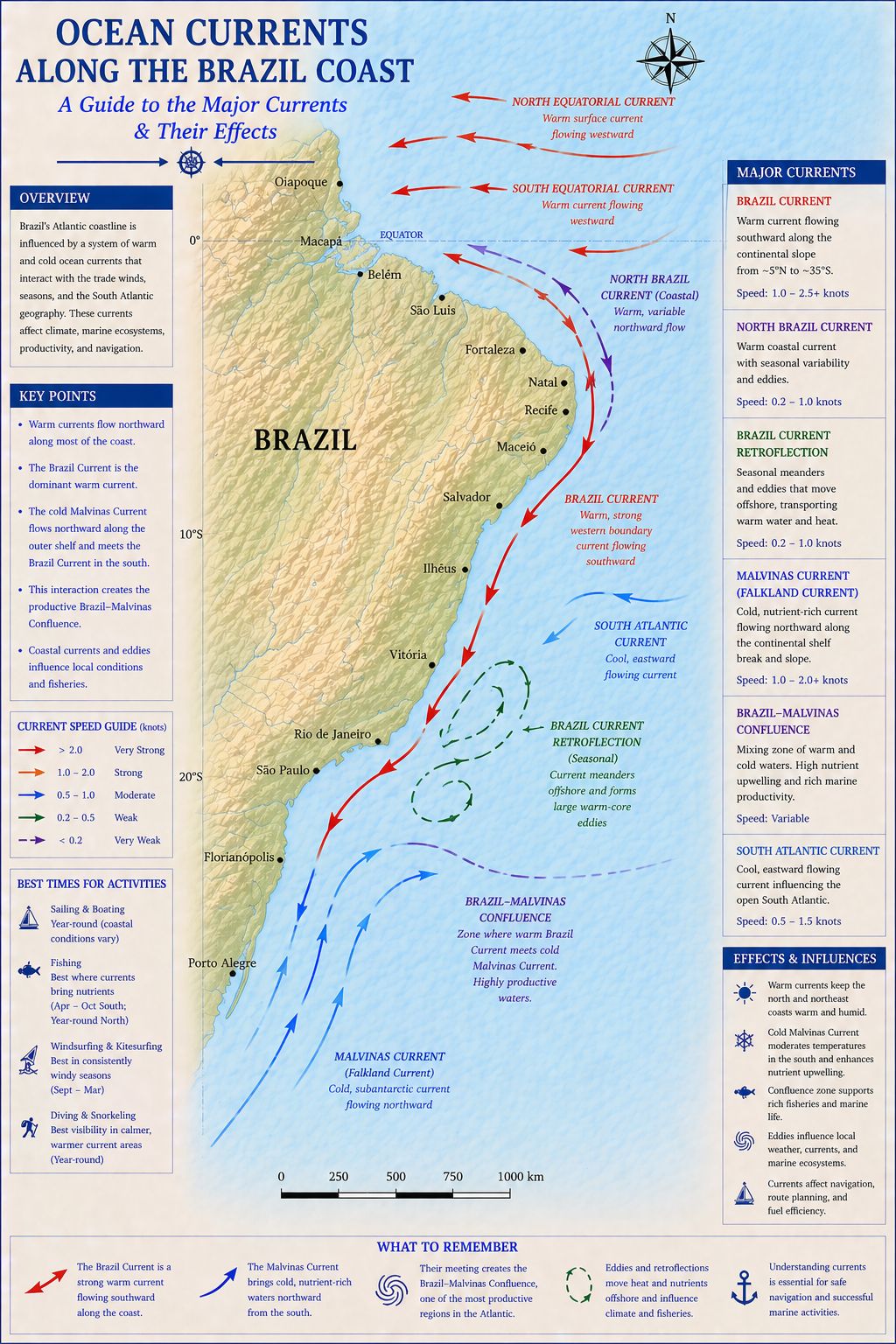
The currents form part of the general counter-clockwise South Atlantic flow. The Northerly component is South Equatorial Current. The principal part of water circulation, it is a broad belt of westerly sets, with northerly limit at 2 N May to October and near 6 N in March. The Guiana Current comes from the South Equatorial current and is strongest in Northern Brasil 200-300 nm wide direction predominantly WNW or NW 1-1.26 knots 2 knots at 150 nm out. Rio Amazon and Cabo de Sao Roque in NE winds coastal counter current ESE
- North Equatorial Current. West going currents. The westerly component is the Brasil Current
- Brasil Current. This forms from part of South equatorial current. The main body is 8S to 40S at 100 nm from the coast. Direction SW ¾ to 1 knot and rare at 2kts
- Brasil Inshore Counter Current. Runs Dec to March North to Rio de la Plata until it meets the South flowing Brasil current. In winter the Brasil moves out and Northerly flow extends, rom April up to 24S in May and June. The average rate is around ¾ knot.
Tidal ranges. Around 4m at Amazonas, 2 m at Recife and 1 m in Rio
About the South Atlantic Drift
The South Atlantic Drift shapes the offshore behaviour of the Brazilian coast, carrying warm water southward from the equatorial region before bending east toward the mid‑Atlantic. Close inshore, the Brazil Current dominates with a steady southbound set that strengthens off headlands and can build steep seas when opposed by southerly winds. Further offshore, the drift becomes broader and more diffuse, creating a gentle west‑to‑east push that influences long‑range routing rather than coastal movement. For yachts, the key operational effect is the persistent southbound flow along the shelf edge, the acceleration zones off Cabo de São Tomé and Cabo Frio, and the shift toward eastbound drift south of Santa Catarina. This current structure defines fuel planning, sea‑state expectations and the timing of southbound passages, particularly when frontal systems interact with the south‑setting flow
Brazil Coast Sailing
Guide – Weather
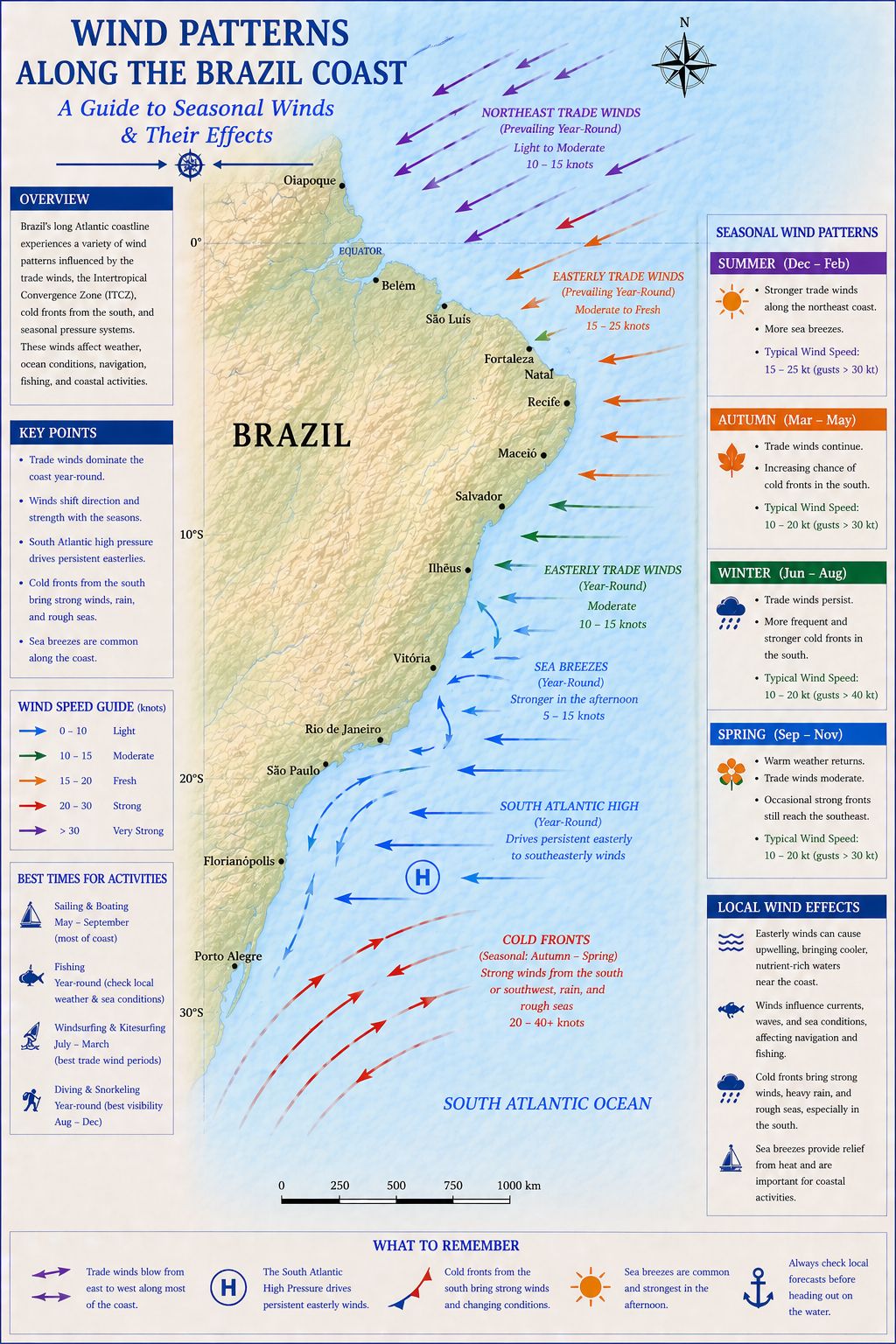
Tropical in the North and the Amazon basin.
- Easterly swell is normal, and SE from 15-20S; 20-40S NE to SE N of E near shore. S of E offshore
- SE Trades. 5-20S E to SE winds prevail all seasons. In summer NE to ESE south of 15S Nov to Feb. Strength typical Force 4 to 5, 3 to 4 near coast
- Squalls April to September along cold front troughs which move NE
- ESE squalls from ESE called Abrolhos in area Caravelas to Cabo Frio from May to August
Brazil Coast Sailing
Guide – Provisioning
Provisioning along the Brazilian coast is reliable in the major cities and limited everywhere else. The Amazon and far‑north regions depend on river‑driven markets with strong availability of fresh fish, cassava products, fruit and basic dry goods, but imported items and yacht‑specific supplies are inconsistent. The northeast improves immediately, with Natal, Recife and Salvador providing full‑range supermarkets, high turnover and predictable stock. The southeast is the strongest provisioning corridor in the country, with Vitória, Rio de Janeiro, Niterói, Angra dos Reis and Ilhabela offering large supermarkets, specialty stores, bakeries and dependable access to imported goods. The south maintains good availability in Itajaí, Florianópolis and Rio Grande, though turnover varies with season. Across the entire coast, fresh produce, rice, beans, cassava flour, long‑life dairy, oils, pasta, sauces and frozen goods are consistently available, while specialist items, yacht spares and international brands are concentrated in the major hubs.
Brazil Coast Sailing
Guide – Local Cuisine
Brazilian coastal cuisine shifts with the regions but stays anchored in fish, cassava, rice, beans and local stews. In the north and Amazon Basin, dishes centre on river fish, tucupi broth, jambu greens and cassava‑based farinha. The northeast moves into moqueca baiana with dendê oil, coconut milk, peppers and fish, alongside acarajé and simple grilled seafood. The southeast leans on coastal stews, rice‑and‑bean plates, fresh fish and bakery staples, while the south introduces churrasco cuts, coastal seafood and heavier grain dishes suited to colder weather. For yachts, provisioning aligns naturally with these regional staples: fresh fish, cassava flour, rice, beans, plantain, citrus, onions, peppers and long‑life dairy form the reliable onboard base across the entire coast.
Brazil Coast Sailing Guide – Beverages
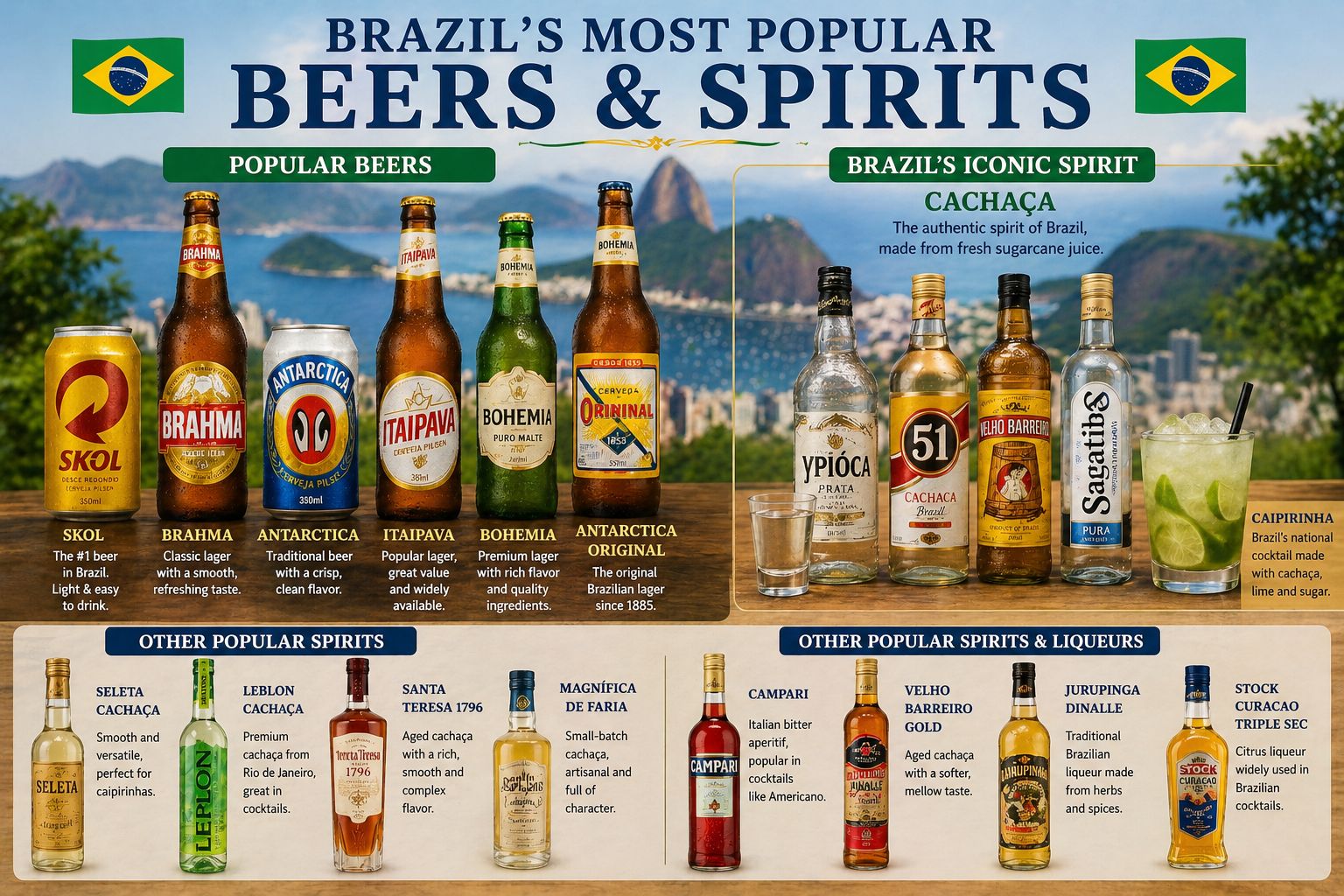
Brazil offers a diverse range of beverages, with a strong emphasis on light, refreshing drinks suited to its warm climate. Popular beers such as Skol, Brahma, and Antarctica (my personal favorite) dominate the market, typically pale lagers served very cold, often in shared bottles in bars and beach settings. The standout spirit is cachaça, a sugarcane-based liquor that forms the backbone of the national cocktail, the caipirinha, mixed with lime and sugar. Premium and artisanal cachaças are widely available, alongside imported spirits and a growing craft beer scene in major cities. Non-alcoholic options are equally abundant, including fresh fruit juices, coconut water, and iced soft drinks, all commonly found in coastal towns and cruising hubs.
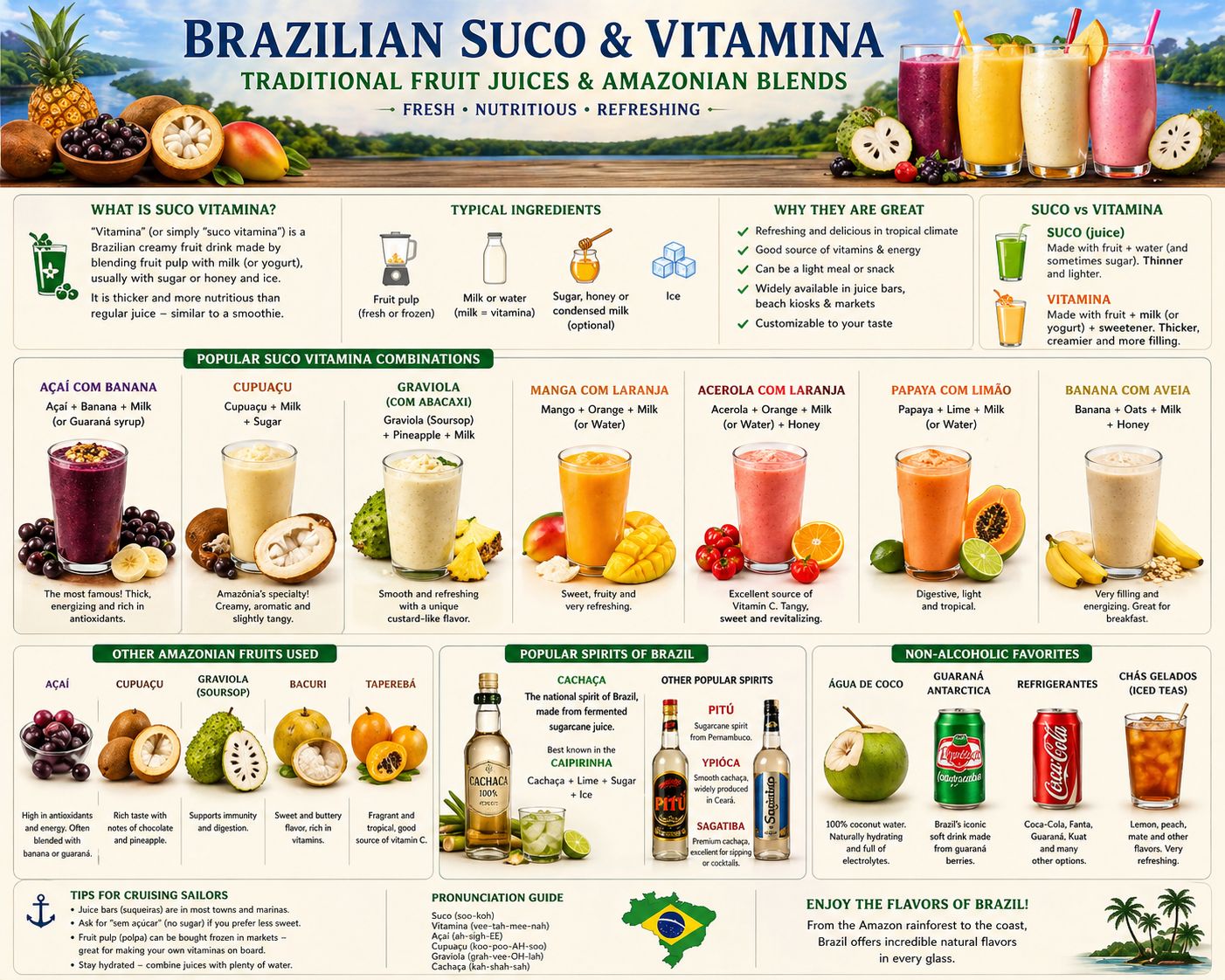
About “suco vitamina” - I am addicted to them
In Brazil, “suco vitamina” (often shortened to just vitamina) refers to a thick, blended fruit drink, closer to a smoothie than a simple juice. Unlike fresh suco (which is usually just fruit plus water), a vitamina is typically made with milk (or sometimes yogurt), fruit pulp, and often sugar or honey, giving it a creamy texture and higher nutritional value. When you see these made with “frutas da Amazônia” (Amazonian fruits), they commonly include the following and I did drink a lot of them!
- Açaí which is a thick, earthy berry pulp, often blended with banana
- Cupuaçu which is a tangy, creamy fruit with a chocolate–pineapple note
- Graviola (soursop) which is smooth, slightly sour and custard-like
- Acerola which is very high in vitamin C, often mixed with sweeter fruits
- Mango, papaya, banana are used as base fruits for body and sweetness
Typical preparation: Fruit pulp (fresh or frozen); Milk or water (milk = vitamina, water = more like suco), Sugar, honey, or condensed milk (optional but common), Ice. What makes them distinctive: Thicker than juice, more filling (almost a light meal), they are often sold in juice bars (lanchonetes) and beach kiosks.
Brazil Coast Sailing
Guide – Security
Security along the Brazilian coast varies by region and is managed through conservative movement, controlled shore access and clear situational awareness. The major yacht centres, Fortaleza, Natal, Recife, Salvador, Vitória, Rio de Janeiro, Angra dos Reis, Ilhabela, Itajaí and Rio Grande are the most reliable points for safe berthing, provisioning and repairs, with marinas providing controlled access and 24‑hour staff. Outside these hubs, anchorages can be exposed to petty theft, and yachts avoid leaving tenders or equipment unsecured. Shore movements in large cities follow standard precautions: use registered taxis, avoid isolated areas, and keep movements purposeful. Offshore, the coast is free of piracy, and the primary risks remain opportunistic theft at anchor and unattended dinghies. With structured planning and the use of recognised marinas, Brazil is a workable and predictable coastline for yachts.
Mechanical
and Electrical Repairs Resource
If you are headed somewhere remote consider the need to expand your knowledge base or have an information resource on board. Why not get a copy of my book The Marine and Electrical and Electronics Bible 4th Edition. By and for yachties, with everything from batteries and charging, solar and wind, diesel engines and marine electronics and so much more. Your complete systems guide. 650 pages of practical advice. In Australia and New Zealand order a copy through Boat Books. UK and European boats can buy the UK Edition Here. US and Canadian boats can get the US Edition Order Here. Marine systems are my profession so let me help you. By a liveaboard boat owner for other boat owners


Brazil Coast Sailing
Guide – Summary
Brazil’s coastline forms a long, structured progression from the river‑dominated north to the frontal‑system south, with a small number of dependable yacht centres spaced across vast distances. Each region behaves differently, shaped by trades, river outflow, swell and seasonal weather patterns, and movement depends on conservative timing and clear routing logic. The major ports provide the provisioning, shelter and marine services needed to reset before the next segment, and the coast as a whole, functions as a continuous operational corridor linking the Caribbean, South Atlantic and River Plate systems. The Brazil Coast Sailing Guide for a lot of useful information.