Ilhabela Yacht Cruising
Guide
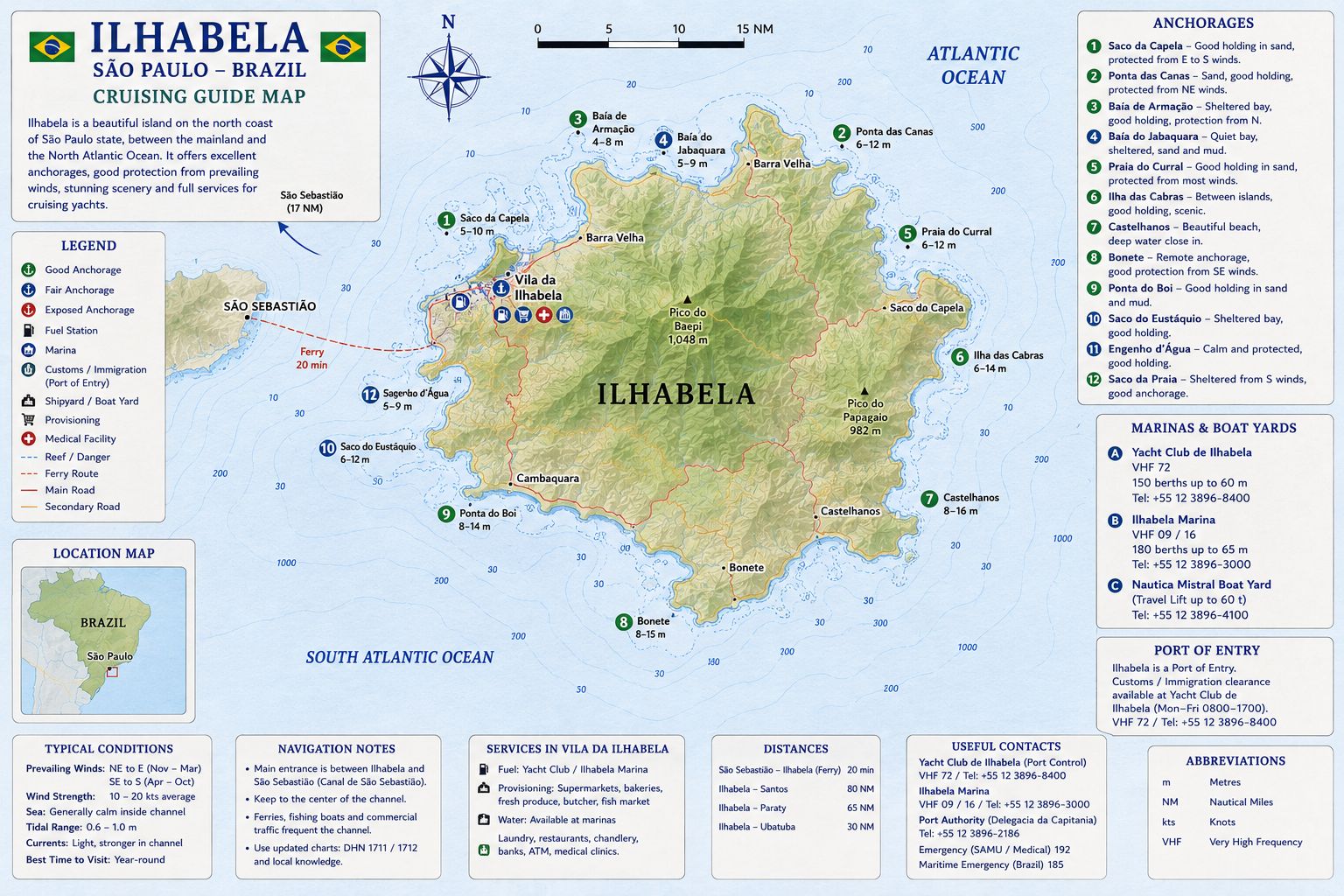
Ilhabela yacht cruising guide. Ilhabela lies off the São Paulo coastline and forms a large island barrier that creates sheltered water on its western side and exposed ocean conditions on its eastern side. The island is steep sided with deep water close to shore, and the western anchorages are protected from the prevailing swell. The channel between Ilhabela and São Sebastião provides the main access to marinas, anchorages and services.
For yachts transiting the southeast Brazil coast, Ilhabela is the primary stop between Santos and the Ilha Grande region. It provides marina access, fuel, water, provisioning and technical support. The island’s western side offers reliable shelter, while the eastern side is exposed to ocean swell and is not suitable for anchoring in most conditions.
This is one of Brasils most popular cruising and yachting areas. Isla de Sao Sebastiao is the largest of an island group with an area of approx 130 sq miles, and 84 miles of coastline. The smaller islands are Vitoria, Buzios, Cabras and Serraria. Over 85% of the whole land mass belongs to The State Park of Ilhabela, which comprises Atlantic Rain Forest and is a declared UNESCO Biosphere Reserve The islands lay off the coast of Sao Paulo which is 138 miles away, and some 210 miles from Rio de Janeiro.
Brazil Coast
Sailing Guide Explainer
I lived, worked and sailed in Brazil for several years. These pages are extracted from an unpublished cruising guide I wrote several years ago and have since updated. As this guide started before electronic charting became mainstream, I have included a lot of the GPS waypoint data, Chart numbers and other navigational information that remains useful. Navigators should ensure they have up to date charts on board, and the accuracy of electronic charts is uncertain. It is a challenging coast to sail, but rewarding with great people, food, music and so on and while there are security challenges, with proper precautions will be manageable.
Ilhabela Yacht Cruising
Guide – History
The Spaniard Americo Vespucci navigated the area first in 1502, and named the island Sao Sebastiao. Portuguese and English navigators regularly visited the area, and pirates are part of local history. The English pirate Thomas Cavendish is reputed to have buried treasure in 1591 on Castelhanos beach after looting Sao Vincente village. In 1805 the island became politically independent being renamed Ilhabela da Princesa. Major industry was sugar cane, then producing coffee after slavery was abolished. The island has around 20,000 inhabitants, and tourism is a major source of income.
Ilhabela Yacht Cruising
Guide - Approaches
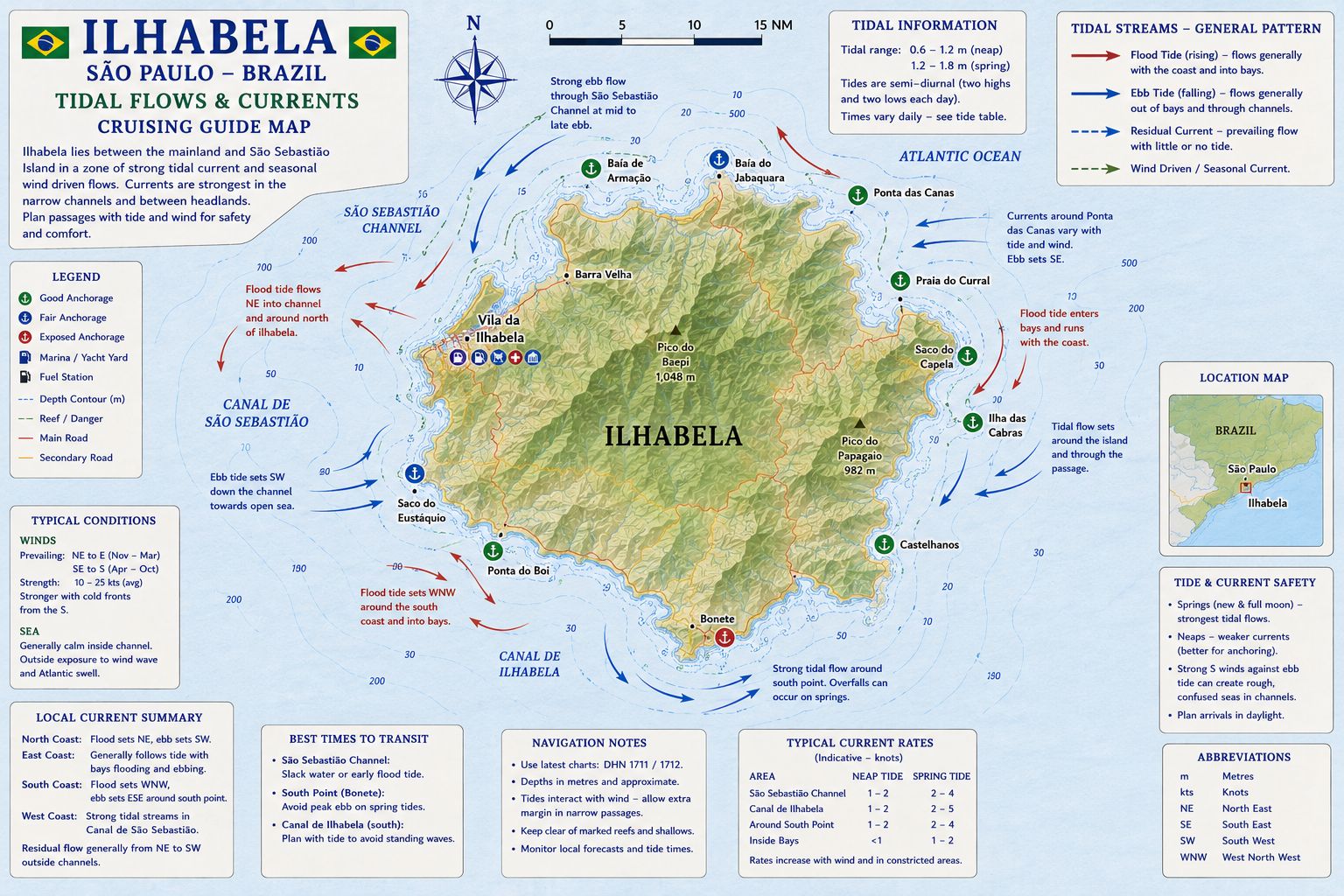
Tidal currents in the channel can reach two knots during peak flow and influence manoeuvring near marina entrances. Approaches from the north and south follow the São Sebastião Channel. Depths outside the island remain 12 to 18 metres. Hazards include strong tidal flow in the channel, ferry traffic between Ilhabela and São Sebastião and unlit fishing gear. The channel carries 12 to 18 metres in its central section, shoaling to 8 to 12 metres near the Ilhabela shoreline and 5 to 8 metres near marina entrances. Sea state is generally moderate on the western side due to shelter from the island. The eastern side is exposed to ocean swell and is not used for approaches in most conditions.
Ilhabela Yacht Cruising
Guide - Navigation Charts
Ilhabela demands large‑scale DHN chart coverage because the São Sebastião Channel is narrow, carries continuous commercial traffic and contains steep‑to hazards, unlit points, shoal projections and strong tidal set. The island’s eastern coast is exposed and drops rapidly from 20 to 200 metres, while the western channel requires precise pilotage with accurate depth contouring. Yachts must carry the DHN large‑scale sheets that cover the channel, the eastern offshore coast and the northern and southern approaches, as these charts provide the only reliable depiction of the commercial‑traffic separation zones, ferry routes, unlit headlands, lajes, pedras and the steep‑to nature of the shoreline. The São Sebastião Channel narrows to less than one mile in several sections, and the 20 to 30 metre contours lie close to the shore, making small‑scale charts inadequate for safe navigation.
Electronic charts derived from DHN data are acceptable provided the yacht carries the large‑scale ENC cells for the channel and keeps them updated. AIS overlay is useful due to the density of commercial traffic, and radar overlay is recommended at night or in rain bands. The eastern coast requires offshore stand‑off distances plotted on DHN charts to avoid unmarked rocks close inshore, and the northern and southern approaches require the detailed DHN sheets that show the offshore hazards and the traffic patterns for vessels entering the Port of São Sebastião. Without these charts, safe pilotage is not possible, as the region contains unlit points that extend farther than expected, steep‑to contours that leave no margin for error and anchorages that require precise depth management between 5 and 12 metres.
Ilhabela Yacht Cruising
Guide - Navigation and Pilotage
Navigation in the São Sebastião Channel requires attention to ferry routes, strong tidal flow and cross winds during sea breeze periods. Pilotage into the Ilhabela marinas requires controlled speed due to narrow entrances and 3 to 5 metres depths inside basins. Night entry is possible in settled conditions but requires caution due to ferry movements and unlit small craft. The eastern coastline of Ilhabela is steep and exposed, with no practical anchorages and no shelter from swell. Visibility can drop during frontal rain bands and morning humidity.
Ponta das Cabeçudas forms a clean, steep‑to headland on the western side of Ilhabela and carries a white metal column light, 11 m high, positioned on the point. Depths remain 20–30 m close in with no offshore projections, and the point can be passed at normal São Sebastião Channel distance. Immediately northwest of the point lies Pedra de Santa Teresa, a charted rock on the eastern side of the channel, marked by a light buoy positioned to keep traffic clear of the hazard. The buoy sits west of the rock’s shallowest area and is used as the offing reference when transiting the northern half of the channel. Enseada das Cabeçudas itself is deep and steep‑to with no anchoring water, fully exposed to tidal set and ferry wake, and is treated purely as a visual reference during transit.
Ponta das Cabeçudas is a clean, steep‑to headland on the western side of Ilhabela, carrying a white metal column light, 11 m high, Fl W. Depths of 20–30 m lie close in with no offshore projections, and the point can be passed at normal São Sebastião Channel offing. Immediately northwest of the point lies Pedra de Santa Teresa, a charted rock on the eastern side of the channel, marked by a light buoy (Fl R) positioned west of the shoal area. The buoy defines the safe offing when transiting the northern section of the channel. Enseada das Cabeçudas is uniformly deep and steep‑to with no anchoring water and remains exposed to tidal set and ferry wake, serving only as a visual reference during transit.
Ilhabela Yacht Cruising
Guide - Anchorage
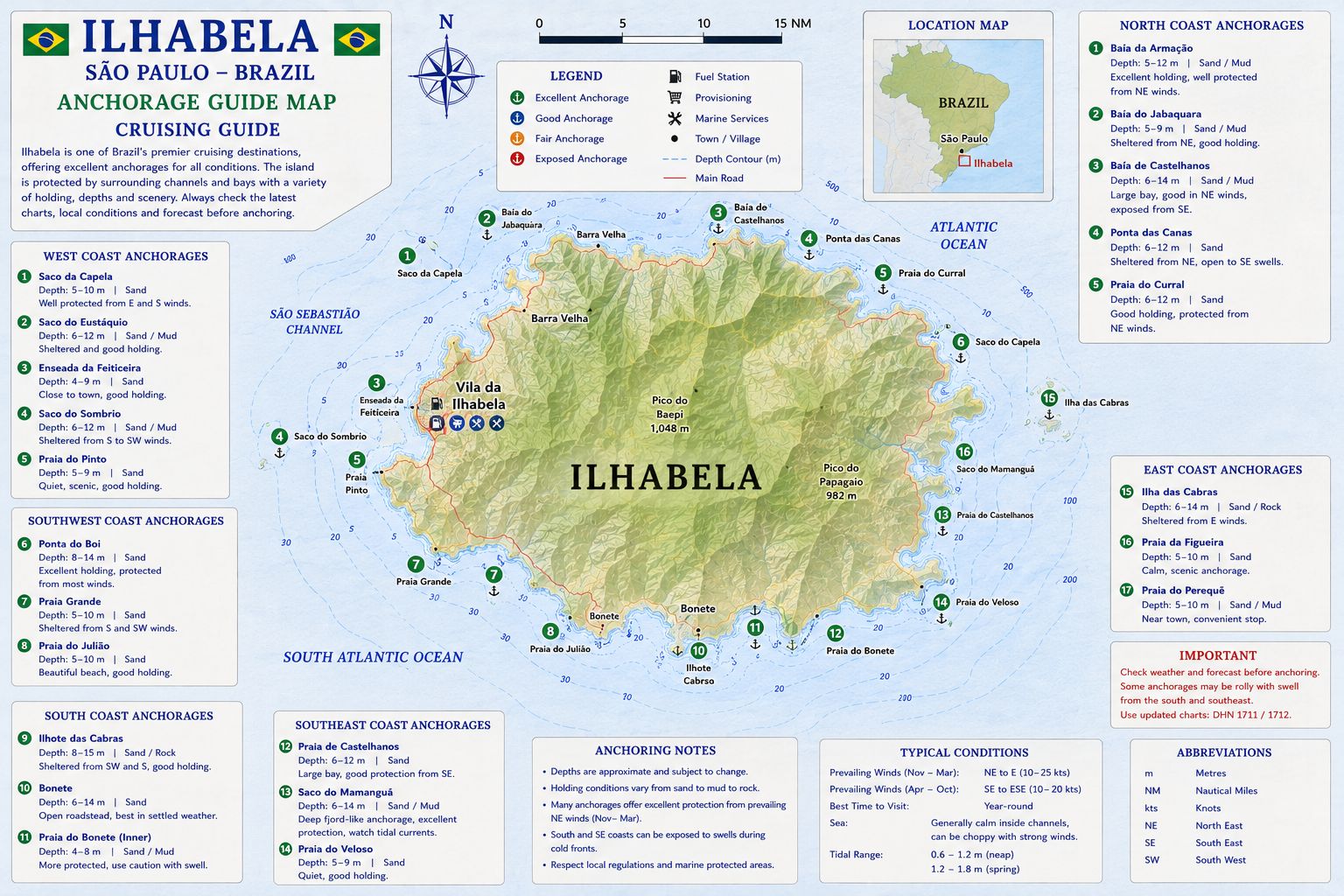
Anchoring on the western side of Ilhabela is possible in several coves with 8 to 12 metres over mud and sand, and 5 to 8 metres in inner pockets. Holding is generally reliable. Weather exposure is low due to shelter from the island, although strong southerly fronts can produce gusts in the channel. The eastern side of the island is exposed to swell and is not suitable for anchoring.
Ilhabela Yacht Cruising
Guide - Entry Formalities
Ilhabela is not a clearance port. All formalities must be completed at Santos or Angra dos Reis. Firearms must be declared at the time of clearance. Starlink is permitted but must not interfere with regulated frequencies. No clearance facilities exist on Ilhabela.
Ilhabela Yacht Cruising
Guide - Marina Facilities
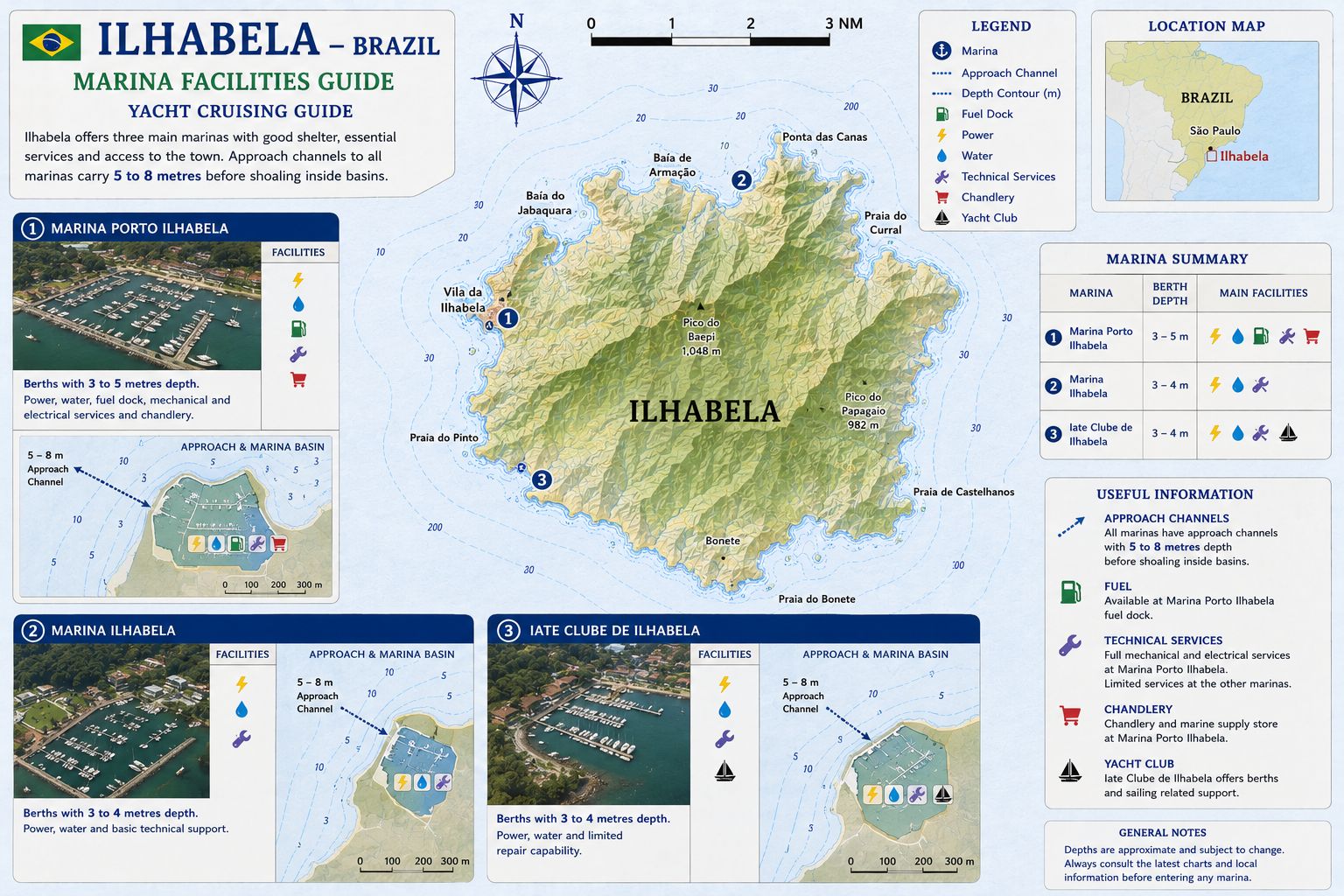
Approach channels to all marinas carry 5 to 8 metres before shoaling inside basins. Marina Porto Ilhabela. Berths with 3 to 5 metres depth. Power, water, fuel dock, mechanical and electrical services and chandlery. Marina Ilhabela. Berths with 3 to 4 metres depth. Power, water and basic technical support. Iate Clube de Ilhabela. Berths with 3 to 4 metres depth. Power, water and limited repair capability.
 Ilhabela in Brasil is one of my favorite places to visit and well worth the effort and great marinas
Ilhabela Yacht Cruising Guide - São Sebastião
São Sebastião functions as a commercial port rather than a yacht facility, with deep‑water berths, tug operations, fuel depots and offshore‑industry support dominating the waterfront, leaving no marina, no protected basin and no haul‑out suitable for keelboats. The shoreline is configured for ferries and cargo vessels, not recreational craft, and yachts anchor on the Ilhabela side where shelter, holding and access are significantly better. What São Sebastião does provide is the full range of shore‑side urban services, supermarkets, hardware stores, pharmacies, banks and general provisioning, which crews reach by ferry from Ilhabela, but its mechanical and electrical workshops are geared to commercial vessels and small local boats rather than cruising yachts. There is no marine fuel dock for yachts, and all technical work, chandlery support and marine services remain concentrated in Ilhabela, Angra dos Reis, Bracuí and Verolme, making São Sebastião a practical support town rather than a yacht destination
Ilhabela Yacht Cruising
Guide - Local Weather
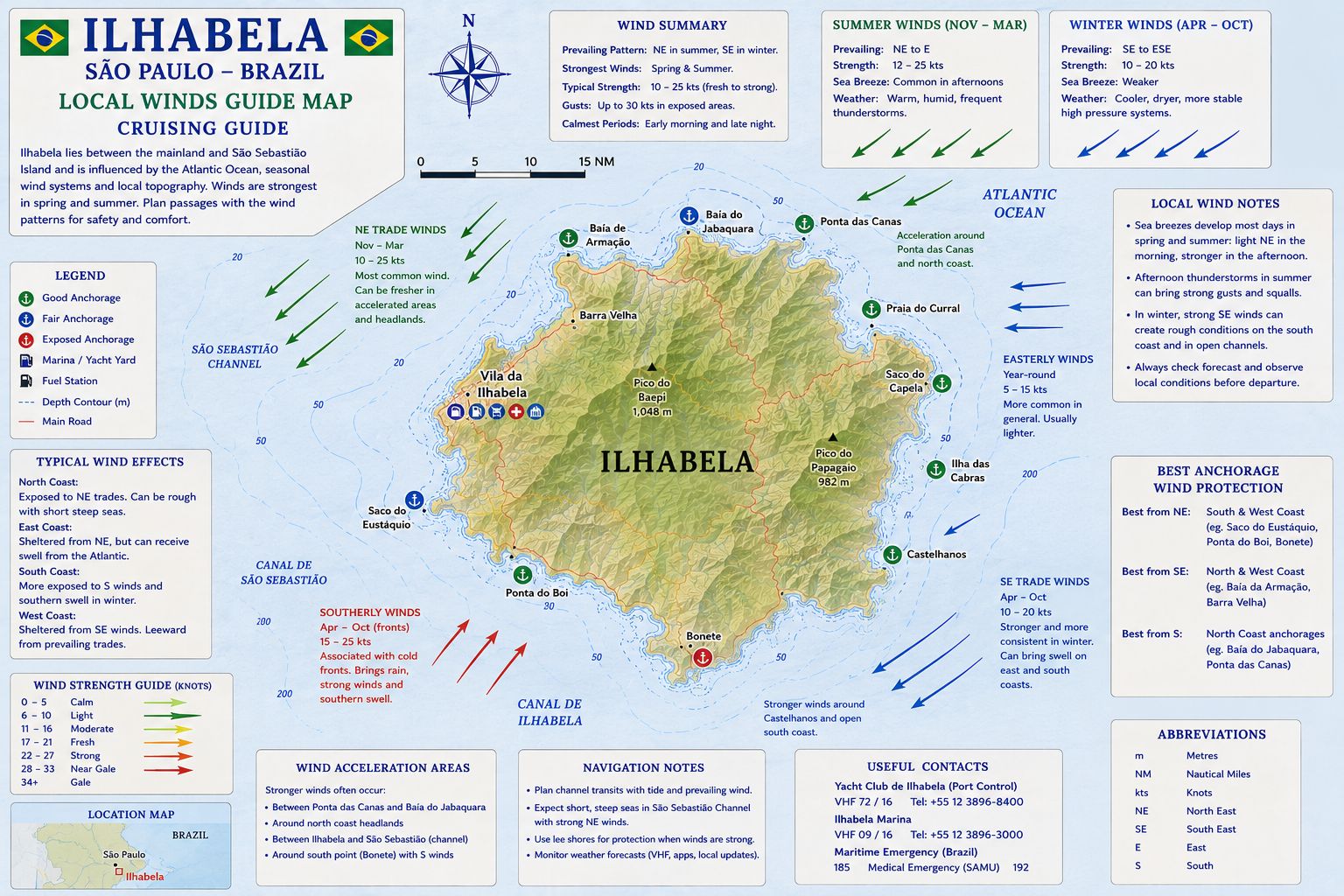
Local weather is shaped by southerly frontal systems, sea breeze cycles and summer convection. The western side of the island remains sheltered in most conditions, while the eastern side is exposed to ocean swell. Frontal passages bring southerly winds, rain and reduced visibility. Sea breezes build from late morning and can create cross winds in the channel. Summer months bring convective squalls with rapid wind shifts and heavy rain. Morning humidity can produce haze that reduces visibility until mid morning.
Ilhabela Yacht Cruising
Guide - Provisioning
Supermarkets. Pão de Açúcar Ilhabela. Full range supermarket with fresh produce, bakery, dairy, meat and frozen goods. Supermercado do Frade. General supermarket with reliable dry goods, fruit, vegetables and packaged items. Supermercado Central Ilhabela. Broad stock of staples, fruit, vegetables and frozen goods.
Markets. Ilhabela Municipal Market. Fruit, vegetables, staples and local produce.
Fish Markets. Mercado de Peixe Ilhabela. Fresh local fish, fillets and shellfish. Harbourfront vendors. Small scale supply depending on daily catch.
Ilhabela Yacht Cruising Guide - Provisioning São Sebastião
São Sebastião provides full urban provisioning through large supermarkets including Pão de Açúcar, Dia, Assaí Atacadista and Cooperativa, all located within the central commercial zone south of the ferry terminal. These stores carry complete fresh‑produce lines, bakery sections, dairy, meat, packaged goods and household supplies Fresh fish at the Mercado Municipal de Peixes near the port area, operating on the standard morning cycle. Pharmacies including Drogaria São Paulo and Drogasil are concentrated along Avenida Dr. Altino Arantes, and hardware supplies are available from Casa do Construtor, Leroy Merlin São Sebastião (on the highway toward Caraguatatuba) and smaller local ferragens in the town centre. All provisioning requires ferry access from Ilhabela, as there is no yacht berthing on the São Sebastião waterfront. Ferries run every 30 minutes between Sao Sebastiao and Ilhabela with transit of 20 minutes.
Ilhabela Yacht Cruising
Guide - Local Cuisine
Local specialty is Azul Marinho, boiled fish with fish head mush. Local cuisine is based on coastal fish, cassava, rice, beans and plantain. Moqueca capixaba is a fish stew prepared with annatto and herbs. Moqueca baiana uses dendê oil and coconut milk. Peixe grelhado is grilled fish served with rice, beans and salad. Bobó de camarão is a shrimp and cassava purée. Caldeirada is a mixed fish and shellfish broth. Farofa is toasted cassava flour served as a side. Acarajé is a black eyed bean fritter filled with shrimp. Vatapá is a thick paste of bread, shrimp, peanuts and coconut milk. These dishes reflect the regional availability of fish, shellfish, cassava and tropical produce.
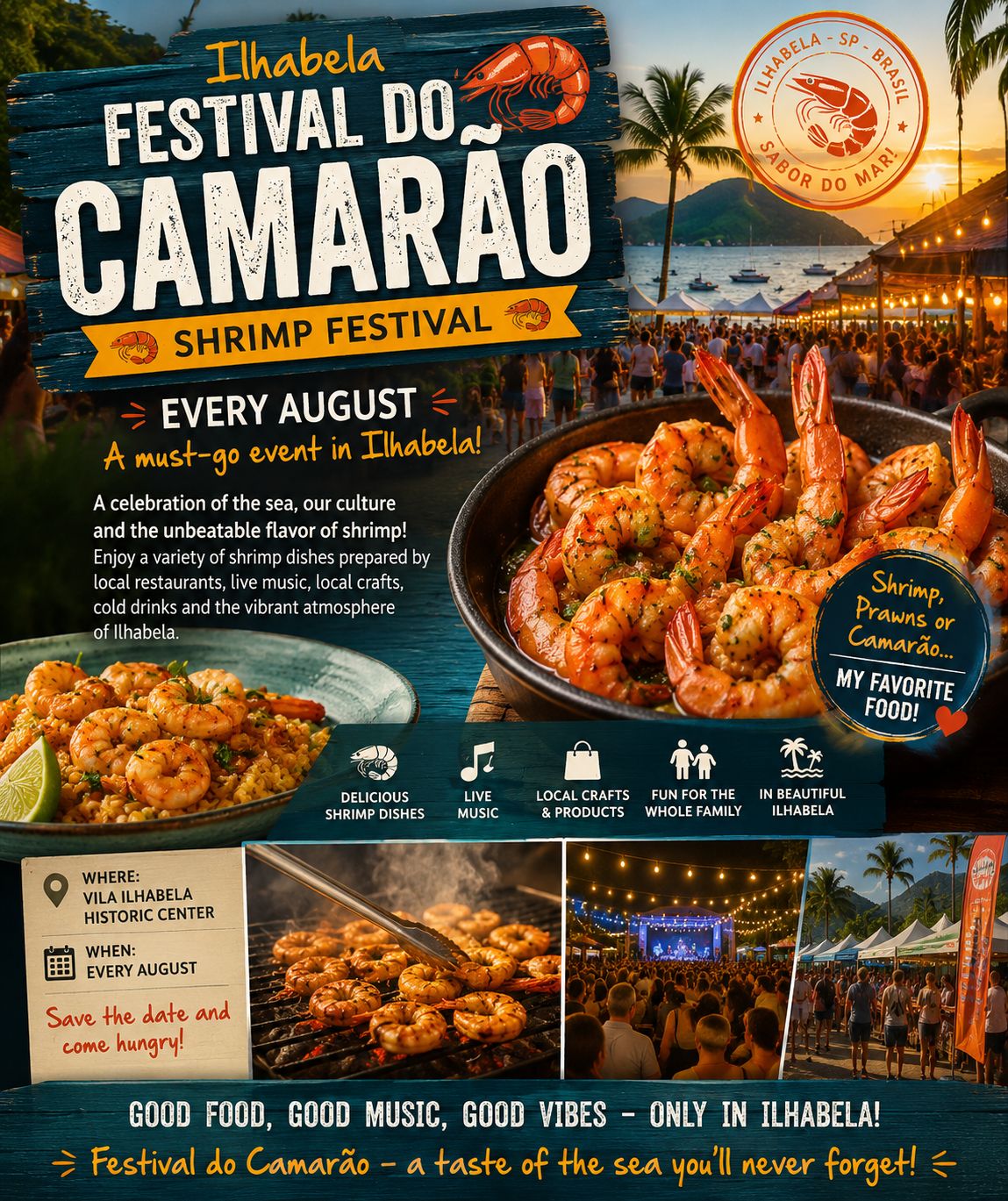
Festival do Camarao is held every August (Shrimp Festival) which is one of my favorite food groups.
Ilhabela Yacht Cruising
Guide - Fuel Supplies
Fuel is available at Marina Porto Ilhabela with 3 to 5 metres alongside. Diesel and gasoline are dispensed from fixed pumps. Turnover is moderate.
Ilhabela Yacht Cruising
Guide - Water Supplies
Potable water is available at marina berths, dispensed from dockside taps with 3 to 5 metres alongside. Pressure and supply are stable.

Mechanical and Electrical Repairs
Resource
If you are headed somewhere remote consider the need to expand your knowledge base or have an information resource on board. Why not get a copy of my book The Marine and Electrical and Electronics Bible 4th Edition. By and for yachties, with everything from batteries and charging, solar and wind, diesel engines and marine electronics and so much more. Your complete systems guide. 650 pages of practical advice. In Australia and New Zealand order a copy through Boat Books. UK and European boats can buy the UK Edition Here. US and Canadian boats can get the US Edition Order Here. Marine systems are my profession so let me help you. By a liveaboard boat owner for other boat owners

Ilhabela Yacht Cruising
Guide - Marine Services
Marine services are available at Marina Porto Ilhabela and Marina Ilhabela. Facilities include diesel engine repair, electrical work, marine electronics and basic rigging support. For full technical capability, yachts may need to use Santos or Angra dos Reis. Volvo Penta and Yanmar agents operate in the Santos and Angra regions.
Ilhabela Yacht Cruising
Guide - Local Customs and Info
Ferries run every 30 minutes between Sao Sebastiao and Ilhabela with transit of 20 minutes. You can bus transfer to Sao Paulo or Rio de Janeiro from there
Sailing. The area was used as the stopover for 1998 Whitbread Race which gives the area a credible yachting destination label. Sail Week takes place in July with many yachts and international competitors in racing classes
Tourism Attractions. Go to the beaches Grande, Portinho, Curral, on the south side, Pinto and Armacao on the North side. Sit back and chill out at beach bars, enjoy food and drink caipirinhas
Etiquette. Brazilian etiquette is informal but respectful, with direct eye contact, steady greetings and a preference for warm, personable interaction. People stand closer than in many cultures, speak with open gestures and expect brief, friendly conversation before moving to practical matters. Politeness is expressed through simple courtesies such as greeting shop staff on entry, acknowledging service workers and avoiding abrupt or overly transactional behaviour. In coastal towns, especially in the Costa Verde, interactions are relaxed but still grounded in mutual respect, and visitors are expected to be patient with slower service rhythms and flexible schedules. Public confrontation is avoided, and calm, courteous communication is the norm when resolving issues.
Ilhabela Yacht Cruising
Guide – Dive Sites
Best sites are Cabras Island with underwater ecological sanctuary. The South Coast is also known as South American Bermuda Triangle with many wrecks to dive on (20 or so) including the following: Brazilian vessel Atilio (1905); British vessel Wharton (1909); and Spanish Principe de Asturias (1916) to name just a few
Health Alert
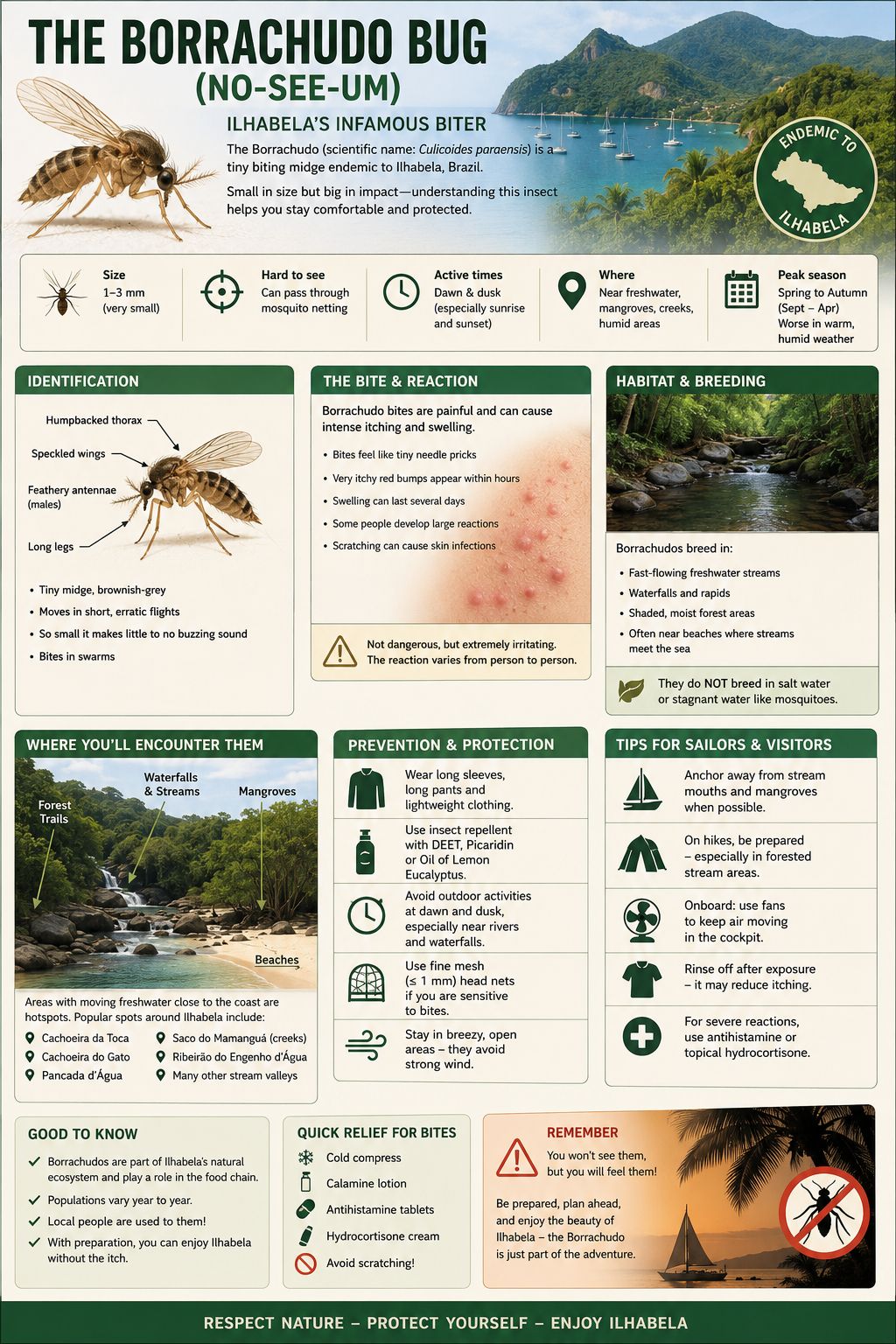
The local nasty is called the Borrachudo Bug, so protection necessary although eradication program is well advanced. The borrachudo is a small black fly (Simuliidae family) that breeds in clean, fast‑flowing freshwater, especially rainforest streams that empty directly into beaches and mangrove edges. It is not a mosquito. It flies silently, bites aggressively during daylight hours and is most active in humid, windless conditions. The bite produces a strong local reaction in most people, with swelling, heat and itching that can last several days. The insect is extremely common in Ilhabela, which is famous across Brazil for its borrachudo density due to the island’s steep rainforest slopes and hundreds of freshwater streams. The same pattern appears in Paraty, Saco do Céu, Saco do Mamanguá, Juatinga, and the Ilha Grande interior bays, where freshwater meets sheltered, wind‑protected anchorages.


Ilhabela Yacht Cruising
Guide - Summary
Ilhabela provides sheltered anchorages on its western side with 8 to 12 metres depths, reliable holding and marina access. The eastern side is exposed and not suitable for anchoring. The island offers provisioning, fuel, water and limited technical support, with full services available at Santos or Angra dos Reis. Ilhabela Yacht Cruising Guide for all you need to know