Itajai Yacht Cruising Guide
Itajai yacht cruising guide. Itajai is the primary maritime centre of Santa Catarina and one of the largest commercial ports in southern Brazil. For yachts, the city provides a sheltered river entrance, a modern full service marina and access to technical support from the region’s established marine industry. The coastline north and south of Itajai is exposed, making the river entrance and marina the only reliable shelter for yachts in this section of the coast.
For vessels transiting between Florianopolis and the ports of Paraná, Itajai is the main stop for fuel, water, provisioning and repairs. The river entrance is well marked, and the marina lies upriver in protected water with stable depths and controlled traffic. The commercial port dominates the waterfront, and all yacht movements must be conducted with awareness of large vessel operations.
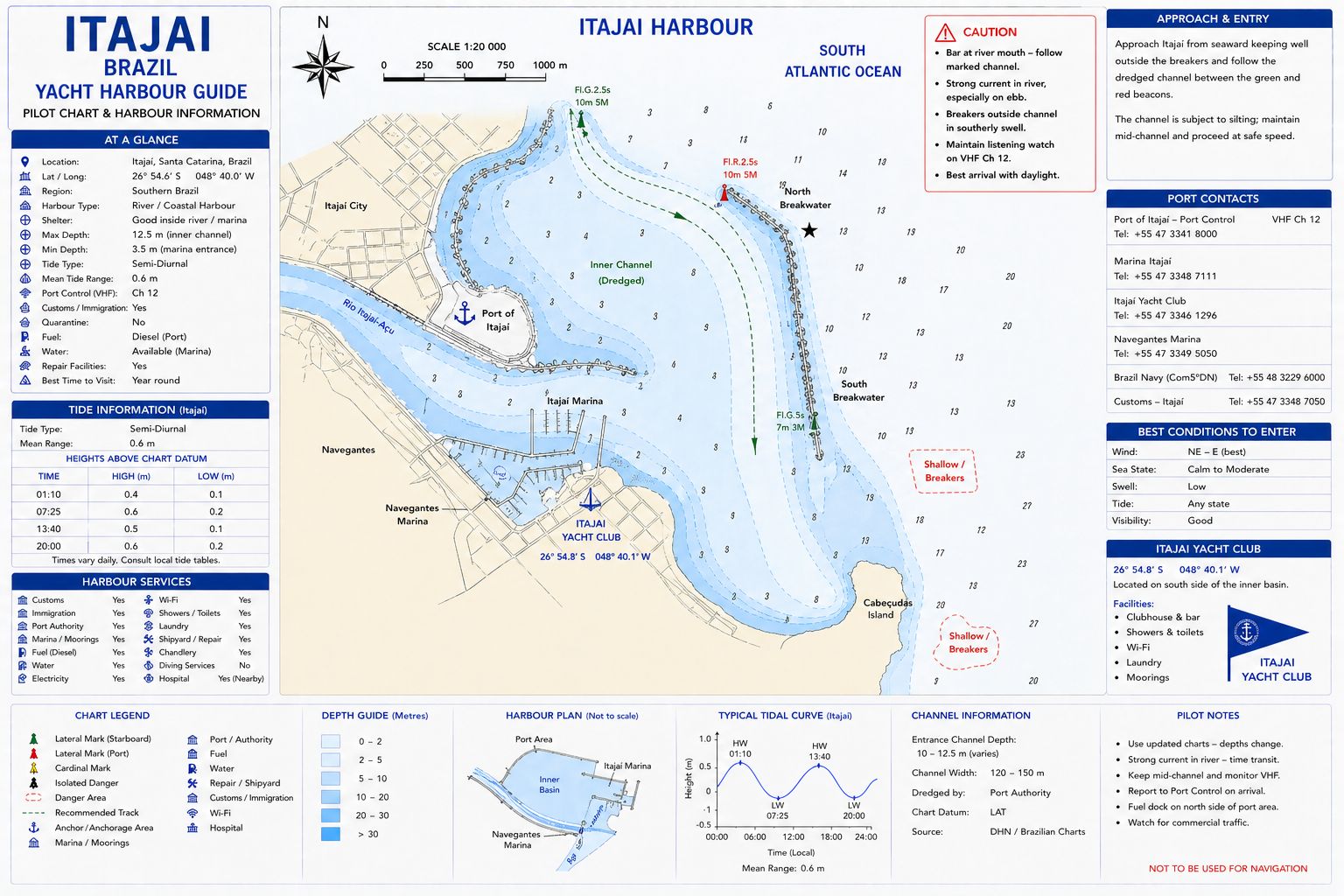
Rio Grande do Sul and the southernmost part of Brasil, and blessed with a beautiful coastline. The state is one of the most prosperous states in Brasil, Down in Santa Catarina the locals are called gauchos. The area is a rich cultured place populated originally with South American Indian, Portuguese, German, Italian, and many other immigrant groups. Itajai is the major local port, with the city located on SW bank of the river. Navigantes is on the Northern bank. Navigantes airport has good regular flights to Sao Paulo with international connections and services
Brazil Coast
Sailing Guide Explainer
I lived, worked and sailed in Brazil for several years. These pages are extracted from an unpublished cruising guide I wrote several years ago and have since updated. As this guide started before electronic charting became mainstream, I have included a lot of the GPS waypoint data, Chart numbers and other navigational information that remains useful. Navigators should ensure they have up to date charts on board, and the accuracy of electronic charts is uncertain. It is a challenging coast to sail, but rewarding with great people, food, music and so on and while there are security challenges, with proper precautions will be manageable.
Itajai Yacht Cruising
Guide - Approaches
The Port of Itajai. (26°55’S, 48°38’W) lies 2 NM inside the river mouth on the River Itajaí‑Açu, with the entrance shared by Itajaí (south bank) and Navegantes (north bank). The approach is via a dredged bar channel used by container ships, with charted depths up to 13.7 m in the access channel. The entrance is fully buoyed and maintained for commercial traffic, with continuous dredging and bathymetric monitoring.
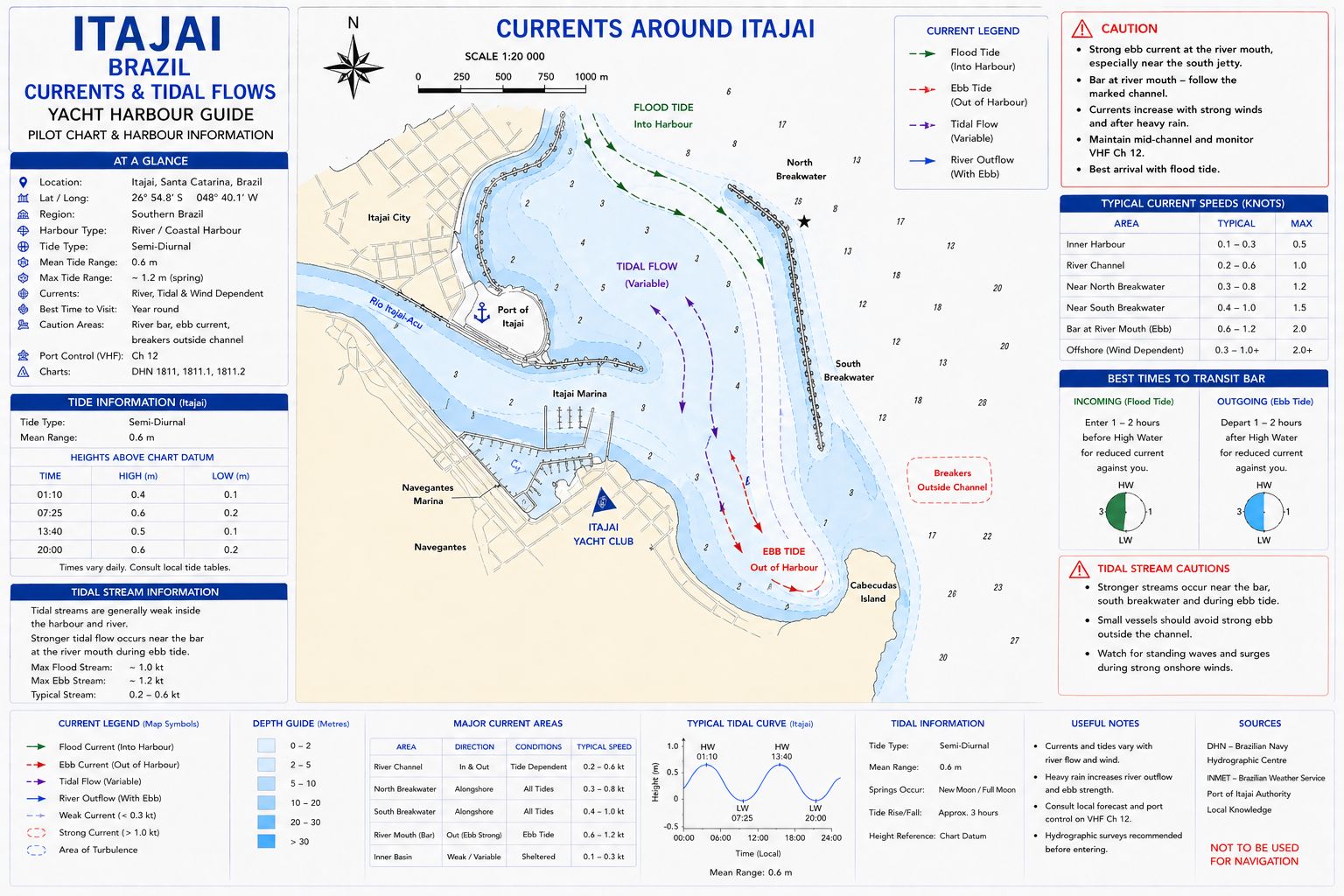
Approaches to Itajai are made from the north or south along an exposed coastline with 12 to 18 metres outside the entrance. The river bar is dredged and maintained, carrying 8 to 12 metres in the approach channel. The river mouth is narrow with strong tidal flow, and all vessels must remain inside the buoyed channel due to shoaling outside the dredged limits. The port is a river port handling container, liquid bulk, reefer, Ro‑Ro and breakbulk traffic, and the channel is constrained, requiring precise adherence to the marked fairway. Hazards include strong southerly swell after frontal systems, commercial traffic entering and leaving the port and unlit fishing gear outside the entrance. Tidal range is moderate, and tidal flow in the river can be strong during peak ebb and flood. Sea state outside the entrance can be rough after southerly winds, but conditions improve rapidly inside the breakwaters. You will see several ships normally anchored off about 1nm
Molhe Sul forms the southern breakwater of the Itajaí bar entrance and defines the south side of the dredged access channel used by commercial traffic entering the Rio Itajaí‑Açu. The structure extends seaward from the Itajaí shoreline and terminates at the bar entrance with a lit aid to navigation marking the end of the breakwater. The dredged channel runs immediately north of the Molhe Sul, and vessels must remain inside the buoyed fairway due to shoaling outside the dredged limits. The area experiences strong ebb flow, and the combination of ebb tide and ocean swell can produce steep, breaking conditions at the bar, particularly near the outer end of the Molhe Sul. The breakwater is a hard boundary with no offing available on its southern side, and all approach traffic aligns with the buoyed channel between the Molhe Sul and the opposite Molhe Norte at Navegantes. The structure is used as a visual and radar reference when making the final approach to the entrance.
- Molhe Norte (Navegantes side): The north entrance is marked by a red‑and‑white vertically striped pointed tower, 5 m high, lit, and positioned at the seaward end of the Molhe Norte breakwater.
- Molhe Sul (Itajaí side): The south entrance is marked by a white cylindrical tower, 5 m high, painted white with two black rings at the top, also lit, and located at the outer end of the Molhe Sul breakwater.
Itajaí – Entrance
& River Pilotage
The entrance to Itajaí is defined by the two breakwaters, Molhe Norte on the Navegantes side and Molhe Sul on the Itajaí side. The north entrance is marked by a red‑and‑white vertically striped pointed tower, 5 m high and shows a green flashing light (Fl G), positioned at the seaward end of the Molhe Norte. The south entrance is marked by a white cylindrical tower, 5 m high, painted white with two black rings at the top and shows a red flashing light (Fl R), located at the outer end of the Molhe Sul. These towers define the limits of the dredged bar channel, which must be followed precisely due to shoaling outside the maintained fairway.
The bar is subject to strong ebb flow, and ebb‑over‑swell can produce steep or breaking seas at the jetty heads. All inbound traffic aligns between the two entrance towers and remains within the buoyed dredged channel.
Brazil uses IALA Region B, where starboard‑hand marks are red and port‑hand marks are green when entering from seaward. The riverbank towers follow this system.
Inside the river, inbound vessels maintain position in the centre of the dredged channel, which is heavily used by fishing vessels and shoals rapidly outside the maintained limits. The starboard bank (south bank when inbound) is marked by red‑and‑white shore towers, and the port bank (north bank when inbound) is marked by black‑and‑white towers, placed at regular intervals to define the channel alignment as the river bends toward the commercial port. Tidal streams outgoing 2-3kts and up to 5kts with a lot of rain runoff in river. From North current sets away from Mohle Sul towards sand bank close to Mohle Norte. Allow for set, approach is ideal at 270 degrees with Mohle light ahead
Upriver from the entrance, the city‑centre waterfront on the Itajaí side often has a Brazilian Naval patrol boat berthed, a fixed presence that sits directly on the main riverfront promenade. Immediately beyond this point two ferry punts operate the short crossing between Itajaí and Navegantes, running continuously across the narrow river and requiring inbound vessels to maintain a steady mid‑channel line as they weave through the ferry movements. Once past the ferry zone, the port side when inbound, the north bank at Navegantes quickly becomes commercial, with the riverfront giving way to the long berths and container terminals of Portonave, where large commercial traffic manoeuvres in and out of the turning basin.
Itajai Yacht Cruising
Guide - Navigation and Pilotage
Official charts for the approach are DHN BR323300, BR501841 and BR601841, with BA 547 and 3981 also covering the area. Pilotage into the river requires alignment with the entrance leads and monitoring of commercial traffic movements. The main channel carries 8 to 12 metres until upriver, where depths reduce to 5 to 8 metres near the marina zone. Manoeuvring must account for tidal flow, which can reach two knots during peak periods. Night entry is possible in settled conditions due to clear marking of the entrance, but caution is required due to fishing boats and commercial movements. Visibility can drop during frontal rain bands and morning humidity. The marina entrance is straightforward with 3 to 5 metres inside the basin.
Itajai Yacht Cruising Guide - Local Currents
Itajai Yacht Cruising
Guide - Anchorage
There is no practical anchorage outside the river entrance due to exposure to swell and commercial traffic. Inside the river, anchoring is not permitted due to port operations and dredged channels. Yachts must proceed directly to the marina.
Itajai Yacht Cruising
Guide - Entry Formalities
Itajai is a clearance port. Immigration, Customs and the Port Captaincy are located within the port complex. Firearms must be declared. Starlink is permitted but must not interfere with regulated frequencies. Clearance procedures are conducted on the commercial side of the port, and yachts must follow port control instructions when moving within the river.
Itajai Yacht Cruising
Guide - Marina Facilities
Marina Itajai. Primary yacht marina with 3 to 5 metres depth at berths. Power, water, fuel dock, haul out, mechanical and electrical workshops, marine electronics, rigging, chandlery, divers and security. This is the only full service marina in the region. ANI Marina. Depths and services are not fully documented. Suitable only for local vessels. Visiting yachts should confirm suitability before entry. Wind 92. Listed as a marina or mooring facility. Limited information available regarding depths and services. Visiting yachts should verify details in advance. All other waterfront facilities are commercial or industrial and not suitable for yachts.
Itajai Yacht Cruising
Guide - Local Weather
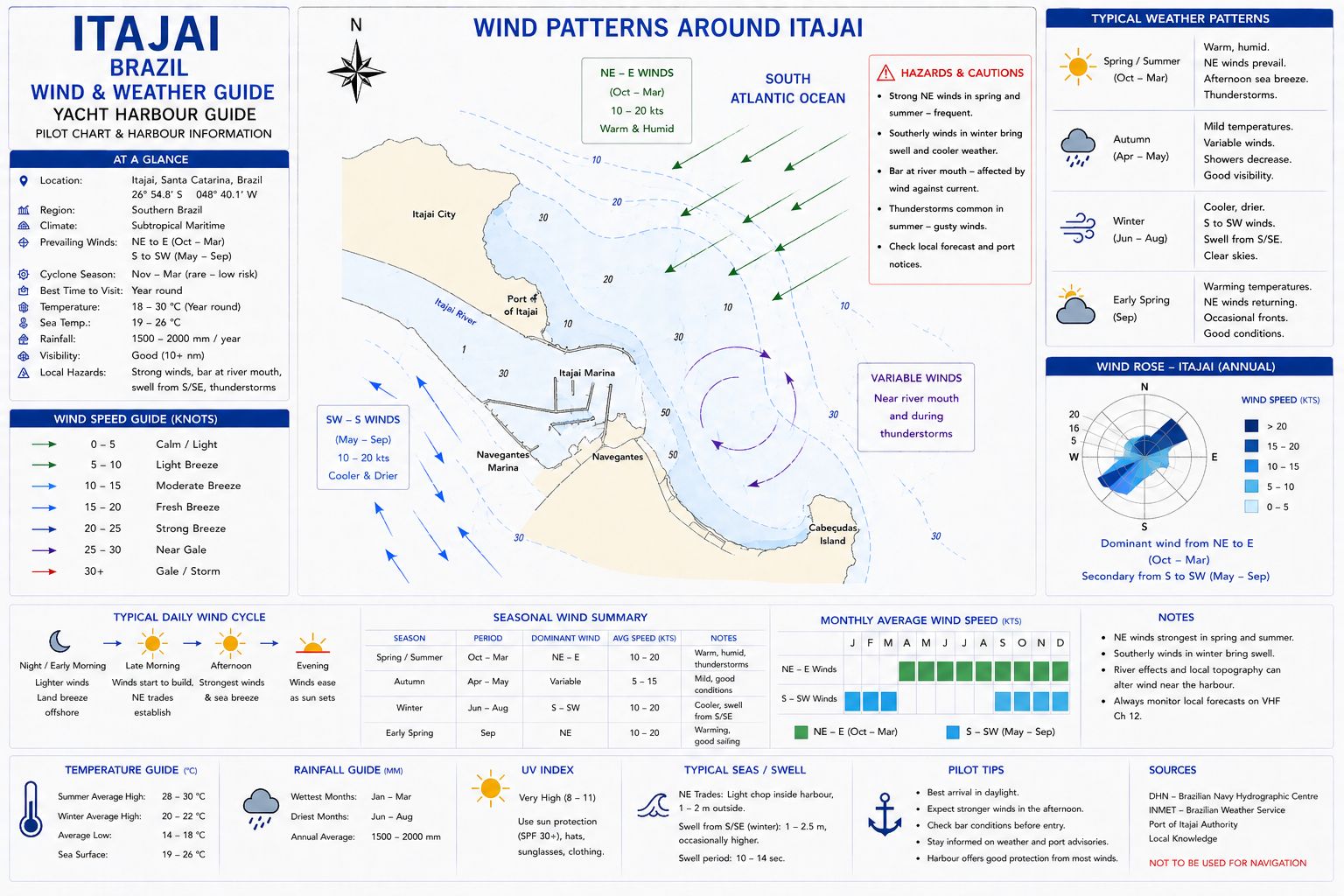
Local weather is shaped by southerly frontal systems, sea breeze cycles and seasonal swell. Frontal passages bring strong southerly winds, rough sea state outside the entrance and reduced visibility. Sea breezes build from late morning and ease after sunset. Winter months can produce persistent southerly swell that affects the entrance channel. Summer months bring convective squalls with rapid wind shifts and heavy rain. Morning humidity can produce haze that reduces visibility until mid morning.
Itajai Yacht Cruising
Guide - Provisioning
Supermarkets. Koch Supermercados. Centro (Rua Brusque). Large, modern supermarket with full fresh‑produce section, bakery, butchery, dairy, frozen goods, and dry stores. Strong on fruit and vegetables, good bread selection, and reliable packaged goods. Closest full‑size supermarket to the marina/riverfront zone. Angeloni Itajaí. Centro (Av. Marcos Konder). Large-format supermarket with wide aisles, strong bakery, good cheese and deli counter, and consistent fresh produce. Reliable for bulk provisioning, beverages, and household items. One of the most complete stores in the city. Bistek Supermercados. São João Full‑range supermarket with good meat counter, bakery, and packaged goods. Slightly further inland but useful for larger provisioning runs. Fort Atacadista. Fazenda. Cash‑and‑carry style wholesale supermarket. Best for bulk quantities, beverages, cleaning products, rice, pasta, oil, flour, and long‑life goods. Limited fresh produce but excellent for volume provisioning. Giassi Supermercados. São Vicente. Large, modern supermarket with strong bakery, good produce, and reliable dry‑goods selection. Useful alternative to Angeloni/Koch if crowds are heavy.
Markets. Itajai Municipal Market. Fruit, vegetables, staples and local produce.
Fish Markets. Mercado do Peixe de Itajai. Fresh local fish, fillets and shellfish. Harbourfront vendors. Small scale supply depending on daily catch.
Itajai Yacht Cruising
Guide - Local Cuisine
Itajaí’s food culture is built around the industrial fishing fleet, the Navegantes fish market, and the river–sea interface that supplies consistent landings of linguado (flounder), tainha (mullet), anchova (bluefish), pescada, camarão sete‑barbas, and siri. Most dishes are built from these species rather than the broader Santa Catarina coastal repertoire. The dominant preparations are simple, pan‑based, and salt‑forward, reflecting the working‑fleet food culture rather than restaurant‑driven cuisine.
Tainha grelhada appears seasonally, grilled whole with coarse salt during the winter mullet run, and is one of the few dishes tied to a fixed fishing season. Anchova na brasa is the standard year‑round grilled fish, cut into thick steaks and cooked over charcoal with minimal seasoning. Linguado à moda da casa is a common local preparation: flounder fillets lightly floured and pan‑fried in butter or oil, served with rice and farofa. Camarão alho e óleo uses the small local seven‑barbas shrimp, quickly sautéed with garlic and oil; it is widely available due to the shrimp trawlers operating out of Itajaí and Navegantes. Moqueca catarinense is a regional variant built on local white fish, tomatoes, onions, and coriander, without the dendê oil typical of Bahia; it is lighter and reflects the southern palate.
River influence appears in caldo de peixe, a clear fish broth made from trimmings landed by the fleet, and in pirão, a thickened fish‑stock and manioc‑flour side dish served with most cooked fish plates. Shellfish is present but not dominant; siri desfiado (picked crab meat sautéed with aromatics) is the most common crab preparation, tied to the local mangrove harvest. Acarajé is a black eyed bean fritter filled with shrimp.
Itajai Yacht Cruising Guide - Beverages
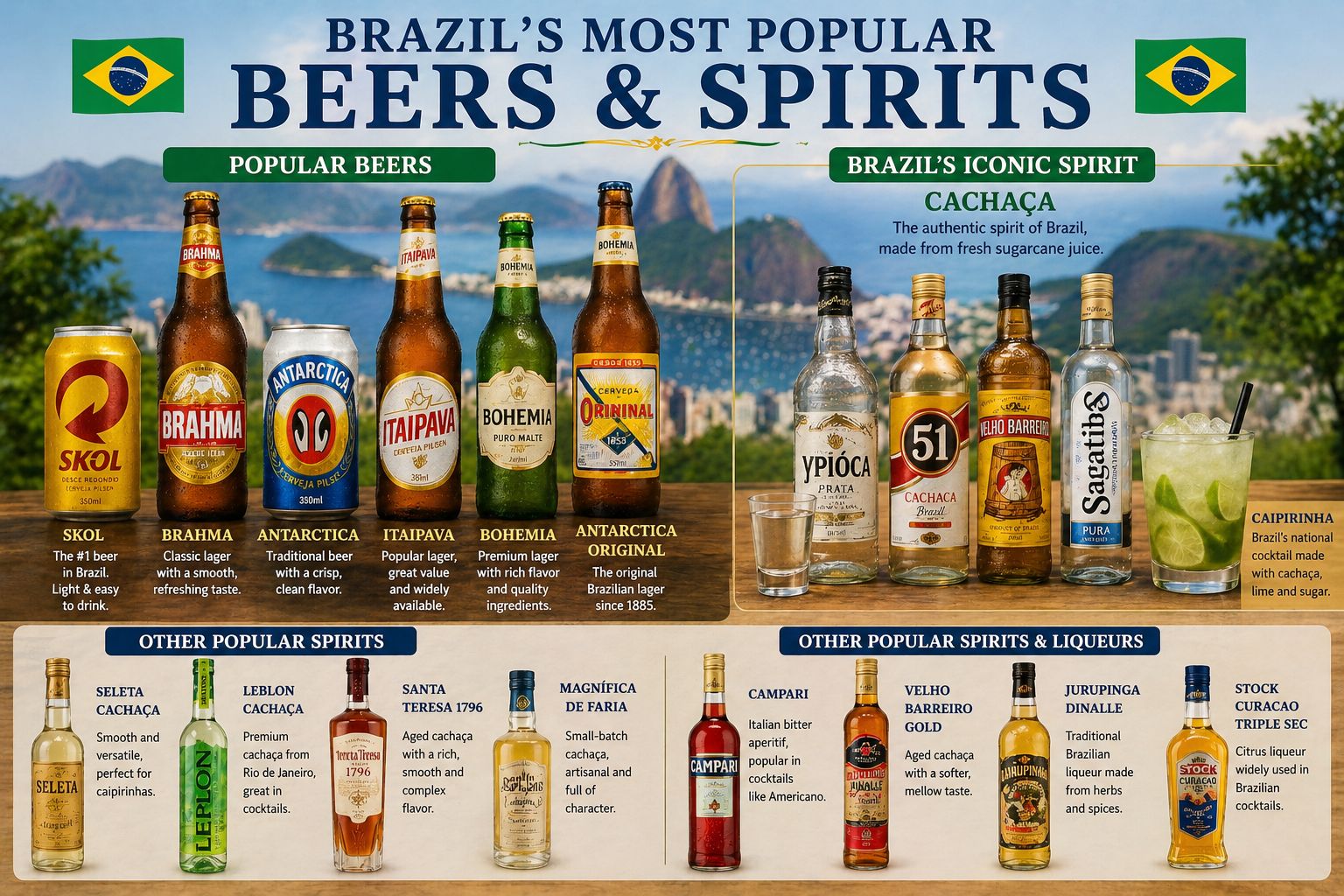
In Brazil, “suco vitamina” (often shortened to just vitamina) refers to a thick, blended fruit drink, closer to a smoothie than a simple juice. Unlike fresh suco (which is usually just fruit plus water), a vitamina is typically made with milk (or sometimes yogurt), fruit pulp, and often sugar or honey, giving it a creamy texture and higher nutritional value. When you see these made with “frutas da Amazônia” (Amazonian fruits), they commonly include:
Açaí which is a thick, earthy berry pulp, often blended with banana, Cupuaçu which is a tangy, creamy fruit with a chocolate–pineapple note, Graviola (soursop) which is smooth, slightly sour and custard-like, Acerola which is very high in vitamin C, often mixed with sweeter fruits, Mango, papaya, banana are used as base fruits for body and sweetness
Typical preparation: Fruit pulp (fresh or frozen); Milk or water (milk = vitamina, water = more like suco), Sugar, honey, or condensed milk (optional but common), Ice. What makes them distinctive: Thicker than juice, more filling (almost a light meal), they are often sold in juice bars (lanchonetes) and beach kiosks

Itajai Yacht Cruising
Guide - Fuel Supplies
Fuel is available at Marina Itajai with 3 to 5 metres alongside. Diesel and gasoline are dispensed from fixed pumps. Turnover is high due to commercial and recreational traffic.
Itajai Yacht Cruising
Guide - Water Supplies
Potable water is available at marina berths, dispensed from dockside taps with 3 to 5 metres alongside. Pressure and supply are stable.
Mechanical and Electrical Repairs
Resource
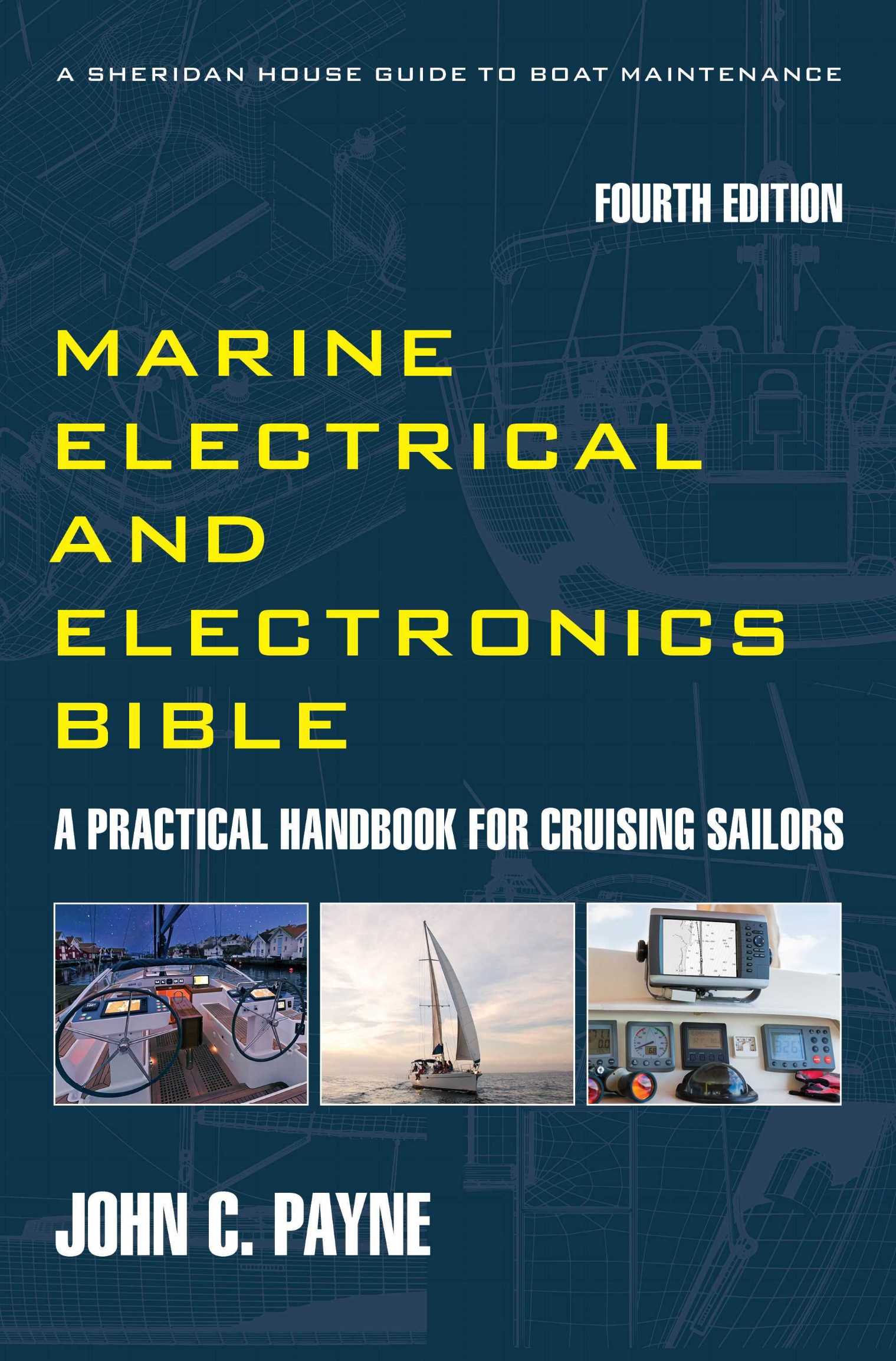
If you are headed somewhere remote consider the need to expand your knowledge base or have an information resource on board. Why not get a copy of my book The Marine and Electrical and Electronics Bible 4th Edition. By and for yachties, with everything from batteries and charging, solar and wind, diesel engines and marine electronics and so much more. Your complete systems guide. 650 pages of practical advice. In Australia and New Zealand order a copy through Boat Books. UK and European boats can buy the UK Edition Here. US and Canadian boats can get the US Edition Order Here. Marine systems are my profession so let me help you. By a liveaboard boat owner for other boat owners


Itajai Yacht Cruising
Guide - Marine Services
Marine services are concentrated at Marina Itajai and the surrounding marine industry zone. Facilities include diesel engine repair, electrical work, marine electronics, rigging, fibreglass repair and chandlery. The region hosts major shipyards and yacht builders, providing access to specialist services. Volvo Penta and Yanmar agents operate in the region.
Itajai Yacht Cruising
Guide - Local Customs
Local behaviour is straightforward and respectful. Yachts must follow port control instructions when moving within the river. Keep noise low at the marina and avoid obstructing commercial traffic. Environmental rules regarding waste and water discharge are strictly enforced.
Festivals.
- June - Festa do Divino e Corpis Cristi with fireworks and shows
- July - Festa de Sao Cristovao and centered on Ingeja de Sao Cristovao
- July - Festa do Colono. Mostly agricultural
- October - Marejada Festa Portuguesa e do Pescado, food, fish and fun and is large festival
Itajai Yacht Cruising
Guide - Summary
Itajai provides a sheltered river entrance, a full service marina with 3 to 5 metres depth and access to provisioning, fuel, water and technical support. There is no anchorage, and all movements must account for commercial port operations. It is the primary yacht facility between Florianopolis and the ports of Paraná. Itajai Yacht Cruising Guide for all you need to know