Lindeman Group Sailing Guide
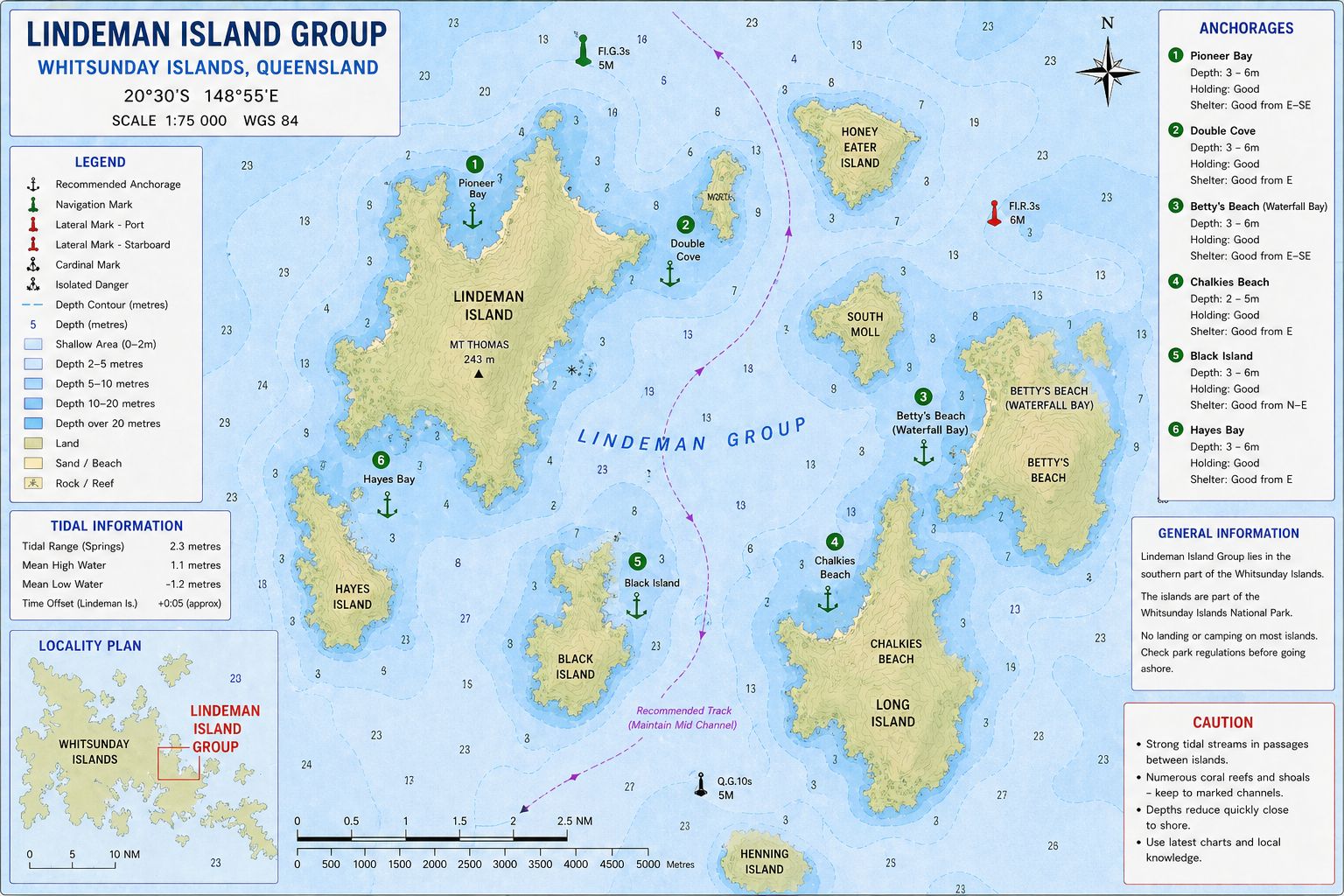
Lindeman Group Sailing Guide. The Lindeman Group forms the southern entrance to the Whitsundays and behaves as a compact, predictable cruising region defined by six primary islands arranged around the Lindeman Passage. It is the first coherent anchorage network encountered when arriving from Mackay or the Cumberland Islands, and it provides a sequence of western bays that behave consistently in the prevailing south‑easterlies. The group is small enough for short, controlled passages between anchorages, yet large enough to function as its own navigational unit, with each island contributing distinct anchoring environments shaped by reef, depth and exposure.
The region is composed of Lindeman Island, Shaw Island, Seaforth Island, Maher Island, Thomas Island and Pentecost Island. Lindeman and Shaw form the operational core of the group, providing the primary anchorages and the most reliable shelter. Seaforth and Maher shape the inner passages and influence the behaviour of the sea state, while Thomas and Pentecost define the southern approaches and the transition toward the Cumberland Islands. The group is straightforward to navigate in settled conditions, but the shallow margins, fringing reef and exposure to northerlies require deliberate planning and conservative positioning.
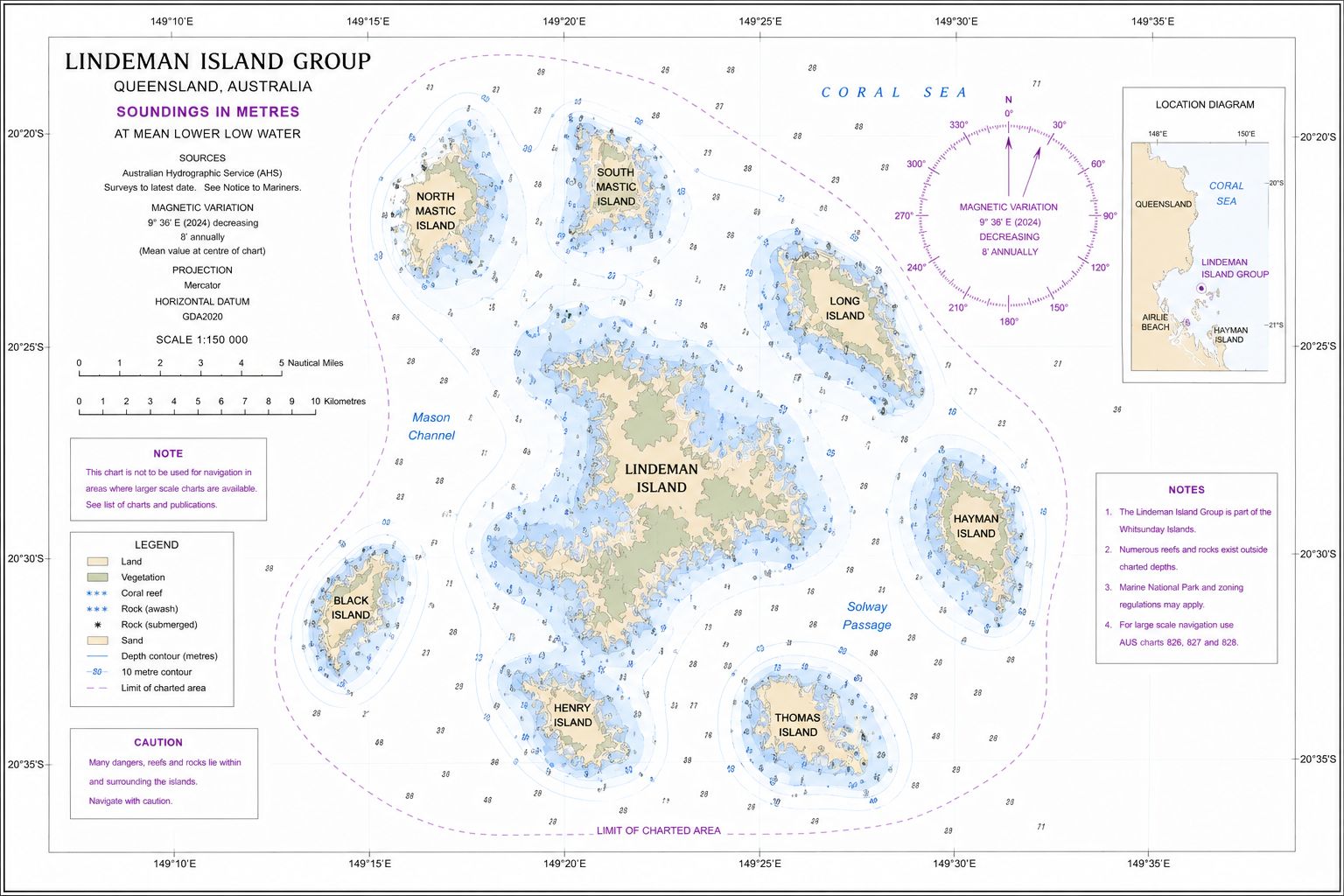
Chart Disclaimer. This chart is a schematic representation for illustrative purposes only and must not be used for navigation. Refer to official hydrographic charts for safe navigation. Be aware ENC charts may differ from official hydrographic charts. Both should be corrected and updated regularly.
Lindeman Group Sailing Guide - Islands
Lindeman Island. This is the largest island in the group and forms the eastern boundary of the region. Its western side provides the broadest and most predictable anchorage, shaped by a gently shelving seabed and reliable holding in moderate south‑easterlies. The eastern coastline is steep, reef‑fringed and exposed to the Coral Sea, and is generally unsuitable for anchoring. Lindeman Island is the natural arrival point for vessels approaching from the south and is central to most Lindeman Group cruising itineraries.
Shaw Island. This lies immediately west of Lindeman and contains the most protected anchorages in the group. Its western shoreline forms a natural lee in the prevailing trades, creating calm pockets that behave consistently even when the breeze freshens. Shaw’s shape produces a mix of enclosed bays and open, weather‑dependent anchorages, making it the operational heart of the group for skippers seeking reliable shelter.
Seaforth Island. This sits between Lindeman and Shaw and shapes the inner corridor of the group. It does not provide a primary anchorage but influences the behaviour of the sea state and the movement of vessels between the main islands. Seaforth is a navigational feature rather than a destination, but it plays a key role in the way the group’s passages behave in fresh south‑easterlies.
Maher Island. This lies close to Seaforth and forms part of the same inner chain. It does not offer a practical anchorage but defines the shape of the passages and the angles of approach to the anchorages on Lindeman and Shaw. Maher is a structural component of the group rather than an anchoring location, but it is a useful visual reference when navigating the inner corridor.
Thomas Island. This sits further south and marks the transition between the Whitsundays and the Cumberland Islands. Its western side offers a remote, weather‑dependent anchorage shaped by its exposure to the Coral Sea and the behaviour of swell wrapping around its headlands. Thomas Island is a settled‑weather destination that behaves differently from the more sheltered bays within the main group.
Pentecost Island. This is a small but distinct island within the group, influencing the shape of the southern approaches and the behaviour of the sea state around Thomas Island. It is not an anchorage destination but forms part of the group’s structural geography and is a useful reference point when approaching from the south.
Lindeman Group Sailing Guide - Anchorages
Lindeman Island Anchorage sits on the island’s western side, offering a broad sand basin outside the fringing reef. Approaches remain in deep water until close to the bay, with offshore depths of 18–25 m reducing steadily to 12–16 m as the vessel closes the western shoreline. Inside the bay, depths taper into a consistent anchoring band of 8–12 m over sand, with isolated coral patches scattered toward the southern margin.
The fringing reef forms an uneven arc, with the southern arm projecting further offshore and rising abruptly from 6–8 m to the reef edge. This requires a positive offset from the southern headland when shaping in, as the reef shelf is not symmetrical. The northern margin is more forgiving, with a gentler rise from 10–12 m into the reef flat.
Tidal range is moderate, and streams set across the bay rather than directly in or out, producing a mild cross‑set during springs. Holding is reliable in sand, though the southern corner becomes uncomfortable in fresh SE trades as swell wraps around the point. The anchorage remains workable in moderate SE conditions, with the island providing partial lee, but becomes exposed and sloppy in northerly winds. Dinghy access is straightforward at mid‑to‑high tide, with 1–1.5 m at the beach edge and a clean sand landing. Care is required near the southern margin where coral heads rise into 3–4 m.
Lindeman Group Sailing Guide - Plantation Bay
Approaches remain in workable depths until close to the bay, with offshore water of 18–22 m reducing to 12–16 m as you close the northern shoreline. Inside the bay, the anchoring band holds 7–10 m over sand at mid‑tide, with a gentle slope toward the beach and isolated coral patches concentrated along the southern margin.
The fringing reef forms a shallow rim across the southern and eastern sides, rising sharply from 6–8 m to the reef flat. The northern side is more forgiving, with a gradual rise from 10–12 m, making it the preferred entry line. When shaping in, vessels should maintain a slight northerly offset to avoid the southern coral arm, which extends further offshore than charted intuition suggests. The central basin offers the cleanest sand and the most predictable holding.
Tidal range is moderate, and streams set weakly across the bay, producing minimal swing except during springs when a gentle cross‑set can be felt. Plantation Bay remains comfortable in moderate SE–E winds, with the island providing a reliable lee, though swell can wrap into the southern corner during fresh conditions. Northerly winds leave the anchorage exposed and uncomfortable. Dinghy access is straightforward at mid‑to‑high tide, with 1–1.5 m at the shoreline and a clean sand landing. Coral heads rise into 3–4 m near the southern edge and should be avoided when manoeuvring.
Neck Bay Shaw
Island
Neck Bay sits between Shaw Island and Burning Point, forming a broad, reliable anchorage with a clean sand bottom and predictable depth profile. Approaches remain straightforward, with offshore depths of 18–22 m reducing evenly to 12–16 m as you close the bay. Inside, the anchoring band holds 7–11 m over firm sand at mid‑tide, with the best holding found in the central basin. The seabed slopes gently toward the beach, and coral is limited to the fringing edges, leaving the main anchorage clear.
The bay is bordered by low fringing reef on both sides, rising from 6–8 m into the reef flat. The northern margin is more forgiving, with a gradual rise from 10–12 m, while the southern margin has isolated coral heads that lift into 3–4 m and should be avoided when manoeuvring. Entry is simplest on a central or slightly northerly line, keeping clear of the southern coral pockets.
Tidal range is moderate, and streams set weakly across the bay, producing minimal swing except during springs when a gentle cross‑set can be felt. Neck Bay is well protected in SE–E winds, with Shaw Island providing a solid lee and minimal swell intrusion. Conditions deteriorate in northerly winds, which leave the bay exposed and uncomfortable. Dinghy access is straightforward at mid‑to‑high tide, with 1–1.5 m at the shoreline and a clean sand landing.
Burning Point on Shaw Island
This provides a more open, weather‑dependent anchorage with a gently shelving seabed and exposure to the behaviour of the Lindeman Passage. It is comfortable in settled south‑easterlies but becomes active when the breeze freshens or the sea state builds across the passage. Burning Point is often used as a day anchorage or a staging point when moving between the Lindeman Group and the central Whitsundays.
Gap Beach on
Shaw Island
This offers a small, quiet anchorage shaped by shallow margins and the influence of surrounding reef. It is a fair‑weather stop that rewards careful positioning and conservative planning. Gap Beach is a niche anchorage but valuable for skippers seeking solitude in settled conditions.
Thomas Island Anchorage
This lies on the island’s western side and provides a remote, weather‑dependent stop shaped by its exposure to the Coral Sea. It is suitable only in settled conditions and behaves differently from the more sheltered bays within the main group.
Lesser Islands and Anchorages
These are smaller features that sit inside the Lindeman Group’s sailing envelope and are often referenced in anchorage descriptions:
- Cole Island. Cole Island is a small, steep‑sided, reef‑fringed island east of Shaw Island, offering a handful of quiet, weather‑dependent anchorages with clean sand holding and straightforward approaches in settled conditions.
- Barber Island. Barber Island is a small, steep, reef‑fringed outlier east of Maher Island, offering only a few quiet, weather‑dependent anchorages suited to experienced skippers operating in settled conditions.
- Tinsmith Island. Tinsmith Island is a small, steep, reef‑fringed outlier east of Barber Island, offering only a couple of tight, weather‑dependent anchorages suited to experienced skippers operating in settled conditions.
- Teague Island. Teague Island sits east of Shaw Island and south‑east of Thomas Island, forming one of the quieter stops in the southern Whitsundays for yachts transiting between the Lindeman Group and the offshore islands
- Anchor Island (tiny, off Shaw). Anchor Island is a tiny, steep, reef‑rimmed islet off the western side of Shaw Island, offering no true anchorage but serving as a useful visual reference point when navigating the passages between Shaw, Lindeman, and Seaforth Islands
- Passage Islet (between Shaw and Lindeman). Passage Islet is a tiny, low‑lying islet between Shaw Island and Lindeman Island, serving mainly as a visual navigation mark when entering or exiting the narrow passages that link the central and southern Whitsunday routes.
- Little Pentecost (small outlier near Pentecost). Little Pentecost is a small outlier just off Pentecost Island’s eastern side, acting mainly as a visual navigation mark with no usable anchorage due to its steep sides and tight fringing reef.
- Unnamed reef islets and drying patches around Shaw, Seaforth, and Thomas are tiny coral outcrops and shallow reef shelves that sit just above or below the surface at low tide, offering no anchorage but acting as important visual and charted hazards that shape the safe approach lines into the surrounding islands
Lindeman Group Sailing Guide - Weather
The Lindeman Group behaves predictably in moderate south‑easterlies, with the western sides of the islands providing reliable shelter and the sea state remaining manageable across the passages. Fresh trades increase exposure in the more open anchorages, particularly at Burning Point and Thomas Island, where the fetch builds quickly. Northerlies expose the entire group and create short, steep chop that makes most anchorages uncomfortable or untenable. Swell from the Coral Sea can wrap around the southern islands and influence the behaviour of the more exposed bays. For skippers researching Lindeman Group weather patterns, the region is best used when the breeze is settled and the weather pattern is stable.
Lindeman Group Sailing Guide - Navigation
Navigation within the Lindeman Group is straightforward in good visibility, with deep water in the passages and clear sightlines to the islands. The approaches to the anchorages are simple, but the skipper must monitor depth carefully when closing the shoreline, as the fringing reef extends further than expected in some areas. The inner corridor between Lindeman, Seaforth and Shaw behaves predictably in moderate weather and provides a sheltered route between anchorages. The southern approaches around Thomas and Pentecost require more caution due to exposure and the behaviour of swell. For skippers planning Whitsunday navigation routes, the Lindeman Group offers a controlled, low‑complexity environment.
Lindeman Group Sailing Guide - Hazards
The primary hazards in the Lindeman Group are the fringing reef, the shallow margins and the exposure created by northerly winds. Coral rises abruptly in several areas, and the skipper must avoid edging too close to the reef when anchoring or manoeuvring. The open‑coast behaviour of the sea state develops quickly in fresh trades, particularly across the Lindeman Passage and around Thomas Island. The anchorages are forgiving in the sandy patches, but the narrow anchoring bands require precise positioning and careful attention to tidal height. For skippers evaluating Lindeman Group anchorage risks, the region rewards conservative planning and disciplined depth management.
Lindeman Group Sailing Guide - Fishing
Fishing around the Lindeman Group is a sheltered inshore–reef blend shaped by the shallow banks, fringing coral, and narrow channels that run between Lindeman, Seaforth, Shaw, and the smaller outer islets. The water is clearer than the mainland coast but more protected than the outer Whitsunday islands, giving the region a dependable mix of trout, sweetlip, tuskfish, and cod along the reef edges, with queenfish, trevally, and mackerel moving through the channels on clean water. The best sessions come on the tide changes, especially the first of the flood when bait lifts off the bottom and pushes across the sand tongues between the islands. The deeper pockets behind Shaw and the rubble patches off Lindeman often fire when the current slackens, while the more exposed eastern faces produce pelagics when the wind drops out. Most skippers fish from the dinghy, drifting the channels or working the bommies in settled conditions, as anchoring close to structure is rarely practical. Ciguatera risk exists but is lower than in the outer island groups, with only larger reef predators warranting caution. Overall, the Lindeman Group offers a reliable, easygoing fishery—tide‑driven, structure‑focused, and best worked when the water is clean and the current begins to ease.
Mechanical and Electrical Repairs
Resource
If you are headed somewhere remote consider the need to expand your knowledge base or have an information resource on board. Why not get a copy of my book The Marine and Electrical and Electronics Bible 4th Edition. By and for yachties, with everything from batteries and charging, solar and wind, diesel engines and marine electronics and so much more. Your complete systems guide. 650 pages of practical advice. In Australia and New Zealand order a copy through Boat Books. UK and European boats can buy the UK Edition Here. US and Canadian boats can get the US Edition Order Here. Marine systems are my profession so let me help you. By a liveaboard boat owner for other boat owners


Lindeman Group Sailing Guide -
Summary
The Lindeman Group is a compact, structurally clear cruising region at the southern edge of the Whitsundays, defined by six primary islands, a handful of reliable western anchorages and straightforward passages that behave predictably in moderate south‑easterlies. Lindeman and Shaw provide the core anchorages, while Seaforth, Maher, Thomas and Pentecost shape the approaches, sea state and route choices for skippers arriving from Mackay or the Cumberland Islands. When the weather is settled and the breeze is in the south‑east, the group offers a controlled, low‑complexity environment for planning, anchoring and moving between bays, making it an ideal starting point for Whitsunday sailing routes or a natural pause on a longer coastal passage. Lindeman Group Sailing Guide is all you need to know.