Whitsunday Island
Sailing Guide
Whitsunday Island Sailing Guide. Whitsunday Island is the largest island in the group and forms the central cruising area of the Whitsundays, offering a mix of deep, protected anchorages, iconic beaches, tidal passages and weather‑dependent bays. The island sits between the Whitsunday Passage and the Coral Sea and provides some of the region’s most reliable shelter on its western side, along with some of its most exposed and visually striking anchorages on the eastern side. For skippers moving between Airlie Beach, Hamilton Island, Hook Island and the southern island group, Whitsunday Island is a natural waypoint with predictable depths, strong holding in the protected bays and clear navigational logic shaped by wind, tide and reef structure.
Although Whitsunday Island is forgiving in settled conditions, the skipper must remain alert to tidal acceleration in the passages, coral bommies near the reef edges, gusts funnelling down the slopes in fresh south‑easterlies and the exposure created by northerly winds. The western side provides deep, protected anchorages suitable for overnight stays, while the eastern side transitions into open‑sea fetch, sand‑fringed beaches and weather‑dependent anchorages that require careful selection. The island is not difficult to navigate, but it rewards a deliberate approach and an understanding of how wind, tide and reef structure interact across its bays and passages.
Whitsunday Island
Sailing Guide - Structure and Navigation Logic
Whitsunday Island is defined by the contrast between its protected western side and its exposed eastern coastline, with the island’s shape and position creating several key navigational corridors:
- Whitsunday Passage (West). Deep, predictable water with reliable shelter in south‑easterlies.
- Cid Harbour and Sawmill Bay. The most secure anchorages on the island, offering deep, protected water and excellent holding.
- Dugong Beach and Cid Island Vicinity. Shallow, sand‑fringed areas suitable for day use and short stays.
- Whitehaven Beach (East). A long, exposed beach with weather‑dependent anchoring and strong tidal influence.
- Hill Inlet (North‑East). A tidal estuary with shifting sandbars and limited anchoring options, suitable only for shallow‑draft vessels.
- Chance Bay and Turtle Bay (South‑East). Weather‑dependent anchorages offering moderate shelter in light south‑easterlies.
- Solway Passage (South). A tidal gateway between Whitsunday Island and Haslewood Island, with strong tidal flow and exposed conditions in fresh trades.
The island’s navigational logic is shaped by wind direction, tidal flow and reef structure. The western side provides reliable shelter in south‑easterlies, while the eastern side requires careful weather selection. Tidal acceleration is noticeable in the passages, particularly near Solway Passage and Hill Inlet.
Whitsunday Island
Sailing Guide - Navigation Hazards
The primary hazards around Whitsunday Island are coral bommies, fringing reefs, tidal acceleration in the passages and the exposure created by northerly winds. The skipper must maintain adequate distance from reef edges, anchor only in sand patches and avoid edging too close to the shoreline in the eastern bays. Hill Inlet requires careful attention to shifting sandbars and tidal height. Solway Passage experiences strong tidal flow and must be transited with awareness of set and drift.
Keep a Bow Watch for Bommies
(Bomboras)
Bommies is a common cruising term (especially in the Pacific and Australia) referring to isolated coral heads that rise abruptly from the seabed, often from deep water to just below, or just above, the surface. Bommies are one of the biggest navigational hazards in reef environments because they can be hard to see in poor light, they are scattered unpredictably across lagoon floors, they are steep‑sided, rising from 20–30 m to 1 m in seconds, they are uncharted or inaccurately charted. A single bommie can ruin a keel, rudder, or prop.
Whitsunday Island
Sailing Guide - Primary Anchorages
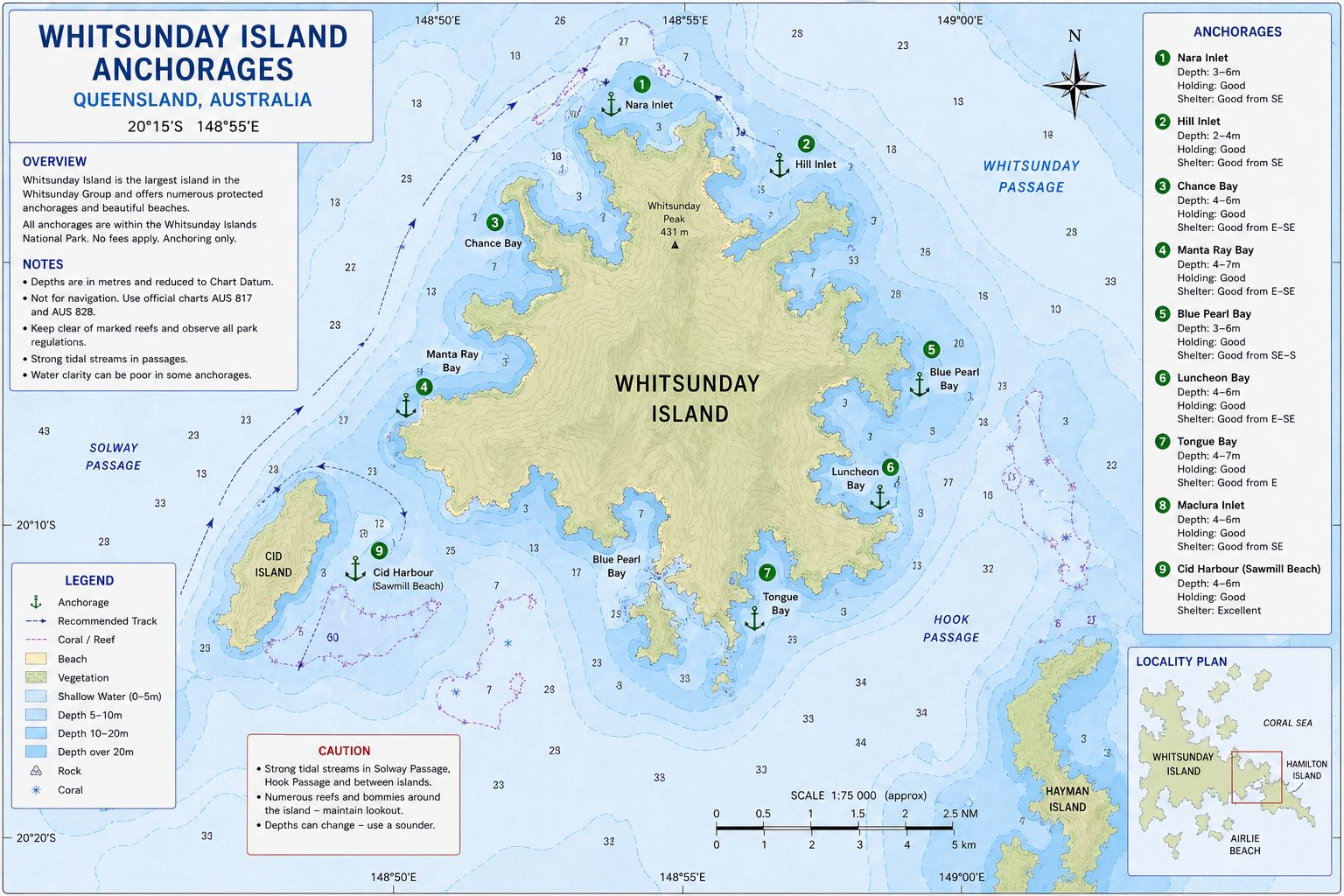
Cid Harbour: A deep, protected anchorage with 10–20 m of depth and complete shelter from all wind directions. One of the most secure anchorages in the Whitsundays.
Sawmill Bay: A calm, protected bay within Cid Harbour offering 8–15 m of depth over mud. Excellent holding and reliable shelter in all conditions.
Dugong Beach: A shallow, sand‑fringed area with 5–10 m of depth. Suitable for day use and short stays in settled conditions.
Whitehaven Beach: A long, exposed beach with 5–15 m of depth over sand. Suitable for day anchoring in light south‑easterlies; exposed in northerlies and fresh trades.
Hill Inlet: A tidal estuary with shifting sandbars and limited anchoring options. Suitable only for shallow‑draft vessels in settled conditions.
Chance Bay: A moderate‑shelter anchorage with 8–12 m of depth over sand. Suitable for overnight stays in light south‑easterlies; exposed in northerlies.
Cairn Beach. This sits on the northeastern side of Whitsunday Island, tucked between Tongue Bay and the rugged headlands that lead toward Hill Inlet.
Turtle Bay: A weather‑dependent anchorage with 10–15 m of depth. Suitable for short stays in settled conditions; exposed in fresh trades.
Tongue Bay. Tongue Bay sits on the northeastern side of Whitsunday Island and serves as the primary anchorage for skippers visiting the Hill Inlet lookout.
Whitsunday Island
Sailing Guide - Wind, Weather and Tides
Whitsunday Island is shaped by the prevailing south‑easterly trade winds, which provide reliable shelter on the western side and create exposure on the eastern coastline. Northerlies expose Whitehaven Beach, Hill Inlet, Chance Bay and Turtle Bay and can create short, steep chop that makes these anchorages uncomfortable or untenable. Tidal flow is noticeable in the passages, particularly near Solway Passage and Hill Inlet. The region is unaffected by swell in south‑easterlies, but northerly swell can enter the eastern bays and increase motion.
Mechanical and Electrical Repairs
Resource
If you are headed somewhere remote consider the need to expand your knowledge base or have an information resource on board. Why not get a copy of my book The Marine and Electrical and Electronics Bible 4th Edition. By and for yachties, with everything from batteries and charging, solar and wind, diesel engines and marine electronics and so much more. Your complete systems guide. 650 pages of practical advice. In Australia and New Zealand order a copy through Boat Books. UK and European boats can buy the UK Edition Here. US and Canadian boats can get the US Edition Order Here. Marine systems are my profession so let me help you. By a liveaboard boat owner for other boat owners


Whitsunday Island
Sailing Guide - Provisioning, Fuel and Water
Whitsunday Island has no facilities of any kind, and the skipper must arrive fully self‑sufficient with all provisions, fuel, water and spares already onboard. There are no shops, fuel points, water access, marinas or landing services anywhere on the island. All resupply must be done at Airlie Beach, Shute Harbour or Hamilton Island before entering the Whitsunday Island anchorages.
Whitsunday Island Sailing Guide - Fishing
Fishing around Hook Island is shaped by deep channels, fringing reef, and the strong tidal flow that funnels between Hook, Hayman, and the mainland passages. The island sits on the edge of the Whitsunday’s clearest water, and the mix of structure and current produces a dependable spread of trout, sweetlip, tuskfish, and cod along the bommies, with queenfish, trevally, and mackerel working the pressure edges when the water is clean. The eastern side is more exposed and produces pelagics on calm days, while the western bays and the passages between Hook and Hayman often fire on the first of the flood as bait lifts off the bottom. The deeper pockets behind the reefs hold fish when the current slackens, and the rubble patches off the northern points can be productive in light winds. Most skippers fish from the dinghy, drifting the channels or working the reef edges in settled conditions, as anchoring close to structure is rarely practical. Ciguatera risk exists, as it does across the broader Whitsunday reef belt, with only larger reef predators warranting caution
Whitsunday Island
Sailing Guide - Summary
Whitsunday Island is the central cruising area of the Whitsundays, offering deep, protected anchorages on its western side and weather‑dependent bays on its eastern coastline. The approaches are straightforward, the anchorages are predictable and the region provides a mix of secure overnight stops and iconic day‑use sites. Northerlies expose the eastern bays and require careful weather selection, but in settled conditions Whitsunday Island is one of the most rewarding cruising destinations in Queensland. Whitsunday Island Sailing Guide is here to help.