Whitehaven Beach Sailing Guide for
Yachts
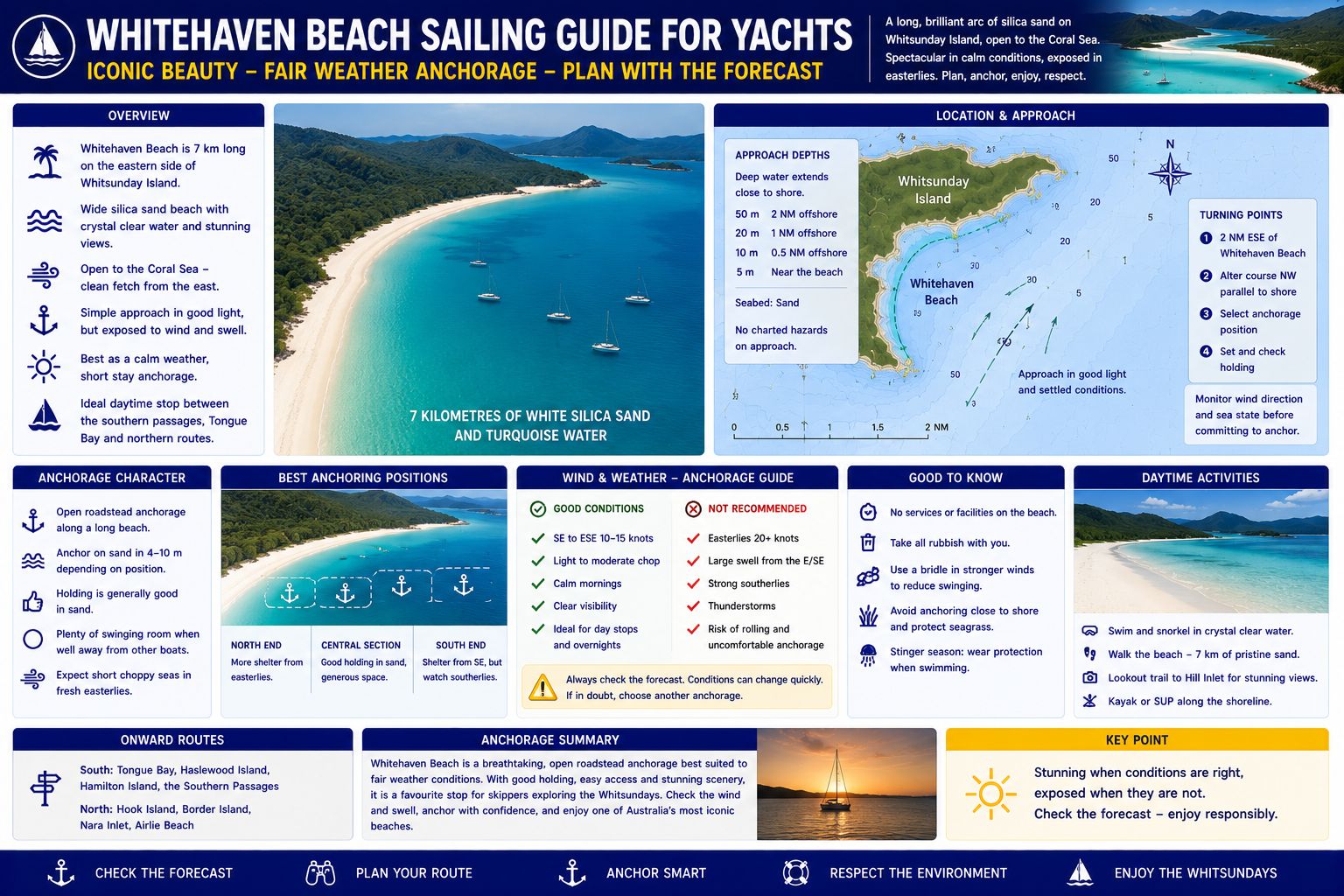
Whitehaven Beach Sailing Guide. Whitehaven Beach stretches for seven kilometres along the eastern side of Whitsunday Island, a long, bright arc of silica sand that feels more like a coastal horizon than a conventional anchorage. The beach is wide, the water is clear, and the shoreline is open to the Coral Sea, giving the anchorage a clean, airy, open‑roadstead character. It is one of the most iconic locations in Australia, but its behaviour as an anchorage is shaped entirely by wind direction, swell, and the long, uninterrupted fetch from the east.
Despite its exposure, Whitehaven is a reliable fair‑weather anchorage and a favourite daytime stop for skippers moving between the southern passages, Tongue Bay, and the northern Whitsunday routes. The beach offers multiple pockets of shelter depending on wind angle, and the approach is simple in good light. Whitehaven is best treated as a calm‑weather, short‑stay anchorage spectacular, accessible, and rewarding when conditions align, but exposed enough that skippers should always consider the forecast before committing to an overnight stay.
Whitehaven Beach Sailing Guide - Location
Whitehaven Beach lies on the eastern side of Whitsunday Island, forming a long, exposed coastline that opens directly toward the Coral Sea. The beach is framed by low forested slopes and a wide arc of white silica sand, creating a visually striking anchorage in settled conditions. Approximate centre position: 20°17.0’S 149°03.0’E
Whitehaven Beach Sailing Guide - Approach
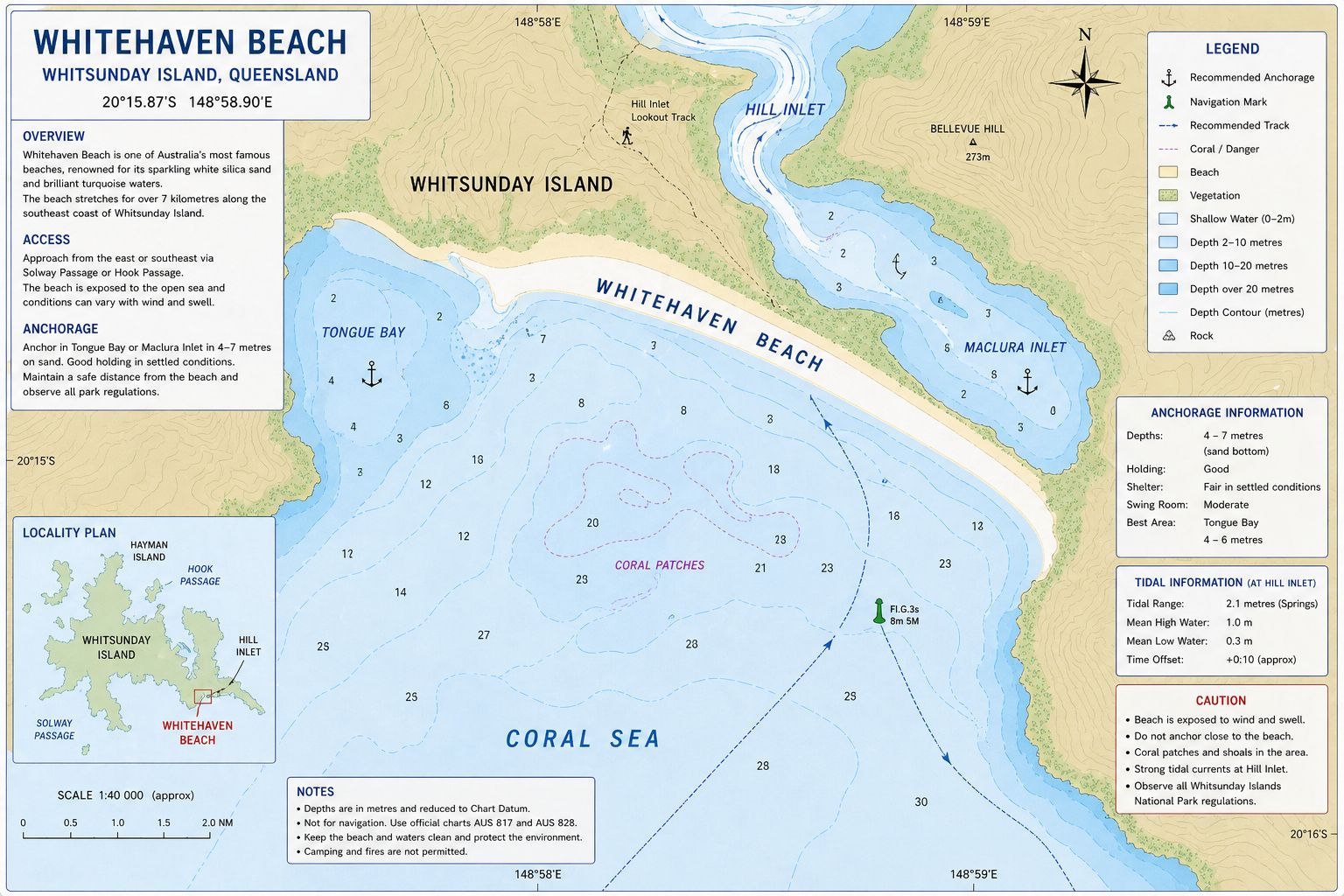
Approaches to Whitehaven Beach are straightforward. Offshore depths ease from 16–24 m into 10–14 m as you close the shoreline, flattening into 6–10 m over sand along most of the beach. The seabed is clean, with only minor patches of rubble near the rocky points at the northern and southern ends. The fringing reef is minimal and sits tight to the headlands, rising into 2–3 m. The approach is wide and free of hazards, though swell can build quickly when the easterlies freshen.
Approaches to Whitehaven Beach are straightforward. Offshore depths ease from 16–24 m into 10–14 m as you close the shoreline, flattening into 6–10 m over sand along most of the beach. The seabed is clean, with only minor patches of rubble near the rocky points at the northern and southern ends. The fringing reef is minimal and sits tight to the headlands, rising into 2–3 m. The approach is wide and free of hazards, though swell can build quickly when the easterlies freshen.
Whitehaven Beach Sailing Guide - Navigation
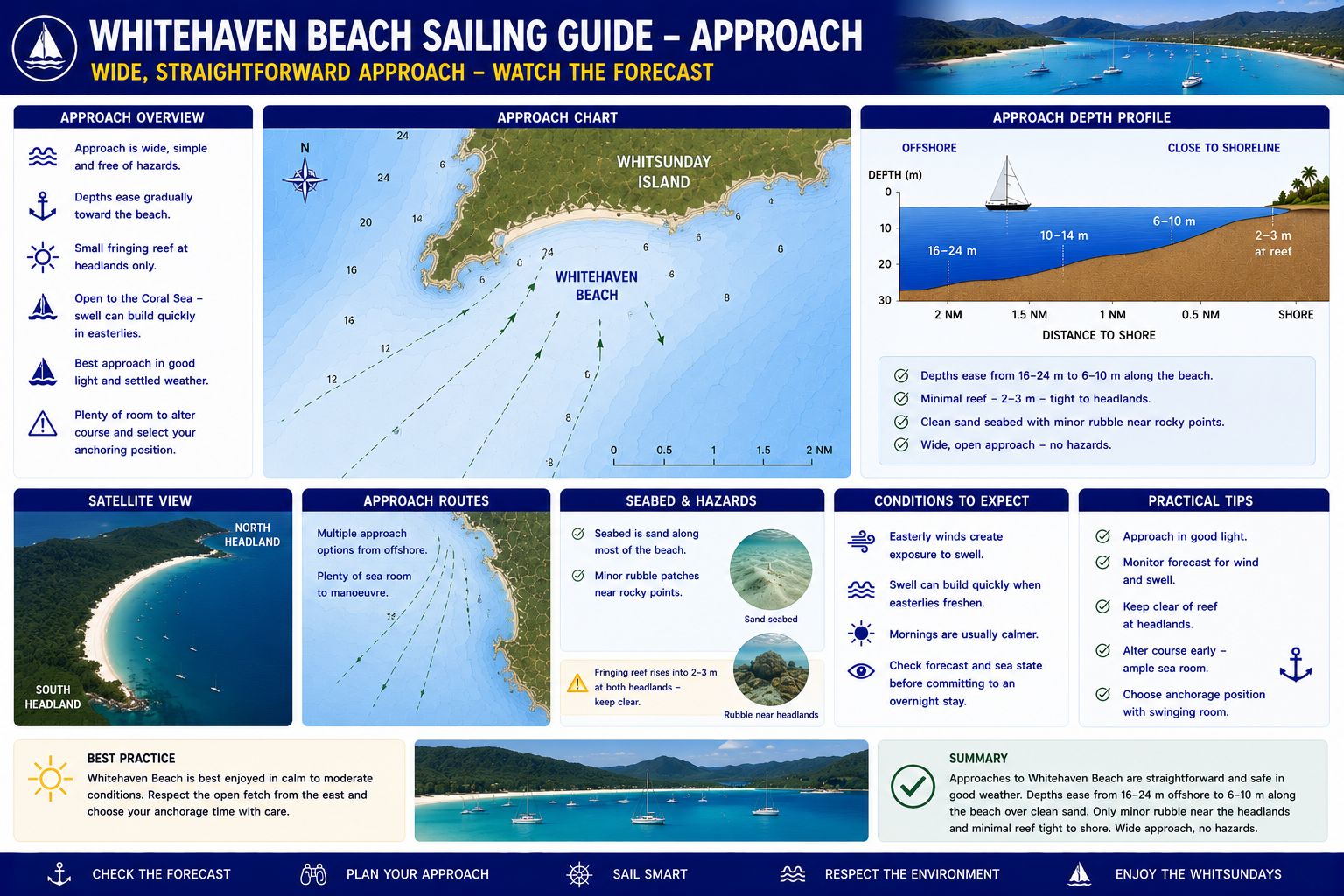
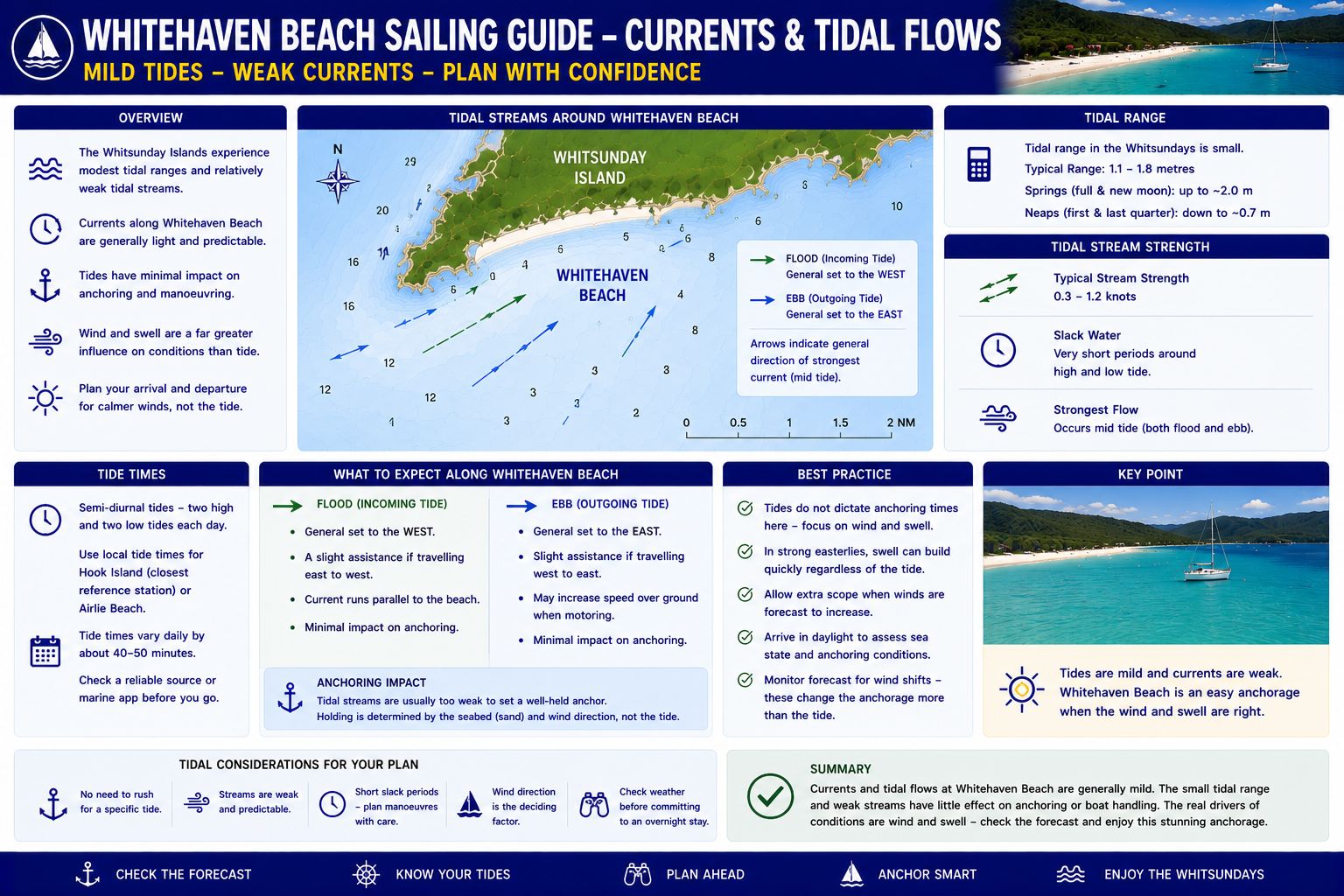
Navigation along Whitehaven Beach is simple, with a clean depth gradient and minimal reef. The shoreline shelves predictably, and the anchoring areas are wide and free of coral. Tidal streams are mild and do not affect anchoring. The main navigational consideration is exposure: swell builds quickly when the easterlies increase, and the anchorage can become uncomfortable faster than expected.
Whitehaven Beach
Sailing Guide Currents and Tidal Flows
Whitehaven Beach Sailing Guide - Inside
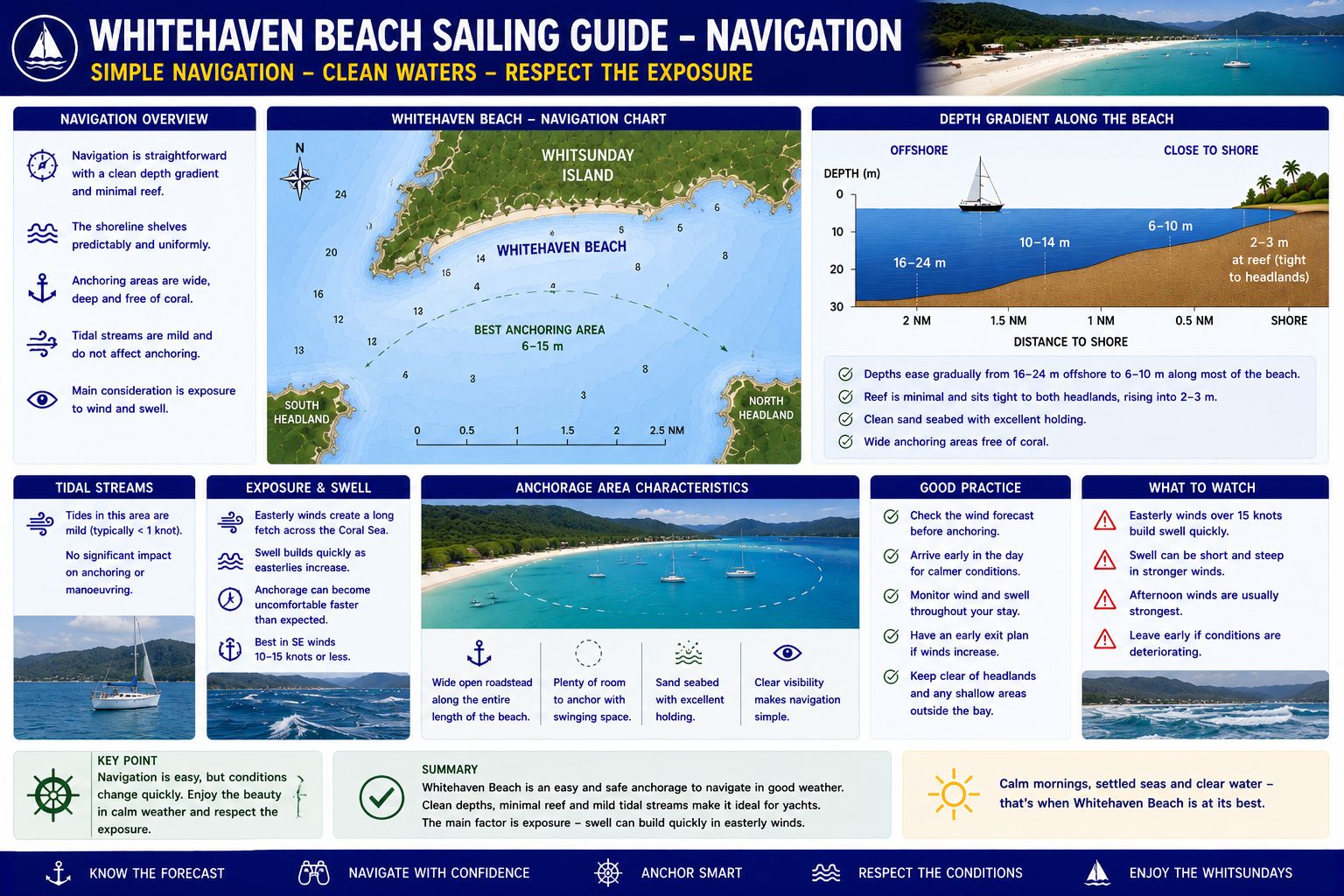
Inside the anchorage, the water shallows to 5–15 m, with a wide sand bottom and a gently shelving shoreline. The anchorage is calm in settled south‑easterlies, and the seabed provides reliable holding. The skipper must anchor well clear of the beach to maintain adequate depth, particularly at low tide. The anchorage is open enough that vessels lie mostly to the breeze, and swing is moderate. Whitehaven Beach is popular for day use, and the skipper must maintain situational awareness when sharing the anchorage with other vessels.
Whitehaven Beach Sailing Guide - Northern
Whitehaven (Most Sheltered)
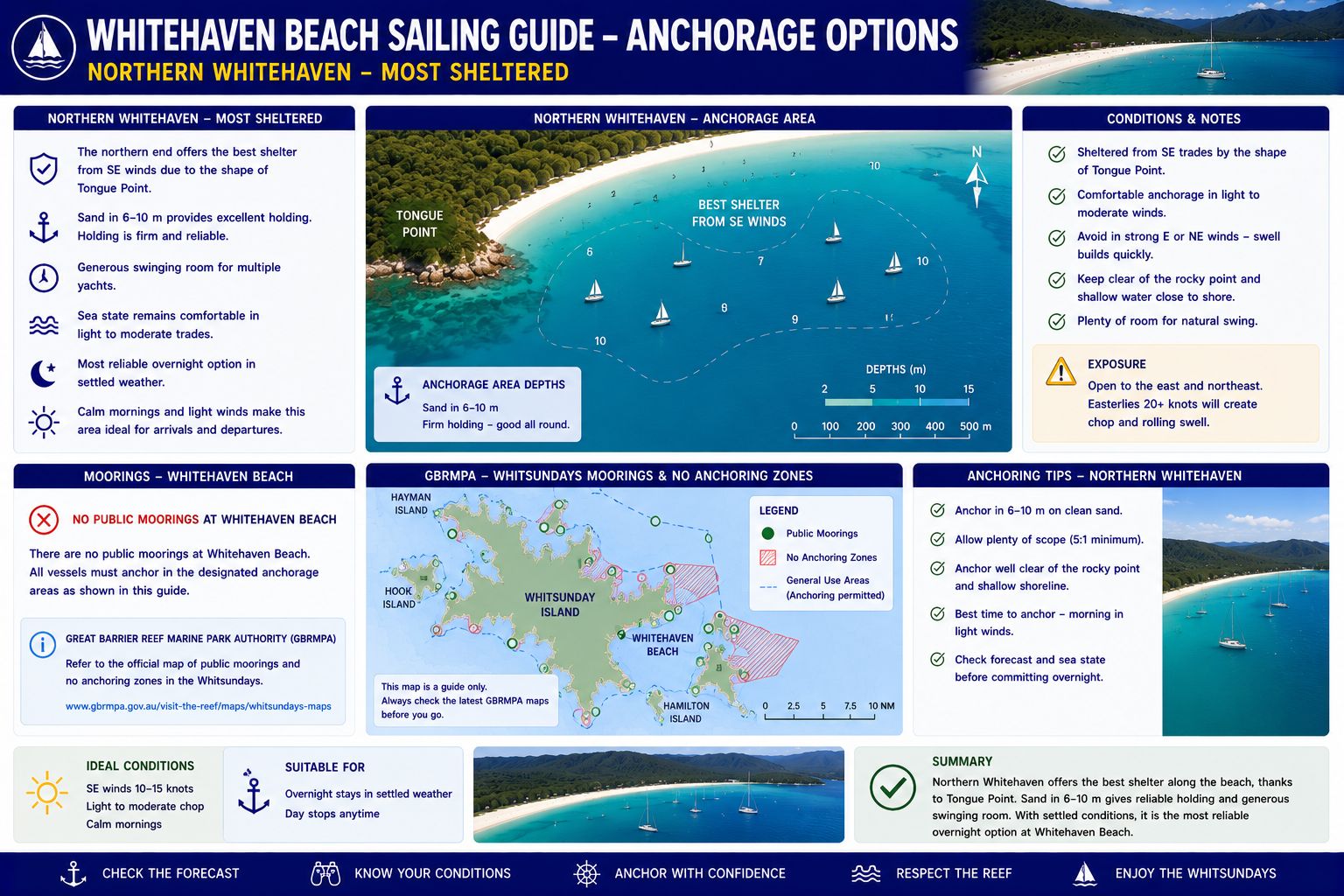
The northern end offers sand in 6–10 m and the best shelter from SE winds due to the shape of Tongue Point. The holding is firm, the swing room generous, and the sea state remains comfortable in light to moderate trades. This is the most reliable overnight option in settled weather.
Moorings. There are no public moorings in Whitehaven. Refer to the map of moorings by the Great Barrier Reef Marine Port Authority. Location of public moorings and no anchoring zones in the Whitsundays.
Central Whitehaven
(Classic Day Anchorage)
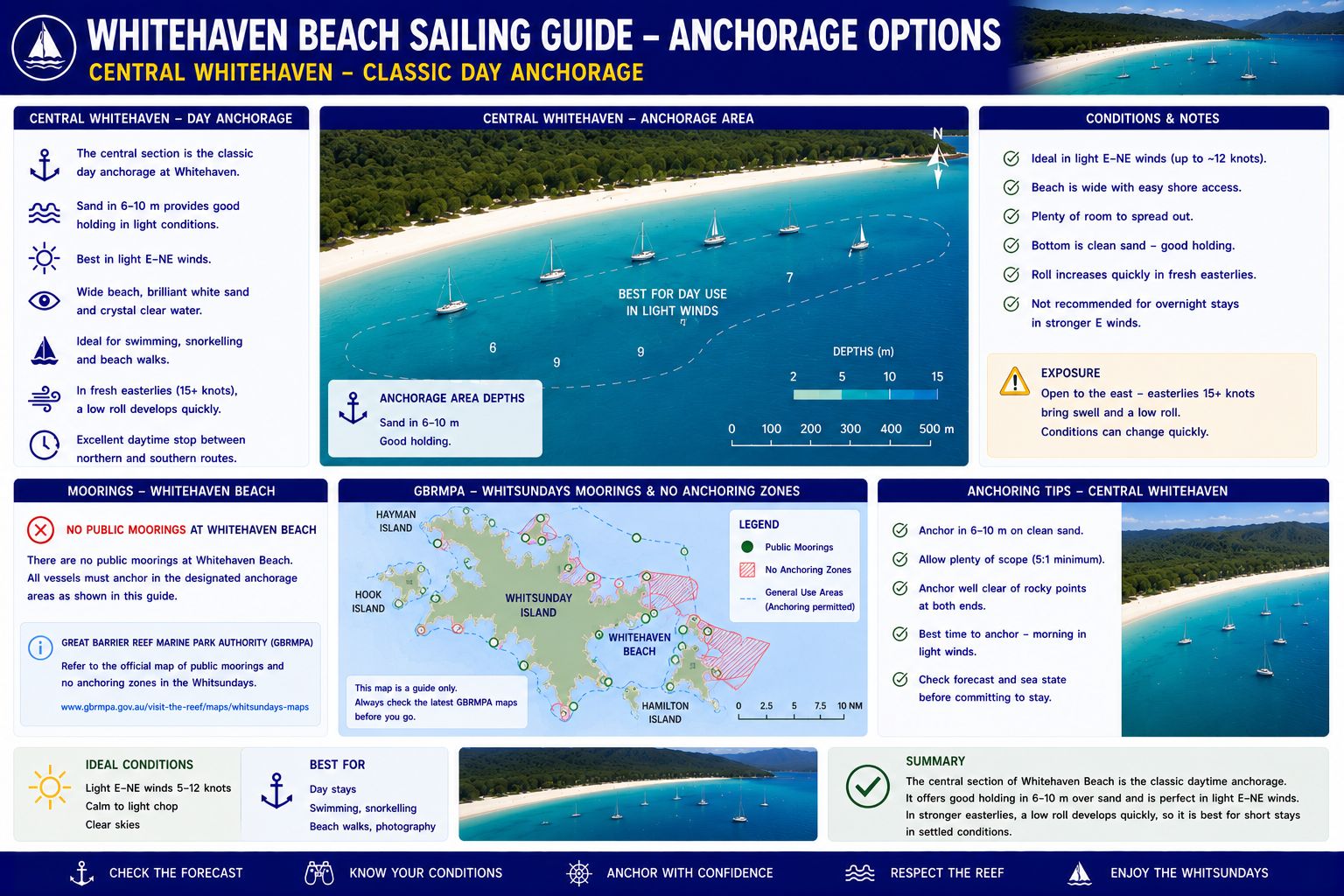
The central section offers sand in 6–10 m and works well in light E–NE winds. The beach is wide, the water is clear, and the anchorage is ideal for daytime stops. In fresh easterlies, a low roll develops quickly.
Moorings. There are no public moorings in Whitehaven. Refer to the map of moorings by the Great Barrier Reef Marine Port Authority. Location of public moorings and no anchoring zones in the Whitsundays.
Southern
Whitehaven (Calm‑Weather Only)
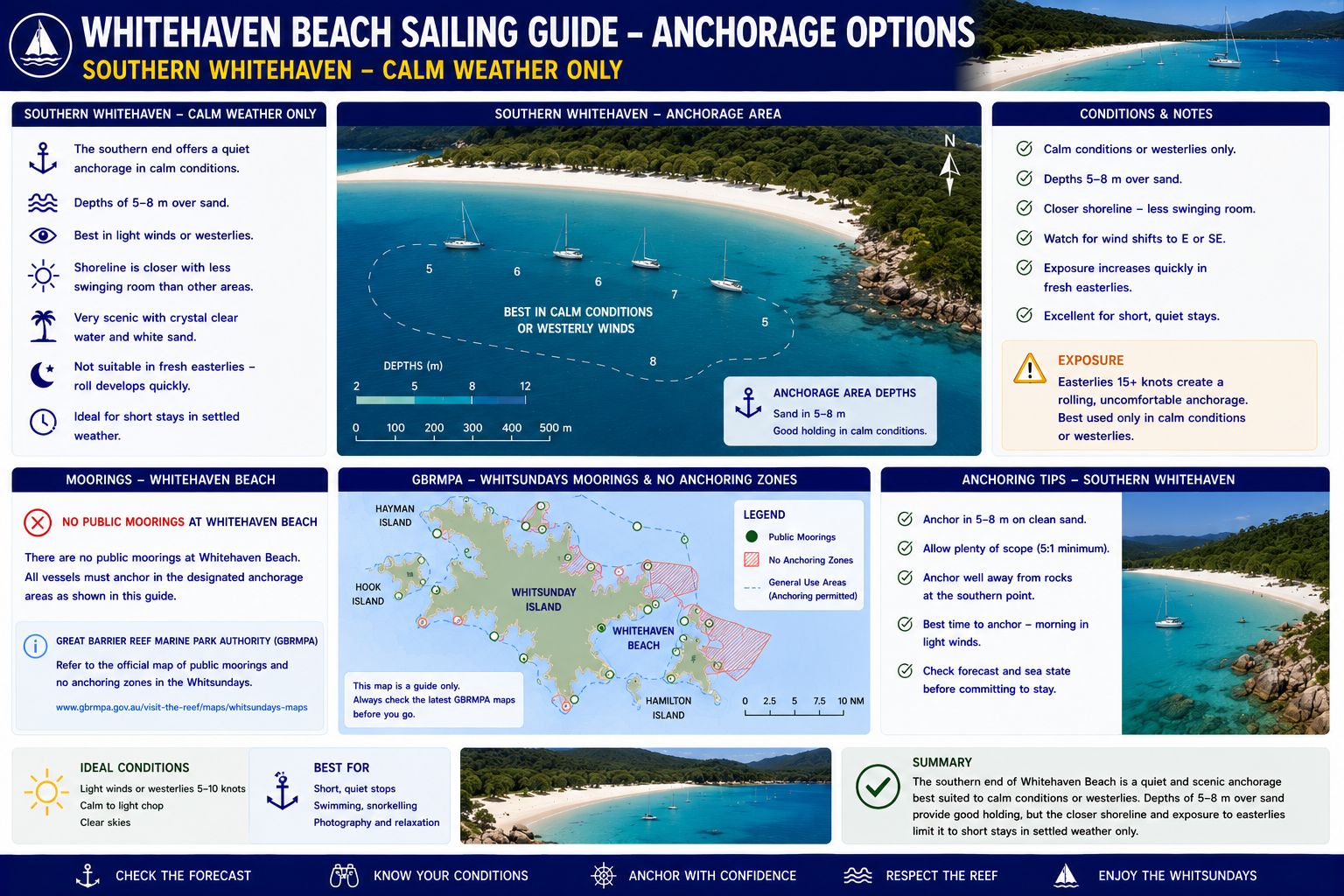
The southern end shoals into 5–8 m and offers a quiet, scenic anchorage in calm conditions. The shoreline is closer here, and the area is best used when the wind is light or westerly.
Moorings. There are no public moorings in Whitehaven. Refer to the map of moorings by the Great Barrier Reef Marine Port Authority. Location of public moorings and no anchoring zones in the Whitsundays.
Whitehaven Beach Sailing Guide - Weather
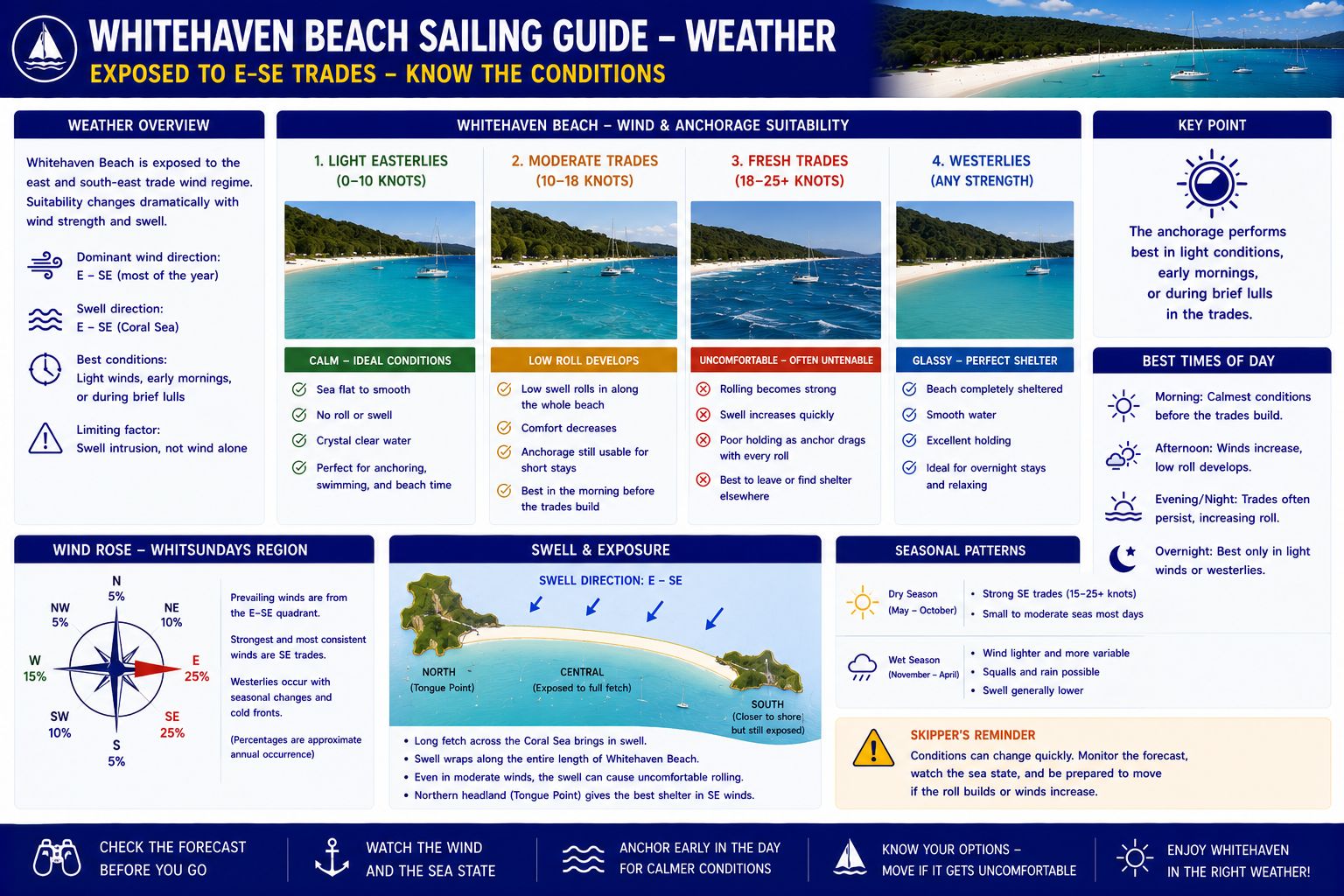
Whitehaven Beach is exposed to the E–SE trade‑wind regime, and its suitability changes dramatically with wind strength.
- Light easterlies: the beach is calm, bright, and ideal.
- Moderate trades: a low roll develops along the entire beach.
- Fresh trades: the anchorage becomes uncomfortable and often untenable.
- Westerlies: the beach becomes glassy and perfectly sheltered.
Swell intrusion is the limiting factor, not wind alone. The anchorage performs best in light conditions, early mornings, or during brief lulls in the trades.
Whitehaven Beach Sailing Guide - Fishing
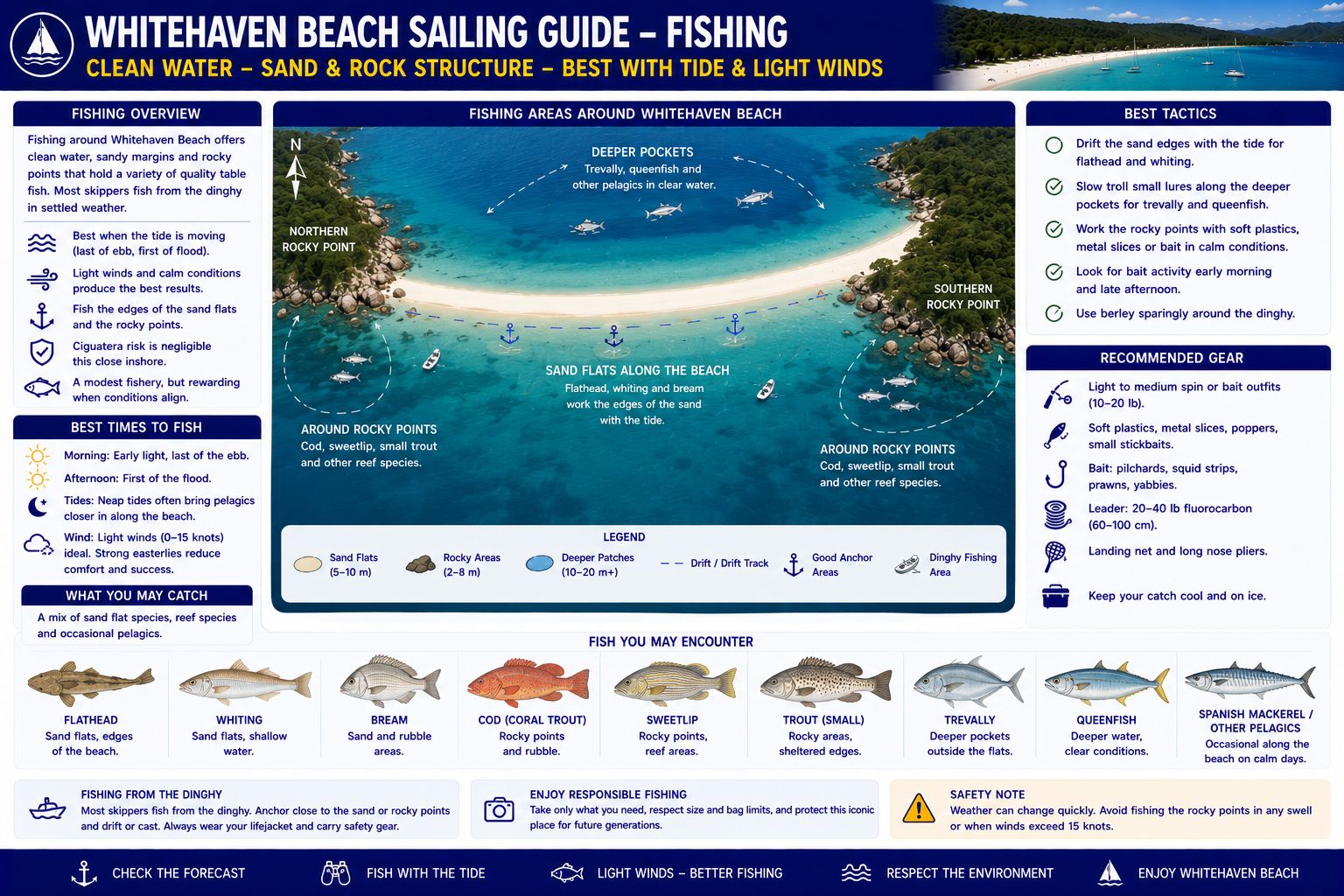
Fishing around Whitehaven Beach has a clean‑water, sand‑flat character shaped by the long beach, open exposure, and the influence of the rocky points at either end. The sandy margins hold flathead and whiting, especially on the last of the ebb and first of the flood when bait concentrates along the shoreline. The rocky points at the northern and southern ends produce cod, sweetlip, and small trout in calm conditions, while the deeper pockets outside the anchoring area hold trevally and queenfish when the water is clear. Pelagics occasionally sweep along the beach on calm days, especially during neap tides. Most skippers fish from the dinghy, drifting the sandy edges or working the rocky points in settled weather. Ciguatera risk is negligible this close inshore. Whitehaven’s fishery is modest but rewarding a bright, open, sand‑and‑rock environment that fishes best when the tide is moving and the wind is light.
Mechanical and Electrical Repairs
Resource
If you are headed somewhere remote consider the need to expand your knowledge base or have an information resource on board. Why not get a copy of my book The Marine and Electrical and Electronics Bible 4th Edition. By and for yachties, with everything from batteries and charging, solar and wind, diesel engines and marine electronics and so much more. Your complete systems guide. 650 pages of practical advice. In Australia and New Zealand order a copy through Boat Books. UK and European boats can buy the UK Edition Here. US and Canadian boats can get the US Edition Order Here. Marine systems are my profession so let me help you. By a liveaboard boat owner for other boat owners


Whitehaven Beach Sailing Guide - Provisioning,
Fuel and Water
Whitehaven Beach has no facilities of any kind, and the skipper must arrive fully self‑sufficient with all provisions, fuel, water and spares already onboard. There are no shops, fuel points, water access, marinas or landing services anywhere along the beach. All resupply must be done at Airlie Beach, Shute Harbour or Hamilton Island before entering the Whitsunday Island anchorages.
Whitehaven Beach Sailing Guide - Summary
Whitehaven Beach is a spectacular, open anchorage on the eastern side of Whitsunday Island, offering simple approaches and multiple pockets of shelter that work well in light conditions. The beach becomes exposed quickly in fresh easterlies, but in calm weather it is one of the most scenic and enjoyable stops in the Whitsundays. Fishing is modest but consistent, shaped by sandy flats, rocky points, and clean water. Whitehaven is best enjoyed as a fair‑weather, short‑stay anchorage with world‑class scenery and easy access to the northern and southern. Whitehaven Beach Sailing Guide with practical information.