Sailing Yacht Boom
Inspection and Maintenance
Sailing Yacht Boom Inspection and Maintenance. This article arose after buying and rerigging my boat. The booms were seriously degraded and I replaced them. It was a long and steep learning curve. The boom carries mainsail foot load and transfers mainsheet, vang, reefing and outhaul forces into the mast and deck structure. It operates as a beam loaded in bending, compression and torsion. Loads are concentrated at the gooseneck, vang attachment, mainsheet connection, reefing sheaves and boom end. An accidental gybe or poorly led preventer can produce loads far above those experienced during normal sail trimming.
The boat owner and skipper must inspect the boom as structural equipment rather than as a convenient support for the mainsail cover and deck gear. Cracking around fittings, corrosion beneath stainless fasteners, worn gooseneck pins and internal reefing failures can remain hidden until the boom is heavily loaded. A boom that appears straight can still contain damaged fittings or local wall thinning at the exact position carrying the highest load.
Sailing Yacht Boom
Inspection and Maintenance - Construction
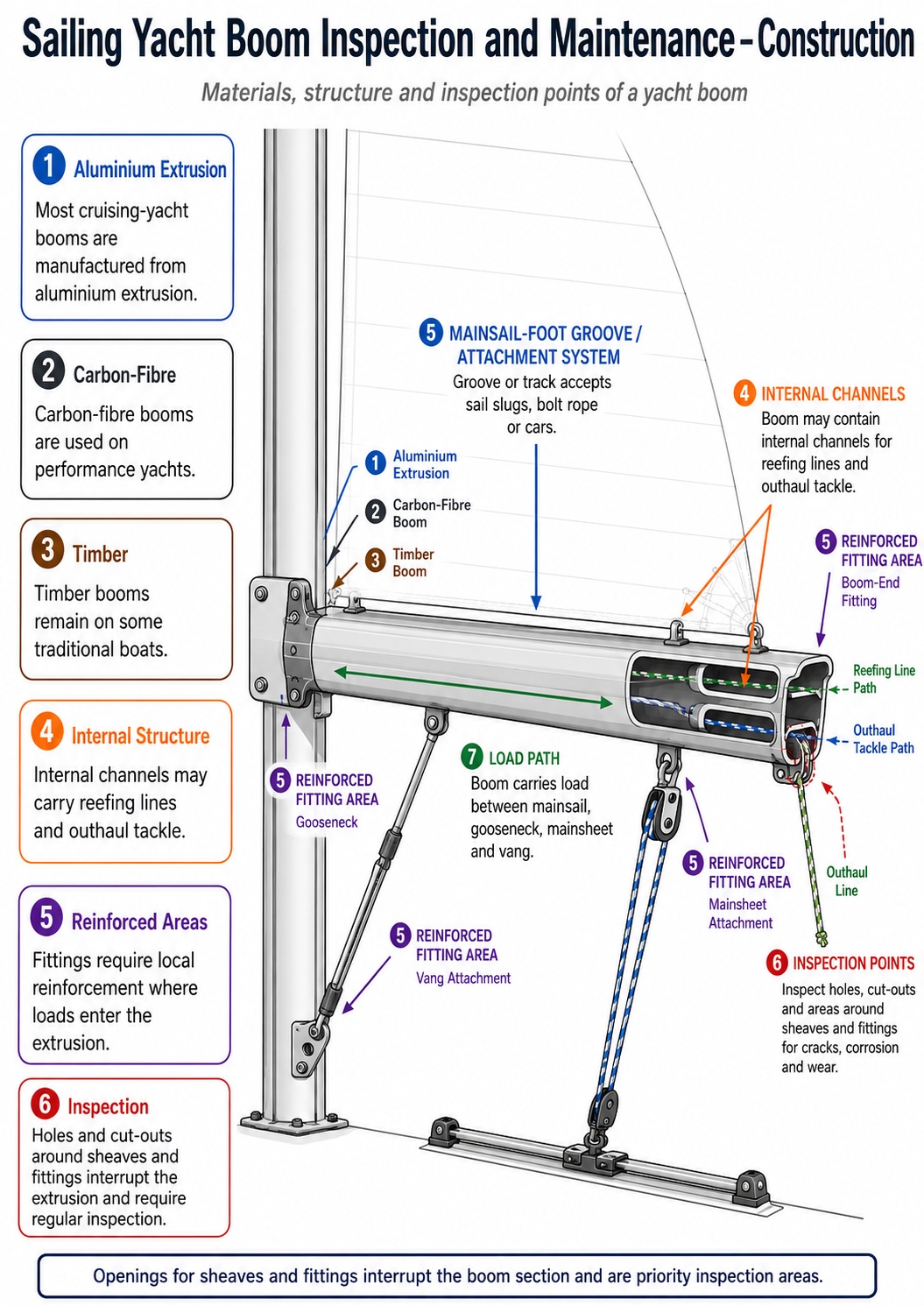
Most cruising-yacht booms are manufactured from aluminium extrusion. Carbon-fibre booms are used on performance yachts, while timber booms remain on some traditional boats which I had on a previous boat of my own. An aluminium boom may contain internal channels for several reefing lines, outhaul tackles and so on. The extrusion normally includes a mainsail-foot groove or attachment system and reinforced areas for fittings. The boom carries load between the mainsail, gooseneck, mainsheet and vang. Holes and cut-outs around sheaves and fittings interrupt the extrusion and require regular inspection.
Sailing Yacht Boom
Inspection and Maintenance - Boom
Loads
The mainsail applies upward and sideways load along the boom. The mainsheet pulls the boom down and toward the traveller or deck attachment. The vang pulls downward and forward. The outhaul pulls the clew aft, while reefing lines pull the sail down and aft. These forces can act at the same time and may oppose each other. The boom must resist several forces as follows:
- Vertical Bending. Mainsheet and vang loads bend the boom downward while the sail load acts upward.
- Horizontal Bending. A preventer, accidental gybe or sail pressure can load the boom sideways.
- Compression. Outhaul and reefing loads can place sections of the boom under axial compression.
- Torsion. Offset mainsheet, vang or reefing attachments can twist the extrusion.
- Impact. The boom can strike shrouds, mast fittings, arches or crew during an uncontrolled gybe.
Do not assess the boom only while it is unloaded at the berth.
Sailing Yacht Boom
Inspection and Maintenance - Aluminium
Boom Corrosion
Aluminium booms are exposed to salt, stainless fasteners, wet sails and retained water. Having been through this on my old booms it is recommended that you inspect the following:
- Beneath All Stainless Fittings. White powder, bubbling paint or lifting sealant indicates galvanic corrosion between the stainless fitting and aluminium extrusion.
- Around Mainsheet and Vang Attachments. These fittings carry high loads, and corrosion beneath them reduces the wall thickness at a critical location.
- At the Boom End. Water can enter around sheaves and remain inside the extrusion.
- Under Sail Covers and Bags. Damp covers can keep salt water against fittings and painted surfaces.
Do not cover corrosion with sealant until the fitting has been removed and the metal condition established.
Sailing Yacht Boom
Inspection and Maintenance - The
Gooseneck
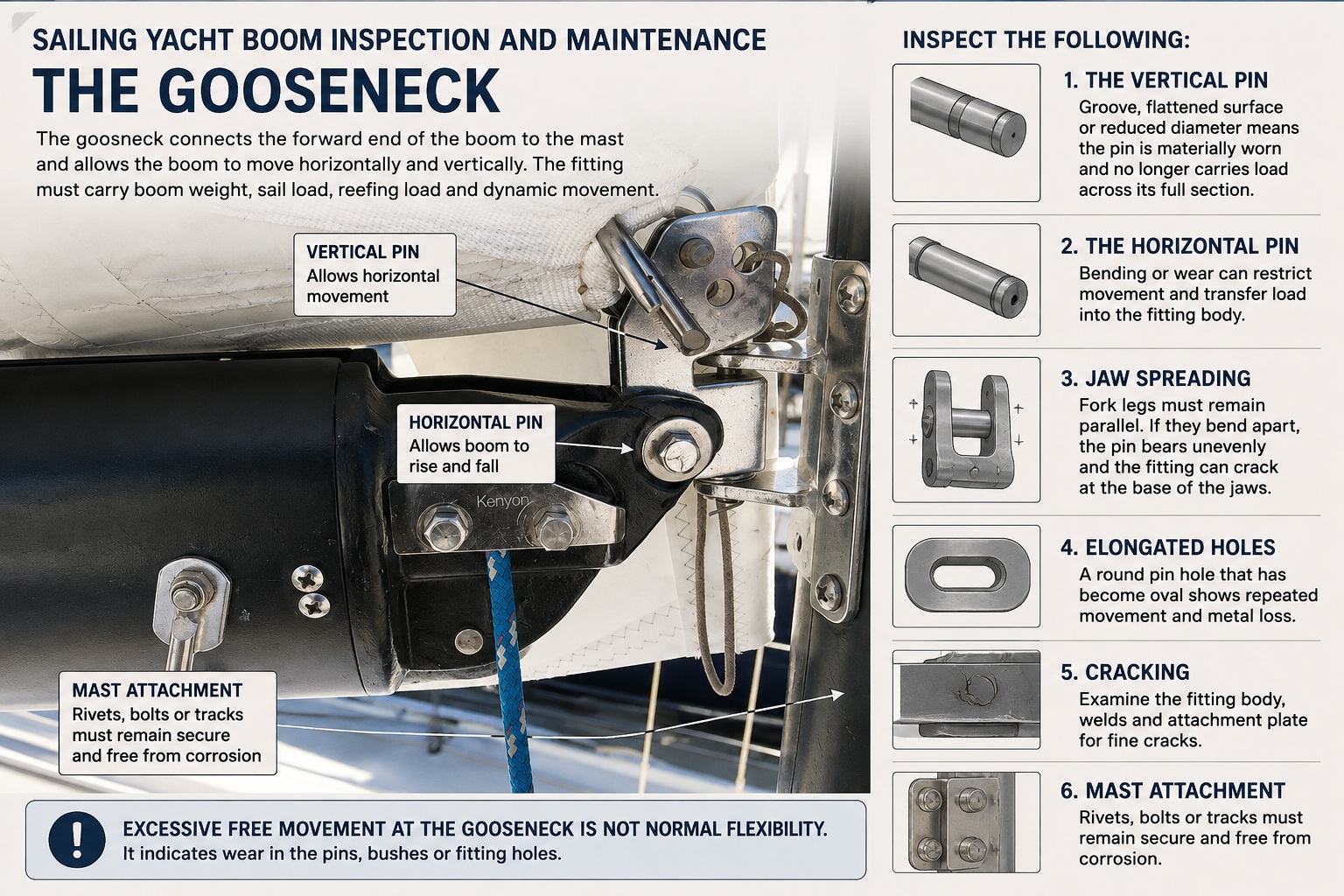
The gooseneck connects the forward end of the boom to the mast and allows the boom to move horizontally and vertically. The fitting must carry boom weight, sail load, reefing load and dynamic movement. My boat had serious issues. Inspect the following:
- The Vertical Pin. This pin permits horizontal movement. A visible groove, flattened surface or reduced diameter means the pin is materially worn and no longer carries load across its full section. (I had to replace mine when I renewed the boom and was surprised at the deterioration)
- The Horizontal Pin. This pin allows the boom to rise and fall. Bending or wear can restrict movement and transfer load into the fitting body.
- Jaw Spreading. Fork legs must remain parallel. If they bend apart, the pin bears unevenly and the fitting can crack at the base of the jaws.
- Elongated Holes. A round pin hole that has become oval shows repeated movement and metal loss.
- Cracking. Examine the fitting body, welds and attachment plate for fine cracks.
- Mast Attachment. Rivets, bolts or tracks must remain secure and free from corrosion.
Excessive free movement at the gooseneck is not normal flexibility. It indicates wear in the pins, bushes or fitting holes.
Sailing Yacht Boom
Inspection and Maintenance - Gooseneck
Bushes
Some goosenecks use replaceable bushes around the pins. A worn bush can allow movement without immediate damage to the main fitting. If it is not replaced, the pin begins to wear into the structural metal. Signs include knocking, visible sideways movement and dark or metallic wear debris. Replace bushes before the fitting holes become elongated. Do not fit an oversized pin into a worn hole unless the repair has been engineered and the fitting retains sufficient material.
Sailing Yacht Boom
Inspection and Maintenance - Boom
Forward End
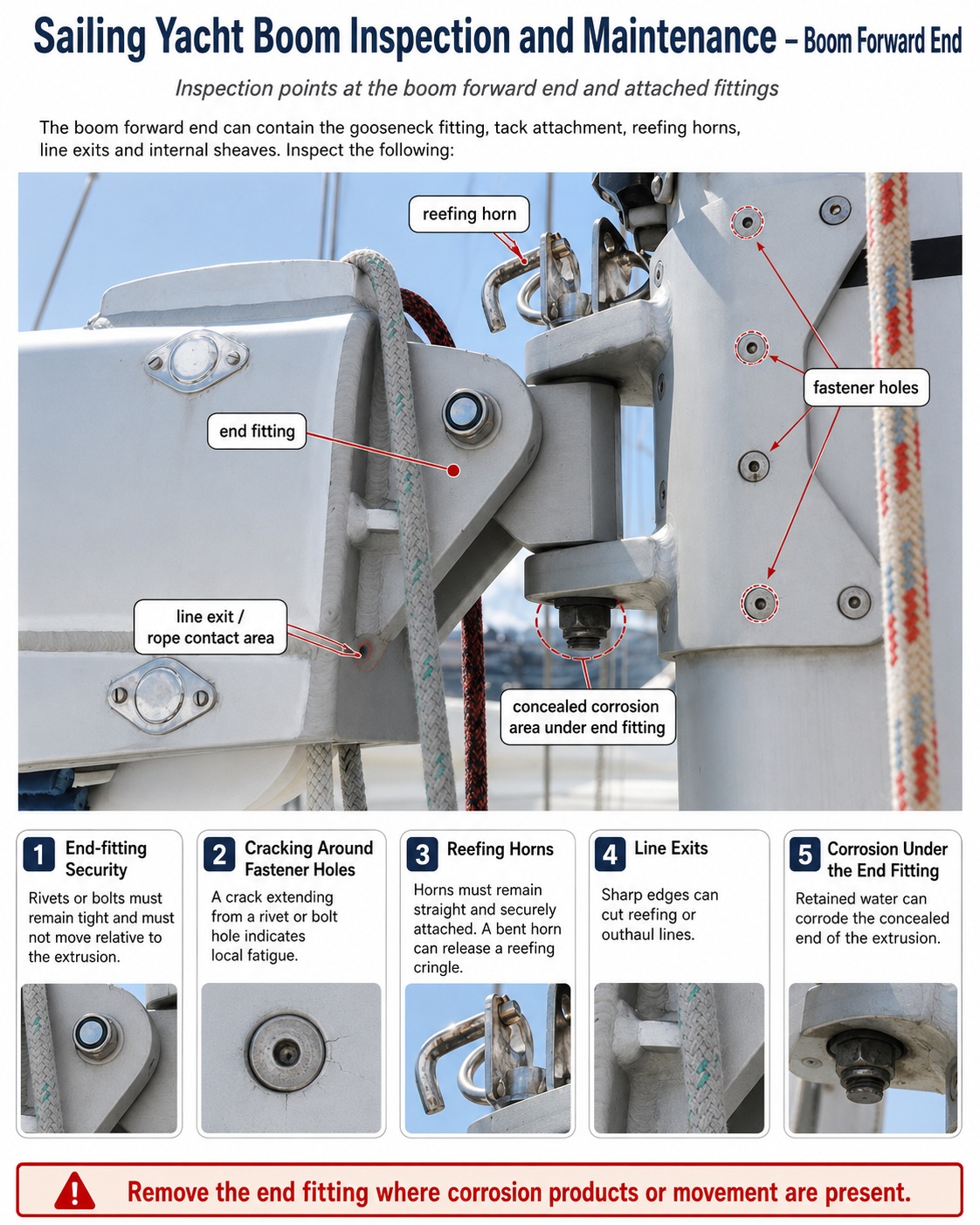
The boom forward end can contain the gooseneck fitting, tack attachment, reefing horns, line exits and internal sheaves. Inspect the following:
- End-fitting Security. Rivets or bolts must remain tight and must not move relative to the extrusion.
- Cracking Around Fastener Holes. A crack extending from a rivet or bolt hole indicates local fatigue.
- Reefing Horns. Horns must remain straight and securely attached. A bent horn can release a reefing cringle.
- Line Exits. Sharp edges can cut reefing or outhaul lines.
- Corrosion Under the End Fitting. Retained water can corrode the concealed end of the extrusion.
Remove the end fitting where corrosion products or movement are present.
Sailing Yacht Boom
Inspection and Maintenance - Vang
Attachment
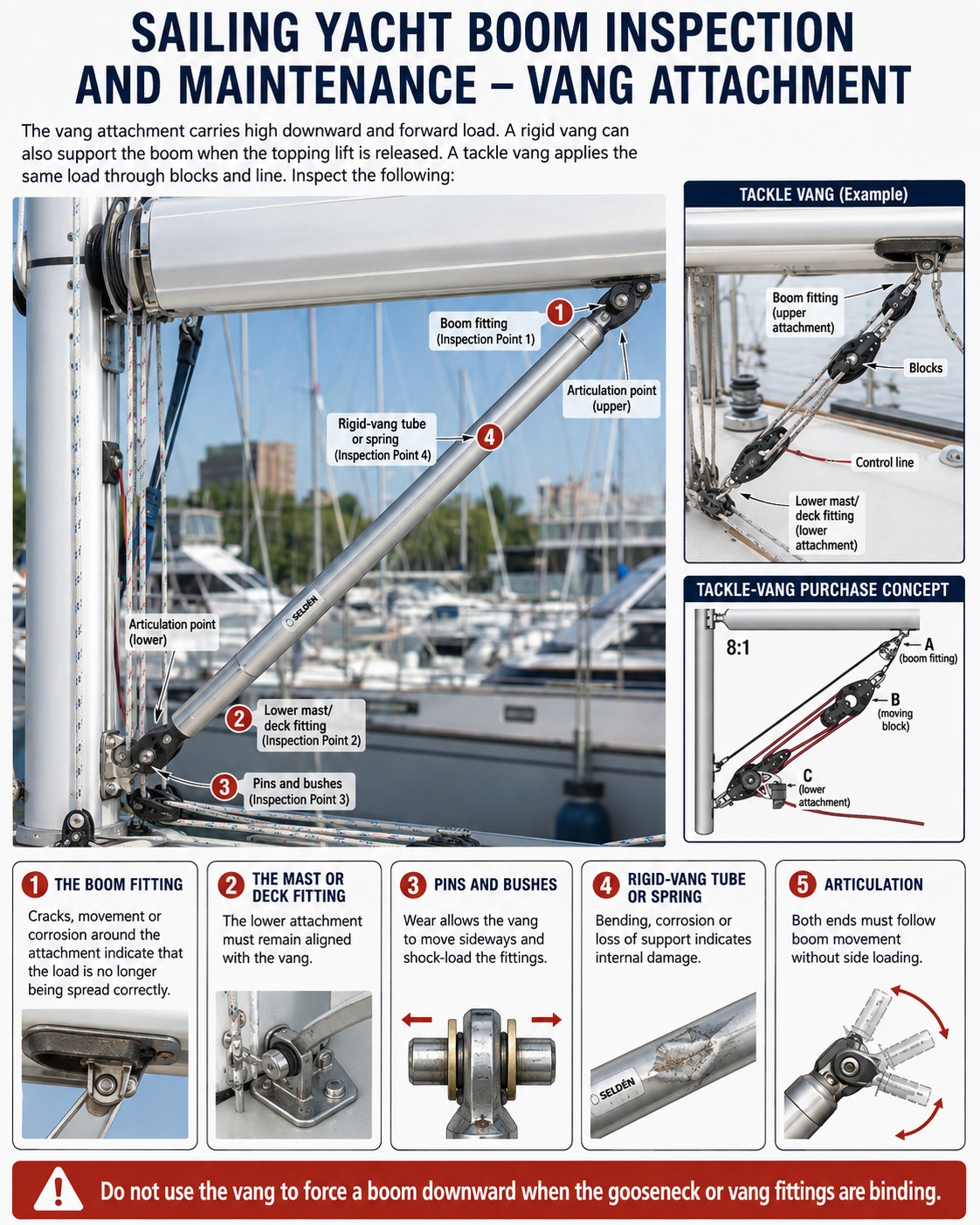
The vang attachment carries high downward and forward load. A rigid vang can also support the boom when the topping lift is released. A tackle vang applies the same load through blocks and line. Inspect the following:
- The Boom Fitting. Cracks, movement or corrosion around the attachment indicate that the load is no longer being spread correctly.
- The Mast or Deck Fitting. The lower attachment must remain aligned with the vang.
- Pins and Bushes. Wear allows the vang to move sideways and shock-load the fittings.
- Rigid-vang Tube or Spring. Bending, corrosion or loss of support indicates internal damage.
- Articulation. Both ends must follow boom movement without side loading.
Do not use the vang to force a boom downward when the gooseneck or vang fittings are binding.
Sailing Yacht Boom
Inspection and Maintenance - Mainsheet
Attachment
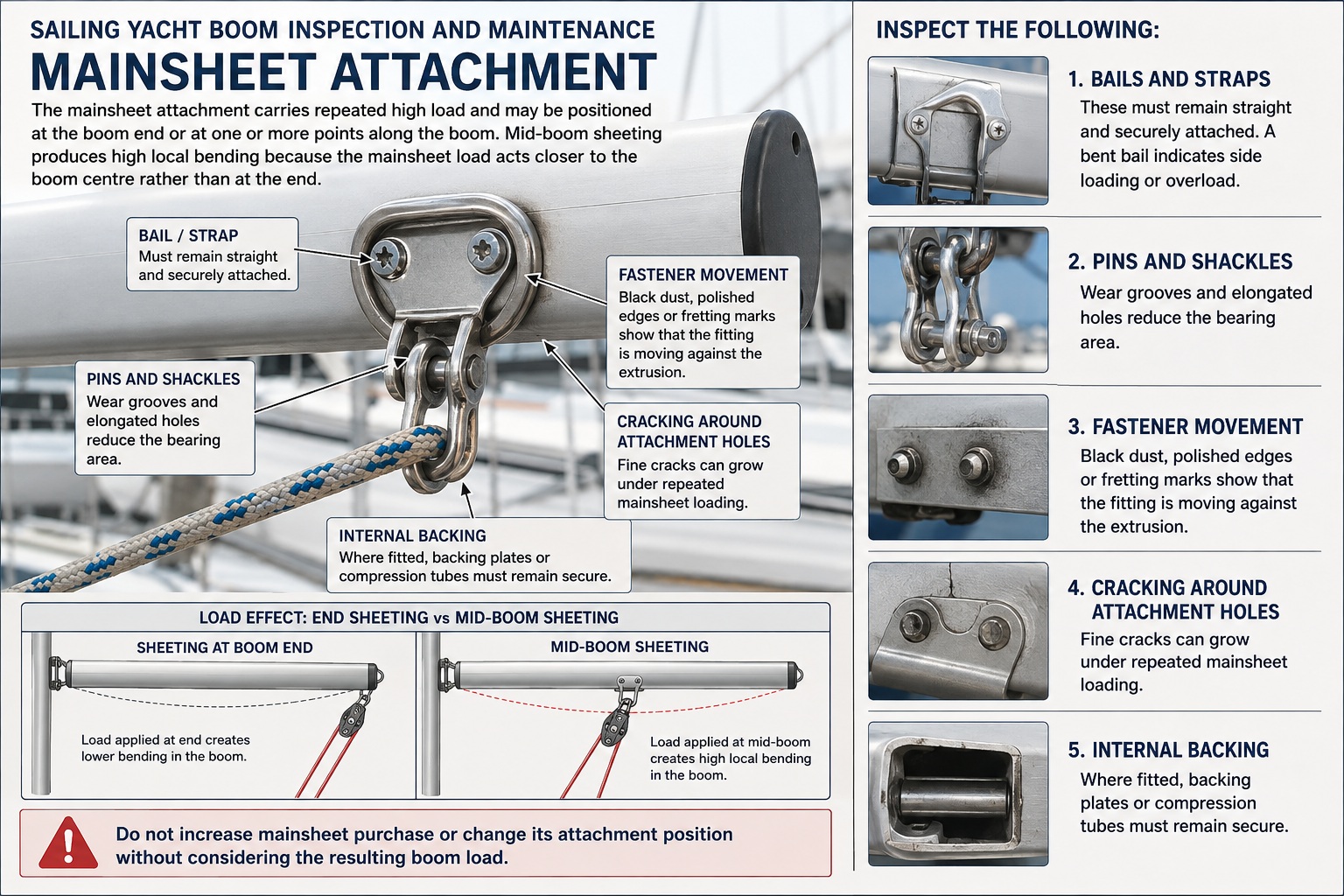
The mainsheet attachment carries repeated high load and may be positioned at the boom end or at one or more points along the boom. Mid-boom sheeting produces high local bending because the mainsheet load acts closer to the boom centre rather than at the end. Inspect the following:
- Bails and Straps. These must remain straight and securely attached. A bent bail indicates side loading or overload.
- Pins and Shackles. Wear grooves and elongated holes reduce the bearing area.
- Fastener Movement. Black dust, polished edges or fretting marks show that the fitting is moving against the extrusion.
- Cracking Around Attachment Holes. Fine cracks can grow under repeated mainsheet loading.
- Internal Backing. Where fitted, backing plates or compression tubes must remain secure.
Do not increase mainsheet purchase or change its attachment position without considering the resulting boom load.
Sailing Yacht Boom
Inspection and Maintenance - Mainsheet
Blocks
Blocks must align with the load and rotate freely. A seized block can twist the boom fitting or force the sheet across a sharp edge. Inspect for the following defects:
- Sheave rotation.
- Side-plate spreading.
- Pin wear.
- Cracked cheeks.
- Distorted shackles.
- Line wear at the block.
Replace a block whose sheave no longer rotates freely under load.
Sailing Yacht Boom
Inspection and Maintenance - Outhaul
System
The outhaul controls mainsail foot tension and carries continuous clew load. It may consist of an internal tackle, wire, synthetic line, sheaves and a cleat or winch. Inspect the following:
- The Clew Attachment. Shackles, sliders and pins must remain secure and free from wear.
- Internal Sheaves. A seized or damaged sheave increases friction and can cut the line.
- Outhaul Line. Inspect for chafe, flattening and cover damage at exits and turning points.
- Internal Tackle. Uneven movement, grinding or sudden loss of purchase can indicate a twisted block or broken attachment.
- Boom-end Fitting. The aft fitting must carry the outhaul load without movement.
Do not continue applying winch load when the outhaul stops moving unexpectedly.
Sailing Yacht Boom
Inspection and Maintenance - Reefing
Systems
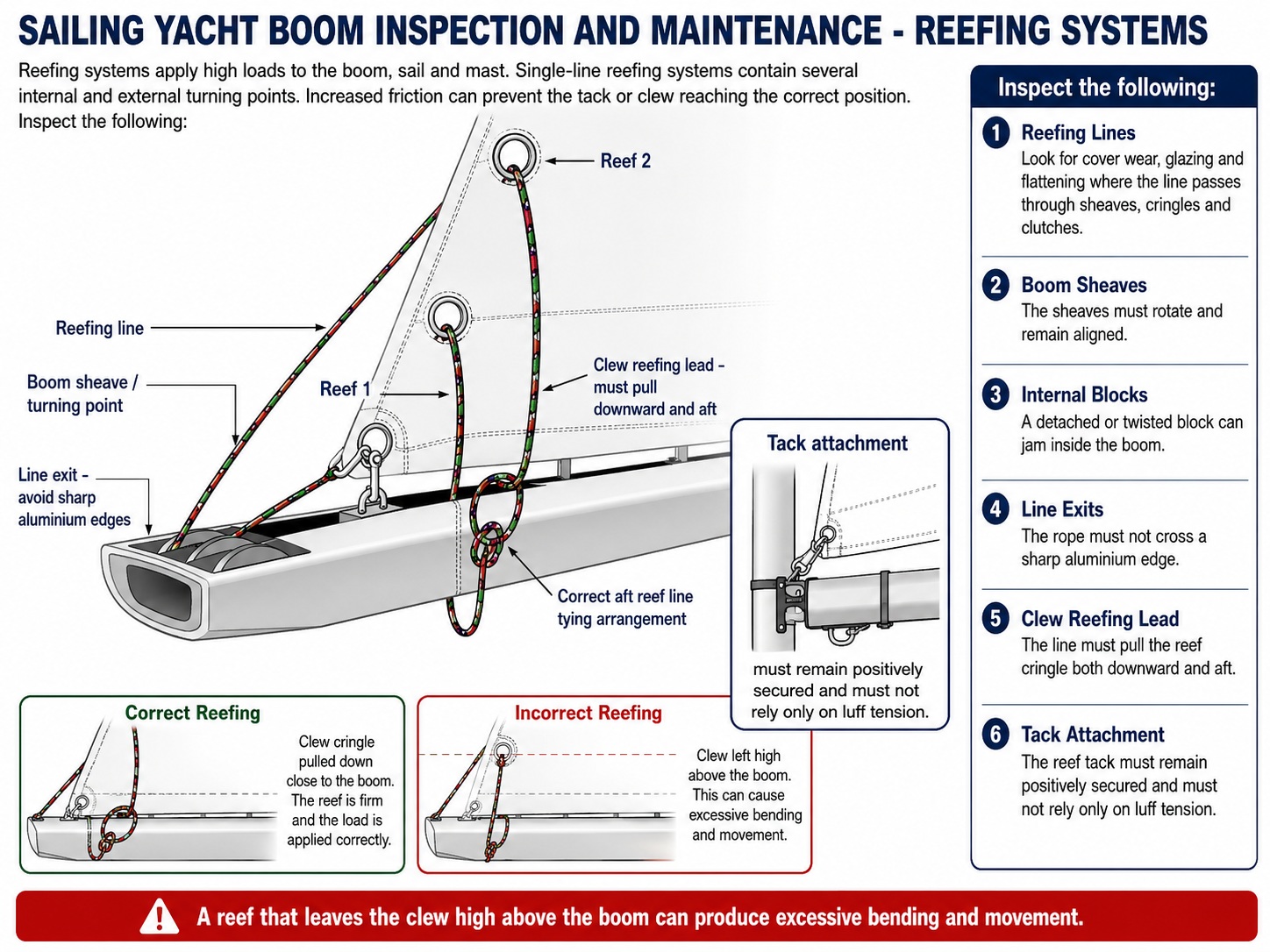
Reefing systems apply high loads to the boom, sail and mast. Single-line reefing systems contain several internal and external turning points. Increased friction can prevent the tack or clew reaching the correct position. Inspect the following:
- Reefing Lines. Look for cover wear, glazing and flattening where the line passes through sheaves, cringles and clutches.
- Boom Sheaves. The sheaves must rotate and remain aligned.
- Internal Blocks. A detached or twisted block can jam inside the boom.
- Line Exits. The rope must not cross a sharp aluminium edge.
- Clew Reefing Lead. The line must pull the reef cringle both downward and aft.
- Tack Attachment. The reef tack must remain positively secured and must not rely only on luff tension.
A reef that leaves the clew high above the boom can produce excessive bending and movement.
Sailing Yacht Boom
Inspection and Maintenance - Boom-End
Fitting
The boom end normally contains outhaul and reefing sheaves, topping-lift attachment points and the mainsail clew connection. Inspect for the following conditions:
- Fitting Movement. Any movement between the end casting and extrusion can enlarge fastener holes.
- Sheave Condition. Cracked or seized sheaves damage reefing and outhaul lines.
- Fastener Corrosion. Stainless fasteners can corrode the surrounding aluminium.
- Drainage. Water must be able to leave the boom.
- Cracking Around the Extrusion End. Cracks can begin where the fitting concentrates load.
Do not assume the internal end of the extrusion is sound because the visible casting remains polished
The Complete DIY
Self Help Systems Book
Need boat systems help? Buy a copy of my book The Marine Electrical and Electronics Bible, 4th Edition. US based boats can get the US Edition Here. You can also order through Amazon. In Australia order a copy through Boat Books. UK based boats can Order Here. Marine systems are my profession so let me help you.

Sailing Yacht Boom
Inspection and Maintenance - Topping
Lift
The topping lift supports the boom when the mainsail and vang do not. It must not be relied upon as the only protection against boom fall if its condition is unknown. Inspect the line, masthead sheave, boom attachment and adjustment tackle. A topping lift that repeatedly snatches tight under sail may be too short or may be interfering with sail shape and boom movement. Do not leave a damaged topping lift supporting a heavy boom over the cockpit.
Sailing Yacht Boom
Inspection and Maintenance - Lazy
Jacks and Sail Bags
Lazy jacks control the mainsail during lowering but can introduce chafe and side load. Inspect the following:
- Lines where they contact spreaders, mast fittings and the sail.
- Boom attachment points for corrosion or cracking.
- Adjustment points for seizure.
- Sail-bag straps for water retention.
Lazy-jack attachments are not automatically strong enough to support the boom or a crew members.
Sailing Yacht Boom Inspection and Maintenance - Preventers
A preventer controls boom movement during downwind sailing. The preventer must lead from a structurally suitable point near the boom end and forward to a strong deck fitting. A short preventer attached at mid-boom can create high bending load. Inspect the following:
- Boom Attachment. The fitting must be approved for side load.
- Deck Lead. The line must lead forward without crossing sharp edges.
- Line Condition. Chafe or glazing reduces strength.
- Release Method. The crew must be able to ease the preventer under load.
- Opposite-side Arrangement. A controlled system permits adjustment without crew working near the boom.
Do not attach a preventer to a mainsheet bail unless the fitting and boom have been assessed for the load direction.
Sailing Yacht Boom
Inspection and Maintenance - Accidental
Gybe Damage
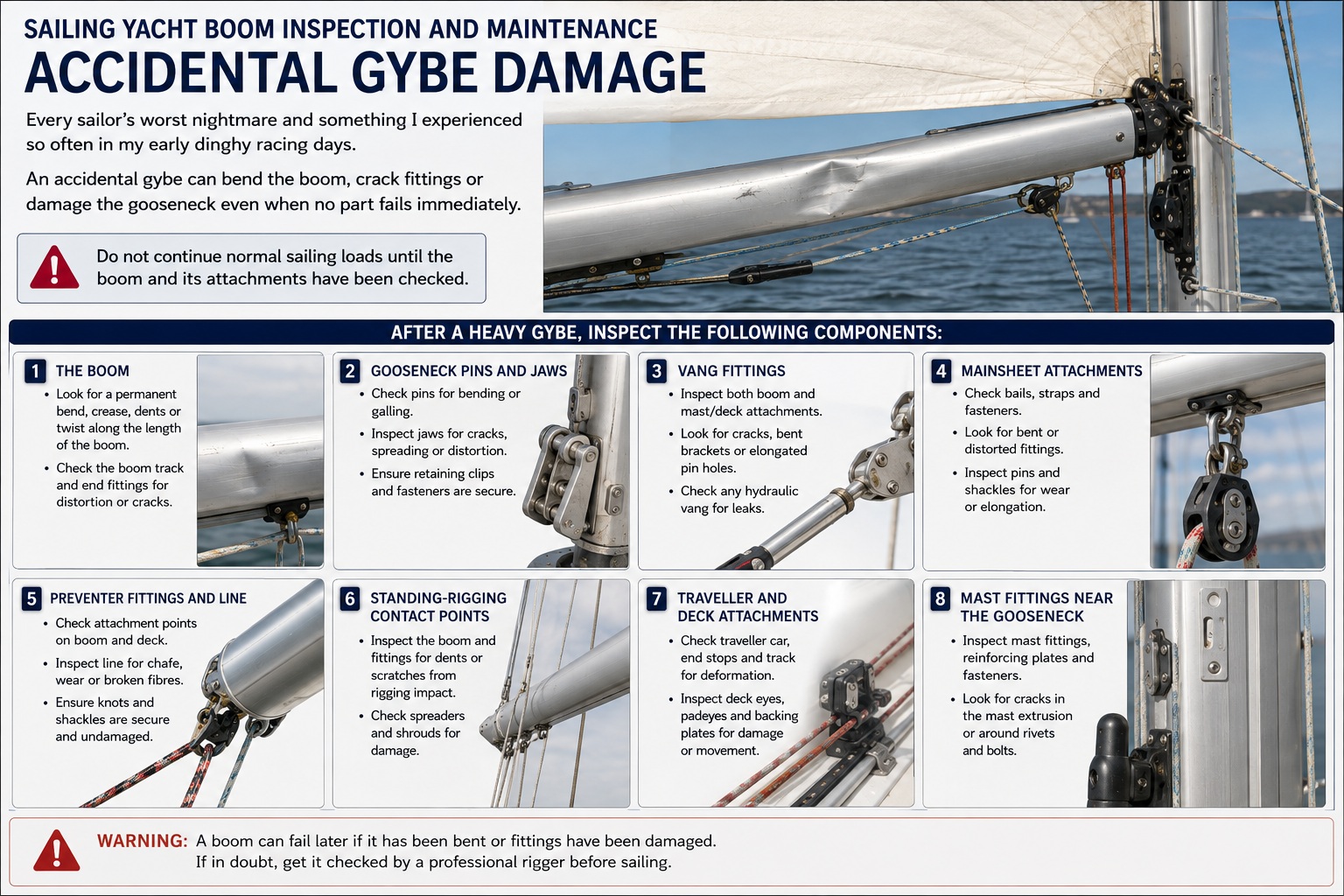
Every sailor’s worst nightmare and something I experienced so often in my early dinghy racing days. An accidental gybe can bend the boom, crack fittings or damage the gooseneck even when no part fails immediately. After a heavy gybe, inspect the following components:
- The boom for a permanent bend or crease.
- Gooseneck pins and jaws.
- Vang fittings.
- Mainsheet attachments.
- Preventer fittings and line.
- Standing-rigging contact points.
- Traveller and deck attachments.
- Mast fittings near the gooseneck.
Do not continue normal sailing loads until the boom and its attachments have been checked.


Sailing Yacht Boom
Inspection and Maintenance - Boom
Bending and Buckling
A boom can flex under load, but it must return to its original shape. Permanent bending appears as a curve that remains after the mainsail, mainsheet and vang are unloaded. Buckling appears as a crease, flattened wall or local collapse. Do not straighten a buckled aluminium boom using the mainsheet or vang. The extrusion has yielded and requires professional assessment.
Sailing Yacht Boom
Inspection and Maintenance - Carbon-Fibre
Booms
Carbon booms require inspection for impact damage, cracking and delamination. A surface mark may represent damaged laminate beneath the coating. Tap testing and specialist inspection may be required after a hard impact. Do not drill new holes or move fittings without a laminate schedule and approved reinforcement method.
Sailing Yacht Boom
Inspection and Maintenance - Internal
Boom Inspection
The inside of the boom can contain corrosion, loose blocks and detached fasteners. Remove end fittings where practical during major service. Inspect for the following:
- Loose internal tackle components.
- Water accumulation.
- Corrosion around concealed fasteners.
- Broken rivet tails and debris.
- Detached backing plates.
A rattle inside the boom requires investigation rather than additional external restraint.
Sailing Yacht Boom
Inspection and Maintenance - Boom
Maintenance
Wash the boom and fittings with fresh water.
Remove covers periodically and allow the spar to dry.
Lubricate pins and moving parts with products suitable for the materials.
Inspect all high-load fittings before an offshore passage.
Do not use carbon-steel brushes or tools that contaminate aluminium or stainless fittings.
Sailing Yacht Boom
Inspection and Maintenance - Boom
Replacement Criteria
A boom requires specialist assessment or replacement when the following are observed:
- A permanent bend remains after unloading.
- The extrusion contains a crease, crack or buckled section.
- Corrosion has removed material beneath a loaded fitting.
- Gooseneck or mainsheet attachment holes are elongated beyond repair limits.
- A carbon boom has structural delamination or fibre damage.
- A timber boom has rot, splitting or failed glue joints.
- The boom manufacturer cannot approve the proposed repair.
Do not plate over a cracked boom without addressing the load concentration that caused the failure.
Sailing Yacht Boom
Inspection and Maintenance - Summary
The boom carries mainsail, mainsheet, vang, reefing and outhaul loads through a limited number of structural fittings. The highest inspection priority lies at the gooseneck, vang attachment, mainsheet connection, reefing sheaves and boom end. Wear in pins and holes, corrosion beneath fittings and damage from accidental gybes can progress without obvious failure. The skipper must inspect the boom unloaded, operate every internal system and investigate movement, cracking or permanent distortion before the spar is returned to full sailing load. Sailing Yacht Boom Inspection and Maintenance for all you need to know.