North Central
Indonesia Sailing Routes
North Central Indonesia sailing routes. North‑Central Indonesia spans the entire western and northern coastline of Kalimantan and the offshore arc of the Karimata Strait and Belitung. The region is defined by a broad continental shelf, extensive mangrove systems, and river deltas that push sediment far into the coastal zone. Yachts moving through this area follow the outer contour of the island rather than attempting inland routes, as most rivers are shallow, shifting, and dominated by commercial and local traffic. The primary nodes of movement include Balikpapan, Banjarmasin, Samarinda, Pontianak, Kumai, Ketapang, Singkawang, Sukadana, Karimata, Sambas, Belitung, Tarakan, and Nunukan, forming a long chain of industrial ports, fishing towns, and river‑delta access points.
Across this coastline, infrastructure is built for commercial shipping, barges, and fishing fleets rather than yachts. Water, fuel, and services are inconsistent, and many locations are inaccessible due to shallow bars, tidal flats, or river‑delta constraints. The region’s operational reality is shaped by sediment‑laden approaches, strong tidal influence, and the absence of yacht‑grade facilities. This hub page defines the movement logic of North‑Central Indonesia and links every port and coastal node into a single navigational framework that reflects the true conditions of the region.
North Central
Indonesia Sailing Routes - Operational
Context
North‑Central Indonesia has no marina infrastructure and only limited shore‑side support for yachts. Water uplift is unreliable and generally restricted to jerry‑can collection from communal taps, while diesel is available only from roadside stations with manual transfer. Approaches to most ports are shaped by sediment, mangrove runoff, and tidal variation, with many river mouths unsuitable for deep‑draft entry. The coastline is long and sparsely serviced, requiring yachts to plan for extended passages without reliable resupply. Movement between ports depends on coastal routing, daylight navigation, and careful depth management, as night entry is unsafe across most of the region due to unlit hazards and fishing activity.
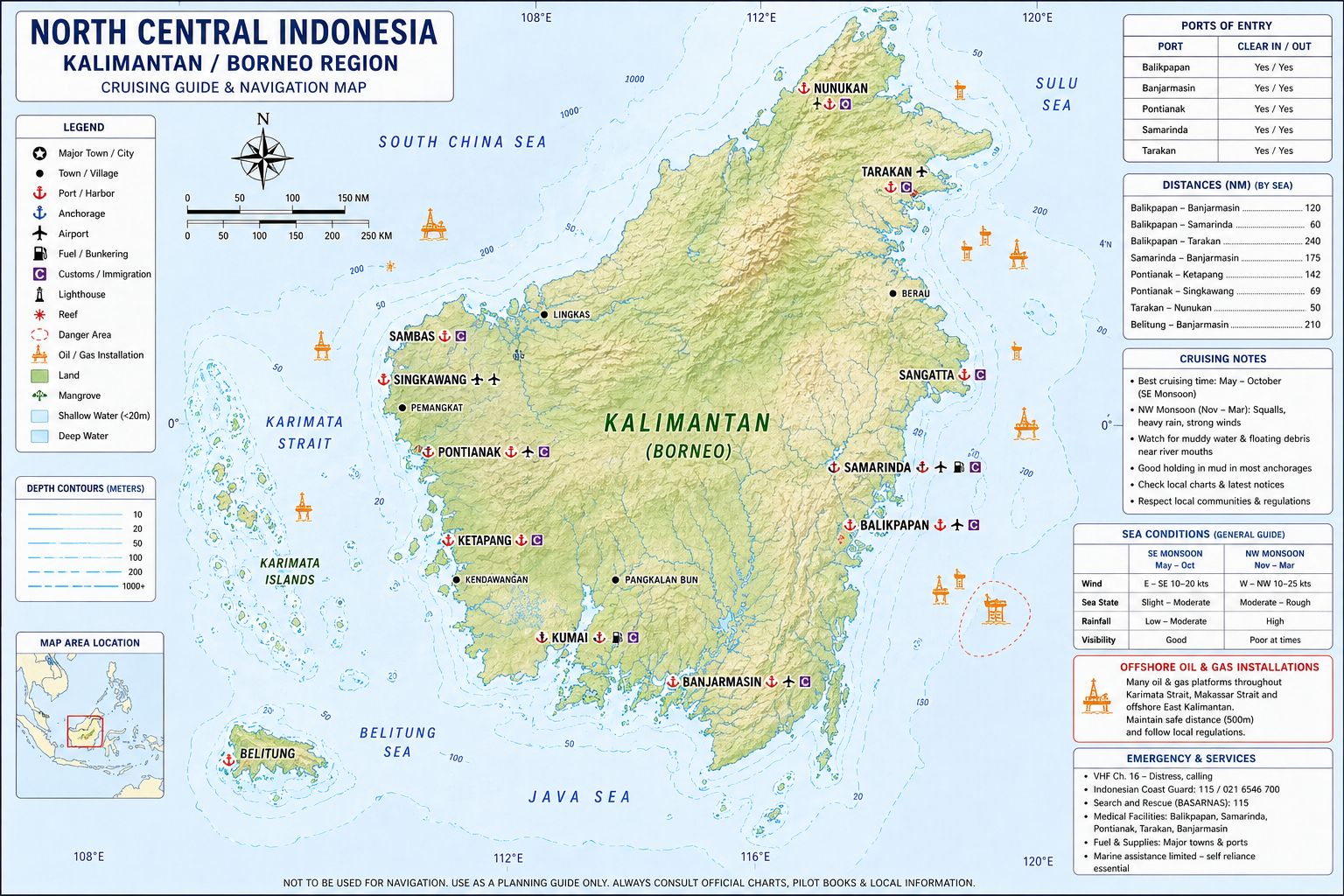
Chart Disclaimer. This chart is a schematic representation for illustrative purposes only and must not be used for navigation. Refer to official hydrographic charts for safe navigation. Be aware ENC charts may differ from official hydrographic charts. Both should be corrected and updated regularly.
North Central
Indonesia Sailing Routes - Ports
Routes through North‑Central Indonesia move along the west‑Kalimantan coastline from Pontianak to Ketapang, then continue south toward Sukadana, Singkawang, Pemangkat, Sambas, and the offshore transition at Karimata, before extending into the southern basins at Kumai, Pangkalan Bun, Sampit, Kotabaru, and the river‑delta access at Banjarmasin. Also in this region are the Bangka Belitung Islands. Eastern movements follow the Makassar Strait from Balikpapan to the upriver commercial centre of Samarinda, then continue north toward Sangatta, Berau, and the offshore anchorages of the Derawan Islands, before reaching the northern frontier at Tarakan, Nunukan, and the coastal settlement of Lingkas. Offshore routes extend further into the Celebes Sea toward Melonguane in the Talaud Islands, with additional northern transitions linking Tidore in North Maluku and the wider Halmahera basin. Together, these ports, islands, and coastal settlements form the operational chain that defines movement through the North‑Central Indonesia region
North Central
Indonesia Sailing Routes –Weather
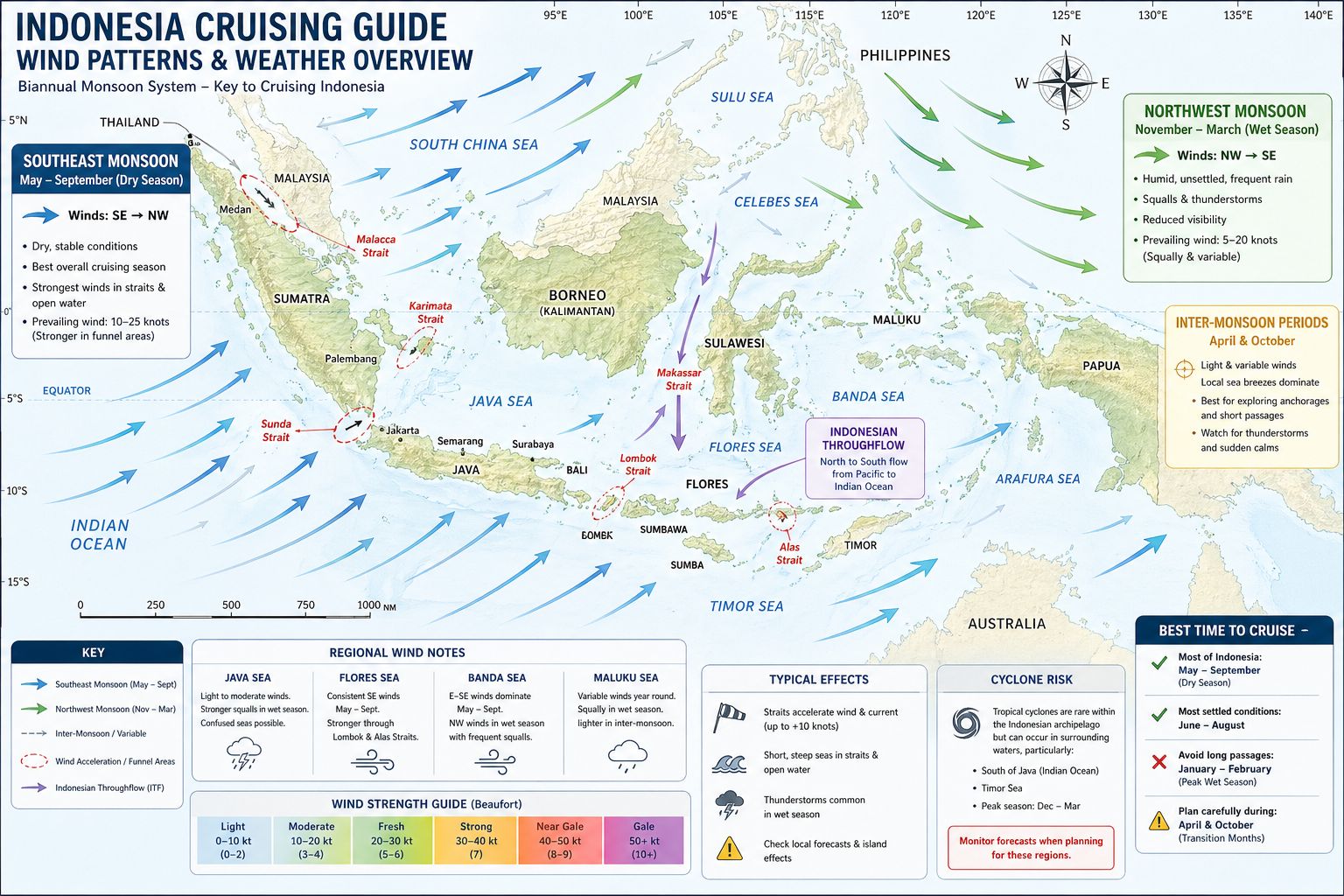
Weather across North‑Central Indonesia is dominated by the monsoon cycle, with the northwest monsoon bringing heavier rain, reduced visibility, and variable winds from December to March. The southeast monsoon, from June to September, provides more stable conditions with moderate, drier airflow, though localised convection remains common. River‑delta zones generate their own micro‑weather, with afternoon thunderstorms, sudden squalls, and rapid cloud build‑up. Humidity remains high throughout the year, and rainfall is frequent, especially along the western coastline where river systems discharge into the sea. Visibility can drop quickly during rain events, and haze from land‑based activity occasionally affects the region.
North Central
Indonesia Sailing Routes - Navigation
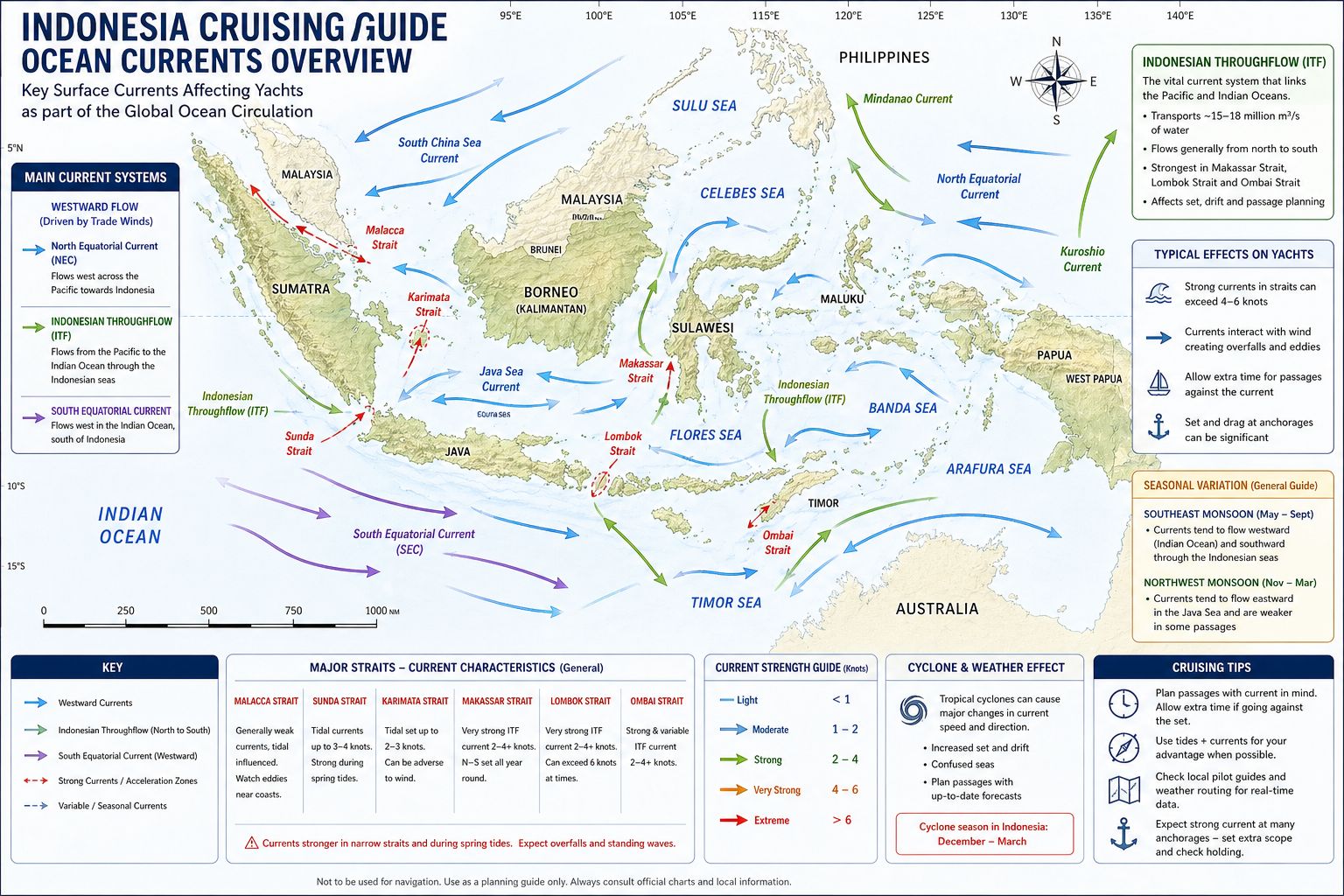
Navigation relies on depth management, daylight entry, and careful reading of river‑delta approaches. Sediment‑laden water reduces visibility, and shifting bars alter depths near river mouths, making charts unreliable in many areas. Mangrove systems create unmarked channels, while commercial traffic dominates the approaches to major ports such as Balikpapan, Pontianak, and Tarakan. Fishing fleets operate close to shore, deploying nets, traps, and unlit markers that complicate night movement. Few navigation aids exist outside industrial zones, and even marked channels may shift after heavy rain or seasonal changes. Yachts must rely on visual navigation, tide awareness, and conservative entry planning.
Oil Rig Navigation Warning
Navigation around Indonesian offshore oil and gas installations is governed by a combination of international maritime law (primarily UNCLOS and IMO guidance) and Indonesian national regulations, and these impose strict safety, clearance, and reporting requirements that are critical for cruising yachts to understand.
The most important rule is the establishment of a mandatory safety (exclusion) zone around offshore platforms. Under United Nations Convention on the Law of the Sea, coastal states such as Indonesia are entitled to create a 500-metre safety zone measured from the outer edge of the installation, within which navigation is restricted and vessels must not enter unless authorised. In practice, many installations also have wider precautionary areas (often charted or advised in Notices to Mariners) where vessels are expected to proceed with extreme caution. From a practical navigation standpoint for yachts:
- Maintain a minimum 500 m clearance or greater at all times (treated as “no-go” zone).
- Expect guard vessels around rigs; these may call you on VHF and direct your course.
- Platforms are well lit at night and marked on charts, but subsea infrastructure (pipelines, wellheads) may extend well beyond the visible structure.
- Anchoring, fishing, or drifting near installations is strictly prohibited due to risk of damage and liability.
In Indonesian waters particularly areas such as the Java Sea, Natuna Sea, and Makassar Strait dense oil and gas infrastructure means that route planning must account for clusters of platforms, not just isolated rigs. For cruising yachts, the real-world implications are:
- Treat oil fields as hazard zones, not just chart features
- Avoid night transits through dense fields where possible
- Use up-to-date electronic charts (ENC) and Notices to Mariners
- Keep a continuous watch and radar guard zones, and AIS active when transiting near installations
Chart Accuracy –
North Central Indonesia
- Official Hydrographic Charts (Indonesian Navy – Pushidrosal). Accuracy level: LOW to MODERATE depending on the sub‑region. Operational reality. Most charts for Karimata, Berau, Derawan, Talaud, Tidore, Sambas, Singkawang, Sukadana, Kendawangan are based on pre‑1970s lead‑line surveys. Depths are approximate, not modern multibeam. Reef edges are generalised, not precise. Many anchorages show no soundings or single‑point soundings only. LAT datum is not consistently applied across older sheets. Where accuracy improves. Balikpapan haS modern survey, good accuracy. Tarakan & Nunukan has moderate accuracy in commercial approaches. Pontianak has fair accuracy in the main river channel only. Where accuracy collapses. Karimata Islands. Berau coast. Derawan Islands. Sambas / Singkawang / Sukadana. Kendawangan. Talaud / Melonguane. Tidore offshore. These areas require visual navigation, drone recon, and satellite‑based reef reading.
- Navionics (SonarChart + Government ENC Blend). Accuracy level: MODERATE in commercial zones, LOW in offshore islands. Good for general coastline shape. Good for major approaches (Balikpapan, Tarakan, Nunukan, Pontianak). SonarChart layer sometimes shows user‑generated depth contours in Belitung and populated areas. Weaknesses. Reef edges in Derawan, Karimata, Talaud are offset by 20–120 m. Depth contours are interpolated, not surveyed. Many shoals are missing. Some islands are mis‑shaped or shifted slightly. Operational rule. Use Navionics for macro routing, never for micro pilotage.
- C‑Map (NT+ / Reveal / 4D). Accuracy level: MODERATE in shipping areas, LOW in remote islands. Better contour smoothing than Navionics. Good depiction of Makassar Strait commercial approaches. Slightly more accurate around Balikpapan and Tarakan. Weaknesses. Reef edges in Derawan, Karimata, Talaud are incomplete. Some anchorages show blank areas with no detail. Depths often copied from old Indonesian charts. Operational rule. C‑Map is no more accurate than Navionics in the offshore island groups.
- Garmin BlueChart. Accuracy level: LOW to MODERATE. Garmin uses a blend of Old Indonesian hydrographic data. C‑Map sources. Satellite‑derived coastline vectors Operational notes. Good for coastline shape. Poor for reef detail. Depths are not reliable in Karimata, Derawan, Talaud, or river deltas.
- Satellite‑Derived Navigation (Google / Bing / SASPlanet / ESRI). Accuracy level: HIGH for reef edges, LOW for depth. Best method for reef reading in Derawan, Karimata, Belitung east coast, Talaud. Reef edges visible to within 3–10 m accuracy. Ideal for anchorage selection and approach planning. Weaknesses. No depth information. Cloud cover can obscure detail. Requires visual confirmation on arrival. Operational rule. Satellite imagery is mandatory for safe entry into remote anchorages.
- Operational Summary. Official Indonesian charts: old, generalised, inconsistent. Navionics: good for routing, unreliable for reef edges. C‑Map: similar limitations, slightly better smoothing. Garmin: coastline OK, depths unreliable. Satellite imagery: essential for reef navigation. Drone recon: highly recommended in Derawan, Karimata, Talaud. Use paper/ENC charts for macro routing, Navionics/C‑Map for cross‑checking, and satellite imagery for every anchorage approach
Mechanical and Electrical Repairs
Resource
If you are headed somewhere remote consider the need to expand your knowledge base or have an information resource on board. Why not get a copy of my book The Marine and Electrical and Electronics Bible 4th Edition. By and for yachties, with everything from batteries and charging, solar and wind, diesel engines and marine electronics and so much more. Your complete systems guide. 650 pages of practical advice. In Australia and New Zealand order a copy through Boat Books. UK and European boats can buy the UK Edition Here. US and Canadian boats can get the US Edition Order Here. Marine systems are my profession so let me help you. By a liveaboard boat owner for other boat owners

North Central
Indonesia Sailing Routes - Provisioning
Provisioning varies widely across North‑Central Indonesia. Larger towns such as Balikpapan, Pontianak, and Tarakan offer basic supermarkets, markets, and dry‑goods suppliers, though availability fluctuates with shipping schedules and local demand. Smaller coastal settlements provide only local produce, rice, and limited packaged goods. Fresh vegetables and fruit are available intermittently, while dairy, meat, and imported goods are inconsistent. No location in the region offers yacht‑grade water, fuel, or technical services, and all major provisioning must be completed before entering the region or at the few larger towns with modest supply chains. Yachts must remain self‑sufficient for extended periods.
North Central
Indonesia Sailing Routes – Cuisine
Cuisine across North‑Central Indonesia reflects coastal Muslim communities, river‑based food traditions, and Kalimantan’s reliance on fish, rice, and sago. Markets offer grilled or fried fish, simple vegetable dishes, and local snacks, with variations between coastal and upriver towns. Dishes are shaped by availability rather than culinary diversity, and prepared foods are basic. Inland areas rely more on river fish and sago, while coastal towns incorporate dried fish and rice. Crews will encounter straightforward, locally sourced meals rather than complex regional cuisine.
Indonesian
Beverages
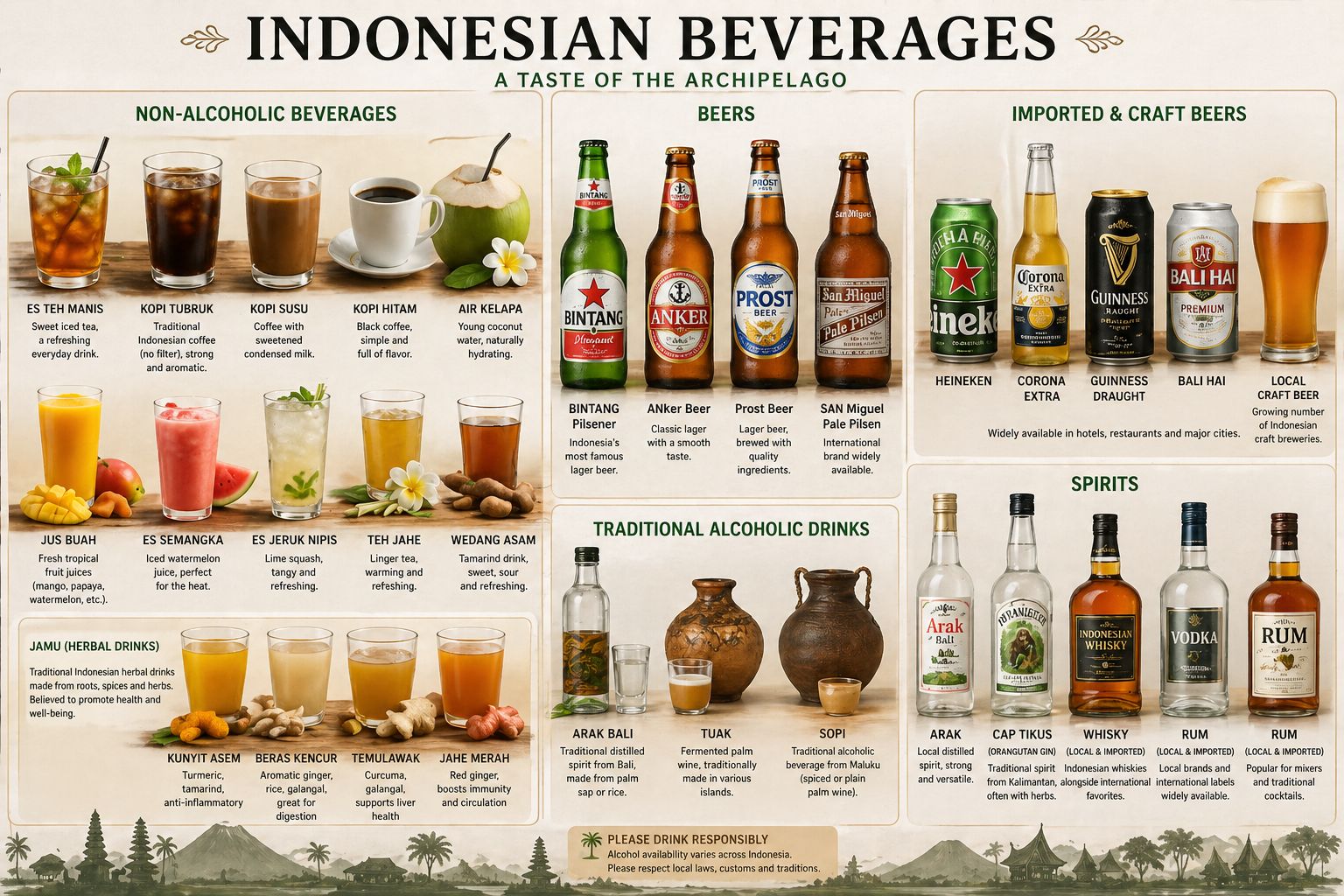
Indonesia offers a varied but locally distinctive range of beverages shaped by culture, climate, and religion. Beer is the most widely available alcoholic drink, with Bintang and Anker Beer being the most common, typically light, refreshing lagers suited to the tropical heat. In some regions, traditional spirits are produced, such as Arak Bali, a strong distilled liquor often made from palm sap or rice, and Tuak, a fermented palm wine found in various islands. Availability of alcohol varies significantly, with stricter limitations in more conservative areas. Non-alcoholic beverages are a major part of daily life, including fresh tropical juices (jus buah), young coconut water (air kelapa), and sweet iced teas. Indonesian coffee is also notable, with varieties such as Kopi Tubruk widely consumed, alongside the globally known Kopi Luwak. Herbal drinks known as jamu, made from turmeric, ginger, and other roots, are traditionally valued for their health benefits and are commonly found in local markets


North Central Indonesia Sailing Routes - Summary
North‑Central Indonesia is a long, shallow coastal region shaped by river deltas, mangrove systems, and industrial ports. Movement depends on daylight navigation, depth awareness, and self‑sufficiency due to limited infrastructure. Ports and villages provide only basic supplies, and yachts must plan for minimal shore support throughout the region. North Central Indonesia Sailing Routes for all you need to know.