Bangka Belitung
Sailing Guide
Bangka Belitung Sailing Guide. The Bangka Belitung Islands are a province off the southeast coast of Sumatra, Indonesia, known for their tin mining heritage, granite boulder beaches. The two main islands are Bangka and Belitung. The Bangka Belitung Islands form a broad, shallow‑shelf region between the Karimata Strait and the Java Sea. The coastline is shaped by granite headlands, fringing reefs, sandbanks and wide bays with gently rising seabeds. Offshore depths fall into 20–40 m, rising to 5–15 m near the anchorages and 2–6 m inside the reef‑lined lagoons. The region is influenced by the monsoon cycle, with the northwest monsoon bringing swell and onshore wind, while the southeast trades create calmer seas and more predictable tidal behaviour.
Bangka is one of the world’s richest tin-producing regions. Mining began in the 18th century and remains central to the economy. Pepper, rubber, palm oil, and seafood are key exports. Pangkalpinang is the capital. Mentok Port connects Bangka to Palembang (Sumatra) via ferry. Bangka and Belitung support provisioning centres, fuel stations, markets and small‑craft operators concentrated around Tanjung Pandan, Manggar, Tanjung Ru and Sungailiat. For yachts transiting between Singapore, the Karimata Strait, the Java Sea and western Borneo, Bangka Belitung functions as a sheltered mid‑route region with multiple anchorages, reliable holding and access to supplies.
Bangka Belitung
Sailing Guide - Approaches
Approaches to Bangka Belitung vary by coast. The western and northern coasts of Bangka rise from 20–30 m offshore to 5–10 m near the shoreline, with granite outcrops and coral heads marking the shallows. The eastern and southern coasts of Belitung rise from 30–40 m to 10–15 m, with wide sandy bays and visually obvious reef lines.
The region’s primary hazard is granite‑reef scatter, where isolated boulders and coral heads rise abruptly from 10–15 m to 1–3 m. These features are visually clear in good light but require disciplined navigation. The Karimata Strait approaches from the east remain deep and predictable, with 30–50 m of water and a smooth depth gradient.
Bangka Belitung
Sailing Guide - Navigation
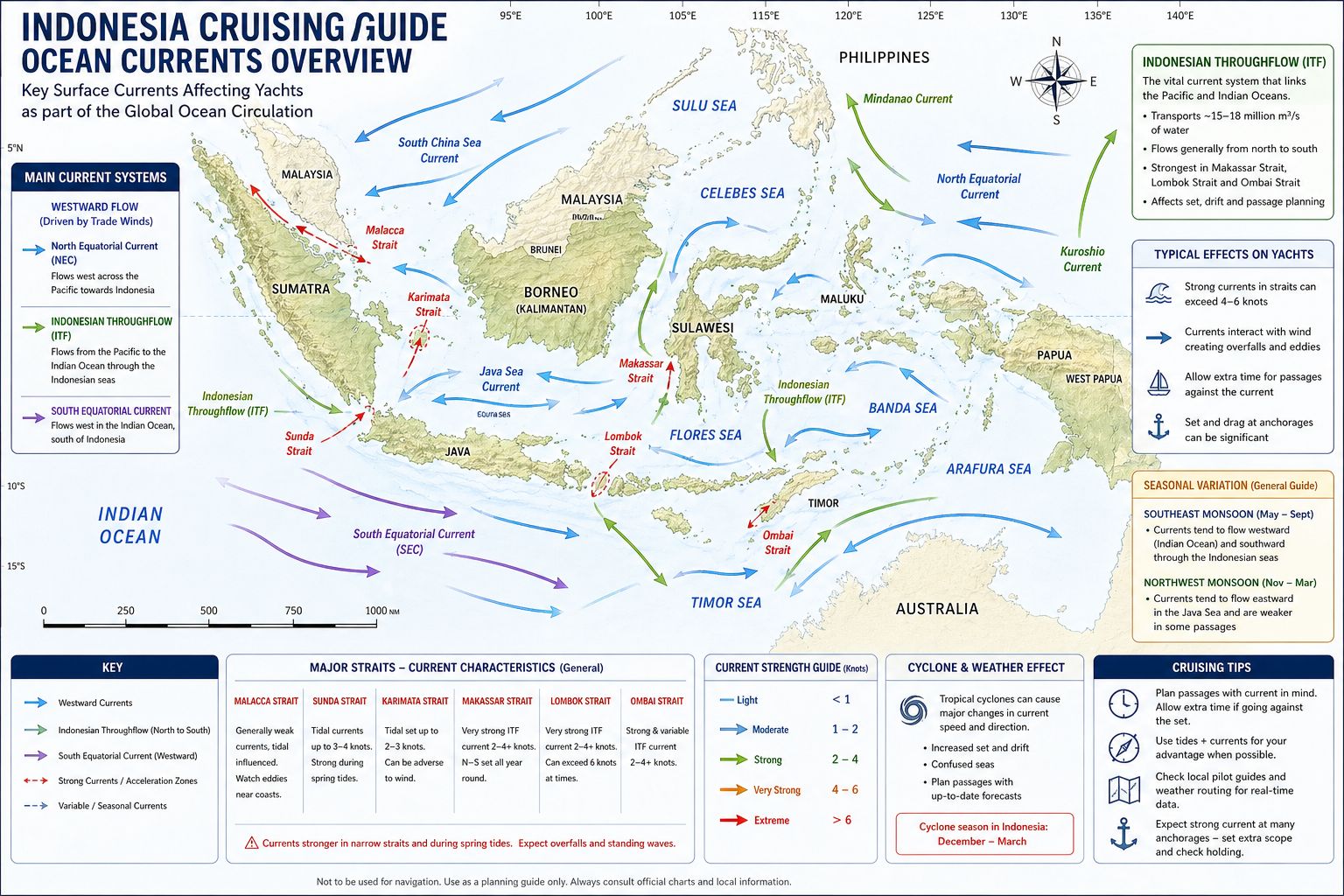
Navigation in Bangka Belitung is shaped by the interaction between the Java Sea monsoon cycle, the Karimata Strait residual flow, and the shallow‑shelf hydrodynamics around the islands. Offshore, a 0.5–1.5 kn westbound set runs along the northern coast during the northwest monsoon, while a 0.5–1 kn eastbound set appears during the southeast trades. These sets weaken rapidly inside the bays, where the flow drops to 0–0.5 kn.
The primary navigational hazard is reef‑edge compression, which occurs where the seabed rises from 10–15 m to 2–6 m near the shoreline. This compression produces a narrow band of accelerated water that can nudge a yacht sideways during low‑speed manoeuvring. The effect is mild but persistent and must be accounted for when lining up an anchoring position.
Granite outcrops create localized turbulence where the flow splits around submerged boulders rising from 8–12 m to 1–3 m. These features are visually obvious but can produce unexpected lateral movement during the last hour of the ebb.
Slack water is broad and predictable due to the shallow‑shelf environment, with minimal shear and no deep‑water throughflow. The region is free of the violent tidal behaviour found in the Lombok Strait or the Penida–Lembongan system.
Chart Accuracy and
Source Disclaimer – Indonesia
Chart accuracy across Indonesia is inconsistent, with most non‑commercial regions still based on pre‑1970s lead‑line surveys that provide approximate depths, generalised reef edges, and sparse or single‑point soundings. Official ENC coverage improves only in major commercial ports, while offshore islands, reef systems, and remote bays across Sumatra, Java, Kalimantan, Sulawesi, Nusa Tenggara, Maluku, and Papua rely on outdated or incomplete data. Navionics and C‑Map offer reasonable coastline shape and usable macro‑routing but suffer from interpolated contours, missing shoals, and reef offsets of 20–150 m in many areas. Garmin BlueChart inherits the same limitations. Satellite imagery (Google, Bing, ESRI, SASPlanet) provides the most accurate depiction of reef and shoal edges, typically within 3–10 m, and is essential for anchorage selection and approach planning.
Skippers should treat all charted depths outside commercial ports as approximate and rely on a combination of ENC cross‑checking, satellite‑based reef reading, visual navigation, and drone reconnaissance for safe entry into anchorages. All chart information referenced in this guide is derived from publicly available Indonesian hydrographic products, international ENC datasets, and third‑party electronic chart packages. These sources vary in age, survey method, positional accuracy, and datum consistency. No guarantee is made regarding the completeness, reliability, or currency of any charted depth, contour, hazard, or navigational feature. Mariners are responsible for verifying all information against the latest official notices, updated charts, and on‑scene conditions. Electronic charts, satellite imagery, and user‑generated data must not be relied upon as sole sources of navigational information. Safe navigation requires continuous visual assessment, prudent seamanship, and independent confirmation of all charted features.
Bangka Belitung
Sailing Guide - Anchorage
Bangka Belitung offers multiple anchorages in 5–15 m over sand with scattered coral. The holding is reliable, and the bays remain sheltered in most conditions. The northern and western coasts of Bangka provide anchorages with 8–12 m depths, while Belitung’s western and southern bays offer 10–15 m with wide swinging room. The seabed is generally uniform, though coral patches and granite outcrops require visual confirmation. Tenders land at beach points or small jetties with 0.5–2 m depending on tide.
Bangka Belitung
Sailing Guide - Entry Formalities
Bangka Belitung is not a primary port of entry. Clearance is handled through Batam, Belawan, Jakarta, Kupang, Makassar or Bitung. Yachts must complete arrival reporting before using Bangka Belitung as an anchorage.
Bangka Belitung
Sailing Guide - Berthing
Facilities
Small‑craft jetties operate at Tanjung Pandan, Manggar, Sungailiat and Tanjung Ru with 2–3 m depth depending on tide. These jetties are used primarily by local boats, and space for yachts is limited. Shore power is minimal, potable water is available at selected points and fuel is obtained by jerry can or delivery. Waste disposal is available through local operators.
Bangka Belitung
Sailing Guide - Local Weather
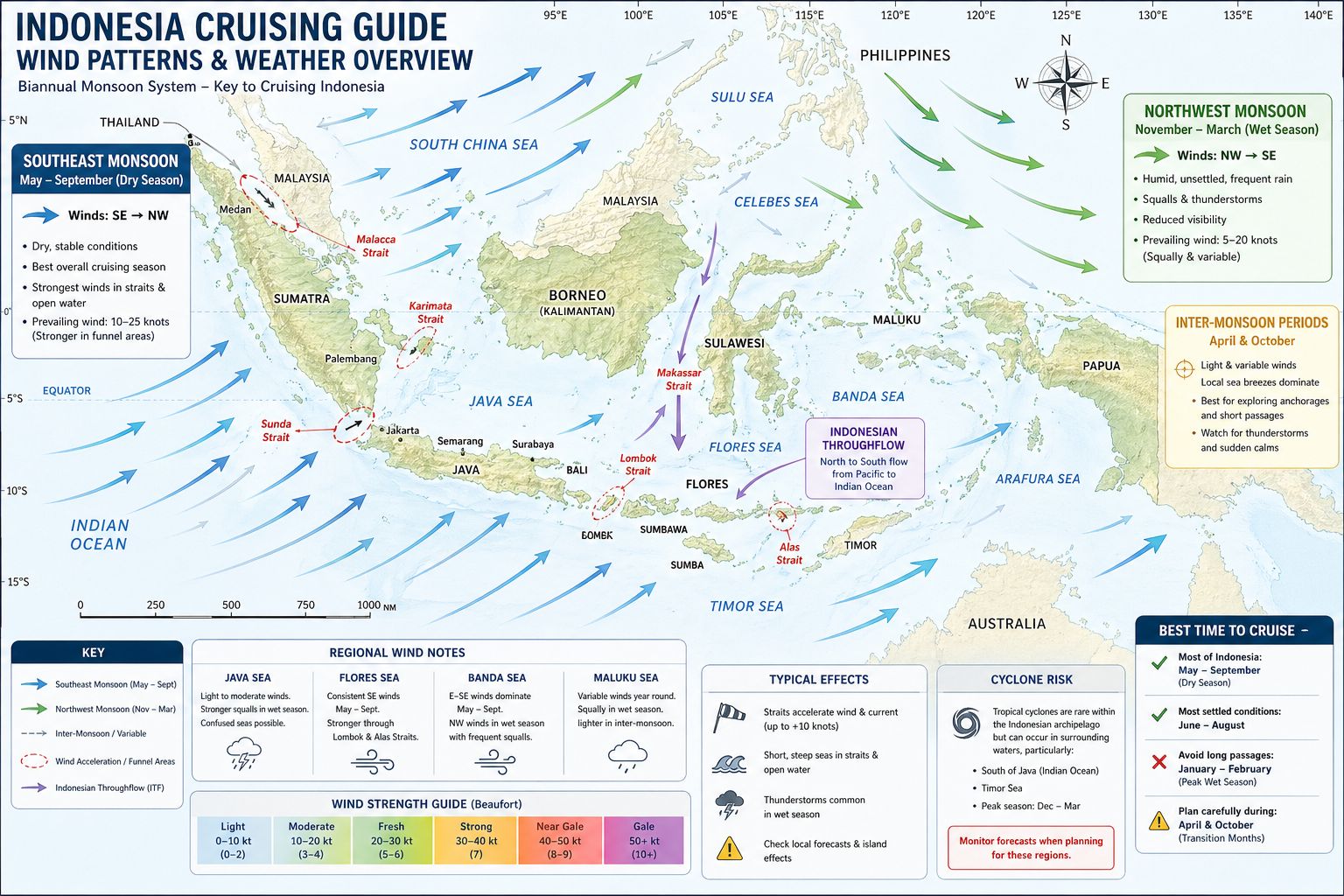
The region experiences the northwest monsoon from November to March, bringing onshore wind, swell and reduced visibility. The southeast trades from May to September create calmer seas, clearer water and more predictable tidal behaviour. Afternoon sea breezes develop but remain manageable due to the wide bays and shallow‑shelf environment.
Bangka Belitung
Sailing Guide - Provisioning
Supermarket. Efendi Market (Pangkalpinang), Puncak Super Market (Sungailiat), Seperadik Mart (Tua Tunu, Pangkalpinang) Local Hypermart Bangka Trade Center (Pangkalpinang), Asoka Supermarket & Department Store Pangkal Pinang. Indomaret, Alfamidi and local outlets supplying dry goods and household staples.
Markets. Pasar Senggol. (Sungailiat) Traditional seafood market with fresh catch and local produce. Bangka Island has at least 18 traditional markets, with major ones also located in Pangkalpinang, Mentok, and Belinyu. Tanjung Pandan Market and Manggar Market also provide daily produce with consistent turnover, including vegetables, fruit, herbs and regional staples.
Fish Markets. Fish supply is obtained from shoreline vendors and fish markets in Tanjung Pandan, Manggar and Sungailiat, with coastal species available year‑round.
Belitung
Supermarkets. Araya Supermarket, Perawas, Swalayan Asoka, Puncak Swalayan. Hypermart Belitung. Babelmart (multiple branches)
Markets. Pasar Tradisional Tanjung Pandan. Manggar City Market (East Belitung) for fresh produce and seafood
Bangka Belitung
Sailing Guide - Local Cuisine
Tanjung Pandan is the capital and main port town of Belitung Island. Local cooking in Bangka Belitung reflects Malay coastal traditions with Chinese influence. Known for seafood, pepper, and Belitung-style coffee (kopi Belitung). This is a strong, dark roast Robusta coffee traditionally served black or with sweetened condensed milk. It’s brewed using a cloth filter and enjoyed in local warung kopi (coffee stalls) as part of Belitung’s social culture. Kopi Belitung is often paired with Kue lapis (layered cake), Pisang goreng (fried banana) and Roti bakar (grilled bread with chocolate or cheese). Local dishes are Gangan (Lempah Kuning) which is a bright yellow fish soup made with tenggiri (mackerel), turmeric, galangal, and pineapple. Ikan Bakar Belitung which is grilled fish marinated in turmeric, garlic, and lime.
Other Signature dishes include Mie Bangka, yellow noodles served with shredded chicken, fish balls, bean sprouts, and savory broth. Lempah Kuning which is a turmeric-based sour fish soup made with pineapple, tamarind, and chili and typically uses tenggiri (mackerel) or snapper and Lempah Darat which is vegetarian version using young jackfruit or taro stems Mie Belitung appears as a noodle dish with seafood broth, while gangan, a turmeric‑based fish soup, is a regional specialty. Coastal broths vary between clear preparations and richer coconut‑based variants.
Bangka Belitung
Sailing Guide - Fuel Supplies
Bangka Belitung has diesel available onshore, but not in a form directly usable by yachts at anchor. Pertamina stations in Pangkal Pinang, Sungailiat, Tanjung Pandan, and Manggar supply automotive diesel only, with no wharf‑side hose service and no facility for direct yacht refuelling. All fuel must be moved by jerry can from the stations to the waterfront, typically using motorbike carriers or small pickups. No drum depots, marine‑grade suppliers, or bulk‑delivery operators serve yachts anywhere in the region, and no fishing bases, surf camps, or guesthouses maintain diesel reserves for external supply. Village‑level fuel availability consists of small bottles or improvised containers intended for motorbikes and fishing skiffs, with low turnover and contamination risk, and is unsuitable for yacht tanks. Yachts must therefore complete all major refuelling on the Sumatran mainland, Palembang, Muntok, or Belitung‑bound supply points before crossing to the islands. Vessels should arrive with adequate tankage for their entire Bangka Belitung operating window, expecting only jerry‑can resupply while in the region.
Bangka Belitung
Sailing Guide - Water Supplies
Bangka Belitung provides no yacht‑suitable potable water at any anchorage, and none of the island settlements maintain hose points or wharf‑side loading positions for visiting vessels. Both Bangka and Belitung rely on shallow wells, rain‑catchment tanks, and small municipal taps with inconsistent pressure, none of which can support high‑volume yacht tank loading. Even the larger towns, Pangkal Pinang on Bangka and Tanjung Pandan on Belitung do not maintain surplus storage systems for external supply, and no guesthouses, fishing bases, or commercial yards hold bulk water reserves suitable for yachts. No tanker delivery service operates anywhere in the Bangka Belitung region, and the commercial wharves do not permit water uplift. River systems on Bangka are brackish or contaminated during rainfall and cannot be used for water production, and the granite‑reef coastline of Belitung offers no protected wharf infrastructure for direct loading even if water were available. Yachts must therefore arrive fully provisioned and expect to take no water in the Bangka Belitung region. The only viable water uplift is by jerry can from the Sumatran mainland, typically Palembang or Muntok before crossing to the islands. All water provisioning must be completed prior to arrival, with yachts planning for zero resupply during their operating window in Bangka Belitung.
Mechanical and Electrical Repairs
Resource
If you are headed somewhere remote consider the need to expand your knowledge base or have an information resource on board. Why not get a copy of my book The Marine and Electrical and Electronics Bible 4th Edition. By and for yachties, with everything from batteries and charging, solar and wind, diesel engines and marine electronics and so much more. Your complete systems guide. 650 pages of practical advice. In Australia and New Zealand order a copy through Boat Books. UK and European boats can buy the UK Edition Here. US and Canadian boats can get the US Edition Order Here. Marine systems are my profession so let me help you. By a liveaboard boat owner for other boat owners


Bangka Belitung
Sailing Guide - Marine Services
Basic mechanical, electrical and general repair workshops operate in Tanjung Pandan, Pangkal Pinang and Manggar. Haul‑out facilities are limited, with larger‑vessel support available in Batam, Jakarta and Surabaya.
Bangka Belitung
Sailing Guide - Local Customs
Village communities across Bangka and Belitung expect quiet, respectful behaviour when crews come ashore, particularly in coastal settlements where houses sit close to the landing areas. Elders should be greeted first, voices kept low near homes, and modest clothing worn when walking through villages, markets, or approaching communal spaces. Photography of people, homes, boats, and mosque compounds requires direct permission, and alcohol should never be consumed in public or visible from the waterfront. Prayer times in these predominantly Muslim communities require reduced noise from tenders and engines, and crews should avoid crossing active fishing‑canoe lanes at dawn and dusk when traffic is heavy along the granite‑reef coastline. Local authority structures are strong and community‑led; visitors should approach the kepala desa or senior fishermen first when requesting access, assistance, or permission to land.
Bangka Belitung
Sailing Guide - Summary
Bangka Belitung is a shallow‑shelf cruising region offering 5–15 m depths over sand, predictable approaches and multiple sheltered anchorages. The operational environment is shaped by 0.5–1.5 kn coastal set, reef‑edge compression, and granite‑reef scatter, but the region remains manageable with disciplined navigation. For yachts transiting the Karimata Strait, the Java Sea or the Sumatra east coast, Bangka Belitung is a reliable provisioning and anchoring hub. Bangka Belitung Sailing Guide for all you need to know.