Menorca Balearics Sailing
Guide
Menorca Balearics Sailing Guide. Menorca is the eastern Balearic island and has a different cruising pattern from Mallorca, Ibiza and Formentera. The island has two main all-weather harbour systems, Port de Maó/Mahón on the east coast and Ciutadella on the west coast, with additional yacht and small-craft facilities at Fornells, Addaia/Port d’Addaia, Cala en Bosch and Es Castell/Cales Fonts. Port de Maó is the principal deep natural harbour and the main service base for yachts on the island, while Ciutadella is the main west-coast port. Fornells and Addaia are useful north-coast refuges, but both require attention to approach conditions, buoyage, draft, local moorings and wind direction. The south coast has many anchorages but few true harbour options, so passage planning must account for the distance between ports
The main operating factor around Menorca is exposure by coast. The north coast is exposed to Tramuntana, Mestral and Gregal, and can become unsuitable quickly in northerly weather. The south coast is more protected from northerly winds but exposed to Migjorn, Xaloc and southerly swell. The west coast around Ciutadella is affected by W–NW weather and is also known for harbour oscillation and surge risk under some pressure and weather patterns. The east coast gives the best harbour refuge in Port de Maó, but approach traffic, ferry movements and the long inlet require controlled pilotage.
Menorca Balearics
Sailing Guide - History
Menorca’s maritime history is centred on its harbours, especially Port de Maó, one of the largest natural harbours in the Mediterranean and the strategic reason for repeated foreign control of the island. The harbour was used by Phoenicians, Romans, Byzantines, Islamic rulers, Catalans, British, French and Spanish forces, and it became a major naval base during periods of British rule. Maó became the island’s capital in the eighteenth century because its harbour was more strategically useful than Ciutadella on the west coast. The forts at La Mola and Marlborough, the naval installations around the harbour and the settlement of Es Castell all reflect that maritime and military role.
Ciutadella was the older capital and still has a confined historic harbour cut into the west coast. It is useful for yachts but does not have the same deep-water inlet geometry as Maó. Menorca also has substantial prehistoric archaeology, including Talaiotic sites, navetas and taulas inland, but these do not generally function as navigation marks. The maritime sites that matter most for cruising are the harbours, lighthouses, headlands and fortified harbour entrances, particularly around Maó, Ciutadella, Fornells and Cap d’Artrutx.
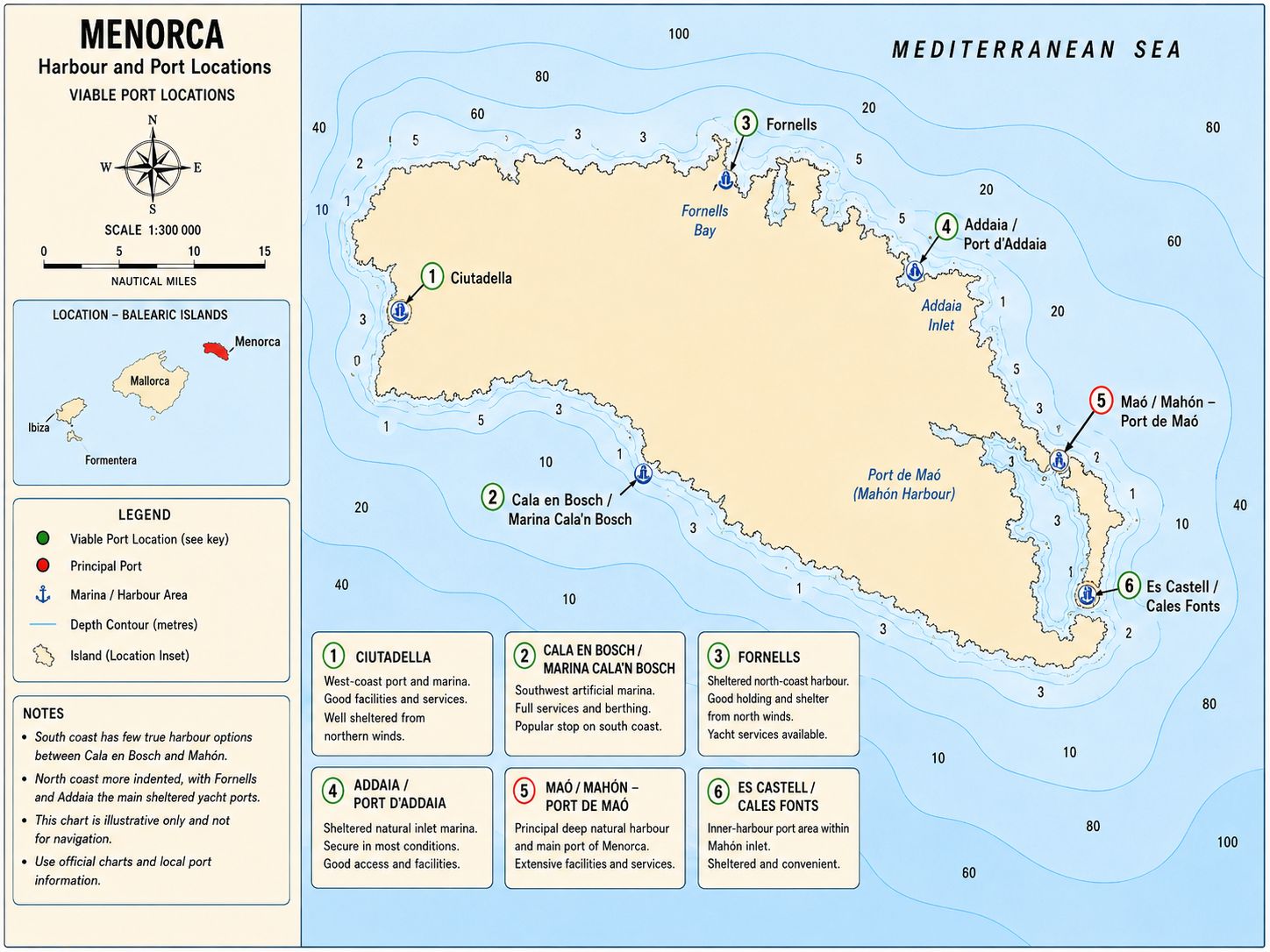
Chart Disclaimer. This chart is a schematic representation for illustrative purposes only and must not be used for navigation. Refer to official hydrographic charts for safe navigation. Be aware ENC charts may differ from official hydrographic charts. Both should be corrected and updated regularly.
Menorca Balearics
Sailing Guide - Currents and
Tidal Flow
Menorca is a microtidal cruising area. Around the Balearics, tidal range and tidal streams are generally small, and yacht handling is normally affected more by wind-driven surface movement, residual drift and sea state around headlands than by tidal stream. Scientific work on the Balearic Sea also notes weak tidal currents in the area, while wider circulation is driven by broader regional water-mass movement. A skipper should not plan Menorca as a tidal-gate coast, but current should not be ignored when wind has been blowing for several hours.
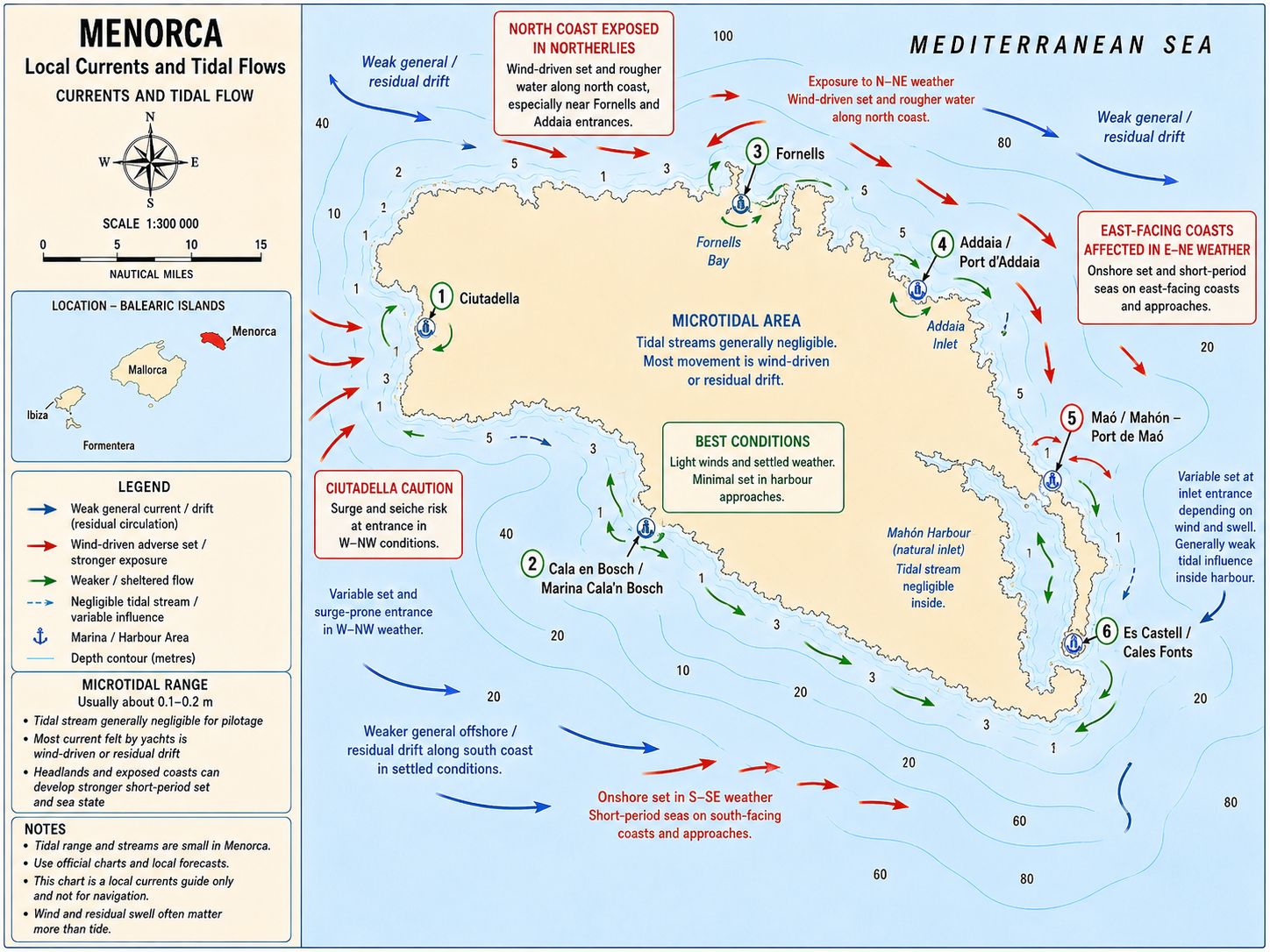
The most important local effects are wind-driven set and sea state around exposed headlands and harbour mouths. The north coast can develop short, steep water in Tramuntana or Gregal, particularly near Fornells, Addaia and the northern capes. The west coast around Ciutadella can be affected by surge and seiche-like harbour oscillations in some W–NW and pressure-change conditions. In Port de Maó, tidal stream is not normally a controlling factor, but the length of the harbour, ferry movements, commercial traffic and gusts can affect slow-speed handling.
Menorca Balearics
Sailing Guide - Weather
Menorca is more exposed to northerly systems than Mallorca, Ibiza or Formentera because it is the easternmost and northernmost of the Balearic Islands. Tramuntana from N–NW is the main weather risk for the north coast. It can make Cala Morell, Cala Pregonda, Fornells outer approaches, Addaia approaches and the north-east coast uncomfortable or unsafe. The south coast may be sheltered from the same northerly wind, but acceleration over the island and gusts near cliffs can still affect anchorage comfort.
The south coast is affected by Migjorn and Xaloc, with swell entering anchorages that are calm in northerly weather. Cala Galdana, Macarella, Son Saura, Cala en Porter and the south-east calas should be treated as fair-weather anchorages, not refuge harbours. Summer conditions are often lighter in the morning, with afternoon sea breeze and local chop. Autumn and winter bring stronger frontal systems, sharper changes in wind direction and larger residual swell on exposed coasts.
The Marine Electrical and Electronics Bible has a complete list of Spanish VHF Radio Channel information and weather forecast times along with NAVTEX UK and Europe and NAVTEX Mediterranean for 490kHz and 518kHz.
Menorca Balearics
Sailing Guide - Local Winds
The key Menorca wind is Tramuntana, a northerly to northwesterly wind that can arrive hard and create dangerous conditions on the north coast. It affects the entire north side from Cala Morell through Pregonda, Fornells, Addaia and toward Favàritx. Gregal from NE also affects the north and east-facing coasts, especially Addaia, Es Grau and exposed north-east anchorages. Mestral and Ponent from W–NW affect Ciutadella and the west coast and can produce uncomfortable conditions in the approaches.
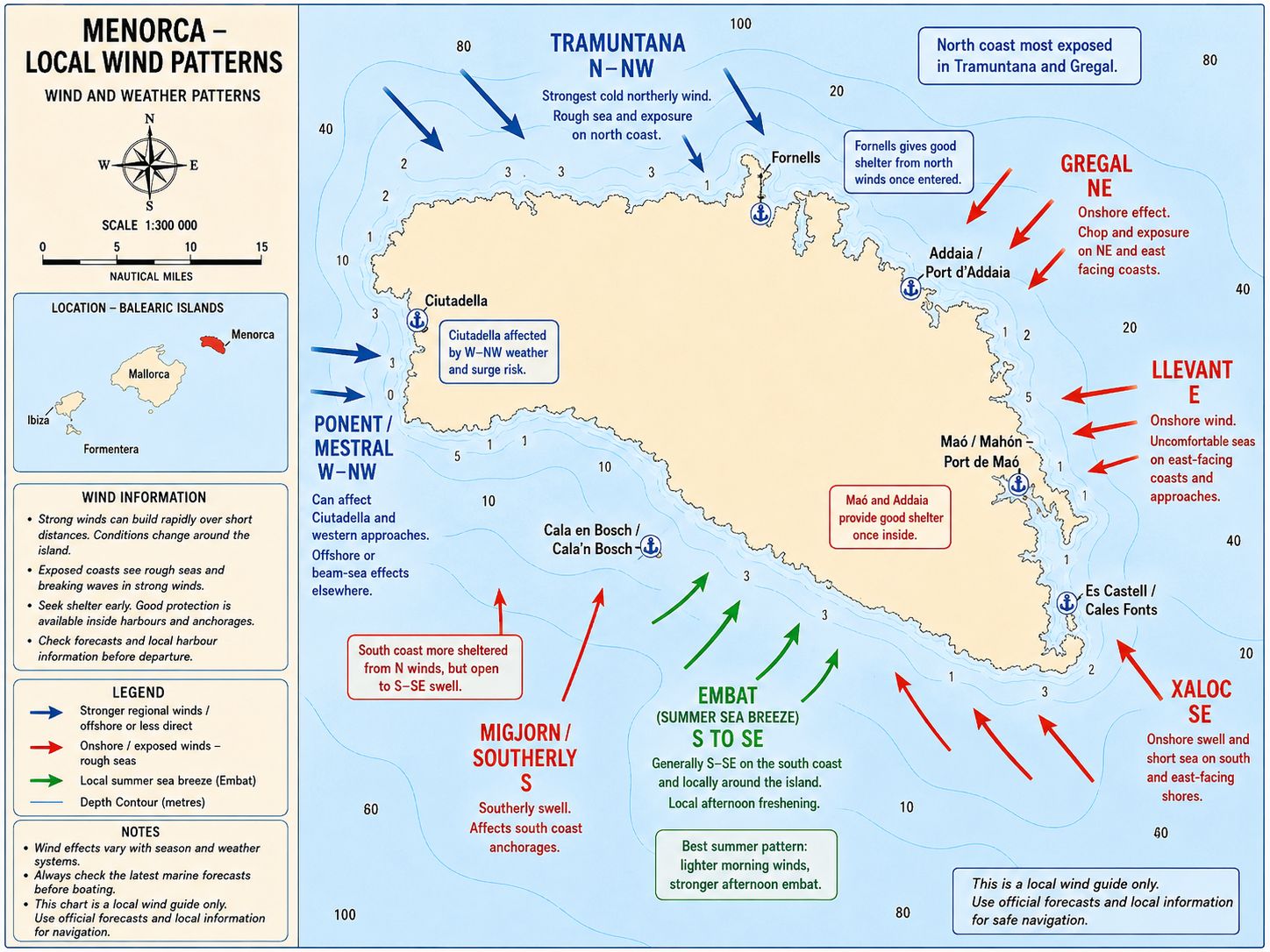
Llevant from E affects the east coast, including the outer approaches to Port de Maó, although the harbour gives strong protection once inside. Xaloc from SE and Migjorn from S affect the south coast, including Cala en Bosch, Cala Galdana, Macarella, Trebalúger, Son Bou, Cala en Porter and south-east anchorages. The summer Embat, or sea breeze, generally develops later in the day and can increase chop in open bays. Passage planning should use wind sector, not just wind speed, because Menorca’s shelter changes completely between north and south coasts.
Menorca Balearics
Sailing Guide - Approaches
Menorca can be approached from Mallorca to the west, from Sardinia and the central Mediterranean to the east, from mainland Spain to the west and northwest, or by inter-island passage from the other Balearics. The main deep-water arrival port is Port de Maó, entered through a long natural harbour on the east coast. The harbour is deep and protected once inside, but the entrance and inner channels are active with ferries, commercial traffic, naval and port activity, marina traffic and local craft. Maó should be approached as a commercial port and natural harbour, not as a small marina basin.
Ciutadella is the main west-coast arrival port and must be treated with caution in W–NW weather. Cala en Bosch lies on the south-west coast close to Cap d’Artrutx and is a shallow artificial marina; published marina information gives 276 berths, a canal entrance with 1.50 m maximum draught, and an access bridge with 6.80 m maximum height in the central part, making it unsuitable for many sailing yachts with rigs or deeper draft. Fornells and Addaia are north-coast inlets with shelter once inside, but approaches are affected by north-sector sea. The south coast has no comparable all-weather harbour between Cala en Bosch and Maó.
Menorca Balearics
Sailing Guide - Navigation
Port-entry navigation in Menorca depends on destination. Port de Maó/Mahón is the principal yacht and commercial harbour, with multiple marina areas including Marina Port Mahón, Marina Menorca, moorings around the long inlet, and berthing at Es Castell/Cales Fonts. Marina Port Mahón lists 165 berths for boats up to 55 m, with fuel, toilets, showers, laundry, waste collection and nearby nautical services. Marina Menorca at the head of the inlet is more limited, with listings giving 230 berths, maximum 15 m LOA, 2 m draft, 220 V power, water, security, showers, maintenance services and a 35-ton travel lift.
Ciutadella and Fornells are PortsIB reservation ports for smaller craft, and the PortsIB reservation system lists those ports with reservable moorings for boats up to 12 m LOA and 4 m beam. Fornells is a natural harbour on the north coast; one marina listing describes capacity for about 115 recreational and fishing boats up to 12 m and 3 m draft, with water, electricity, toilets, showers, a weather station and small-boat ramp. Entry into north-coast ports should be avoided in heavy northerly sea. Entry into Cala en Bosch is draft- and air-draft-limited and should not be considered by most normal cruising yachts unless measurements have been checked against the 1.50 m canal draft and 6.80 m bridge clearance.
Menorca Balearics
Sailing Guide - Lighthouses
I like to keep my coastal navigation skills alive and lighthouses are part of that process. The principal coastal lights and lighthouse landmarks around Menorca are Cavalleria, Punta Nati, Favàritx, Illa de l’Aire, Cap d’Artrutx, Ciutadella/Punta de sa Farola and the Sant Carles light at the Port de Maó entrance. These are really useful for coastal recognition and sector identification, and pilotage should be based on corrected charts, harbour lights and buoyage. Menorca has seven main lighthouses used as coastal landmarks, plus the Sant Carles light within the Port de Maó harbour system. For a sailing guide, the principal ones to name are:
- Cavalleria Lighthouse. Located on the north coast at Cap de Cavalleria; one of the key north-coast landfall marks.
- Punta Nati Lighthouse. Located north-west of Ciutadella; useful west/north-west coast landmark.
- Favàritx Lighthouse. Located north-east coast, near Cap de Favàritx; distinctive white tower with black spiral band.
- Illa de l’Aire Lighthouse. Located on the islet off Punta Prima, south-east Menorca; important for the SE corner and approaches from the south/east. It is a tall cylindrical masonry tower with a double balcony and lantern, painted in black-and-white bands with a grey lantern. Published data gives tower height 38 m, focal height 53 m, nominal range 18 nautical miles, and light characteristic white flash every 5 seconds.
- Artrutx Lighthouse/Cap d’Artrutx. Located south-west Menorca, near Cala en Bosch; marks the Menorca Channel side toward Mallorca. It has a black-and-white striped tower, focal height 45 m, nominal range 18 NM, and groups of 3 white flashes every 10 seconds.
- Ciutadella/Punta de sa Farola Lighthouse. Located at the entrance area to Ciutadella harbour.
- Maó/Sant Carles Lighthouse. This is associated with the Port de Maó entrance area.
Menorca Balearics
Sailing Guide - Chart Accuracy
Menorca requires current official charts, corrected electronic charts and visual confirmation in anchorages. The north coast is irregular, with rocky points, islets, shoal patches and calas that can look similar from seaward. The south coast has many pale-water sandy calas, but sand, rock and Posidonia can sit close together. Electronic charts may show the general shape and depth contours, but anchoring decisions require seabed identification and compliance with local protected-area rules.
The Balearic Posidonia regime applies around Menorca. Anchoring must avoid Posidonia, and both the anchor and chain must remain on clear sand. PortsIB ecological buoy reservation information is managed through the Balearic reservation platform, which includes buoy fields for protection of Posidonia oceanica and publishes seasonal booking information. In Menorca, special attention is needed in popular calas where the sand patches are small, the water is clear and anchoring density is high. Do not assume that a charted anchorage is legal for free anchoring in the current season.
Menorca Balearics
Sailing Guide - Anchorages
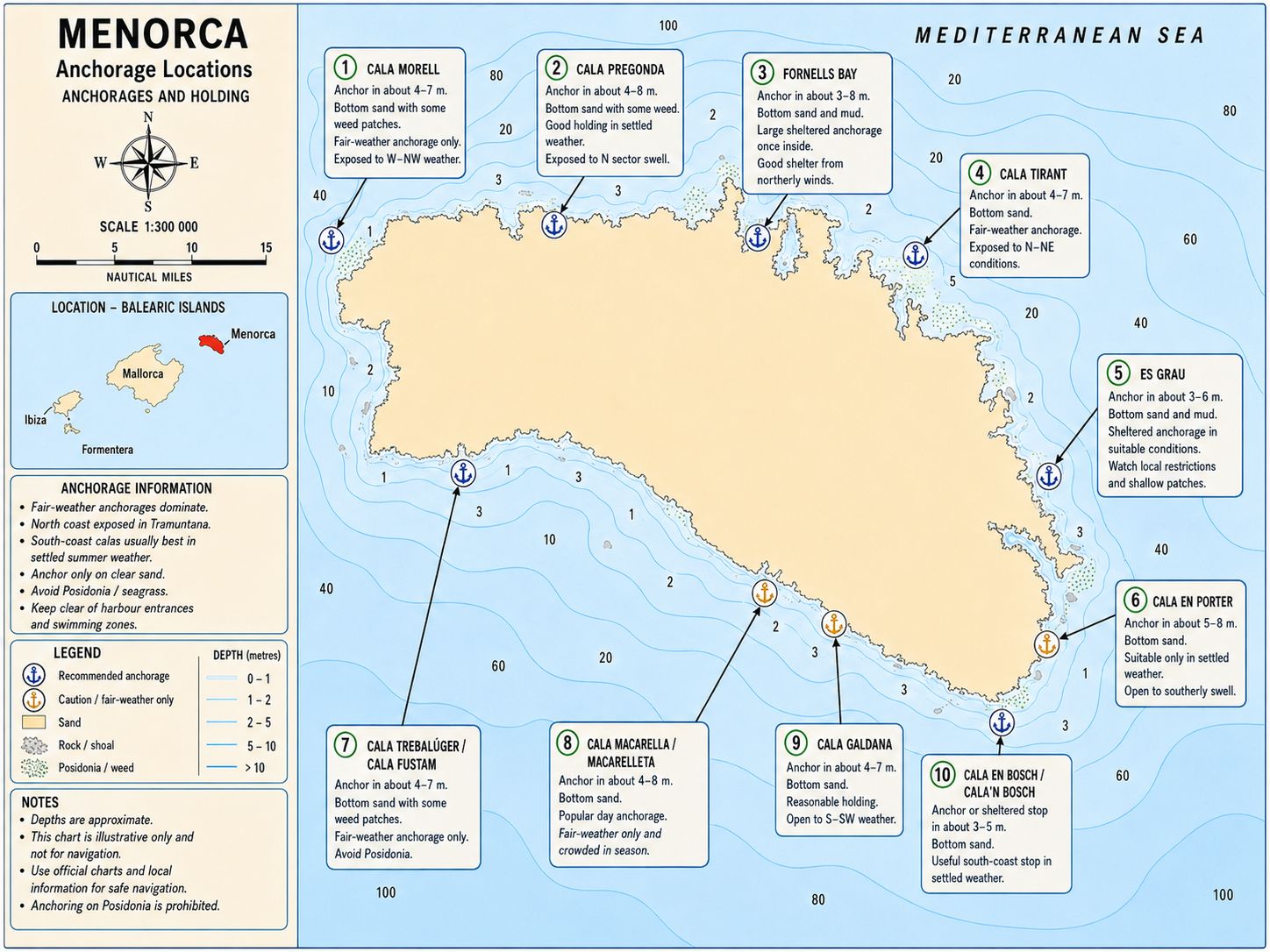
- Cala Morell. North-west anchorage. Anchor in about 4–7 m over sand with weed patches. Fair-weather only. Exposed to W–NW and N weather and not suitable in Tramuntana or Mestral.
- Cala Pregonda. North coast anchorage. Anchor in about 4–8 m over sand with some weed. Holding is good in clean sand. Exposed to N sector swell and should be used only in settled conditions.
- Fornells Bay. Large north-coast natural harbour anchorage and mooring area. Anchor or take moorings in about 3–8 m, with sand and mud in parts. Good shelter once inside, but the outer approach is affected by northerly weather. Check local restrictions and buoy/mooring areas.
- Cala Tirant. North coast west of Fornells. Anchor in about 4–7 m over sand. Fair-weather anchorage only. Exposed to N–NE conditions and uncomfortable in swell.
- Es Grau. East-north-east anchorage near the Albufera des Grau. Anchor in about 3–6 m over sand and mud, with shallow areas and protected zones nearby. Suitable only with local conditions checked and anchoring restrictions observed.
- Cala en Porter. South-east anchorage. Anchor in about 5–8 m over sand where clear patches are available. Suitable in settled weather, but open to southerly swell and subject to beach traffic and swimming areas.
- Cala Trebalúger/Cala Fustam. South coast anchorage area. Anchor in about 4–7 m over sand with weed patches. Fair-weather stop only. Avoid Posidonia and expect exposure to southerly weather.
- Cala Macarella/Macarelleta. South coast anchorage. Anchor in about 4–8 m over sand, with weed patches to avoid. Good in settled northerly or offshore conditions, but crowded in season and open to southerly swell.
- Cala Galdana. South coast bay. Anchor in about 4–7 m over sand. Reasonable holding in sand, but the bay is open to S–SW weather and can be crowded with local craft and beach activity.
- Cala en Bosch/Cala’n Bosch approaches. South-west harbour and anchorage area. Anchor outside only in settled weather in about 3–5 m over sand, clear of harbour traffic and swim zones. The marina itself is restricted by canal draft and bridge clearance.
Menorca Balearics
Sailing Guide - Entry Formalities
Spain and the Balearic Islands are within the Schengen Area and the EU customs territory, so yachts arriving from another Spanish or Schengen/EU port normally do not complete full border clearance again. Yachts arriving from a non-Schengen port must clear through an authorised port of entry, for practical yacht clearance, the main Balearic entry ports include Palma, Alcudia, Ibiza, Mahon and La Savina. The usual formalities include crew passports handled by the Frontier Police and vessel/customs formalities handled through the appropriate Spanish authorities. Since 10 April 2026, the EU Entry/Exit System records non-EU short-stay entries and exits electronically rather than by passport stamping. Non-EU visitors remain subject to Schengen short-stay limits, normally 90 days in any 180-day period, unless they hold a visa or residence status allowing longer stay. Non-EU flagged yachts may also need to consider Temporary Admission rules for EU waters, commonly allowing private non-EU yachts used by non-EU residents to remain in EU customs territory for up to 18 months without VAT/import duty being due, provided the conditions are met.
Communications equipment normally used on cruising yachts does not require harbour-specific clearance, but drone use is regulated under Spanish and EU UAS rules. AESA states that drone operators must register in the member state of residence or activity and that the operator registration number must be included on the operator’s drones. Starlink use should be checked against the service plan and local availability; Starlink states that in-motion use in territorial waters requires local government approval and may not be available in all regions.
Menorca Balearics
Sailing Guide - Menorca Ports
and Harbours
The principal yacht harbour on Menorca is Port de Maó/Mahón, the island’s main deep-water port and marine-service centre. On the west coast, Ciutadella is the main passage port for yachts arriving from or departing toward Mallorca, but its confined harbour and west-facing exposure require separate pilotage notes. The north coast has two important harbour options: Fornells, a broad natural inlet with shelter once entered, and Addaia/Port d’Addaia, a more intricate north-east inlet where the approach, buoyage and local depth constraints need specific treatment. On the south-west coast, Cala en Bosch/Cala’n Bosch is a marina option only for shallow-draft craft due to its canal and bridge limits. Within the Maó harbour system, Es Castell/Cales Fonts provides sheltered berthing and shore access but should be read alongside the main Port de Maó guide because all arrivals use the same harbour approach.
Menorca Balearics
Sailing Guide - Marina Facilities
Port de Maó/Mahón is the main marina and technical-service centre. Marina Port Mahón lists 165 berths for boats up to 55 m, with a fuel station, toilets, showers, changing rooms, laundry, waste collection, restaurant, bar and nearby sailmaker, technicians. Marina Menorca, at the head of the inlet, is listed with 230 berths, visitor berths, max 15 m LOA, max 2 m draft, 220 V power, water, security, showers, maintenance services and a 35-ton travel lift. Es Castell/Cales Fonts provides additional berthing inside the Maó harbour system, but it should be treated as part of the harbour network rather than a separate refuge from the same weather system.
Ciutadella is the main west-coast port and is useful for west-coast cruising and Mallorca passages. Fornells is the main north-coast harbour refuge; listings give about 115 boats, up to 12 m and 3 m draft, with water, electricity, toilets, showers. In 2025, PortsIB delivered new Fornells pontoons to five concession companies managing close to 300 moorings, with associated Posidonia restoration works reported. Cala en Bosch has 276 berths, but its 1.50 m canal draft and 6.80 m bridge clearance make it mainly a motorboat and small-craft marina rather than a general sailing-yacht harbour.
Menorca Balearics
Sailing Guide - Provisioning
Supermarkets. The main provisioning centres are Maó, Ciutadella, Alaior, Es Mercadal, Sant Lluís and the resort areas. Major supermarket names on the island include Mercadona, Lidl, EROSKI, Hiper Centro, Binipreu, Suma, Spar and smaller local supermarkets. Mercadona’s lists stores at Ciutadella de Menorca, Ctra. Ciutadella a Maó, S/N and Maó, Avda. Europa, with hours shown as 09:00–21:30. Large stores in Maó and Ciutadella are the practical choice for full yacht provisioning. Most standard shops open roughly 09:00–13:30 and 16:30/17:00–20:30, while larger resort and town supermarkets may stay open all day in summer. For a berth in Maó, provisioning by taxi or delivery is practical. For Ciutadella, the town stores and market can support normal crew supplies. Fornells, Addaia and south-coast anchorages have limited provisioning compared with Maó or Ciutadella, so water, fuel, dry stores and fresh food should be loaded before moving to the north or south coast.
Markets. Maó and Ciutadella are the most useful market centres for yacht provisioning AgroMaó Farmers Market in Maó on Carrer Nou and Carrer s’Arravaleta, every Sunday 09:00–14:00, and the Mercat Agrari de Ciutadella at Plaça de la Llibertat fish market area, every Wednesday and Saturday 08:00–14:00. Maó’s AgroMaó local and ecological food market on Sundays 09:00–14:00. Markets sell fruit, vegetables, bread, cheese, cured meats, local farm products and seasonal produce. Maó and Ciutadella markets are more practical for provisioning than resort craft markets. Summer night markets in Es Mercadal, Fornells and Ciutadella may have local food products, but they should be treated as supplementary rather than primary yacht provisioning sources. For reliable food supply, use town markets in the morning and supermarkets for bulk items.
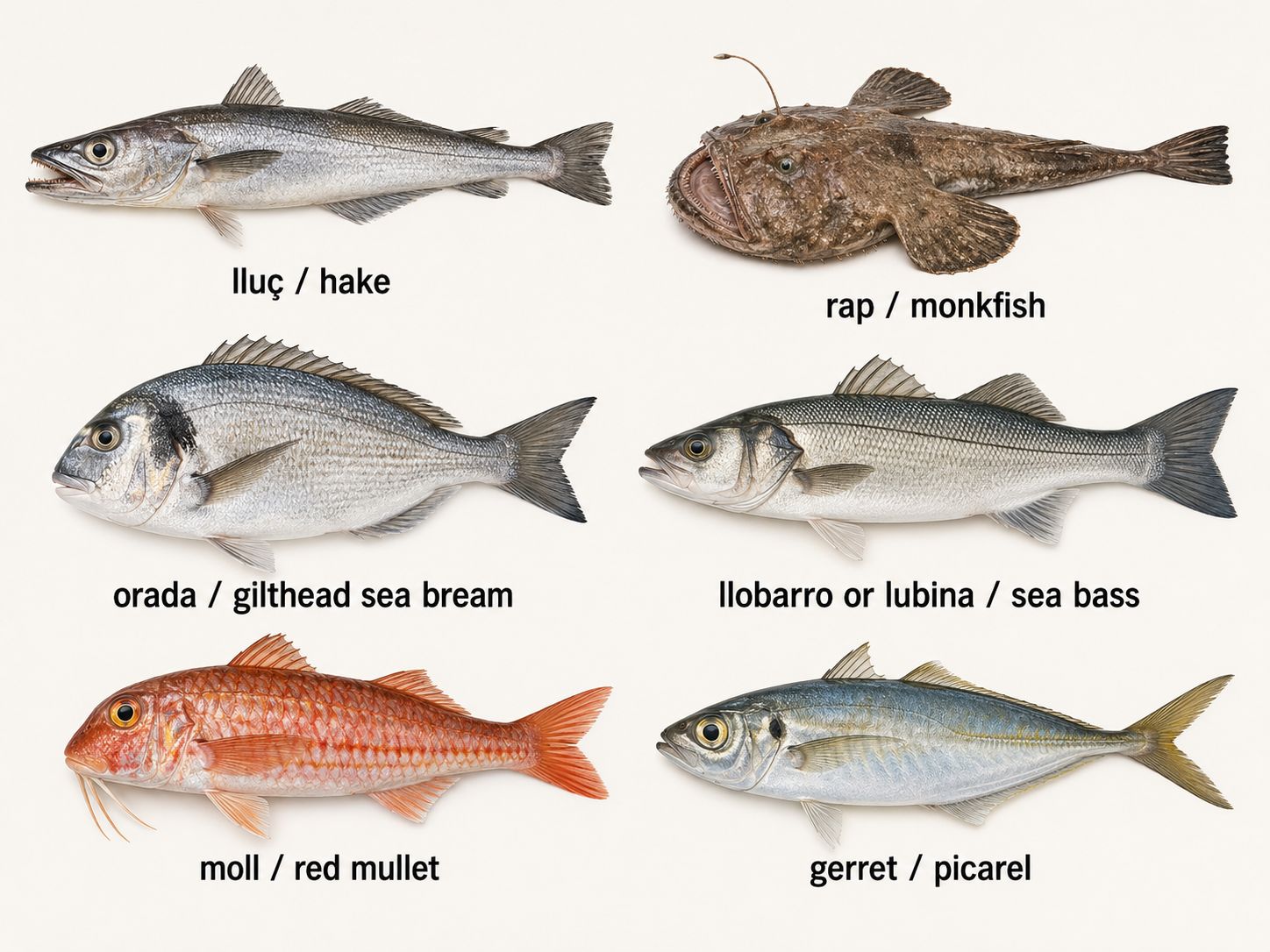
Fish Markets. The main fish markets are in Maó and Ciutadella. Mercat del Peix in Maó at Plaça d’Espanya, operating since 1927. Fish-market hours are generally morning-based; and fish markets in Maó and Ciutadella are normally open 08:00–13:30, except Sunday and Monday or when weather prevents boats from fishing. Useful fish and seafood names include llagosta for lobster, used in caldereta de langosta; gamba roja for red prawn; dorada for gilt-head bream; lubina for sea bass; moll for red mullet; calamar for squid; sepia for cuttlefish; pulpo for octopus; rape for monkfish; and raor for pearly razorfish when legally available in season.
Menorca Balearics
Sailing Guide - Local Cuisine
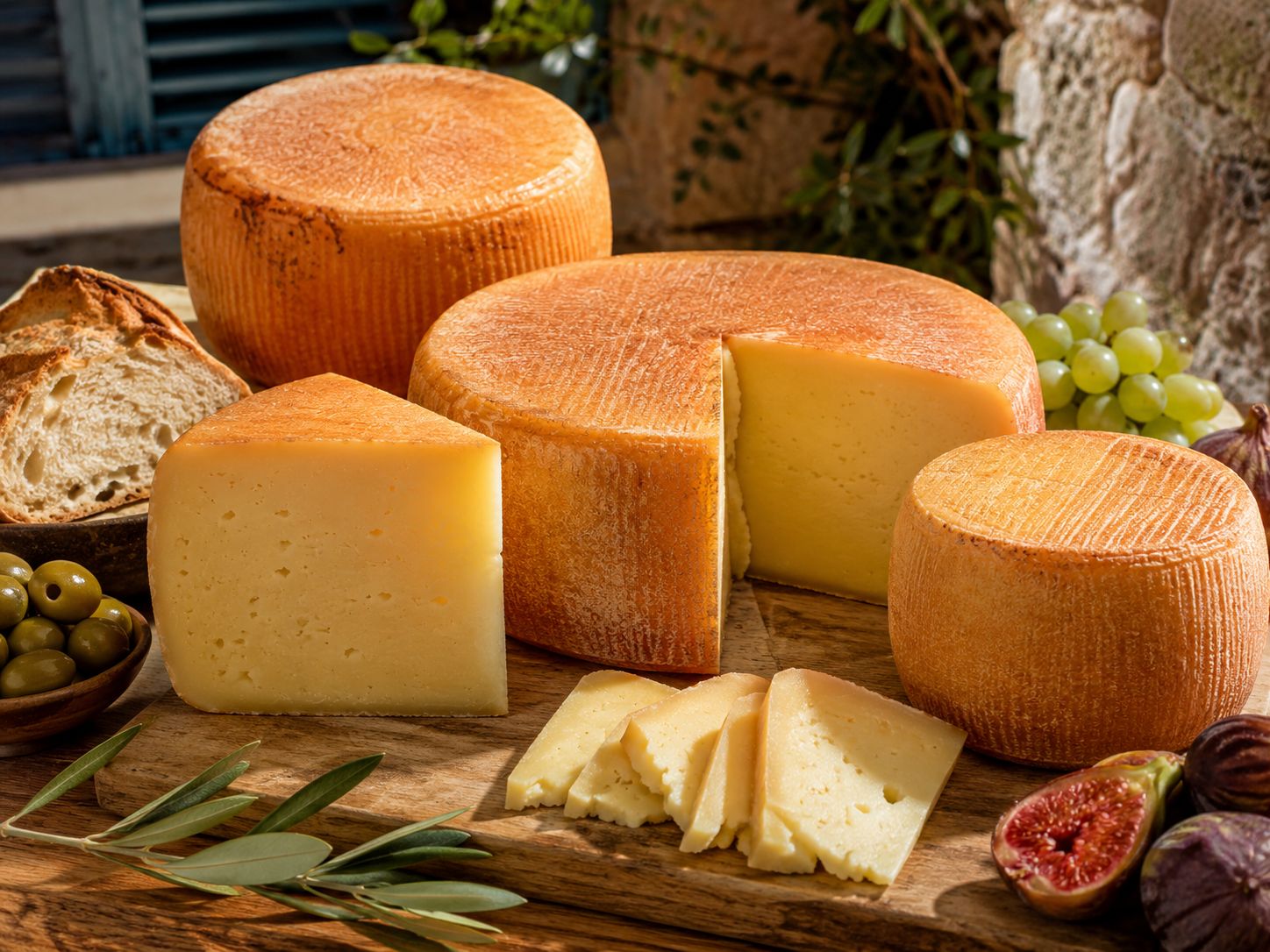
Menorca’s local cuisine is based on seafood, farm produce, cheese, cured meats, bread, vegetables and British-influenced island traditions. The main maritime dish is caldereta de langosta, a lobster stew strongly associated with Fornells and the north coast. Other practical crew dishes include grilled fish, arròs de la terra, oliaigua, formatjades, sobrassada, carn i xua, and flaó. Menorca is also known for Mahón-Menorca cheese, a protected island cheese made from cow’s milk, and food references consistently identify Mahón cheese and caldereta de langosta as key island dishes.
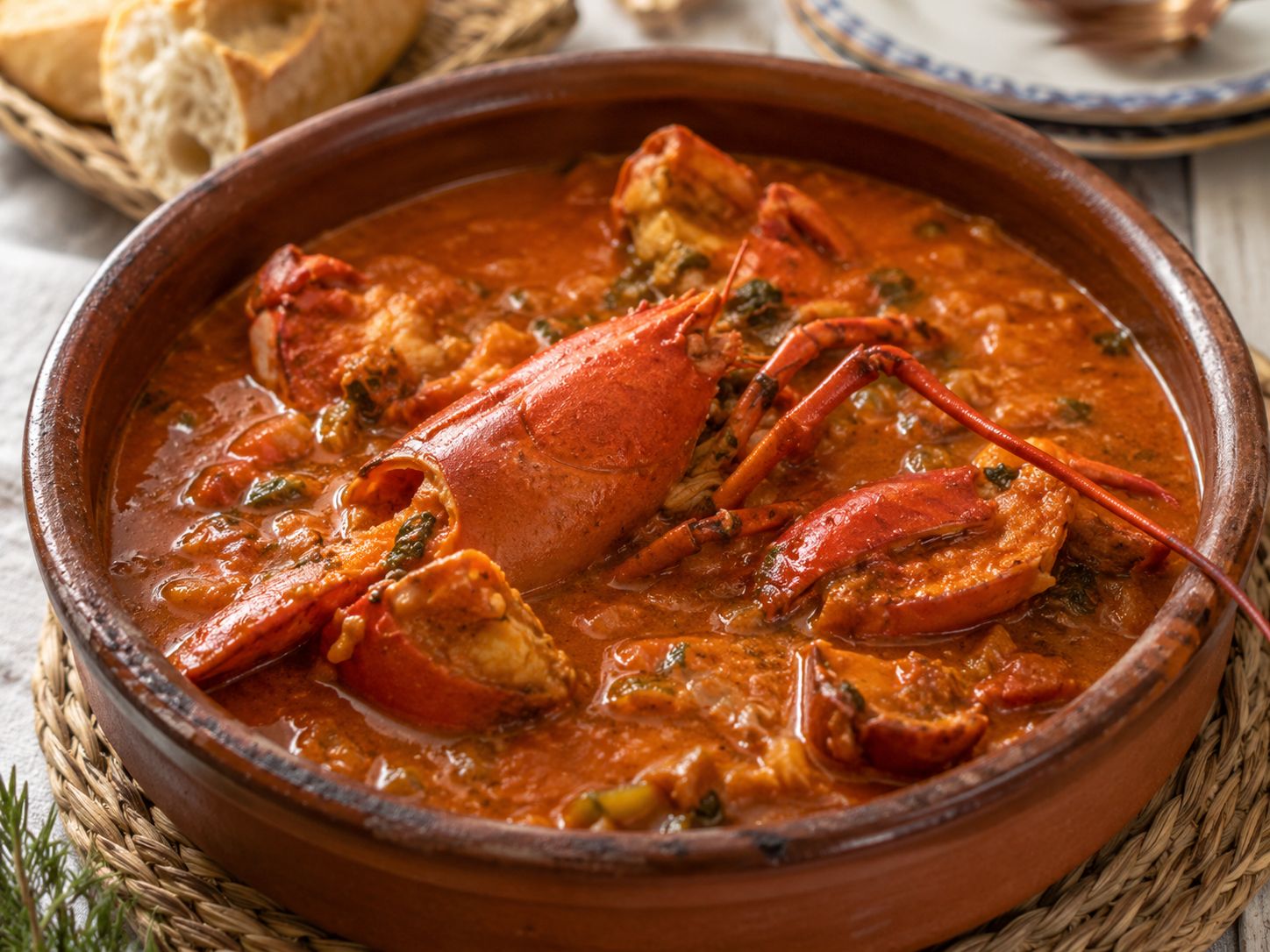
For galley provisioning, useful local products include Mahón-Menorca cheese, sobrassada, local sausages, seasonal vegetables, tomatoes, peppers, potatoes, almonds, honey, bread and seafood. North-coast restaurants and suppliers are linked to lobster and fish, but skippers should not assume lobster supply without reservation or confirmation. In Maó and Ciutadella, markets and fishmongers give the best access to local produce and fish before moving to anchorages.
Menorca Balearics
Sailing Guide - Local Beverages
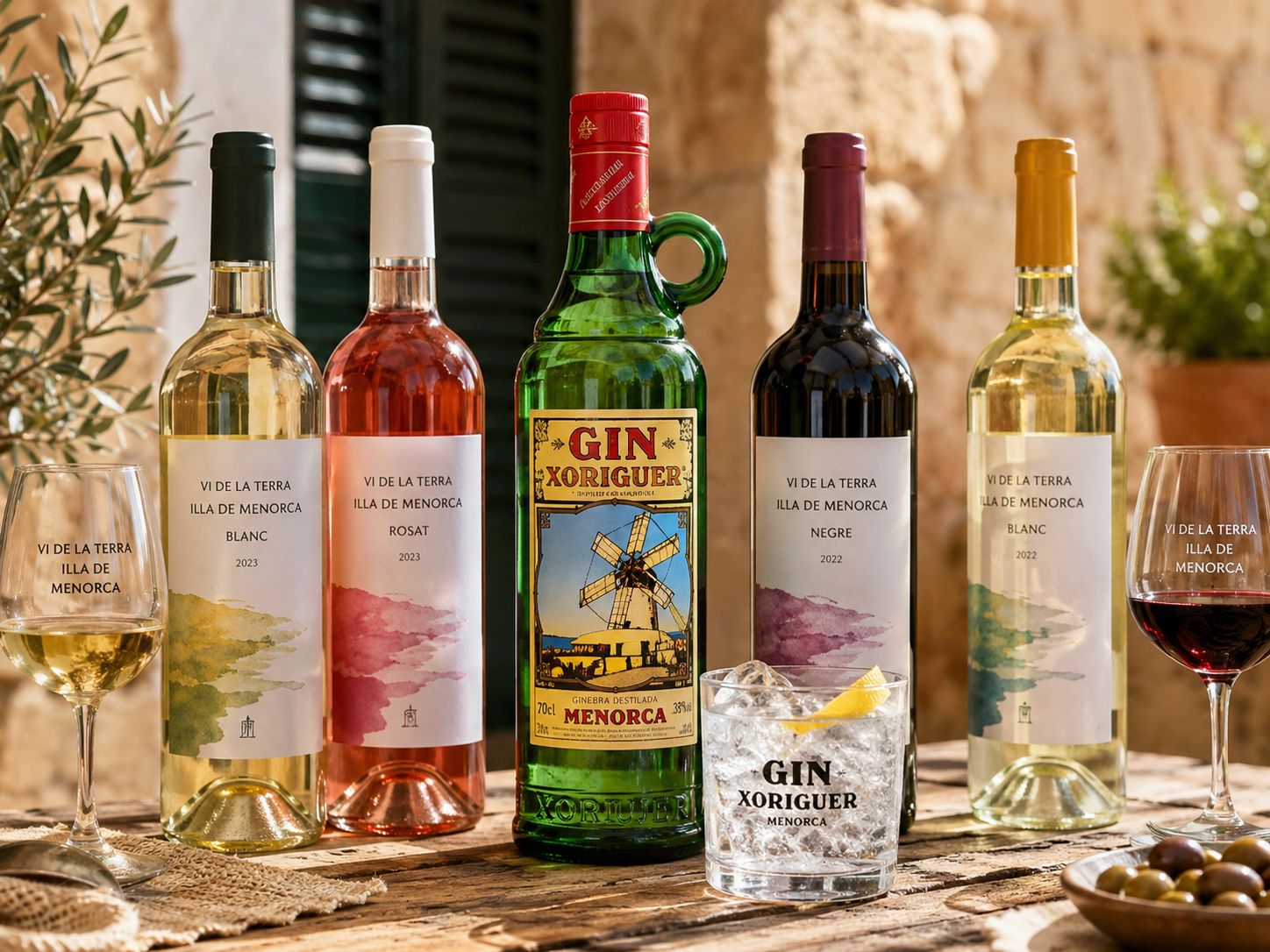
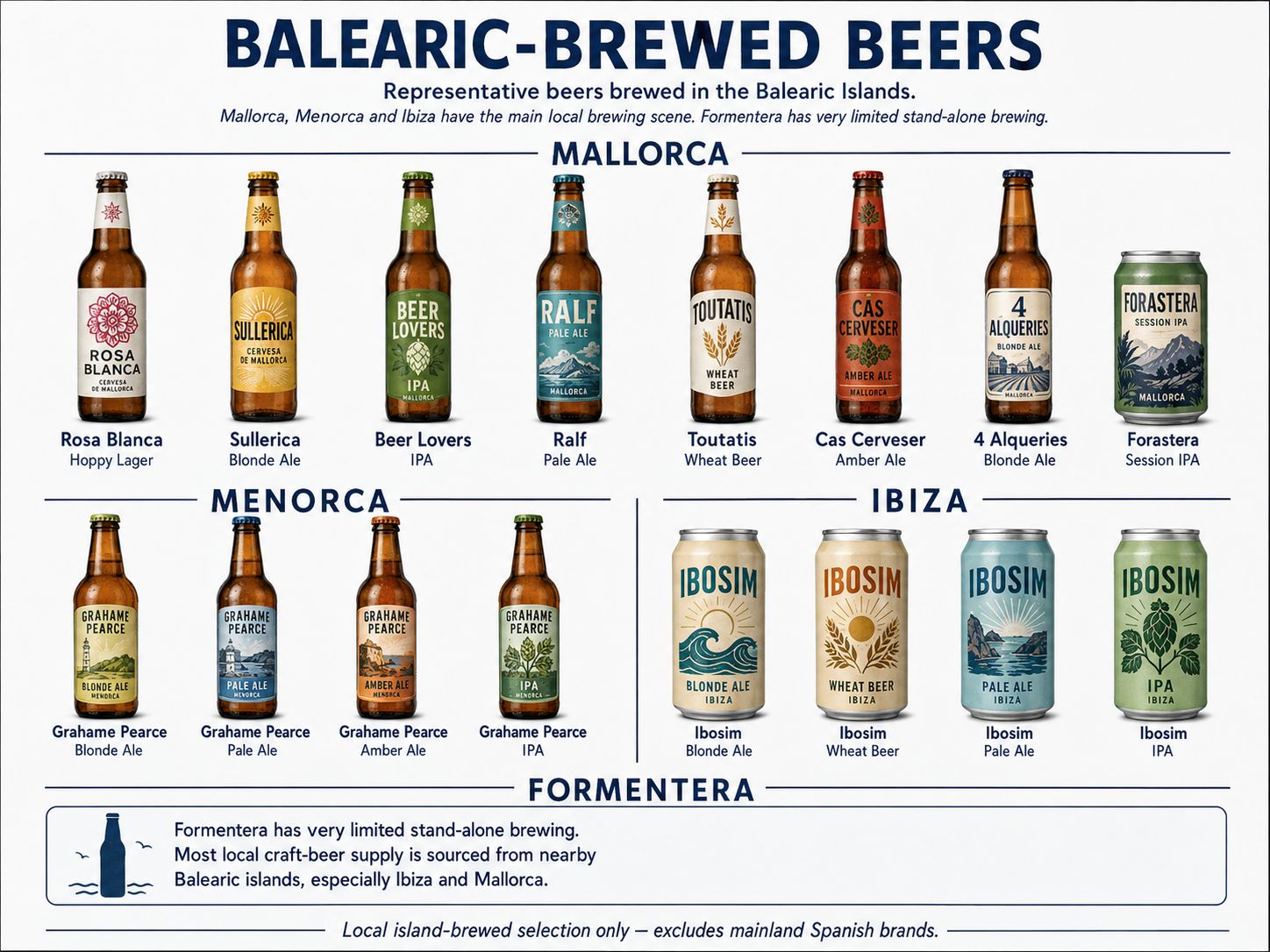
The principal local spirit is Gin Xoriguer, the Menorcan gin associated with Maó and the island’s British naval history. The common local mixed drink is pomada, made with Menorcan gin and lemonade. Local wine is produced on the island under the Vi de la Terra Illa de Menorca designation, and local beers and soft drinks are available through supermarkets and bars. Menorca guides consistently list Xoriguer Mahón gin, island wine, Mahón cheese and caldereta among the island’s defining food and drink products.
The Local Beers are Very Acceptable
Menorca Balearics
Sailing Guide - Diesel Fuel
Supplies
Diesel is available at the main harbour centres, especially Port de Maó, Ciutadella, Fornells and other marina facilities where fuel is listed. Marina Port Mahón lists a fuel station among its facilities. Fornells marina also lists harbour services, though skippers should confirm fuel availability directly because north-coast services can be smaller and seasonal. Diesel quality should be treated as standard Spanish marina diesel.
Menorca Balearics
Sailing Guide - Water Supplies
Potable water is available at serviced berths in the main marinas and PortsIB harbours. Marina Port Mahón and Marina Menorca list water at berth or marina services, and Fornells listings include drinking water among services. Water access is berth-based, so yachts at anchor should not assume they can come alongside without prior harbour instruction.
Mechanical and Electrical Repairs
Resource
If you are headed somewhere in the Mediterranean or Spain or somewhere more remote consider the need to expand your knowledge base or have an information resource on board. Why not get a copy of my book The Marine and Electrical and Electronics Bible 4th Edition. with everything from batteries and charging, solar and wind, diesel engines and marine electronics and so much more. Your complete systems guide. 650 pages of practical advice. In Australia and New Zealand order a copy through Boat Books. UK and European boats can buy the UK Edition Here. US and Canadian boats can get the US Edition Order Here. Marine systems are my profession so let me help you DIY and save some valuable technician callout rates. This is by a cruising yachtsman and liveaboard boat owner for other boat owners.


Menorca Balearics
Sailing Guide - Marine Services
Port de Maó is the principal
marine-service base. Marina Port Mahón lists nearby sailmakers, technicians as
well as waste collection, fuel, laundry and marina support. Marina Menorca
lists maintenance services and a 35-ton travel lift, making it useful for
smaller yachts requiring haul-out or service at the head of Maó harbour. Maó is
the first place to source mechanics, electricians, sail repairs, chandlery,
divers and marina logistics. Ciutadella and Fornells have
more limited service capacity. Fornells has water, electricity, toilets,
showers but complex yacht repair should be planned through Maó or a
pre-arranged mobile technician.
Menorca Balearics
Sailing Guide - Local Etiquette
Menorca’s local etiquette is practical and environmental. Keep wash down in Maó, Ciutadella, Fornells, Addaia and small calas. Do not obstruct ferry routes, commercial quays, harbour entrances, fuel berths, fishing quays, dinghy channels or mooring fields. In confined calas, allow proper swinging room and avoid anchoring over another boat’s chain. In Maó and Ciutadella, port traffic has priority and local harbour instructions should be followed without delay. Anchoring etiquette is also regulatory. Do not anchor on Posidonia, and do not allow chain to sweep across seagrass. Use ecological buoys where required and comply with patrol instructions. In crowded south-coast calas, dinghies should avoid swimming zones and approach shore only where permitted. Noise, generators and bright deck lights should be controlled in enclosed anchorages. Fishing boats and local small craft should be given room because they often operate on fixed local routes close to the shore.
Menorca Balearics
Sailing Guide - Summary
Menorca is a two-main-harbour cruising island, with Maó as the primary deep-water service base and Ciutadella as the principal west-coast port. Fornells and Addaia provide useful north-coast shelter in suitable conditions, while Cala en Bosch is restricted by shallow draft and low bridge clearance. The south coast is mainly an anchorage coast and should be used only with wind direction, swell, seabed and Posidonia restrictions checked. Passage planning around the island should be based on coast exposure, harbour spacing, forecast wind sector and the operational detail in this Menorca Balearics Sailing Guide for all you need to know.