Croatia
Mediterranean Sailing Guide
Croatia Mediterranean sailing guide. Croatia occupies the eastern arc of the Adriatic, extending from the Istrian peninsula southward through the Kvarner Gulf, the Dalmatian coast, and the deep island chains that define one of the most structured sailing environments in the Mediterranean. The coastline is long, indented, and highly sheltered, with predictable hydrography and a dense network of ports that support both short‑range island hopping and long‑range routing toward Italy, Slovenia, Montenegro, and Greece. Croatia’s maritime geography is shaped by steep offshore profiles, deep channels, and a complex arrangement of islands that create natural wind breaks, acceleration zones, and sheltered passages. This structure makes Croatia one of the most reliable and versatile sailing regions in the basin, with consistent navigation patterns and a high density of operational ports.
Croatia’s position along the eastern Adriatic makes it a central waypoint for yachts undertaking basin‑wide movements. The coastline supports a comprehensive port system, with clear approaches, defined harbour limits, and predictable formalities that streamline entry and onward routing. The region’s infrastructure is extensive, with marinas, fuel stations, and technical facilities distributed along both mainland and island sectors. Croatia’s maritime zone also provides a stable operational environment for yachts preparing for longer passages toward Italy or Montenegro, with consistent charting, reliable weather patterns, and a well‑developed provisioning network.
Croatia
Mediterranean Sailing Guide - Key
Ports
- Istria: Pula, Rovinj, Poreč, Umag (secondary: Savudrija, Novigrad, Vrsar, Medulin)
- Kvarner: Rijeka, Opatija, Krk, Cres, Mali Lošinj (secondary: Ilovik, Susak, Unije, Valun, Nerezine, Rab, Pag Town)
- North Dalmatia: Zadar, Šibenik (secondary: Nin, Kali, Biograd, Vodice, Primošten, Rogoznica)
- Central Dalmatia: Trogir, Split, Hvar, Vis (secondary: Marina, Stari Grad, Jelsa, Komiža, Kaštela, Makarska, Brač – Milna)
- South Dalmatia: Korčula, Dubrovnik, Cavtat (secondary: Trpanj, Orebić, Slano, Lastovo, Mljet – Pomena, Elaphiti Islands – Lopud, Šipan, Koločep)
Croatia – Offshore
Island Ports by Region
- Kvarner Gulf – Northern Offshore Islands. These islands extend the Kvarner routing corridor and form the northern offshore chain. Rab, Pag, Silba, Olib, Ist, Molat (all are offshore primary island nodes)
- North Dalmatia – Central Offshore Islands. This group forms the central Adriatic island chain and links Kvarner to the Kornati and Zadar–Šibenik sectors. Dugi Otok (Sali), Murter (Sali is the operational centre of Dugi Otok; Murter is the mainland‑linked island hub for the Kornati approaches)
- Central Dalmatia – Mid‑Adriatic Islands. These islands form the mid‑Adriatic routing spine between Split, Hvar and Vis. Brač (Milna, Bol), Šolta (Maslinica) (Milna and Bol are the two primary Brač nodes; Maslinica is the primary Šolta node)
- South Dalmatia – Outer Adriatic Islands. These are the true offshore nodes extending Croatia’s network toward Italy, Montenegro and the wider Mediterranean. Biševo, Palagruža (Biševo sits west of Vis; Palagruža is the most remote Croatian outpost and a major offshore routing marker)
Croatia
Mediterranean Sailing Guide - Navigation
Navigation along the Croatian coastline is shaped by island chains, narrow channels, steep offshore gradients in the south, mixed‑depth passages in the central islands and shallow shelves in the north. Southern Dalmatia offers deep approaches and predictable sea states, though strong southerlies can generate long‑fetch swell that affects harbour entrances. Central Dalmatia requires attention to confined channels, cross‑sea patterns between islands and ferry traffic. The Šibenik archipelago introduces river approaches, narrow channels and sheltered inland basins. Northern Dalmatia and Kvarner require awareness of bora‑driven northeasterlies and shallow gradients. Istria introduces long‑fetch southerlies and shallow approaches to several ports.
Commercial traffic density is high around Split, Zadar and Rijeka, requiring adherence to traffic separation schemes and awareness of ferry movements. Fishing vessels operate throughout the region, often with unlit gear or nets extending from small craft. Night navigation is supported by reliable light structures, though the combination of narrow channels, fishing activity and unlit small craft requires heightened vigilance. Many harbour entrances are narrow, with breakwaters extending into shallow water, requiring precise alignment and speed control during entry.
Croatia
Mediterranean Sailing Guide - Chart
Accuracy
Croatia benefits from modern and regularly updated hydrographic surveys, with harbour approaches, dredged channels, and coastal depths closely matching official data across both mainland and island waters. Official ENCs provide the most authoritative digital representation of surveyed depths and harbour layouts, while Navionics offers strong general accuracy but may show minor offsets in older marina basins or areas undergoing redevelopment, particularly along the Dalmatian coast. C‑Map behaves similarly, sometimes presenting more conservative depth shading in shallow approaches, while Garmin BlueChart typically aligns with Navionics but may lag in reflecting recent construction or harbour modifications. Satellite imagery remains the most reliable tool for identifying nearshore features, sediment patterns, and rocky shelves, particularly around the outer islands and exposed headlands. Cross‑checking electronic charts against visual references, depth trend logic, and updated notices ensures accurate pilotage when entering Croatian ports or navigating the surrounding coastline.
Croatia
Mediterranean Sailing Guide - Weather
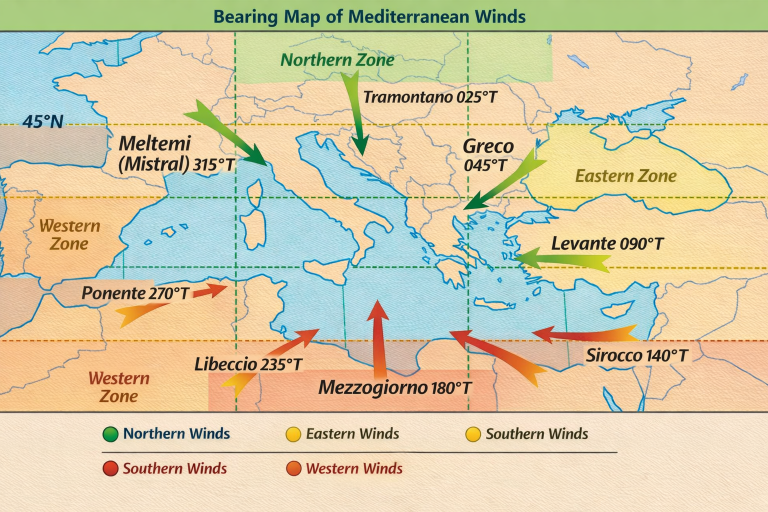
Weather along the Croatian coast is shaped by the broader patterns of the Adriatic, with seasonal variations that influence routing and sea state. The Bora, a strong northeasterly wind, can develop rapidly and produce steep seas, particularly in the Velebit Channel and the northern Adriatic. These events require conservative planning and careful monitoring of forecasts, as conditions can deteriorate quickly. The Sirocco, a warm southeasterly wind, brings longer‑period seas and reduced visibility, affecting approaches and anchoring conditions along the Dalmatian coast. Summer weather is generally stable, with predictable thermal breezes and light to moderate winds supporting reliable coastal movement. Localised effects around headlands, channels, and island gaps can influence wind strength and direction, requiring attention when routing between the islands or approaching exposed anchorages. Seasonal patterns are well‑defined, with summer offering the most predictable conditions and winter bringing more variable weather requiring cautious planning.
The Sirocco is a warm, humid southerly wind that originates over the Sahara and moves northward across the Mediterranean, carrying dust and reduced visibility into coastal regions. As it reaches Italy, Malta, Tunisia, and the central Mediterranean, it produces long‑fetch swell, rising humidity, and uncomfortable sea states that build ahead of approaching low‑pressure systems. Its strength and duration depend on the pressure gradient between North Africa and the central Mediterranean, with the most pronounced effects occurring when a deep low forms over the Gulf of Genoa or the Adriatic.
The Bora is a cold, dense northeasterly wind that descends abruptly from the Dinaric Alps toward the Adriatic, producing violent gusts and rapid sea‑state changes. Its katabatic nature creates extreme acceleration zones at gaps and valleys, especially around Trieste, Senj and the Velebit Channel, where gusts can exceed storm force with little warning. The Bora is most common in winter but can occur year‑round, defined by sharp pressure gradients and the rapid onset that makes it one of the Adriatic’s most operationally significant winds.
The Marine Electrical and Electronics Bible has a complete list of VHF Radio Channel information and weather forecast times along with NAVTEX UK and Europe and NAVTEX Mediterranean for 490kHz and 518kHz.
Croatia
Mediterranean Sailing Guide - Entry
Formalities
Croatia is part of the Schengen area, requiring yachts arriving from outside Schengen to complete immigration and customs procedures at designated ports of entry. Once formalities are completed, movement within Schengen is straightforward, with no additional immigration checks when continuing to Slovenia, Italy, or Montenegro. Clearance procedures are consistent and well‑defined, with harbourmaster, immigration, and customs offices typically located within the same port complex. Reporting requirements for equipment such as satellite communications systems may apply depending on the vessel’s configuration and intended movements, and yachts must ensure compliance with local regulations regarding radio equipment and safety gear when operating along the Croatian coastline.
Croatia
Mediterranean Sailing Guide - Provisioning
Provisioning in Croatia is reliable and comprehensive, with widespread access to supermarkets, markets, fuel stations, and marine services. Major ports such as Pula, Zadar, Šibenik, Split, and Dubrovnik offer extensive technical support, while smaller towns provide adequate supplies for routine needs. Fuel quality is consistent across the region, and spare parts are readily available in larger centres. Island provisioning varies by location, with the larger islands offering strong networks, while smaller islands may require planning for seasonal availability. The density of provisioning points along both mainland and island sectors makes Croatia one of the most dependable resupply regions in the Adriatic, supporting both short‑range coastal movements and longer offshore passages.
Croatia
Mediterranean Sailing Guide - Cuisine
Seafood dishes are central along the coast, including brancin (sea bass), orada (gilt‑head bream), lignje (squid), hobotnica (octopus) and srdele (sardines), typically grilled with olive oil, garlic and herbs. Brodet is a slow‑cooked fish stew using mixed Adriatic fish, tomato, wine and bay leaf, served with polenta and widely available in Dalmatian ports. Pašticada is a long‑marinated beef dish cooked with wine, prunes and vegetables, served with gnocchi and common in Split and surrounding regions. Peka uses lamb, veal or octopus cooked under a metal dome with potatoes, olive oil and herbs, producing a slow‑roasted, steam‑braised dish. Pršut (air‑dried ham) and paški sir (Pag island sheep’s cheese) are key provisioning items found in markets and coastal shops. Black risotto (crni rižot) uses cuttlefish, ink, garlic and wine, common in Istria and Dalmatia. Desserts include rožata (caramel custard), kroštule (fried pastry) and fritule (small dough balls with citrus and raisins).
Mechanical and Electrical Repairs
Resource
If you are headed somewhere remote consider the need to expand your knowledge base or have an information resource on board. Why not get a copy of my book The Marine and Electrical and Electronics Bible 4th Edition. By and for yachties, with everything from batteries and charging, solar and wind, diesel engines and marine electronics and so much more. Your complete systems guide. 650 pages of practical advice. In Australia and New Zealand order a copy through Boat Books. UK and European boats can buy the UK Edition Here. US and Canadian boats can get the US Edition Order Here. Marine systems are my profession so let me help you. By a liveaboard boat owner for other boat owners.



Croatia
Mediterranean Sailing Guide - Summary
Croatia provides a structured and highly reliable sailing environment, with straightforward navigation, accurate charting, predictable formalities, and strong provisioning. Its mainland and island ports form a dense operational network that supports both local cruising and basin‑wide routing, making Croatia one of the most important sailing regions in the Mediterranean. Croatia Mediterranean Sailing Guide for all you need to know.