Dubrovnik Sailing Guide
Dubrovnik sailing guide. Dubrovnik is a controlled harbour environment on the southern Dalmatian coast with defined approaches, predictable depths and established port infrastructure. The port functions as a southern Adriatic operational node for vessels transiting between central Croatia and Montenegro, with formalities, provisioning and marine services concentrated in the Gruž district and the upriver marina complex. The surrounding islands provide staging points for arrivals from the north and west, while the coastal corridor from Montenegro offers a direct approach with minimal navigational complexity.
The harbour area includes commercial, ferry and private‑vessel movements that require continuous situational awareness. Harbour structures, river access and marina basins are charted with consistent accuracy, and the port supports year‑round operations with defined procedures for entry, berthing and services. Dubrovnik’s position makes it a consolidation point before northbound coastal routing or offshore passages toward Italy.
Dubrovnik Sailing Guide
– Useful Information
Dubrovnik developed as the Republic of Ragusa, a maritime city‑state operating from the medieval period until the early nineteenth century with a trading network across the Adriatic and eastern Mediterranean. The Old Town’s fortifications, gates and harbour structures form a continuous historical complex recognised as a UNESCO World Heritage Site. The city’s walls, forts and streets were used extensively as filming locations for the television series Game of Thrones, where they represented the fictional city of King’s Landing. The protected‑heritage status restricts structural modification, commercial activity within designated zones and the handling of archaeological material.
Dubrovnik Sailing Guide - Approaches
Approaches to Dubrovnik are made through deep water with soundings generally above 20 m until close to the shoreline. Vessels arriving from the north typically route through the Koločep Channel, maintaining separation from ferry lanes and monitoring cross‑traffic from the Elaphiti Islands. The channel can experience wind acceleration under N–NE flows, producing short‑period seas requiring controlled speed and heading adjustments. Approaches from the south follow a coastal track from the Montenegro border with consistent depths and minimal hazards, though localised gusts can descend from the hinterland during frontal activity.
Tidal range is minimal, but local currents can form near headlands during strong wind events, particularly under SE Jugo conditions. Swell from the S–SW can wrap into exposed bays but does not generally affect the main harbour entrance. Night approaches are viable with established leading marks and lit structures, though ferry movements require continuous monitoring. The river entrance to the marina complex has depths of approximately 4–5 m and is navigable in all normal conditions.
Dubrovnik Sailing Guide
- Navigation
Navigation within the Dubrovnik sector requires attention to ferry routes, cruise‑ship manoeuvres and local traffic entering and exiting the Koločep Channel. The approach lanes are well defined, and buoyage is maintained to Croatian standards. Crosswinds can affect final alignment when entering the river, particularly under NE Bora or local katabatic flows. Manoeuvring space within the marina basins is adequate but can tighten during peak occupancy, requiring controlled propulsion and awareness of wind effects on bow and stern.
The commercial port at Gruž generates predictable traffic patterns, and AIS density is high. Vessels should maintain conservative speeds and avoid crossing ferry tracks at shallow angles. The river bend before the marina requires a steady approach with minimal drift, and turning circles are constrained by moored vessels and infrastructure.
Dubrovnik Sailing Guide
- Chart Accuracy
Croatian Hydrographic Office charts for Dubrovnik are accurate, with reliable soundings, breakwater positions and buoyage. Electronic charts align closely with paper references, and no significant datum discrepancies are noted in the main approaches or marina entrance. Harbour structures, dredged areas and river depths match charted information. Sedimentation in the river is minimal and does not materially affect access for vessels drawing up to 3 m. Electronic chart users should verify updates for ferry‑lane adjustments and port‑authority notices.
Dubrovnik Sailing Guide
- Anchorage
Anchoring directly off Dubrovnik is restricted due to traffic density, seabed protection zones and commercial operations. The most practical anchorages for staging are located within the Elaphiti Islands, including Uvala Tiha on Šipan and the bays of Lopud. Depths range from 8–20 m with sand and mud holding. These anchorages provide shelter from N–NE winds but can experience swell under S–SW conditions. Anchorage restrictions apply near protected seabeds, and vessels must avoid obstructing ferry approaches.
Dubrovnik Sailing Guide
- Entry Formalities
Dubrovnik is an authorised port of entry with customs, immigration and harbour authority offices located at the Gruž facility. Required documentation includes vessel registration, insurance, crew list and passports. The Croatian vignette system applies, and harbour authorities may inspect safety equipment. There are no specific restrictions on communications equipment such as Starlink, though devices must comply with national telecommunications regulations. Firearms must be declared. Drones are subject to Croatian aviation rules and may require registration.
Dubrovnik Sailing Guide
- Marina Facilities
ACI Marina Dubrovnik is located upriver on the Ombla and provides sheltered berthing with depths of 3–5 m at the pontoons. Access is via a straight river entrance with adequate width for controlled manoeuvring. The marina offers water and power on all berths, fuel dispensing at the dedicated dock, and mechanical, electrical and rigging services. A hardstand and travel lift support haul‑out operations, and the on‑site chandlery carries standard Adriatic inventory. The marina remains operational in all weather conditions due to its sheltered position, and turning space is sufficient for yachts up to the upper size limits of the facility.
Dubrovnik Sailing Guide
- Local Weather
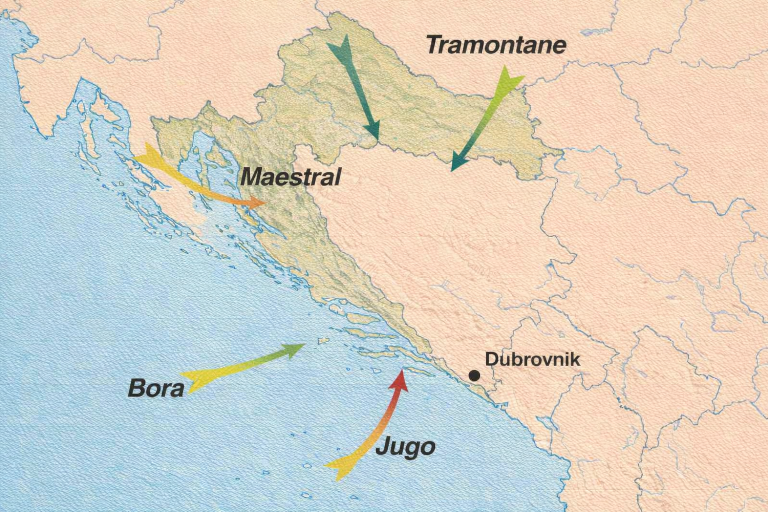
The Dubrovnik sector experiences NW–W sea breezes during summer with predictable afternoon strengthening. NE Bora events can produce strong gusts and steep seas, particularly near exposed headlands. SE Jugo brings long‑period swell and reduced visibility. Local Katabatic winds in the Dubrovnik region occur when cooled night air drains downslope from the inland hills toward the coast. They develop under clear‑sky conditions and produce short, concentrated offshore gusts that can affect approaches and river‑entrance manoeuvring. These winds are localised, brief, and strongest in the late‑night to early‑morning period. Seasonal patterns are consistent with the wider southern Adriatic.
SE Jugo is a southeast wind in the Adriatic generated by low‑pressure systems over the central or southern Mediterranean. It produces long‑period swell, reduced visibility, and persistent humid conditions. It builds gradually, often over 12–36 hours, and can reach strong sustained speeds during established low‑pressure phases. The Jugo drives S–SE swell into exposed coasts and anchorages and affects harbour manoeuvring due to its steady directional flow.
The Tramontane is a northerly to north‑westerly wind that forms under high‑pressure influence over central Europe and flows southward across the Adriatic toward the Dubrovnik sector. It produces clear air, stable visibility and short‑period seas aligned to its axis, with gusts exceeding the mean wind where terrain channels the flow between coastal ridges. Its influence extends offshore along the southern Adriatic, shaping routing decisions between Dubrovnik, the Pelješac channel, the Mljet approaches and northbound coastal tracks.
The Bora is a northeasterly wind that forms when dense continental air descends from the Dinaric Alps toward the Adriatic, accelerating through gaps and valleys before reaching the Dubrovnik sector. It produces downslope flow with rapid gusting and short‑period seas aligned to its axis, with gusts exceeding the mean wind where terrain funnels the outflow. Its influence extends offshore along the southern Adriatic, shaping routing decisions between Dubrovnik, the Pelješac channel, the Mljet approaches and southbound tracks toward Montenegro.
The Maestral is a north‑westerly wind that develops as a diurnal sea‑breeze circulation under stable pressure patterns and moves down the Adriatic toward the Dubrovnik sector. It produces consistent daytime flow with predictable timing and short‑period seas aligned to its axis, with local acceleration where coastal orientation channels the breeze. Its influence extends offshore along the southern Adriatic, shaping afternoon routing decisions between Dubrovnik, the Elaphiti Islands, the Mljet approaches and northbound coastal tracks.
The Marine Electrical and Electronics Bible has a complete list of Croatian VHF Radio Channel information and weather forecast times for Croatia along with NAVTEX Mediterranean for 490kHz and 518kHz.
Dubrovnik Sailing Guide
- Provisioning
Supermarkets. Dubrovnik is served by Konzum in the Gruž district near the harbour area., Lidl, Tommy, Studenac Market, Pemo, and Ribola, with branches concentrated in the Gruž district and additional units across Lapad and the Old Town periphery.
Markets. Gruž Market is the main municipal market in the harbour district. Lapad Market is a smaller municipal market in the Lapad area.
Fish Markets. Gruž Fish Hall is the municipal fish market in the harbour district. Direct‑from‑boat seafood sales occur along the Gruž quay in early morning.
Dubrovnik Sailing Guide
- Local Cuisine
Black risotto (crni rižot) uses cuttlefish, ink and rice. Fish stew (brodet) combines mixed Adriatic fish with tomato and wine. Grilled fish (riba na žaru) includes bream, bass, sardines and mackerel. Stewed beef (pašticada) uses long‑marinated beef cooked with wine and dried fruit. Octopus salad (salata od hobotnice) uses cooked octopus with onion, parsley, oil and vinegar. Cuttlefish with broad beans (sipice s bobom) is common in the region. Green pasta with seafood (zelene makarule) uses handmade pasta with shellfish or cuttlefish. Caramel custard (rožata) is a regional dessert.
Dubrovnik Sailing Guide
- Fuel Supplies
Fuel is dispensed at the ACI Marina Dubrovnik fuel dock with depths of 3–4 m. Diesel and petrol are available. Access is straightforward, though queues can form during peak periods.
Dubrovnik Sailing Guide
- Water Supplies
Potable water is available on all marina berths with stable pressure. Supply is reliable year‑round.
Mechanical and Electrical Repairs
Resource
If you are headed somewhere remote consider the need to expand your knowledge base or have an information resource on board. Why not get a copy of my book The Marine and Electrical and Electronics Bible 4th Edition. By and for yachties, with everything from batteries and charging, solar and wind, diesel engines and marine electronics and so much more. Your complete systems guide. 650 pages of practical advice. In Australia and New Zealand order a copy through Boat Books. UK and European boats can buy the UK Edition Here. US and Canadian boats can get the US Edition Order Here. Marine systems are my profession so let me help you. By a liveaboard boat owner for other boat owners.



Dubrovnik Sailing Guide
- Marine Services
Mechanical, electrical and rigging services are available at ACI Marina Dubrovnik. Local shipyards in Gruž provide hull, paint and metalwork. Chandlery services are located within the marina. Diver services are available for hull cleaning and inspections. Electronics technicians operate through the marina office. Volvo and Yanmar support is available through regional service agents.
Dubrovnik Sailing Guide
- Local Customs
Greetings are direct and use simple verbal acknowledgement when entering shops or speaking with officials. Modest dress is expected in residential districts, religious sites and government buildings. Photography of government facilities and security areas is restricted. Alcohol consumption is regulated in public spaces, and open containers are not permitted in municipal zones. Interaction with elders and officials follows formal address conventions. There are no indigenous peoples in the Dubrovnik region whose customs affect crew interaction.
Dubrovnik Sailing Guide
- Summary
Dubrovnik is a controlled southern Adriatic port with reliable approaches, sheltered berthing and full provisioning and service coverage. The marina complex upriver provides stable conditions in all weather. Formalities are centralised at Gruž with predictable procedures. The port functions as a consolidation point for northbound coastal routing or cross‑border movements to Montenegro. Dubrovnik Sailing Guide for all you need to know.