Split Croatia Sailing Guide
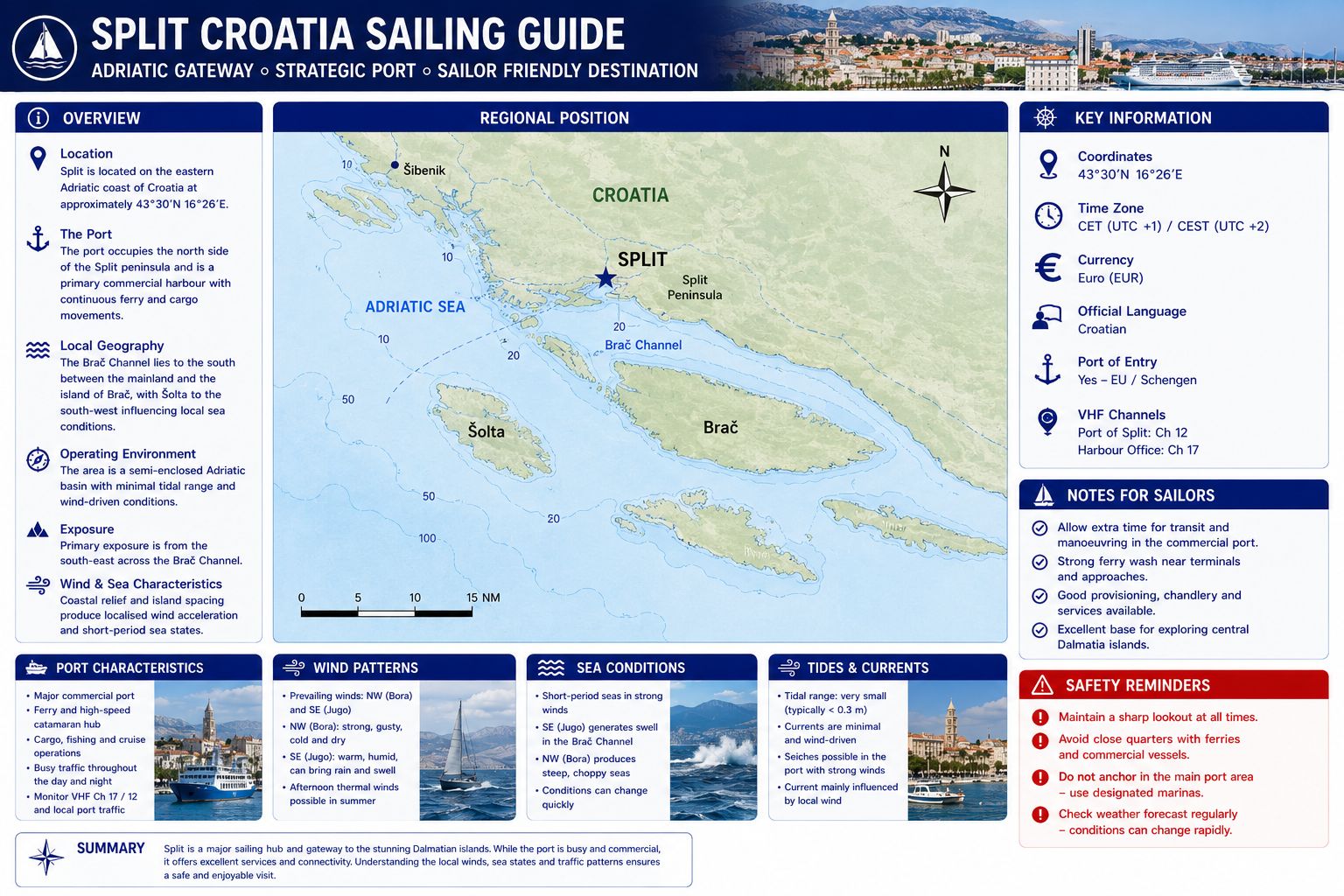
Split Croatia Sailing Guide. Split is located on the eastern Adriatic coast of Croatia at approximately 43°30′N 16°26′E. The port occupies the north side of the Split peninsula and is a primary commercial harbour with continuous ferry and cargo movements. The Brač Channel lies to the south between the mainland and the island of Brač, with Šolta to the south-west influencing local sea conditions.
The operating environment is defined by a semi-enclosed Adriatic basin with minimal tidal range and wind-driven conditions. Exposure is from the south-east across the Brač Channel. Coastal relief and island spacing produce localised wind acceleration and short-period sea states.
Split Croatia
Sailing Guide - Approaches
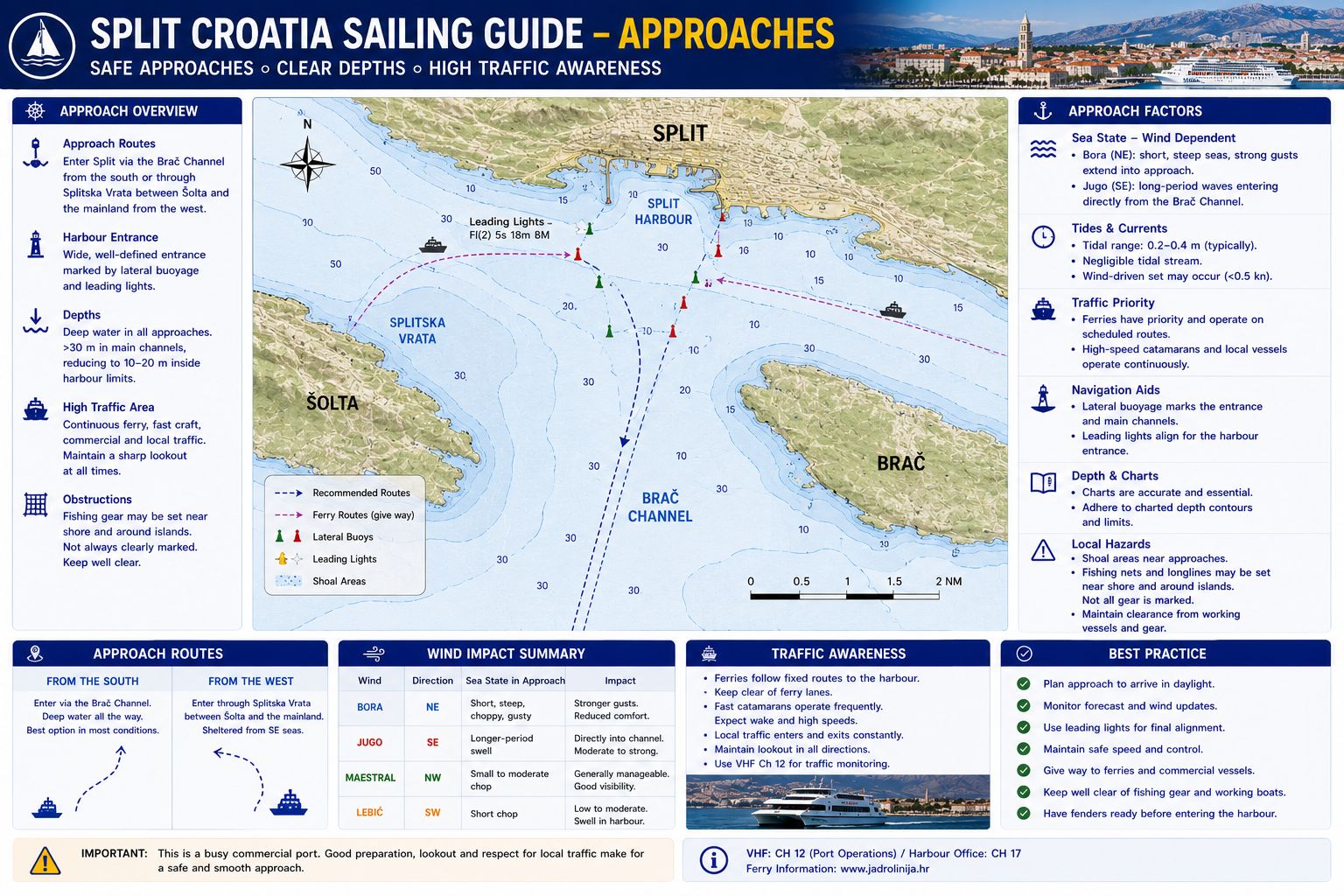
Approach is made through the Brač Channel or via Splitska Vrata between Šolta and the mainland. Depths in approach channels exceed 30 m, reducing to 10–20 m within harbour limits. The harbour entrance is wide and marked by lateral buoyage and leading lights.
Sea state is wind dependent. Bora (NE) produces short, steep seas with strong gusts extending into the approach. Jugo (SE) produces longer-period waves entering directly from the Brač Channel. Tidal range is typically 0.2–0.4 m with negligible tidal stream; wind-driven set may occur below 0.5 knots.
Traffic density is high. Ferries operate on fixed routes with priority. Fast catamarans and local vessels operate continuously. Shoal areas exist near harbour approaches and require adherence to charted limits. Fishing gear including nets and longlines may be set near shore and around islands and is not always clearly marked; clearance is maintained from working vessels and gear.
Split Croatia
Sailing Guide - Navigation
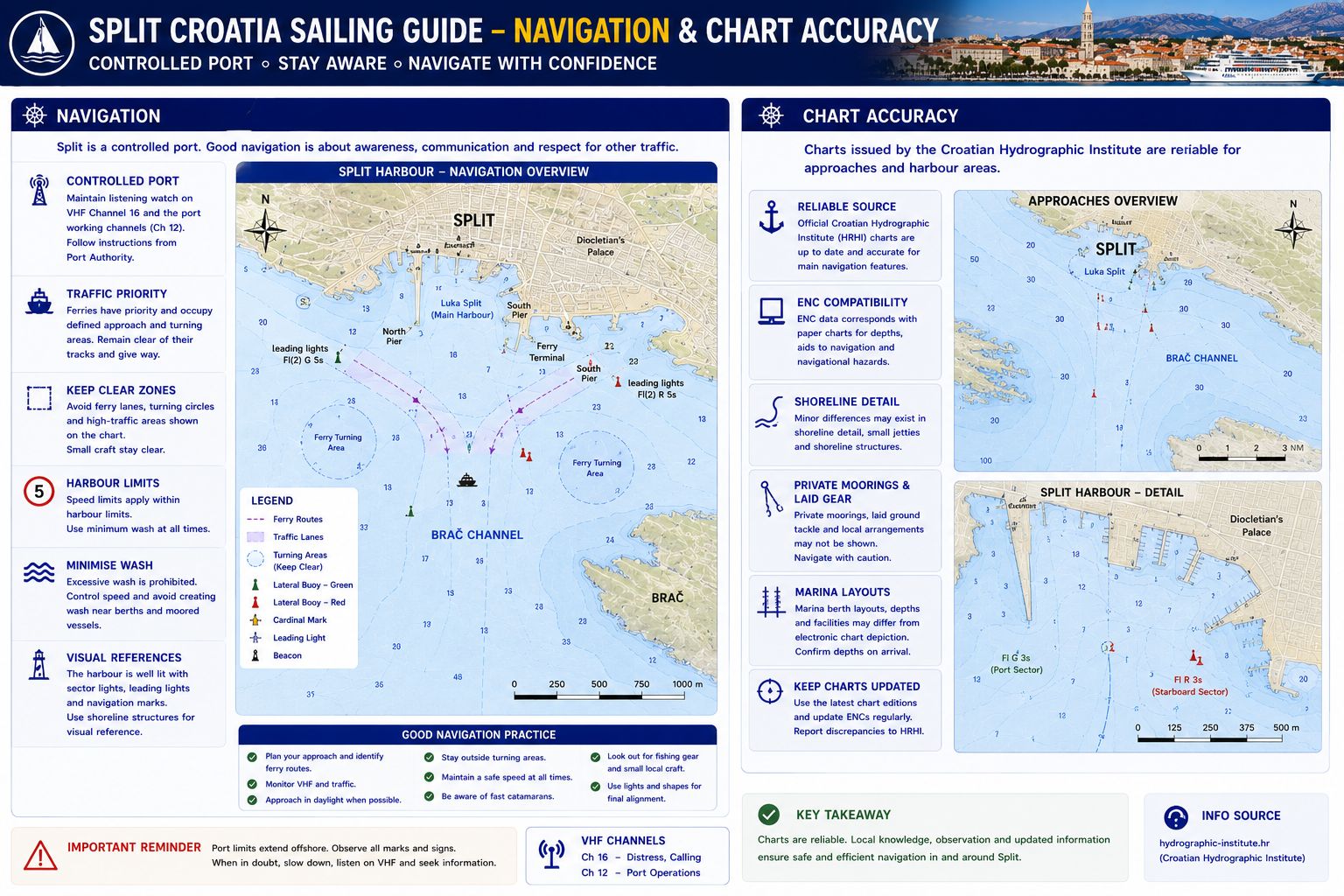
Split is a controlled port. Maintain listening watch on VHF Channel 16 and port working channels. Ferry movements have priority and occupy defined approach and turning areas. Small craft remain clear of these zones.
The harbour is fully lit with sector lights and navigation marks. Shoreline structures provide visual reference. Speed limits apply within harbour limits with wash control enforced.
Split Croatia
Sailing Guide - Chart Accuracy
Charts issued by the Croatian Hydrographic Institute are reliable for approaches and harbour areas. ENC data corresponds with paper charts for main navigation features. Variations may exist in shoreline detail and in areas with private moorings or laid ground tackle. Marina layouts may differ from electronic chart depiction.
Split Croatia
Sailing Guide - Anchorages
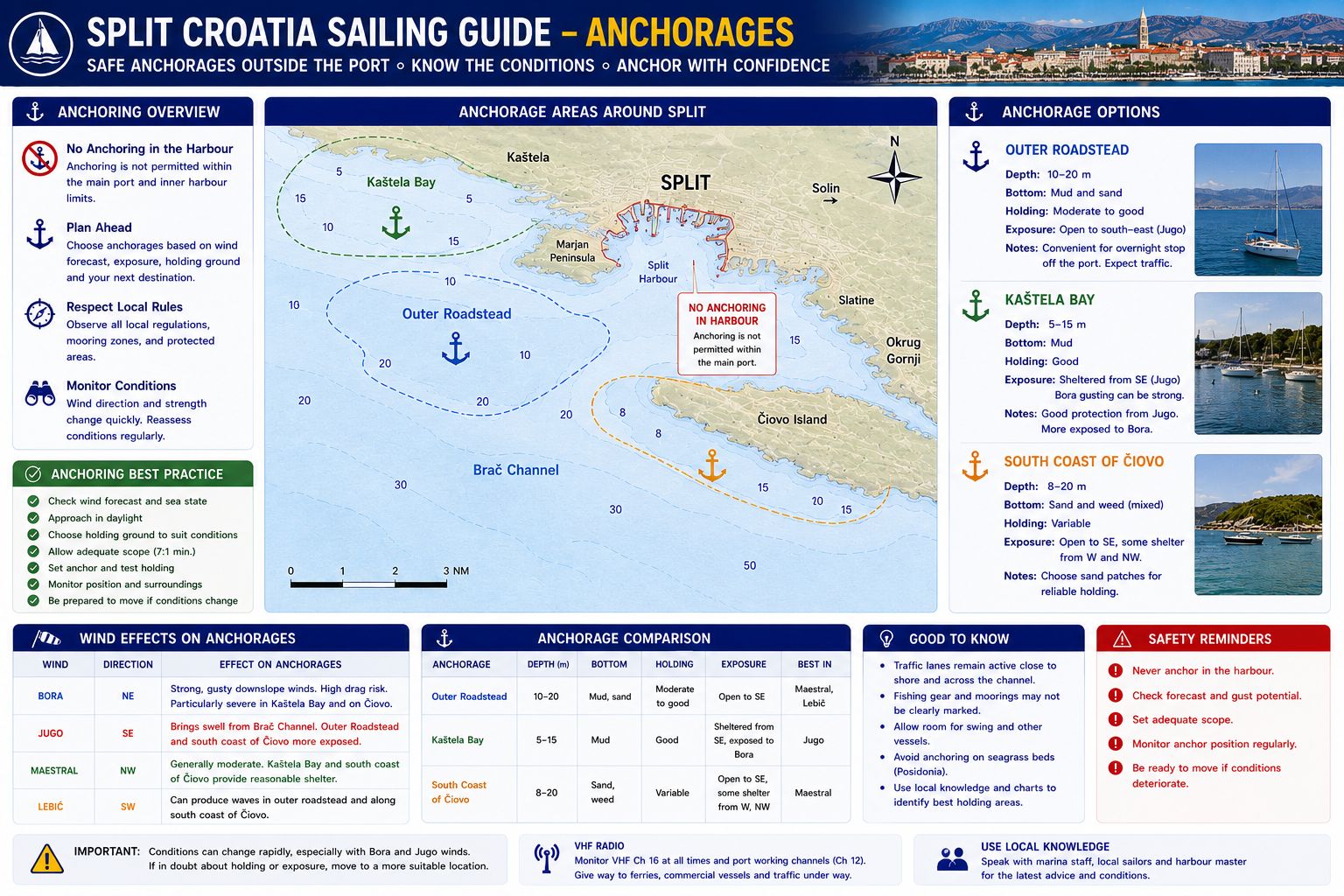
Anchoring is not permitted within the main harbour. Outside the port, the outer roadstead provides depths of 10–20 m over mud and sand with moderate to good holding and exposure to south-east conditions. Kaštela Bay to the north-west provides depths of 5–15 m over mud with good holding and reduced exposure to Jugo but subject to Bora gusting. The south coast of Čiovo provides depths of 8–20 m over mixed sand and weed with variable holding.
Wind effects are primary. Bora produces strong gust loading and increases drag risk. Jugo introduces swell into exposed anchorages. Katabatic gusting occurs near elevated terrain.
Split Croatia
Sailing Guide - Entry Formalities
Split is a port of entry. Customs and immigration clearance is required for arrivals from outside Schengen areas. Harbour master clearance is required for all vessels. Vessel and crew documentation may be inspected.
Drones are subject to Croatian aviation authority regulation. Communications equipment, including satellite systems, must comply with national telecommunications requirements. Waste discharge is regulated and holding tank use is required within port limits.
Split Croatia
Sailing Guide - Marina Facilities
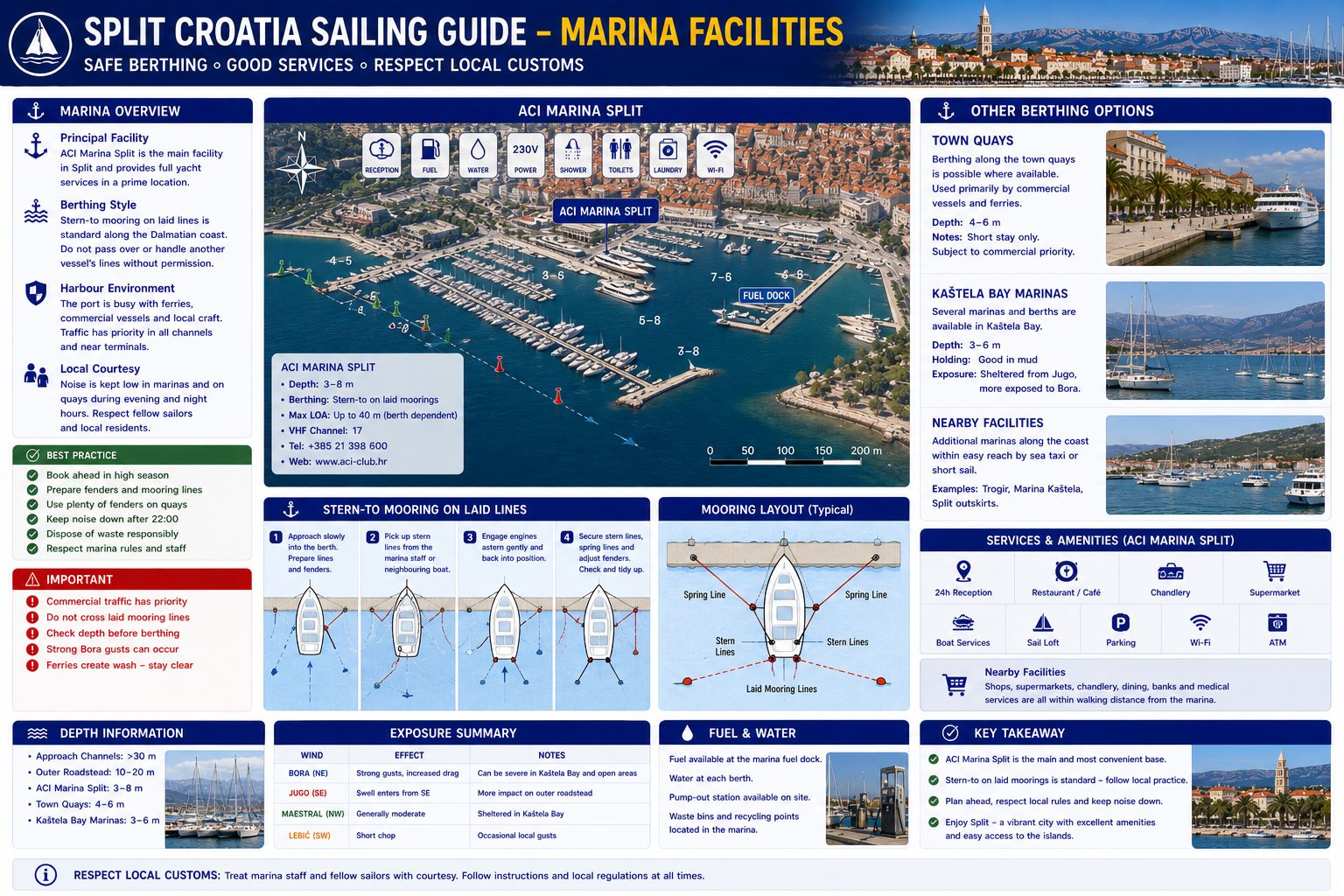
The principal facility is ACI Marina Split with depths alongside generally 3–8 m. Berthing is stern-to on laid moorings. Along the Dalmatian coast, stern-to mooring on laid lines is standard; passing over or handling another vessel’s lines without permission is avoided. Quay space is used closely and fendering is required to prevent contact. Noise is kept low in marina and quay areas during evening and night hours. Additional berthing exists on town quays subject to commercial priority and in nearby facilities within Kaštela Bay with depths typically 3–6 m.
Split Croatia
Sailing Guide - Local Weather
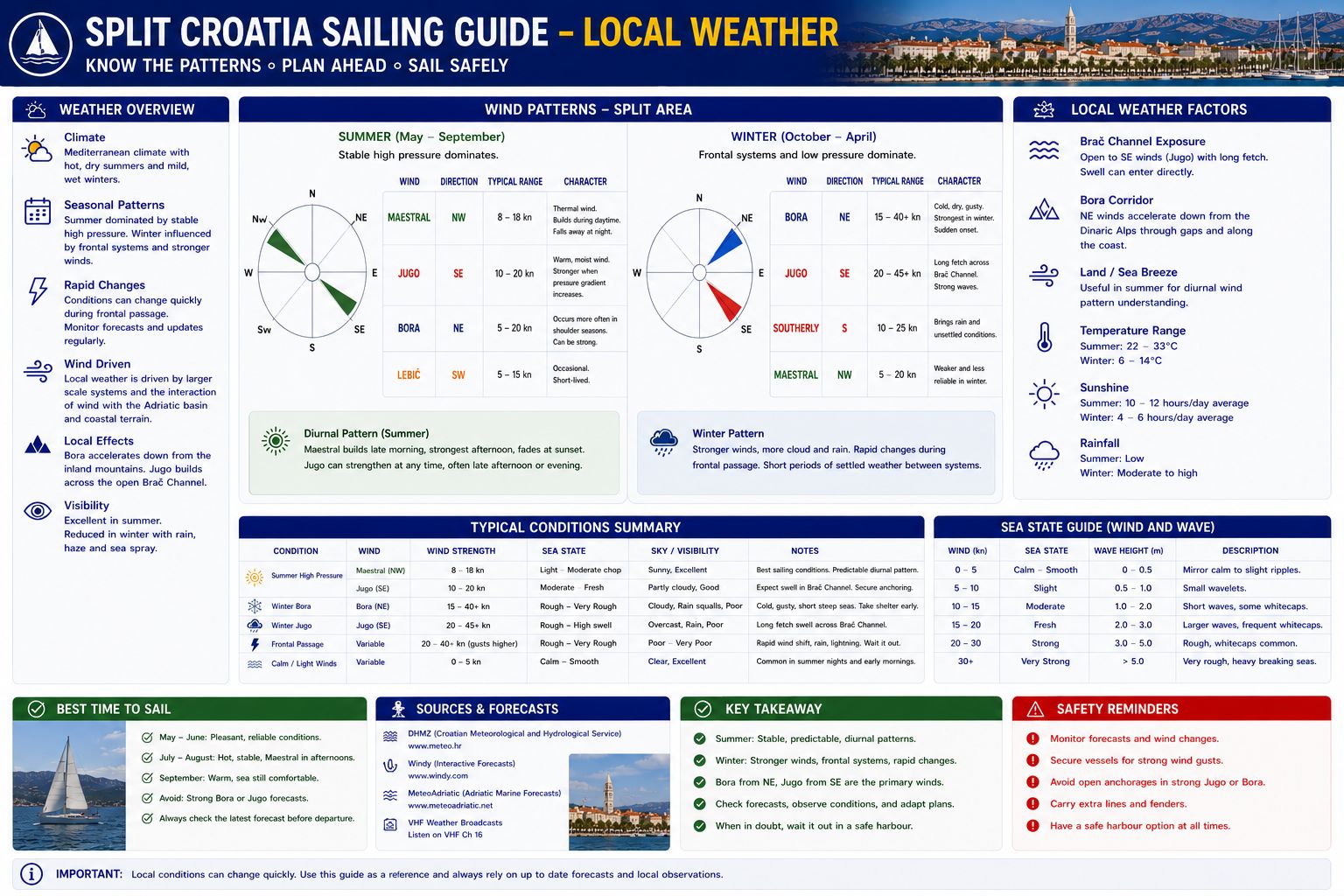
Summer conditions are dominated by stable high pressure with predictable diurnal patterns. Winter conditions are influenced by frontal systems with increased wind strength and reduced visibility. Rapid changes occur during frontal passage.
The Marine Electrical and Electronics Bible has a complete list of Croatian VHF Radio Channel information and weather forecast times for Croatia along with NAVTEX Mediterranean for 490kHz and 518kHz.
Split Croatia
Sailing Guide - Local Winds
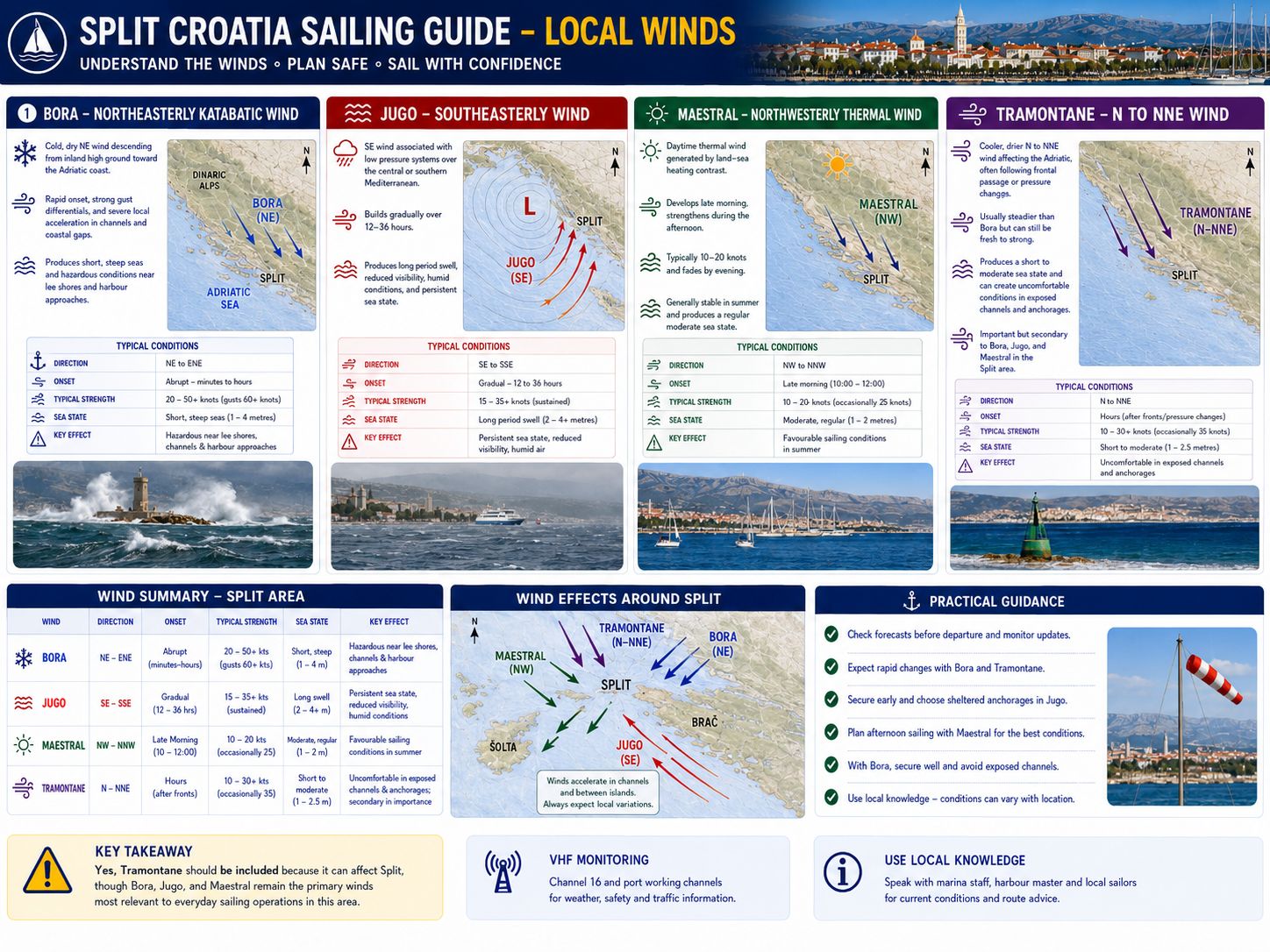
The Bora is a cold, dense northeasterly wind that descends abruptly from the Dinaric Alps The Bora is a cold, dry north-easterly katabatic wind descending from inland high ground toward the Adriatic coast. It is characterised by rapid onset, strong gust differentials often exceeding mean wind speed, and severe local acceleration in channels and coastal gaps. It produces short, steep seas and can generate hazardous conditions for navigation, particularly near lee shores and harbour approaches.
SE Jugo is a southeast wind in the Adriatic generated by low‑pressure systems over the central or southern Mediterranean. It produces long‑period swell, reduced visibility, and persistent humid conditions. It builds gradually, often over 12–36 hours, and can reach strong sustained speeds during established low‑pressure phases. The Jugo drives S–SE swell into exposed coasts and anchorages and affects harbour manoeuvring due to its steady directional flow.
The Maestral is a north-westerly thermal wind generated by daytime heating differences between land and sea along the Adriatic coast. It develops from late morning, strengthens through the afternoon typically in the 10–20 knot range, and diminishes toward evening. It produces a regular, moderate sea state aligned with the channel orientation and is generally stable in summer conditions.
The Tramontane is a northerly to north‑westerly wind that forms under high‑pressure influence over central Europe and flows southward across the Adriatic toward the Dubrovnik sector. It produces clear air, stable visibility and short‑period seas aligned to its axis, with gusts exceeding the mean wind where terrain channels the flow between coastal ridges. Its influence extends offshore along the southern Adriatic, shaping routing decisions between Dubrovnik, the Pelješac channel, the Mljet approaches and northbound coastal tracks.
Split Croatia
Sailing Guide - Provisioning
Supermarkets. Konzum, SPAR, INTERSPAR, Tommy Supermarket, and Lidl.
Markets. Pazar Green Market, supplying olive oil, cheeses, pršut, and seasonal fruit and vegetables. Seasonal produce includes figs, olives, grapes, citrus, and almonds.
Fish Markets. Split Fish Market (Peškarija), with species including orada (gilthead seabream), brancin (European seabass), škarpina (scorpionfish), lignje (squid), hobotnica (octopus), and tuna (tuna).
Split Croatia
Sailing Guide - Local Cuisine
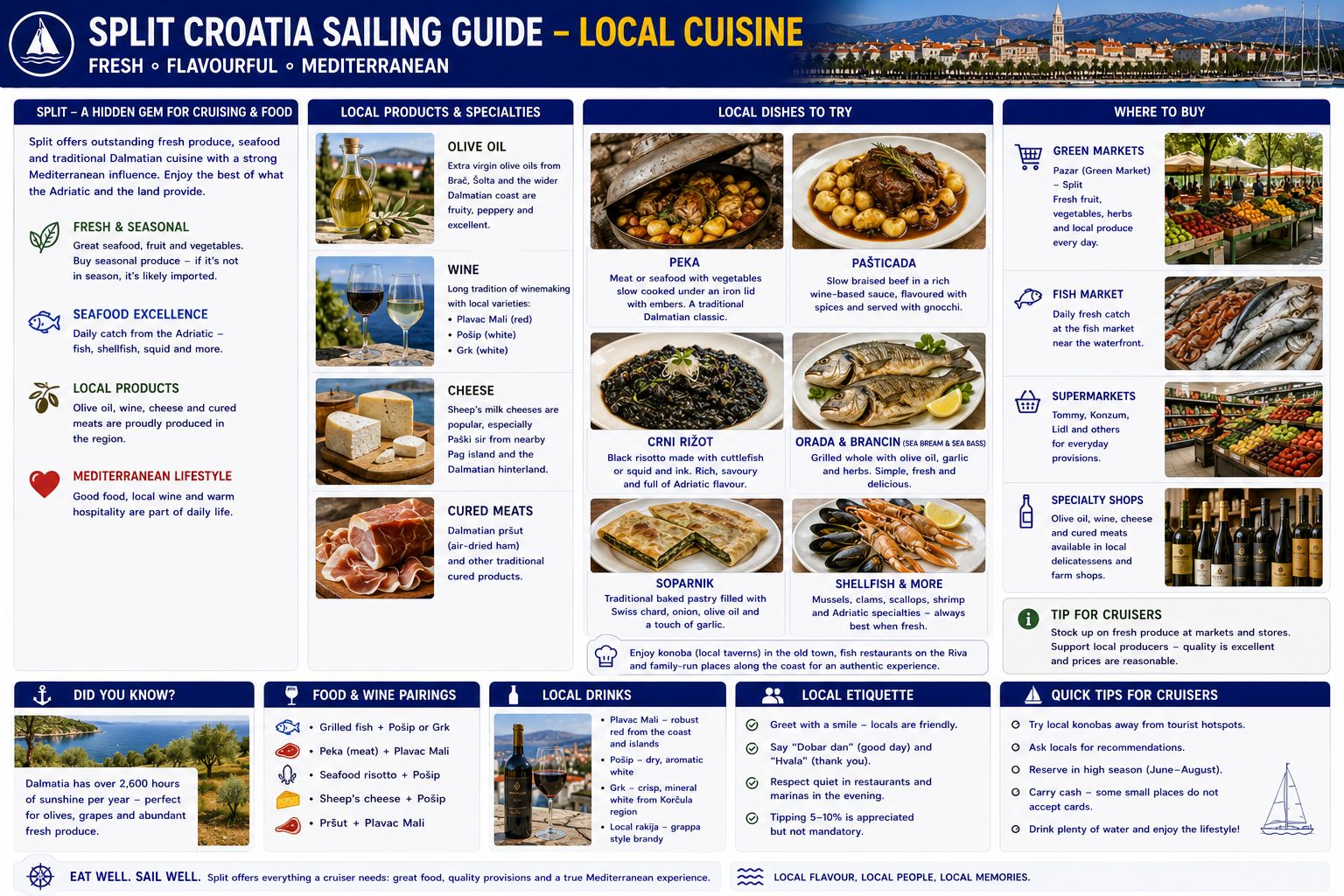
The hidden gem for cruising and food. Great seafood and excellent fruit and vegetables. Special thanks to my Croatian friend Fedja for all the extra research material. Buy the seasonal produce, if it’s not seasonal then its imported.
Olive oil is a primary product, including extra virgin oils from nearby islands such as Brač and Šolta. Wine production is established, with local varieties including Plavac Mali (red) and Pošip and Grk (white). Cheese production includes sheep’s milk cheeses such as Paški sir from the wider region. Cured meats include Dalmatian pršut (air-dried ham)
Local dishes include peka, consisting of meat or seafood with vegetables cooked under an iron lid with embers, pašticada, a braised beef dish in a wine-based sauce served with gnocchi, and crni rižot prepared with cuttlefish or squid and ink. Fish such as orada (gilthead seabream) and brancin (European seabass) are grilled whole, and soparnik is a baked pastry filled with Swiss chard, onion, and olive oil.
Split Croatia
Sailing Guide - Fuel Supplies
Fuel is available at the marina fuel berth and at the main port fuel station. Diesel and petrol are supplied by dockside pump.
Split Croatia
Sailing Guide - Water Supplies
Potable water is available at marina berths and quay connections. Supply is metered.
Mechanical and Electrical Repairs
Resource
If you are headed somewhere remote consider the need to expand your knowledge base or have an information resource on board. Why not get a copy of my book The Marine and Electrical and Electronics Bible 4th Edition. By and for yachties, with everything from batteries and charging, solar and wind, diesel engines and marine electronics and so much more. Your complete systems guide. 650 pages of practical advice. In Australia and New Zealand order a copy through Boat Books. UK and European boats can buy the UK Edition Here. US and Canadian boats can get the US Edition Order Here. Marine systems are my profession so let me help you. By a liveaboard boat owner for other boat owners.


Split Croatia
Sailing Guide - Marine Services
Marine services include diesel engine support for Yanmar and Volvo Penta through local agents, and marine electronics service for Raymarine. Lift and repair facilities are available within Split and nearby Kaštela.
Split Croatia
Sailing Guide - Local Customs
Dress standards apply in urban and historic areas; swimwear is not worn away from beaches. Churches require covered shoulders and appropriate dress. Conduct ashore is direct and reserved. Split is part of the Dalmatian region with a continuous resident population; there is no separate indigenous group with distinct maritime customs applicable beyond national Croatian norms.
Split Croatia
Sailing Guide - Summary
Split is a commercial port with high traffic density and controlled navigation. Approaches are deep and marked with wind-driven sea conditions. Anchorage is outside the harbour with exposure dependent on wind direction. Full marina, fuel, provisioning, and marine services are available. Split Croatia Sailing Guide for all you need to know.