Marine Anti Siphon Valve
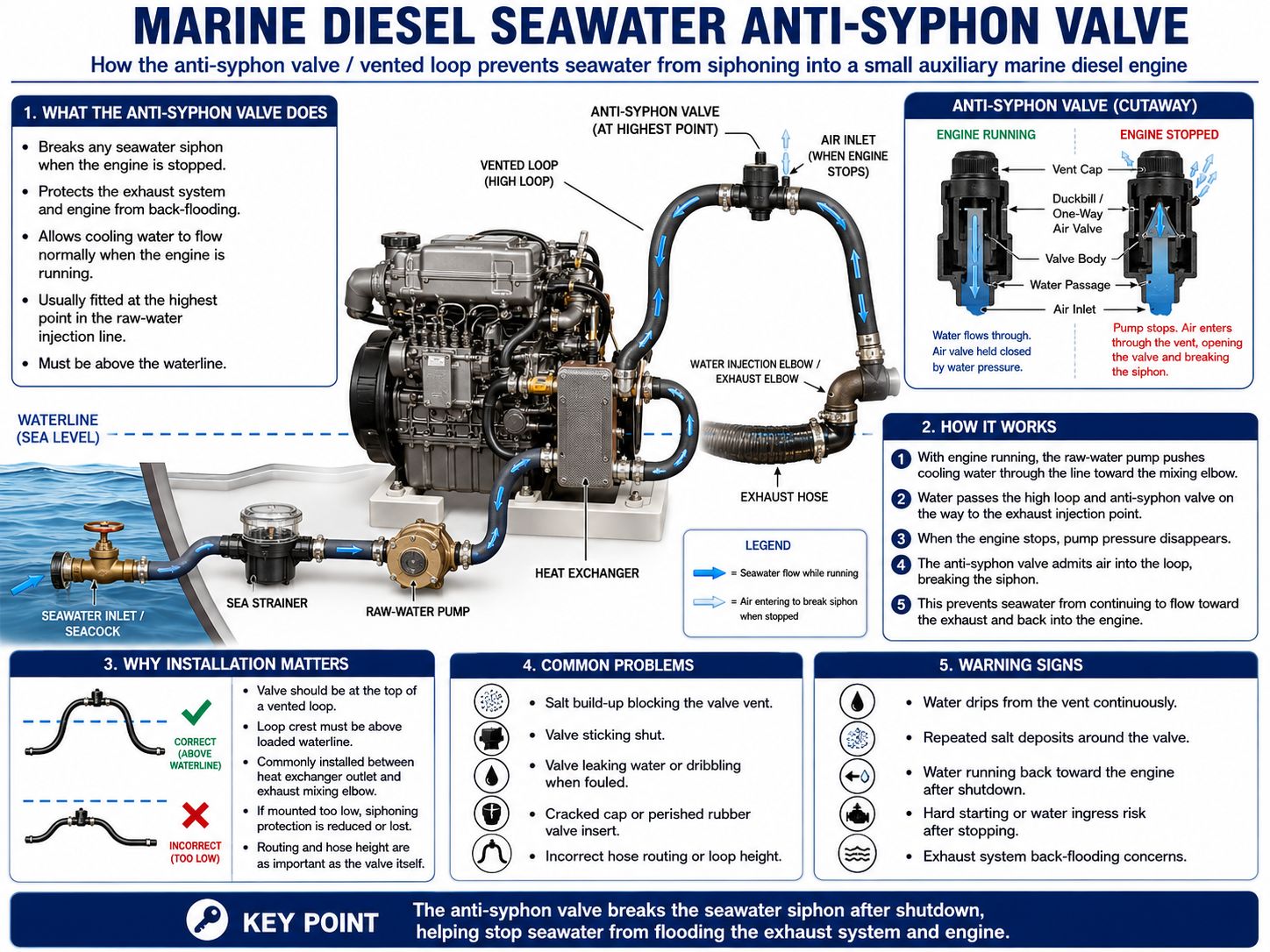
The marine anti siphon valve, also known as a vented loop or anti-siphon loop are essential safeguards in many small marine diesel installations. They prevent seawater from siphoning into the engine or flooding the exhaust system when the engine is not running. Although simple in concept, vented loops must be sized, installed, and maintained correctly to ensure reliable anti-siphoning performance.
Manufacturers such as Vetus, Perko, Whale, Groco, and various OEM engine brands supply vented loops for both raw-water cooling and exhaust injection circuits. Installed incorrectly or allowed to fail, a vented loop can lead to rapid seawater flooding, hydrolock, and extensive engine damage. Understanding their operation and placement is therefore fundamental to safe marine diesel engineering.
Purpose of a Marine Anti Siphon Valve
A marine diesel cooling system and wet exhaust rely on raw seawater delivered by a pump. Because the pump is below the waterline, it can unintentionally allow seawater to continue flowing even when stopped if a siphon is established.
A vented loop prevents this by introducing a controlled air break at the highest point of the water circuit. The key functions of a siphon break are:
- Breaks siphon action when the engine is off
- Prevents flooding of engine, exhaust elbow, or waterlock
- Stops backflow into raw-water pump or heat exchanger
- Maintains compliant exhaust routing when long vertical runs exist
This makes vented loops vital in installations where the hose path rises above the waterline before descending again.
Marine Anti Siphon Valve Operation
A siphon break contains a small spring-loaded or one-way air valve mounted at the top of a U-shaped pipe. The valve must seal reliably under pump pressure while opening instantly when pressure falls. When the system is not under pressure:
- The valve opens
- Air enters, breaking any siphon that would draw seawater into the engine
- When the raw water pump is running:
- System pressure forces the valve shut
- Water flows through the loop without leakage or loss of cooling volume
Mechanical
and Electrical Repairs Resource
If you are headed somewhere remote consider the need to expand your knowledge base or have an information resource on board. Why not get a copy of my book The Marine and Electrical and Electronics Bible 4th Edition. By and for yachties, with everything from batteries and charging, solar and wind, diesel engines and marine electronics and so much more. Your complete systems guide. 650 pages of practical advice. In Australia and New Zealand order a copy through Boat Books. UK and European boats can buy the UK Edition Here. US and Canadian boats can get the US Edition Order Here. Marine systems are my profession so let me help you. By a liveaboard boat owner for other boat owners

Where Siphon Valves Are Required
- Raw-Water Supply Line. A siphon break is typically required after the raw-water pump and before the injection elbow when the pump sits below the waterline. Without this loop, seawater can siphon through the pump and fill the exhaust system.
- Exhaust Injection Line. If the seawater injection point sits below the vessel’s heeled waterline, or the hose has a downward run before the elbow, a vented loop must be placed between pump and elbow.
- Toilet and Sanitation Systems. Many marine toilets also incorporate vented loops for the same purpose, though these are outside the scope of engine cooling.
- Siphon Break Installation Rules. A siphon break or vented loop must be placed at least 300 mm above the vessel’s heeled waterline (often 200–450 mm depending on manufacturer guidance).
Marine Anti Siphon Valve Construction
Different brands offer vented loops in a range of materials, with some differences in valve mechanisms.
Siphon Break Materials.
- Nylon / Polypropylene (Vetus, Perko, Whale, TruDesign). Lightweight and corrosion-proof. Ideal for small raw-water systems. Economical and easy to install
- Bronze (Groco, Buck Algonquin). Extremely durable. Often used in larger commercial installations. Resistant to heat and UV.
- Composite Fibreglass Reinforced Plastics. High strength. Excellent temperature tolerance. Often used in high-performance systems
Valve Mechanisms
- Top-cap valve (Vetus) with easy-clean outlet. Duckbill valve (Whale/Perko.Trudesign) with simple one-way design. Trudesign have electric solenoid version.
- Spring-loaded poppet valve (Groco) for high reliability
Regardless of design, the valve must automatically open to air and close under pressure.

Marine Anti Siphon Valve Installation
Proper installation is critical for siphon-break reliability.
Mounting Height
- Must be at the absolute highest point of the hose run
- At least 300 mm above heeled waterline
- Higher is better, provided hose routing remains smooth
Orientation
- Valve must be at the highest physical point
- Loop must not lie on its side
- Vertical orientation ensures correct vent function
Hose Routing
- Avoid downward dips immediately before or after the loop
- Keep bends gentle to avoid kinking or restriction
- Use correct hose diameter across the entire section
Accessibility
- The valve must be reachable for cleaning
- Do not hide vented loops behind bulkheads without access panels
Manufacturers like Vetus offer models with remote vent lines, useful in cramped engine bays.
Marine Anti Siphon Valve Maintenance
Requirements
Vented loops require regular maintenance, particularly in salty environments.
Routine Maintenance Tasks
- Inspect the valve. Ensure it moves freely and is not seized with salt crystals.
- Flush with fresh water. Every few weeks or after long passages.
- Clean the valve seat. Carbon, salt, and biological fouling can prevent sealing.
- Check for leaks. Slight dribbling when running is acceptable on some models, but not excessive dripping.
- Replace worn valves. Duckbill and poppet inserts are consumables.


Marine Anti Siphon Valve Common
Failure Points
- Valve stuck closed and is a siphon risk
- Valve stuck open and is a continuous dribble or reduced cooling efficiency
- Blocked air vent is a siphon risk
- Cracked housing due to overtightened hose clamps
- Proactive inspection prevents most failures.
Marine Anti Siphon Valve Troubleshooting
Dripping Water When Running
- Cause: valve stuck open or worn
- Fix: clean or replace valve insert
Engine Overheating at Idle
- Cause: excessive air ingress if valve not sealing
- Fix: inspect valve spring or duckbill flap
Water Backflow into Exhaust System
- Cause: vent stuck closed, siphon formed
- Fix: restore vent function immediately; check entire downstream hose path
Intermittent Blockages
- Cause: salt crystals forming under the cap
- Fix: remove cap and soak in vinegar or fresh water
Marine Anti Siphon Valve Manufacturers
- Vetus: Highly reliable, simple top-cap vent, easy access for cleaning
- Whale / Perko / Trudesign: Uses duckbill valves, excellent one-way function, but needs periodic replacement
- Groco: Heavy-duty bronze versions for professional or commercial environments
- Volvo Penta OEM: Often rebadged versions of Vetus or Perko units
Understanding these differences assists in selecting the right vented loop for engine cooling, exhaust injection, or auxiliary systems.
Marine Anti Siphon Valve Summary
Vented loops are small but vital components of marine diesel raw-water and wet-exhaust systems. Properly installed, they ensure that seawater cannot siphon into the engine, preventing one of the most catastrophic failure scenarios such as hydrolock. Their effectiveness depends on correct mounting height, proper valve function, clear air venting, and simple but regular maintenance. When understood and maintained correctly, a vented loop provides silent, passive, and indispensable protection for any raw-water-cooled marine installation. The siphon break is essential safety equipment, check yours regularly.