Tinos Greece Sailing Guide
Tinos Greece Sailing Guide. Tinos lies in the northern Cyclades, immediately north-west of Mykonos, at approximately 37°32′N 25°10′E and separated by a narrow channel subject to strong wind acceleration. The island has a high, rugged terrain, rising to over 700 metres, with steep coastlines and limited natural shelter. The coastline is generally exposed, with few indentations suitable for anchorage, and depths increase rapidly offshore. The island lies immediately north-west of Mykonos and east of Andros, forming part of a confined but high-energy wind corridor between these islands. The principal port is Tinos (Chora) on the south coast.
The main port and settlement are located on the south coast at Tinos Town (Chora), which serves as the primary harbour and operational centre. The surrounding waters are strongly influenced by the Meltemi, particularly in the channel between Tinos and Mykonos where wind and sea state can be significantly intensified. For navigation, Tinos should be treated as an exposed island with a single principal harbour and limited alternative shelter options.
Tinos Greece
Sailing Guide - History
The history of Tinos spans from antiquity to modern Greece, shaped by its strategic position in the Cyclades and its strong religious significance. In ancient times the island was part of the classical Greek world and later came under Roman and Byzantine control. During the medieval period, Tinos was ruled by Venice from the 13th century until 1715, longer than most Cycladic islands, leaving a lasting imprint on its fortifications, settlements, and administration. It then passed to Ottoman rule, though with a degree of local autonomy. Tinos played a role in the Greek War of Independence and was incorporated into the modern Greek state in 1830. The island later became one of Greece’s most important religious centres following the discovery of the icon of the Virgin Mary in 1823, making it a major pilgrimage destination. Alongside this, Tinos has maintained a long tradition of marble craftsmanship and village-based culture.

Chart Disclaimer. This chart is a schematic representation for illustrative purposes only and must not be used for navigation. Refer to official hydrographic charts for safe navigation. Be aware ENC charts may differ from official hydrographic charts. Both should be corrected and updated regularly.
Tinos Greece
Sailing Guide – Currents and Tidal
Flows

Tinos Greece
Sailing Guide - Approaches
Approach to Tinos is from open water with offshore depths generally 50–100 m, reducing to 10–20 m within 1 NM of the coast and 5–10 m approaching harbour limits. There are no constrained pilotage channels. Sea state is dominated by Meltemi (N–NE), which accelerates strongly through the Mykonos–Tinos channel. Wind strength in this channel frequently exceeds surrounding areas, producing steep, short-period seas and reduced manoeuvring margins. Southerly winds occur less frequently but generate longer-period seas affecting the south coast. Tidal range is typically 0.2–0.4 m with no operational tidal stream. Wind-driven drift is the primary factor affecting vessel control. Hazards include strong wind acceleration, ferry traffic, and limited shelter options during approach. Sea conditions can deteriorate rapidly in the channel.
Tinos Greece
Sailing Guide - Navigation
Primary approaches are from the W and S across clear water with depths 50–150 m offshore, shoaling to 20–40 m within 1 NM of the coast. The main hazard is not seabed obstruction but extreme wind acceleration. The channel between Tinos and Andros is a major Meltemi acceleration zone so you can expect 25–40 knots, frequently higher, with short, steep seas and heavy leeway. Similar but slightly less severe conditions occur in the passage between Tinos and Mykonos. Gets very bumpy!
The main port, Tinos Town (Chora), is approached from the S or SE in 15–25 m, reducing to 8–12 m at the entrance and 5–8 m inside. Entrance is wide and clear but exposed to strong crosswinds and ferry traffic. North and east coasts are exposed with depths 50–100 m close inshore and no safe shelter in Meltemi conditions. West coast offers limited protection but still subject to gusts and turbulence. No significant off-lying shoals, but rapid depth changes, strong winds, and heavy commercial traffic require diligent pilotage. Night entry is possible but difficult in strong winds. Fishing gear including nets and lines may be present near shore and is not consistently marked.
Tinos Greece
Sailing Guide - Chart Accuracy
Charts issued by the Hellenic Navy Hydrographic Service are accurate for approaches and harbour areas. ENC data aligns with official charts. Local moorings, laid ground tackle, and seasonal anchoring density may not be fully represented.
Tinos Greece
Sailing Guide - Anchorages
Tinos provides limited anchorage options due to exposure and seabed conditions. No anchorage provides reliable protection across all wind directions.
- Tinos Harbour outer areas provide anchoring in 5–10 m over sand with moderate holding but exposure to northerly winds and harbour traffic.
- South coast bays provide depths of 5–15 m over sand with variable holding and partial shelter depending on wind direction.
- West coast bays provide depths of 5–15 m but are exposed to prevailing northerly winds.
- North coast anchorages are generally untenable under Meltemi conditions due to direct exposure.
Tinos Greece
Sailing Guide - Entry Formalities
This is not a designated port of entry for international clearance, and there are no customs or immigration facilities on the island. Vessels arriving from outside Greece or the Schengen Area must first clear into the country at an official port of entry before proceeding to this port. Direct arrival from a non-Schengen country is not permitted. The Greek cruising tax (TEPAI) must be valid and paid, and the vessel’s cruising log (DEKPA for non-EU vessels, or transit log where applicable) should be up to date and available for inspection if requested by port authorities or coastguard.
Tinos Greece
Sailing Guide - Marina Facilities
There is no full-service marina on Tinos. Berthing is in Tinos Town (Chora) harbour, where yachts berth stern-to or alongside on the town quay. Depths are typically 5–8 m alongside, with deeper water near the entrance. Mooring is by own anchor laid from the bow with stern lines ashore; there are no laid moorings. Space is limited and shared with ferries and commercial vessels, with frequent traffic. Facilities are basic, with water and electricity available in sections of the quay, though not consistently. The harbour is exposed to strong Meltemi winds, causing crosswinds and occasional surge, making berthing difficult in stronger conditions. There is no fuel dock, no travel lift, and no repair yard.
Tinos Greece
Sailing Guide - Local Weather
Weather is dominated by the Meltemi (N–NE) from June to September, typically 20–30 knots, frequently increasing to 30–40 knots or higher, particularly in the Andros–Tinos channel. Conditions are dry with excellent visibility and virtually no rainfall during summer. Spring and autumn are more variable, with winds 10–20 knots from N or S sectors, and occasional unsettled periods with reduced visibility and showers.
Winter (November–March) brings S–SW systems 20–35 knots, with rain, lower visibility, and longer-period swell. Temperatures range from 25–35°C in summer to 10–18°C in winter. Most annual rainfall occurs in winter, while sea state is slight to moderate in sheltered areas but moderate to rough in exposed channels and along the north coast.
The Marine Electrical and Electronics Bible has a complete list of Greek VHF Radio Channel information and weather forecast times for Greece along with NAVTEX UK and Europe and NAVTEX Mediterranean for 490kHz and 518kHz.
Tinos Greece
Sailing Guide - Local Winds
Local winds are dominated by the Meltemi (N–NE), typically 20–30 knots, frequently increasing to 30–40 knots and higher in the channel between Tinos and Andros due to strong acceleration. The passage between Tinos and Mykonos also experiences enhanced winds and steep seas. Wind strength is greatest on the north and west coasts and around headlands, with severe gusting and turbulence. Tinos Town harbour is exposed to crosswinds, making berthing challenging in strong northerlies.

There is little diurnal moderation, and winds often persist both day and night during Meltemi periods. Outside summer, winds are more variable, with S–SW systems 15–30 knots during frontal passages and occasional strong northerly flows following fronts.
The Meltemi is a strong, dry northerly wind that dominates the Aegean in summer, accelerating through channels and between islands to produce steep, short seas. It is most persistent in July and August, often blowing for several days with little diurnal variation, creating fast north‑to‑south passages and challenging return routes. Its strength is shaped by pressure gradients between the Balkans and Anatolia, with local acceleration zones around major island gaps.
Tinos Greece
Sailing Guide - Provisioning
Supermarkets. Provisioning is centred on Tinos Town (Chora) close to the harbour. The main outlets are AB Vassilopoulos Tinos (full-service supermarket on the main road near the port area) and Bazaar Supermarket Tinos, both within approximately 0.5–1 km of the quay. Additional medium-sized local supermarkets operate within the town, with smaller minimarkets located near the waterfront. There is also a Masoútēs and Karpos Tinian Traditional Products.
Markets. Local produce is available through greengrocers in Tinos Town. A weekly Laiki Agora (farmers’ market) operates in Tinos Town, typically once per week (day varies seasonally). Local products include olive oil, tomatoes, citrus, capers, herbs (oregano, thyme), honey (buy the honey!!) and regional cheeses, including locally produced varieties.
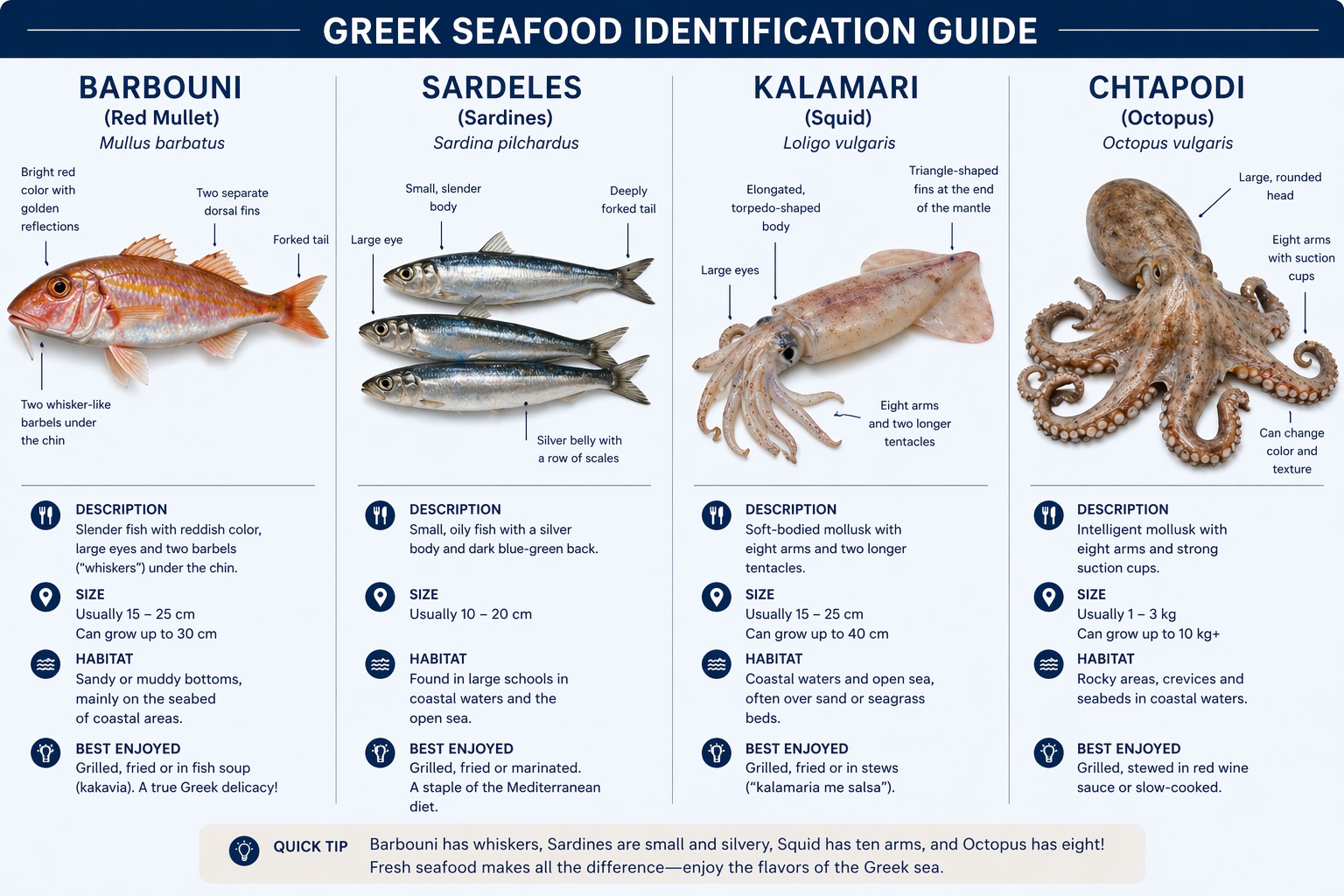
Fish Markets. There is no large central fish market. Fresh fish is sold through local fishmongers in Tinos Town near the harbour, supplied by daily catch. Common seafood includes tsipoura (gilthead sea bream), lavraki (European sea bass), sardeles (sardines), gavros (anchovies), kalamari (squid), htapodi (octopus), garides (prawns), and barbouni (red mullet). Availability depends on weather and fishing conditions.
Tinos Greece
Sailing Guide - Local Cuisine
Cuisine on Tinos is distinctly Cycladic with strong local identity, based on dairy, cured meats, and seasonal produce, alongside seafood. Signature dishes include Tinian Louza which is cured pork loin, air-dried and spiced, a key local product. Tinian sausages are pork sausages flavoured with fennel and herbs. Kopanisti Tinos is spicy soft cheese, strong and peppery. Graviera Tinos. This is a local hard cheese, firm and slightly sweet. Artichokes (Anginara Tiniou) are local artichokes, often braised or used in stews is a regional speciality. Revithia is a slow-cooked chickpea dish, often baked. Fresh grilled fish include Tsipoura (sea bream), lavraki (sea bass), and other local catch. Octopus and squid dishes such as grilled or stewed (htapodi, kalamari). Amygdalota are almond sweets, common in the Cyclades.
Tinos Greece Sailing Guide – Beverages
Tinos has one island brewed beer called Nisos Pilsner, and very acceptable indeed. Beer, wine, and spirits across the Greek islands are locally produced and widely available through tavernas, small bars, and provisioning outlets. Beer is predominantly lager, with domestic brands including Mythos, Alfa, Fix, and Vergina alongside imported products; and over 100 microbreweries operate on several islands with limited distribution. Wine is region-specific, with white varieties dominant in the islands, including Assyrtiko, Moschofilero, and Roditis, alongside local table wines served in bulk; retsina remains in circulation as a resin-flavoured wine. Distilled products include ouzo (anise-based), tsipouro (grape marc distillate), raki or tsikoudia (Crete), souma (fig or grape distillate in eastern Aegean islands), and kitron (citrus liqueur from Naxos), with alcohol strength typically in the 37–45% range and higher for unregulated local distillations.

Tinos Greece
Sailing Guide - Fuel Supplies
Fuel is available in Tinos Town harbour by road tanker delivery to the quay, not from a fixed fuel dock. Supply is arranged locally through port-based fuel distributors, commonly associated with EKO, Shell, or BP, with delivery made alongside by hose. Diesel is readily available; petrol can be supplied on request. Delivery access depends on quay space and ferry movements, so timing must be coordinated. Fuel quality is standard and generally reliable.
Tinos Greece
Sailing Guide - Water Supplies
Water is available in Tinos Town harbour from municipal supply points along the quay. Connection is made directly from shore taps; vessels must use their own hoses and fittings. Supply coverage is not continuous along all berths and pressure can be inconsistent, particularly during peak season. Water is potable but commonly treated onboard before drinking. Availability is generally reliable where connections are provided.
Mechanical and Electrical Repairs
Resource
If you are headed to Tinos somewhere remote consider the need to expand your knowledge base or have an information resource on board. Why not get a copy of my book The Marine and Electrical and Electronics Bible 4th Edition. By and for yachties, with everything from batteries and charging, solar and wind, diesel engines and marine electronics and so much more. Your complete systems guide. 650 pages of practical advice. In Australia and New Zealand order a copy through Boat Books. UK and European boats can buy the UK Edition Here. US and Canadian boats can get the US Edition Order Here. Marine systems are my profession so let me help you. By a liveaboard boat owner for other boat owners.



Tinos Greece
Sailing Guide - Marine Services
Marine services on Tinos are limited to basic support in Tinos Town. Minor diesel engine servicing and general mechanical repairs can be arranged locally, but there are no authorised Volvo Penta or Yanmar agents on the island. Basic electrical assistance is available; however, there are no official Raymarine or major marine electronics service agents based in Tinos. There are no haul-out facilities, travel lifts, or shipyards on the island. For engine diagnostics, electronics work, or parts supply, the nearest authorised agents and full-service facilities are located in Syros, Mykonos, or mainland Greece.
Tinos Greece
Sailing Guide - Local Etiquette
Interaction is direct and formal on first contact, with a greeting expected before any request or transaction. Conversation tone is measured and transactional, with limited small talk unless initiated locally. Personal space is closer than in northern Europe, but physical contact is minimal unless familiarity is established. Shore behaviour is conservative in non-tourist areas, particularly near churches and village centres where modest dress and low noise are expected.
Tinos Greece
Sailing Guide - Summary
Tinos is a high-exposure Cycladic location with strong wind acceleration and limited shelter. Harbour access is available but wind affected. Anchorage options are restricted and condition dependent. Provisioning and services are basic with reliance on nearby islands for support. Tinos Greece Sailing Guide for all you need to know.