Thirasia Greece Sailing Guide
Thirasia Greece Sailing Guide. Thirasia is located on the western side of the Santorini caldera opposite Santorini. The island forms part of the volcanic caldera system and is characterised by steep cliffs on the caldera side and more gradual slopes on the outer western coast. The primary port is Korfos, located at the base of the caldera cliffs on the east coast.
The coastline offers limited anchorage options due to steep underwater gradients within the caldera. Korfos provides the main operational access point with additional anchoring possible in the adjacent caldera waters under suitable conditions. There is no marina infrastructure.
Thirasia Greece Sailing Guide - History
Thirasia shares geological and historical origins with Santorini, formed as part of the volcanic complex that shaped the caldera. Settlement dates back to antiquity with links to the Minoan eruption that defined the current landscape. The island remained sparsely populated through classical, Roman, and Byzantine periods, with maritime activity centred on local transport and fishing. Under Ottoman and later Greek administration, Thirasia maintained a small population with limited port development. Archaeological remains are present but less extensive than on Santorini.
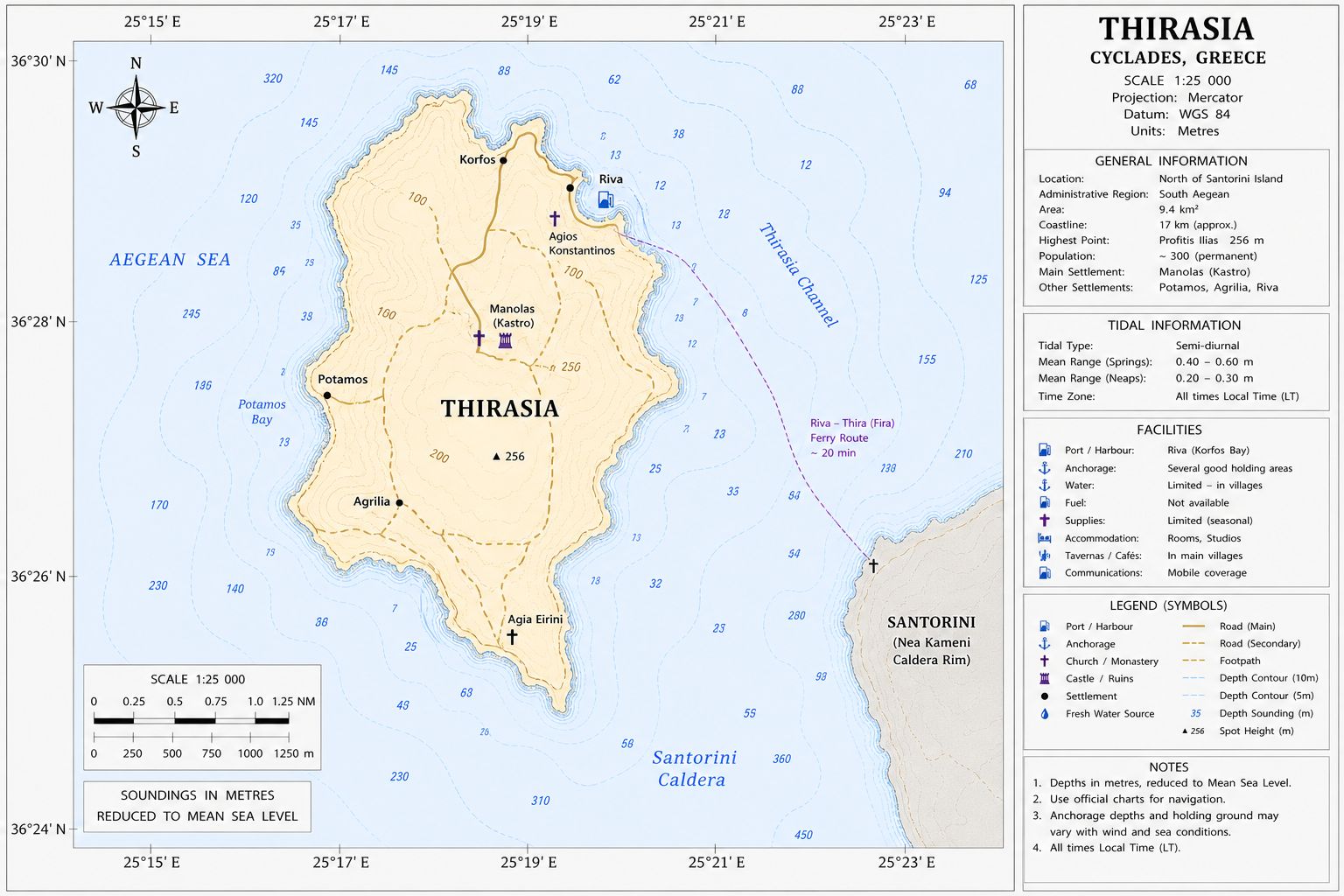
Chart Disclaimer. This chart is a schematic representation for illustrative purposes only and must not be used for navigation. Refer to official hydrographic charts for safe navigation. Be aware ENC charts may differ from official hydrographic charts. Both should be corrected and updated regularly.
Thirasia Greece Sailing Guide - Ocean
Currents and Tidal Flow
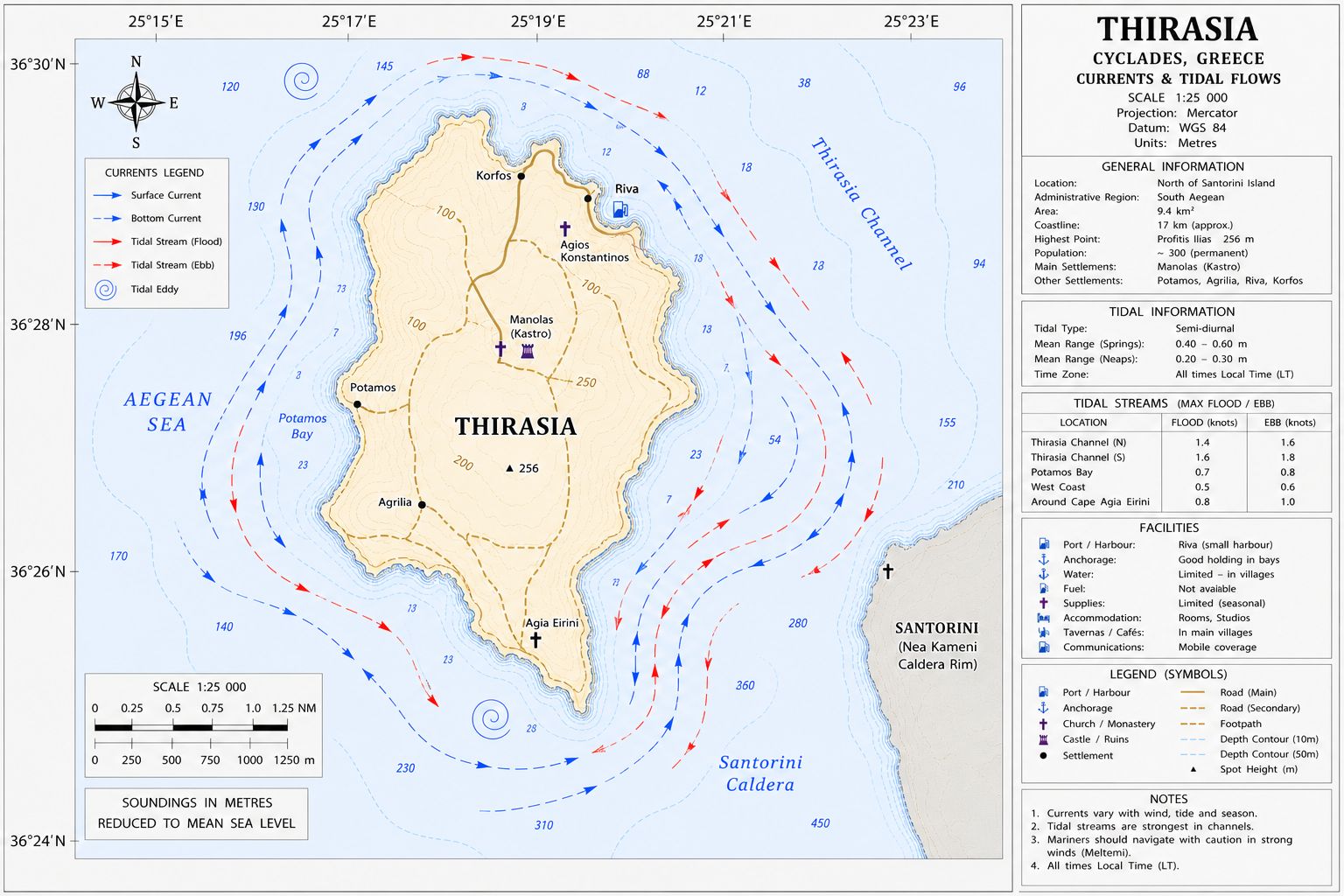
Tidal range in the caldera is minimal, generally less than 0.3 metres, with negligible tidal streams. Current patterns are influenced by wind and confined water movement within the caldera basin. Under Meltemi conditions, surface currents typically set southward within the caldera at approximately 0.5–1.0 knots. Localised eddies and counterflows occur near cliff faces and within Korfos harbour approaches. These effects influence anchoring alignment and manoeuvring.
Thirasia Greece Sailing Guide - Weather
Summer conditions are dominated by stable high-pressure systems with clear visibility and minimal precipitation. Sea state within the caldera is reduced compared to open Aegean conditions but can be affected by wind funneling. Winter conditions introduce variability with southerly winds generating swell within the caldera. Wave reflection from steep cliffs can create confused sea states. Visibility may be reduced during passing weather systems.
The Marine Electrical and Electronics Bible has a complete list of Greek VHF Radio Channel information and weather forecast times for Greece along with NAVTEX UK and Europe and NAVTEX Mediterranean for 490kHz and 518kHz
Thirasia Greece Sailing Guide - Local
Winds
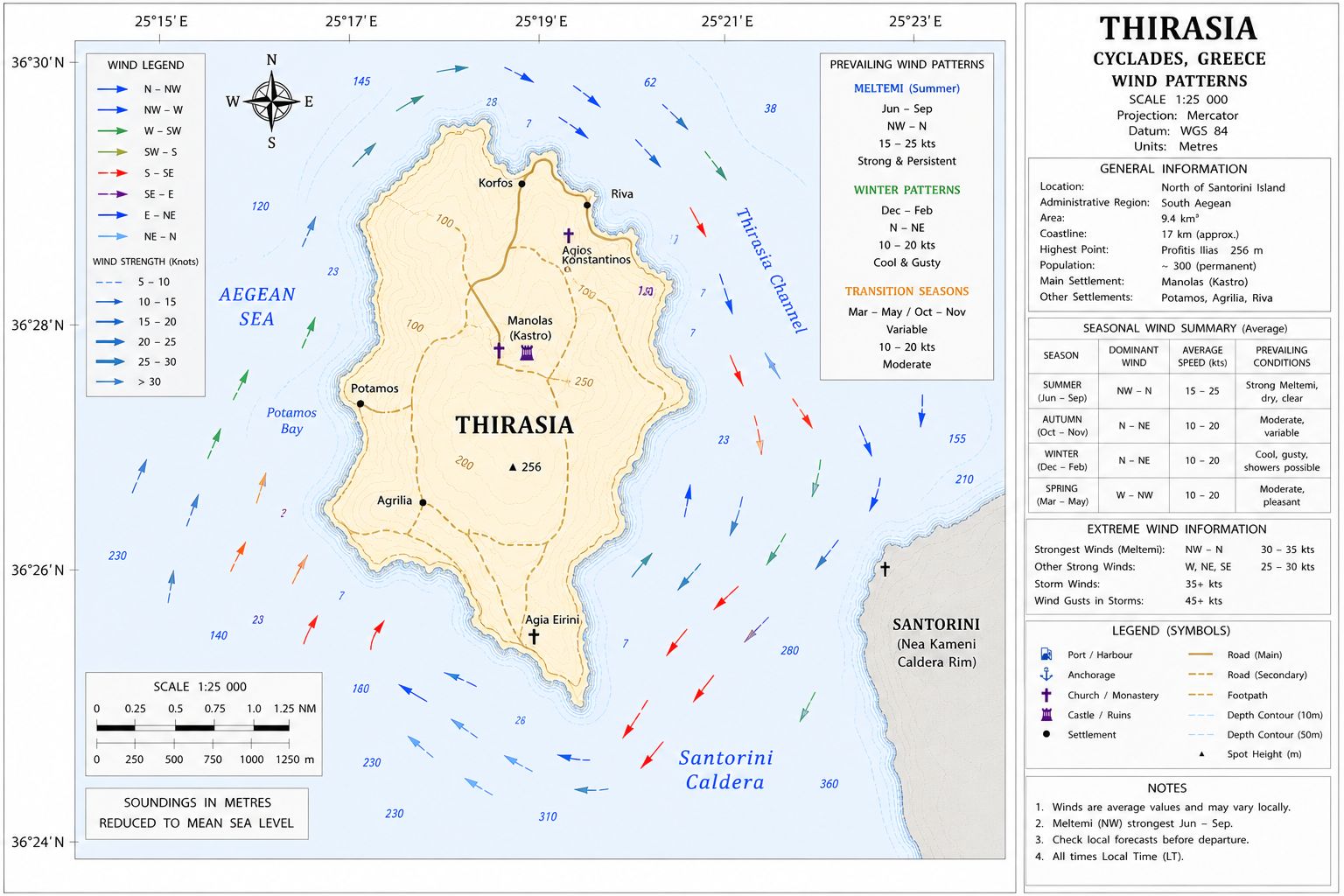
The Meltemi is the dominant wind, blowing from the north to northwest at Force 5–7. Within the caldera, wind direction can be modified by terrain, creating gusting and variable conditions. Southerly winds occur outside the summer period and can generate swell within the caldera. Wind acceleration and turbulence occur along cliff faces and at harbour entrances. Wind direction significantly affects anchorage selection.
Thirasia Greece Sailing Guide - Approaches
Approach to Thirasia is via the Santorini caldera through the main entrances north or south of Santorini. Depths are significant, exceeding 100 metres in most of the caldera. Approach to Korfos harbour is direct along the east coast of Thirasia. No offshore hazards exist, but steep cliffs and deep water close to shore require precise positioning. Sea state is generally moderate within the caldera but influenced by wind and vessel traffic.
Thirasia Greece Sailing Guide - Navigation
Navigation around Thirasia is mainly visual coastal pilotage along a steep volcanic shoreline with deep water close inshore. The main harbour at Riva on the north-east side is the usual ferry and small-craft landing. Approach depths outside Riva are generally deep, commonly 20 m or more, then reduce quickly close to the quay and harbour margins. Usable depths near the small harbour and landing area are typically about 3–6 m, but space is limited and ferry movement takes priority.
Most of the east coast facing the Santorini caldera is steep-to, with depths often exceeding 30–50 m close offshore, making anchoring difficult except on small shelves. Temporary anchoring may be possible in selected bays in about 8–15 m, where sand or mixed bottom can be found, but much of the seabed drops away rapidly. Keep clear of ferry routes between Santorini and Thirasia, use the depth sounder continuously, and avoid close inshore work in poor light because rock shelves, moorings, and local craft may be difficult to identify.
Thirasia Greece Sailing Guide - Chart
Accuracy
Hydrographic charts accurately depict coastline and caldera bathymetry. Electronic charts align with official data but may not reflect detailed seabed composition nearshore. Caution is required due to steep depth gradients and limited anchoring areas. Depth soundings are reliable but require continuous monitoring when operating close to shore.
Thirasia Greece Sailing Guide –
Anchorage
Thirasia anchorage options are limited but operationally useful. There are no all-weather anchorages.
- Riva/Thirasia Harbour Anchorage. This is the main practical anchoring and landing area on the north-east side of Thirasia. Anchor clear of the ferry quay, local moorings, and small-craft manoeuvring area. Depths outside the harbour are commonly 8–15 m, reducing closer inshore, with mixed sand, rock, and weed. Holding is variable and should be checked carefully. Ferry wash and limited room make this more suitable for short stops than quiet overnight anchoring.
- Korfos/Manolas Landing. This lies on the eastern caldera side below Manolas village. This is a steep-to anchoring area with very deep water close offshore. Depths often exceed 20–30 m close to the waterfront, with only limited shelves suitable for anchoring. Bottom is mixed rock, sand, and weed with inconsistent holding. The area is affected by ferry and excursion-boat traffic, caldera gusts, wash, and steep shoreline rebound. It is mainly a temporary stop in settled weather.
- Agia Irini/South-East Caldera Side. This offers limited temporary anchoring where depth and bottom permit. Expect steep-to conditions, with depths commonly 15–30 m close in and poor holding where rock predominates. Use only in calm settled conditions with good light and a bow watch. This side is exposed to wash, gusts descending from the caldera rim, and swell reflection from the cliff coastline.
- Western Thirasia Coast. This has several open roadstead positions, but no reliable yacht anchorage in normal cruising terms. Depths are generally deep close offshore, commonly 20 m plus, with rock, weed, and isolated sand patches. Shelter depends entirely on wind direction. The coast is exposed to Aegean swell and is unsuitable in Meltemi or any unsettled weather.
- Northern Thirasia/Cape Area. This may provide short fair-weather anchoring in selected indentations where sand patches can be found. Depths are typically 10–20 m with mixed bottom. Holding is variable and the area is exposed to northerly weather and passing sea state. Use only as a daylight stop in settled conditions.
- Southern Thirasia Roadstead. This is an exposed temporary option only. Depths are commonly 15–30 m with mixed rock and sand patches. Protection is poor, and the area is open to southerly swell and wind shifts around the southern caldera approaches. It is not suitable as a secure overnight anchorage.
Additional limited positions along the caldera shoreline may allow anchoring in settled conditions where depth reduces sufficiently, typically between 8 and 20 metres over mixed seabed. These locations are restricted in extent, subject to depth constraints, and not suitable in unstable weather.
Thirasia Greece Sailing Guide - Entry
Formalities
Entry formalities follow standard Greece procedures for visiting yachts. This is not a designated port of entry for international clearance, and there are no customs or immigration facilities on the island. Vessels arriving from outside Greece or the Schengen Area must first clear into the country at an official port of entry before proceeding to this port. Direct arrival from a non-Schengen country is not permitted. The Greek cruising tax (TEPAI) must be valid and paid, and the vessel’s cruising log (DEKPA for non-EU vessels, or transit log where applicable) should be up to date and available for inspection if requested by port authorities or coastguard.
Thirasia Greece Sailing Guide - Marina
Facilities
Riva/Agia Irini Port. This is the main port on Thirasia and the principal ferry landing. It is not a marina. The approach is steep-to, with depths commonly 15–30 m outside the immediate harbour area, reducing quickly close to the quay. Usable depths near the ferry landing and quay margins are approximately 3–6 m, but space is limited and ferry traffic has priority. Visiting yachts should not assume berth availability and should keep clear of the ferry manoeuvring area.
Korfos Port/Old Port. This is the small caldera-side landing below Manolas. It is used by local boats and small ferry-boats from Santorini. Depth at the outer end of the short pier is reported at about 3 m. The surrounding bay is very steep-to, with depths commonly 20–30 m close offshore and deeper water further out. Yacht berthing is not normally practical except possibly very short-term by local direction. Anchoring nearby requires care because the bottom shelves irregularly and holding is mixed rock, sand, and weed.
Riva Beach/Riva Cove. This landing area is part of the main Riva port frontage. It is a beach and small-craft landing area rather than a yacht berth. Depths shoal quickly close to the beach, with shallow water inside approximately 1–3 m and deeper water of 5–10 m just off the landing area. It is suitable only for small local craft or tender landing in settled conditions.
Korfos Bay. This anchoring area outside the old port has steep volcanic depths. Usable anchoring shelves, where present, are generally 12–20 m, but depths often exceed 25–30 m close to shore. Holding is variable over rock, weed, and isolated sand patches. It is affected by caldera gusts, ferry wash, excursion boats, and rebound from the steep shoreline.
There are no other reliable yacht berthing points on Thirasia. The island has no marina, yacht basin, visitor pontoon, fuel berth, haul-out, or formal yacht quay. Most yachts anchor off in 8–20 m where a suitable shelf and bottom can be found, or remain in deeper water clear of traffic.
Thirasia Greece Sailing Guide - Provisioning
Supermarkets. Provisioning on Thirasia is limited. The named supermarket option is Karkanias Mini Market in Manolas. Other supplies are available from small grocery stores, mini markets, and the bakery in Manolas and Potamos.
Markets. Fresh produce on Thirasia is limited. Supply is mainly through the mini market, grocery store, and bakery in Manolas, with additional basic grocery supply in Potamos. There is no large produce market or municipal market on the island.
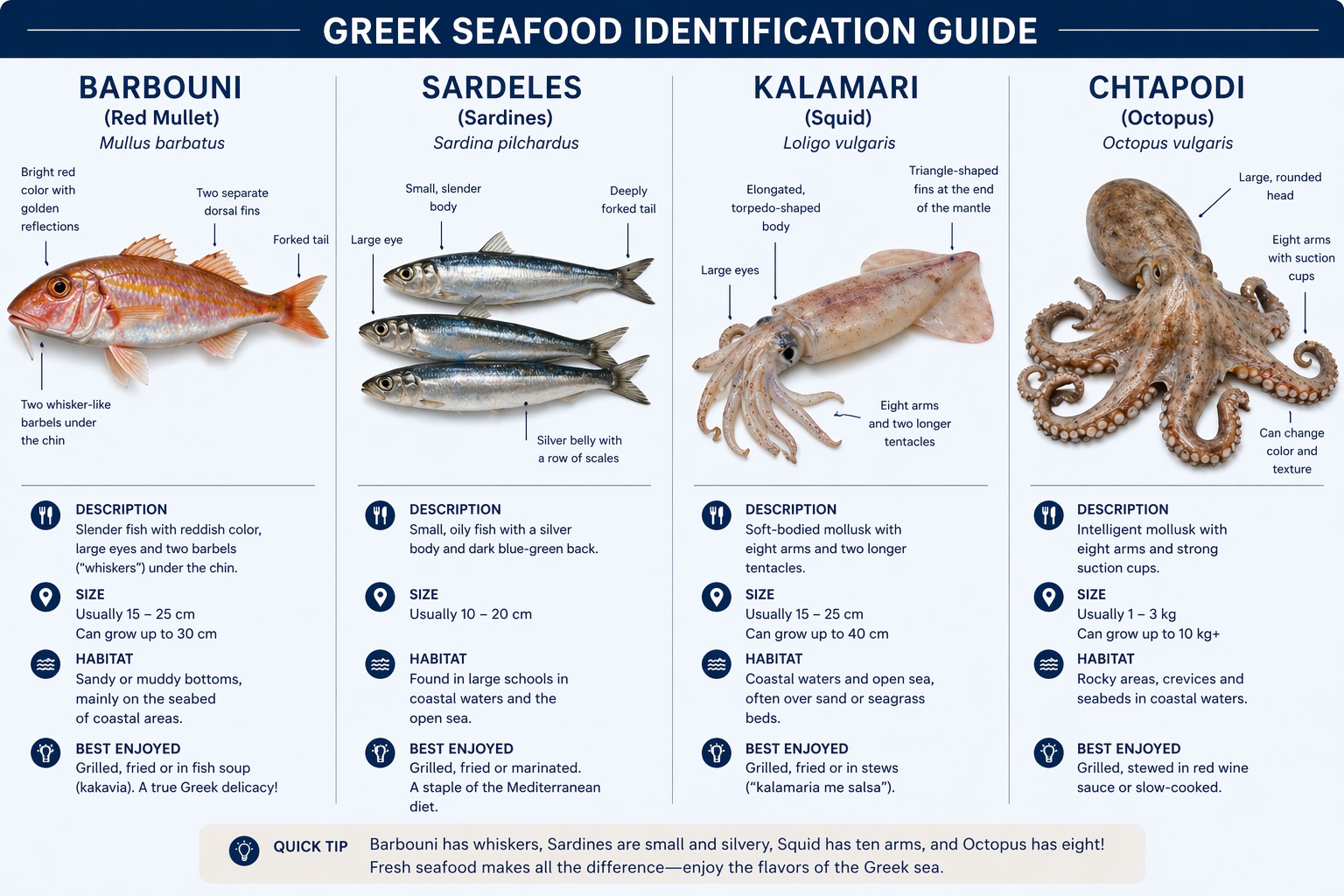
Fish Markets. Fish supply on Thirasia is limited. Fresh fish may be available from local fishing boats at Riva or Korfos, but supply is irregular and depends on weather, landings, and local demand. There is no formal fish market on Thirasia. Seafood is more reliably available through tavernas at Korfos, Riva, and Manolas, where common items may include small local fish, sea bream, red mullet, squid, octopus, cuttlefish, and prawns.
Thirasia Greece Sailing Guide - Local
Cuisine
Local cuisine on Thirasia follows Santorini and Cyclades cooking, with simple dishes based on pulses, tomatoes, capers, onions, olive oil, fish, goat, pork, and local cheese. Common dishes include fava, tomato fritters, caper salad, grilled fish, fried calamari, octopus, kakavia fish soup, souvlaki, goat stew, pork dishes, gemista, horiatiki salad, local cheese, olives, and bread. Local products used in tavernas include Santorini fava, cherry tomatoes, capers, wild herbs, figs, grapes, honey, local wine, and seasonal seafood. Food supply is limited by island size and ferry supply, so menus are usually based on available produce and daily catch rather than wide fixed choice.
Thirasia Greece Sailing Guide - Local
Beverages
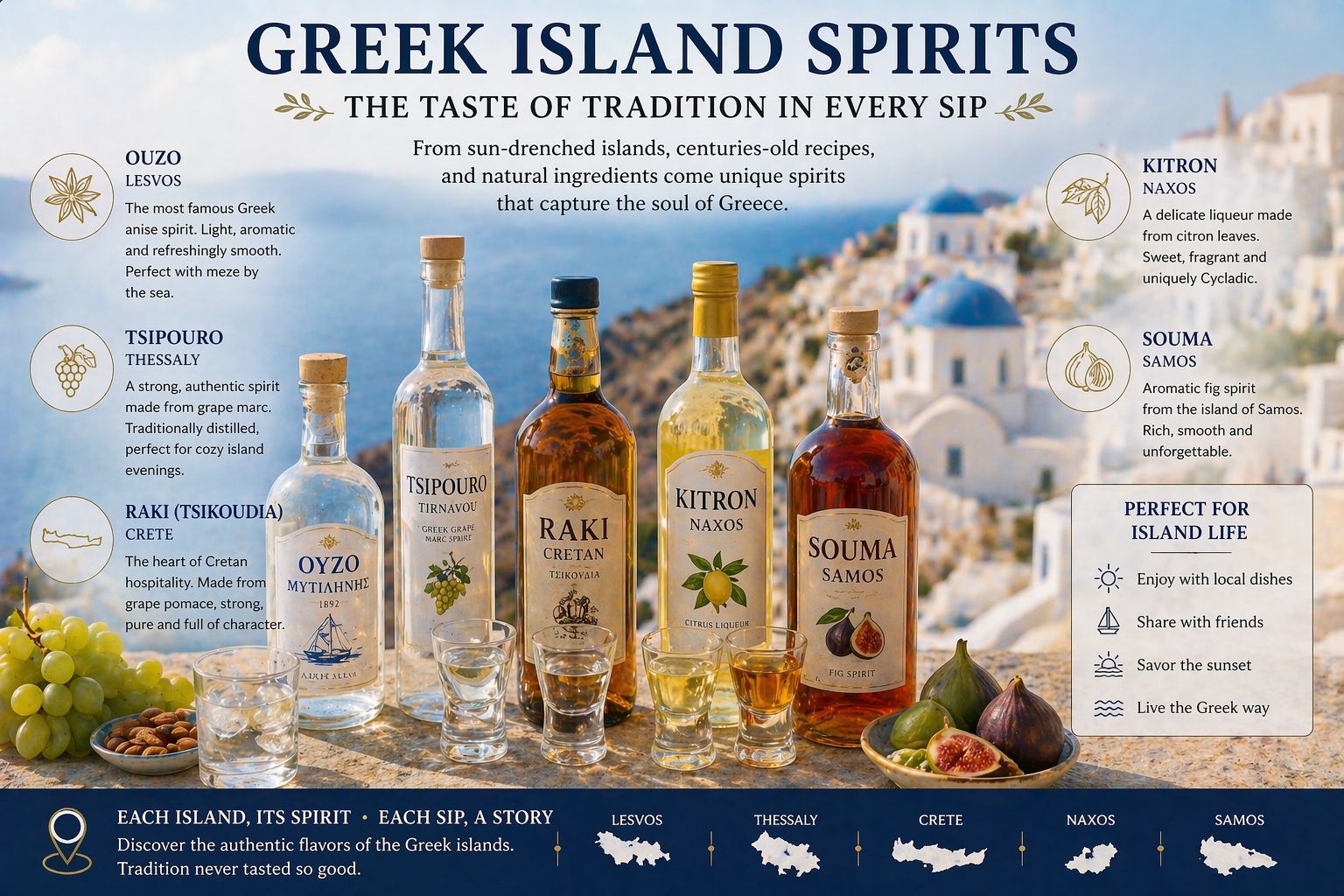
Local wine from Santorini is available. Standard Greek beers and spirits including ouzo are available in limited quantities. Non-alcoholic beverages are bottled products.
Thirasia Greece Sailing Guide - Diesel
Fuel Supplies
Diesel fuel is not available on Thirasia. There is no marina fuel berth, fuel dock, or regular yacht fuel delivery service on the island. Yachts should refuel before arrival at Santorini, Ios, Naxos, or another equipped Cyclades harbour. Emergency small-quantity fuel may be possible only by local arrangement in jerry cans, but it should not be relied on.
Thirasia Greece Sailing Guide - Water
Supplies
Water supply on Thirasia is limited. There is no marina water berth or reliable yacht water service at Riva, Korfos, or the island’s small landing points. Bottled water is available from Karkanias Mini Market in Manolas, small grocery stores and mini markets.
Mechanical and Electrical Repairs
Resource
If you are headed somewhere remote consider the need to expand your knowledge base or have an information resource on board. Why not get a copy of my book The Marine and Electrical and Electronics Bible 4th Edition. By and for yachties, with everything from batteries and charging, solar and wind, diesel engines and marine electronics and so much more. Your complete systems guide. 650 pages of practical advice. In Australia and New Zealand order a copy through Boat Books. UK and European boats can buy the UK Edition Here. US and Canadian boats can get the US Edition Order Here. Marine systems are my profession so let me help you. By a liveaboard boat owner for other boat owners.



Thirasia Greece Sailing Guide - Marine
Services
No marine service facilities exist on Thirasia. Minor assistance may be possible locally. Full service capability requires transit to Santorini.
Thirasia Greece Sailing Guide - Local
Etiquette
Interpersonal etiquette on Thirasia is informal, quiet, and village-based. Use basic greetings in shops, cafés, tavernas, and ferry areas: kalimera in the morning, kalispera later in the day, and efcharisto when leaving. Dress is casual, but swimwear is not normal in shops, tavernas, churches, or village streets. Keep communication polite and patient, especially around Manolas, Riva, and Korfos, where services are small-scale and seasonal. Avoid loud behaviour, blocking narrow lanes, entering private yards, or assuming supplies, water, berthing, or transport are available without asking first.
Thirasia Greece Sailing Guide - Summary
Thirasia provides limited anchorage and berthing primarily at Korfos within the Santorini caldera. Protection is dependent on wind direction with exposure to southerly systems. Infrastructure is minimal with reliance on Santorini for services. Navigation is straightforward but constrained by depth and space. The Thirasia Greece Sailing Guide has all you need to know.