Thessaloniki
Greece Sailing Guide
Thessaloniki Greece Sailing Guide. Situated at the head of the Thermaic Gulf in Thessaloniki, this port functions as a major commercial harbour with extensive traffic movements, large vessel berthing, and defined traffic separation. The waterfront extends along a continuous urban frontage with limited sheltered anchoring options in immediate proximity. Approaches are open to the south-southwest with long fetch across the gulf, generating short, steep seas under fresh southerlies. Depths increase gradually from the outer gulf toward the port approaches, with maintained dredged channels and turning basins supporting deep-draft commercial shipping.
For a cruising yacht, Thessaloniki is primarily a port of entry, provisioning point, and service location rather than a destination for extended anchorage. Berthing is concentrated within organised marina facilities and designated harbour zones, with restricted areas surrounding commercial quays, ferry terminals, and naval installations. Local conditions are influenced by seasonal wind patterns in the Thermaic Gulf, including northerly flows in summer and southerly systems in transitional periods, with associated sea state build-up across the gulf. Currents are generally weak but can be locally affected by wind-driven set and harbour movements.
Thessaloniki
Greece Sailing Guide - History
The area of Thessaloniki was established in 315 BC by Cassander, who consolidated a number of smaller settlements around the head of the Thermaic Gulf into a single urban centre. Its position at the northern Aegean made it a key maritime and overland junction, linking inland Balkan routes with sea trade. Under Roman Empire control, the city developed as a principal port on the Via Egnatia, facilitating movement of goods, military logistics, and communication across the region. Harbour infrastructure expanded progressively, establishing Thessaloniki as a primary commercial outlet for the hinterland.
Through the Byzantine Empire period, the port remained strategically significant, with fortified waterfronts and sustained maritime trade activity. Control shifted during the Ottoman conquest of Thessaloniki, after which the harbour continued to operate as a regional trading port with modifications to accommodate changing shipping practices. Integration into the modern Greek state followed the First Balkan War, leading to redevelopment of port facilities and expansion of commercial shipping capacity. The present harbour reflects successive phases of construction, with modern breakwaters, dredged basins, and industrial quays supporting contemporary cargo operations alongside limited marina infrastructure for smaller vessels.
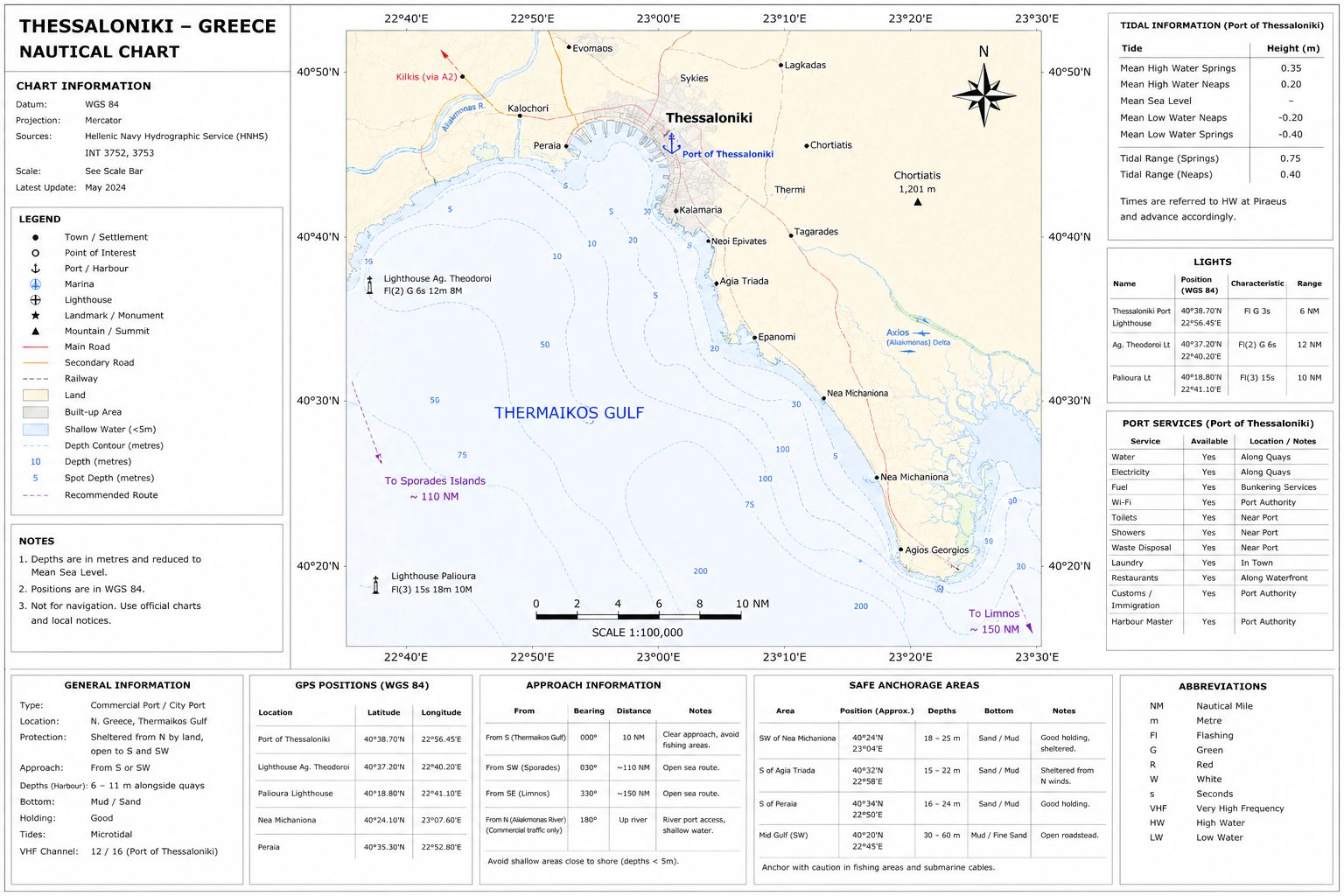
Chart Disclaimer. This chart is a schematic representation for illustrative purposes only and must not be used for navigation. Refer to official hydrographic charts for safe navigation. Be aware ENC charts may differ from official hydrographic charts. Both should be corrected and updated regularly.
Thessaloniki
Greece Sailing Guide - Ocean
Currents and Tides
Within the Thermaic Gulf, tidal influence at Thessaloniki is negligible for navigation, with a microtidal range typically less than 0.3 m. There is no significant tidal stream development, and water level variation is more strongly affected by barometric pressure changes and wind setup within the enclosed gulf. Prolonged southerly winds can raise water levels along the northern shoreline, while sustained northerlies can produce a measurable set-down.
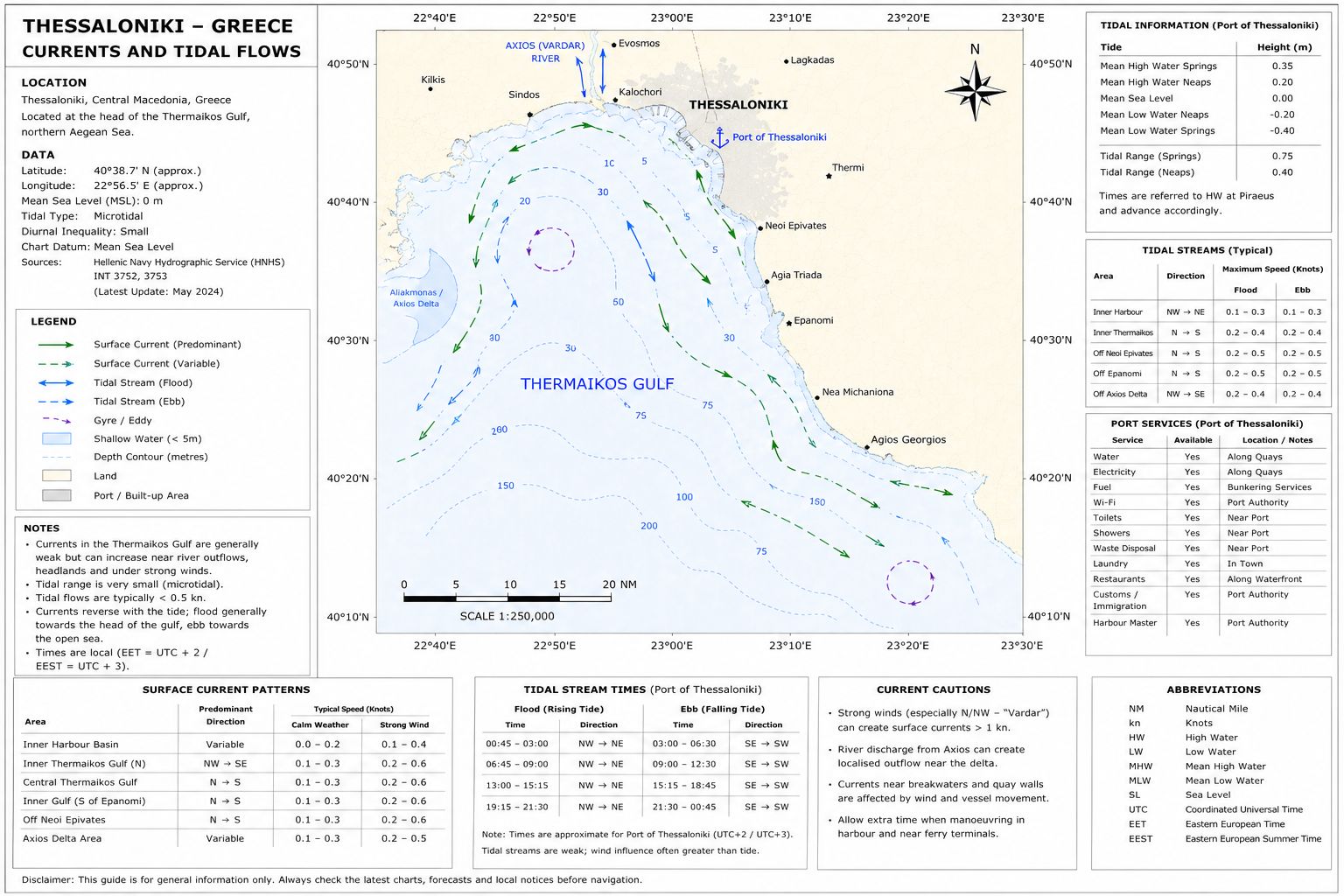
Current flow is weak and predominantly wind-driven. In settled conditions, surface drift is minimal and variable. Under fresh southerly winds, a northward set develops toward the head of the gulf, with short-period steep seas building over the shallow gradient. Northerly winds generate a reverse southward set, often accompanied by flatter sea states but increased short chop near the urban waterfront due to reflected wave action. Localised current effects may be observed in proximity to harbour entrances, breakwaters, and commercial basins due to vessel movement and confined water displacement, but these are intermittent and not chart-predictable.
Thessaloniki
Greece Sailing Guide - Weather
Weather conditions at Thessaloniki are governed by its position at the head of the Thermaic Gulf, with a transitional Mediterranean–continental regime. Summers are typically hot, dry, and stable, with prolonged periods of clear visibility and light pressure gradients. Afternoon sea breezes develop along the gulf axis, generally from the south to southeast, increasing to 10–15 knots and moderating near sunset. In contrast, northerly winds associated with regional systems can establish more persistent flows, occasionally fresh to strong, producing short, steep seas over the limited fetch toward the port approaches.
Winter conditions are more variable and driven by passing low-pressure systems across the northern Aegean and Balkans. Southerly winds ahead of frontal passages can build rapidly, generating reduced visibility, rain bands, and steep sea states across the gulf. Following frontal passage, winds typically veer northwest to north, often increasing in strength with colder, drier air and improved visibility. Thunderstorm activity is most common in transitional seasons, with locally severe gusts and rapid wind shifts. For harbour operations, wind direction is the primary factor affecting sea state and water level within the gulf, while swell penetration into port areas remains limited due to the enclosed geography.
The Marine Electrical and Electronics Bible has a complete list of Greek VHF Radio Channel information and weather forecast times for Greece along with NAVTEX UK and Europe and NAVTEX Mediterranean for 490kHz and 518kHz.
Thessaloniki
Greece Sailing Guide - Local Winds
Local wind patterns at Thessaloniki are strongly influenced by the funneling effect of the Thermaic Gulf and surrounding terrain. The dominant regime in summer is a diurnal cycle. Light offshore or variable winds prevail overnight and early morning, followed by the development of a sea breeze from the south to southeast by late morning. This typically builds to 10–15 knots in the afternoon, aligned along the axis of the gulf, before easing again toward evening. The fetch allows short, steep wave formation despite moderate wind speeds, particularly toward the head of the gulf.
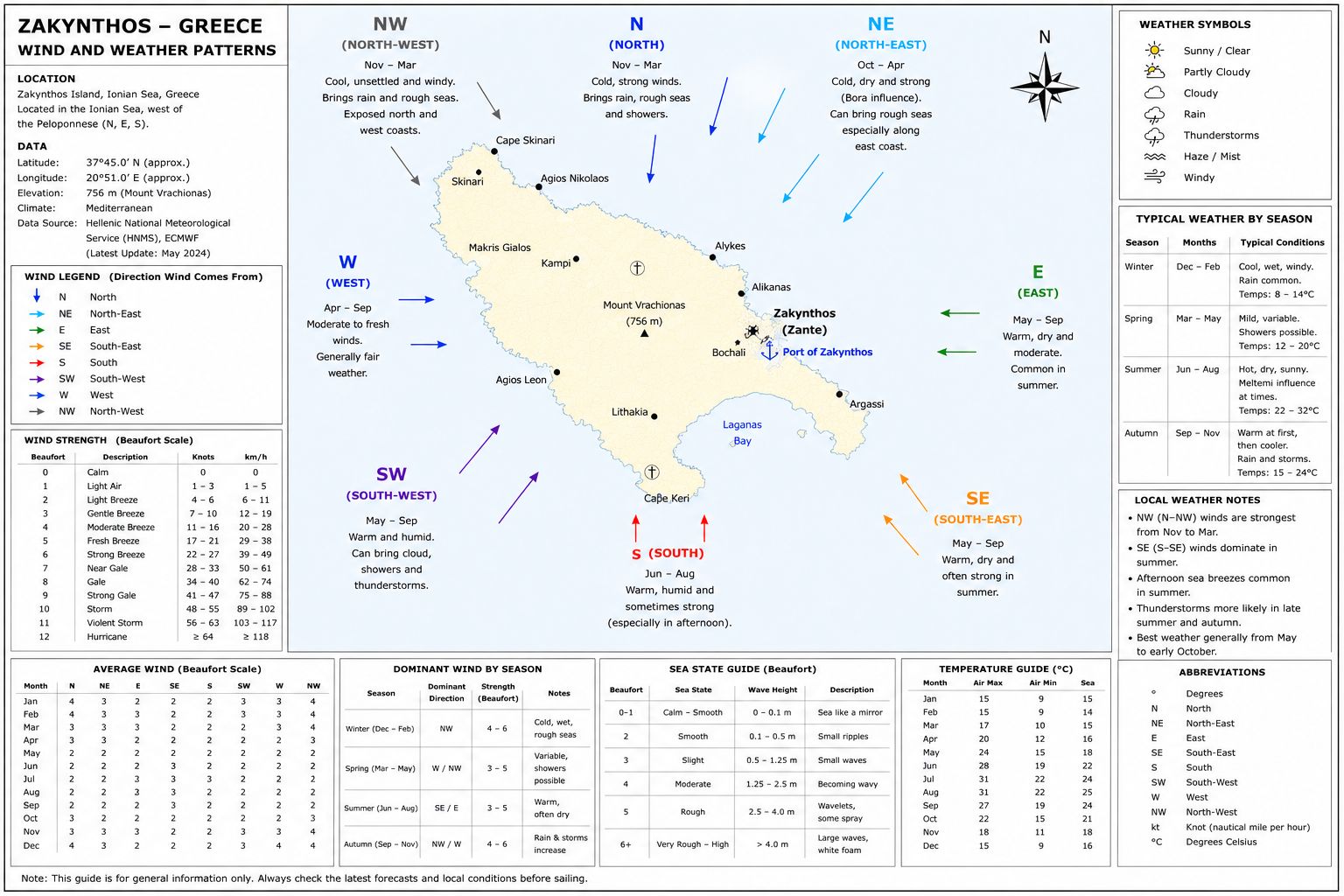
The Vardaris is a local northerly wind affecting northern Greece, particularly around Thessaloniki and the Thermaic Gulf. It originates inland over the Balkans and is channelled southward through the Vardar/Axios valley, where the terrain accelerates the flow toward the coast. The wind is cold, dry, and typically blows from the north to north-west, developing rapidly and often without extended warning. It is characterised by gusting rather than steady flow, producing sudden increases in wind strength, sharp drops in temperature, and low humidity. In coastal and harbour environments it generates short-period wind-driven chop and significant turbulence, with wind direction and strength varying quickly due to interaction with urban structures and terrain.
Thessaloniki
Greece Sailing Guide - Approaches
Approach is made from the Thermaic Gulf toward the harbour entrance defined by breakwaters. Depths in the outer approach exceed 20 m and reduce gradually toward the port. The entrance channel is wide and dredged for commercial traffic. No bar or shallow sill exists. Navigation hazards are limited to traffic density rather than depth restriction. Wind-driven set may occur across the approach track under strong northerly or southerly winds. Commercial traffic operates continuously and must be accounted for during entry.
Thessaloniki
Greece Sailing Guide - Navigation
Port navigation at Thessaloniki is conducted within a controlled commercial harbour administered by port authority and VTS. Entry is via a dredged, buoyed channel aligned from the south–southwest into the main basins at the head of the Thermaic Gulf. Maintain continuous VHF watch on port working channels and monitor traffic movements prior to committing to the approach. Deep-draft cargo vessels, ferries, and tugs operate continuously; their movements dictate sequencing within the channel and turning areas.
Manoeuvring space is constrained by quay alignments, breakwaters, and active berths. Turning basins are designated for commercial vessels; small craft are to remain clear at all times. Cross-channel movement should be avoided unless specifically required and only when clear of traffic. Expect propeller wash and surge effects in proximity to large vessels, particularly during berthing and departure.
Navigation marks are standard IALA Region A lateral buoyage, supported by leading lights and sector lights defining the dredged channel. Background lighting from the urban waterfront reduces contrast at night; visual identification of marks requires close attention. Radar returns from port infrastructure are strong and can mask smaller targets in confined water. Depths are maintained within dredged limits; outside these areas, depths reduce progressively with no guarantee of charted clearance.
Restricted zones are enforced around commercial quays, ferry terminals, and naval installations. Anchoring within port limits is generally prohibited except in designated areas and is not suitable for small craft due to traffic and depth. Berthing for yachts is confined to allocated marina facilities and specific harbour sections; direct use of commercial quays is not available. Wind effects within the port are variable due to shielding and channeling between structures, producing gusts and localised shifts that affect low-speed control alongside.
Thessaloniki
Greece Sailing Guide - Chart
Accuracy
Hydrographic charts for Thessaloniki harbour are maintained to commercial standards and accurately depict basin layout and depths. Electronic charts correspond closely to published data. Local variation occurs near quay edges due to sediment and debris. Depth verification by sounder is required when berthing. Note- Have you checked your offsets lately?
Thessaloniki
Greece Sailing Guide - Anchorages
Anchorage options in the immediate vicinity of Thessaloniki are limited and generally unsuitable due to commercial traffic density, depth, and seabed conditions at the head of the Thermaic Gulf. Within port limits, anchoring is restricted or prohibited outside designated areas, and there are no practical holding positions for a cruising yacht clear of shipping lanes and manoeuvring zones. Depths increase rapidly off the waterfront, with soft mud substrates and poor holding characteristics where depths are excessive. No anchorage is available near central quay berthing or Kapani.
Thessaloniki
Greece Sailing Guide - Entry
Formalities
Thessaloniki is an official port of entry. Clearance is conducted with Port Police, Customs, and Immigration. Documentation includes vessel registration, passports, crew list, and insurance. TEPAI cruising tax applies. AIS transmission is required where applicable. Drone use is restricted within port and urban areas. Satellite systems including Starlink are subject to national regulation.
Thessaloniki
Greece Sailing Guide - Marina
Facilities
Marina and berthing for cruising yachts at Thessaloniki is concentrated in designated small-craft facilities separate from the main commercial port within the Thermaic Gulf. The primary option is Thessaloniki Marina (Aretsou/Kalamaria area), located southeast of the commercial harbour. This facility provides organised berthing with fixed pontoons and stern-to mooring arrangements. Depths are suitable for cruising yachts, generally in the 3–5 m range alongside, with sheltered conditions under most wind directions except strong southerlies, which can introduce surge within the basin.
Berthing is also available in smaller municipal harbours and yacht basins along the Kalamaria waterfront, though these are limited in capacity and infrastructure. Quay berthing is typically stern-to with laid moorings or anchor assistance. Space availability is variable, particularly during peak summer periods, and advance contact is advisable where possible. These locations provide basic access rather than full marina services.
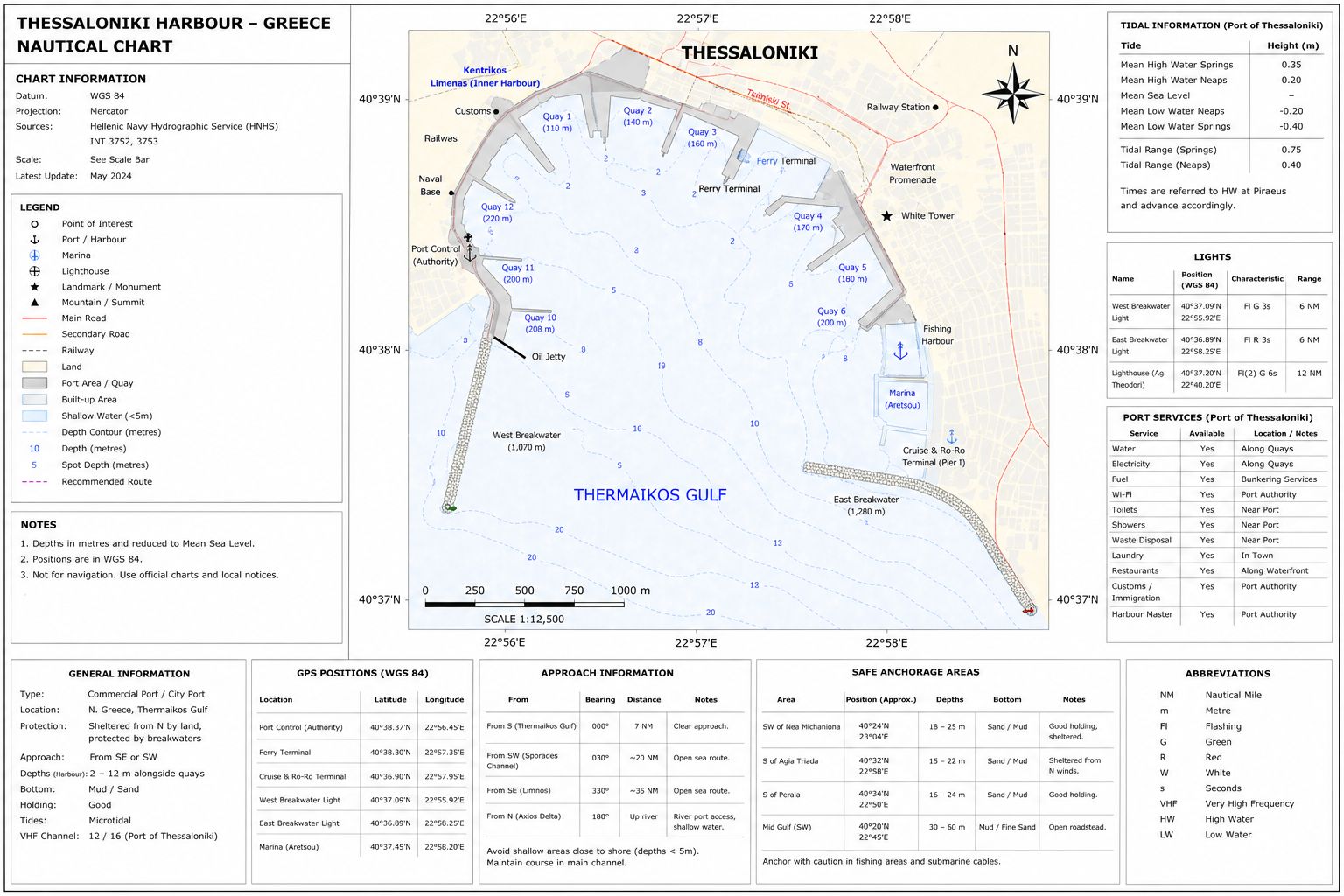
The main commercial port of Thessaloniki is not available for recreational berthing. Commercial quays, ferry terminals, and industrial berths are restricted, with active traffic and security controls in place. Transiting yachts are required to proceed directly to allocated small-craft facilities or remain clear of port operations.
Thessaloniki
Greece Sailing Guide - Provisioning
Supermarkets. Supermarket provisioning in Thessaloniki is comprehensive. Smaller neighbourhood supermarkets and minimarkets supplement this supply, often located within short walking distance of marina and harbour areas. AB Vassilopoulos, Sklavenitis, and Lidl operate within 1 km to 3 km of central quay berths with typical hours 08:00–21:00. Smaller supermarkets and grocers operate within 200 m to 500 m of the waterfront.
Markets. Kapani Market is located directly behind Aristotelous Square within walking distance of central berthing. It operates daily with peak activity from early morning to early afternoon. The market consists of covered lanes with fixed vendors. Supply includes regional produce including Florina peppers sold fresh and roasted and Halkidiki olives sold cured and prepared. Additional supply includes cheeses, cured meats, spices, legumes, honey, and fresh vegetables sourced from northern Greece.
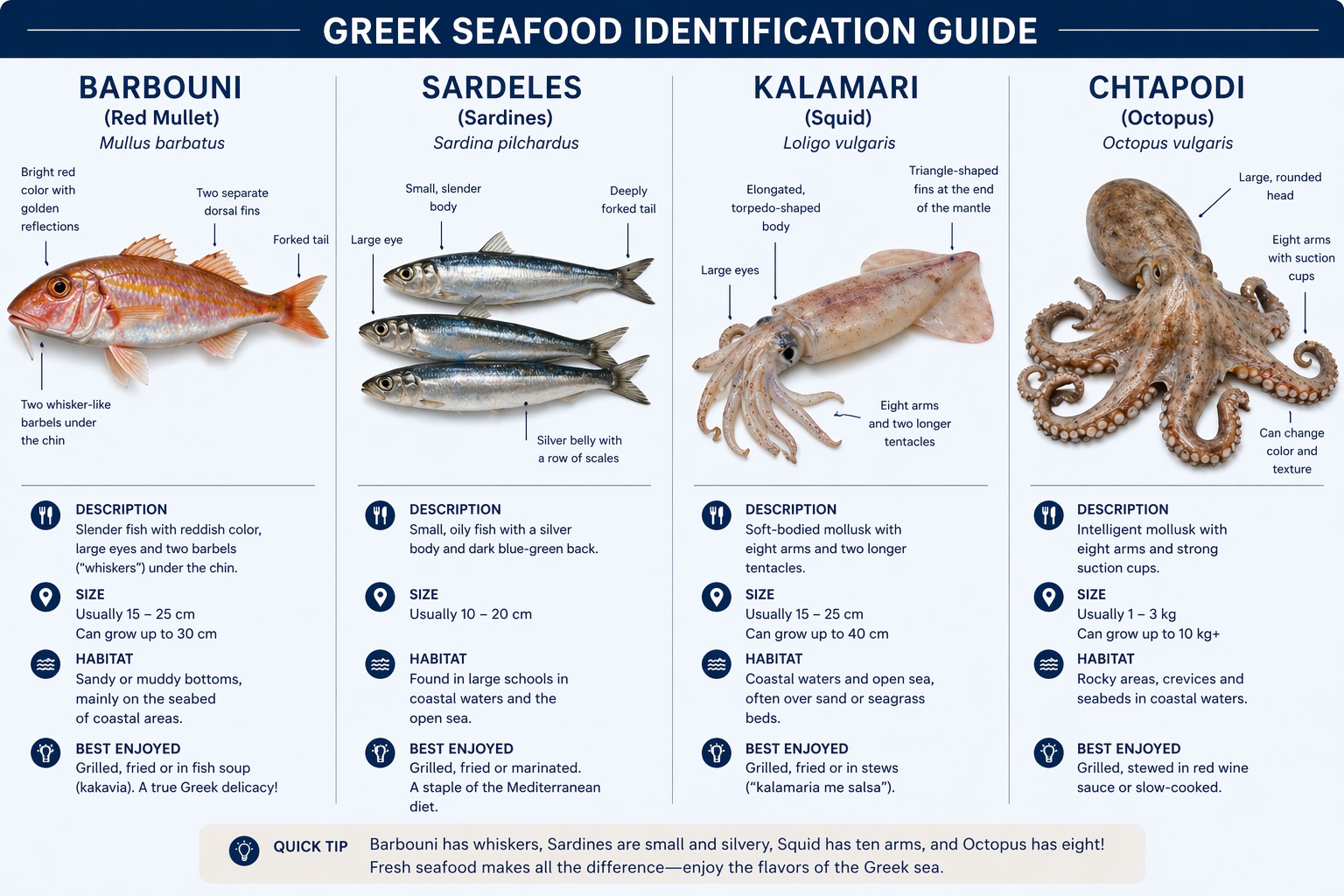
Fish Markets. The main fish market in Thessaloniki is the Modiano Market (historically linked with the central market district), where multiple vendors supply fresh fish and seafood on a daily basis. Stock is sourced from the Thermaic Gulf and wider Aegean, Species include tsipoura (gilthead bream), lavraki (sea bass), sardela (sardine), gavros (anchovy), barbouni (red mullet), kalamari (squid), and octopus. Additional supply is available from harbour vendors.
Thessaloniki
Greece Sailing Guide - Local Cuisine
Cuisine reflects northern Greek and Macedonian food patterns. Florina peppers are used roasted, stuffed, and preserved. Halkidiki olives are consumed as table olives and used in dishes. Bougatsa is a local pastry made with layered phyllo filled with custard, cheese, or minced meat. Soutzoukakia consists of spiced minced meat cooked in tomato sauce. Seafood includes sardela and gavros fried whole and octopus prepared grilled or stewed. Legumes including lentils and beans are prepared as stews. Food preparation reflects regional agricultural supply and daily market availability.
Halkidiki olives are a major regional product from Halkidiki and are widely available in Thessaloniki in both bulk and packaged form. They are large, firm green olives harvested before full ripening, with a high flesh-to-pit ratio and mild, slightly tangy flavour. Processing is typically by brining, with variations including plain salted, garlic, lemon, or herb-infused preparations, and they are also commonly sold stuffed (e.g., with almond, pepper, or garlic).

Florina peppers are a standard northern Greek product widely available in Thessaloniki, typically encountered in preserved form rather than fresh. Originating from the Florina region, they are long, thick-fleshed red peppers with a sweet profile and no heat. For provisioning, they are most commonly sold roasted and peeled, then packed in oil, brine, or vinegar, giving a stable product with extended shelf life suitable for onboard storage. They are used as a ready-to-eat item or as an ingredient in salads, grain dishes, and meat preparations. Fresh peppers are seasonal and less consistently available, whereas jarred or vacuum-packed forms are stocked year-round in supermarkets and delicatessens,
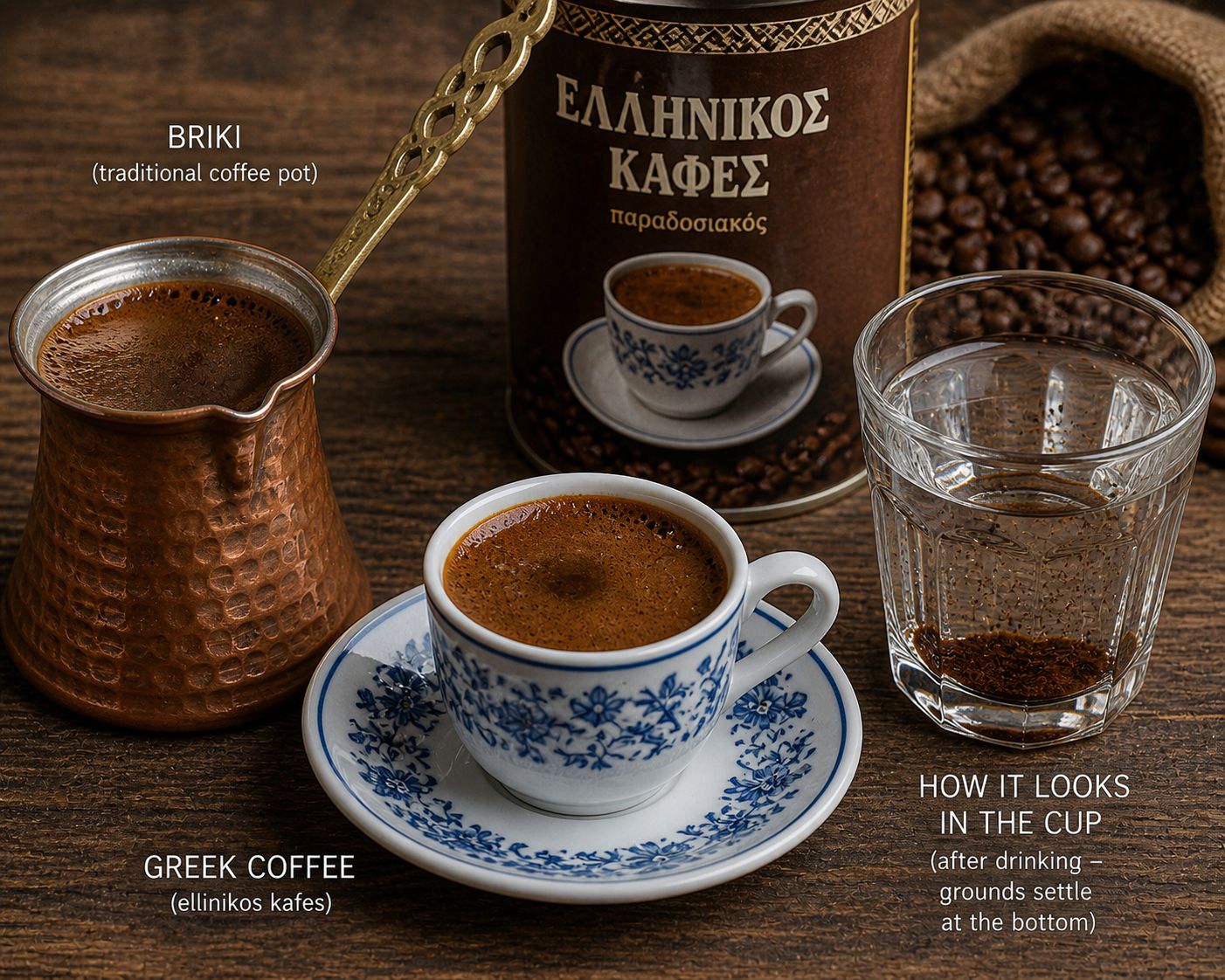
Greek coffee (ellinikos kafes) is a standard beverage in Thessaloniki, prepared by boiling finely ground coffee with water in a small pot (briki) and served unfiltered in a small cup. The brew includes the grounds, which settle at the base, producing a dense liquid with a thick surface foam (kaimaki). It is typically prepared to order in varying sweetness levels—unsweetened (sketos), medium (metrios), or sweet (glykos)—and consumed slowly, allowing the grounds to settle. For provisioning, it is widely available in supermarkets and small shops as finely ground coffee, requiring no specialised equipment beyond the briki, and is suitable for onboard preparation due to its simple method and minimal storage requirements.
Thessaloniki
Greece Sailing Guide - Local
Beverages
Beer, wine, and spirits across the Greek islands are locally produced and widely available through tavernas, small bars, and provisioning outlets. Beer is predominantly lager, with domestic brands including Mythos, Alfa, Fix, and Vergina alongside imported products; and over 100 microbreweries operate on several islands with limited distribution. Wine is region-specific, with white varieties dominant in the islands, including Assyrtiko, Moschofilero, and Roditis, alongside local table wines served in bulk; retsina remains in circulation as a resin-flavoured wine. Distilled products include ouzo (anise-based), tsipouro (grape marc distillate), raki or tsikoudia (Crete), souma (fig or grape distillate in eastern Aegean islands), and kitron (citrus liqueur from Naxos), with alcohol strength typically in the 37–45% range and higher for unregulated local distillations.
Thessaloniki
Greece Sailing Guide - Diesel Fuel
Supplies
Diesel supply in Thessaloniki is available alongside within designated port fuel berths and through roadside fuel stations with delivery to quay. Within the commercial port and marina areas, fuel is supplied either directly from fixed fuel points where accessible or by tanker truck delivery arranged through local suppliers. Roadside stations including Shell, EKO, BP, and Avin operate throughout the Thessaloniki port and urban area and are used for jerry can transfer or coordinated quay delivery depending on berth location. Transfer methods therefore include direct pump delivery at fuel berths, road tanker supply to the waterfront, and manual jerry can transfer for smaller quantities. No universal fuel pontoon exists across all quay sections, and supply method depends on berth allocation within the port. Fuel is standard automotive or marine diesel, and onboard filtration is required prior to use.
Thessaloniki
Greece Sailing Guide - Water
Supplies
Potable water in Thessaloniki is supplied from the municipal network and is available along sections of the waterfront quay and within marina facilities where installed. At quay berths, water access is provided at fixed connection points, but supply is not continuous along the full length of the harbour and depends on berth position and local arrangement. Within organised marina areas, water is distributed through dedicated supply points with more consistent pressure and availability. At open quay locations, pressure varies with demand and may reduce during peak usage periods. Connections are not standardised and vessels are required to provide their own hose and fittings. Water is treated municipal supply suitable for tank filling, with onboard filtration used as required.
Mechanical and Electrical Repairs
Resource
If you are headed somewhere remote consider the need to expand your knowledge base or have an information resource on board. Why not get a copy of my book The Marine and Electrical and Electronics Bible 4th Edition. By and for yachties, with everything from batteries and charging, solar and wind, diesel engines and marine electronics and so much more. Your complete systems guide. 650 pages of practical advice. In Australia and New Zealand order a copy through Boat Books. UK and European boats can buy the UK Edition Here. US and Canadian boats can get the US Edition Order Here. Marine systems are my profession so let me help you. By a liveaboard boat owner for other boat owners.



Thessaloniki
Greece Sailing Guide - Marine
Services
Marine services in Thessaloniki are based within the commercial port area and the industrial zones to the west of the harbour and provide full support capability for cruising yachts. Service includes diesel engine maintenance and repair, electrical systems, marine electronics, fabrication, and general mechanical work carried out by established workshops. Authorised support is available locally for Yanmar and Volvo Penta installations. Marine electronics service is available for Raymarine, B&G, and Simrad systems including installation, calibration, and fault diagnosis. Haul-out, antifouling, hull repair, and structural work are available at facilities outside the central quay area, requiring relocation by water to yards equipped with travel lift and hardstand. Parts supply is continuous through local distributors and chandlery outlets within the Thessaloniki port and urban area.
Thessaloniki
Greece Sailing Guide - Local
Etiquette
In Thessaloniki, interaction is direct and begins with a greeting before any transaction. Dress ashore is standard urban wear, with beachwear limited to waterfront areas. Meal times are later with evening dining typically after 20:00, and alcohol such as ouzo and tsipouro is diluted and consumed over extended periods. Cash is commonly used in markets such as Kapani while cards are accepted in larger outlets, tipping is by rounding, and conversational tone is direct without indicating conflict.
Thessaloniki
Greece Sailing Guide - Summary
Thessaloniki operates as a commercial harbour with designated yacht berthing within an enclosed basin. The location provides direct access to urban provisioning infrastructure including Kapani market within walking distance of quay berths. Marine services, fuel supply, and municipal water are available within the port area. The harbour functions as an urban operational base consistent with a Thessaloniki Greece Sailing Guide for all you need to know.