Thassos Greece
Sailing Guide
Thassos Greece Sailing Guide. Thassos lies in the northern Aegean off the mainland coast of eastern Macedonia, with the shortest mainland access between Keramoti and Limenas. The island is a coastal cruising destination with several small harbours, ferry ports, and anchorages distributed around its perimeter rather than one central yacht marina. Sailing operations are affected by northern Aegean wind patterns, ferry traffic, limited harbour depths, and the need to match anchorage choice to wind direction.
Thassos Greece Sailing Guide.Thassos lies in the northern Aegean off the mainland coast of eastern Macedonia, with the shortest mainland access between Keramoti and Limenas. The island is a coastal cruising destination with several small harbours, ferry ports, and anchorages distributed around its perimeter rather than one central yacht marina. Sailing operations are affected by northern Aegean wind patterns, ferry traffic, limited harbour depths, and the need to match anchorage choice to wind direction.
The main yacht-use ports are Limenas on the north-east side, Skala Prinos on the north-west side, Limenaria on the south-west side, and smaller harbour or quay options at locations including Skala Kallirachis, Potos, and Skala Potamia depending on draught and weather. The coastline is steep-to in many places, with depths increasing rapidly outside the bays. The island economy includes fishing, olive oil, honey, marble, and seasonal provisioning networks, with island produce including Thassian honey, olives, olive oil, almonds, walnuts, and wine.
Thassos Greece
Sailing Guide - History
Thassos has a long maritime history linked to northern Aegean trade routes, mineral extraction, timber, and harbour control. The island was colonised from Paros in antiquity and developed as a trading and resource island with access to timber, metals, marble, wine, and agricultural products. Ancient harbour works and archaeological remains are concentrated around Limenas, where the old city, theatre, agora, and harbour remains connect the modern port to earlier maritime use.
The island’s marble quarries were worked from antiquity, especially around Aliki, and marble export shaped coastal movement and harbour use. During later Byzantine, Ottoman, and modern periods, Thassos remained tied to mainland trade through short sea routes to Kavala and Keramoti. Modern ferry operations continue this mainland link, with Limenas connected to Keramoti and Skala Prinos connected to Kavala.
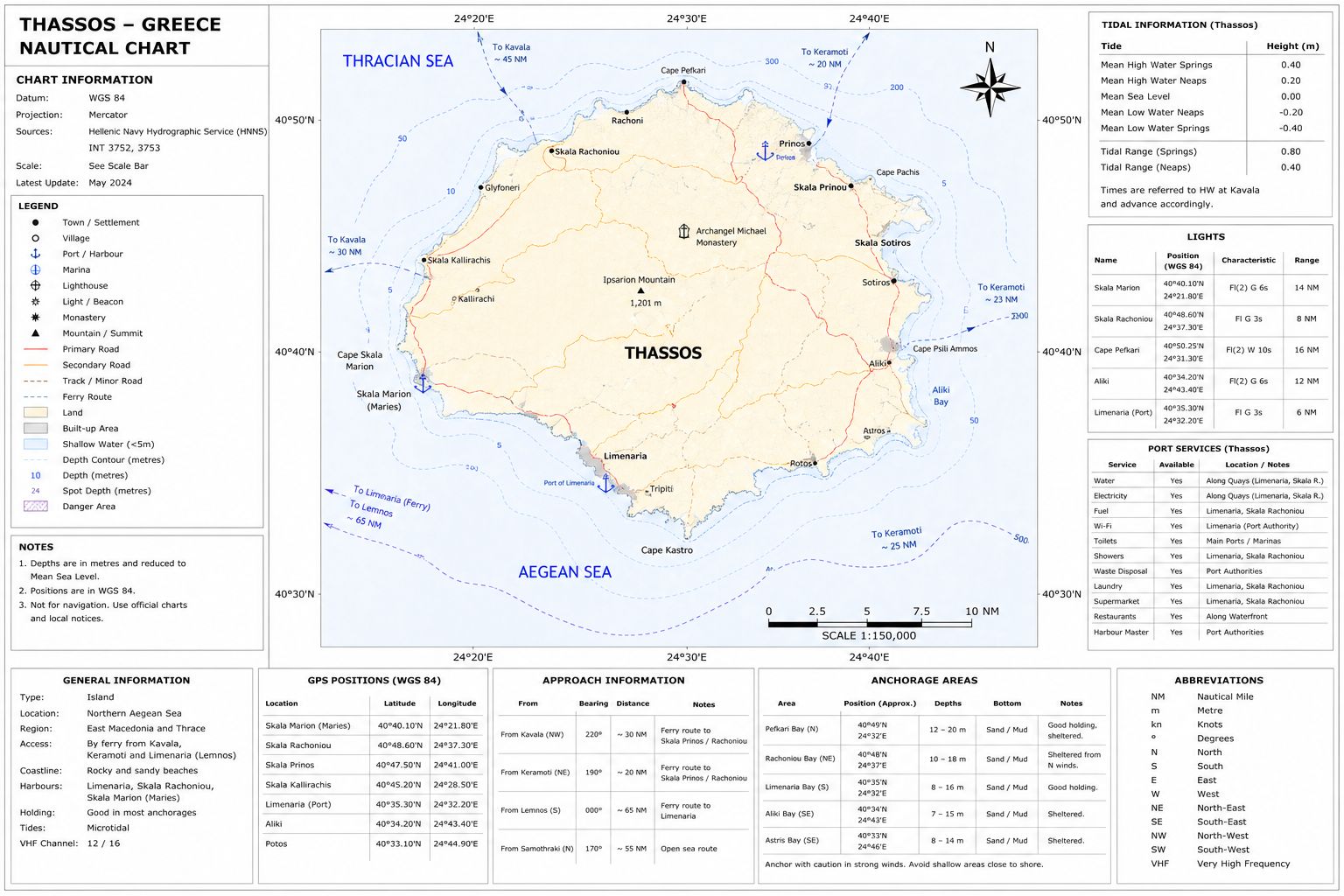
Chart Disclaimer. This chart is a schematic representation for illustrative purposes only and must not be used for navigation. Refer to official hydrographic charts for safe navigation. Be aware ENC charts may differ from official hydrographic charts. Both should be corrected and updated regularly.
Thassos Greece
Sailing Guide - Ocean Currents and Tides
Tidal range around Thassos is small and normally not a limiting factor for yacht navigation. Water movement is mainly wind-driven, with local set developing in the channel between Thassos and the mainland and around headlands. In settled weather, current is generally weak, often less than 1 knot, but wind-driven movement can be noticeable when sustained northerly or southerly flow pushes water through the mainland channel.
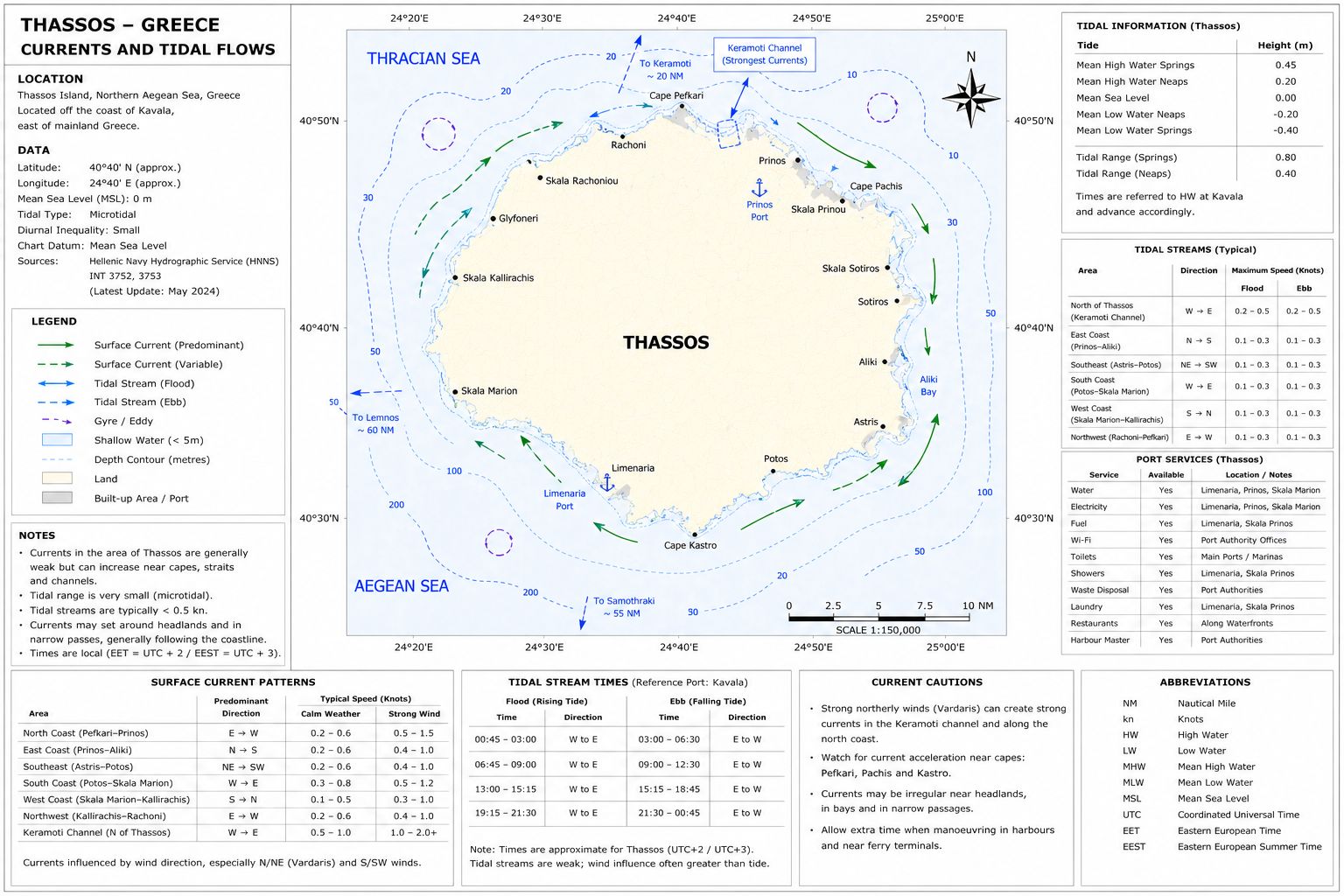
The Keramoti–Limenas channel has the most traffic and the most consistent water movement due to ferry wash, wind set, and restricted sea room between the island and mainland. Around exposed headlands, surface set follows wind direction and can combine with short steep sea under opposing conditions. Inside small harbours, current is not normally a berthing factor, but surge, ferry wash, and reflected sea can affect moored yachts.
Thassos Greece
Sailing Guide - Weather
Thassos has a northern Aegean Mediterranean pattern with dry summer periods and wetter winter conditions. Summer visibility is generally good, but heat haze can occur over the mainland and in the channel. Afternoon thermal wind can increase locally around headlands and along the open coasts. Winter and shoulder-season conditions are affected by low-pressure systems crossing the northern Aegean. These systems bring rain, reduced visibility, and rapid wind shifts. Northerly outbreaks can be cold and strong, while southerly systems can produce swell on the south and west coasts. Harbour choice is therefore weather-dependent, with no single small harbour on the island providing full protection from all directions.
The Marine Electrical and Electronics Bible has a complete list of Greek VHF Radio Channel information and weather forecast times for Greece along with NAVTEX UK and Europe and NAVTEX Mediterranean for 490kHz and 518kHz.
Thassos Greece
Sailing Guide - Local Winds
The main summer wind influence is the northerly Aegean flow, including Meltemi conditions when established across the northern Aegean. Northerly wind affects the north and east coasts directly and produces acceleration around exposed headlands. The south coast gains partial lee in northerly conditions but can still experience gusts descending from the island’s high ground. Southerly winds expose the south and south-west coast, including Limenaria and Potos approaches. Easterly conditions affect Limenas and the east coast anchorages. Westerly and north-westerly winds affect Skala Prinos and the west coast. Local katabatic gusts can occur off the higher terrain, especially where valleys open toward the coast.
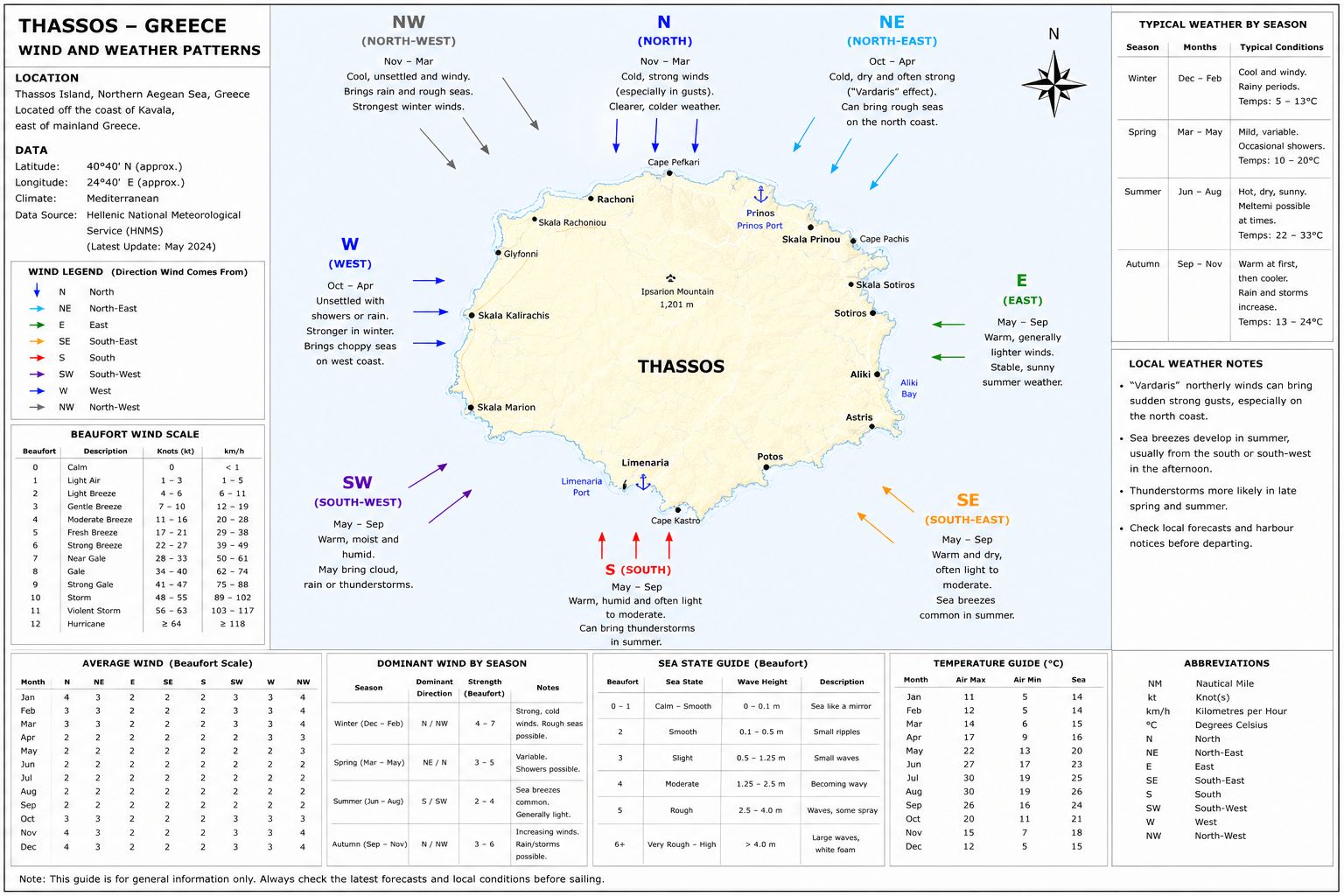
The Meltemi is a strong, dry northerly wind that dominates the Aegean in summer, accelerating through channels and between islands to produce steep, short seas. It is most persistent in July and August, often blowing for several days with little diurnal variation, creating fast north‑to‑south passages and challenging return routes. Its strength is shaped by pressure gradients between the Balkans and Anatolia, with local acceleration zones around major island gaps.
Thassos Greece
Sailing Guide - Approaches
Approach from the mainland is normally from Keramoti toward Limenas or from Kavala toward Skala Prinos. The Keramoti–Limenas route crosses the narrowest water between the island and mainland and carries frequent ferry traffic. The Kavala–Skala Prinos route is longer and enters the north-west side of the island. Offshore depths are generally greater than 20 m and the island is steep-to outside the bays.
Limenas approach is from the north-east, with ferry traffic the main operational hazard. The harbour entrance is protected by breakwaters and used by ferries and local vessels. Depths in the approach are adequate for yachts, but inner harbour depths reduce toward quay edges and should be checked by sounder. Skala Prinos approach is from the north-west and is affected by ferry movement on the Kavala route. Limenaria approach from the south-west has deeper water outside the harbour but is exposed under southerly conditions. Smaller quays around the island have limited depth and may be unsuitable for deeper-draught cruising yachts in settled water only.
Thassos Greece
Sailing Guide - Navigation
Navigation around Thassos is coastal and largely visual, but ferry routes must be treated as fixed traffic lanes. Ferries operate on scheduled routes between Keramoti and Limenas and between Kavala and Skala Prinos. Their approach speed, wash, and manoeuvring requirements dominate the harbour entrances used by yachts.
Limenas is the main harbour and administrative centre. Yacht berthing is normally on available quay sections outside ferry manoeuvring areas. Depths are generally in the range of 2.5 m to 5 m depending on position, with less water close to old quay edges. Skala Prinos has ferry infrastructure and local berthing, with similar caution required near ferry movement. Limenaria has a smaller harbour with quay berthing and reduced manoeuvring room. Potos, Skala Kallirachis, and other smaller harbour points should be treated as local craft harbours, with draught, surge, and quay availability assessed on arrival.
Night navigation is possible into the main harbours but should account for shore lighting, ferry movement, and unlit small craft. Fishing gear may be encountered close inshore, especially around working harbour approaches and bays used by local boats.
Thassos Greece
Sailing Guide - Chart Accuracy
Hydrographic charts show the island outline, main harbour structures, ferry ports, and coastal depths with sufficient accuracy for passage planning. The limitation is not the island-scale charting but the detail at small quay faces and secondary harbours, where silting, local debris, and small craft moorings change usable depth. Electronic charts should not be used as sole authority for close-in berthing. Sounder confirmation is required on final approach to quay walls and inside smaller basins. Satellite imagery can assist with identifying harbour layout and sandy anchorage patches but does not provide reliable depth information. Weed, rock patches, and harbour debris are not consistently represented on vector charts.
Thassos Greece
Sailing Guide - Anchorages
Anchorages around Thassos are weather-dependent. Many bays provide fair-weather anchoring only because the island is steep-to and exposed to wind shifts. Depths commonly range from 5 m to 15 m in usable anchoring zones, with sand, weed, rock patches, and mixed seabed. On the south and south-east coasts, anchorages can provide shelter from northerly winds where cliffs and high ground create lee. These areas become poor choices under southerly or south-easterly winds. On the north coast, anchorages and harbour approaches are exposed to northerly flow and ferry wash in the Limenas area. On the west coast near Skala Prinos and Skala Rachoni, shelter is dependent on wind direction and local fetch from the mainland channel. Holding is best where sand or mud is present. Weed patches reduce holding and require visual placement of the anchor. Rock patches occur close to shore in several bays. Scope may be limited by depth increasing rapidly outside the bay head.
Thassos Greece
Sailing Guide - Entry Formalities
Thassos is not normally treated as the primary international port of entry for foreign yachts. Clearance should be completed at an official port of entry such as Kavala before proceeding to the island. Standard Greek requirements apply, including vessel registration, passports, crew list, insurance, and TEPAI cruising tax compliance.
Port Police may be present in the main harbour areas, particularly Limenas and ferry ports. AIS requirements apply according to vessel size and regulations. Drone use is subject to Greek civil aviation rules and local restrictions near ports, ferry terminals, archaeological sites, and populated areas. Satellite communication equipment including Starlink is subject to national telecommunications rules, with no specific Thassos harbour prohibition identified.
Thassos Greece
Sailing Guide - Marina Facilities
Thassos does not have a full-service yacht marina equivalent to mainland marina facilities. Berthing is by harbour quay, local port basin, or anchorage. Limenas is the main harbour and provides the most practical yacht access, with quay depths generally about 2.5 m to 5 m depending on location. Berthing availability is constrained by ferries, fishing vessels, local craft, and seasonal demand. Mooring is normally stern-to or alongside where directed, using own anchor or existing harbour arrangements.
Skala Prinos provides ferry-port berthing and local quay space on the west side of the island. Depths are variable and must be checked on approach. Ferry manoeuvring takes priority. Limenaria provides a smaller harbour on the south-west coast with quay berthing suitable for yachts in settled conditions and appropriate draught. Shelter depends on wind direction, and southerly conditions can create surge.
Smaller harbour points such as Skala Kallirachis, Potos, and Skala Potamia are more limited and should be treated as small craft harbours. Shore power and water availability are inconsistent and should not be assumed at all quay positions. There is no island-scale haul-out and hardstand service comparable with Kavala or mainland yards.
Thassos Greece
Sailing Guide - Provisioning
Supermarkets. Two large Masoutis supermarkets operate on Thassos, with one at Limenas and one at Pefkari. The Limenas store is the main supermarket option for yachts using the island’s principal harbour and the Keramoti ferry side. The Pefkari store serves the south coast between Limenaria and Potos. A Lidl operates near the Limenas ferry terminal area and is practical for bulk dry stores when using Limenas. Latsouris at Skala Rachoni is a large local supermarket on the west-coast road and is the practical supply point for yachts using Skala Prinos, Skala Rachoni, or west-coast anchorages. Smaller minimarkets operate in Limenas, Limenaria, Potos, Skala Prinos, Skala Kallirachis, and Skala Potamia, but these are mainly top-up stores rather than bulk provisioning points. Opening hours vary by season, with longer summer trading and reduced winter operation.
Markets. Fruit and vegetables are available from roadside vendors around the island, especially on the coast road and near village approaches. These vendors supply seasonal island and mainland produce, including tomatoes, cucumbers, peppers, aubergines, greens, figs, grapes, melons, walnuts, almonds, olives, olive oil, and honey. Thassian honey is a specific local product made from pine, arbutus, myrtle, chestnut, and other island flora, with pine honey strongly associated with the island. The Prinos market operates on Monday, generally from about 08:00 to 13:00, in Prinos village. It is a small weekly market with fruit, vegetables, nuts, preserves, dairy products, olive oil, olive products, honey, household goods, and clothing.
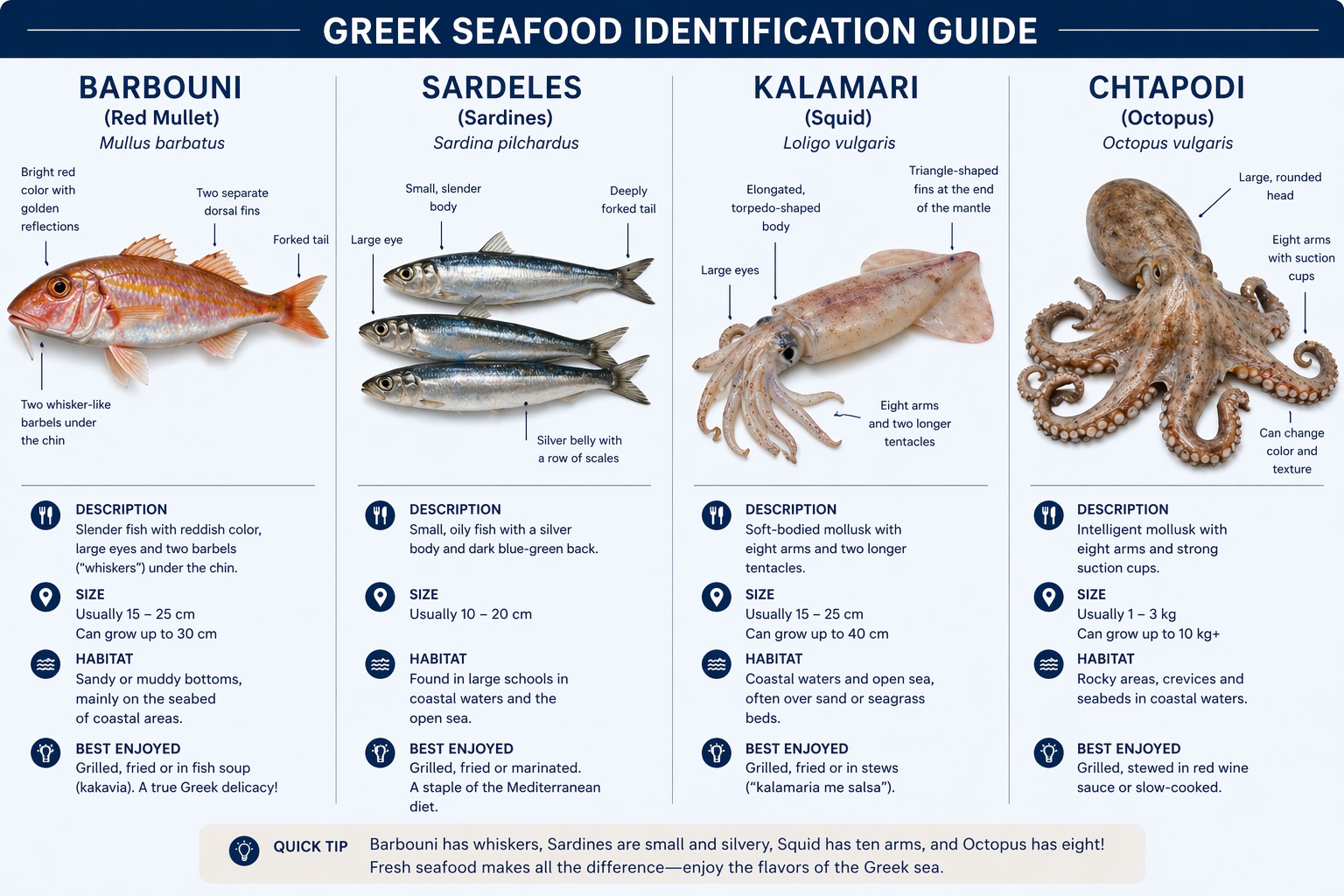
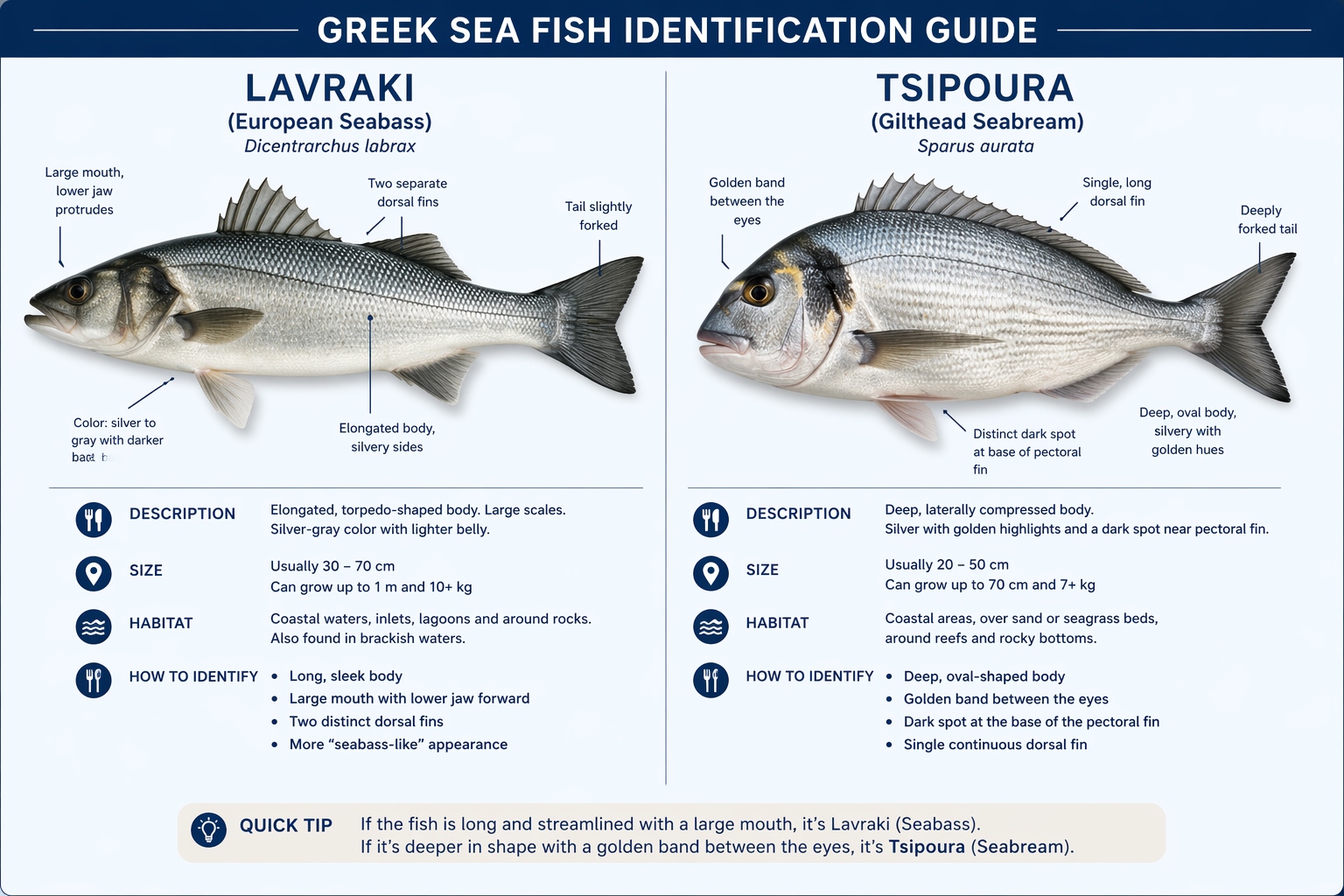
Fish Markets. Thassos does not operate around a single central fish market comparable with a large mainland port. Fish is obtained through local fishmongers and direct purchase from fishermen after landing. The practical purchase points are the working harbours at Limenas, Skala Prinos, Limenaria, and smaller fishing harbours where local boats land early in the day. Common local seafood includes tsipoura, gilthead bream; lavraki, sea bass; sardela, sardine; gavros, anchovy; barbouni, red mullet; kolios, chub mackerel; kalamari, squid; and chtapodi, octopus. Availability depends on weather, season, and daily catch, and direct harbour purchase is normally a morning transaction.
Thassos Greece
Sailing Guide - Local Cuisine
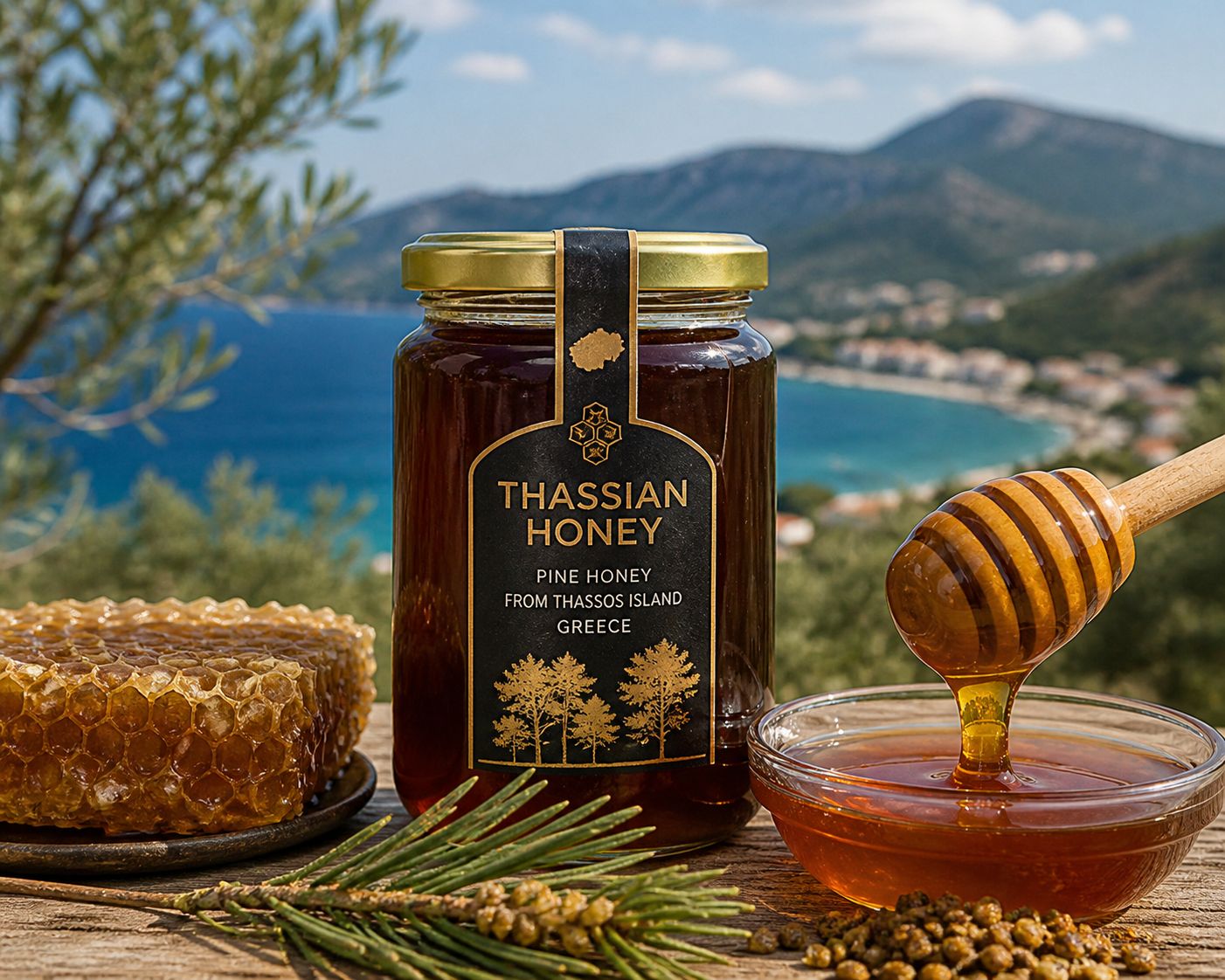
Thassos food is based on island olive oil, fish, goat and sheep products, local honey, and produce from small agricultural areas. Thassian honey is one of the island’s principal food products, with pine honey and mixed floral honeys from arbutus, myrtle, chestnut, heather, and other vegetation used at breakfast, in pastries, and with yoghurt or cheese. Thassos is also known for olives and olive oil, including local olive products and cured table olives.
Thassian honey from Thassos is produced in a mixed pine and wild herb environment, resulting in a dense, low-moisture honey with high mineral content and strong aromatic profile. A significant proportion is pine honey, derived from honeydew rather than nectar, giving it a darker colour, reduced sweetness, and higher viscosity compared to floral honeys. Seasonal variations introduce thyme and other herb nectars, producing lighter, more aromatic batches in smaller quantities. Production is small-scale and localised, with minimal processing and filtration, and the product is typically unblended. For provisioning, it is available in standard retail outlets and local producers, with good shelf stability and resistance to crystallisation due to its composition.
Fish is commonly grilled or fried, with smaller species such as sardela and gavros cooked whole. Octopus is grilled or stewed, and squid is fried or stuffed. Meat dishes include goat, lamb, and pork cooked grilled or slow-braised. Local vegetable dishes use aubergine, courgette, peppers, tomatoes, beans, and greens cooked with olive oil. Cheese from sheep and goat milk appears in pies, salads, and cooked dishes. Local sweets and preserves use honey, walnuts, almonds, figs, and grape products. Walnut and almond-based desserts are common in northern Greek island cooking
Thassos Greece
Sailing Guide - Local Beverages
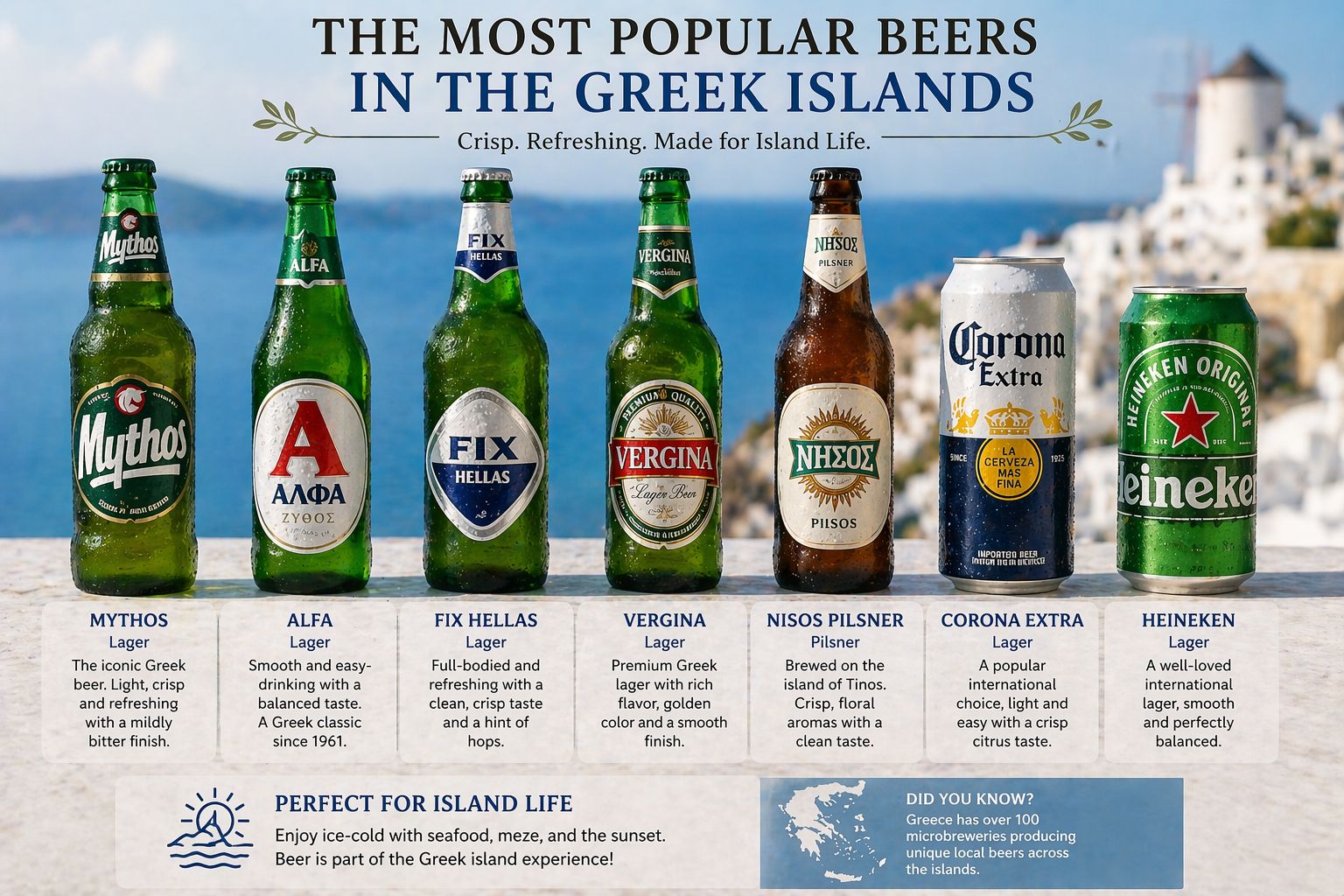
Beer supply includes Greek national brands such as Mythos, Alfa, Fix, and Vergina, available through supermarkets, tavernas, and kiosks. Wine is sold in bottled and bulk form, including northern Greek wines and island-supplied table wine depending on outlet. Local grape production exists, but yacht provisioning normally relies on retail distribution rather than direct cellar supply. Spirits include ouzo and tsipouro. Tsipouro may be available with or without anise and is commonly consumed with food rather than as a short drink. Ouzo is diluted with water and served with small dishes. Non-alcoholic supply includes bottled water, Greek coffee, instant and filtered coffee, tea, soft drinks, sour cherry drink, lemonade, orange drink, and packaged fruit juices. Honey-based drinks and herbal infusions may be found through local producers rather than supermarkets.
Thassos Greece
Sailing Guide - Diesel Fuel Supplies
Diesel fuel is available on Thassos through roadside fuel stations near the main settlements and ferry routes. Direct alongside marine fuel infrastructure is limited and should not be assumed at every harbour. In some ports, fuel must be obtained by jerry cans or arranged by road delivery if available locally. Limenas and Skala Prinos are the most practical points for fuel logistics because of ferry-port road access and nearby service stations. Diesel quality is standard road diesel supply. Water or sediment contamination risk is managed by normal vessel filtration and visual inspection during transfer.
Thassos Greece
Sailing Guide - Water Supplies
Potable water is available in main harbours at selected quay points, but supply is not continuous along all berthing positions. Pressure varies by harbour and season. Smaller harbours may have limited or no convenient water point for yachts. Municipal water is treated supply. For tank filling, use onboard filtration and hose hygiene procedures. In summer, water demand increases across the island and access at quay points may be controlled locally.
Mechanical and Electrical Repairs
Resource
If you are headed somewhere remote consider the need to expand your knowledge base or have an information resource on board. Why not get a copy of my book The Marine and Electrical and Electronics Bible 4th Edition. By and for yachties, with everything from batteries and charging, solar and wind, diesel engines and marine electronics and so much more. Your complete systems guide. 650 pages of practical advice. In Australia and New Zealand order a copy through Boat Books. UK and European boats can buy the UK Edition Here. US and Canadian boats can get the US Edition Order Here. Marine systems are my profession so let me help you. By a liveaboard boat owner for other boat owners.



Thassos Greece
Sailing Guide - Marine Services
Marine services on Thassos are limited to basic mechanical and electrical repair in Limenas, Limenaria, and Skala Prinos. Work includes routine engine service, batteries, and minor systems repair. There is no travel lift, haul-out, or full-service yacht yard on the island. Hull work, antifouling, rigging, and major repairs require relocation to mainland facilities at Kavala. Service support for Yanmar and Volvo Penta is mainland-based. Marine electronics service for Raymarine, B&G, and Simrad is not established on the island.
Thassos Greece
Sailing Guide - Local Etiquette
On Thassos, interaction is direct and begins with a greeting before any transaction. Dress ashore is standard day wear, with beachwear limited to beach, quay, and immediate waterfront areas. Churches and monasteries require covered shoulders and legs, and photography may be restricted. Meal times are later, with evening dining commonly after 20:00; cash remains useful for small vendors, roadside produce sellers, and fishermen, while cards are accepted in larger supermarkets and many restaurants.
Thassos Greece
Sailing Guide - Summary
Thassos is a northern Aegean island with distributed small harbours, ferry ports, and weather-dependent anchorages. The island supports practical cruising operations through basic berthing, local produce, fish supply, fuel by road logistics, and limited technical services. Provisioning is strongest around Limenas, Pefkari, Skala Rachoni, Prinos, and the Monday Prinos market, with Thassian honey, olives, olive oil, and fish forming key local supply. The island functions as a coastal cruising and provisioning stop within the northern Aegean consistent with a Thassos Greece Sailing Guide for all you need to know.