Tasmania Sailing Guide
for Cruising Yachts
Tasmania sailing guide for cruising yachts. Tasmania’s coastline demands conservative planning due to strong Southern Ocean weather patterns, rapid frontal changes, and long stretches of exposed shoreline with limited all‑weather refuge. Yachts arriving from Bass Strait or the Tasman Sea encounter steep seas in wind‑against‑tide conditions, acceleration zones around major capes, and weather systems that move quickly. Safe passage depends on timing around swell, tide, and wind shifts, with particular attention to Tasmania’s tidal gates, bar entrances, and exposed sectors. This Tasmania cruising guide focuses on practical navigation, anchorages, hazards, and the realities of provisioning and fuel availability for yachts operating in a region where distances between safe harbours can be significant.
Once inside Tasmania’s protected waterways, such as the Tamar River, D’Entrecasteaux Channel, and Bathurst Harbour, conditions stabilise, offering secure holding and predictable tidal behaviour. Even so, these areas experience strong katabatic winds, sharp reversals, and localised sea‑state changes that require attention. The east and southeast coasts provide the most reliable sequence of anchorages, while the south, southwest, and west coasts remain strictly weather‑window territory. Provisioning and fuel availability are concentrated in the north and southeast, so yachts must plan resupply carefully before committing to remote regions.
Bass Strait Approaches – Primary Entry Zone
The Bass Strait Approaches form Tasmania’s main arrival corridor for yachts crossing from mainland Australia. This region extends from Cape Grim to Eddystone Point and includes the state’s most accessible all‑weather harbours. Conditions are shaped by strong tidal flow around headlands and steep seas when wind opposes tide, making timing essential for safe entry. Stanley, Burnie, Devonport, and the Tamar River (Beauty Point, George Town, Inspection Head, Launceston, Bell Bay). provide reliable shelter, fuel, provisioning, and marine services, making them the logical staging points before continuing south or east. Smaller locations such as Wynyard and Port Sorell offer limited options in settled weather but are not primary resupply points. This region functions as the operational backbone for arrivals, departures, and major provisioning.
Tasmania - Wind Patterns
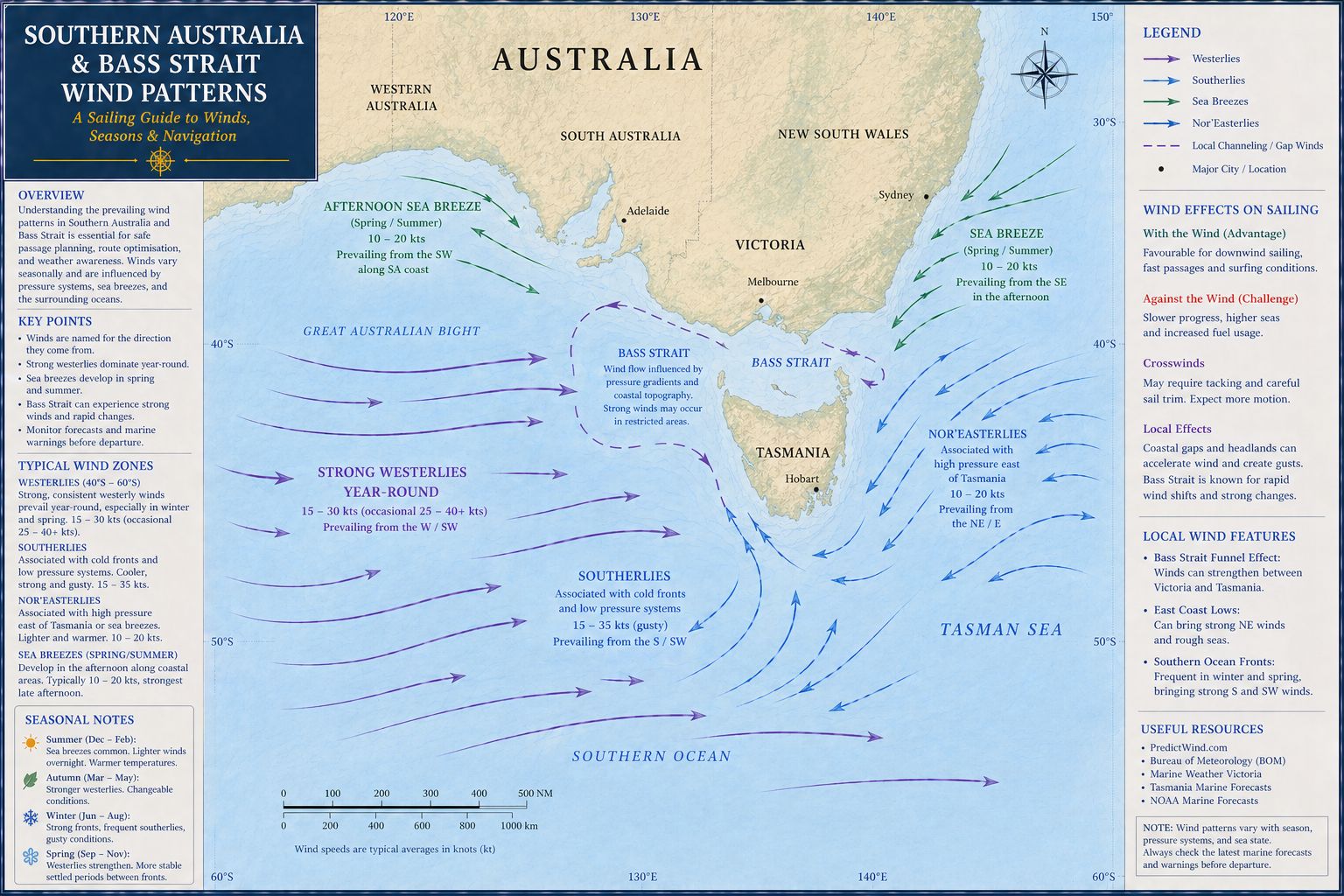
Wind patterns around Tasmania are dominated by the mid-latitude westerlies, which blow persistently from the west and southwest as part of the Southern Ocean circulation. These winds are strongest and most frequent from late autumn through spring (April–October), when passing low-pressure systems track eastward south of the continent, bringing fresh to gale-force W–SW winds, rapidly changing conditions, and large, long-period swells. In summer, the westerlies tend to weaken and shift slightly south, allowing more frequent sea breezes and variable coastal winds, particularly on the eastern side of Tasmania where conditions can be comparatively lighter and more stable. The island’s rugged terrain creates pronounced local effects: wind acceleration around capes (such as South East Cape and Cape Grim), strong funneling through Bass Strait, and significant wind shadowing on the lee (eastern) coasts. Cold fronts can pass quickly, producing sharp wind shifts from northwest to southwest, often with squalls and temperature drops. Overall, sailing around Tasmania requires close attention to synoptic weather patterns, as wind strength, direction, and sea state can change rapidly with each passing system.
Tasmania - Ocean Currents
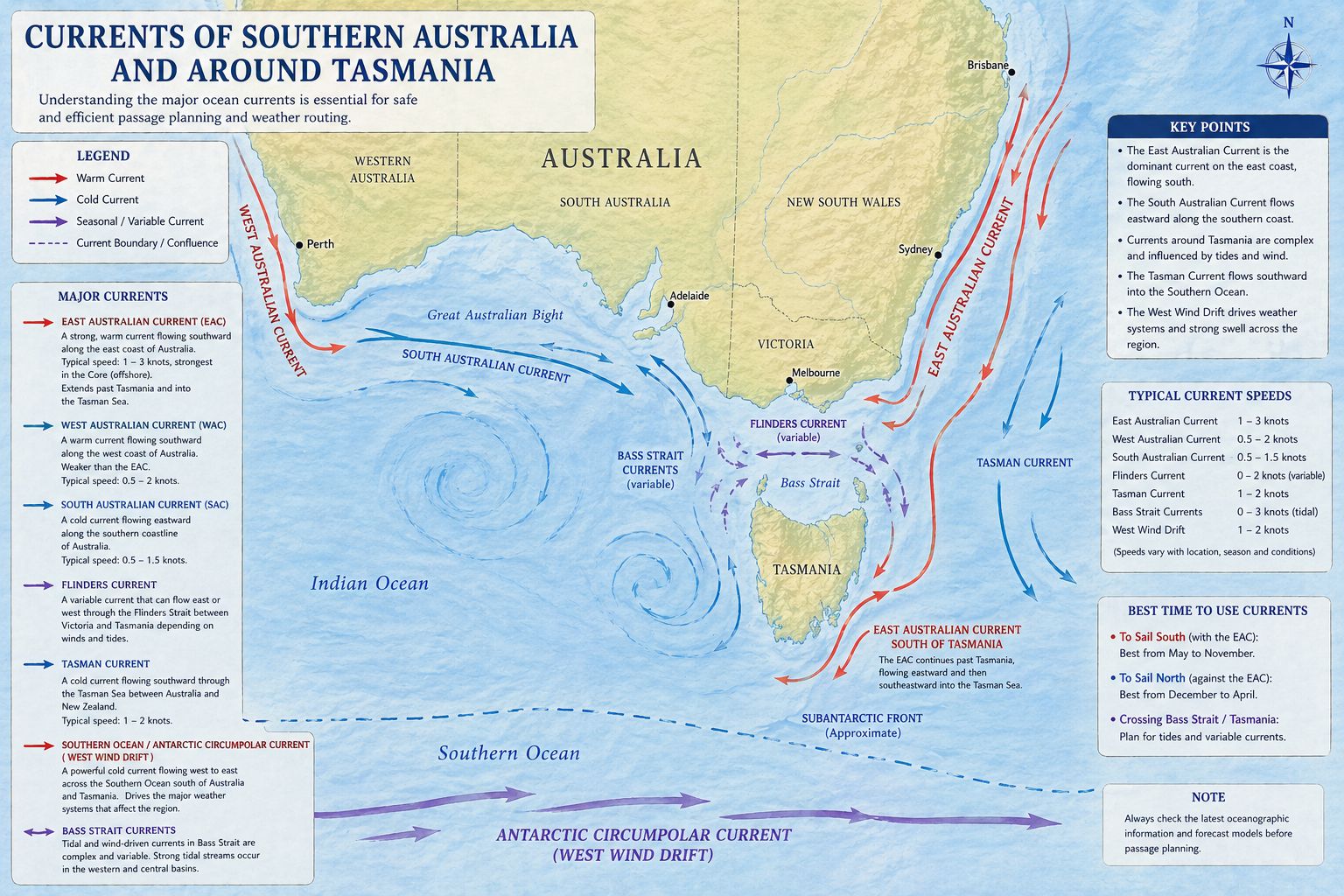
Current flows around Tasmania are complex and highly variable, sitting at the meeting point of subtropical and Southern Ocean systems. The dominant influence is the East Australian Current (EAC), which flows south along the New South Wales coast before shedding eddies and filaments into the Tasman Sea, some of which wrap around eastern Tasmania and can create strong, irregular set to the south and east. South of the island, the Subantarctic Front and the broader Antarctic Circumpolar Current (West Wind Drift) drive an eastward flow, generating persistent swell and occasional east-setting currents that can influence offshore routes. To the west, flow from the South Australian Current contributes weaker eastward movement across the Great Australian Bight toward Bass Strait. Within Bass Strait itself, currents are largely tidal and wind-driven, often reaching 2–3 knots and reversing with the tide, with additional complexity from shallow banks and constricted channels such as Banks Strait. Around the Tasmanian coast, localized eddies, coastal countercurrents, and wind-driven flows are common, especially near headlands and in exposed areas like the south and west coasts. For navigation, the key challenge is not a single steady current, but rather high variability, where set and drift can change quickly with weather systems, tides, and offshore eddy activity.
Furneaux Group &
Banks Strait – Tidal Gate Region
East of the Bass Strait Approaches lies the Furneaux Group and the Banks Strait tidal gate, an area defined by strong streams, shallow banks, and exposed anchorages. Banks Strait is one of Tasmania’s most powerful tidal zones, producing steep, confused seas in wind‑against‑tide conditions and requiring tide‑driven passage planning. The islands offer limited shelter, with Whitemark providing the most practical anchorage in offshore winds and Lady Barron offering a tidal harbour that demands careful pilotage. Trousers Point and other exposed anchorages are strictly fair‑weather options. Provisioning and fuel are available only at Whitemark and Lady Barron, so yachts must arrive prepared. This region is best treated as a specialised transit area where timing and conditions dictate movement.
East Coast – Primary
Cruising Corridor
The East Coast, stretching from Eddystone Point to the Tasman Peninsula, provides the most consistent sequence of anchorages in Tasmania and is the preferred route for most cruising yachts. Weather patterns are more predictable here than on the west or south coasts, and several anchorages offer partial protection with good holding. St Helens, accessed via a bar entrance requiring settled conditions, provides excellent shelter and full provisioning once inside Georges Bay. Bicheno, Wineglass Bay, Coles Bay, and the anchorages around Schouten Passage offer options in the right conditions, though many are exposed to easterly or southerly swell. Maria Island adds further anchorages, with Darlington offering the best protection from southerlies. This coast supports steady, staged movement with manageable distances between stops and is the backbone of most Tasmania sailing itineraries. Maria Island, Mercury Passage, Schouten Passage, and the Freycinet coast form the key transition zone between Tasmania’s sheltered southeast and the more exposed east‑coast run. Mercury Passage offers the safest route north in settled weather, while Schouten Passage demands timing around swell and tide. Freycinet provides reliable anchorages once clear, making this entire stretch a tactical but rewarding section of the voyage
Tasmania Sailing Guide
for Cruising Yachts – Southeast Coast
From the Tasman Peninsula through Storm Bay and into the D’Entrecasteaux Channel, yachts enter Tasmania’s most reliable all‑weather cruising region. This area contains multiple sheltered anchorages, predictable sea breezes, and minimal swell, making it the state’s primary safe‑harbour network. The channel offers numerous anchorages, deep water, and reliable shelter. Tidal flow is noticeable in constricted areas, and katabatic winds are common at night. Weather systems funnel through the channel, producing gusty conditions. Triabunna offers secure access and full provisioning, while Port Arthur provides deep, dependable shelter with minimal swell intrusion. The D’Entrecasteaux Channel itself is the most forgiving waterway in Tasmania, with numerous anchorages, marinas, and marine services concentrated around Kettering, Margate, and Hobart. Good provisioning and services make this region the operational heart of Tasmanian cruising and the ideal staging area before committing to the south or west coasts. Bruny Island forms the long, protective barrier between Storm Bay and the D’Entrecasteaux Channel, creating one of Tasmania’s most reliable sheltered cruising grounds and acting as the weather gate for yachts moving between Hobart, the Channel, and the Tasman Peninsula.
South Coast – Weather‑Window
Passage Zone
The South Coast, running from Southport to South West Cape, is fully exposed to Southern Ocean swell and offers almost no refuge. Recherche Bay is the only reliable anchorage and serves as the key waiting point for yachts preparing to round South East Cape. Conditions here change rapidly, with strong acceleration zones and heavy swell common even in moderate weather. There are no provisioning or fuel options, and distances between safe harbours are significant. This region is strictly weather‑window territory and should be approached with conservative planning and clear escape strategies. Yachts must be fully stocked before departing the southeast coast.
Tasmania Sailing Guide for Cruising Yachts – Southwest Wilderness
West of South-West Cape lies the Southwest Wilderness, one of the most remote and exposed sailing regions in Australia. The only viable refuges are Port Davey and Bathurst Harbour, both offering extensive shelter once inside but requiring stable conditions for entry. Strong katabatic winds, narrow channels, and complete lack of services define this region. Yachts must be fully self‑sufficient, carrying all fuel, provisions, and spares needed for the duration of their stay. This area is a destination in its own right but demands a high level of preparation and seamanship.
Tasmania Sailing Guide
for Cruising Yachts – West Coast
The West Coast, from Low Rocky Point to Cape Grim, is dominated by heavy swell, surf‑affected shorelines, and long distances between safe harbours. Macquarie Harbour (Strahan), accessed via the narrow and bar‑influenced Hells Gates, is the only reliable entry point and provides extensive shelter and full provisioning once inside. Other locations such as Granville Harbour and Trial Harbour are fair‑weather only and unsuitable in typical west coast conditions. This region requires careful weather planning and should be treated as a high‑risk coastline with limited escape options.
Mechanical
and Electrical Repairs Resource
If you are headed somewhere remote consider the need to expand your knowledge base or have an information resource on board. Why not get a copy of my book The Marine and Electrical and Electronics Bible 4th Edition. By and for yachties, with everything from batteries and charging, solar and wind, diesel engines and marine electronics and so much more. Your complete systems guide. 650 pages of practical advice. In Australia and New Zealand order a copy through Boat Books. UK and European boats can buy the UK Edition Here. US and Canadian boats can get the US Edition Order Here. Marine systems are my profession so let me help you. By a liveaboard boat owner for other boat owners



Tasmania Sailing Guide
for Cruising Yachts – Northwest Coast
The Northwest Coast, from Cape Grim to Marrawah and West Point, offers almost no usable shelter for cruising yachts. The shoreline is surf‑dominated, heavily exposed to swell, and lacks reliable anchorages. Locations such as Marrawah, West Point, and Arthur River are waypoints rather than destinations, and Robbins Passage is only suitable with local knowledge due to its shallow, tidal nature. This entire section is best treated as a transit zone, with yachts planning to continue to the north coast or Macquarie Harbour rather than expecting overnight stops. The Hunter Group lies off Tasmania’s remote north‑west tip and forms a scattered chain of exposed Bass Strait islands, including Three Hummock Island, Robbins Island, and Albatross Island. These islands sit directly on the Victoria–Tasmania passage route and offer limited but valuable shelter in an otherwise unforgiving stretch of water. For skippers, the Hunter Group is a tactical waypoint system rather than a cruising destination.
Tasmania Sailing Guide
for Cruising Yachts – King Island
King Island and Grassy is a Point of Entry and sits alone in the western entrance of Bass Strait and functions as a critical weather‑break waypoint for yachts moving between Victoria and Tasmania. It is remote, exposed, and shaped by Southern Ocean systems, with only two practical anchorages and minimal services, so skippers treat it as a serious operational stop rather than a cruising destination. Approaches are straightforward in settled conditions but unforgiving in bad weather, and timing is everything; most yachts use King Island to pause, reset, and wait for the next window before committing to the long legs toward Stanley, Three Hummock Island, or the Victorian coast.
Tasmania sailing guide
for cruising yachts - Summary
Tasmania offers secure shelter in its major waterways but demands conservative planning along exposed coasts where Southern Ocean swell, strong tidal streams, and rapid weather changes shape every passage. Safe navigation depends on timing weather windows, understanding local hazards such as bar crossings, tidal gates, and wind acceleration zones, and planning provisioning and fuel availability before committing to remote regions. For skippers using this Tasmania cruising guide, the key is to treat exposed sectors as limited‑escape environments and rely on protected harbours only after conditions and timing align. Tasmania sailing guide for cruising yachts has a lot of useful information.