Symi Greece
Sailing Guide
Symi Greece Sailing Guide. Symi lies in the south-eastern Dodecanese, just off the Turkish coast north of Rhodes, at approximately 36°37′N 27°50′E and is one of the most visually distinctive cruising destinations in the region. The island is defined by steep, rugged terrain and deeply indented bays, with its principal harbour at Gialos forming a natural amphitheatre lined with neoclassical buildings. Approaches are generally clear and well charted, though the surrounding coastline is rocky with limited off-lying hazards, requiring normal caution when closing the shore.
For cruising yachts, Symi is both a destination and a key stop within the southern Dodecanese passage routes linking Rhodes, Kos, and the Turkish coast. The main harbour is busy and often crowded in peak season, particularly with charter fleets and excursion vessels, while numerous bays around the island offer quieter anchorages with good holding and clear water. Wind conditions are typically more moderate than the open Aegean, though gusts and local acceleration can occur around headlands. Overall, Symi combines reliable navigation, striking scenery, and a well-established yachting environment.
Symi Greece
Sailing Guide History
Symi has been inhabited since prehistoric times and developed early as a maritime and shipbuilding centre linked to Rhodes and nearby Asia Minor. It passed through successive control under the Byzantine Empire and later the Knights Hospitaller, who fortified the island, before coming under the Ottoman Empire in 1522, where it retained relative autonomy and expanded its shipbuilding and sponge-diving industries. Occupied by Italy in 1912, Symi later became a focal point in the Surrender of the Dodecanese at the end of World War II, before being incorporated into Greece in 1947; following post-war economic decline, the island has since stabilised through tourism while retaining its traditional harbour settlements.
Symi Greece
Sailing Guide - Approaches
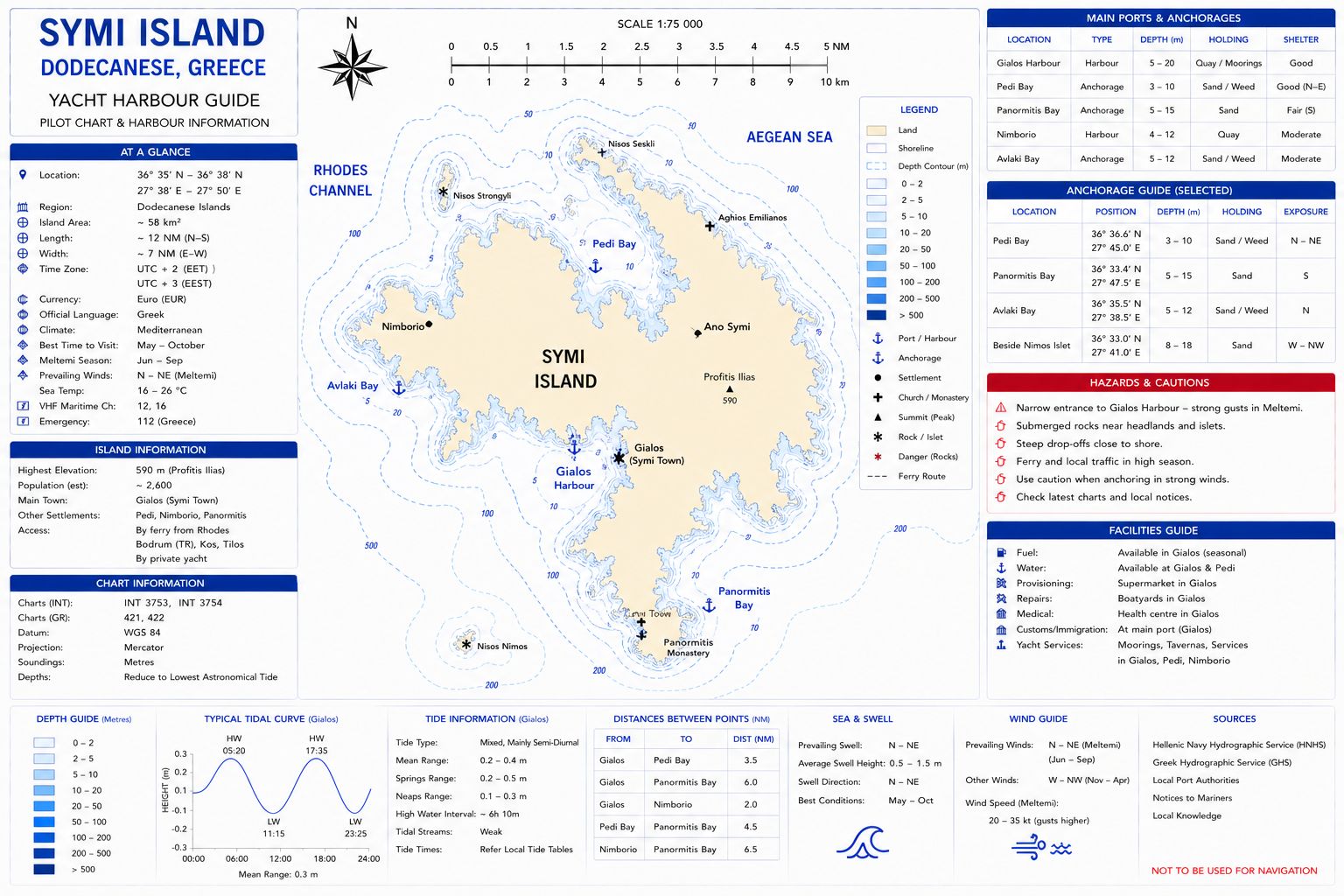
Approach to Symi is generally straightforward with deep water prevailing close to the island and good chart accuracy throughout the surrounding area. The island is steep-sided and clearly visible from distance, with prominent headlands and ridgelines providing strong visual reference. There are few significant off-lying dangers on the main approaches, though the coastline is rocky with isolated shoals close inshore, requiring standard caution when closing the land.
The primary landfall is toward the main harbour at Gialos on the north-east coast. Entry is made through a narrow, well-defined opening between headlands, leading into a large, enclosed natural harbour. The entrance is clear of major hazards but can be affected by crosswinds and gusts, particularly under northerly Meltemi conditions. Traffic is often heavy, including ferries, excursion boats, and charter vessels, requiring careful situational awareness on approach. Approach is from open water with depths exceeding 50–100 m offshore, reducing to 5–10 m approaching harbour limits.
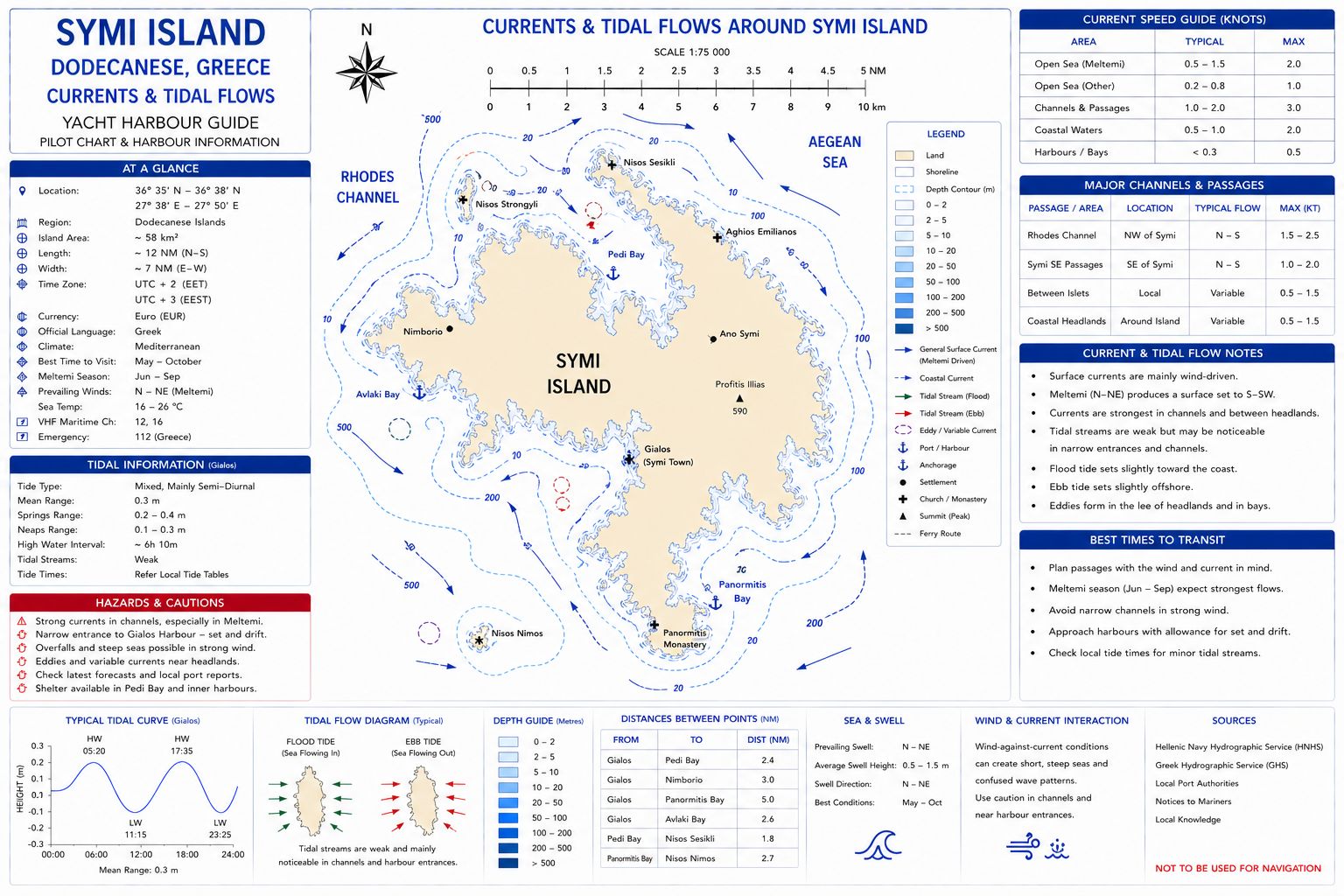
Sea state is wind driven. Meltemi (N–NW) produces strong winds and gust acceleration around headlands and within harbour entrances. The inlet at Gialos reduces sea state but not gusting. Tidal range is typically 0.2–0.4 m with negligible tidal stream.
Alternative approaches to anchorages around the island follow similar conditions, with deep water, steep-to shores, and generally good holding once inside bays. Wind acceleration can occur around exposed points and within confined inlets, while sea state remains moderate in open approaches but reduces significantly within sheltered bays. Overall, approaches are uncomplicated but require attention to traffic, wind effects, and proximity to a rocky shoreline.
Symi Greece
Sailing Guide - Navigation
Navigation around Symi is straightforward in open water, with generally deep, clear approaches and good chart accuracy. Depths around the island typically exceed 50–100 m offshore, shoaling rapidly when closing the coast due to steep-sided topography. The shoreline is predominantly rocky with limited shallow shelves, though isolated shoals and rocks may be found within 50–100 m of the coast, requiring normal caution when entering bays or manoeuvring close inshore.
The principal pilotage area is the approach and entry to Gialos Harbour on the north-east coast. The harbour entrance is narrow but well defined, with depths of approximately 20–30 m in the entrance channel, reducing to 10–20 m within the outer harbour. Inner harbour areas shoal further to 3–8 m alongside quays, depending on berth location. Manoeuvring space is adequate but constrained by heavy traffic, particularly ferries and excursion vessels.
Pilotage requires close attention to traffic density, wind effects, and limited turning space within the harbour. Northerly winds (Meltemi) can produce gusts and crosswinds at the entrance and within the harbour basin, while calm conditions can lead to congestion due to high vessel numbers. Outside the main harbour, anchorages around the island generally offer depths of 5–15 m in bays, with good holding in sand or sand and weed.
Electronic navigation systems are reliable but should be cross-checked with official charts. A continuous lookout is required for local craft, moorings, and swimmers near populated areas. Overall, navigation is uncomplicated offshore but requires accurate pilotage and vessel control when entering harbour areas and confined anchorages. Fishing gear including nets and lines may be present near shore and is not always clearly marked.
Symi Greece
Sailing Guide - Chart Accuracy
Charts issued by the Hellenic Navy Hydrographic Service are reliable for approaches and harbour areas. ENC data aligns with official charts. Local moorings, laid ground tackle, and berth arrangements may not be fully represented on electronic charts.
Symi Greece
Sailing Guide - Anchorages
Symi provides several anchorages with generally good holding but wind-dependent shelter.
- Pedi Bay (east coast) provides depths of 4–10 m over sand and mud with good holding and protection from northerlies.
- Panormitis Bay (south coast) provides depths of 5–12 m over sand and mud with good holding and shelter from northerly winds.
- St George’s Bay (north-east coast) provides depths of 10–20 m over sand and rock with variable holding and exposure to northerlies.
- Other inlets provide anchoring in 5–15 m over mixed seabed with varying shelter depending on wind direction.
Symi Greece
Sailing Guide - Entry Formalities
Symi is a port of entry. Customs and immigration clearance is required for arrivals from outside Schengen areas. Vessel and crew documentation must be available. Movements to and from nearby Turkish ports require formal clearance procedures. Harbour authority control applies within port limits. Drones are regulated under Greek aviation rules. Communications equipment must comply with national regulations. Waste discharge is controlled.
Symi Greece
Sailing Guide - Marina Facilities
Berthing on Symi is centred on the main harbour at Gialos Harbour, which functions as a natural harbour rather than a purpose-built marina. There are no pontoons or laid mooring lines, and most yachts berth stern-to or alongside the town quay using anchors. Depths along the quay typically range from 3–6 m, though this varies by location, with deeper water toward the outer harbour and shallower areas in the inner sections. The harbour itself is deep, generally 10–20 m within the basin, with limited swinging room due to the number of vessels. Holding is generally good in sand and mud where anchoring is required.
Berthing space is limited and highly competitive in peak season, with ferries, excursion vessels, and charter yachts taking priority positions. Wash from ferry movements and restricted manoeuvring space require careful handling, particularly in strong winds or crowded conditions. Electricity and water may be available on parts of the quay, but supply is limited and not consistently accessible.
There is no full-service marina or haul-out facility on Symi. Yachts requiring lift-out, repairs, or technical services typically use nearby centres such as Rhodes. Alternative berthing and anchorage options exist around the island, including bays such as Pedi Bay and Panormitis Bay, where depths are generally 5–15 m with good holding and more space, though facilities ashore are minimal or absent.
Symi Greece
Sailing Guide - Local Weather
Weather on Symi is typical of the southern Dodecanese, with long, dry summers and stable conditions through the main cruising season. From late spring to early autumn, conditions are dominated by the northerly Meltemi, usually 15–25 knots, with stronger periods reaching 25–30 knots or more, particularly in July and August. Sea state in open water can become moderate to rough, while conditions inside the island’s deep bays and harbours remain comparatively sheltered.
Temperatures are consistently high in summer with excellent visibility and minimal rainfall. Outside the main season, conditions become more variable, with southerly and easterly systems bringing cloud, rain, and longer-period swell. The island’s steep terrain creates localised effects, including gusts and wind shadowing around headlands and within bays. Overall, Symi offers predictable summer weather with strong winds but good shelter options, making it a reliable cruising area when conditions are managed appropriately.
The Marine Electrical and Electronics Bible has a complete list of Greek VHF Radio Channel information and weather forecast times for Greece along with NAVTEX UK and Europe and NAVTEX Mediterranean for 490kHz and 518kHz.
Symi Greece
Sailing Guide - Local Winds
Wind conditions around Symi are dominated in summer by the Meltemi, a northerly to north-west wind that typically blows 15–25 knots, frequently increasing to 20–30 knots or more during peak periods. The wind is strongest in the afternoon and can persist for several days, producing moderate to rough seas in exposed areas, particularly on the north and west sides of the island. Local katabatic effects occur near steep slopes producing sudden wind shifts.
Local topography has a strong influence on wind behaviour. The steep terrain and narrow inlets create gusts, wind acceleration, and shifting directions, especially around headlands and within harbour entrances such as Gialos. Conversely, the south and south-east coasts, including areas like Pedi Bay and Panormitis Bay, provide effective shelter from northerly winds, often with significantly reduced wind strength.
Outside summer, wind patterns become more variable, with southerly and easterly systems bringing unsettled conditions, stronger gusts, and longer-period swell. Overall, Symi experiences strong but predictable summer winds, with pronounced local effects that require careful anchorage selection and awareness during harbour approaches.
The Meltemi is a strong, dry northerly wind that dominates the Aegean in summer, accelerating through channels and between islands to produce steep, short seas. It is most persistent in July and August, often blowing for several days with little diurnal variation, creating fast north‑to‑south passages and challenging return routes. Its strength is shaped by pressure gradients between the Balkans and Anatolia, with local acceleration zones around major island gaps.

Symi Greece
Sailing Guide - Provisioning
Supermarkets. Provisioning on Symi is centred on Gialos Harbour, where a number of small to medium supermarkets and general stores provide adequate resupply for cruising yachts. Stock includes fresh produce, meat, dairy, dry goods, and basic onboard supplies, with regular replenishment via ferry connections from Rhodes. While not large-scale, supply is reliable for routine provisioning. Shops around Gialos and into the upper town (Chorio) include bakeries, butchers, delicatessens, and specialty stores. Daily goods such as bread, fruit, vegetables, and local products are readily available, though range and volume are more limited than mainland ports. Local products include olive oil, honey, herbs, and small-scale regional items.
Markets. There is no large central market; instead, provisioning is distributed across individual retailers. Seasonal produce is available through local greengrocers, with supply reflecting island logistics and time of year.
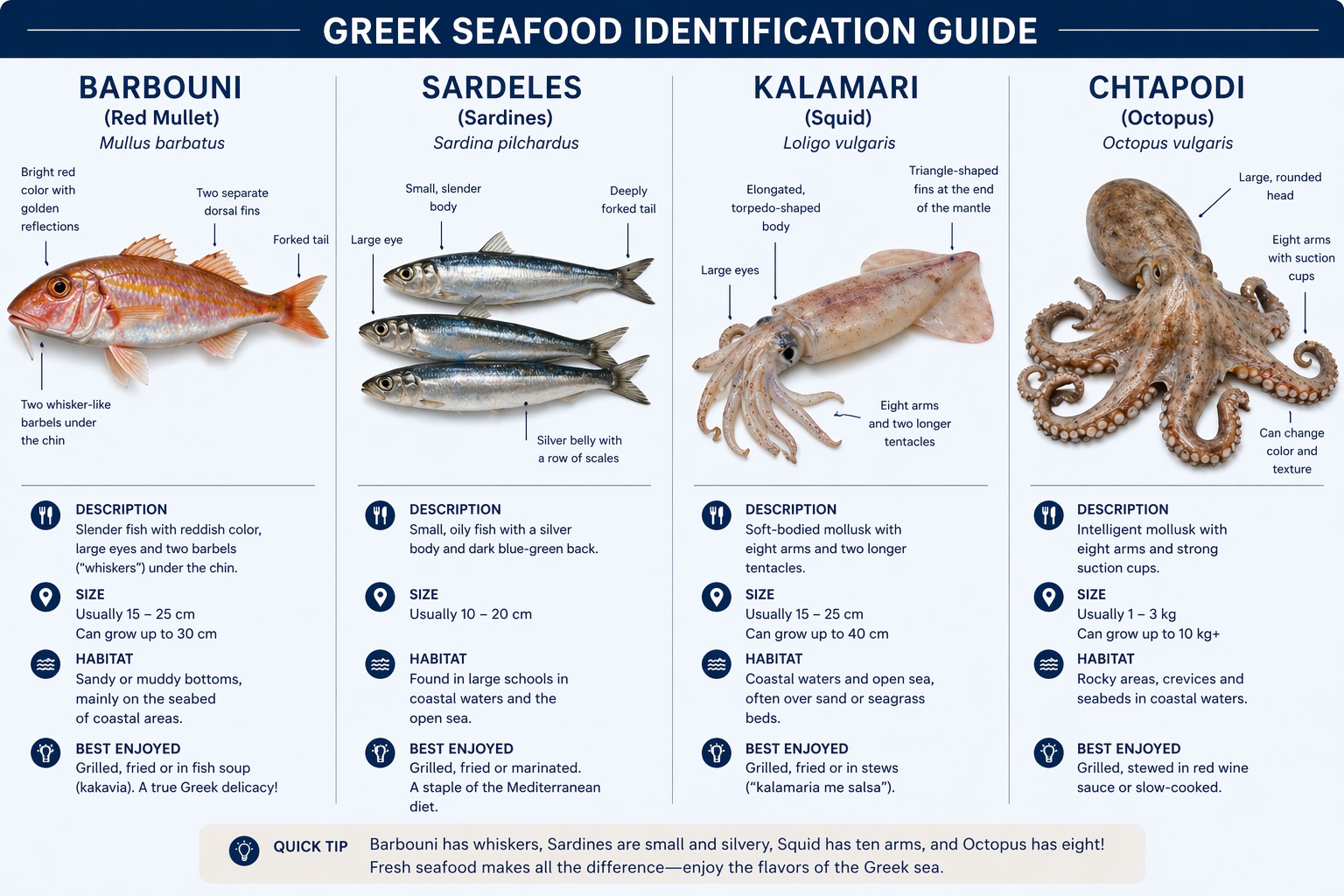
Fish Supply. Fish is available through local fishermen and small fishmongers operating around Gialos Harbour, typically in the morning following landings. Species include common Aegean varieties such as seabass, seabream, sardines, squid, and octopus, though availability varies depending on catch.
Symi Greece
Sailing Guide - Local Cuisine
Cuisine on Symi is strongly defined by its maritime character, with a clear emphasis on seafood and a small number of distinctive local dishes rather than a broad mainland-style range. The island is particularly known for Symi shrimp, very small shrimp typically served whole, lightly fried in olive oil and eaten with lemon, forming the most recognisable local speciality. Fresh fish is otherwise central and usually prepared simply, most often as grilled lavraki and tsipoura, whole fish cooked over charcoal with olive oil and lemon.
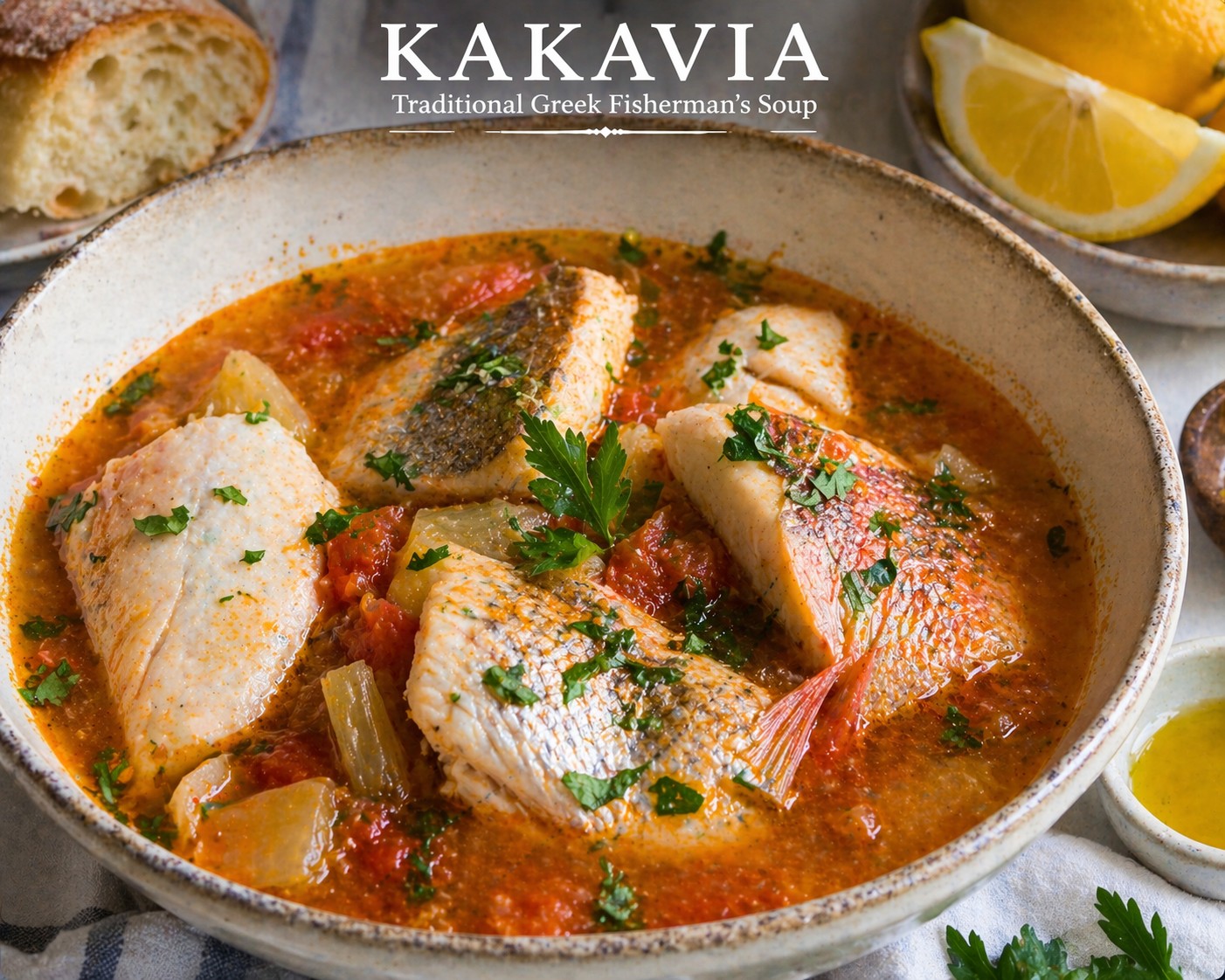
Traditional dishes also include kakavia / psarosoupa, a fish-based soup made with mixed catch, olive oil, and vegetables, reflecting the island’s fishing heritage. Meat dishes are present but less dominant, generally limited to straightforward preparations such as souvlaki or slow-cooked lamb and goat dishes using olive oil, herbs, and potatoes.
Local products include olive oil, honey, and herbs, while desserts follow standard Greek forms, with baklava and similar syrup-based pastries widely available. Overall, cuisine on Symi is simple, seafood-driven, and locally identifiable, with the Symi shrimp standing out as the key signature dish.

Symi shrimp (often called Symi prawns) are a very small species of shrimp caught in the waters around Symi and the nearby Turkish coast. They are typically only 2–5 cm long, much smaller than standard prawns, and are notable for their bright red colour even when raw. What makes them distinctive is how they are prepared and eaten. They are usually lightly fried whole in olive oil, without peeling, so the shell becomes thin and crisp. They are then served simply with lemon juice and sometimes a light dusting of flour or salt, allowing their natural flavour to dominate. Because of their size and soft shell, they are eaten entire head, shell, and all. Their flavour is intense, slightly sweet, and distinctly “sea-rich”, more concentrated than larger prawns. They are considered a local delicacy and signature dish of Symi, and are widely served in tavernas around the island, particularly in Gialos harbour.
Symi Greece
Sailing Guide - Beverages
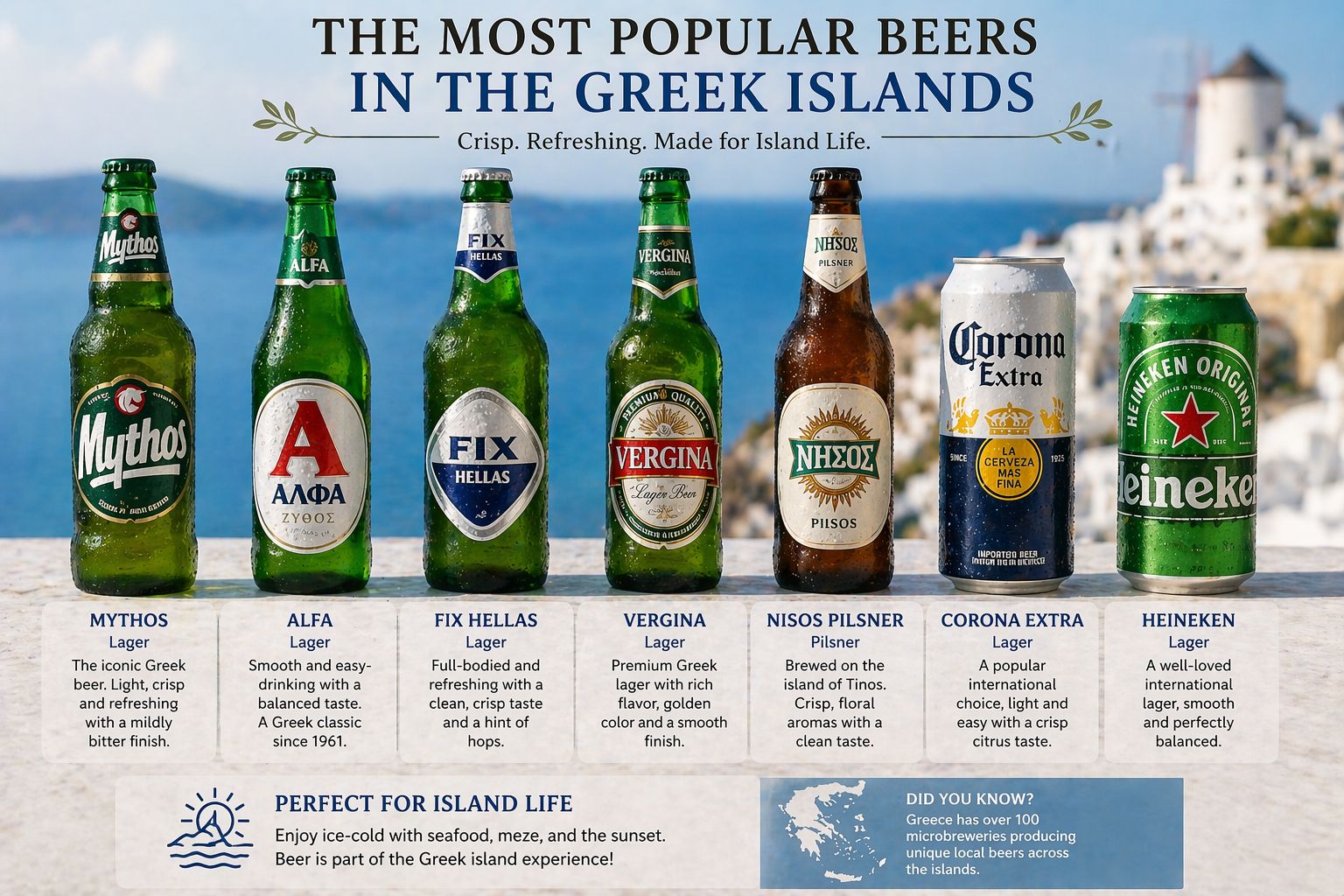
Beer, wine, and spirits across the Greek islands are locally produced and widely available through tavernas, small bars, and provisioning outlets. Beer is predominantly lager, with domestic brands including Mythos, Alfa, Fix, and Vergina alongside imported products; and over 100 microbreweries operate on several islands with limited distribution. Wine is region-specific, with white varieties dominant in the islands, including Assyrtiko, Moschofilero, and Roditis, alongside local table wines served in bulk; retsina remains in circulation as a resin-flavoured wine. Distilled products include ouzo (anise-based), tsipouro (grape marc distillate), raki or tsikoudia (Crete), souma (fig or grape distillate in eastern Aegean islands), and kitron (citrus liqueur from Naxos), with alcohol strength typically in the 37–45% range and higher for unregulated local distillations.
Symi Greece
Sailing Guide - Fuel Supplies
Fuel supply on Symi is available primarily at Gialos Harbour via road tanker delivery to the quay, supplying marine diesel directly to berthed vessels. There is no dedicated fuel dock, and all refuelling is arranged locally through harbour contacts or agents, typically with short notice. Delivery is generally reliable due to regular supply links with Rhodes, though availability can be affected by demand during peak season, and advance arrangement is recommended. Berthing space constraints and harbour congestion may influence timing and positioning for refuelling. No fuel is available at anchorages around the island, including areas such as Pedi Bay or Panormitis Bay. Petrol and bottled gas are available ashore in limited quantities through local suppliers.
Symi Greece
Sailing Guide - Water Supplies
Water supply on Symi is available at Gialos Harbour via quay connections, though it is limited and controlled compared to mainland ports. Supply is typically provided through municipal points along the harbour and may require coordination with local authorities or quay operators. Pressure can be variable, particularly during peak season when demand is high. Water is sourced locally, often supplemented by desalination, and while potable, it can be high in mineral content, making onboard filtration advisable for drinking use. Availability is generally sufficient for topping up tanks but may not support unrestricted full refills during busy periods. No water supply is available at outlying anchorages such as Pedi Bay or Panormitis Bay, where yachts must rely on onboard reserves.
Mechanical
and Electrical Repairs Resource
If you are headed to Symi or somewhere remote consider the need to expand your knowledge base or have an information resource on board. Why not get a copy of my book The Marine and Electrical and Electronics Bible 4th Edition. By and for yachties, with everything from batteries and charging, solar and wind, diesel engines and marine electronics and so much more. Your complete systems guide. 650 pages of practical advice. In Australia and New Zealand order a copy through Boat Books. UK and European boats can buy the UK Edition Here. US and Canadian boats can get the US Edition Order Here. Marine systems are my profession so let me help you. By a liveaboard boat owner for other boat owners.



Symi Greece
Sailing Guide - Marine Services
Marine services on Symi are basic and limited, focused on small-scale repairs and routine support. In Gialos Harbour, local technicians can assist with minor mechanical, electrical, and general maintenance issues, but facilities are not equipped for complex work. Major engine support for Yanmar and Volvo Penta is accessed via Rhodes. There are no haul-out, yard, or major repair facilities on the island, and chandlery supply is minimal. Spare parts and specialised equipment are typically sourced from nearby centres such as Rhodes, with delivery by ferry.
Symi Greece
Sailing Guide - Local Customs
Interaction is direct and formal on first contact, with a greeting expected before any request or transaction. Conversation tone is measured and transactional, with limited small talk unless initiated locally. Personal space is closer than in northern Europe, but physical contact is minimal unless familiarity is established. Shore behaviour is conservative in non-tourist areas, particularly near churches and village centres where modest dress and low noise are expected.
Symi Greece
Sailing Guide - Summary
Symi provides enclosed harbour access with constrained manoeuvring and strong wind effects. Multiple anchorages offer good holding with wind-dependent protection. Facilities are limited with reliance on Rhodes for major services. Conditions are dominated by Meltemi and terrain effects. Symi Greece Sailing Guide for all you need to know.