Skopelos Greece Sailing Guide
Skopelos Greece Sailing Guide. Skopelos lies in the western Sporades in the north-western Aegean Sea, between Skiathos and Alonissos, at approximately 39°07′N 23°43′E. and is characterised by a deeply indented coastline, forested hills, and numerous sheltered bays. The island presents a distinctive green landscape compared to the drier Cyclades, with pine-covered slopes extending to the waterline. Approaches are generally clear with good chart accuracy, and the coastline offers a mix of small coves and larger bays suitable for anchorage in a range of conditions.
For cruising yachts, Skopelos provides a combination of reliable shelter and straightforward navigation within the Sporades cruising area. The main harbour at Skopelos Town serves as the principal port, supported by secondary anchorages around the island offering good holding in sand and weed. Conditions are typically more moderate than in the central Aegean, with less intense Meltemi influence but still subject to northerly winds. The island sits within a well-defined cruising circuit linking Skiathos, Alonissos, and the surrounding marine park, making it both a destination and a convenient staging point.
Skopelos Greece
Sailing Guide - History
Skopelos has a long maritime and cultural history within the Sporades, with settlement dating back to antiquity when it was known as Peparethos. In ancient times the island was recognised for its wine production and trade, exporting across the Aegean Sea. Its location along key sea routes contributed to its development as a small but active maritime centre.
During the Byzantine period, Skopelos remained an inhabited and productive island, later coming under Venetian control and then Ottoman rule. Like many Aegean islands, it experienced periods of piracy and conflict, leading to fortified settlements and inland development for protection. In the modern era, Skopelos became part of the Greek state and developed through shipping, agriculture, and later tourism. Today, the island retains a strong traditional character, with its ports continuing to serve as local centres for fishing, trade, and visiting yachts within the Sporades cruising network.
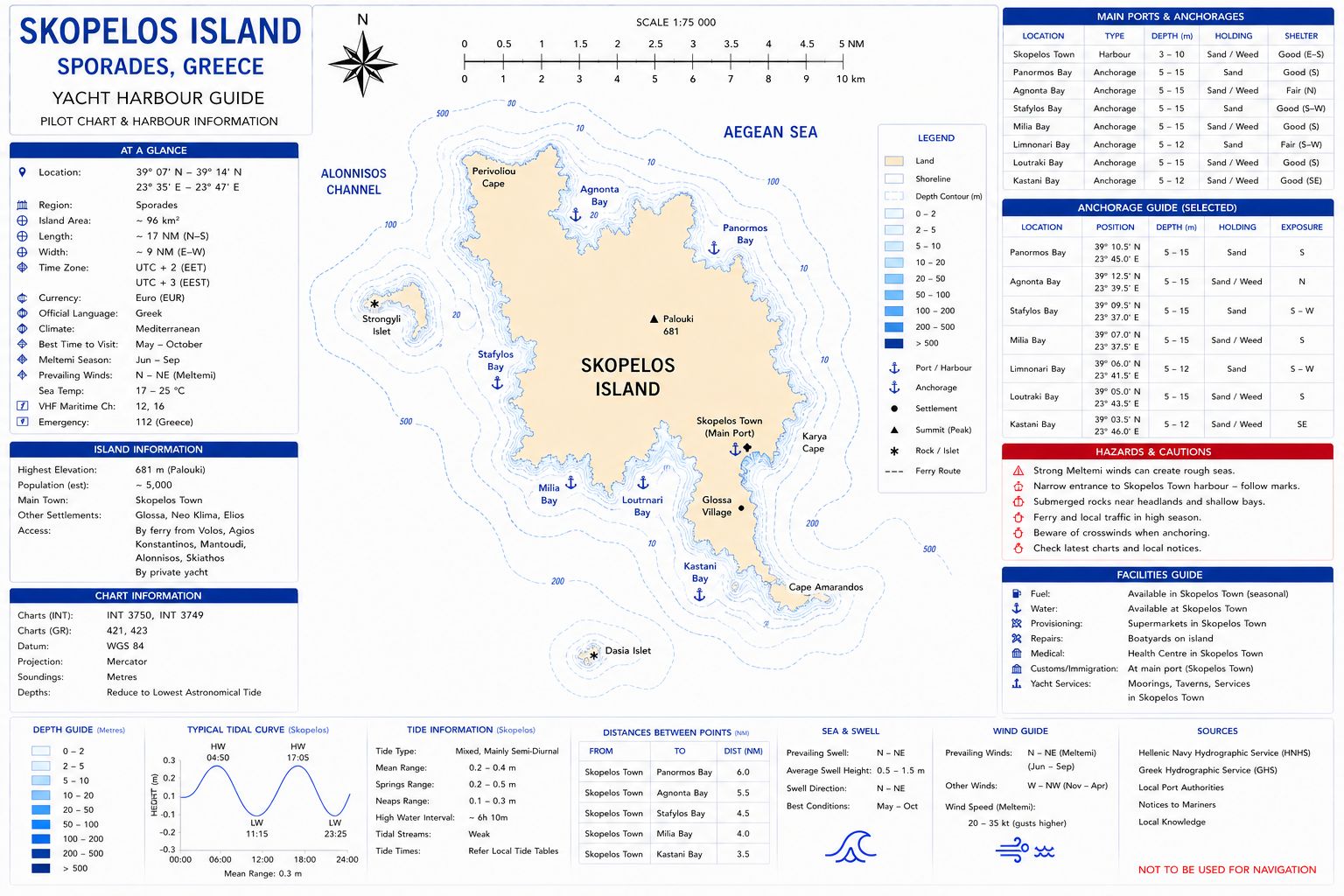
Chart Disclaimer. This chart is a schematic representation for illustrative purposes only and must not be used for navigation. Refer to official hydrographic charts for safe navigation. Be aware ENC charts may differ from official hydrographic charts. Both should be corrected and updated regularly.
Skopelos Greece
Sailing Guide - Approaches
Approach to Skopelos is from open water with offshore depths generally 40–100 m, reducing quickly to 10–20 m within 1 NM of the coast and 5–10 m approaching harbour limits. There are no constrained pilotage channels. Sea state is influenced by northerly winds which produce short, steep seas across the Northern Sporades. Southerly winds generate longer-period seas but with reduced frequency during summer months. The island group provides partial lee conditions depending on position relative to Skiathos and Alonissos.
Tidal range is typically 0.2–0.4 m with no operational tidal stream. No current-driven constraints exist. Hazards include ferry traffic operating between Sporades islands, local fishing activity, and gust acceleration around headlands. Coastal profiles are steep with limited shoal warning areas.

Skopelos Greece
Sailing Guide - Navigation
Navigation to Skopelos is generally straightforward within the Sporades, with clear approaches and good chart accuracy. The island is prominent and easily identified by its high, forested terrain, visible from distance across the surrounding waters. Offshore depths typically exceed 50–100 m, shoaling progressively toward the coast, though many areas remain relatively deep close in due to steep seabed profiles.
Approaches from Skiathos and Alonissos are short and well travelled, with no major off-lying hazards on standard routes. Caution is required when closing the coast, as isolated rocks and shoal patches may exist near headlands and within smaller bays. The coastline is irregular, with numerous inlets offering anchorage, but requiring accurate pilotage on entry.
The main harbour at Skopelos Town Harbour lies on the north coast and serves as the primary pilotage focal point. Entry is open but can be affected by northerly winds, with depths in the approach generally 10–20 m, reducing to 3–6 m alongside. Alternative anchorages around the island typically offer 5–15 m depths with good holding in sand and weed.
Wind conditions influence navigation, with northerly winds producing short, steep seas on exposed coasts, while the south and east sides of the island are more sheltered. Electronic navigation systems are reliable but should be cross-checked with official charts, and a lookout maintained for local traffic, fishing activity, and swimmers near popular bays. Fishing gear including nets and lines may be present near shore and is not consistently marked.
Skopelos Greece
Sailing Guide - Chart Accuracy
Charts issued by the Hellenic Navy Hydrographic Service are accurate for approaches and harbour layouts. ENC data aligns with official sources. Local moorings, laid ground tackle, and seasonal berth arrangements may not be fully represented. Depth data in approaches is consistent.
Skopelos Greece
Sailing Guide - Anchorages
Skopelos provides multiple anchorages, primarily along the south coast where shelter from northerly winds is available. No anchorage provides full protection across all wind directions.
- Panormos Bay (west coast) provides depths of 5–12 m over sand and weed with good holding and protection from northerlies.
- Stafilos Bay (south coast) provides depths of 4–10 m over sand with good holding and partial shelter depending on wind direction.
- Agnontas Bay (south-west coast) provides depths of 5–10 m over sand with good holding and protection from northerly winds.
- North coast anchorages provide depths of 5–15 m but are exposed to Meltemi conditions and are not suitable in sustained northerlies.
Skopelos Greece
Sailing Guide - Entry Formalities
Skopelos operates under Greek national and Schengen procedures. Customs and immigration clearance is required for arrivals from outside Schengen areas. Vessel and crew documentation must be available. Harbour authority control applies within port limits. Drones are regulated under Greek aviation rules. Communications equipment must comply with national regulations. Waste discharge is controlled.
Skopelos Greece
Sailing Guide - Marina Facilities
Berthing on Skopelos is centred on Skopelos Town Harbour, which serves as the island’s main port. There is no purpose-built marina, and yachts berth along the town quay, typically stern-to using anchors or occasionally alongside where space permits. Depths along the quay are generally 3–6 m, with deeper water toward the outer sections and more exposure to northerly winds. The harbour is open to the north and can become uncomfortable in strong Meltemi conditions due to swell and wash. Basic services, including water and electricity, may be available on parts of the quay, though supply is limited and not always consistent. Berthing space can be constrained in peak season, particularly with ferry movements and local traffic affecting manoeuvring.
Alternative berthing and anchorage options are found around the island. On the south coast, bays such as Panormos Bay and Stafylos Bay provide well-sheltered anchorages with depths typically 5–15 m and good holding in sand or sand and weed. These locations offer protection from northerly winds but have limited or no shore facilities. There are no haul-out or yard facilities on Skopelos, and marine services are basic. For more comprehensive berthing infrastructure or technical support, nearby islands such as Skiathos or Volos are used.
Skopelos Greece
Sailing Guide - Local Weather
Weather on Skopelos is typical of the Sporades, with milder and more variable conditions than the central and southern Aegean. Summer weather is generally settled, with warm temperatures, good visibility, and low rainfall, though influenced by northerly winds extending from the Meltemi system. These winds are usually 10–20 knots, occasionally increasing to 20–25 knots, but are typically less persistent and less severe than in the Cyclades.
Sea conditions remain moderate in open water, with short-period waves developing under northerly flow, while the south and east coasts of the island are often significantly more sheltered. The island’s forested terrain contributes to localised weather variation, with calmer conditions in lee areas and occasional gusts around headlands. Outside the main season, conditions become more changeable, with southerly and westerly systems bringing cloud, rain, and increased sea state. Overall, Skopelos offers moderate, manageable weather conditions, with a balance of predictable summer patterns and localised variability.
The Marine Electrical and Electronics Bible has a complete list of Greek VHF Radio Channel information and weather forecast times for Greece along with NAVTEX UK and Europe and NAVTEX Mediterranean for 490kHz and 518kHz.
Skopelos Greece
Sailing Guide - Local Winds
Wind conditions around Skopelos are influenced by the northern Aegean pattern but are generally more moderate than the central Aegean. During summer, the prevailing wind is the northerly Meltemi, typically 10–20 knots, occasionally increasing to 20–25 knots, though usually less persistent and less severe than further south.
The island’s orientation creates a clear contrast between exposed and sheltered areas. The north coast is fully exposed to northerly winds, often experiencing stronger breeze and short, steep sea state, while the south and east coasts lie in the lee, with significantly reduced wind strength and calmer conditions. Bays such as Panormos Bay provide reliable shelter during northerly conditions.

Local topography produces gusts and wind acceleration around headlands and in confined bays, particularly where valleys funnel the wind. Wind strength typically builds through the afternoon due to thermal effects and eases overnight.
Outside summer, winds become more variable, with southerly and westerly systems bringing unsettled conditions, stronger gusts, and longer-period swell. Overall, Skopelos experiences moderate, predictable winds with strong local shelter contrasts, making anchorage selection important in changing conditions.
The Meltemi is a strong, dry northerly wind that dominates the Aegean in summer, accelerating through channels and between islands to produce steep, short seas. It is most persistent in July and August, often blowing for several days with little diurnal variation, creating fast north‑to‑south passages and challenging return routes. Its strength is shaped by pressure gradients between the Balkans and Anatolia, with local acceleration zones around major island gaps.
Skopelos Greece
Sailing Guide - Provisioning
Supermarkets. AB Vassilopoulos (the main branded supermarket on the island), along with local stores such as Exarchos Supermarket, Sklavenitis (smaller format / partner supply), and a number of independent minimarkets located near the harbour and throughout the town. While smaller than mainland equivalents, they are sufficient for routine yacht provisioning. Bakeries, butchers, and greengrocers operate throughout Skopelos Town and surrounding villages, providing daily fresh goods. The island has a strong local agricultural base, with good availability of vegetables, fruit, olive oil, honey, and herbs. Bread and pastries are baked daily and widely available.
Markets. There is no central market; provisioning is distributed across individual retailers. Seasonal produce is readily available, reflecting local agriculture and island supply patterns.
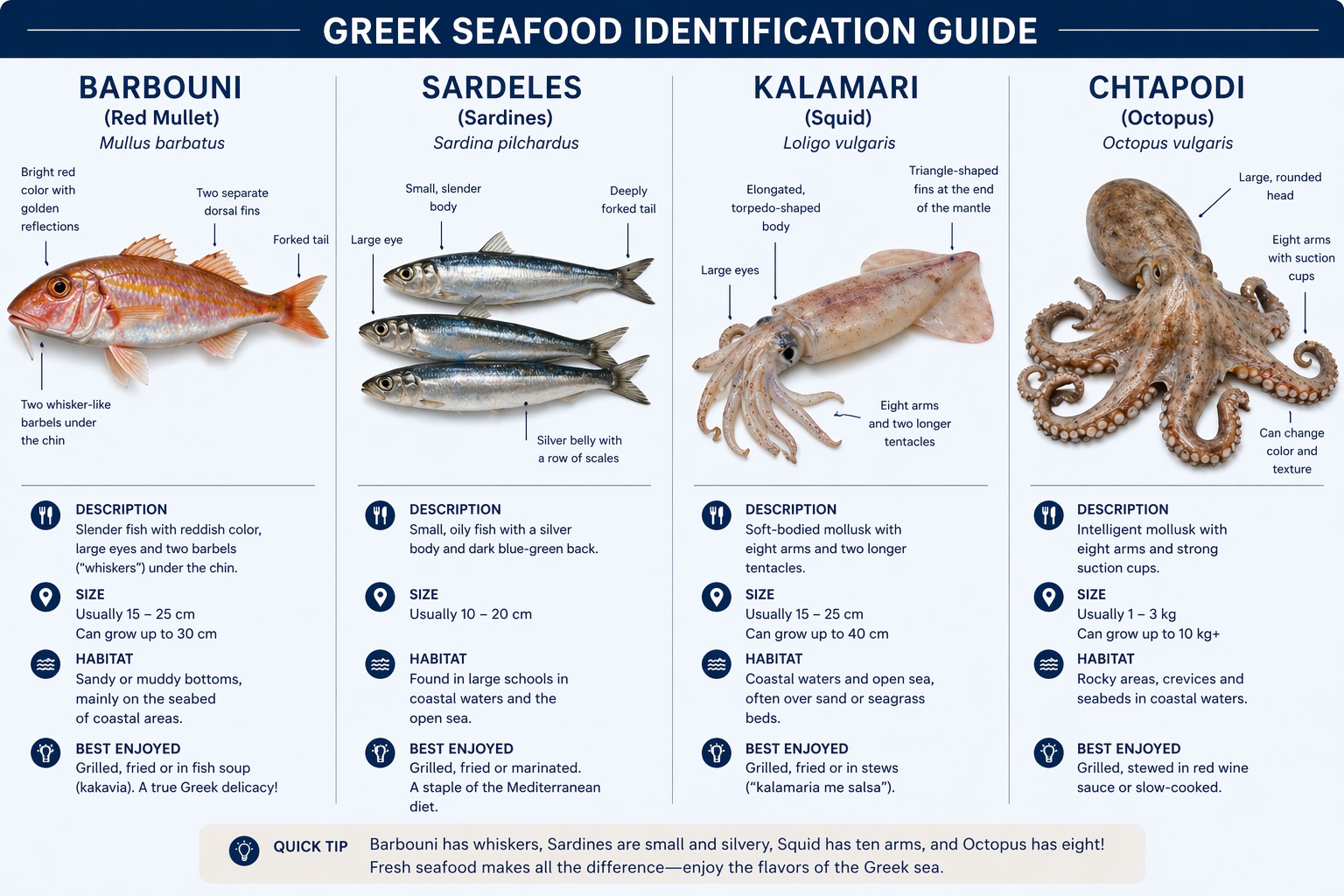
Fish Supply. Fish is supplied by local fishermen and small fishmongers, particularly around Skopelos Town Harbour. Availability typically includes seabass, seabream, sardines, squid, and octopus, with best selection in the morning following landings.
Skopelos Greece
Sailing Guide - Local Cuisine
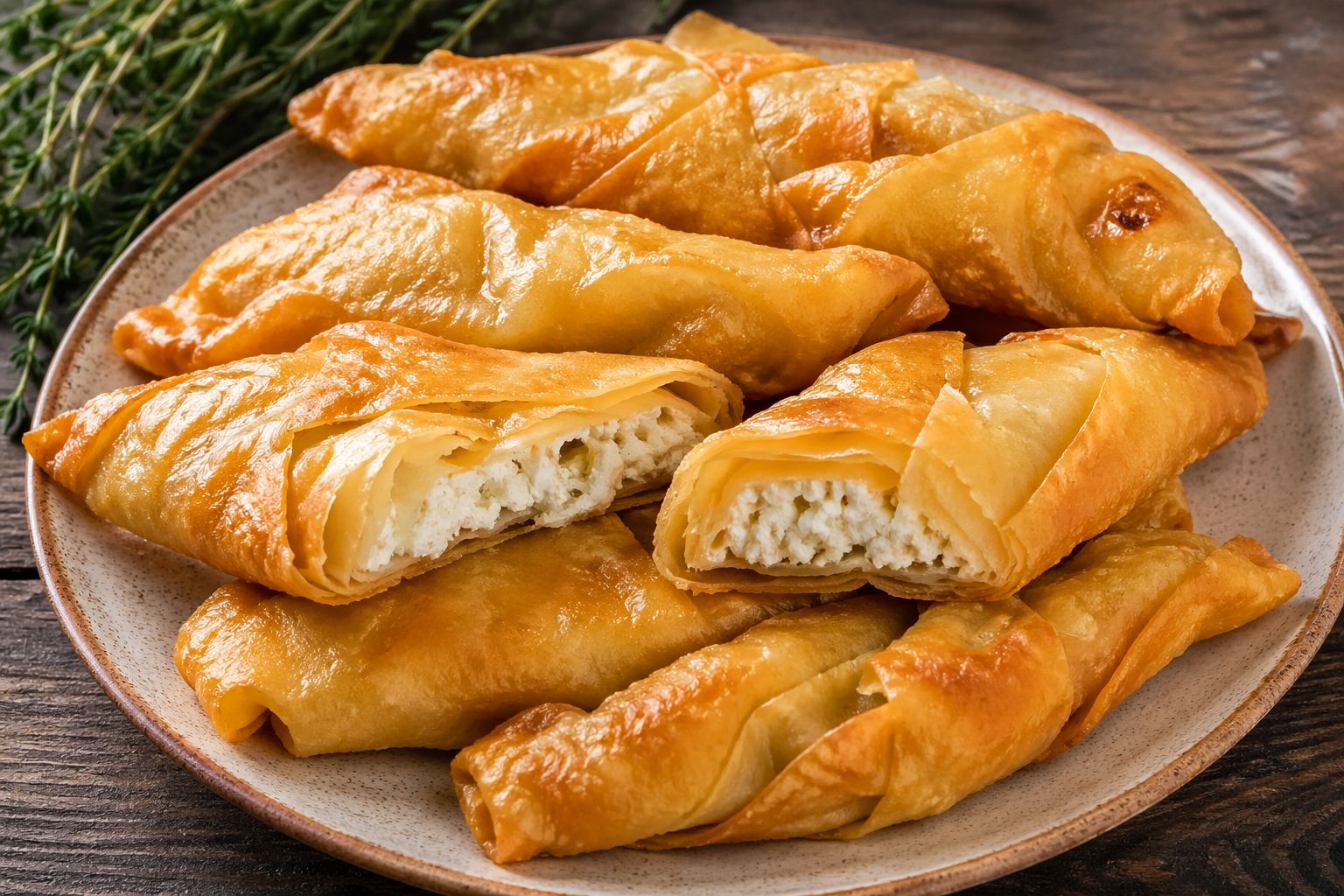
Cuisine on Skopelos is simple, regional, and strongly tied to local produce, with a few clearly identifiable signature dishes rather than a broad mainland-style range. The island is particularly known for Skopelos cheese pie (Skopelitiki tyropita), made from thin hand-rolled pastry filled with local goat or sheep cheese, folded or twisted, and fried in olive oil. Another distinctive dish is grouper stifado, where fish is slow-cooked with onions, tomato, olive oil, and spices, adapting a traditional meat stew to local seafood.
Seafood is otherwise prepared in straightforward forms, most commonly as grilled lavraki and tsipoura, whole fish cooked over charcoal with olive oil and lemon, alongside dishes such as kakavia / psarosoupa, fish-based soups using mixed catch, vegetables, and herbs. Meat dishes are present but secondary, typically including souvlaki and simple oven-baked lamb or goat with herbs and potatoes. Local products include olive oil, honey, plums, and almonds, all used in both savoury and sweet preparations. Desserts follow traditional patterns, often incorporating local ingredients such as fruit preserves and nuts.
Skopelos Greece
Sailing Guide - Beverages
Beer, wine, and spirits across the Greek islands are locally produced and widely available through tavernas, small bars, and provisioning outlets. Beer is predominantly lager, with domestic brands including Mythos, Alfa, Fix, and Vergina alongside imported products; and over 100 microbreweries operate on several islands with limited distribution. Wine is region-specific, with white varieties dominant in the islands, including Assyrtiko, Moschofilero, and Roditis, alongside local table wines served in bulk; retsina remains in circulation as a resin-flavoured wine. Distilled products include ouzo (anise-based), tsipouro (grape marc distillate), raki or tsikoudia (Crete), souma (fig or grape distillate in eastern Aegean islands), and kitron (citrus liqueur from Naxos), with alcohol strength typically in the 37–45% range and higher for unregulated local distillations.
Skopelos Greece
Sailing Guide - Fuel Supplies
Fuel supply on Skopelos is available but limited, with refuelling primarily conducted at Skopelos Town Harbour via road tanker delivery to the quay. There is no dedicated fuel dock or marina fuel berth, and all supply is arranged locally, typically with advance notice. Delivery is generally reliable due to regular supply links with nearby mainland ports and Skiathos, though availability can be affected by demand during peak season. Berthing constraints and harbour exposure to northerly winds may influence timing and positioning during refuelling. Petrol and LPG (bottled gas) are available ashore in Skopelos Town through local fuel stations and suppliers. No fuel is available at anchorages around the island.
Skopelos Greece
Sailing Guide - Water Supplies
Water supply on Skopelos is available at Skopelos Town Harbour via quay connections, though provision is basic and can be variable. Supply is drawn from the municipal network, with pressure and availability depending on berth location and seasonal demand, particularly during peak summer periods. Water is generally suitable for onboard use but can be moderately mineral-rich, making filtration advisable for drinking. Access is typically metered or controlled locally, and hoses are required for connection. Limited supply may be available at some secondary quays around the island, but this should not be relied upon. No water is available at anchorages such as Panormos Bay. Overall, Skopelos offers adequate but not abundant water supply, suitable for topping up tanks with some planning, rather than unrestricted full replenishment.
Mechanical and Electrical Repairs
Resource
If you are headed somewhere remote consider the need to expand your knowledge base or have an information resource on board. Why not get a copy of my book The Marine and Electrical and Electronics Bible 4th Edition. By and for yachties, with everything from batteries and charging, solar and wind, diesel engines and marine electronics and so much more. Your complete systems guide. 650 pages of practical advice. In Australia and New Zealand order a copy through Boat Books. UK and European boats can buy the UK Edition Here. US and Canadian boats can get the US Edition Order Here. Marine systems are my profession so let me help you. By a liveaboard boat owner for other boat owners.



Skopelos Greece
Sailing Guide - Marine Services
Marine services on Skopelos are basic and limited, centred on Skopelos Town. Local support is available for minor mechanical, electrical, and general maintenance through small workshops and independent technicians, suitable for routine repairs and troubleshooting. Chandlery supply is minimal, with only essential items available locally. There are no haul-out or yard facilities on the island, and no capacity for major repairs or refit work. Spare parts and specialised equipment are typically sourced from nearby Skiathos or the mainland port of Volos.
Skopelos Greece
Sailing Guide - Local Customs
Interaction is direct and formal on first contact, with a greeting expected before any request or transaction. Conversation tone is measured and transactional, with limited small talk unless initiated locally. Personal space is closer than in northern Europe, but physical contact is minimal unless familiarity is established. Shore behaviour is conservative in non-tourist areas, particularly near churches and village centres where modest dress and low noise are expected.
Skopelos Greece
Sailing Guide - Summary
Skopelos provides multiple south coast anchorages with good holding and shelter from northerly winds. Harbour facilities are limited and exposed on the north coast. Conditions are wind driven with moderate regional shelter from surrounding islands. Provisioning is available with reliance on nearby centres for major services. Skopelos Greece Sailing Guide for all you need to know.