Shoalwater Bay Sailing Guide
Shoalwater Bay Sailing Guide. Shoalwater Bay is one of the most remote and weather‑exposed cruising regions on the Queensland coast, offering deep inlets, secure all‑weather anchorages and vast stretches of uninhabited coastline. The region forms the northern section of the Capricorn Coast and is part of the Shoalwater Bay Training Area, a Defence‑controlled zone with periodic closures and restricted access. For skippers transiting between the Keppel Islands and Cape Manifold, Shoalwater Bay provides some of the most reliable natural anchorages on the coast, including Port Clinton, Pearl Bay and Island Head Creek. The approaches are clear, the depths are generous and the anchorages are secure, but the remoteness of the area demands self‑sufficiency and disciplined seamanship.
Although the region is generally forgiving in settled conditions, the skipper must remain alert to wind‑driven sea state, tidal flow and the isolation of the coastline. Northerlies expose the outer bays and create short, steep chop, while south‑easterlies provide reliable shelter in most of the inlets. The shoreline is dominated by mangroves, sand dunes and rugged headlands, and the anchorages vary from deep, protected basins to open road steads that require careful weather selection. Shoalwater Bay is not a difficult region, but it rewards a deliberate approach and a clear understanding of how wind and tide interact across its wide, open spaces.
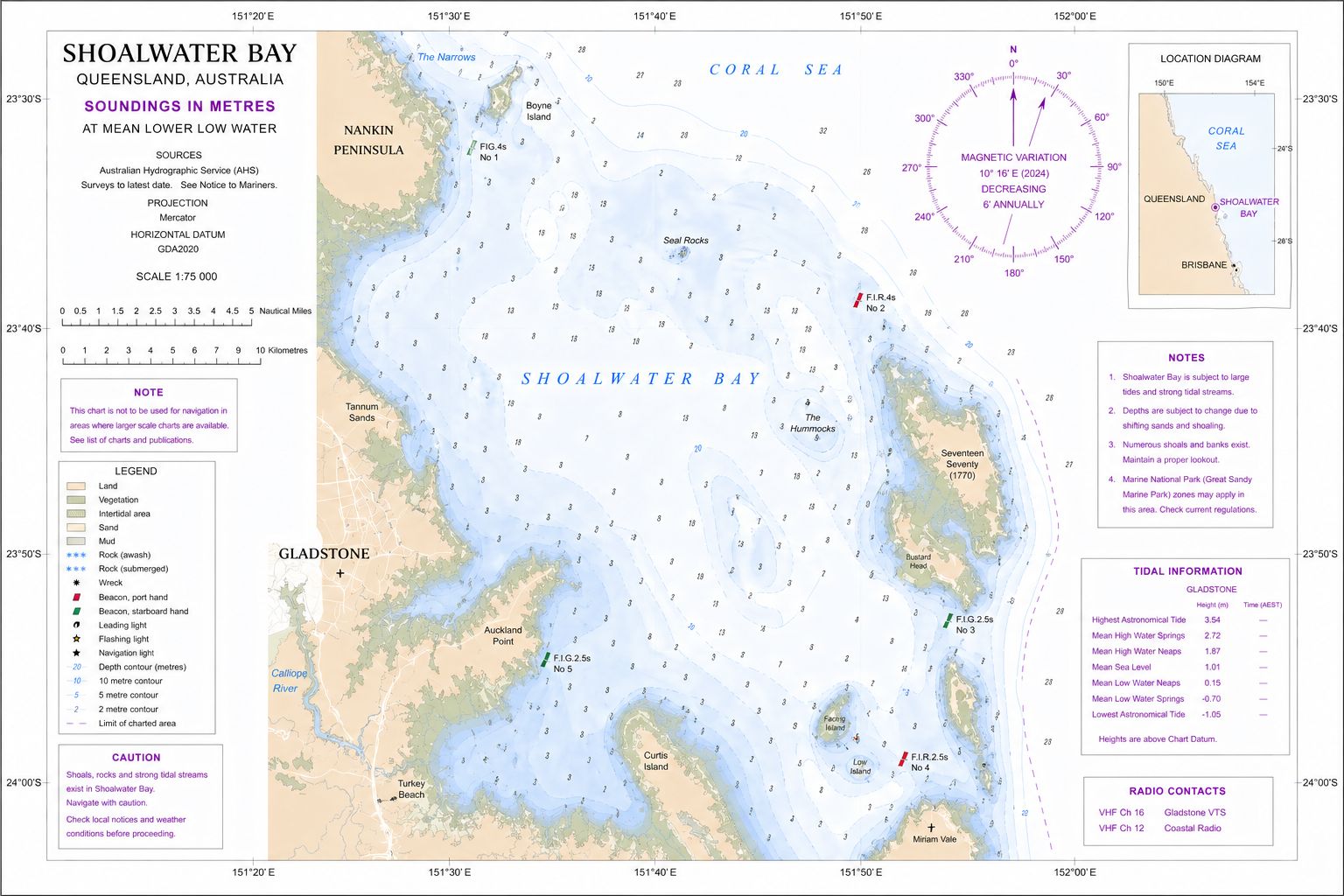
Chart Disclaimer. This chart is a schematic representation for illustrative purposes only and must not be used for navigation. Refer to official hydrographic charts for safe navigation. Be aware ENC charts may differ from official hydrographic charts. Both should be corrected and updated regularly.
Shoalwater Bay Sailing Guide - Location
Shoalwater Bay lies north of the Keppel Islands and south of Cape Manifold, forming the remote northern section of the Capricorn Coast. The region includes Port Clinton, Pearl Bay, Island Head Creek, Freshwater Bay and the extensive Shoalwater Inlets. The coastline is largely undeveloped, with no services, settlements or infrastructure. Approximate centre position: 22°22.0’S 150°35.0’E
Shoalwater Bay Sailing Guide - Approach
The approach to Shoalwater Bay is clear, with 20–40 m of water outside the region and wide, unobstructed lines toward the major inlets. The skipper can shape a direct approach from the Keppel Islands, Cape Manifold or offshore routes, with depths remaining consistent at 15–25 m until nearing the coastline. In strong south‑easterlies, the sea state remains manageable due to the shelter provided by the mainland, but in northerlies the outer bays become exposed and can develop short, steep chop. The coastline is easy to identify, with the distinctive headlands of Island Head Creek and the wide entrance of Port Clinton providing strong visual references.
Shoalwater Bay Sailing Guide - Exposure
Shoalwater Bay is a region of contrasts, with deep, protected inlets lying only a short distance from exposed outer bays. The anchorages are comfortable in south‑easterlies, with the mainland providing reliable shelter, but become exposed in northerly winds. Tidal flow is modest across most of the region but becomes more noticeable in the narrow entrances of Island Head Creek and the Shoalwater Inlets. The seabed varies from sand and mud in the protected inlets to sand and coral rubble near the headlands. The skipper must choose anchorages carefully based on wind direction and intended transit timing.
Shoalwater Bay Sailing Guide - Primary
Anchorages
The Shoalwater Bay region contains several major anchorages, each with distinct characteristics and operational considerations. These anchorages form the backbone of the region and provide secure shelter for vessels transiting the Capricorn Coast.
Port Clinton: The most secure all‑weather anchorage in the region, offering 6–15 m of depth, excellent holding and complete protection from all wind directions. The inlet is calm, deep and reliable, making it the primary refuge for skippers moving between the Keppel Islands and Pearl Bay.
Pearl Bay: A scenic, semi‑protected anchorage with 6–12 m of depth over sand. Pearl Bay offers good shelter from south‑easterlies but becomes exposed in northerlies. The anchorage is comfortable in settled conditions and is a popular stop for vessels transiting the region.
Island Head Creek: A deep, mangrove‑lined inlet with 6–12 m of depth and excellent protection from all wind directions. The entrance is narrow but straightforward, and the inlet provides multiple anchorage zones. Island Head Creek is one of the most secure anchorages on the Capricorn Coast.
Freshwater Bay: A broad, semi‑protected bay with 6–10 m of depth over sand and mud. Freshwater Bay offers good shelter from south‑easterlies but becomes exposed in northerlies. The anchorage is comfortable in settled conditions and provides a useful stop between Port Clinton and Pearl Bay.
Shoalwater Inlets: A series of deep, mangrove‑lined channels with 5–12 m of depth and excellent protection from all wind directions. The inlets are remote, tidal and extremely sheltered, offering complete isolation and calm water in almost all conditions.
Shoalwater Bay Sailing Guide - Wind,
Weather and Tide
Shoalwater Bay is well protected from south‑easterly trade winds, and the inlets remain comfortable in these conditions. Northerlies expose the outer bays and create short, steep chop that makes the open anchorages uncomfortable or untenable. Tidal flow is modest across most of the region but becomes more noticeable in the narrow entrances of Island Head Creek and the Shoalwater Inlets. The region is unaffected by swell, and the sea state remains flat inside the inlets even when the sea outside is steep.
Shoalwater Bay Sailing Guide - Navigation
Hazards
The primary hazards in the Shoalwater Bay region are exposure to northerly winds, shallow margins near the mangroves, tidal flow in the narrow entrances and the remoteness of the coastline. The region is part of the Shoalwater Bay Training Area, and access may be restricted during Defence exercises. The skipper must check current notices and comply with all restrictions. There are no significant underwater obstructions, and navigation is straightforward in good visibility.
Mechanical and Electrical Repairs
Resource
If you are headed somewhere remote consider the need to expand your knowledge base or have an information resource on board. Why not get a copy of my book The Marine and Electrical and Electronics Bible 4th Edition. By and for yachties, with everything from batteries and charging, solar and wind, diesel engines and marine electronics and so much more. Your complete systems guide. 650 pages of practical advice. In Australia and New Zealand order a copy through Boat Books. UK and European boats can buy the UK Edition Here. US and Canadian boats can get the US Edition Order Here. Marine systems are my profession so let me help you. By a liveaboard boat owner for other boat owners



Shoalwater Bay Sailing Guide - Resources
Shoalwater Bay has no facilities of any kind, and the skipper must arrive fully self‑sufficient with all provisions, fuel, water and spares already onboard. There are no settlements, shops, fuel docks, water points, marinas or landing services anywhere in the region, and the inlets are surrounded by mangroves and Defence‑controlled coastline. Once inside Shoalwater Bay, there is no opportunity to resupply, and the skipper must plan for complete isolation until returning to Rosslyn Bay, the Keppel Islands or other ports to the south.
Shoalwater Bay Sailing Guide - Summary
Shoalwater Bay is one of the most remote and sheltered cruising regions on the Capricorn Coast, offering deep inlets, secure anchorages and reliable protection in south‑easterlies. The region demands self‑sufficiency and careful weather selection, but rewards the skipper with calm water, generous depths and some of the most isolated anchorages on the Queensland coast. For vessels transiting between the Keppel Islands and Cape Manifold, Shoalwater Bay is an essential part of the coastal route. The Shoalwater Bay Sailing Guide for useful information.