Seychelles Yacht Cruising
Guide
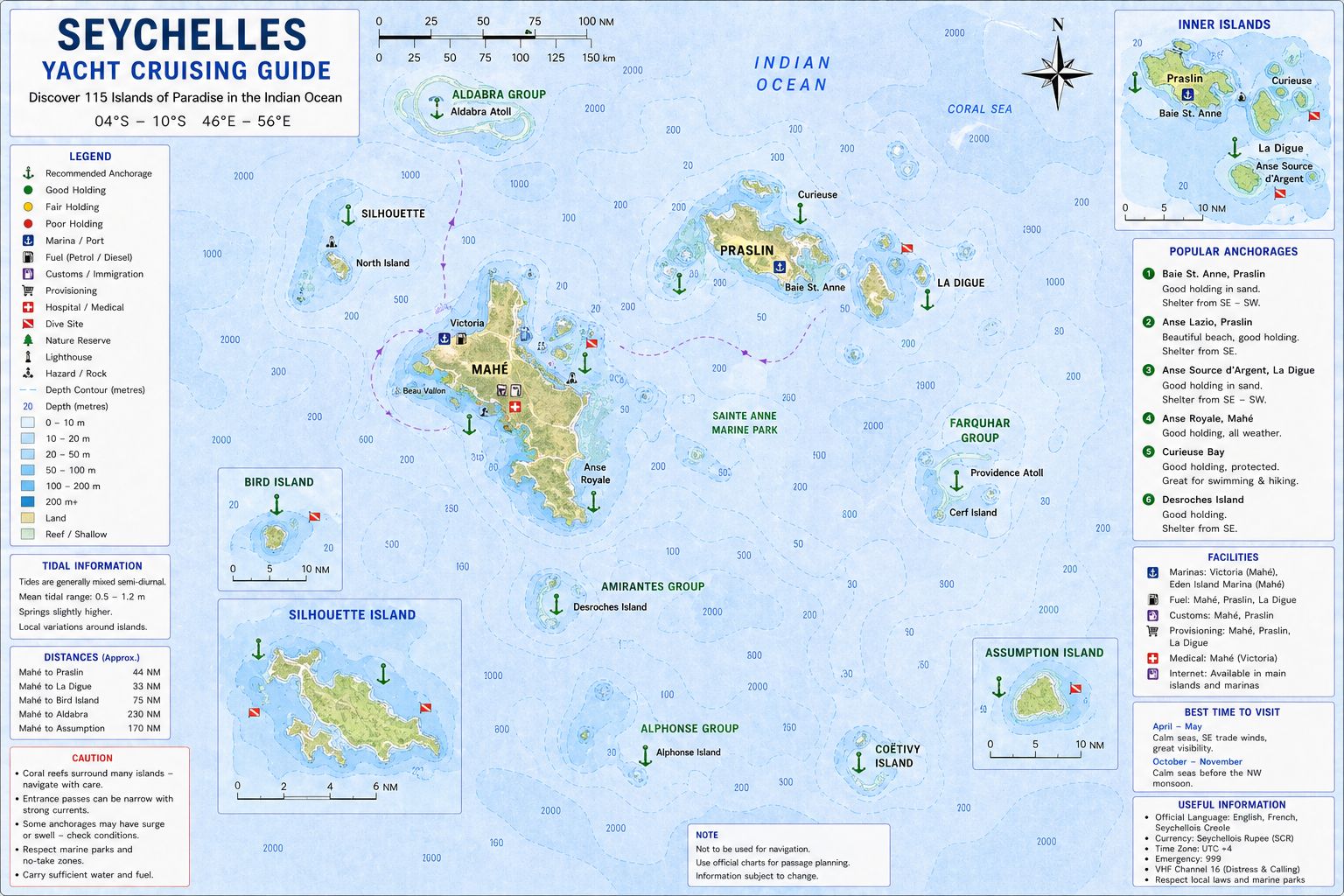
Seychelles Yacht Cruising Guide. The Seychelles function as the primary full‑service stop for yachts crossing the western Indian Ocean between the Maldives, Chagos, and East Africa. Mahé provides the only deep‑water port with formal clearance, fuel, water, provisioning, and marine services. Praslin and La Digue offer sheltered anchorages and limited supplies but are not suitable for major provisioning or repairs. Navigation throughout the archipelago is defined by granite islands, steep depth contours, and reef‑fringed approaches requiring daylight entry.
Yachts use the Seychelles as a staging point for westbound passages to Madagascar, Comoros, or Tanzania, or northbound toward the Gulf of Aden. The region’s SE trade‑wind weather, strong currents, and reef‑defined anchorages require precise planning. Mahé is the operational centre; all other islands should be treated as self‑sufficiency zones with only minor top‑up capability.
Seychelles Yacht Cruising
Guide - Approaches
Approaches to the Seychelles are clear of offshore hazards, with ocean depths >1,000 m until within 1–2 NM of the islands. Granite islands rise steeply, and the fringing reefs are narrow but abrupt. Approaches must be made in daylight with overhead sun for reef definition. Numerous unlit fishing vessels operate at night, especially around Mahé and Praslin.
Victoria Harbour (Mahé) is the primary entry port. The approach channel is well‑marked with depths of 10–20 m. Tidal range is small (≈1.5 m), but local currents can reach 1–2 kn near headlands. Swell is minimal inside the harbour.
Seychelles Yacht Cruising
Guide - Anchorage
Mahé offers several anchorages outside Victoria, including Beau Vallon and Anse Royale, but these are exposed in strong SE trades. Most yachts anchor in the designated area outside the commercial port before receiving clearance instructions. Praslin’s Baie Sainte Anne and Anse Lazio provide sheltered anchorages in 10–20 m over sand. La Digue offers moorings only; anchoring is restricted due to coral protection. Holding is generally good in sand, but coral patches and granite boulders require visual selection. Anchorages open to the SE become uncomfortable or untenable during peak trade‑wind periods.
Seychelles Yacht Cruising
Guide - Entry Formalities
All yachts must clear in at Victoria, Mahé. Clearance includes Immigration, Customs, Port Authority, and Coast Guard. Advance notice is recommended. Officials may board the vessel or conduct clearance ashore. A cruising permit is issued for inter‑island movement. Biosecurity rules apply to fresh produce, meat, and plants. Firearms must be declared. Starlink and other satellite communications equipment must be declared. Drone use is restricted and requires prior approval. Movement to outer islands requires adherence to marine park regulations and, in some cases, additional permits.
Seychelles Yacht Cruising
Guide - Marina Facilities
Mahé has the only marina‑style berthing at Eden Island Marina, with depths of 3–6 m, floating pontoons, shore power, water, and fuel. Space is limited during peak season. Victoria Harbour provides commercial berths but is not suitable for yachts except under direction of authorities. No marinas exist on Praslin or La Digue; moorings and anchoring only. No haul‑out for large yachts exists; small‑vessel haul‑out is possible at selected yards but not suitable for deep‑keel monohulls.

Seychelles Yacht Cruising
Guide - Local Weather
Weather is dominated by the monsoon cycle. Cyclones are rare but can influence weather patterns indirectly. Local katabatic winds occur near steep granite slopes.
- Southeast Monsoon (May–Oct): Strong SE trades 15–25 kn, rougher seas, reduced visibility in squalls.
- Northwest Monsoon (Dec–Mar): Lighter NW winds, calmer seas, higher humidity.
- Inter‑monsoon periods: Variable winds, thunderstorms, and short‑lived squalls.
Seychelles Yacht Cruising Guide - Ocean Currents
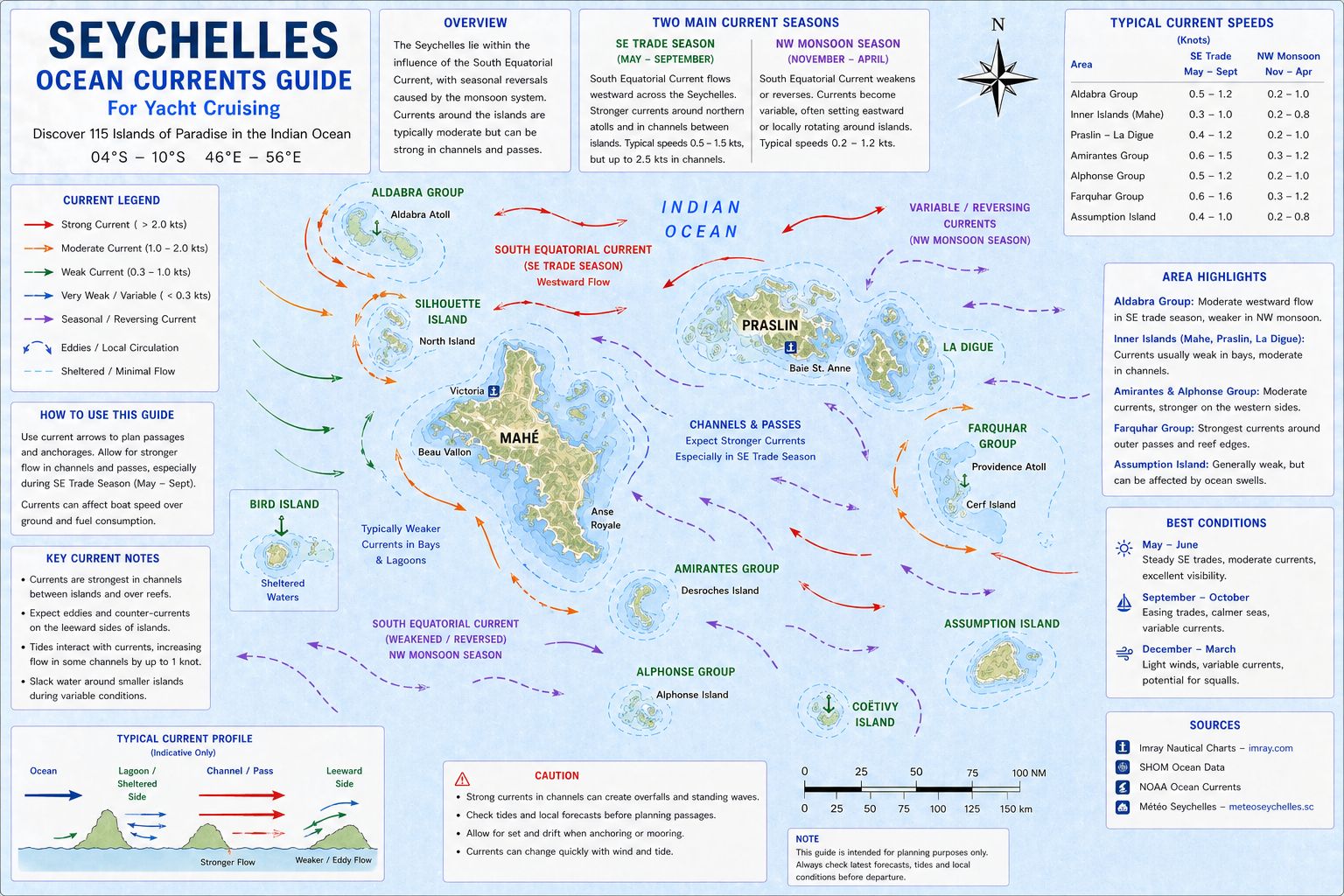
Ocean currents around the Seychelles are governed by the seasonal reversal of the monsoon system, making them more variable than in many trade-wind regions. From May to September, the southeast monsoon drives a generally westward to northwestward surface flow, often linked to the broader South Equatorial Current, with typical rates of 0.5–1.5 knots in open water. During the northwest monsoon (December to March), currents weaken and may reverse or become more irregular, with eastward or variable drift influenced by shifting winds and regional circulation. Around the granitic inner islands such as Mahé and Praslin, currents are further modified by complex bathymetry, producing eddies, counter-currents, and localized acceleration near headlands and channels, while the outer coral islands experience more consistent open-ocean flow. Tidal currents are generally modest but can be noticeable in narrow passes and between closely spaced islands. For yacht navigation, allowance should be made for seasonal set and drift offshore, while inshore conditions require attention to localized current effects and wind-against-current sea states.
Seychelles Yacht Cruising
Guide - Provisioning
Supermarkets. Mahé has the only island in the Seychelles with true reprovisioning capacity. GSC Gastronomy Supermarket (Victoria). Strong on imported European goods, including a wide range of Leader Price products (dry goods, snacks, sauces, tinned food, cleaning supplies). Good for packaged staples and mid‑range frozen items. Grocers Supermarkets Pty Ltd (Orion Mall). Reliable for dry goods, frozen meat, dairy, snacks, beverages, and household items. Good stock turnover due to mall location. Kannus Supermarkets (multiple branches). Broad selection of everyday staples, frozen goods, and household supplies. Useful for top‑up provisioning and general dry‑goods shopping. Spar (Eden Island & Mahé). High‑quality packaged goods, fresh produce, bakery items, imported cheeses, and frozen meat. Strong for Western staples and consistent stock. Seychelles Trading Corporation (STC Hypermarket & STC Supermarkets). The largest and most reliable national retailer. Full range of dry goods, frozen meat, dairy, beverages, household supplies. The Hypermarket has the widest selection in the country. ISPC Seychelles (industrial food supplier). Best source for bulk frozen meat, butter, cheese, imported dairy, and Western specialty items. Essential for long‑passage provisioning. Local minimarkets (island‑wide). Useful for bottled water, eggs, onions, potatoes, basic fruit, and emergency top‑ups.
Markets. Victoria Market (Sir Selwyn Clarke Market). Primary source of fresh vegetables, fruit, herbs, and spices. High turnover and consistent supply. Local produce stalls (Mahé). Additional fresh items, coconuts, bananas, papaya, and seasonal fruit. Praslin and La Digue village markets. Limited selection; suitable only for top‑up produce. Vanilla, cinnamon, nutmeg, and dried seafood are locally sourced and ideal for yacht provisioning.
Fish Markets. Victoria Fish Market. Daily landings of tuna, wahoo, trevally, and reef species. Best availability early morning. Harbour‑side vendors (Mahé). Additional fresh fish depending on local catch. Praslin and La Digue small fish stalls. Limited but reliable for small quantities.
Food‑Related Risk on Indian Ocean Passages
Marine‑toxin food poisoning (Ciguatera) is a recognised hazard across the western Indian Ocean, particularly on long passages where crews rely on self‑caught fish or locally sourced reef species. Toxins such as ciguatoxin occur naturally in reef ecosystems and are not destroyed by cooking, freezing, or cleaning. Illness can develop rapidly and incapacitate an entire crew if the same fish is consumed. Two‑person crews are especially vulnerable because simultaneous onset leaves the vessel unmanned.
High‑Risk Species. Reef‑associated predatory fish carry the highest toxin load. The following species are consistently identified as high‑risk in the western Indian Ocean, Barracuda, Grouper (all large species), Trevally, Amberjack, Snapper (large reef species) and Moray eel. These species should be avoided entirely on ocean passages. Pelagic species such as tuna, wahoo, and mahi‑mahi carry significantly lower risk and are the preferred option when fishing offshore.
Geographic Hotspots. Ciguatera risk is elevated around Madagascar’s west and northwest reefs. Comoros archipelago, Mayotte lagoon and fringing reefs, Mozambique Channel islands and banks. Seychelles outer islands. Risk increases near shallow reefs, coral rubble zones, and areas with algal growth following storms or warm‑water events.
Onboard Risk‑Reduction Protocols. These are operational guidelines, not medical instructions. Avoid all reef fish caught within 20–30 nm of land. Prioritise pelagic species caught in deep water. Do not consume fish if the flesh has an unusual smell, texture, or colour. Do not consume large or old fish; toxin load increases with size and age. Do not consume fish liver, roe, or head meat, where toxins concentrate. If one crew member becomes unwell after eating fish, all remaining portions should be discarded immediately.
Two‑Person Crew Vulnerability. A two‑person crew is at highest operational risk because: Both typically eat the same meal. Onset can be rapid, leaving no functional watchkeeper. Passage planning for two‑person crews should assume zero tolerance for reef‑fish consumption.
Passage‑Planning Implications. Provision sufficient protein to avoid reliance on reef fishing. Treat all reef‑caught fish as unsuitable for consumption. Maintain a conservative fishing policy offshore: pelagic species only. Ensure the vessel can maintain course and speed under autopilot if both crew are incapacitated. Maintain regular check‑ins with shore contacts during long legs.
Relevance to the Recent Fatality. The suspected food‑poisoning deaths of two experienced sailors in the Mozambique Channel highlight the operational reality: marine toxins can incapacitate a crew without warning, and a yacht at sea cannot rely on medical intervention. The case reinforces the need for strict fish‑selection protocols and conservative food‑safety practices on long passages.
Seychelles Yacht Cruising
Guide - Local Cuisine
Seychellois Creole cooking is built around fish, coconut, chillies, and slow‑cooked curries. The following dishes represent the core local repertoire and can be prepared onboard using ingredients sourced in Victoria’s markets and supermarkets: Pwason griye. Grilled fish, typically jobfish, trevally, or tuna, seasoned with lime, salt, and chilli. Kari pwason. Fish curry made with coconut milk, turmeric, cinnamon leaf, and local chillies. Kari poul. chicken curry using coconut milk, curry leaves, and mild Creole spices. Ladob sale. Savoury dish of breadfruit or plantain cooked in coconut milk with salt and spices. Ladob dou. Sweet version using plantain, sweet potato, coconut milk, and vanilla. Satini reken. Shark chutney made from boiled, shredded shark meat mixed with lime, onion, and chilli (availability varies due to conservation rules). Pwason ek diri. Simple fish‑and‑rice plate common in local eateries. Rougaille. Tomato‑based Creole stew with fish or sausage, onions, garlic, and chilli. The local beer is called SeyBrew and quite acceptable when chilled.
Seychelles Yacht Cruising
Guide - Fuel Supplies
Diesel is available at Eden Island Marina via dockside pumps. Quality is reliable. Petrol is available at island fuel stations and must be transported by jerry can. No fuel dock exists on Praslin or La Digue; fuel must be transported by dinghy.
Seychelles Yacht Cruising
Guide - Water Supplies
Potable water is available at Eden Island Marina via dockside taps. Water quality is treated and reliable. Outside Mahé, potable water is limited and usually requires jerry‑can transport.
Mechanical
and Electrical Repairs Resource
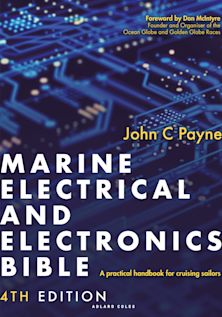
If you are headed somewhere remote consider the need to expand your knowledge base or have an information resource on board. Why not get a copy of my book The Marine and Electrical and Electronics Bible 4th Edition. By and for yachties, with everything from batteries and charging, solar and wind, diesel engines and marine electronics and so much more. Your complete systems guide. 650 pages of practical advice. In Australia and New Zealand order a copy through Boat Books. UK and European boats can buy the UK Edition Here. US and Canadian boats can get the US Edition Order Here. Marine systems are my profession so let me help you. By a liveaboard boat owner for other boat owners


Seychelles Yacht Cruising
Guide - Marine Services
Mahé has the only meaningful marine services in the Seychelles. Diesel mechanics. General electricians and basic marine electronics support. No sailmakers, riggers, or authorised Volvo/Yanmar agents are based in the Seychelles. Praslin and La Digue have no marine services.
Seychelles Yacht Cruising
Guide - Local Customs
The Seychelles is culturally mixed with Creole, French, and East African influences. Modest dress is appropriate in towns and villages. Respectful behaviour is expected in religious sites. Alcohol is permitted but regulated in certain areas. Photography of people should be requested politely.
Seychelles Yacht Cruising
Guide - Summary
The Seychelles provide the only full‑service stop between the Maldives and East Africa, with Mahé offering clearance, fuel, water, provisioning, and limited repairs. Navigation is defined by granite islands, steep depth contours, and reef‑fringed anchorages requiring daylight entry. Praslin and La Digue offer sheltered anchorages but minimal services. For Indian Ocean crossings, the Seychelles function as a reliable staging point for westbound or northbound routes, with all critical operations centred on Mahé. Seychelles Yacht Cruising Guide for all you need to know.