Santorini Greece
Sailing Guide
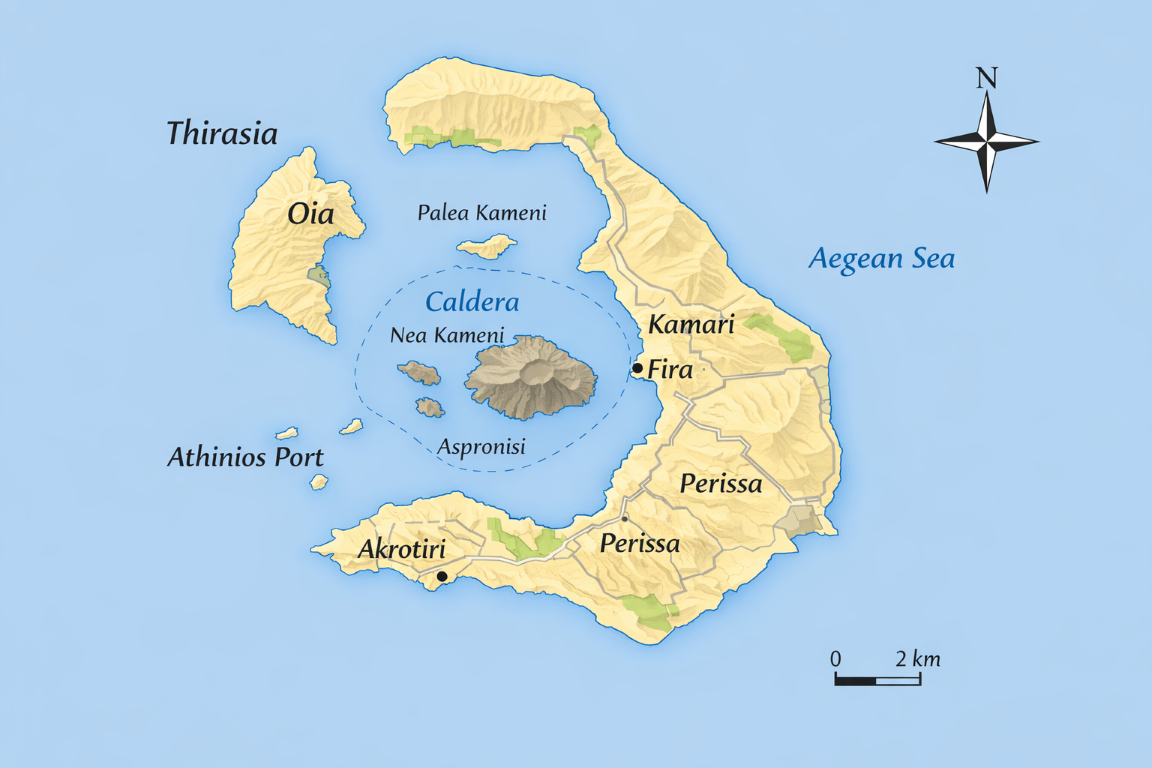
Santorini Greece Sailing Guide. Santorini is located in the southern Cyclades of the Aegean Sea in Greece at approximately 36°24′N 25°26′E. The island forms part of a volcanic caldera with steep cliffs on the west side and open coasts to the east and south-east. The principal commercial port is Athinios on the west coast within the caldera.
The operating environment is open Aegean with strong wind influence and negligible tidal range. The caldera provides deep, enclosed water but with limited secure anchoring and exposure to katabatic gusts descending from high terrain.
Santorini Greece
Sailing Guide - History
Santorini has a continuous settlement history shaped by the Minoan eruption of Thera, which reconfigured the island into its present caldera form and buried the settlement of Akrotiri, now excavated and accessible. Subsequent occupation under Greek, Roman, Byzantine, Venetian, and Ottoman control is reflected in fortifications, churches, and harbour structures around the caldera rim. Remains include the Akrotiri archaeological site, fortified settlements such as Pyrgos, and caldera-edge infrastructure, with the island’s geology and preserved ruins forming the primary features of interest.
Santorini Greece Sailing Guide - Approaches
Approach is from open water with depths exceeding 50–100 m offshore. Entry to the caldera is via a wide opening to the west between Therasia and the southern headland of Santorini. Depths within the caldera increase rapidly to over 200 m.
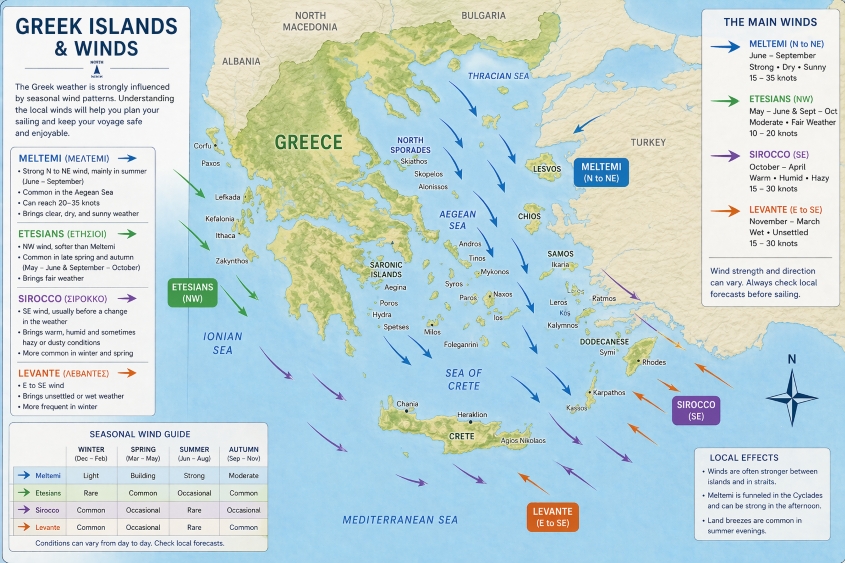
Sea state is wind dependent. Meltemi (N–NE) produces strong winds and acceleration around the caldera entrance and across exposed coasts. Within the caldera, sea state is reduced but gusting is significant. Tidal range is typically 0.2–0.4 m with no operational tidal stream.
Hazards include steep-to coastlines, lack of shallow holding ground, strong gusts near cliffs, and heavy ferry and cruise ship traffic. Manoeuvring space is constrained near Athinios port.
Santorini Greece
Sailing Guide - Navigation
Navigation at Santorini is defined by the caldera, with steep-to depths exceeding 100–300 m close to shore and no general anchoring inside except in limited areas such as Ormos Firon. Entry to the caldera is via the passage between Akrotiri and Thirasia with unrestricted depth but high traffic from ferries and commercial vessels requiring continuous watch and controlled manoeuvring. Athinios Port is the primary harbour with depths 5–8 m and constrained access affected by ferry wash and wind acceleration, while the outer east and south coasts provide anchorable depths of 5–15 m over sand but are fully exposed to Meltemi conditions; katabatic gusts and rapid depth change are consistent factors. Navigation is dominated by commercial traffic including ferries and cruise vessels. Maintain watch on VHF Channel 16 and port working channels. Commercial vessels have priority.
Santorini Greece
Sailing Guide - Chart Accuracy
Charts issued by the Hellenic Navy Hydrographic Service are reliable for approaches and caldera navigation. ENC data aligns with official charts. Depths within the caldera are extreme and seabed detail is less relevant for anchoring. Local moorings and temporary arrangements may not be charted.
Santorini Greece
Sailing Guide - Anchorages
Santorini provides limited anchoring due to depth and exposure. Within the caldera, anchoring is generally not practical due to depths exceeding 50–200 m. Vessels anchor where depth permits near the base of cliffs in selected areas with depths typically 20–40 m over mixed seabed, holding variable.
- Vlychada (south coast) provides a small harbour with depths of approximately 3–5 m and limited protection.
- East coast beaches provide depths of 5–15 m over sand but are exposed to Meltemi and swell.
No anchorage provides reliable shelter across conditions. Moorings or harbour berths are preferred where available.
Santorini Greece
Sailing Guide - Entry Formalities
Santorini operates under Greek national and Schengen procedures. Customs and immigration clearance is required for arrivals from outside Schengen areas. Vessel and crew documentation must be available.
Harbour authority control applies within port limits. Drones are regulated under Greek aviation rules. Communications equipment must comply with national regulations. Waste discharge is controlled.
Santorini Greece
Sailing Guide - Marina Facilities
There is no large marina. Berthing is limited to Athinios port and small facilities such as Vlychada Harbour. Depths alongside are generally 3–5 m. Berthing is constrained by commercial traffic and limited space.
Stern-to mooring on laid lines is standard where applicable. Conditions are affected by ferry wash and wind.
Santorini Greece
Sailing Guide - Local Weather
Summer conditions are dominated by strong northerly winds and dry weather. Winter conditions include frontal systems with variable winds and precipitation. Weather is wind driven with minimal tidal influence.
The Marine Electrical and Electronics Bible has a complete list of Greek VHF Radio Channel information and weather forecast times for Greece along with NAVTEX UK and Europe and NAVTEX Mediterranean for 490kHz and 518kHz.
Santorini Greece
Sailing Guide - Local Winds
Meltemi (N–NE) is the dominant wind, often strong with gusting and acceleration around terrain and within the caldera. Local katabatic winds descend from high ground producing sudden gusts within the caldera and near cliffs.
The Meltemi is a strong, dry northerly wind that dominates the Aegean in summer, accelerating through channels and between islands to produce steep, short seas. It is most persistent in July and August, often blowing for several days with little diurnal variation, creating fast north‑to‑south passages and challenging return routes. Its strength is shaped by pressure gradients between the Balkans and Anatolia, with local acceleration zones around major island gaps.
Santorini Greece
Sailing Guide - Provisioning
Supermarkets. Provisioning on Santorini is concentrated in the main settlements of Fira, Kamari, and the Athinios port area. AB Vassilopoulos operates a full-scale outlet in Fira with consistent stock turnover suitable for full reprovisioning. Sklavenitis presence is limited, with reliance primarily on AB and independent supermarkets. Supply is dependent on ferry logistics from mainland Greece and Crete. Independent supermarkets and mini-markets operate across Fira, Imerovigli, Perissa, and Kamari with reduced range and higher turnover variability. Stock reliability is generally stable in peak season but can fluctuate with ferry schedules and demand. Bulk provisioning is most practical in Fira. There is also the Big Co-op in Kamari and Perissa; Champion (Fira, Mesaria, Emporio); Denaxas (Mesaria, Emporio) and Market Zoi in Oia.
Markets. There is no central wholesale market. Produce is distributed through small vendors and local shops. Santorini agricultural output is limited but specific: tomatoes (tomataki Santorinis), white eggplant, fava (yellow split peas), capers, and local herbs. These are available through local grocers and small market stalls.
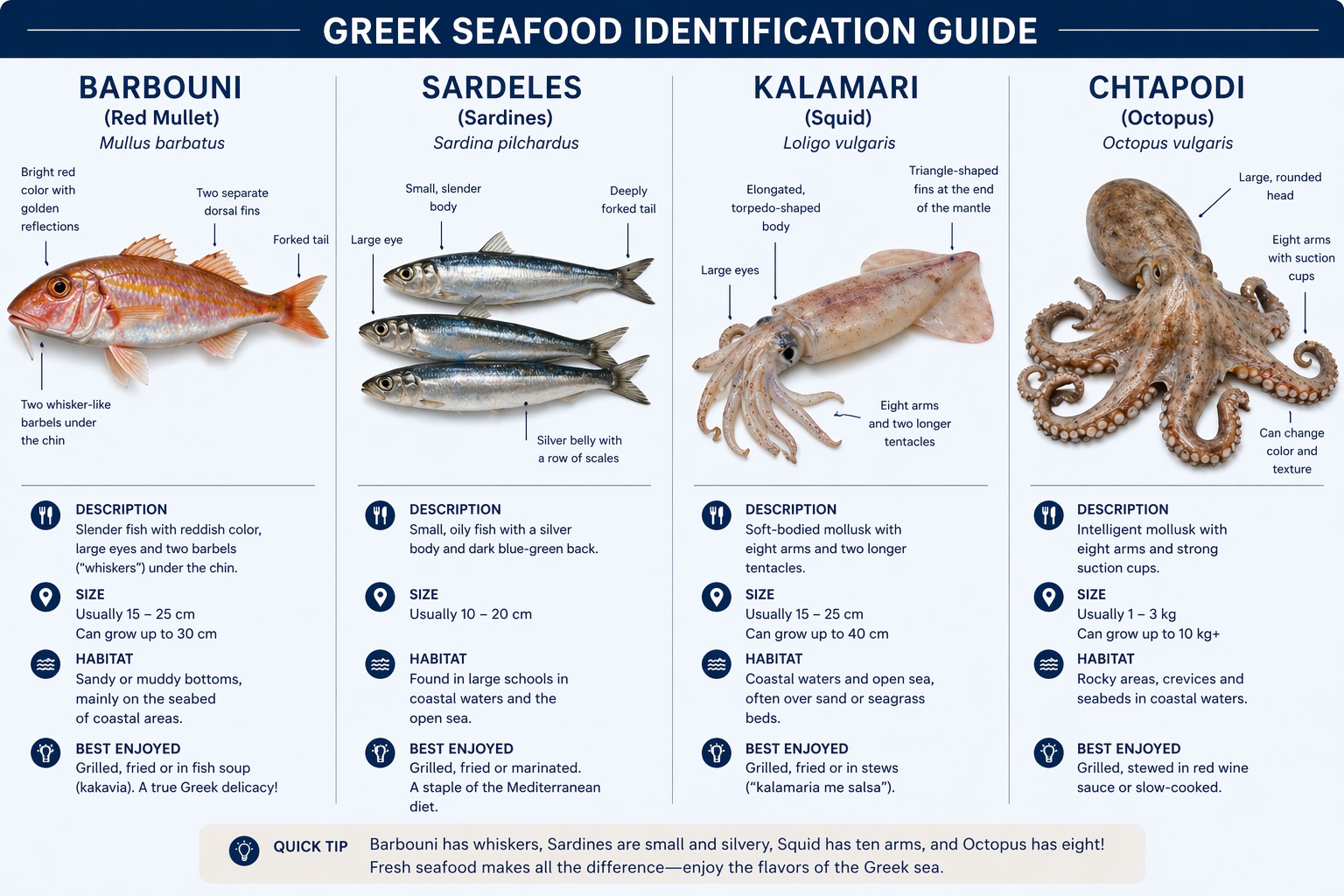
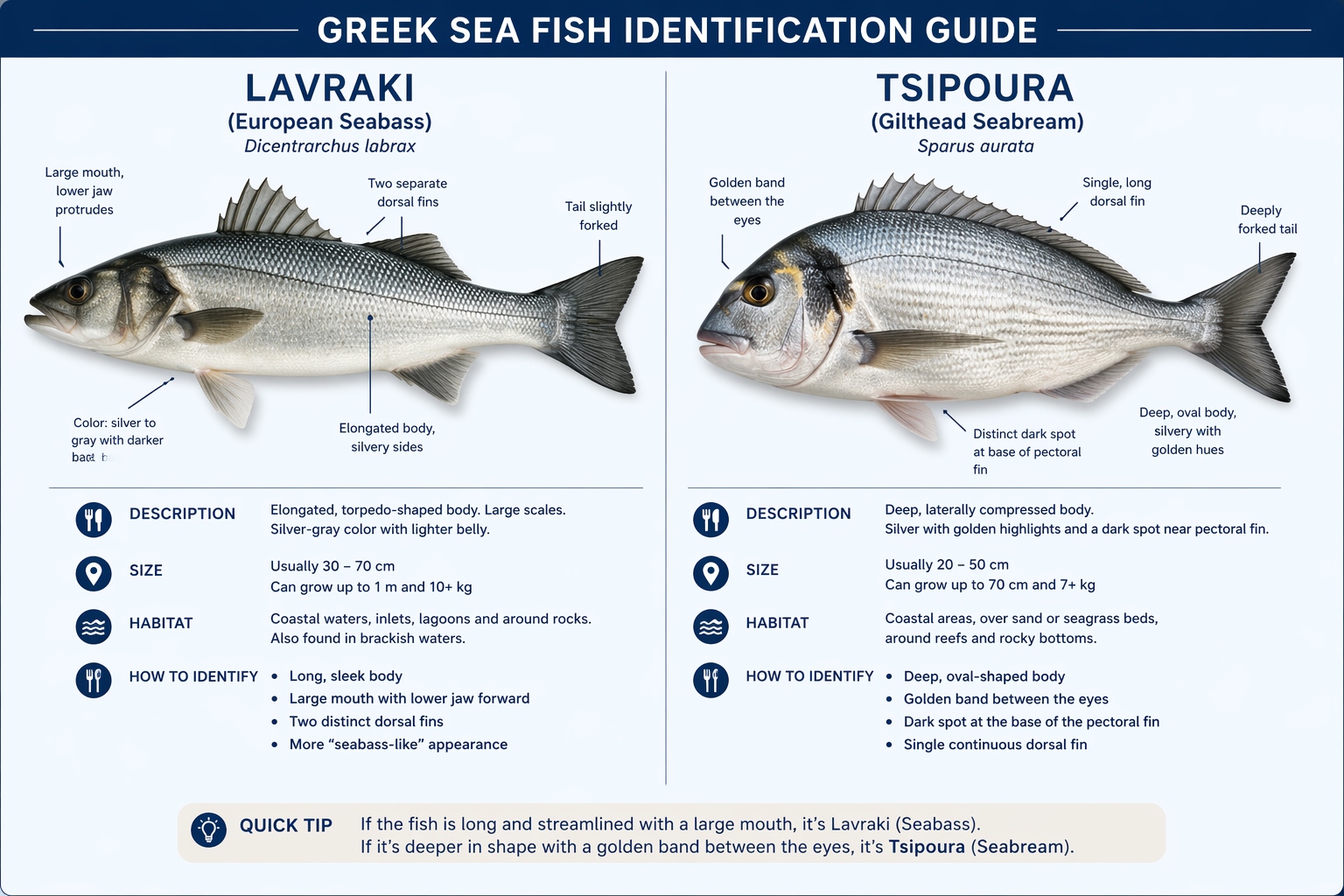
Fish Markets. There is no large central fish market. Fish supply is distributed through local fishmongers in Fira and Kamari with daily availability dependent on local catch and ferry imports. Species available include lavraki (European seabass), tsipoura (gilthead seabream), kalamari (squid), chtapodi (octopus), sardela (sardine), and gavros (anchovy). Volume is lower than mainland ports and availability varies with weather and fishing activity.
Santorini Greece
Sailing Guide - Local Cuisine
The local raw honey here is famous and comes from herbs and blossoms in the volcanic soils that include thyme, eucalyptus, oregano, and “Myriokalo”, which is a rare blossom. Santorini cuisine is based on dry-land agriculture and volcanic soil conditions, producing low-yield but high-intensity ingredients with limited water availability. Core dishes include fava (yellow split pea puree), tomatokeftedes (tomato fritters from Santorini cherry tomatoes), and white eggplant preparations, supported by capers and local herbs. Seafood such as lavraki (European seabass), tsipoura (gilthead seabream), octopus, and squid is typically grilled or stewed, with supply supplemented externally. Chlorotyri (fresh soft cheese) is used locally, while preserved foods, barley rusks, and simple cooking methods dominate. Wine production is central, with Assyrtiko as the primary white grape and Vinsanto as a sweet wine derived from sun-dried grapes.to (as a sweet wine produced from sun-dried grapes.
Santorini Greece
Sailing Guide - Fuel Supplies
Fuel is available on Santorini primarily at Athinios Port via road tanker delivery to quay or anchorage, with marine diesel as the standard supply. Advance notice is required and delivery is scheduled around ferry traffic and port access constraints. No fixed fuel dock exists and no fuel is available at anchorages or secondary locations.
Santorini Greece
Sailing Guide - Water Supplies
Water is available at Athinios Port via quay connections with metered supply from municipal or desalination sources. Pressure and availability vary with demand and delivery timing, and hose connection compatibility may require adapters. No water supply exists at anchorages or secondary locations.
Mechanical and Electrical Repairs Resource
If you are headed somewhere remote consider the need to expand your knowledge base or have an information resource on board. Why not get a copy of my book The Marine and Electrical and Electronics Bible 4th Edition. By and for yachties, with everything from batteries and charging, solar and wind, diesel engines and marine electronics and so much more. Your complete systems guide. 650 pages of practical advice. In Australia and New Zealand order a copy through Boat Books. UK and European boats can buy the UK Edition Here. US and Canadian boats can get the US Edition Order Here. Marine systems are my profession so let me help you. By a liveaboard boat owner for other boat owners.



Santorini Greece
Sailing Guide - Marine Services
Marine services are limited. Routine maintenance is available locally. Major engine support for Yanmar and Volvo Penta is accessed via larger Cycladic centres. Marine electronics support including Raymarine is regionally available.
Santorini Greece
Sailing Guide - Local Customs
Dress standards apply in urban areas; swimwear is not worn away from beaches. Churches require covered shoulders and appropriate dress. Interaction ashore is direct. Santorini has a continuous resident population with no separate indigenous maritime customs beyond standard Greek norms.
Santorini Greece
Sailing Guide - Summary
Santorini is an exposed Cycladic location with limited anchoring due to depth and terrain. Harbour access is constrained by traffic and wind conditions. The caldera provides enclosed water but not secure anchoring. Facilities are limited with reliance on regional centres for support. Santorini Greece Sailing Guide for all you need to know.