Salamina Greece Sailing Guide
Salamina Greece Sailing Guide. Salamina is a large island in the Saronic Gulf, lying close to the mainland coast between Piraeus, Elefsina, Megara, and Aegina. It sits inside one of the busiest marine areas in Greece, with commercial shipping, naval activity, ferries, fishing vessels, shipyards, and local traffic operating around the island. For yachts, Salamina is more a practical Saronic stop, shelter option, or passage-planning point than a remote cruising island.
The island has several usable harbours and bays, including Paloukia, Salamina town, Selinia, Kanakia, and the western and southern anchorages. Navigation requires attention to ferry routes, restricted or military areas, commercial shipping lanes, fish farms, moorings, and local harbour traffic. Shelter varies by side of the island: the northern and eastern waters are more industrial and traffic-heavy, while the western and southern bays provide quieter anchoring options in suitable weather.
Salamina Greece Sailing Guide - History
Salamina is historically important for the Battle of Salamis in 480 BC, when the Greek fleet defeated the Persian fleet in the narrow waters between Salamina and the Attic mainland. The battle was one of the decisive naval actions of the Greco-Persian Wars and shaped later control of the Aegean. The island was occupied from antiquity, with settlement linked to fishing, farming, coastal trade, and its position close to Athens, Piraeus, Elefsina, and Megara.
In later periods Salamina remained tied to the mainland ports and naval activity of the Saronic Gulf. During Byzantine, Frankish, Venetian, and Ottoman rule it functioned as a local agricultural and maritime island rather than a major independent port. In modern Greece it developed strong links with Piraeus, ship repair, ferry transport, fishing, naval facilities, and residential settlement. Today its maritime character is defined by working harbours, ferry crossings, shipyards, naval zones, and local Saronic traffic.
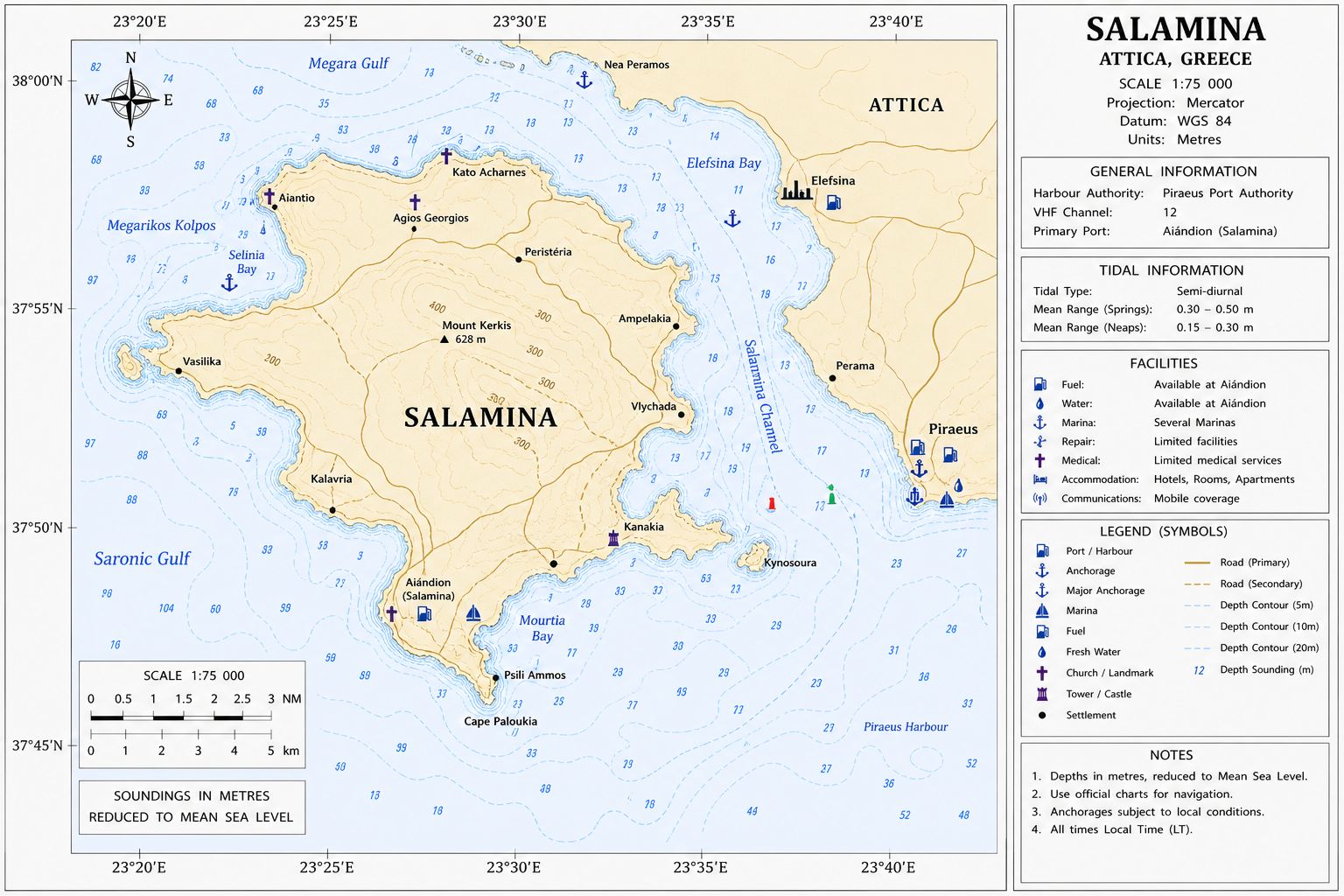
Chart Disclaimer. This chart is a schematic representation for illustrative purposes only and must not be used for navigation. Refer to official hydrographic charts for safe navigation. Be aware ENC charts may differ from official hydrographic charts. Both should be corrected and updated regularly.
Salamina Greece Sailing Guide - Ocean
Currents and Tidal Flow
Tidal range around Salamina is small, normally about 0.2–0.4 m, and astronomical tidal streams are generally weak. Currents are usually most noticeable in the narrow channels between Salamina and the mainland, especially around the Paloukia–Perama ferry route, the Elefsina approaches, and constricted passages on the north and east sides of the island. In these areas, local set may reach about 0.5–1 knot when wind, tide, and harbour circulation combine.
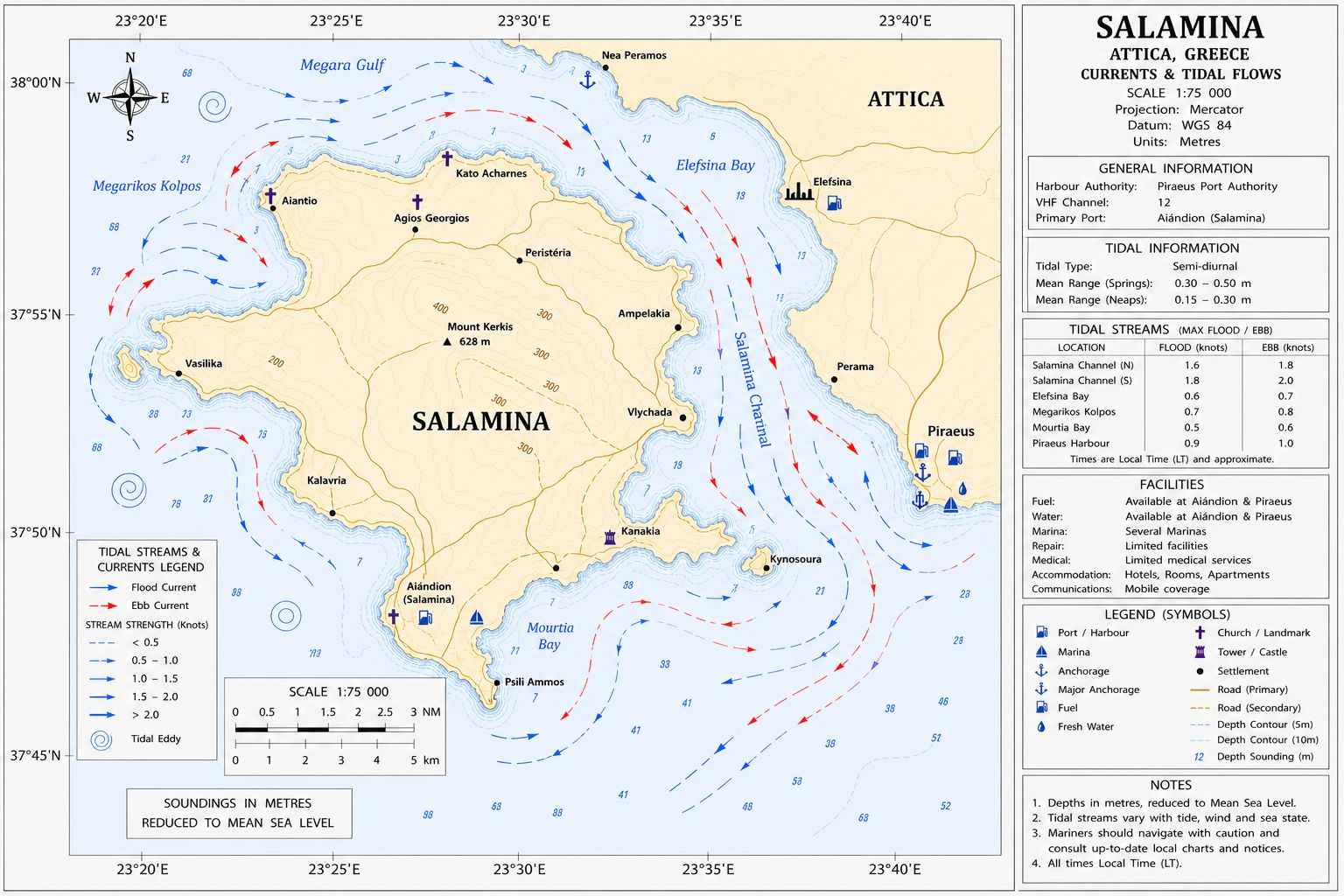
Water movement is affected more by wind, ferry wash, ship movement, and local channel geometry than by tide. North and north-east winds can push surface water through the Salamina–Piraeus side channels, while southerly and westerly weather can create chop and residual set around the southern and western bays. There are no major tidal races around Salamina, but skippers should allow for ferry wash, reflected chop, ship wake, and wind-driven drift when anchoring or manoeuvring near harbours, shipyards, and narrow passages.
Salamina Greece Sailing Guide - Weather
Salamina has a Saronic Gulf climate with hot dry summers and mild wetter winters. From May to September conditions are generally settled, with daytime temperatures commonly around 28–35°C and limited rainfall. Heat haze and reduced visibility can occur over the industrial northern waters near Elefsina, Perama, and Piraeus.
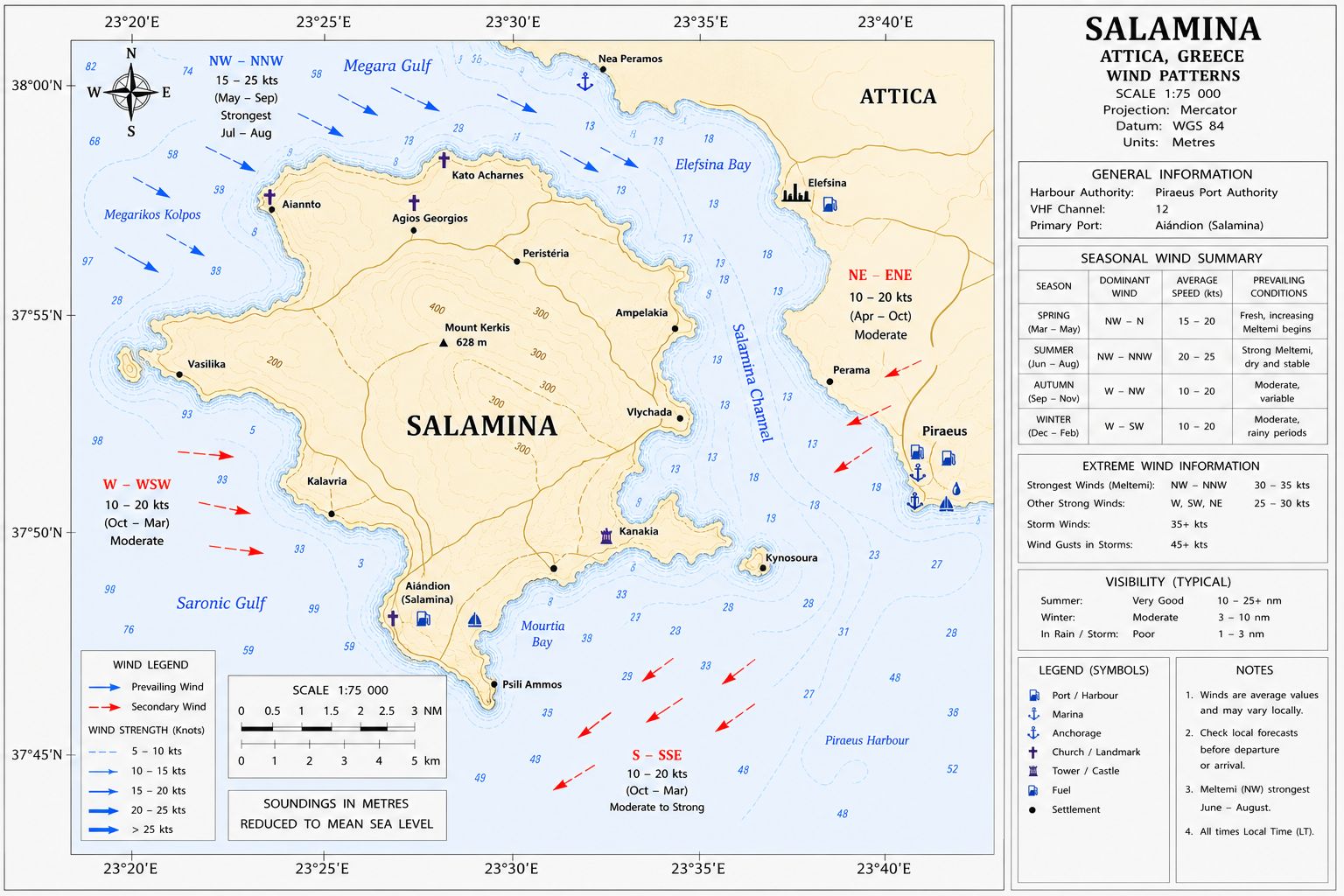
The island is sheltered compared with the open Aegean, but local conditions are affected by the surrounding mainland, narrow channels, ship traffic, and ferry wash. Summer north and north-east winds can create chop on the eastern and northern sides, especially near Perama, Paloukia, and the Elefsina approaches. Southerly and south-westerly weather can make the southern and western bays less comfortable. Winter and shoulder-season fronts can bring strong southerlies, rain, thunderstorms, and rapid wind shifts.
The Marine Electrical and Electronics Bible has a complete list of Greek VHF Radio Channel information and weather forecast times for Greece along with NAVTEX UK and Europe and NAVTEX Mediterranean for 490kHz and 518kHz.
Salamina Greece Sailing Guide - Local
Winds
Local winds around Salamina are shaped by the Saronic Gulf, the Attic mainland, and the narrow channels around the island. In summer, north and north-east winds are common and can produce short chop on the eastern side of the island, especially around Paloukia, Perama, Ampelakia, and the approaches toward Piraeus and Elefsina.
Afternoon sea breezes can build from the south-west or west, affecting the western and southern bays, including Kanakia, Peristeria, and the open water toward Aegina. These winds are usually moderate but can create uncomfortable chop in exposed anchorages. Stronger southerlies and south-westerlies are more common with frontal weather and can make the southern and western anchorages poor.
Salamina Greece Sailing Guide - Approaches
Approaches to Salamina are made through busy Saronic Gulf waters. From the east, the approach from Piraeus, Perama, and Paloukia carries deep water in the main channels, generally 15–40 m, but traffic density is high. The Paloukia–Perama ferry route operates continuously and should be crossed with clear separation. Near the ferry terminals and harbour margins, depths reduce quickly to about 3–8 m, with shoaling, moorings, wash, and local craft close to shore.
From the north, the Elefsina Gulf approach carries mostly moderate depths of about 10–30 m, with shallower water near industrial quays, mooring areas, and the northern Salamina shoreline. From the south and west, approaches from Aegina, Megara, and the open Saronic generally carry 20–60 m until closing the bays and headlands, where depths reduce to 5–15 m near anchoring areas. The eastern and northern approaches are traffic-heavy and industrial. The southern and western approaches are less confined but more exposed to south-west, west, and south weather.
Salamina Greece Sailing Guide - Navigation
The eastern side between Perama and Paloukia is the busiest area, with continuous ferry movement across a short channel. Main-channel depths are generally 15–40 m, reducing to about 3–8 m near ferry terminals, harbour margins, and local mooring areas. Do not loiter in the ferry track. Navigation around Salamina requires close attention to traffic, restricted areas, ferry routes, and local harbour congestion.
For Paloukia, approach from the east through the Perama channel, keeping clear of ferries and small craft. Depths remain adequate in the approach, but the harbour margins shoal quickly. For Salamina town / Vourkari, approach from the north or north-east, avoiding moorings and local traffic. Depths in the bay are commonly 4–10 m, reducing near the quays and inner edges. For Selinia and Ampelakia, approach from the south-east in moderate depths, then reduce speed near moorings, fishing boats, and shallow waterfront areas. The western and southern bays are simpler to enter, but rely on visual pilotage, depth sounder use, and daylight assessment of weed, rocks, fish farms, and local moorings.
Salamina Greece Sailing Guide - Chart
Accuracy
Hydrographic charts accurately depict coastline, depths, and navigational features. Electronic charts are reliable and align with official data. Caution is required for uncharted debris, moorings, and industrial installations along the shoreline. Depth soundings are generally accurate but should be verified in anchorage areas.
Salamina Greece Sailing Guide - Anchorages
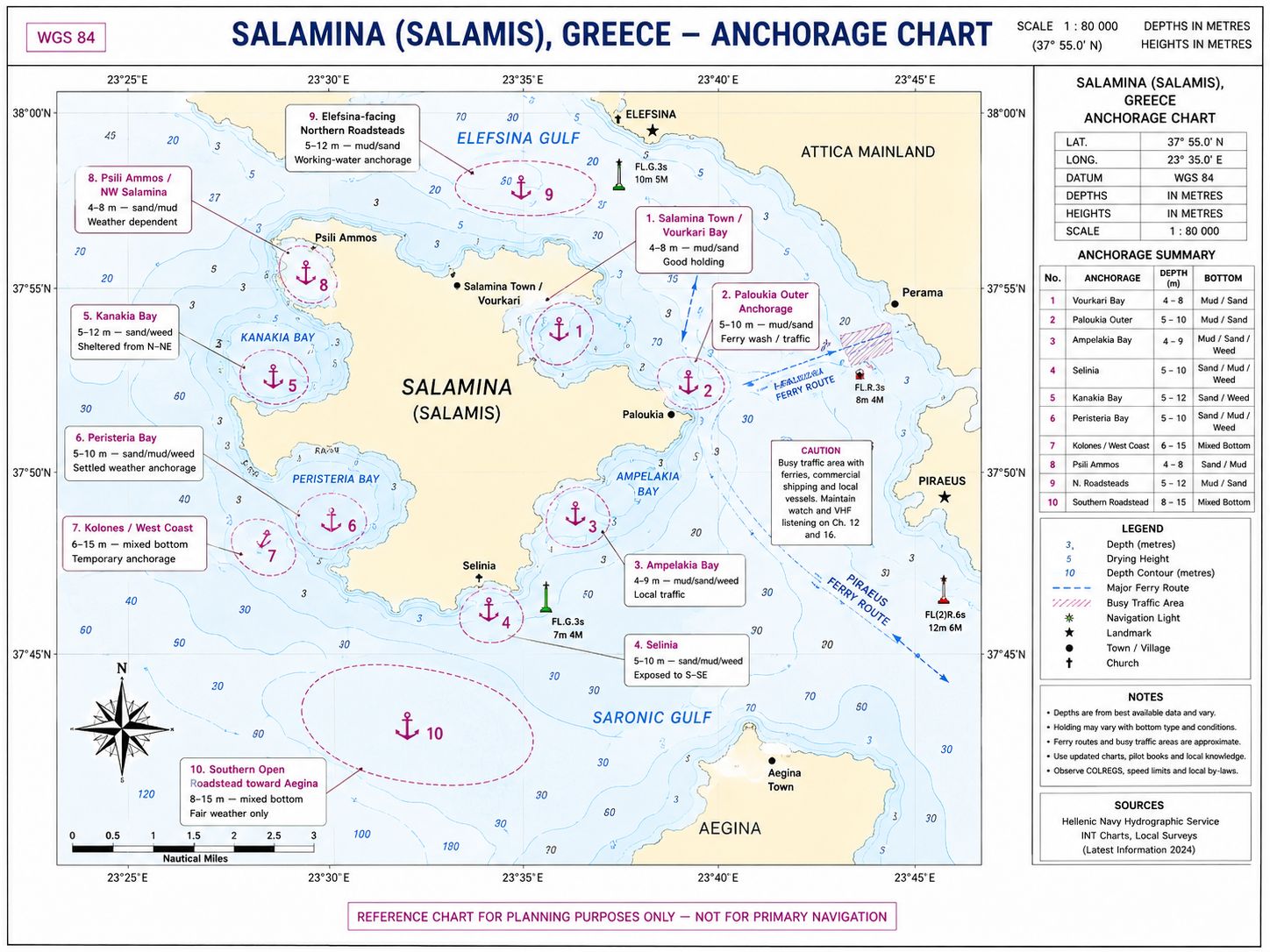
Salamina anchorage options are multiple and operationally useful. There are no all-weather anchorages due to exposure to traffic and wind effects.
- Salamina Town / Vourkari Bay. This is the most practical anchorage for access to the main town. Anchor clear of harbour traffic and moorings in about 4–8 m over mud and sand. Holding is generally good. The area is affected by local craft, ferry wash, and traffic from the northern and eastern channels.
- Paloukia outer anchorage. This can be used only with care, clear of the Perama ferry route and harbour approaches. Depths are generally 5–10 m over mud and sand. It is a functional short-stay anchorage, not a quiet or secure cruising anchorage. Ferry wash and traffic are constant.
- Ampelakia Bay. This lies on the eastern side of Salamina, south of Paloukia. Anchor in about 4–9 m over mud, sand, and weed patches. Holding is reasonable where sand or mud is found. The area is affected by shipyard activity, moorings, local craft, and traffic from the Piraeus side.
- Selinia. This is on the south-east side of Salamina. Anchor off the waterfront in about 5–10 m over sand, mud, and weed. It gives access to the settlement and is less congested than Paloukia. It is open to south and south-east conditions and may receive chop from traffic in the eastern Saronic.
- Kanakia Bay. Located on the south-west coast is one of the better quiet-weather anchorages. Anchor in about 5–12 m over sand and weed. Holding is good in clean sand. It gives useful shelter from north and north-east winds but is exposed to south, south-west, and west swell.
- Peristeria Bay. Situated on the south coast provides settled-weather anchoring in about 5–10 m over sand, mud, and weed. It is less industrial than the north and east sides. Shelter is reasonable from northerly winds but poor with southerly or south-westerly weather.
- Kolones/Western Salamina coast. This has several temporary anchoring positions in small bays and roadsteads. Depths are commonly 6–15 m over sand, mud, and weed. These anchorages are suitable only in settled weather with visual bottom checks. They are exposed to west and south-west winds.
- Psili Ammos/north-western Salamina. This can be used in settled conditions or light southerlies, depending on position. Anchor in about 4–8 m over sand and mud. The area is exposed to northerly and north-westerly winds and can be affected by traffic using the Elefsina Gulf.
- Elefsina-facing northern roadsteads. These offer temporary anchoring in selected positions clear of commercial routes, moorings, and restricted areas. Depths are generally 5–12 m over mud and sand. These are working-water anchorages rather than cruising stops, with industrial traffic, harbour restrictions, and poor water quality in places.
- Southern open roadstead toward Aegina. This can be used only in calm settled weather. Anchor in about 8–15 m over mixed sand, mud, and weed. It has more room but less shelter. It is unsuitable in south, south-west, west, or strong sea-breeze conditions.
Salamina Greece Sailing Guide - Entry
Formalities
Entry formalities follow standard Greece procedures for visiting yachts. This is not a designated port of entry for international clearance, and there are no customs or immigration facilities on the island. Vessels arriving from outside Greece or the Schengen Area must first clear into the country at an official port of entry before proceeding to this port. Direct arrival from a non-Schengen country is not permitted. The Greek cruising tax (TEPAI) must be valid and paid, and the vessel’s cruising log (DEKPA for non-EU vessels, or transit log where applicable) should be up to date and available for inspection if requested by port authorities or coastguard.
Salamina Greece Sailing Guide - Marina
Facilities
Salamina has no single full-service yacht marina equivalent to the larger Saronic or Athens marinas. Berthing is mainly by town quays, local harbours, fishing harbours, private moorings, and shipyard or boatyard facilities. Visiting yachts may find short-stay space at Salamina town / Vourkari, Paloukia, Ampelakia, and Selinia, but berth availability depends on local craft, fishing boats, ferries, and port instructions.
Salamina town / Vourkari has the most practical yacht berthing, with quay space and nearby town services. Depths are commonly about 2.5–4 m along usable sections, with deeper water off the quay and shallower edges inside. Paloukia is ferry-dominated and not a preferred yacht berth except by local direction. Ampelakia has working harbour and boatyard activity, with yacht access limited by moorings, local vessels, and shipyard traffic. Selinia has small-craft quay space and local moorings, generally suitable only for smaller yachts or short stays.
Salamina Greece Sailing Guide - Provisioning
Supermarkets. Available across the main town, Paloukia, and the Aianteio road corridor. In Salamina town, named options include Sklavenitis - Salamina, AB Vassilopoulos, My Market - Salamina and Cheliotis Panteleimon.
On the Aianteio side, supermarket options include Kritikos - L. Aianteiou, Lidl - Salamina Island and Super Market Alyki. At Paloukia, Voidilas Konstantinos & Sia
Markets. Fresh produce on Salamina is available from supermarket produce sections, local greengrocers, small grocery stores, and seasonal street stalls. Main supply areas are Salamina town, Paloukia, Aianteio, and the road corridors between the larger settlements.
Fish Markets. Fish supplies on Salamina are available from local fishing boats, seafood retailers, and tavernas supplied by the island fleet. Main supply areas are Salamina town / Vourkari, Paloukia, Selinia, and smaller fishing harbours around the island.
Salamina Greece Sailing Guide - Local
Cuisine
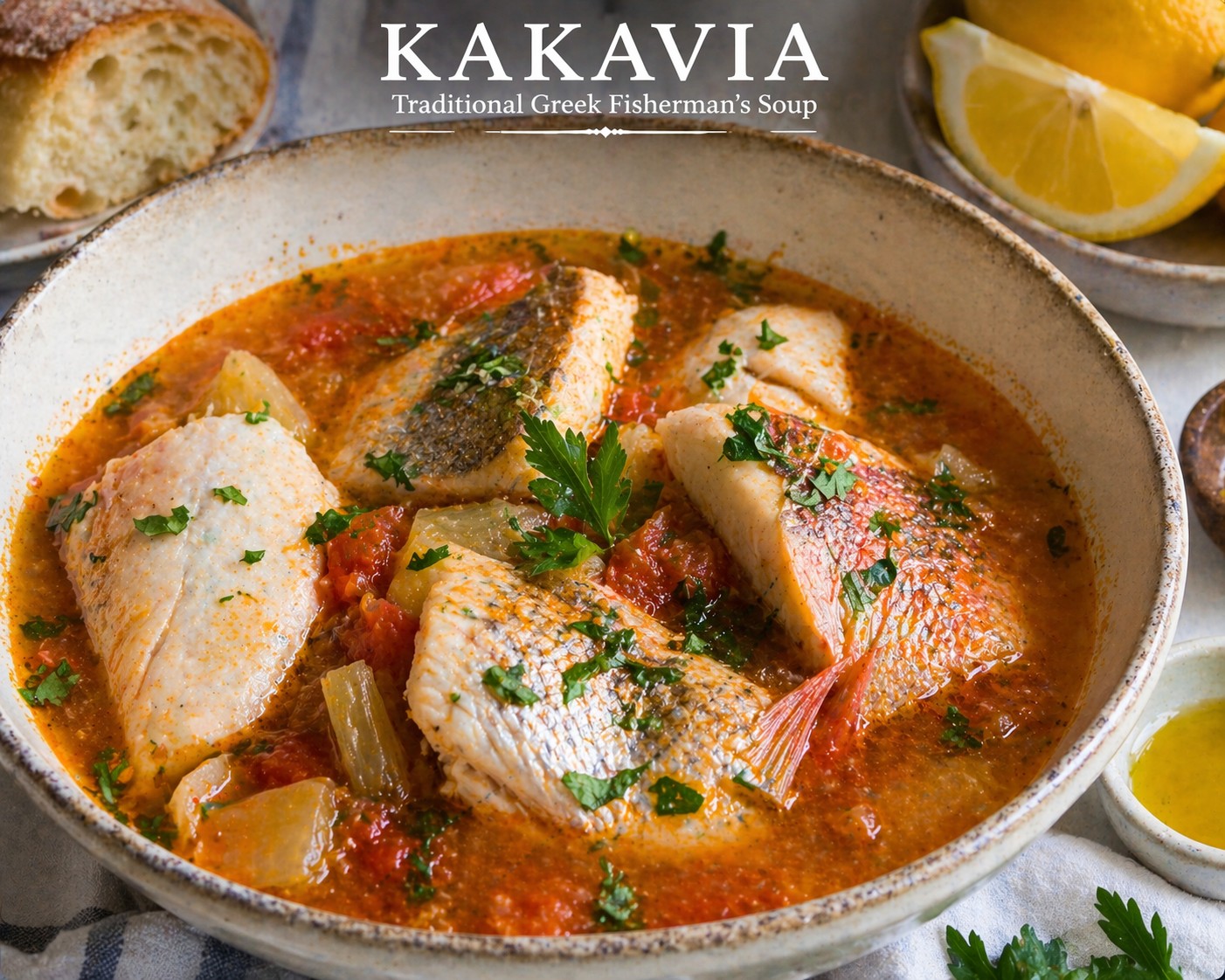
Local cuisine on Salamina is Saronic Gulf coastal cooking, with seafood, olive oil, vegetables, pulses, pork, lamb, goat, and local cheeses. Common dishes include grilled fish, fried calamari, octopus, sardines, anchovies, red mullet, shrimp saganaki, kakavia fish soup, souvlaki, grilled lamb, pork kontosouvli, kokkinisto, moussaka, gemista, fasolada, horiatiki salad, feta, olives, and seasonal vegetable dishes. Salamina also has local working-harbour food rather than resort-style cuisine. Tavernas around Salamina town, Vourkari, Paloukia, Selinia, and Kanakia commonly serve grilled seafood, fried small fish, octopus, squid, meat dishes, cooked vegetables, salads, bread, local wine,
Salamina Greece Sailing Guide - Local
Beverages
Local beverages on Salamina include regional Attica and Saronic wines, retsina, ouzo, tsipouro, Greek beer, Greek coffee, freddo espresso, mountain tea, fresh citrus juice, and bottled soft drinks. Cafés and tavernas around Salamina town, Vourkari, Paloukia, Selinia, and Kanakia commonly stock domestic beer, house wine, ouzo, tsipouro, coffee,
Salamina Greece Sailing Guide - Diesel Fuel Supplies
Diesel fuel on Salamina is supplied by local fuel stations rather than dedicated yacht fuel berths. Road tanker delivery may be available to quay areas by arrangement. Jerry-can supply is available from fuel stations in Salamina town, Paloukia, Aianteio, and along the main road corridors.
Salamina Greece Sailing Guide - Water
Supplies
Water on Salamina may be available from quay points in the main harbours, including Salamina town / Vourkari, Paloukia, Ampelakia, and Selinia, depending on berth position and local port arrangements
Mechanical
and Electrical Repairs Resource
If you are headed somewhere remote consider the need to expand your knowledge base or have an information resource on board. Why not get a copy of my book The Marine and Electrical and Electronics Bible 4th Edition. By and for yachties, with everything from batteries and charging, solar and wind, diesel engines and marine electronics and so much more. Your complete systems guide. 650 pages of practical advice. In Australia and New Zealand order a copy through Boat Books. UK and European boats can buy the UK Edition Here. US and Canadian boats can get the US Edition Order Here. Marine systems are my profession so let me help you. By a liveaboard boat owner for other boat owners.



Salamina Greece Sailing Guide - Marine
Services
Marine services on Salamina are stronger than on most Saronic islands because of the island’s shipyard, boatyard, and repair activity. Main service areas are Ampelakia, Paloukia, Salamina town / Vourkari, and the eastern industrial waterfront facing Perama.
Salamina Greece Sailing Guide - Local
Etiquette
Interpersonal etiquette on Salamina is direct and informal. Use basic greetings in shops, cafés, tavernas, fuel stations, harbour offices, and boatyards. Kalimera in the morning, kalispera later in the day, and efcharisto when leaving are appropriate. Dress is casual, but swimwear is not normal in shops, cafés, offices, or town streets. Keep communication with harbour staff, fishers, ferry workers, shopkeepers, and yard staff clear and polite. Around working harbours, shipyards, naval areas, and ferry zones, avoid entering restricted spaces, photographing sensitive areas, or obstructing local operations.
Salamina Greece Sailing Guide - Summary
Salamina provides multiple anchorage options within a high-traffic maritime environment. Protection is dependent on wind direction and vessel movement. Infrastructure is extensive due to proximity to Athens. Navigation requires continuous traffic awareness. The Salamina Greece sailing guide has all you need to know.