Pylos Greece Sailing Guide
Pylos Greece Sailing Guide. Pylos is located on the south-west Peloponnese within Navarino Bay, at approximately 36°55′N 21°41′E. a large natural harbour enclosed by the island of Sphacteria. The bay provides one of the most protected anchorages on the west coast of Greece, with restricted entrances controlling sea state and allowing internal operations largely independent of offshore conditions. Yacht activity is centred within the bay and along the quay at Pylos town on the eastern side.
Navarino Bay is extensive with depths suitable for anchoring throughout large areas and seabed predominantly mud providing consistent holding. The enclosing landmass reduces exposure to prevailing wind and swell, making it a primary shelter location for vessels transiting the Ionian–Peloponnese route. Harbour infrastructure at Pylos is limited to quay berthing and local services, with no enclosed marina basin.
Pylos Greece Sailing Guide History
Pylos and Navarino Bay have long maritime significance due to the natural harbour formed by Sphacteria. The bay was the site of the Battle of Navarino in 1827, where allied naval forces engaged the Ottoman fleet. Earlier history includes classical Greek and Roman maritime use of the harbour. The natural enclosure has made the bay a strategic anchorage throughout successive periods, with Pylos town developing as the principal settlement serving the harbour.
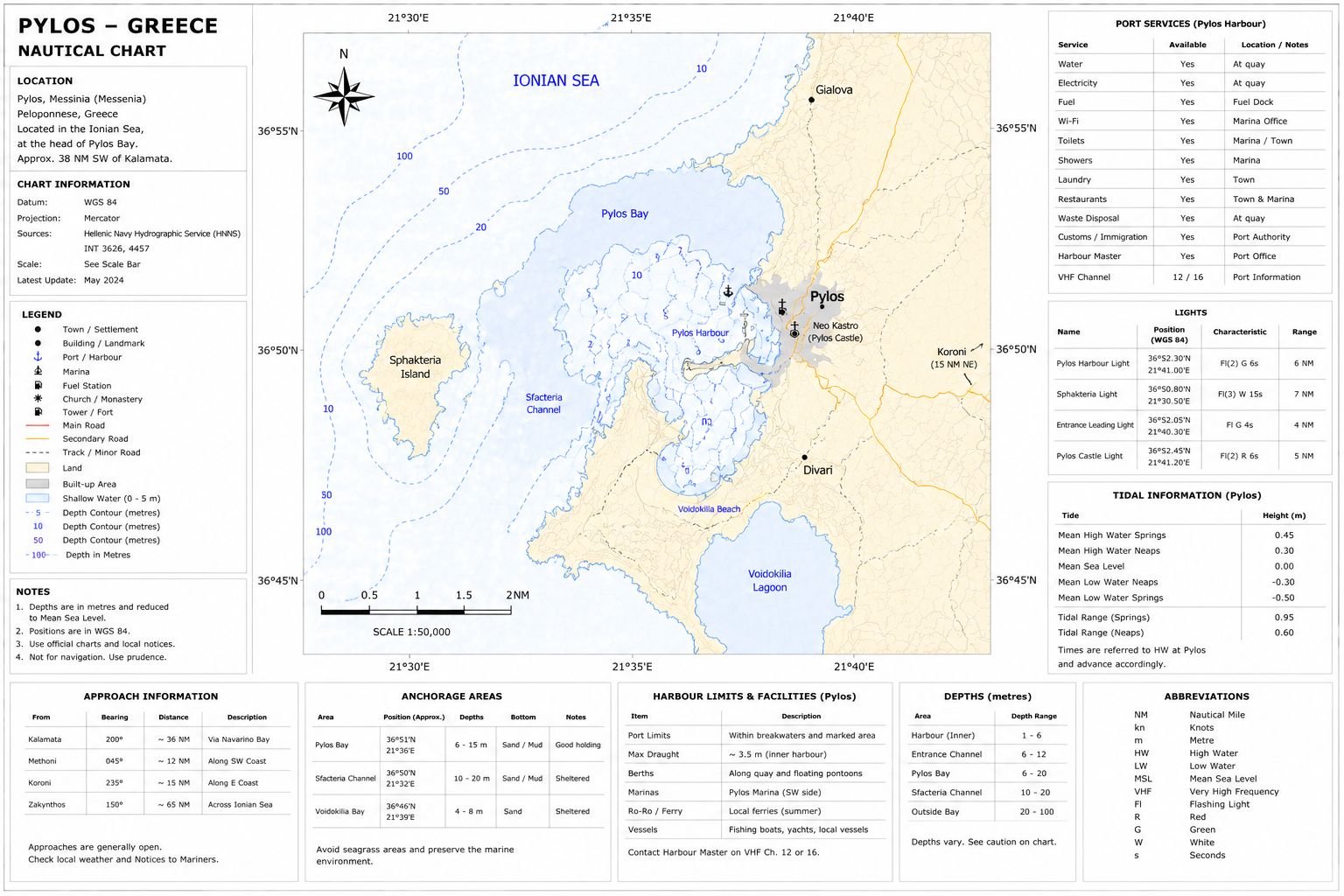
Chart Disclaimer. This chart is a schematic representation for illustrative purposes only and must not be used for navigation. Refer to official hydrographic charts for safe navigation. Be aware ENC charts may differ from official hydrographic charts. Both should be corrected and updated regularly.
Pylos Greece Sailing Guide -
Ocean Currents and Tides
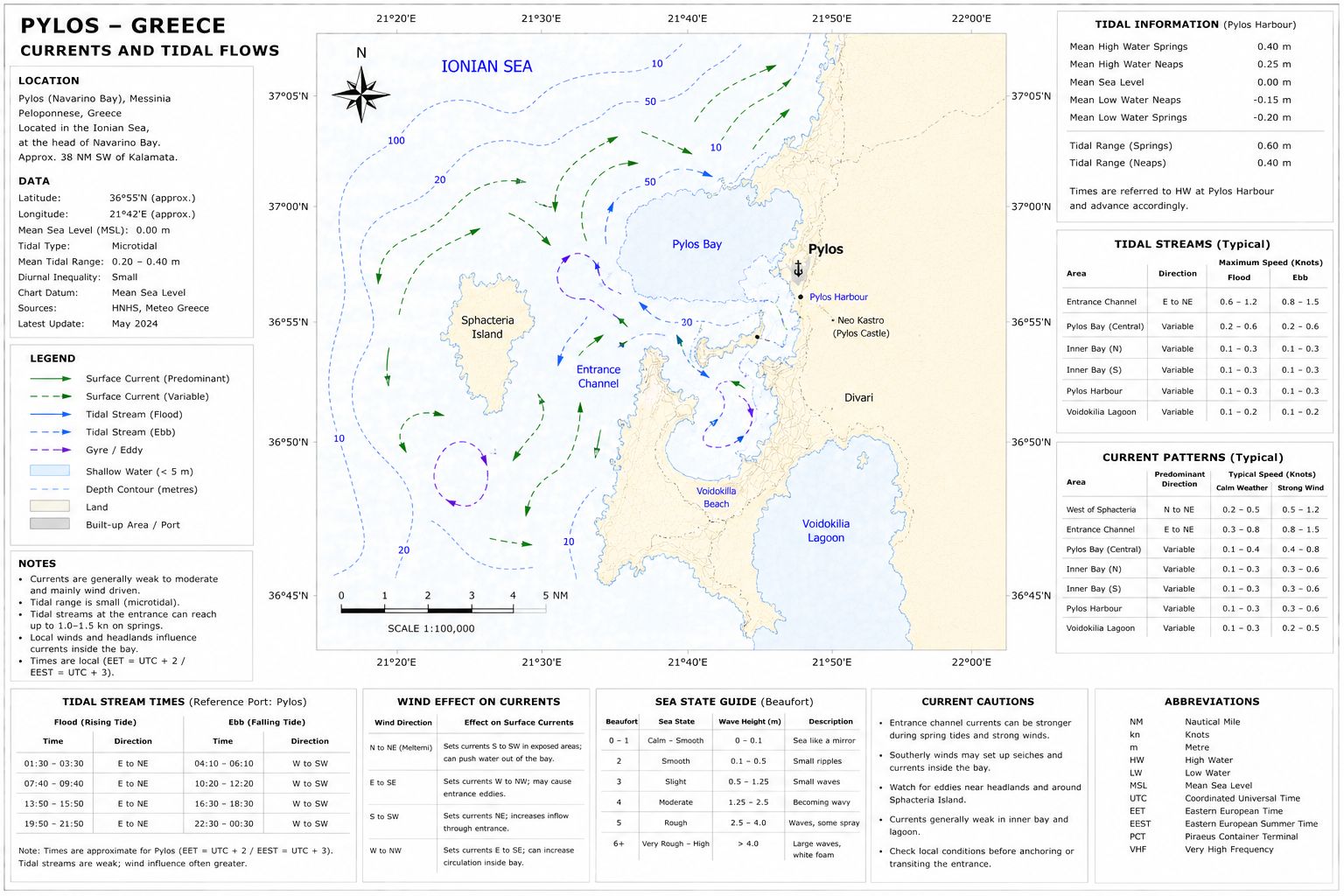
Tidal variation is negligible and does not influence navigation. Water movement within Navarino Bay is minimal and primarily wind-driven. At the bay entrances, limited current may develop under sustained wind conditions, generally less than 1 knot. Inside the bay, current is negligible, and vessel movement is influenced mainly by wind and localised effects.
Pylos Greece Sailing Guide -Weather
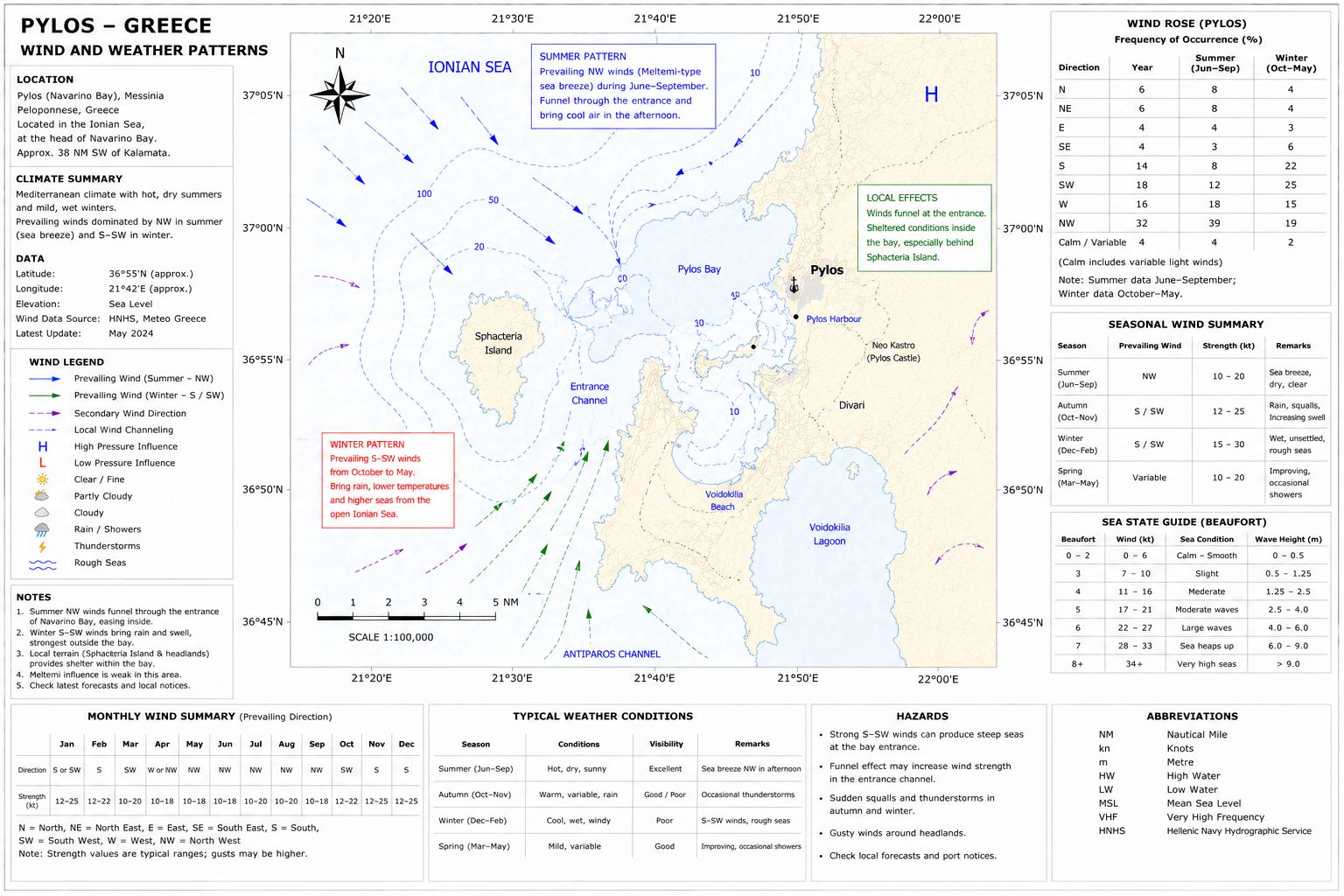
Summer conditions are stable with high pressure, clear visibility, and low precipitation. The bay remains calm relative to offshore conditions due to enclosure. Winter conditions involve low-pressure systems producing rainfall and variable wind. Offshore swell may be present, but its effect inside Navarino Bay is reduced due to the protective barrier of Sphacteria.
Pylos Greece Sailing Guide -
Local Winds
Prevailing winds include north-westerly flow during summer afternoons, with lighter morning conditions. Wind strength increases during the day and reduces after sunset. Southerly winds affect the outer coast but have reduced impact within Navarino Bay. Local wind inside the bay is moderated by surrounding land but may produce gusts near shorelines.
Pylos Greece Sailing Guide - Approaches
Approach is from the Ionian Sea with offshore depths generally 50–100 m, reducing to 20–30 m approaching the entrance to Navarino Bay and 5–15 m within the bay. Entry is via a wide southern entrance between Sphacteria Island and the mainland. Depths in the entrance are generally 10–20 m with no significant restrictions. Sea state outside the bay reflects open Ionian conditions with longer-period swell. Inside the bay, sea state reduces significantly. Tidal range is typically 0.2–0.4 m with no operational tidal stream. Hazards are minimal. The entrance is open and well defined. Local fishing activity may be present near the coastline.
Pylos Greece Sailing Guide - Navigation
Navigation within Navarino Bay is unrestricted with large areas available for anchoring. Depths range from approximately 5 m to 20 m depending on location. Pylos harbour is located on the eastern side of the bay with quay berthing. Depth alongside is typically between 2.5 m and 4 m. Mooring is stern-to using own anchor. Manoeuvring is not constrained by current but requires consideration of wind and proximity to other anchored vessels. Traffic density is low compared with major ports. Fishing gear may be present in parts of the bay but is limited.
Pylos Greece Sailing Guide - Chart Accuracy
Charts issued by the Hellenic Navy Hydrographic Service are accurate for approaches, bay, and harbour areas. ENC data aligns with official charts. Hydrographic charts accurately represent Navarino Bay, entrance, and harbour structures. Electronic charts correspond closely to published data. Local variation may occur near quay edges and shallow margins. Depth verification is required when berthing close to shore. Anchoring density and temporary moorings may not be fully represented.
Pylos Greece Sailing Guide - Anchorages
Navarino Bay provides extensive anchorage with depths between 5 m and 15 m over mud seabed. Holding is generally good. The bay is protected from most wind directions, though local exposure varies by position within the bay. Anchorage selection is based on proximity to shore and other vessels rather than exposure constraints. No significant swell penetrates the bay under normal conditions.
- Pylos provides extensive anchorage within Navarino Bay with generally good holding.
- Main anchorage off Pylos provides depths of 5–10 m over mud with good holding and strong protection from prevailing conditions.
- Inner bay areas provide anchoring in 5–15 m over mud and sand with consistent holding and reduced sea state.
- Outer areas near the entrance provide anchoring in 10–20 m with moderate holding and increased exposure.
- Shelter is high within the bay except under specific wind directions affecting open sectors.
Pylos Greece Sailing Guide - Entry Formalities
Pylos is not typically used as a primary port of entry. Clearance should be completed at a designated port prior to arrival. Standard Greek regulations apply including vessel documentation and TEPAI cruising tax. AIS transmission is required where applicable. Satellite systems including Starlink are subject to national regulation. Pylos operates under Greek national and Schengen procedures. Customs and immigration clearance is available for arrivals from outside Schengen areas. Vessel and crew documentation must be available. Harbour authority control applies within port limits. Drones are regulated under Greek aviation rules. Communications equipment must comply with national regulations. Waste discharge is controlled.
Pylos Greece Sailing Guide - Marina Facilities
There is no dedicated marina at Pylos. Berthing is along the town quay. Depth alongside is typically between 2.5 m and 4 m. Mooring is stern-to using own anchor. Quay length is limited and berth availability varies. Water supply may be available at quay points but is not continuous. Shore power is limited or unavailable. No travel lift or haul-out facility exists.
Pylos Greece Sailing Guide - Provisioning
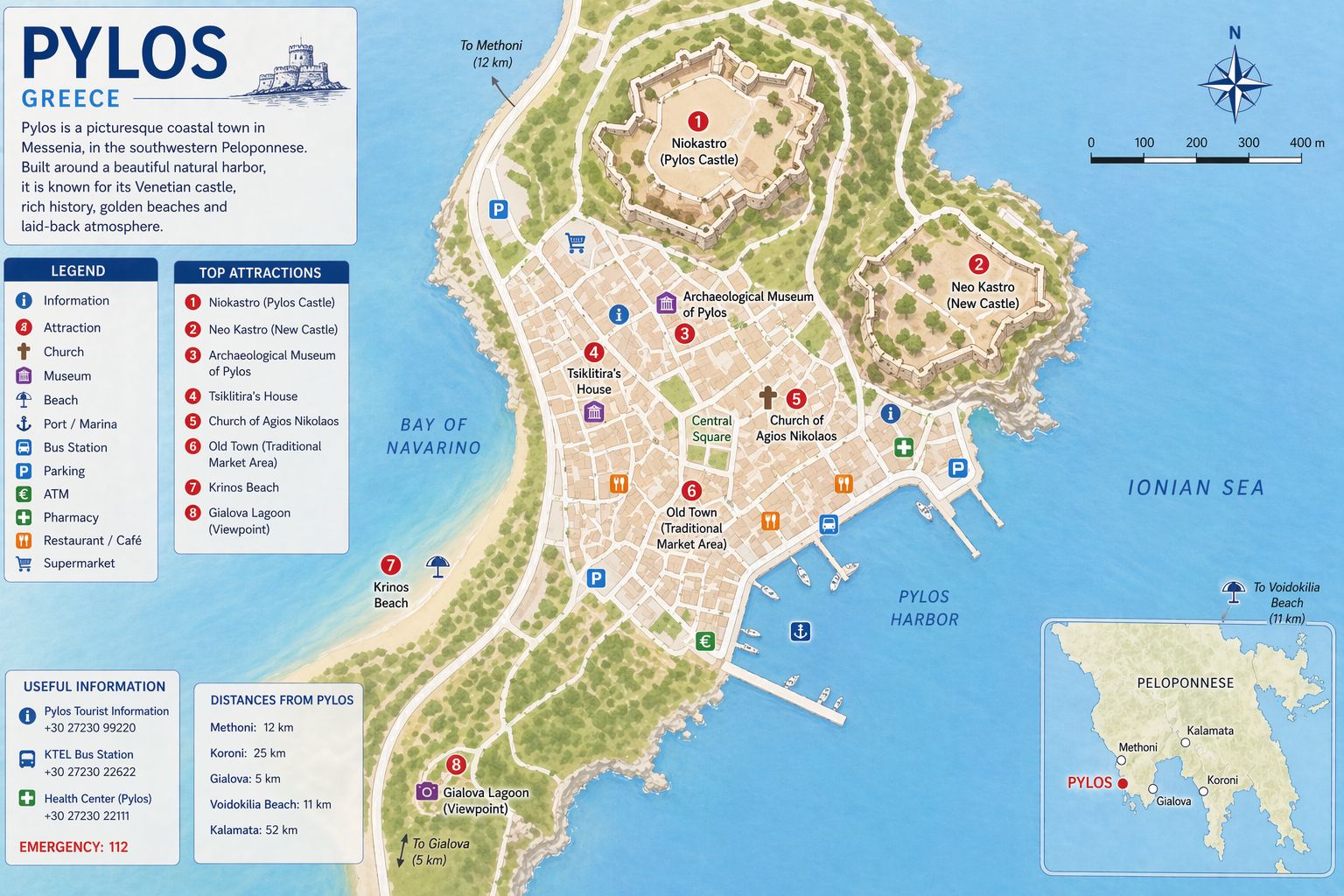
Supermarkets. Supermarket provisioning in Pylos is centred within the town area adjacent to the quay. AB Vassilopoulos operates within walking distance of the harbour. Local supermarkets and grocery outlets operate within the same area and provide general provisioning supply.
Markets. Produce is available from local greengrocers and vendors supplying vegetables, fruit, olive oil, and regional products. Supply reflects local agriculture in Messenia, including olives, olive oil, citrus, and vegetables.
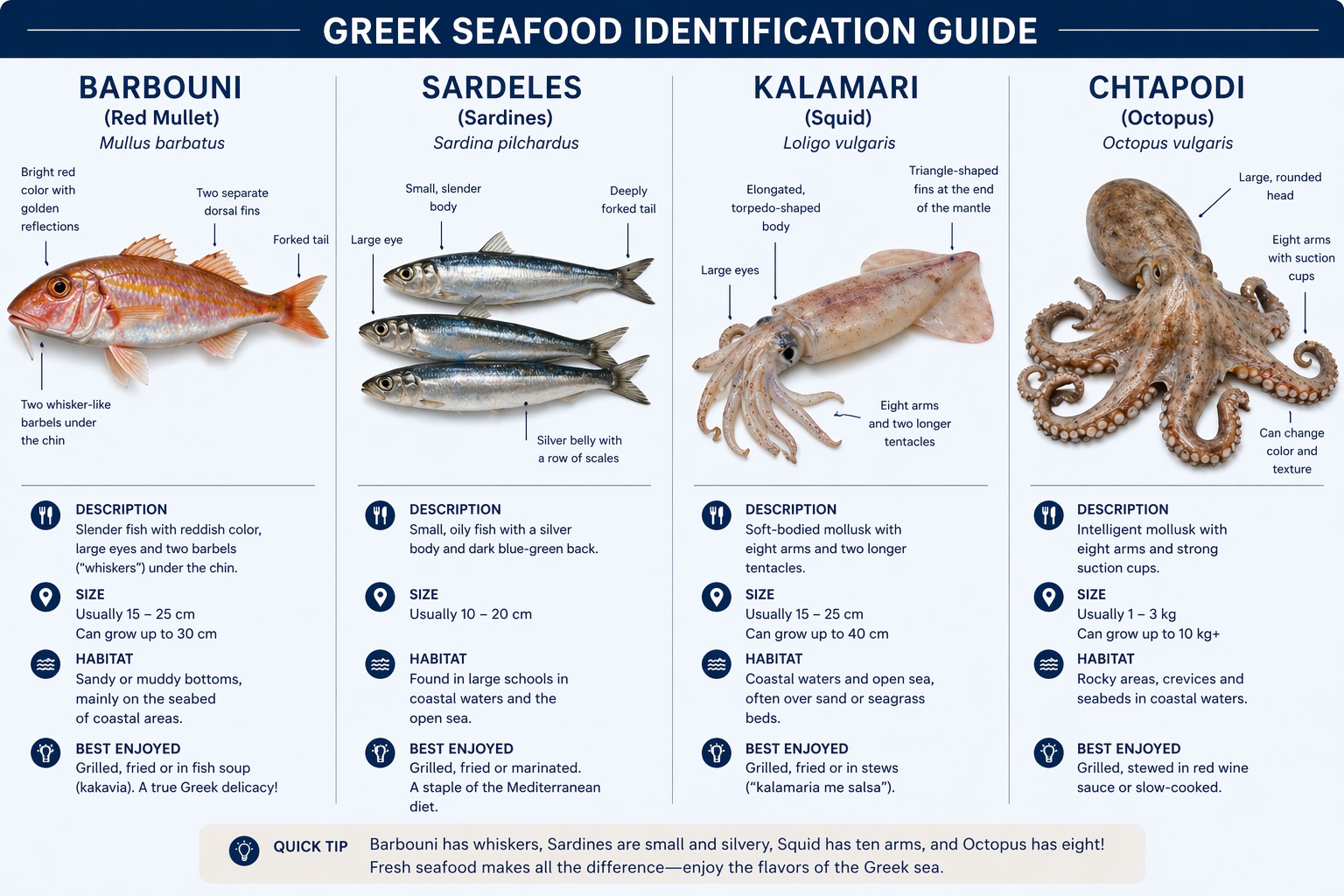
Fish Markets. Fish is supplied through local fishmongers and direct sale from fishing vessels in the harbour. Species include tsipoura, lavraki, sardines, and cephalopods. Availability depends on daily catch.
Pylos Greece Sailing Guide - Local Cuisine
Local produce in Pylos and the wider Messenia region includes Kalamata olives and olive oil, citrus, figs, grapes, tomatoes, peppers, aubergines, and legumes, forming the base of most food preparation. Seafood supply includes sardines, anchovies, sea bream (tsipoura), sea bass (lavraki), and octopus sourced from the Ionian coast.
Signature dishes include gemista, vegetables such as tomatoes and peppers stuffed with rice and herbs; briam, a baked vegetable dish of courgette, aubergine, potato, and tomato; and ladera, vegetables cooked in olive oil. Seafood dishes include grilled tsipoura and lavraki, gavros tiganitos, fried anchovies, and chtapodi psito, grilled octopus. Meat dishes include arnaki psito, roast lamb, and kontosouvli, slow-roasted skewered pork.
Pylos Greece Sailing Guide - Local Beverages
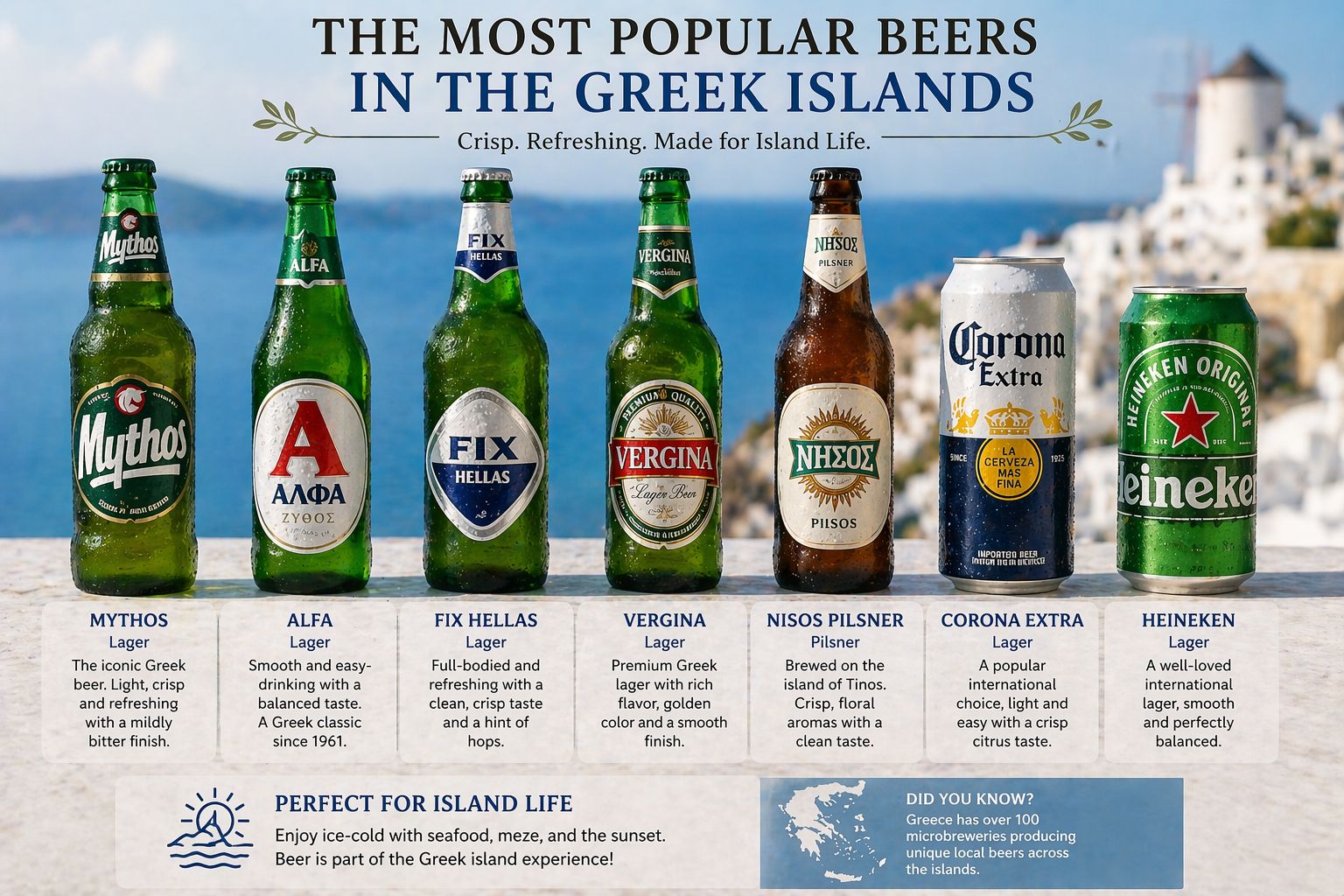
Beer, wine, and spirits across the Greek islands are locally produced and widely available through tavernas, small bars, and provisioning outlets. Beer is predominantly lager, with domestic brands including Mythos, Alfa, Fix, and Vergina alongside imported products; and over 100 microbreweries operate on several islands with limited distribution. Wine is region-specific, with white varieties dominant in the islands, including Assyrtiko, Moschofilero, and Roditis, alongside local table wines served in bulk; retsina remains in circulation as a resin-flavoured wine. Distilled products include ouzo (anise-based), tsipouro (grape marc distillate), raki or tsikoudia (Crete), souma (fig or grape distillate in eastern Aegean islands), and kitron (citrus liqueur from Naxos), with alcohol strength typically in the 37–45% range and higher for unregulated local distillations.
Pylos Greece Sailing Guide - Fuel Supplies
Diesel supply in Pylos is not provided from a fixed marine fuel dock and is instead obtained from roadside fuel stations and transferred to vessels either by jerry can or by arranged delivery to the quay. Fuel stations are located within short road distance of the harbour, with Shell and Revoil operating on the Gialova road approximately 5–10 minutes from the quay, and Avin Oil Kafkas located inland on the Pylos–Petritsi route and accessed by vehicle for larger quantities. Transfer to vessels is conducted manually using jerry cans or by local arrangement with station operators for small tanker delivery where available, with coordination sometimes handled through local contacts or harbour personnel for higher volumes. No dedicated fuel pontoon, bunker station, or high-flow marine pump exists within Pylos harbour, and supplied fuel is standard automotive diesel requiring onboard filtration prior to use.
Pylos Greece Sailing Guide - Water Supplies
Potable water in Pylos is supplied from the municipal network and accessed at selected points along the town quay where connections are installed. Supply is not continuous along the full quay length and access depends on berth position and local arrangement. Pressure varies with demand and can reduce during peak usage periods, particularly in summer. Hose connections are not standardised and vessels are expected to supply their own fittings and hose. No dedicated marina distribution system or metered pedestal network is installed. Water quality is municipal treated supply suitable for tank filling, with onboard filtration used as required.
Mechanical
and Electrical Repairs Resource
If you are headed somewhere remote consider the need to expand your knowledge base or have an information resource on board. Why not get a copy of my book The Marine and Electrical and Electronics Bible 4th Edition. By and for yachties, with everything from batteries and charging, solar and wind, diesel engines and marine electronics and so much more. Your complete systems guide. 650 pages of practical advice. In Australia and New Zealand order a copy through Boat Books. UK and European boats can buy the UK Edition Here. US and Canadian boats can get the US Edition Order Here. Marine systems are my profession so let me help you. By a liveaboard boat owner for other boat owners.



Pylos Greece Sailing Guide - Marine Services
Marine services are limited. Routine maintenance is available locally. Major engine support for Yanmar and Volvo Penta is accessed via Kalamata or regional centres. Marine electronics support including Raymarine is regionally available. There is no haul-out facility, travel lift, or full-service yard in Pylos.
Pylos Greece Sailing Guide - Local Customs
In Pylos, interaction is direct and begins with a greeting before transactions. Dress ashore is standard day wear. Meal times are later with evening dining after 20:00. Cash is commonly used in smaller vendors while cards are accepted in larger outlets.
Pylos Greece Sailing Guide - Summary
Pylos provides a large enclosed anchorage within Navarino Bay with extensive shelter from offshore conditions. The location supports basic provisioning, fuel supply, and limited marine services within the town. Navigation is straightforward with minimal current and ample anchoring space. The bay functions as a secure stop on the Peloponnese coast consistent with a Pylos Greece Sailing Guide and all you need to know.