Princess Charlotte Bay Sailing
Guide
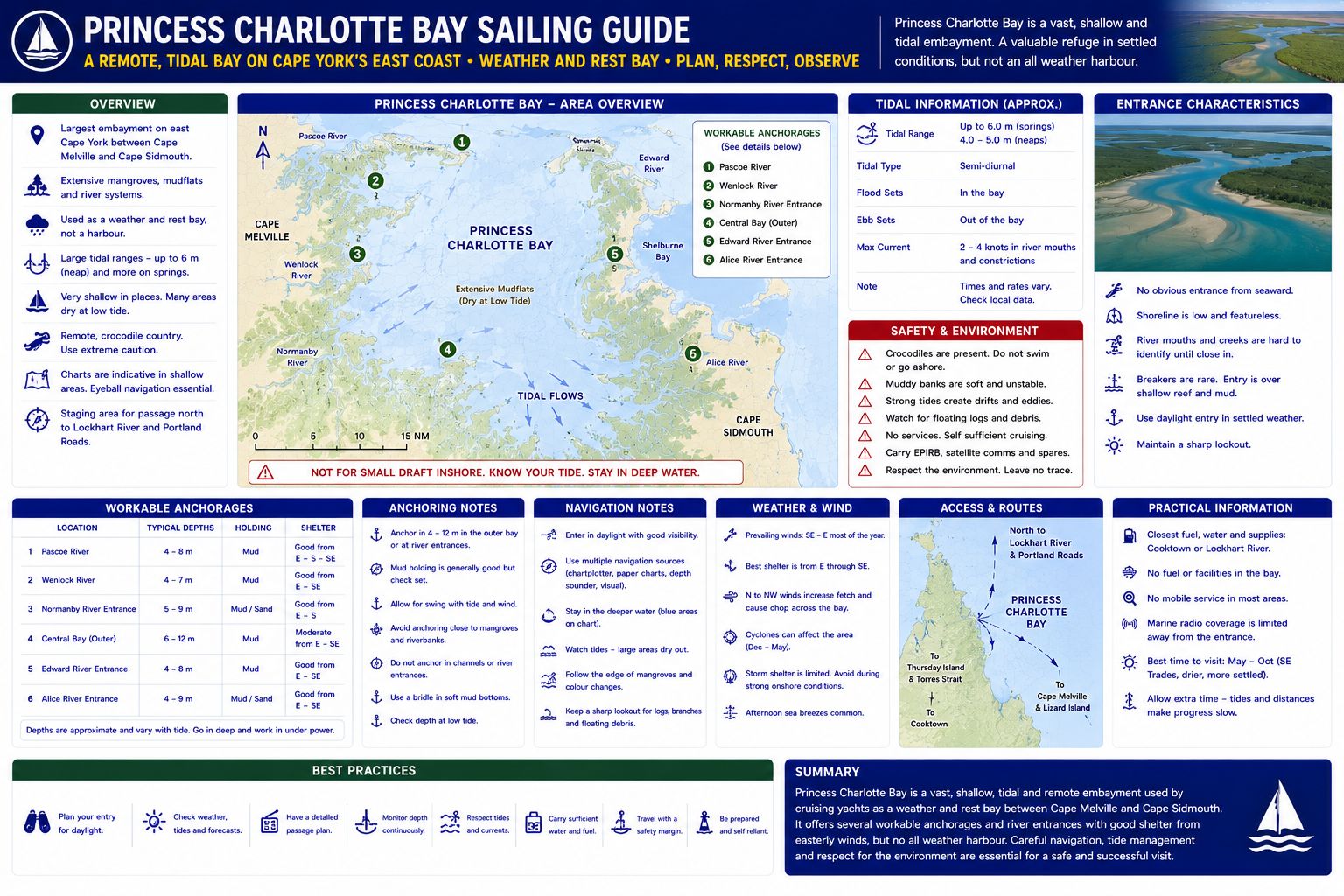
Princess Charlotte Bay Sailing Guide. Princess Charlotte Bay is the largest and most complex embayment on the east side of Cape York, lying between Cape Melville and Cape Sidmouth. It is a shallow, mangrove‑lined bay with multiple river systems, extensive mudflats, and large tidal ranges. For yachts, it is a weather and rest bay, not a harbour: there is no single all‑weather anchorage, but there are several workable anchorages and river entrances that provide varying degrees of shelter.
The bay is remote, crocodile country, and operationally serious; it is used by cruising yachts as a staging and waiting area between the more exposed outer‑reef coast and the run north toward Lockhart River and Portland Roads. The shoreline is low and featureless from seaward, with river mouths and mangrove creeks difficult to distinguish until close in. Large areas dry at low tide, and the inner bay is dominated by soft mud and sandbanks. Charts are indicative rather than precise in the shallowest areas, and eyeball navigation in good light is essential.
Princess Charlotte
Bay Sailing Guide - Approaches
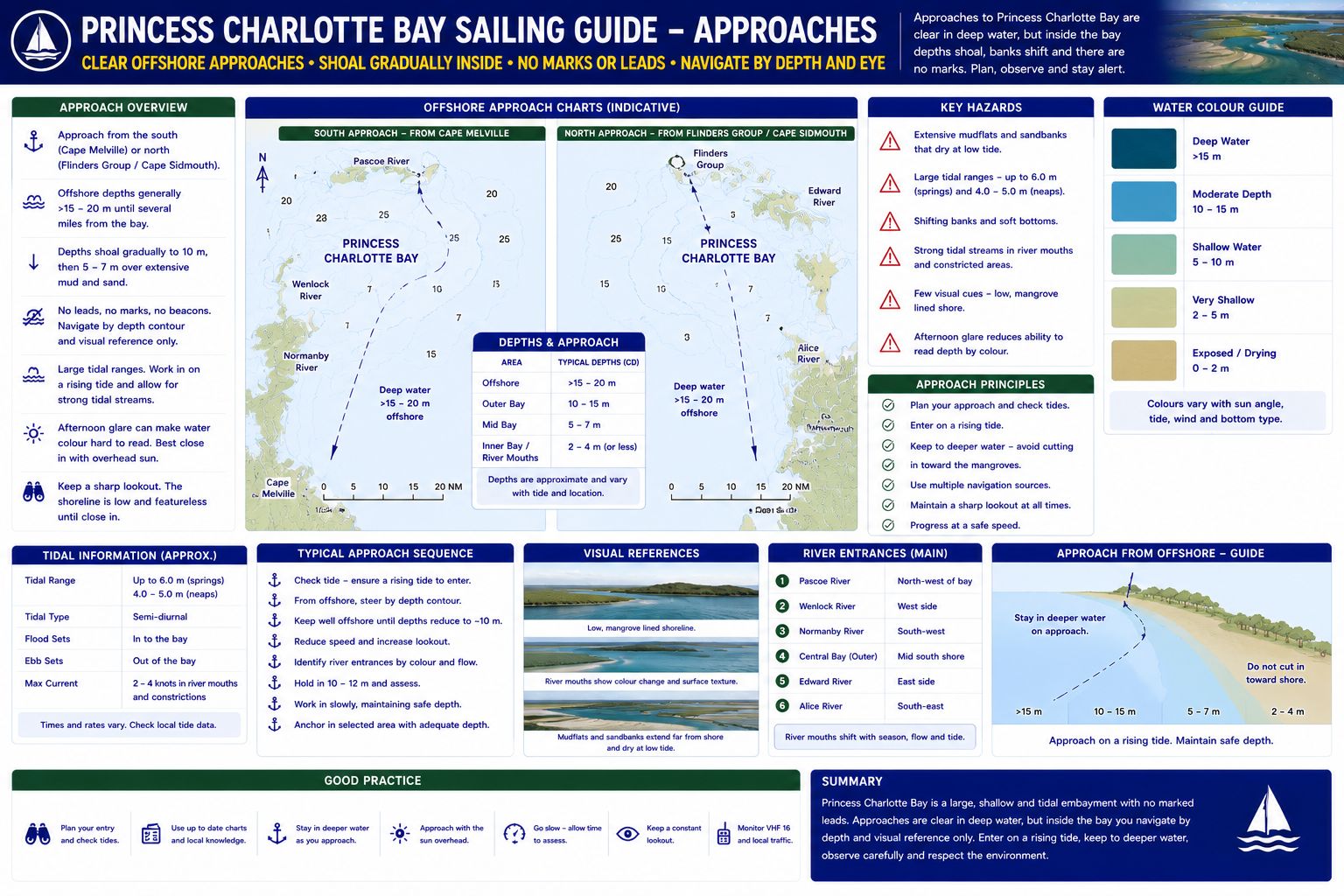
Approaches from the south (Cape Melville) or north (Flinders Group / Cape Sidmouth) are clear in offshore depths, with soundings generally >15–20 m until within several miles of the bay. As you enter the bay, depths shoal gradually to 10 m, then 5–7 m, over extensive mud and sand. There are no leads or marks; the approach is by depth contour and visual reference only.
The main hazard is featureless water with few visual cues, combined with large tidal ranges and soft, shifting banks. You work in on a rising tide, keeping to the deeper contours and avoiding any temptation to cut corners toward the mangrove shore. Afternoon glare can make it difficult to read water colour; all close‑in work is best done with overhead sun.
Princess Charlotte
Bay Sailing Guide - Anchorages
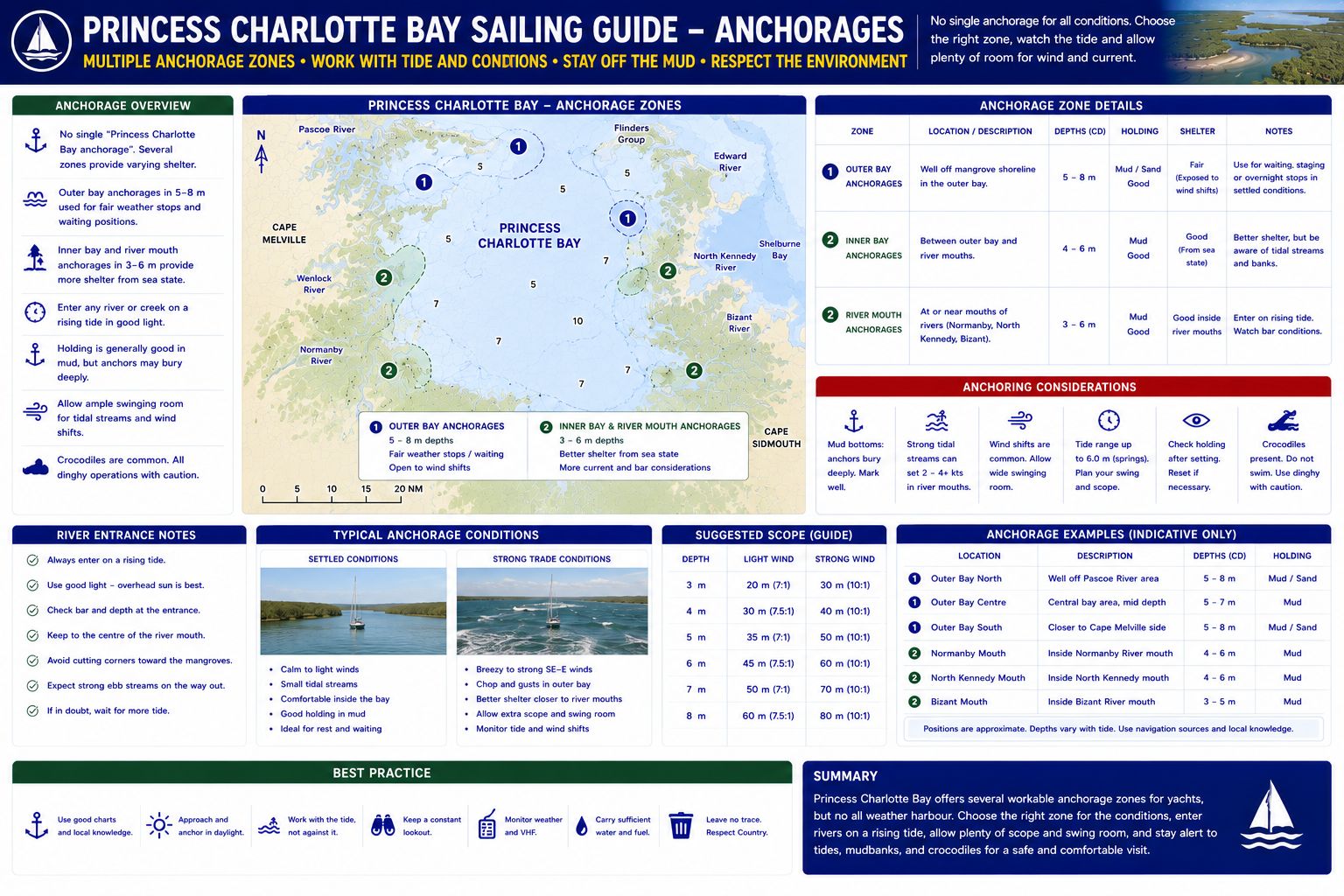
There is no single “Princess Charlotte Bay anchorage”; instead, skippers choose from several broad zones:
- Outer bay anchorages in 5–8 m over mud and sand, well off the mangroves, used as fair‑weather stops or waiting positions. These are open to wind shifts and can be uncomfortable in strong trades but avoid the worst of the sandbanks and bar work.
- Inner bay and river‑mouth anchorages, where yachts work closer in toward the mouths of rivers such as the Normanby, North Kennedy, and Bizant. Depths here are 3–6 m, with better shelter from sea state but more exposure to tidal currents, mudbanks, and bar conditions. Entry into any river or creek is strictly a rising‑tide, good‑light operation.
Holding is generally good in mud, but anchors can become deeply buried. Swinging room must account for strong tidal streams and wind shifts. Crocodiles are common; all dinghy operations are conducted with caution.
Princess Charlotte
Bay Sailing Guide - Entry
Princess Charlotte Bay is not a clearance port and has no formal facilities. All international arrivals must clear at a designated port such as Cairns, Cooktown, or Thursday Island before entering these waters. Satellite communications equipment such as Starlink is permitted without local restriction. Firearms must be declared on entry into Australia and cannot be landed without authorisation.
Princess Charlotte
Bay Sailing Guide - Marina
There are no marinas, jetties, or berths anywhere in Princess Charlotte Bay. There are no public wharves suitable for yachts. All access is by dinghy to mangrove edges or beaches where they exist, and in many places there is no practical landing at all due to mud and crocodiles. There are no haul‑out facilities.
Princess Charlotte
Bay Sailing Guide - Local Weather
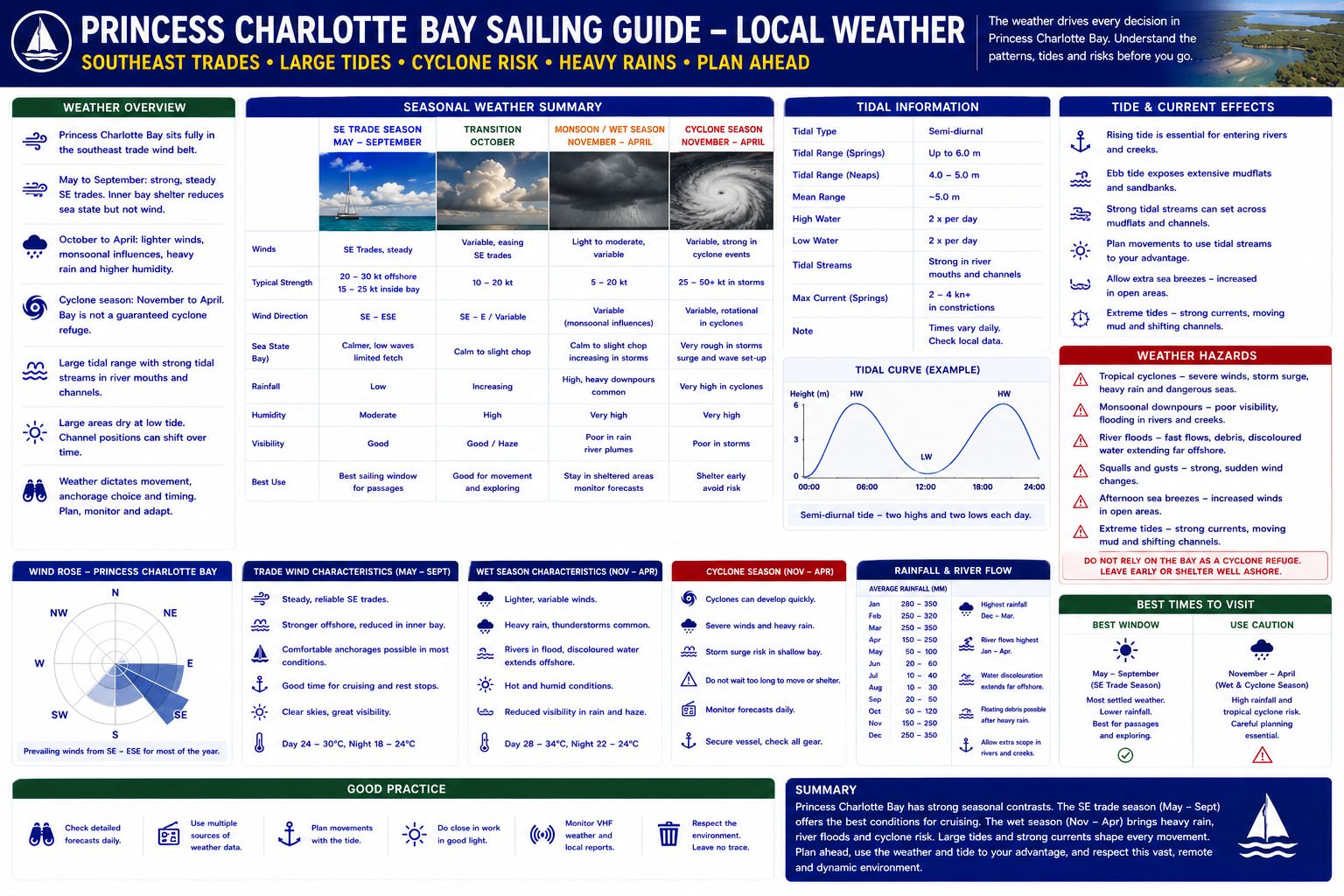
Princess Charlotte Bay sits fully in the southeast trade‑wind belt. From May to September, trades of 20–30 kt are common offshore, but the inner bay can be significantly calmer in terms of sea state, with wind still strong but waves reduced by fetch limits. Summer brings lighter winds, heavy rain, and monsoonal influences, with river flows increasing and water discolouration extending far offshore. Cyclone risk is significant from November to April; the bay is not a guaranteed cyclone refuge, despite its apparent shelter, because of shallow depths, fetch, and storm surge potential.
Tidal range is large, and currents in river mouths and channels can be strong, especially on springs. Large areas of the bay dry at low tide, and the position of usable channels can shift over time.
Princess Charlotte
Bay Sailing Guide - Provisioning
Supermarkets. There are no supermarkets or shops in Princess Charlotte Bay. All provisioning must be completed in Cooktown, Cairns, or further south before committing to this coast. The bay is purely a wilderness anchorage area. Markets. There are no markets. No fresh produce is available. Fish markets. There are no fish markets. The bay is, however, a major fishing ground, and many yachts supplement stores with line‑caught fish and crabs, observing all regulations and local closures.
Princess Charlotte
Bay Sailing Guide - Fishing, Crabbing
and Ciguatera
Princess Charlotte Bay and the waters around Cape Melville form one of the most productive mixed‑habitat fisheries on the Queensland coast, with reef edges, rubble patches, mudflats, tidal channels and mangrove river systems all contributing different species. For a yacht provisioning in remote country, this region provides reliable protein across reef, estuary and pelagic environments, provided the skipper respects tides, crocodiles and ciguatera limits.
Reef edges and rubble around Cape Melville and the outer bay hold coral trout, grass emperor, spangled emperor, stripey snapper, Moses perch, tuskfish and both Spanish and grey mackerel. These fish sit on hard bottom, bommies and sand‑to‑reef transitions, and feed most consistently in the early morning and late afternoon when the wind is lowest. Small reef fish carry low ciguatera risk, but large coral trout, large emperor and large cod are avoided. Mackerel are consistently clean and form the safest large‑fish option in the area.
The mudflats and channel edges of inner Princess Charlotte Bay produce threadfin salmon, blue salmon, grunter, golden trevally, queenfish and seasonal barramundi. These species feed heavily on tidal changes, with the last of the ebb and the first of the flood producing the most reliable results. Grunter and threadfin are among the best table fish in the bay, with firm flesh, low ciguatera risk and predictable behaviour around channel drop‑offs.
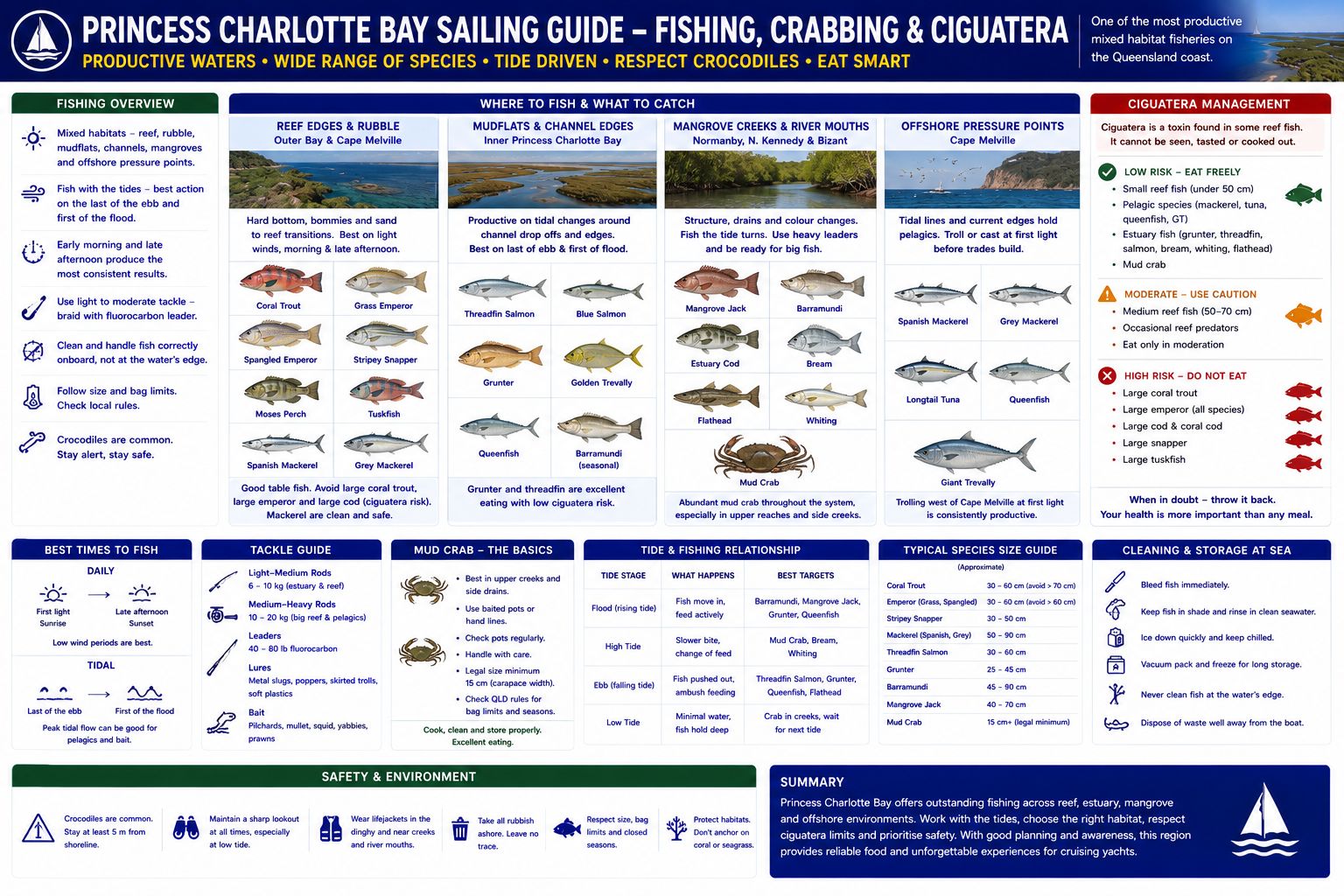
The mangrove creeks and river mouths of the Normanby, North Kennedy and Bizant systems hold mud crab, barramundi, mangrove jack, estuary cod, bream, flathead and whiting. Mud crab is abundant throughout the system, particularly in the upper reaches and side creeks where tidal flow slackens. Barramundi and mangrove jack sit tight to structure, drains and colour changes, and are most active around the turn of the tide. These areas require strict caution due to crocodiles, and fish cleaning is never done at the water’s edge.
Offshore pressure points around Cape Melville concentrate pelagics, with Spanish mackerel, grey mackerel, longtail tuna, queenfish and giant trevally working the tidal lines. Trolling the pressure zone west of the cape at first light is consistently productive before the trades rise and the sea state becomes confused.
Ciguatera management in this region is straightforward: small reef fish are low risk, pelagics are safe, and large reef predators are avoided. The combination of reef species, estuary fish, pelagics and mud crab makes Princess Charlotte Bay and Cape Melville one of the most effective self‑provisioning zones on the Cape York coast.
Princess Charlotte
Bay Sailing Guide - Local cuisine
There is no local cuisine in the sense of restaurants or outlets. Food culture here is what you bring aboard and what you catch. Regionally, this coast is known for mud crab, barramundi, and reef fish, often cooked simply, grilled, pan fried, fish cakes, whatever your chosen method, but for a yacht, this is entirely self‑provisioned.
Princess Charlotte
Bay Sailing Guide - Fuel
There is no fuel available anywhere in Princess Charlotte Bay. All diesel and petrol must be loaded in Cooktown, Cairns, or other ports before entering this region. The bay is remote; running low on fuel here is a serious planning failure.
Princess Charlotte
Bay Sailing Guide - Water
There is no reliable potable water supply for yachts. Some skippers collect rainwater or, in the wet season, may find fresh water in upper reaches of rivers, but this is not a dependable or recommended strategy. All drinking water should be carried aboard.
Mechanical and Electrical Repairs
Resource
If you are headed somewhere remote consider the need to expand your knowledge base or have an information resource on board. Why not get a copy of my book The Marine and Electrical and Electronics Bible 4th Edition. By and for yachties, with everything from batteries and charging, solar and wind, diesel engines and marine electronics and so much more. Your complete systems guide. 650 pages of practical advice. In Australia and New Zealand order a copy through Boat Books. UK and European boats can buy the UK Edition Here. US and Canadian boats can get the US Edition Order Here. Marine systems are my profession so let me help you. By a liveaboard boat owner for other boat owners


Princess Charlotte
Bay Sailing Guide - Marine services
There are no marine services, no chandlery, and no repair facilities. Any mechanical, electrical, or rigging issues must be handled with onboard spares and skills, or deferred until reaching a serviced port. Princess Charlotte Bay should be treated as a self‑reliance zone.
Princess Charlotte
Bay Sailing Guide - Local customs
Princess Charlotte Bay lies within traditional lands of several Aboriginal groups, and many areas have cultural significance. Access to some onshore areas may be restricted or require permission. The entire bay is crocodile habitat; swimming is not advised, and dinghy operations near mangroves and river mouths must be conservative.
Princess Charlotte
Bay Sailing Guide - Summary
Princess Charlotte Bay is a large, shallow, mangrove‑lined embayment used by yachts as a weather and rest bay on the remote Cape York coast. Approaches are clear in offshore depths but become featureless and tide‑dominated closer in, with extensive mudflats and shifting banks. There are multiple workable anchorages but no facilities, no provisioning, no fuel, and no water. Navigation is by depth contour and eyeball in good light, with strong emphasis on tide and self‑reliance. For a prepared skipper, the bay is a valuable tactical pause on a demanding coast; for an unprepared one, it is an unforgiving trap. The Princess Charlotte Bay Sailing Guide is here to assist your passage planning.