Port Klang Sailing and Cruising Guide
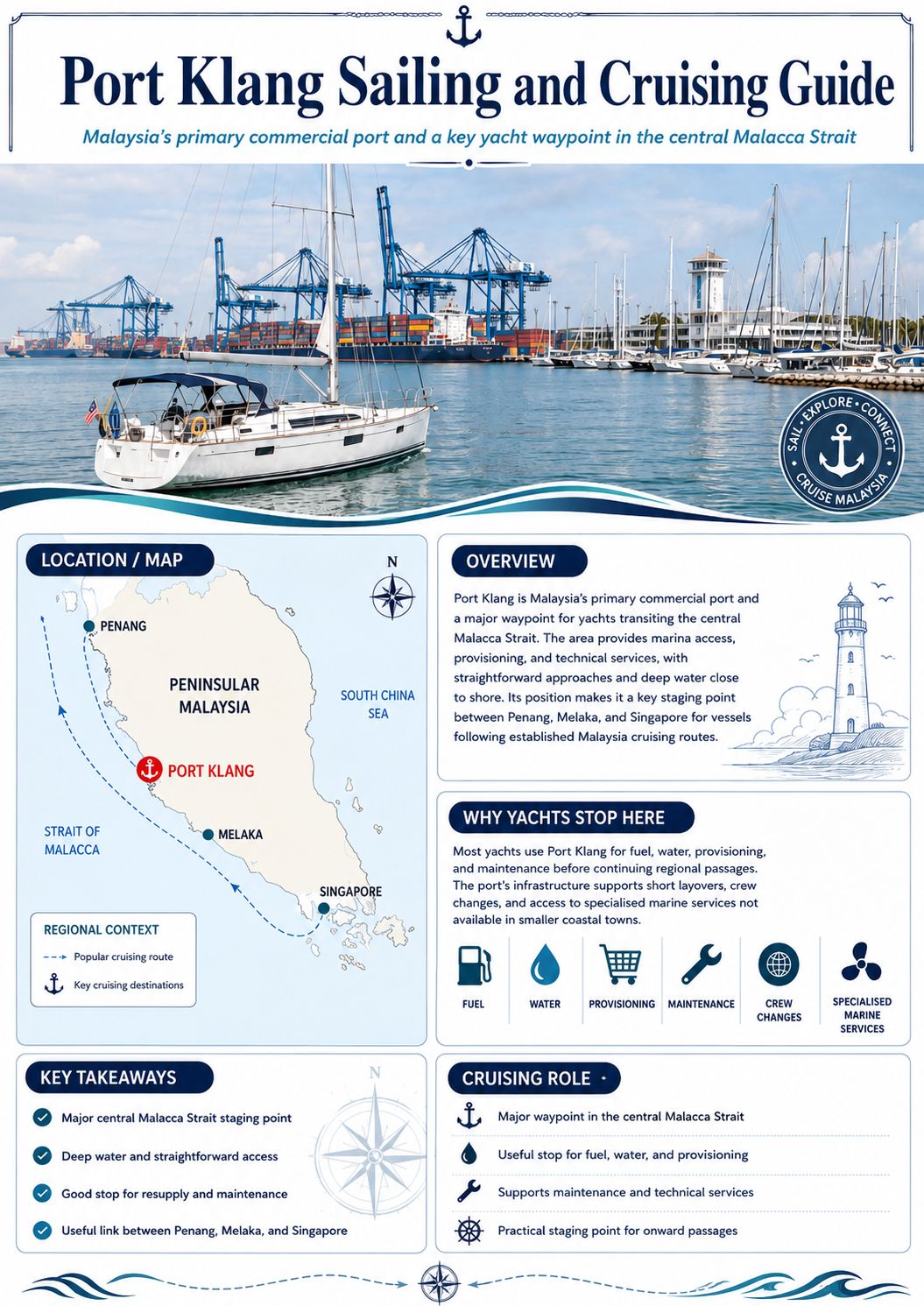
Port Klang sailing and cruising guide. Port Klang is Malaysia’s primary commercial port and a major waypoint for yachts transiting the central Malacca Strait. The area provides marina access, provisioning, and technical services, with straightforward approaches and deep water close to shore. Its position makes it a key staging point between Penang, Melaka, and Singapore for vessels following established Malaysia cruising routes.
Most yachts use Port Klang for fuel, water, provisioning, and maintenance before continuing regional passages. The port’s infrastructure supports short layovers, crew changes, and access to specialised marine services not available in smaller coastal towns.
Port Klang Sailing and Cruising Guide -
Approaches
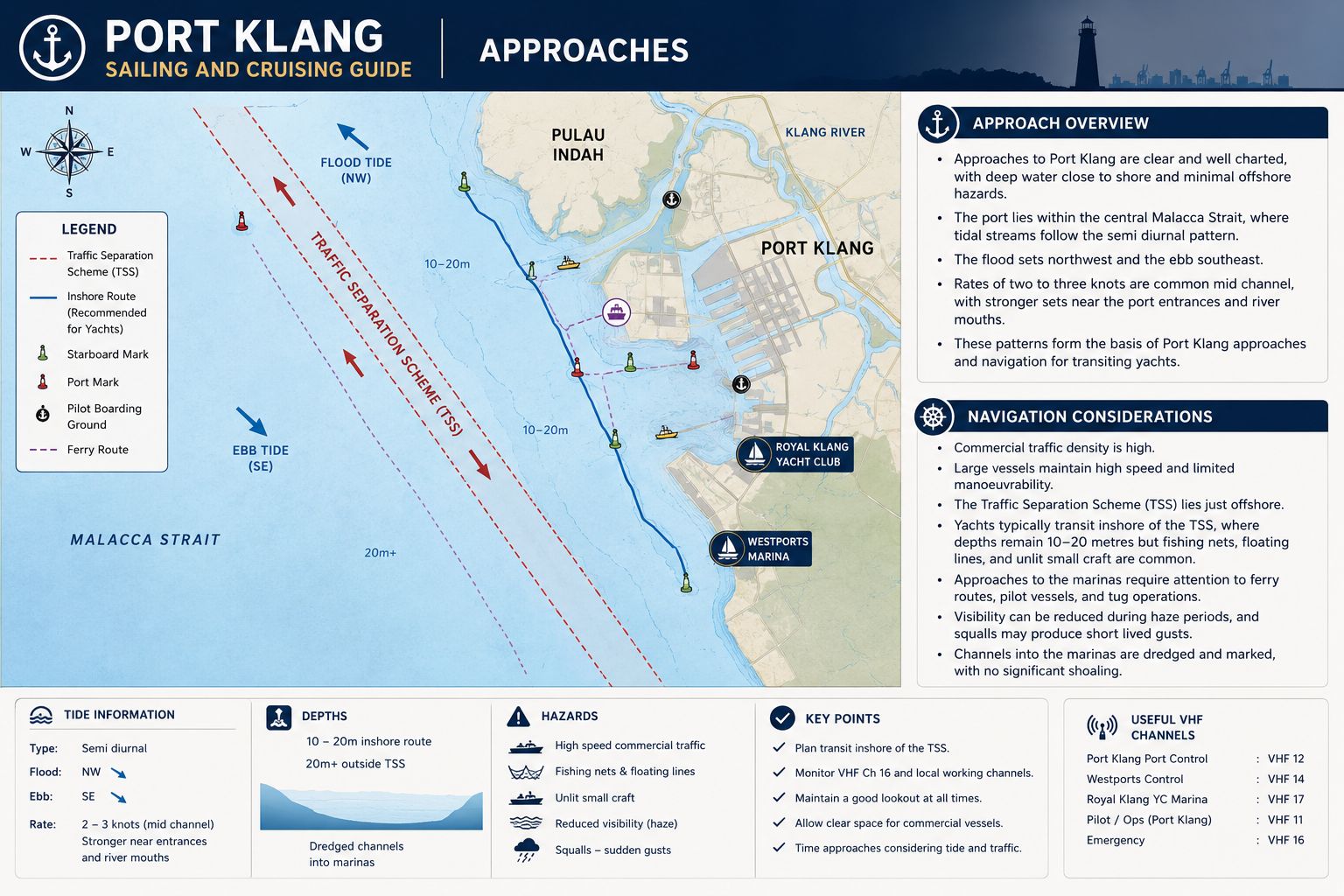
Approaches to Port Klang are clear and well charted, with deep water close to shore and minimal offshore hazards. The port lies within the central Malacca Strait, where tidal streams follow the semi‑diurnal pattern: the flood sets northwest and the ebb southeast. Rates of two to three knots are common mid‑channel, with stronger sets near the port entrances and river mouths. These patterns form the basis of Port Klang approaches and navigation for transiting yachts.
Commercial traffic density is high. Large vessels maintain high speed and limited manoeuvrability, and the Traffic Separation Scheme (TSS) lies just offshore. Yachts typically transit inshore of the TSS, where depths remain 10–20 metres but fishing nets, floating lines, and unlit small craft are common. Approaches to the marinas require attention to ferry routes, pilot vessels, and tug operations. Visibility can be reduced during haze periods, and squalls may produce short‑lived gusts. Channels into the marinas are dredged and marked, with no significant shoaling.
Port Klang Sailing and Cruising Guide -
Anchorage
Anchoring options near Port Klang are limited due to commercial traffic and restricted zones. Temporary anchoring is possible in designated areas off Pulau Indah in 6–12 metres over mud, with good holding. These areas are exposed to wake from passing vessels and require continuous watchkeeping. This location forms the core of the Port Klang yacht anchorage guide used by transiting yachts. Most vessels proceed directly to marina berths rather than anchoring due to traffic density and operational constraints.
Port Klang Sailing and Cruising Guide -
Entry Formalities
Port Klang is a designated port of entry. Yachts must clear with Immigration, Customs, and the Marine Department. Arrival documents, crew passports, vessel registration, and previous‑port clearance papers are required. Clearance is typically conducted at the Marine Department office near Pulau Indah. Movement between anchorages and marinas must be reported if directed by authorities. These procedures form the basis of Port Klang entry formalities for yachts. Communications equipment such as Starlink is permitted but may require registration depending on installation and usage. Quarantine inspections occur as needed.
Port Klang Sailing and Cruising Guide -
Marina Facilities
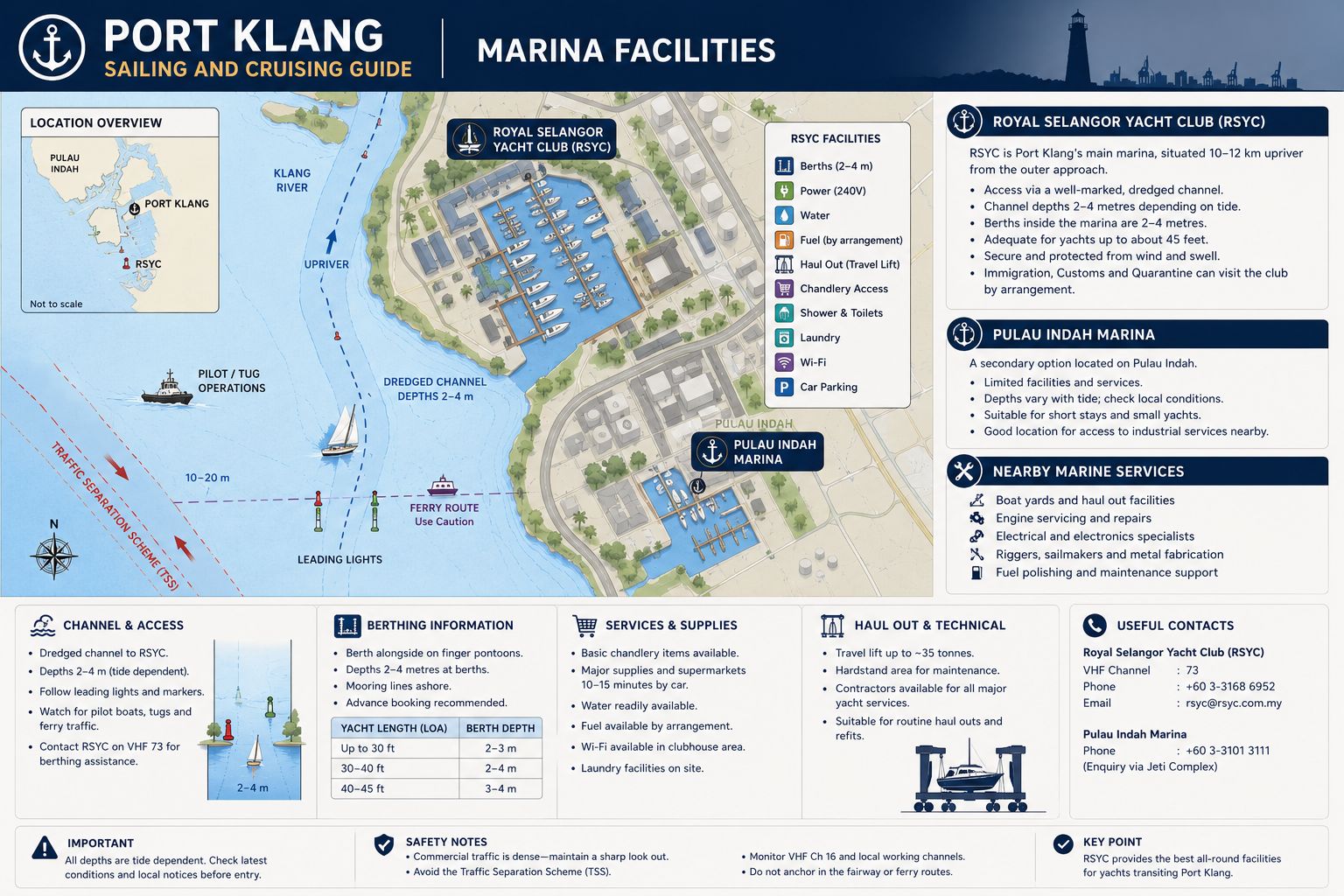
Port Klang’s primary marina is Royal Selangor Yacht Club (RSYC), located upriver with access via a dredged channel. Depths in the channel are 2–4 metres depending on tide, with berths inside offering similar depths. Facilities include power, water, fuel (by arrangement), haul‑out, and basic chandlery access. These facilities form the core of Port Klang marina facilities used by regional cruising yachts. Additional berthing options exist at Pulau Indah Marina, though facilities are limited and depths vary with tide. Most major work is carried out at RSYC or in industrial yards nearby.
Port Klang Sailing and Cruising Guide -
Local Weather
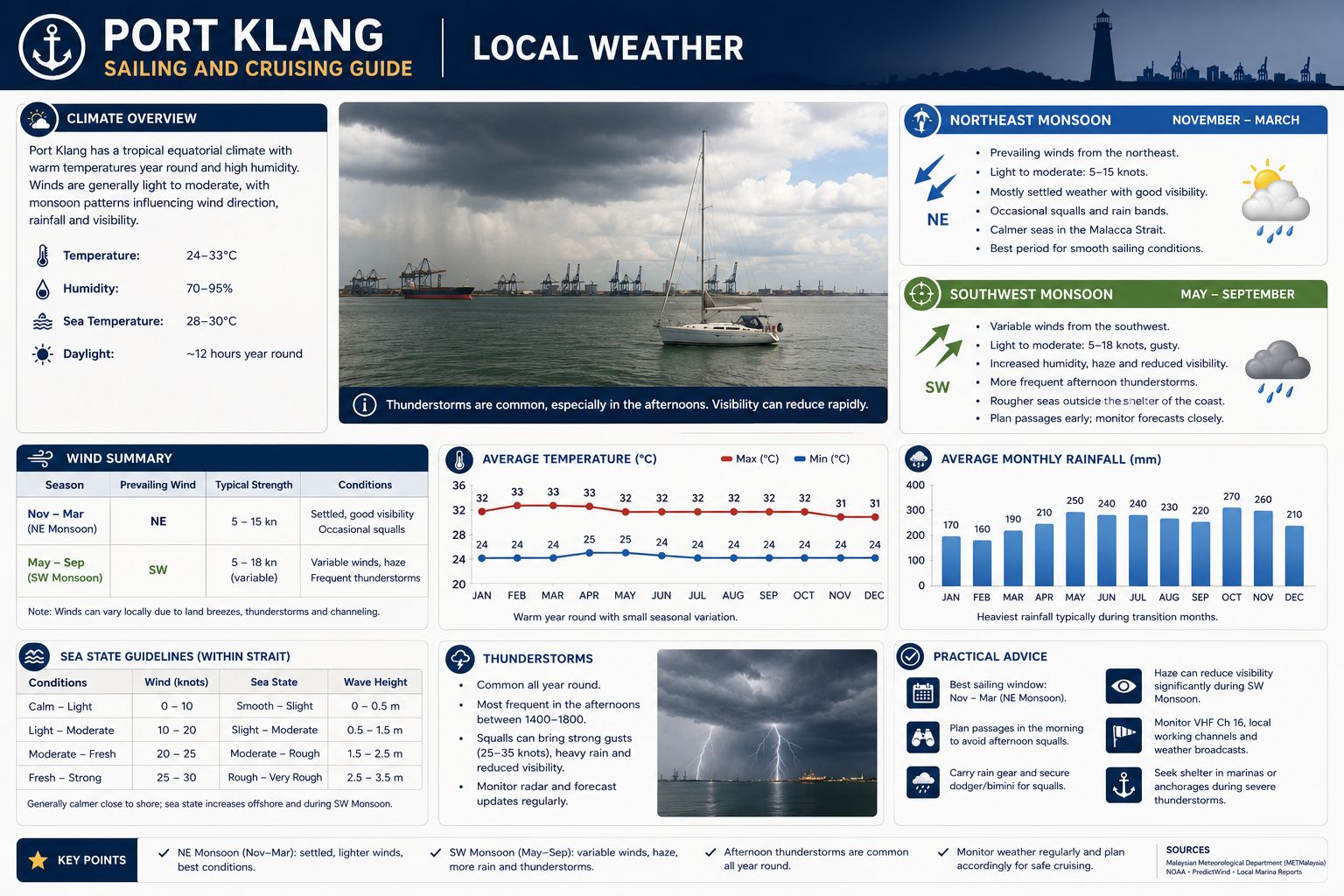
Port Klang experiences consistent tropical conditions with light to moderate winds. The Northeast Monsoon from November to March brings settled conditions with occasional squalls. The Southwest Monsoon from May to September produces variable winds, haze, and reduced visibility. Thunderstorms occur throughout the year, particularly in the afternoons. These patterns define typical Port Klang sailing conditions during monsoon transitions.
Port Klang Sailing and Cruising Guide -
Provisioning
Supermarkets: Port Klang offers reliable provisioning through several large supermarkets. Lotus’s, Giant, and AEON supply packaged goods, imported items, and household products. Fresh produce is widely available, and imported goods are more accessible here than in smaller Malaysian ports. These outlets form the core of Port Klang provisioning for yachts.
Markets: Local markets supply vegetables, fruit, herbs, and basic staples. The Klang Market and Port Klang Morning Market are consistent sources of fresh produce. Smaller neighbourhood markets provide supplementary items.
Fish Markets: Fresh seafood is available at the Klang Fisheries Complex, with daily landings of fish, squid, and shellfish. Supply varies with weather and fishing activity but is generally reliable.
Port Klang Sailing and Cruising Guide -
Local Cuisine
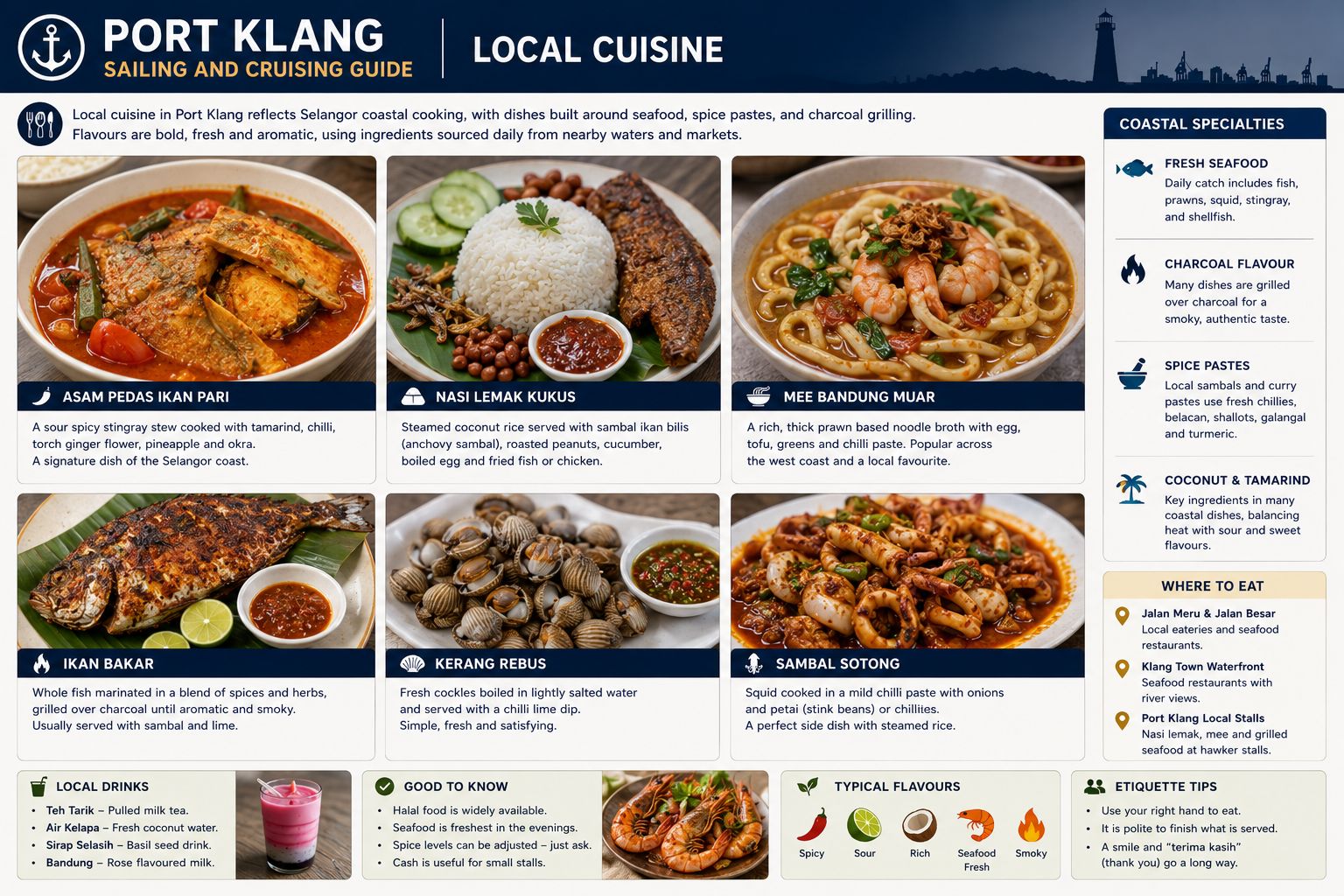
Local cuisine in Port Klang reflects Selangor coastal cooking, with dishes built around seafood, spice pastes, and charcoal grilling. Common regional dishes include asam pedas ikan pari, a sour‑spicy stingray stew using tamarind and chilli; nasi lemak kukus, steamed coconut rice served with anchovy sambal and fried fish; and mee bandung Muar, a thick prawn‑based noodle broth common across the west coast. Coastal stalls often prepare ikan bakar, whole fish grilled over charcoal with a dry spice rub, and kerang rebus, boiled cockles served with chilli‑lime dip. Local eateries also serve sambal sotong, squid cooked in a mild chilli paste used as a side dish with rice.
Port Klang Sailing and Cruising Guide -
Fuel Supplies
Fuel is available via roadside stations, with jerry‑can transport required for most yachts. Diesel quality is generally reliable. RSYC may offer fuel by arrangement, though availability varies. These arrangements form the basis of Port Klang fuel and water supplies used by transiting yachts.
Port Klang Sailing and Cruising Guide -
Water Supplies
Potable water is available at marinas and municipal taps. Quality is generally reliable, though many yachts use filtration or onboard treatment systems. Water is supplied via dockside connections at RSYC.
Mechanical
and Electrical Repairs Resource
If you are headed somewhere remote consider the need to expand your knowledge base or have an information resource on board. Why not get a copy of my book The Marine and Electrical and Electronics Bible 4th Edition. By and for yachties, with everything from batteries and charging, solar and wind, diesel engines and marine electronics and so much more. Your complete systems guide. 650 pages of practical advice. In Australia and New Zealand order a copy through Boat Books. UK and European boats can buy the UK Edition Here. US and Canadian boats can get the US Edition Order Here. Marine systems are my profession so let me help you. By a liveaboard boat owner for other boat owners


Port Klang Sailing and Cruising Guide -
Marine Services
Marine services are concentrated around RSYC and nearby industrial zones. Facilities include haul‑out yards, mechanical and electrical services, sailmaking, rigging, and chandlery support. Independent technicians operate throughout the area. Volvo and Yanmar agents are accessible through regional service providers in Kuala Lumpur and Port Klang. These resources form the core of Port Klang marine services for diesel engines and electrical systems.
Port Klang Sailing and Cruising Guide -
Local Customs
Respectful behaviour is expected, with modest dress in rural areas and sensitivity around religious sites. Alcohol consumption is permitted but regulated in certain locations. Waste disposal must follow local rules, and discharge is prohibited in marinas and anchorages.
Port Klang Sailing and Cruising Guide -
Summary
Port Klang is a practical and reliable destination for yachts transiting the central Malacca Strait. With straightforward approaches, marina access, provisioning, and marine services, it functions as a key waypoint between Penang and Singapore. The Port Klang Sailing and Cruising Guide is here to help you.