Malaysia Sailing and Cruising Guide
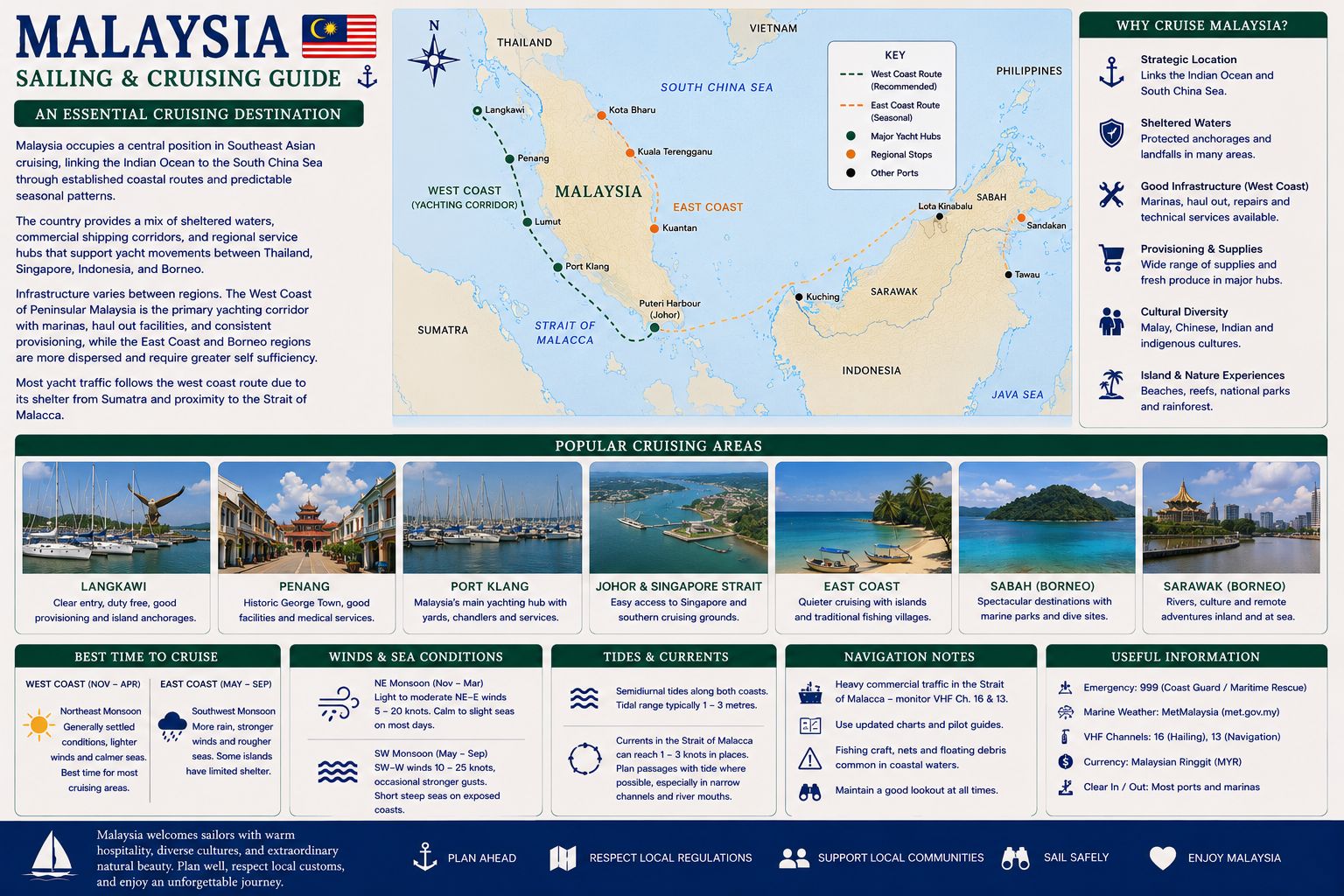
Malaysia Sailing and Cruising Guide. Malaysia occupies a central position in Southeast Asian cruising, linking the Indian Ocean to the South China Sea through established coastal routes and predictable seasonal patterns. The country provides a mix of sheltered waters, commercial shipping corridors, and regional service hubs that support yacht movements between Thailand, Singapore, Indonesia, and Borneo.
Infrastructure varies between regions. The West Coast of Peninsular Malaysia is the primary yachting corridor with marinas, haul‑out facilities, and consistent provisioning, while the East Coast and Borneo regions are more dispersed and require greater self‑sufficiency. Most yacht traffic follows the west‑coast route due to its shelter from Sumatra and proximity to the Strait of Malacca.
Malaysia Sailing and
Cruising Guide - Navigation
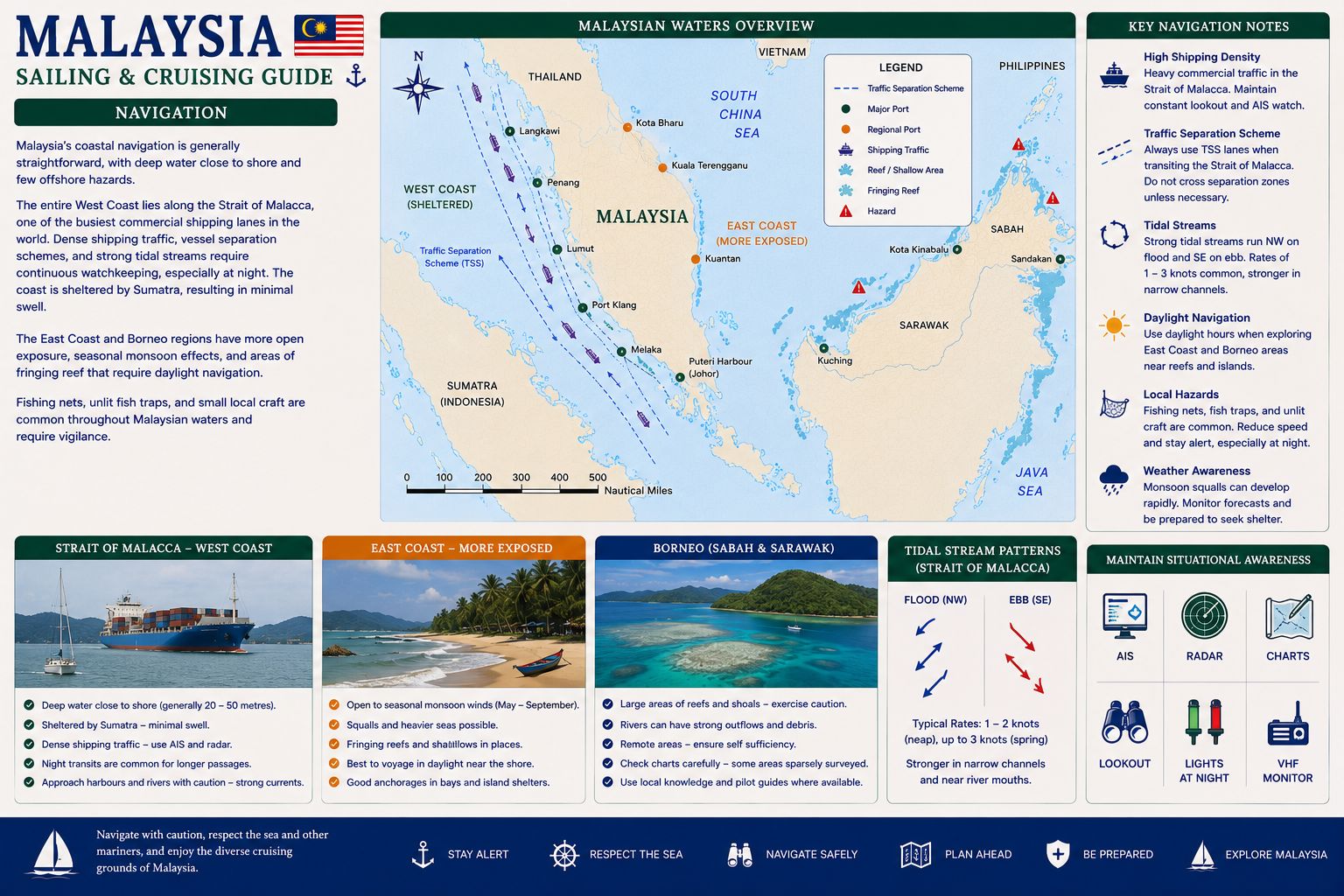
Malaysia’s coastal navigation is generally straightforward, with deep water close to shore and few offshore hazards. The entire West Coast lies along the Strait of Malacca, one of the busiest commercial shipping lanes in the world. Dense shipping traffic, vessel separation schemes, and strong tidal streams require continuous watchkeeping, especially at night. The coast is sheltered by Sumatra, resulting in minimal swell.
The East Coast and Borneo regions have more open exposure, seasonal monsoon effects, and areas of fringing reef that require daylight navigation. Fishing nets, unlit fish traps, and small local craft are common throughout Malaysian waters and require vigilance.
Strait
of Malacca – Tidal Streams and Operational Notes
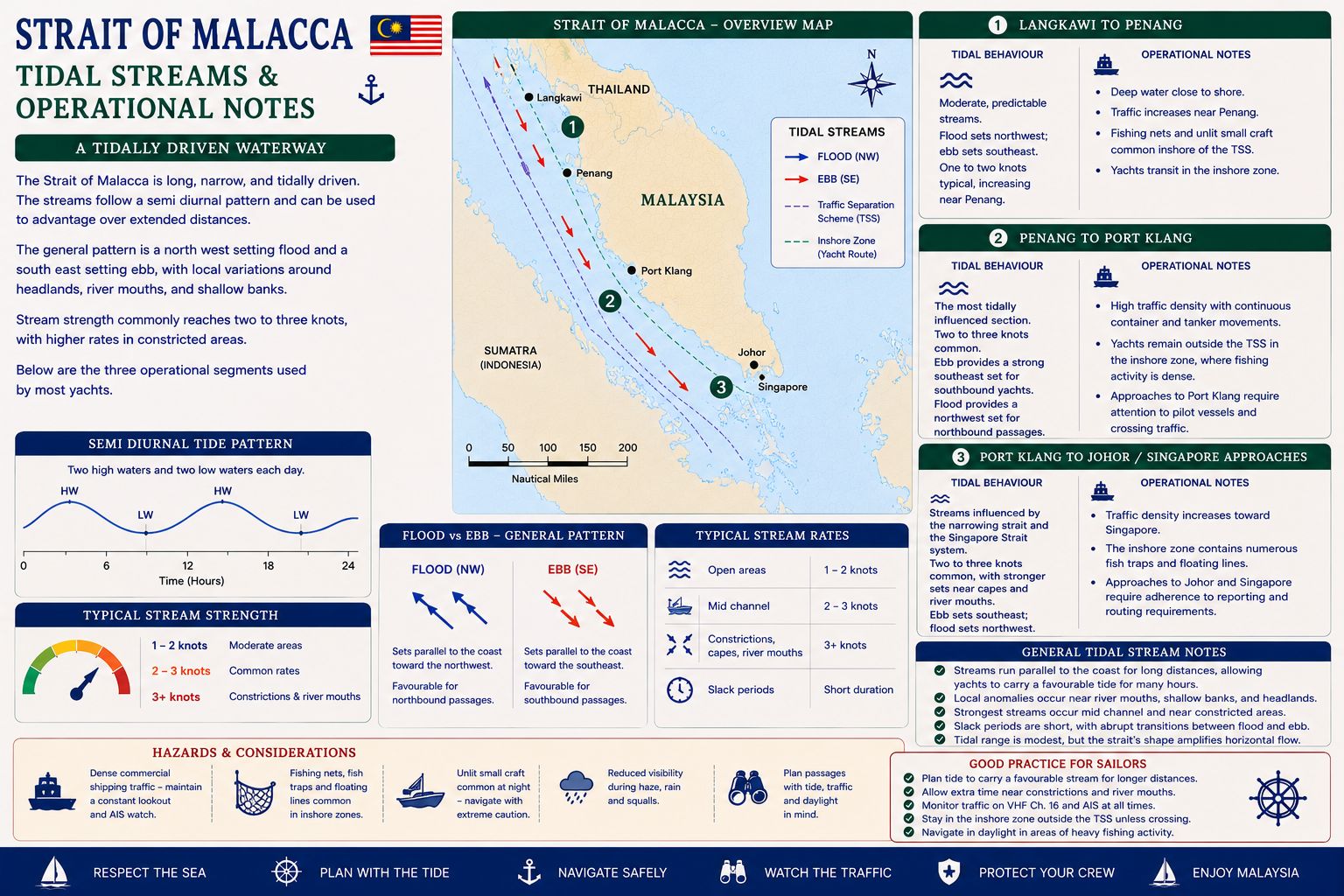
The Strait of Malacca is long, narrow, and tidally driven. The streams follow a semi‑diurnal pattern and can be used to advantage over extended distances. The general pattern is a north‑west‑setting flood and a south‑east‑setting ebb, with local variations around headlands, river mouths, and shallow banks. Stream strength commonly reaches two to three knots, with higher rates in constricted areas. Below are the three operational segments used by most yachts.
1.
Langkawi to Penang
Tidal Behaviour: Moderate, predictable streams. Flood sets northwest; ebb sets southeast. One to two knots typical, increasing near Penang.
Operational Notes: Deep water close to shore. Traffic increases near Penang. Fishing nets and unlit small craft common inshore of the TSS. Yachts transit in the inshore zone.
2.
Penang to Port Klang
Tidal Behaviour: The most tidally influenced section. Two to three knots common. Ebb provides a strong southeast set for southbound yachts; flood provides a northwest set for northbound passages.
Operational Notes: High traffic density with continuous container and tanker movements. Yachts remain outside the TSS in the inshore zone, where fishing activity is dense. Approaches to Port Klang require attention to pilot vessels and crossing traffic.
3.
Port Klang to Johor / Singapore Approaches
Tidal Behaviour: Streams influenced by the narrowing strait and the Singapore Strait system. Two to three knots common, with stronger sets near capes and river mouths. Ebb sets southeast; flood sets northwest.
Operational Notes: Traffic density increases toward Singapore. The inshore zone contains numerous fish traps and floating lines. Approaches to Johor and Singapore require adherence to reporting and routing requirements.
General Tidal Stream
Notes
- Streams run parallel to the coast for long distances, allowing yachts to carry a favourable tide for many hours.
- Local anomalies occur near river mouths, shallow banks, and headlands.
- Strongest streams occur mid‑channel and near constricted areas.
- Slack periods are short, with abrupt transitions between flood and ebb.
- Tidal range is modest, but the strait’s shape amplifies horizontal flow.
Malaysia Sailing and
Cruising Guide - West Coast
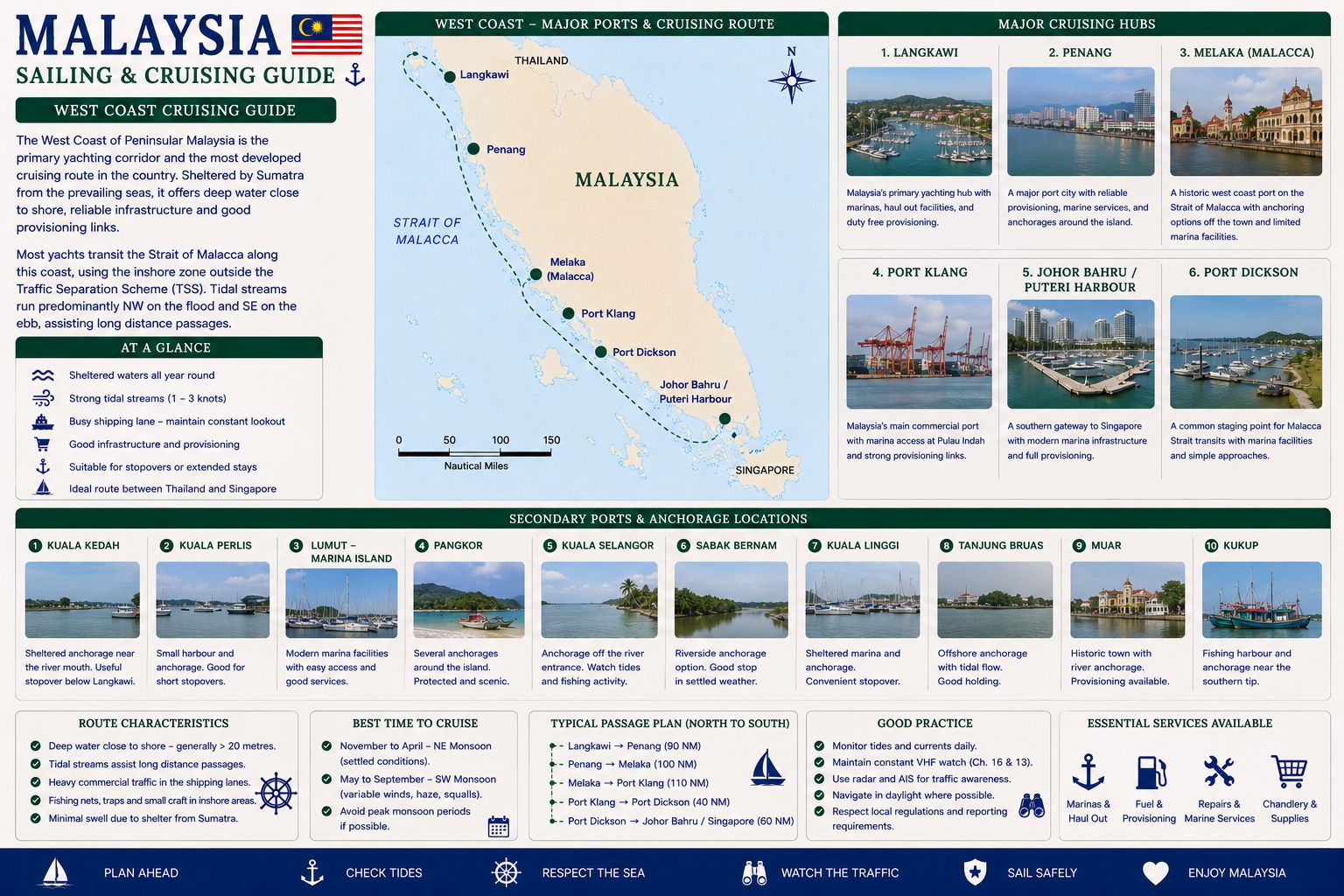
Below are the major cruising regions and ports, each intended to link to a dedicated sub‑page.
- Langkawi: Malaysia’s primary yachting hub with marinas, haul‑out facilities, and duty‑free provisioning.
- Penang: A major port city with reliable provisioning, marine services, and anchorages around the island.
- Melaka (Malacca): A historic west‑coast port on the Strait of Malacca with anchoring options off the town and limited marina facilities.
- Port Klang: Malaysia’s main commercial port with marina access at Pulau Indah and strong provisioning links.
- Johor Bahru / Puteri Harbour: A southern gateway to Singapore with modern marina infrastructure and full provisioning
- Port Dickson: A common staging point for Malacca Strait transits with marina facilities and simple approaches.
The secondary ports and anchorage locations are Kuala Kedah, Kuala Perlis, Lumut-Marina Island, Pangkor, Kuala Selangor, Sabak Bernam, Kuala Linggi, Tanjung Bruas, Muar and Kukup
Malaysia Sailing and
Cruising Guide - East Coast
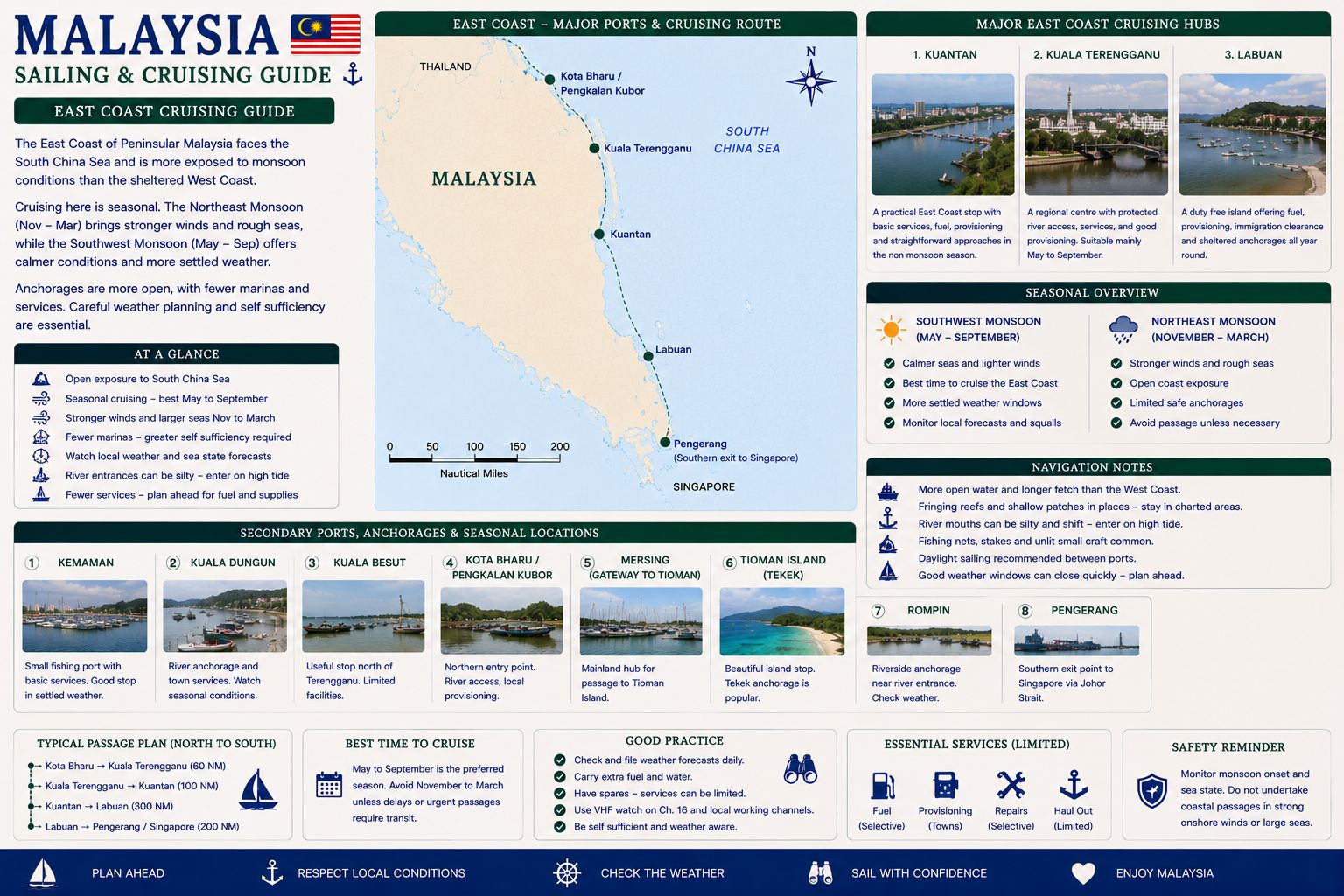
Below are the major cruising regions and ports, each intended to link to a dedicated sub‑page.
- Kuantan: A practical East Coast stop with basic services and straightforward approaches in the non‑monsoon season.
- Kuala Terengganu: A regional centre with protected river access and seasonal suitability.
- Labuan: A duty‑free island offering fuel, provisioning, and sheltered anchorages.
The secondary ports and anchorage locations and seasonal locations due to monsoon exposure are Kemaman, Kuala Dungun, Kuala Besut, Kota Bharu / Pengkalan Kubor, Mersing (gateway to Tioman), Tioman Island (Tekek), Rompin and Pengerang (southern exit to Singapore).
Malaysia Sailing and
Cruising Guide - Sabah
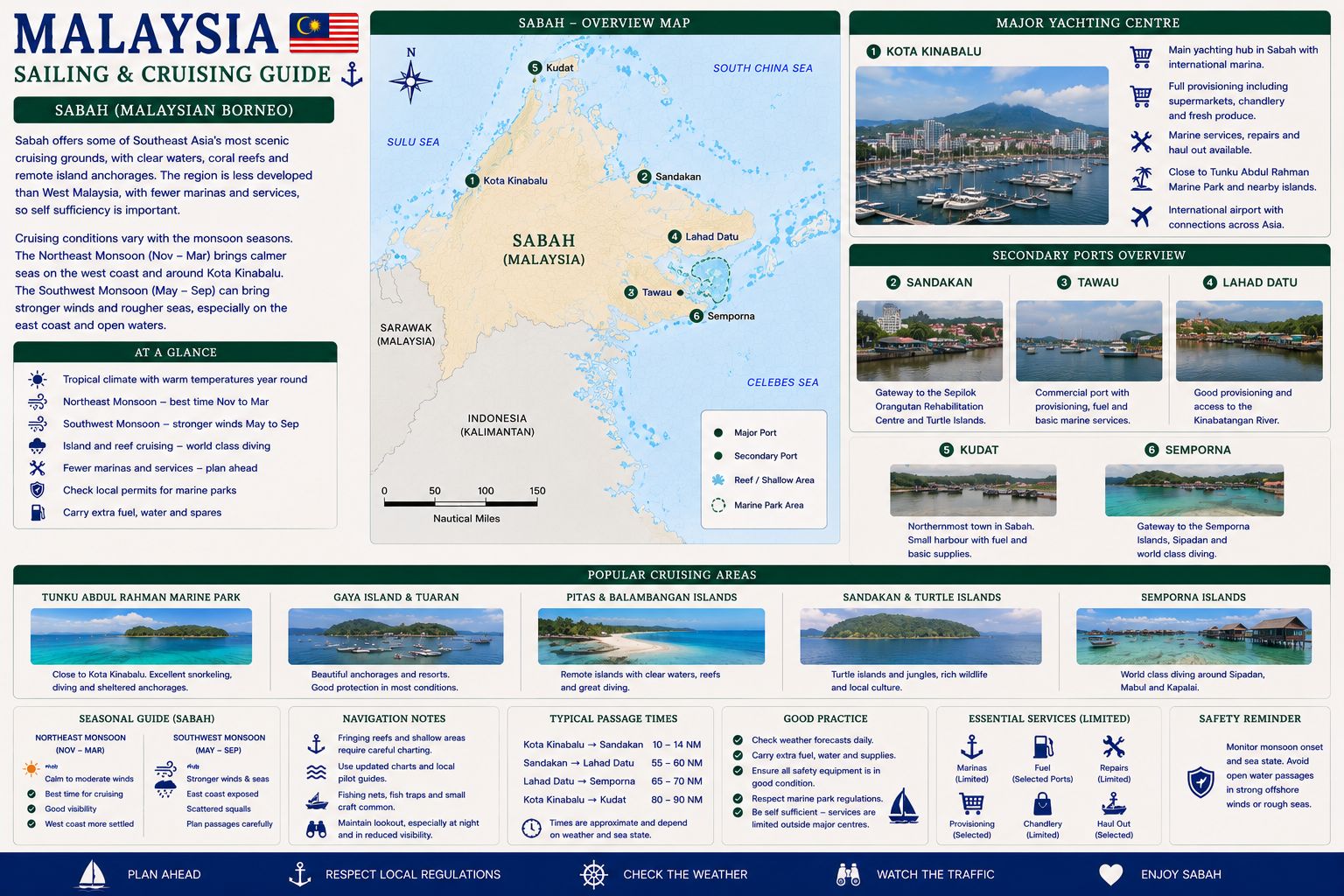
Below are the major cruising regions and ports, each intended to link to a dedicated sub‑page.
- Kota Kinabalu. The main yachting centre in Malaysian Borneo with marina facilities and provisioning.
Secondary Sabah ports include Sandakan, Tawau, Lahad Datu, Semporna and Kudat.
Malaysia Sailing and
Cruising Guide - Sarawak
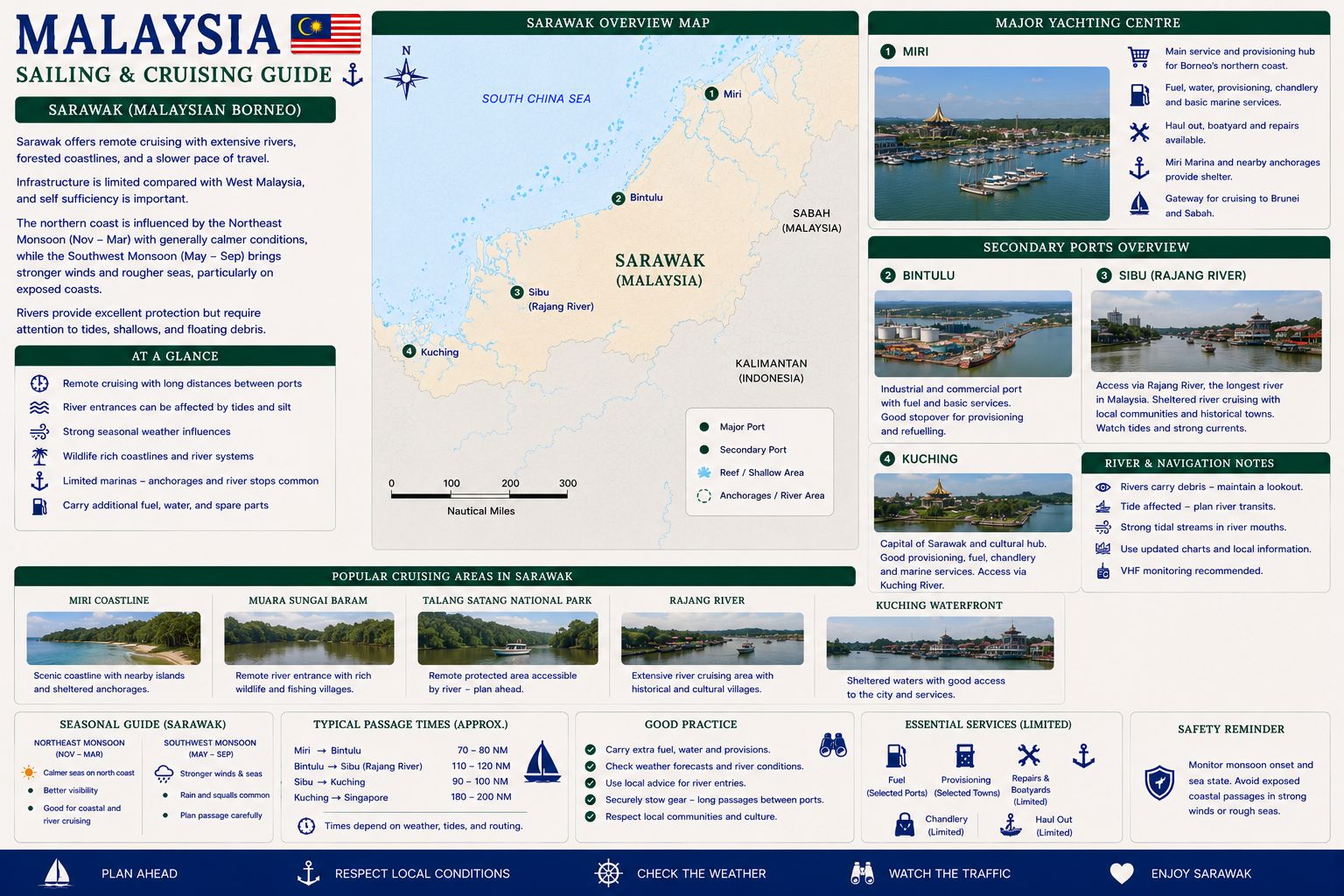
Below are the major cruising regions and ports, each intended to link to a dedicated sub‑page.
- Miri. A service and provisioning hub for yachts transiting Borneo’s northern coast.
Secondary Sarawak ports include Bintulu, Sibu Rajang River and Kuching
Malaysia Sailing and
Cruising Guide - Entry Formalities
Malaysia requires yachts to clear with Immigration, Customs, and the Harbourmaster at designated ports of entry. Arrival and departure must be reported, and vessel documents, crew passports, and previous‑port clearance papers are required. Quarantine procedures are straightforward and inspections occur as needed. Communications equipment such as Starlink is permitted but may require registration depending on installation and usage. Coastal movements between Malaysian ports require reporting but are generally uncomplicated.
Malaysia Sailing and Cruising Guide - Weather
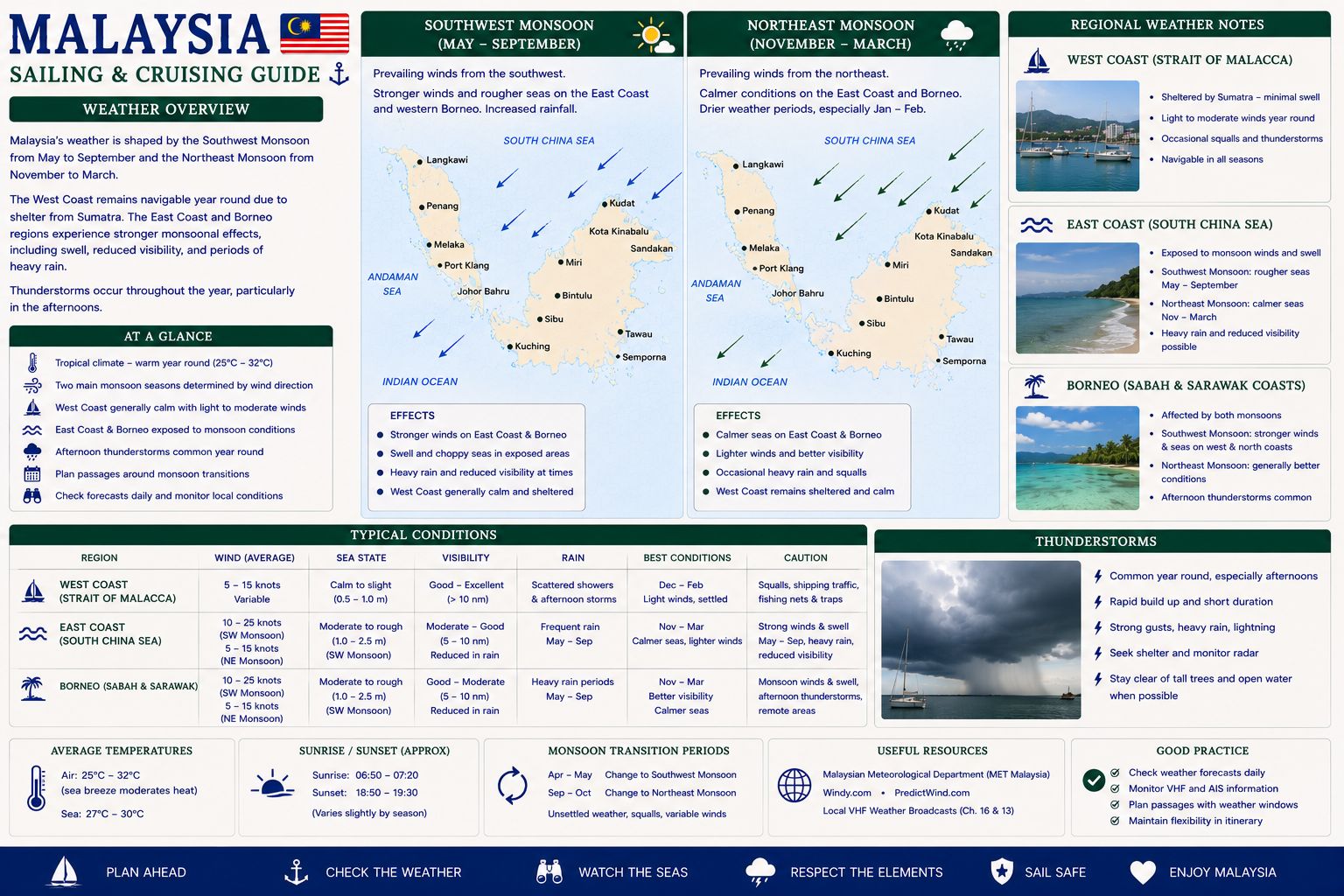
Malaysia’s weather is shaped by the Southwest Monsoon from May to September and the Northeast Monsoon from November to March. The West Coast remains navigable year‑round due to shelter from Sumatra. The East Coast and Borneo regions experience stronger monsoonal effects, including swell, reduced visibility, and periods of heavy rain. Thunderstorms occur throughout the year, particularly in the afternoons.
Malaysia Sailing and Cruising Guide - Provisioning
Provisioning standards vary by region. Langkawi, Penang, Port Klang, Johor Bahru, Kota Kinabalu, and Miri offer full provisioning with supermarkets, markets, and imported goods. Smaller ports provide only basic supplies. Markets supply consistent fresh produce, and coastal towns offer reliable seafood. Duty‑free zones such as Langkawi and Labuan provide cost‑effective access to alcohol and packaged goods.
Malaysia Sailing and Cruising Guide - National Cuisine
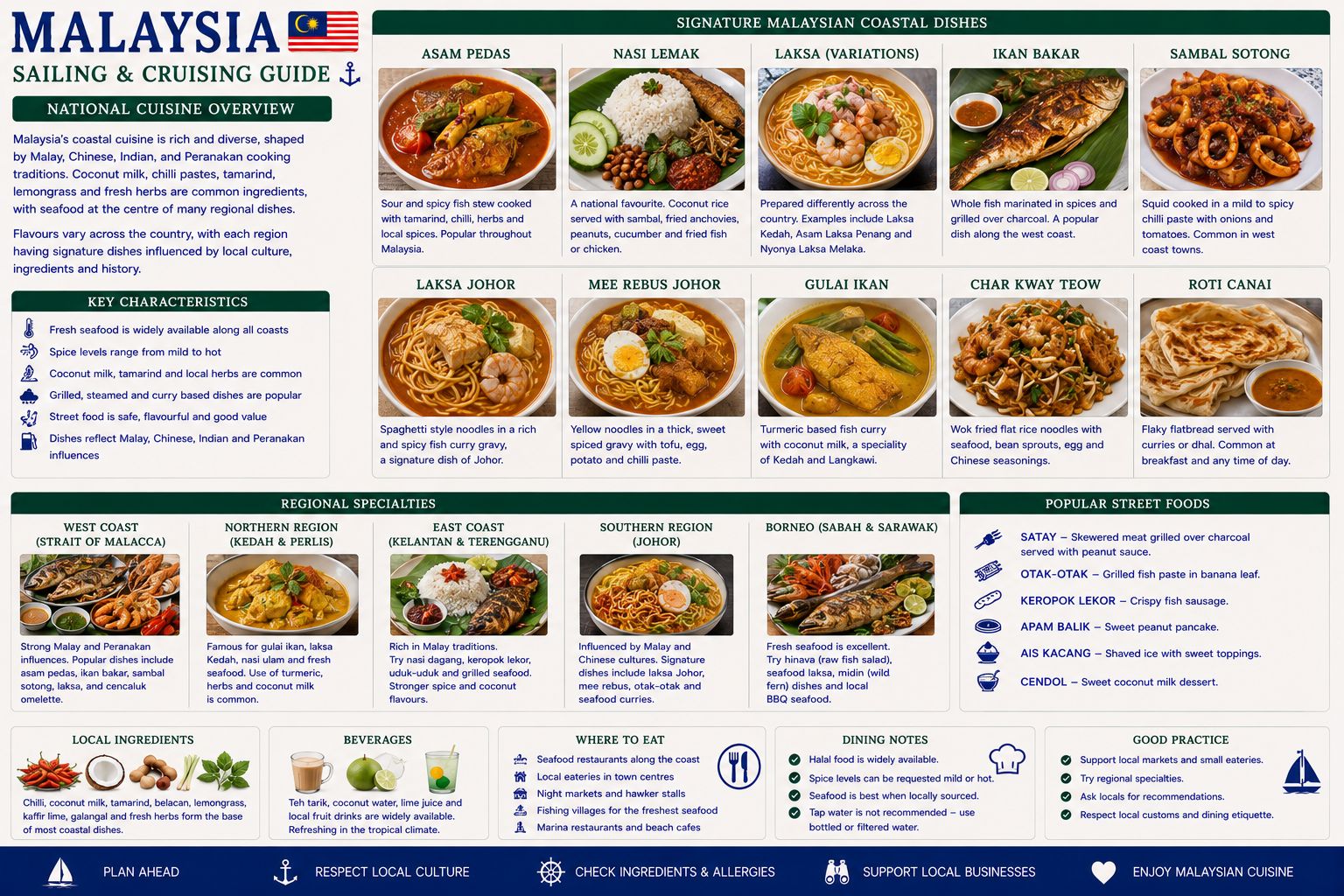
Malaysia’s coastal cuisine varies by region, with dishes shaped by Malay, Chinese, Indian, and Peranakan cooking traditions. Common regional dishes include asam pedas, a sour‑spicy fish stew using tamarind and chilli; nasi lemak, coconut rice served with anchovy sambal and fried fish; and laksa, prepared differently across the country, such as laksa Kedah, asam laksa Penang, and nyonya laksa Melaka. West‑coast towns frequently serve ikan bakar, whole fish grilled over charcoal with a dry spice rub, and sambal sotong, squid cooked in a mild chilli paste. In southern regions, dishes such as laksa Johor (spaghetti‑based fish curry) and mee rebus Johor (noodles in a sweet‑spiced gravy) are common. Northern areas often prepare gulai ikan, a turmeric‑based fish curry typical of Kedah and Langkawi.
Malaysia Sailing and Cruising Guide - Fuel Supplies
Fuel is widely available in major ports, with diesel quality generally reliable. Some marinas offer dockside fuel, while others require jerry‑can transport from roadside stations. Duty‑free fuel is available in Langkawi and Labuan. Remote areas may have variable supply or limited access during weather disruptions.
Malaysia Sailing and Cruising Guide - Water Supplies
Potable water is available at marinas and municipal taps in major ports. Quality varies by region, and many yachts use filtration or onboard treatment systems. Remote areas may require jerry‑can collection or reliance on onboard storage.
Mechanical
and Electrical Repairs Resource
If you are headed somewhere remote consider the need to expand your knowledge base or have an information resource on board. Why not get a copy of my book The Marine and Electrical and Electronics Bible 4th Edition. By and for yachties, with everything from batteries and charging, solar and wind, diesel engines and marine electronics and so much more. Your complete systems guide. 650 pages of practical advice. In Australia and New Zealand order a copy through Boat Books. UK and European boats can buy the UK Edition Here. US and Canadian boats can get the US Edition Order Here. Marine systems are my profession so let me help you. By a liveaboard boat owner for other boat owners


Malaysia Sailing and Cruising Guide - Marine Services
Marine services are concentrated in Langkawi, Penang, Port Klang, Johor Bahru, Kota Kinabalu, and Miri. These centres offer haul‑out facilities, mechanical and electrical services, sailmaking, rigging, and chandlery support. Smaller ports have limited or no marine services, and maintenance planning should be based around the major hubs.
Malaysia Sailing and Cruising Guide - Local Customs
Malaysia is culturally diverse, with Malay, Chinese, and Indian communities. Respectful behaviour and modest dress are expected in rural or conservative areas. Sensitivity around religious sites is important. Alcohol consumption is acceptable in most urban and tourist areas but restricted in some regions. Public behaviour should remain restrained during religious observances.
Malaysia Sailing and Cruising Guide - Summary
Malaysia offers predictable navigation, reliable infrastructure in key centres, and year‑round cruising opportunities on the West Coast. The East Coast and Borneo regions require seasonal planning and greater self‑sufficiency. With established ports, consistent provisioning, and straightforward formalities, Malaysia functions as a practical and strategic cruising region within Southeast Asia. The Malaysia Sailing and Cruising Guide is here to help you.