Piraeus Greece
Sailing Guide
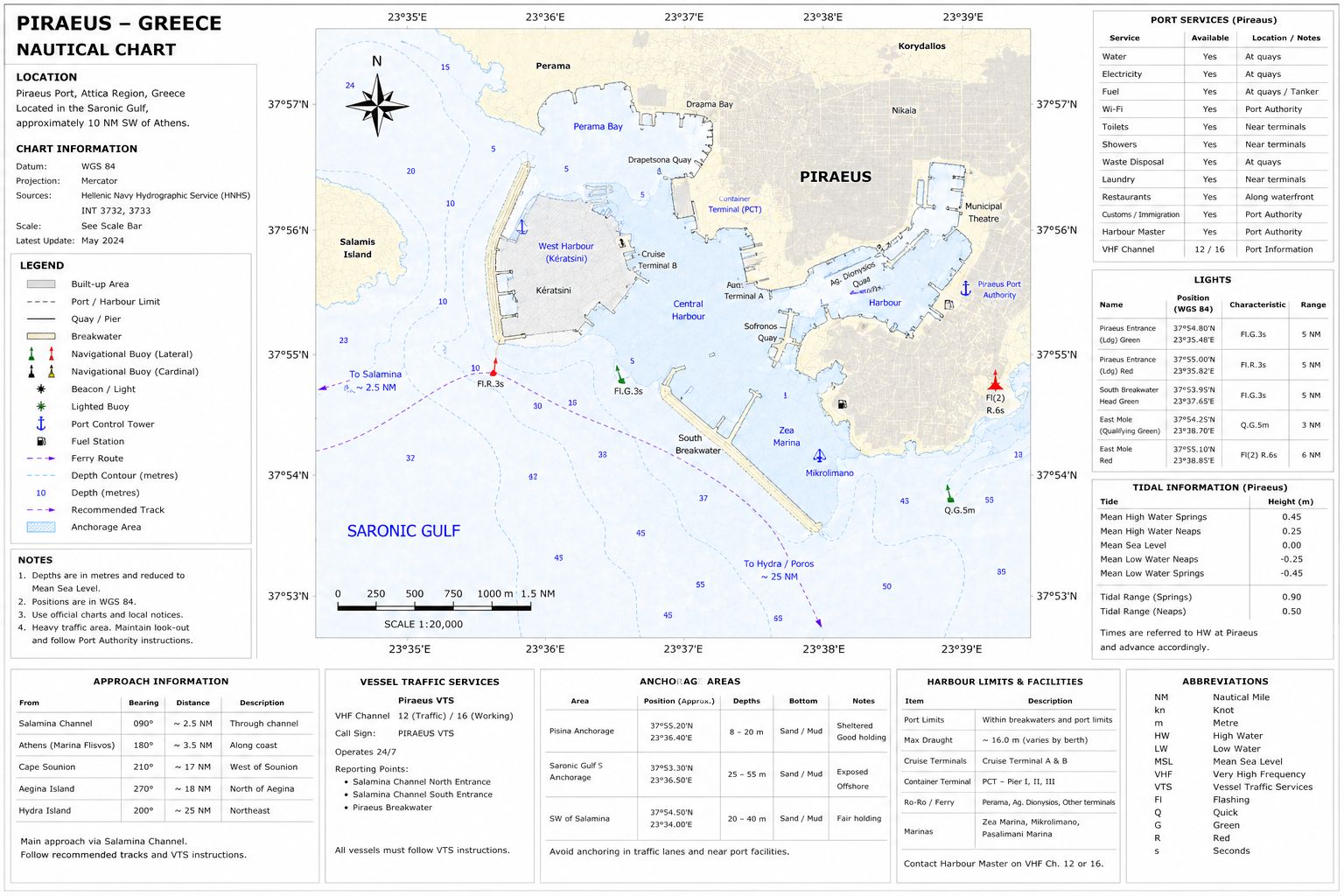
Piraeus Greece Sailing Guide. Piraeus is the principal port of Athens and the primary commercial and passenger harbour of Greece, at approximately 37°56′N 23°38′E. and located on the Saronic Gulf approximately 8 nautical miles south-west of Athens. The port consists of multiple basins, ferry terminals, commercial docks, naval areas, and marina facilities, with high-density vessel traffic operating continuously. Yacht operations are conducted within designated marina areas and secondary harbour zones rather than the main commercial basins.
The harbour complex is enclosed by breakwaters and subdivided into distinct operational zones including the central passenger port, Zea Marina, Mikrolimano, and other basins. Depth is generally sufficient for commercial vessels in main channels, with reduced depths and constrained manoeuvring space in marina and quay areas. Navigation is controlled by traffic patterns, ferry schedules, and port authority regulation.
Piraeus Greece
Sailing Guide History
Piraeus developed as the maritime port of Athens in the 5th century BC under Themistocles, when the three natural harbours of Kantharos, Zea, and Munichia were fortified and connected to Athens by the Long Walls. The port functioned as the primary naval base of the Athenian fleet, with ship sheds, arsenals, and dockyards supporting trireme construction and operations.
During the Hellenistic and Roman periods, Piraeus continued as a commercial harbour, though its strategic importance reduced following damage during successive conflicts. Activity persisted through Byzantine and Ottoman periods at a reduced scale, with the port serving regional trade.
Modern redevelopment commenced in the 19th century after Greek independence, with expansion of harbour infrastructure for commercial shipping and passenger transport. Piraeus developed into the principal port of Greece and one of the largest passenger ports in Europe. Greece is the largest shipowning nation in the world by fleet capacity, and Piraeus is the principal port of registry for Greek-owned vessels, reflected in the widespread use of “Piraeus” as the home port designation on merchant ships.
Piraeus Greece
Sailing Guide - Ocean Currents
and Tides
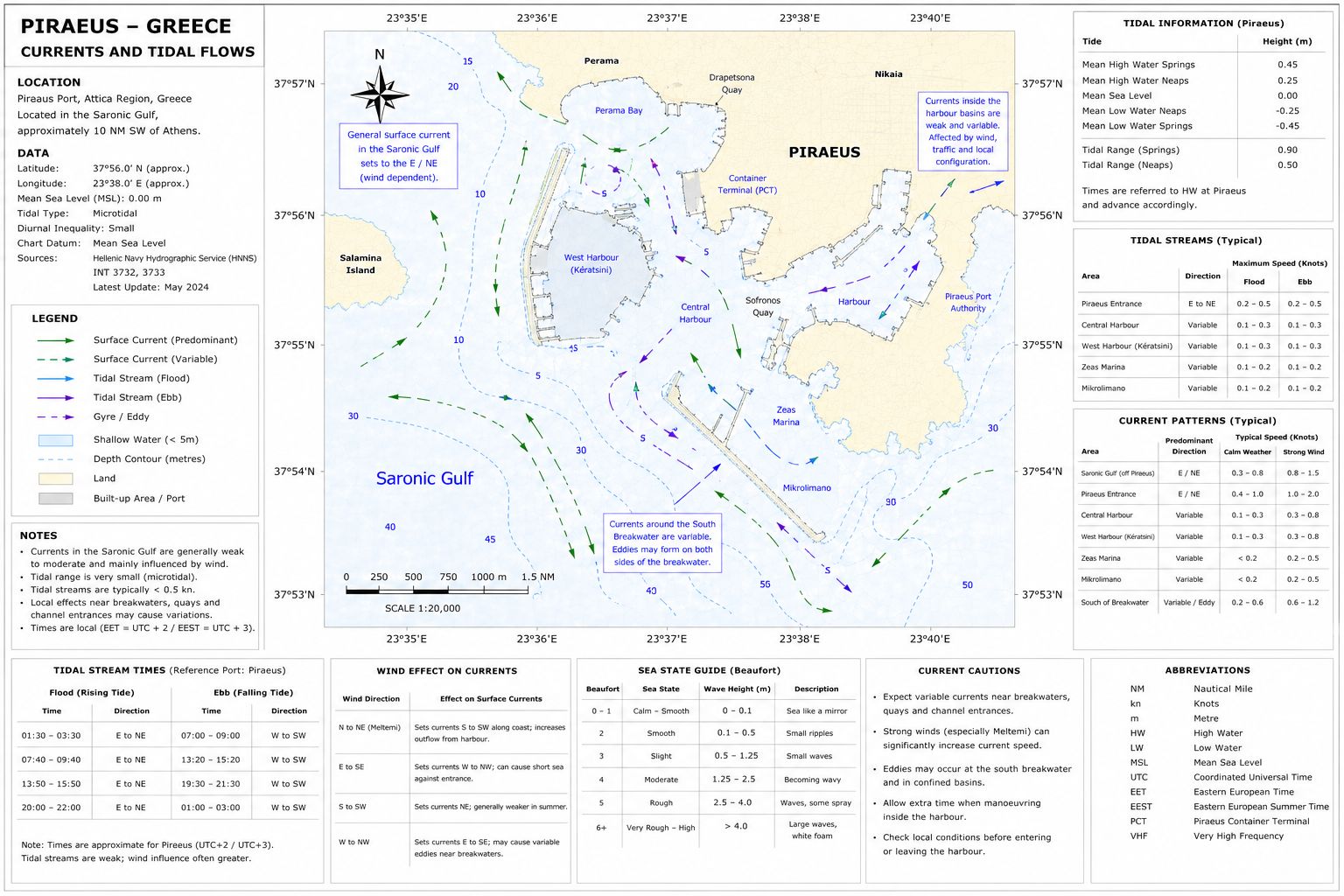
Tidal variation in the Saronic Gulf is negligible and does not affect navigation. Water movement within Piraeus is minimal and primarily wind-driven. Within harbour basins, current is typically below 0.5 knots and influenced by wind and vessel movement. Localised flow occurs near ferry manoeuvring areas due to prop wash and confined basin geometry. No consistent current direction exists within the port.
Piraeus Greece
Sailing Guide - Weather
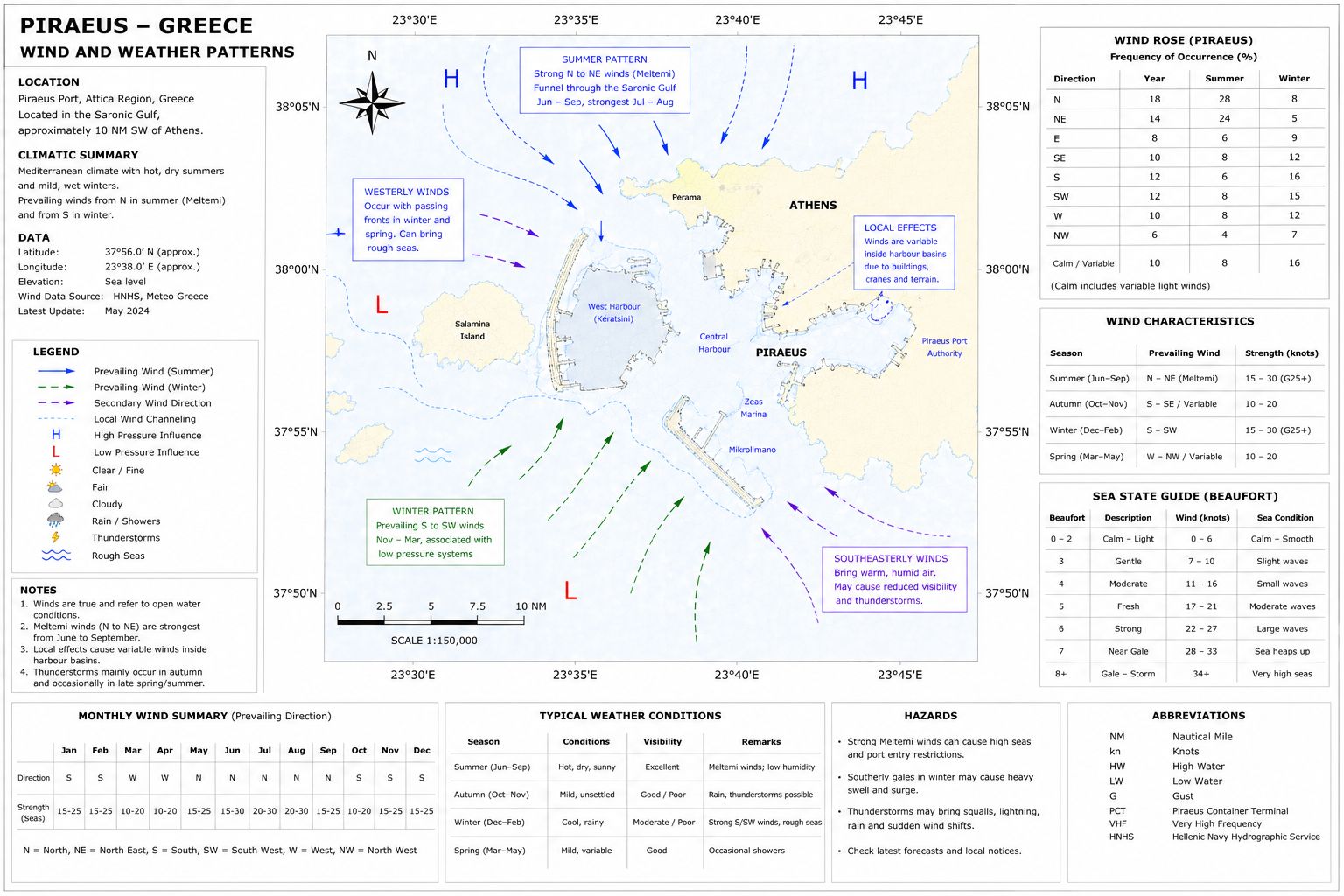
Weather in Piraeus follows a Mediterranean pattern with strong seasonal contrast between summer stability and winter frontal systems. Summer is dominated by persistent high pressure with clear visibility, no precipitation, and sustained dry conditions. Air temperature is elevated and urban heat accumulation over Athens and Piraeus produces haze, particularly under light wind conditions. Wind is the primary operational factor during summer, with northerly and north-easterly flow prevailing across the Saronic Gulf. These winds are reinforced by regional pressure gradients and interact with urban topography, producing variable and gusting conditions within harbour basins. Afternoon strengthening is typical, with reduced wind intensity overnight.
Winter conditions are controlled by passing low-pressure systems moving across the Aegean. These systems produce rainfall, reduced visibility, and variable wind direction with periods of strong southerly or south-westerly flow. Under southerly conditions, swell can enter outer harbour areas and create surge along exposed quay faces. Rapid changes in wind direction and intensity occur during frontal passage, requiring continuous monitoring. Transitional periods in spring and autumn involve alternating high-pressure and low-pressure influence, with variable wind direction, intermittent rainfall, and reduced predictability compared to summer conditions.
The Marine Electrical and Electronics Bible has a complete list of Greek VHF Radio Channel information and weather forecast times for Greece along with NAVTEX UK and Europe and NAVTEX Mediterranean for 490kHz and 518kHz.
Piraeus Greece
Sailing Guide - Local Winds
Local wind in Piraeus is governed by Saronic Gulf patterns and urban topography. During summer, northerly to north-easterly flow develops, with afternoon strengthening and evening reduction. Wind is channelled between land masses and port structures, producing variable direction and gusting within harbour basins. Sea breeze circulation develops during the day with onshore flow from the south to south-west, interacting with prevailing northerly flow and creating shifting conditions inside the port. Gusts are amplified along quay lines and between buildings, with rapid changes in direction over short distances. Southerly winds affect the outer harbour more directly, producing surge and increased motion alongside. Within enclosed marina basins, wind remains variable with reduced fetch but continued gusting due to reflection from surrounding structures.
Piraeus Greece
Sailing Guide - Approaches
Approach to Piraeus is from the Saronic Gulf toward a wide, well-defined harbour entrance bounded by breakwaters and leading into multiple internal basins. Offshore depths exceed 20 m and reduce gradually toward the entrance without any bar or depth restriction. The primary constraint on approach is traffic density rather than hydrography.
The outer approach is shared with commercial shipping, high-speed ferries, cruise vessels, tankers, and naval traffic. Vessel movement is continuous, with ferries operating on fixed schedules and maintaining speed until close to turning basins. Crossing or overtaking traffic must be assessed early, with allowance for restricted manoeuvrability of larger vessels.
No significant tidal stream exists; however, wind-driven set may be present across the approach, particularly under sustained northerly or southerly conditions. Northerly wind can produce a slight southward drift, while southerly wind may generate surface set toward the harbour entrance. Sea state in the approach is generally low within the Saronic Gulf but increases under strong southerly systems, producing short-period waves at the entrance.
The entrance itself is wide with multiple traffic lanes leading to separate harbour sectors. Port structure becomes complex immediately inside, with divisions toward ferry basins, commercial docks, naval areas, and marina basins including Zea and Mikrolimano. Early identification of intended basin is required prior to entry, as internal course alterations are constrained by traffic and basin geometry.
Navigation hazards are traffic-related and include high-speed ferry movement, prop wash, restricted visibility from vessel superstructure, and frequent course alterations by commercial traffic. Additional hazards include service craft, pilot boats, and unlit small vessels operating close to harbour margins. Night approach is affected by extensive background lighting, reducing contrast of navigation marks.
Piraeus Greece
Sailing Guide - Navigation
Navigation within Piraeus is governed by high-density commercial traffic and strict separation between ferry basins, commercial docks, naval areas, and marina zones. Movement is continuous, with ferries operating on fixed schedules and maintaining priority within all main basins and turning areas. Yacht navigation is conducted outside designated ferry tracks and clear of manoeuvring zones.
After entry, the harbour divides into multiple basins with defined traffic flows. Course selection must be made early, as alteration options are limited once inside due to vessel density and constrained geometry. The main commercial basin is not used for yacht operations and must be avoided except for transit under control. Access to yacht areas is typically via secondary basins leading toward Zea Marina, Mikrolimano, or other smaller harbour zones.
Speed control is required due to confined space and wash from large vessels. Prop wash from ferries and commercial ships creates localised turbulence, particularly near turning basins and quay heads. Reflected wave from harbour walls produces short-period motion affecting low-speed manoeuvring.
Depth in main channels exceeds 10 m. In marina basins and quay berths, depth reduces to approximately 3 m to 6 m depending on location. Silting and debris may reduce effective depth near quay edges, requiring echo sounder verification on approach to berth.
Pilotage considerations are dominated by traffic awareness, basin identification, and timing relative to ferry movements. Entry into marina basins such as Zea Marina requires crossing or running parallel to ferry routes and must be timed to avoid conflict with arrivals and departures. Visual monitoring of ferry tracks and maintaining a clear escape route are required during transit.
Wind within the harbour is variable due to urban structures and basin layout, producing sudden gusts and directional shifts. Combined with prop wash and restricted space, this affects low-speed handling when turning or berthing.
Night navigation is affected by extensive shore lighting, which reduces contrast of navigation aids and vessel lights. Reliance on AIS, radar, and visual identification of vessel movement is required.
Piraeus Greece
Sailing Guide - Chart Accuracy
Hydrographic charts for Piraeus are maintained to commercial standards and accurately represent harbour layout and depths. Electronic charts correspond closely to published data. Local variation occurs near quay edges due to sediment and debris. Depth verification is required when approaching berths. Charts issued by the Hellenic Navy Hydrographic Service are accurate with frequent updates for harbour infrastructure. ENC data reflects current port layouts.
Piraeus Greece
Sailing Guide - Anchorages
Anchoring within Piraeus harbour is restricted and not permitted within the main commercial basins, ferry turning areas, or traffic channels. No anchorage is available inside the central port complex.
Anchorage options are located outside the main harbour limits in adjacent bays and marina approaches where permitted. Off Zea Marina, anchoring may be possible outside the entrance in depths typically between 5 m and 10 m over mud and sand, subject to traffic separation and local control. Holding is generally moderate to good in mud areas, with reduced reliability where seabed is mixed.
Additional anchorage is available off Mikrolimano Harbour in limited space, with depths generally between 4 m and 8 m over mud. This area is constrained by local vessel movement, moorings, and restricted swinging room.
Further anchorage options exist in the wider Saronic Gulf outside the immediate port area, where depths increase rapidly beyond 10 m. Seabed is typically mud or sand with generally reliable holding. These areas are exposed to wind and vessel wash and must be selected based on wind direction.
No anchorage location in the immediate Piraeus area provides protection from all wind directions. All anchoring requires allowance for commercial traffic, restricted zones, and local regulations.
Piraeus Greece
Sailing Guide - Entry
Formalities
Piraeus is an official port of entry. Clearance is conducted with Port Police, Customs, and Immigration. Documentation includes vessel registration, passports, crew list, and insurance. TEPAI cruising tax applies. AIS transmission is required where applicable. Drone use is restricted within port and urban areas. Satellite systems including Starlink are subject to national regulation.
Piraeus Greece
Sailing Guide - Marina
Facilities
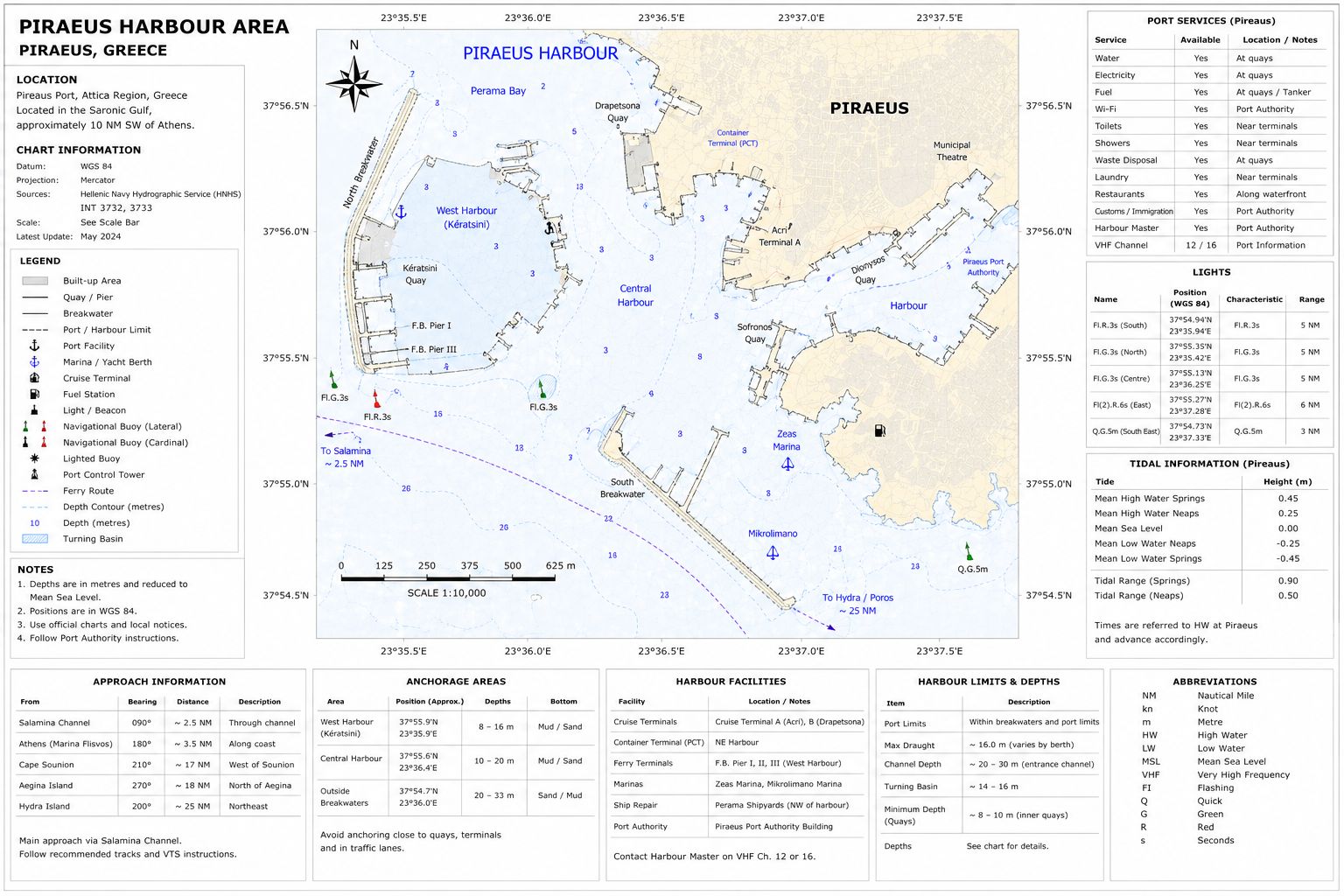
Berthing for yachts in Piraeus is conducted within dedicated marina basins separated from the main commercial port. Primary facilities are located at Zea Marina and Mikrolimano Harbour, both of which provide controlled-access berthing environments distinct from ferry and cargo operations.
Zea Marina is a fully developed marina basin with organised berth layout. Depth alongside is typically between 3 m and 6 m depending on berth position. Mooring is stern-to using laid lines. Basin entrance is wide but subject to cross-traffic from adjacent harbour movement. Manoeuvring space within the marina is constrained by berth density. Shore power and potable water are provided at berth pedestals. Security control, access gates, and marina management are in place. Fuel supply is available within the marina area or by arrangement.
Mikrolimano provides a smaller enclosed harbour with quay berthing. Depth alongside generally ranges from approximately 2.5 m to 4 m. Mooring is stern-to or alongside depending on berth allocation and local arrangements. Space is limited and manoeuvring is constrained by basin size and vessel density. Shore services are limited compared with Zea, with variable availability of water and power.
Additional berthing exists in secondary basins and yacht clubs within the Piraeus area, with similar stern-to mooring arrangements and depth ranges typically between 3 m and 5 m. These locations operate under local management and may have restricted access.
No yacht berthing is permitted within the main commercial ferry basins or cargo docks. All marina access requires navigation through high-traffic harbour zones and coordination with local traffic conditions.
Piraeus Greece
Sailing Guide - Provisioning
Supermarkets. Supermarket provisioning in Piraeus is available within the urban area around Zea Marina, Pasalimani, Mikrolimano, and the main port district. Sklavenitis operates a Piraeus store on Bouboulinas near Pasalimani, close to Zea Marina. AB Vassilopoulos operates stores in Piraeus and is suitable for harbour-area provisioning. Masoutis, Lidl, Kritikos, Market In, Bazaar, My Market, OK Anytime Markets, and smaller local grocery outlets also operate in the wider Piraeus area, with access depending on berth location and whether the vessel is lying at Zea, Mikrolimano, or another basin. Normal supermarket trading is generally Monday to Saturday, with Sunday opening limited to kiosks, convenience stores, and some small-format outlets.
Markets. Piraeus has local produce supply through the Piraeus central market area and street-level greengrocers around the port districts. Produce supply is mainland-based and includes vegetables, fruit, olives, olive oil, herbs, legumes, dairy, bread, and dry stores. The larger Athens Central Market is inland from Piraeus and is the broader regional wholesale and retail food market for meat, fish, fruit, and vegetables when transport is available.
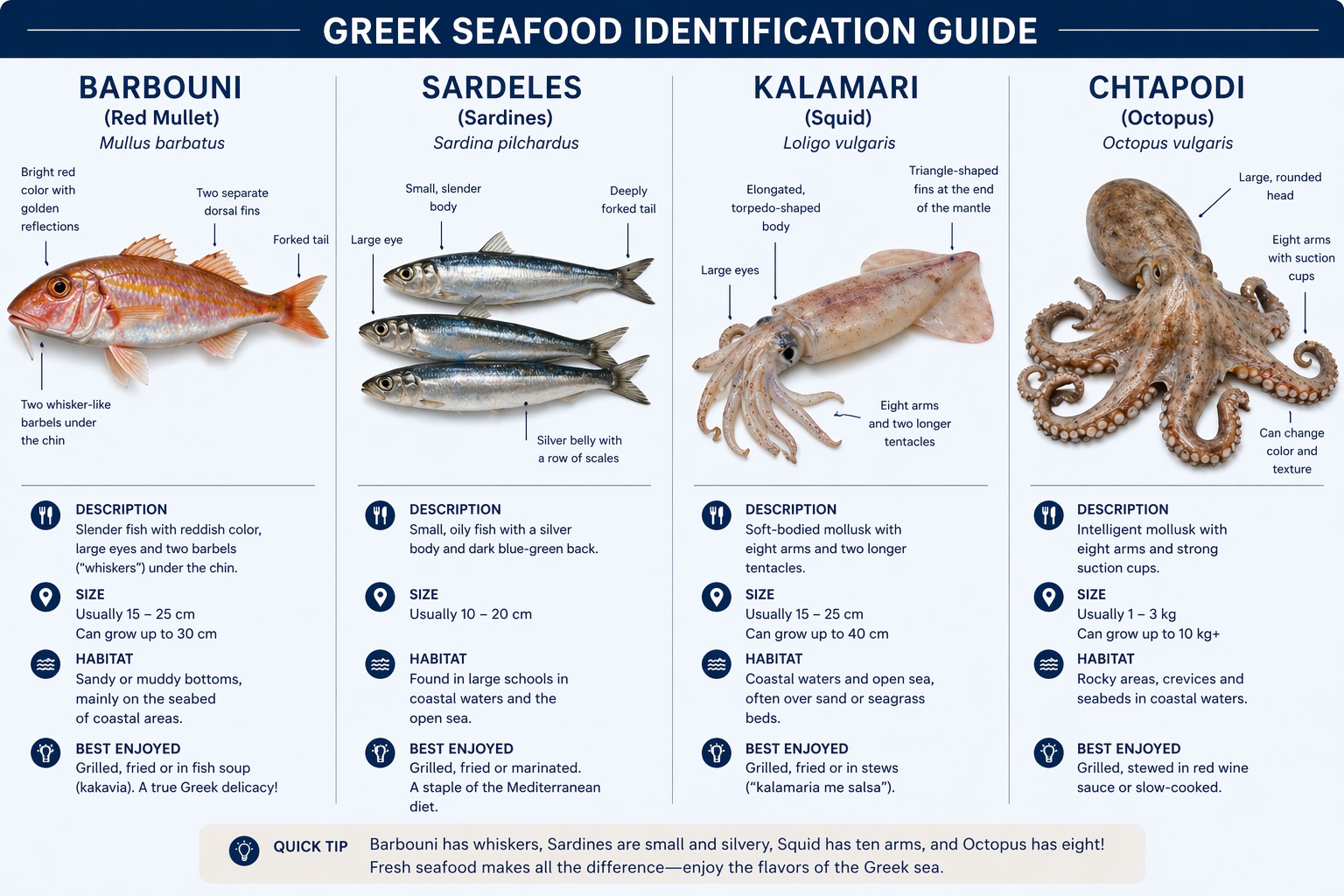
Fish Markets. Fish supply is available through Piraeus fishmongers, the Piraeus market area, and the Athens Central Market when road transport is used. Common supply includes tsipoura (gilthead bream), lavraki (sea bass), sardela (sardine), gavros (anchovy), barbouni (red mullet), kalamari (squid), and chtapodi (octopus). The Athens Central Market has a large dedicated fish section with daily supply from Greek waters and distribution channels into the wider Athens–Piraeus area.
Piraeus Greece
Sailing Guide - Local Cuisine
Local cuisine in Piraeus reflects an urban port environment with direct supply from the Saronic Gulf and mainland Greece. Core produce includes olive oil, olives, tomatoes, peppers, aubergines, legumes, and citrus, combined with continuous fish supply landed through regional distribution.
Signature seafood dishes include psari psito, whole grilled fish such as tsipoura (gilthead bream) and lavraki (sea bass); gavros tiganitos, fried anchovies; kalamari tiganito, fried squid; and chtapodi psito, grilled octopus. Kakavia is a fish soup prepared from mixed catch. Meze-style dishes include taramosalata, fish roe dip, and fava, yellow split pea purée.
Meat dishes include souvlaki, skewered grilled pork or chicken; gyros, sliced roasted meat served with bread; and paidakia, grilled lamb chops. Vegetable dishes include gemista, vegetables stuffed with rice and herbs, and briam, baked courgette, aubergine, potato, and tomato.
Piraeus Greece
Sailing Guide - Local Beverages
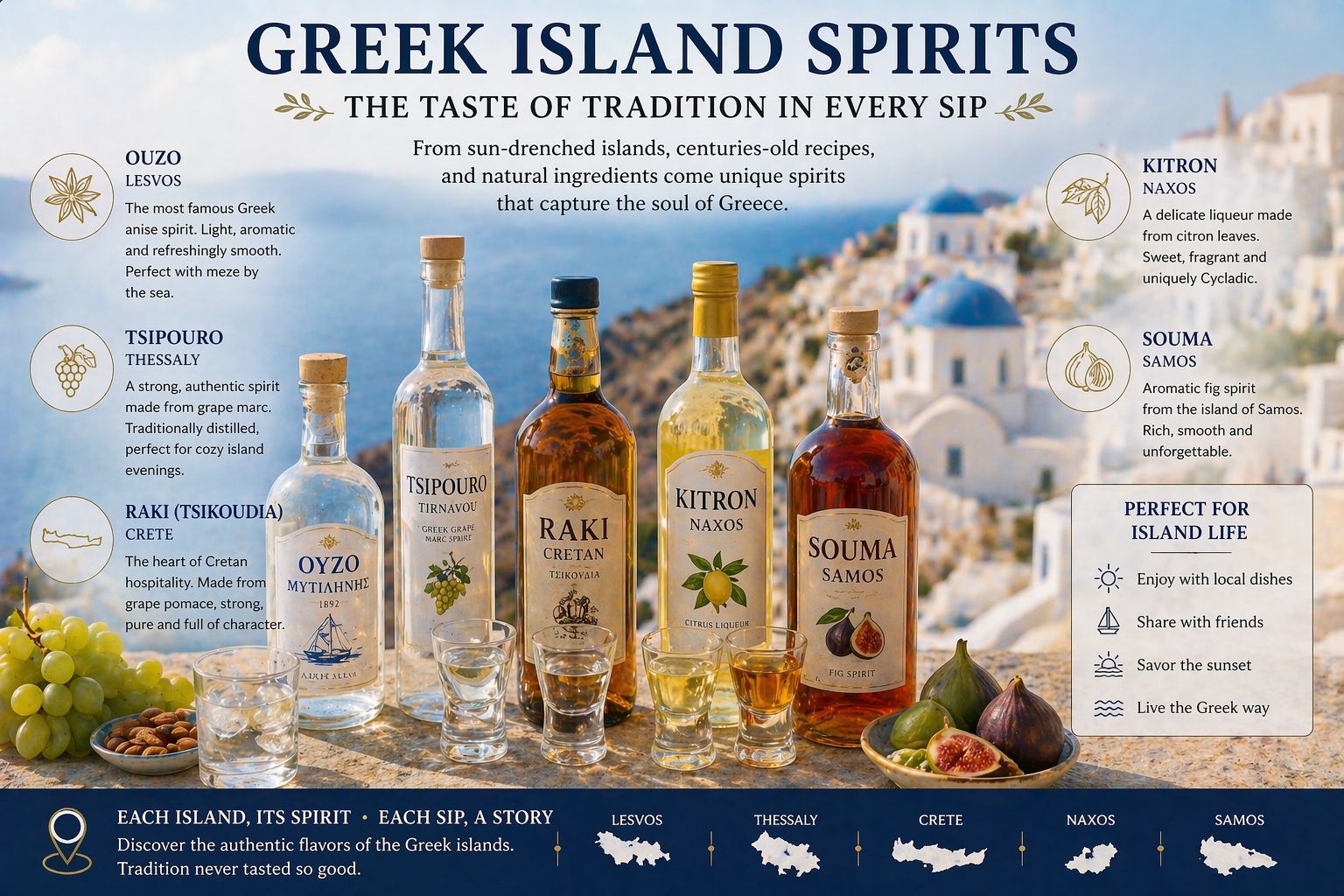
Beer, wine, and spirits across the Greek islands are locally produced and widely available through tavernas, small bars, and provisioning outlets. Beer is predominantly lager, with domestic brands including Mythos, Alfa, Fix, and Vergina alongside imported products; and over 100 microbreweries operate on several islands with limited distribution. Wine is region-specific, with white varieties dominant in the islands, including Assyrtiko, Moschofilero, and Roditis, alongside local table wines served in bulk; retsina remains in circulation as a resin-flavoured wine. Distilled products include ouzo (anise-based), tsipouro (grape marc distillate), raki or tsikoudia (Crete), souma (fig or grape distillate in eastern Aegean islands), and kitron (citrus liqueur from Naxos), with alcohol strength typically in the 37–45% range and higher for unregulated local distillations
Piraeus Greece
Sailing Guide - Diesel Fuel
Supplies
Diesel supply in Piraeus is available both alongside within marina facilities and from roadside fuel stations within the port area. At Zea Marina, fuel is supplied directly at a dedicated marina fuel berth with pump delivery to vessels. Additional fuel supply is available within the wider Piraeus harbour through bunker barges and road tanker delivery arranged through local agents, particularly for larger quantities.
Roadside fuel stations including Shell, EKO, BP, and Avin operate throughout the Piraeus port district and are used for jerry can transfer or arranged quay delivery. Transfer to vessels is conducted either directly alongside at marina fuel points, by tanker delivery to the quay, or by manual jerry can transfer depending on berth location.
High-flow marine pumps are available within marina facilities, while quay and external berths rely on arranged delivery. Fuel quality is standard marine-grade or automotive diesel depending on supply method, with onboard filtration required.
Piraeus Greece
Sailing Guide - Water Supplies
Potable water in Piraeus is supplied from the municipal network and is available within marina facilities and at selected quay connection points. At Zea Marina, water is distributed through fixed berth pedestals with continuous supply and metered or controlled access depending on berth allocation.
Outside marina environments, water access is available at quay points where connections exist, but supply is not continuous along all harbour sections and depends on berth position and local arrangement. Pressure is generally consistent within marina systems and variable at open quay locations, with reduction possible during peak demand periods.
Connections are standard marina fittings within managed facilities, while quay supply may require vessel-provided hose and adapters. Water is treated municipal supply suitable for tank filling, with onboard filtration used as required.
Mechanical and Electrical Repairs
Resource
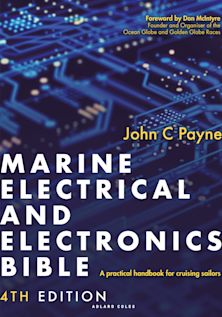
If you are headed somewhere remote consider the need to expand your knowledge base or have an information resource on board. Why not get a copy of my book The Marine and Electrical and Electronics Bible 4th Edition. By and for yachties, with everything from batteries and charging, solar and wind, diesel engines and marine electronics and so much more. Your complete systems guide. 650 pages of practical advice. In Australia and New Zealand order a copy through Boat Books. UK and European boats can buy the UK Edition Here. US and Canadian boats can get the US Edition Order Here. Marine systems are my profession so let me help you. By a liveaboard boat owner for other boat owners.


Piraeus Greece
Sailing Guide - Marine Services
Marine services in Piraeus are concentrated within the port and adjacent industrial zones and provide full support capability for yachts. Work includes diesel engine service, electrical systems, marine electronics, plumbing, refrigeration, and general mechanical repair carried out by established workshops and service agents. Authorised support for Yanmar and Volvo Penta is available locally. Marine electronics service is available for Raymarine, B&G, and Simrad systems including installation, calibration, and fault diagnosis. Haul-out, antifouling, hull repair, and structural work are available at yards within the greater Piraeus and Athens area, with travel lift and hardstand facilities.
Piraeus Greece
Sailing Guide - Local Etiquette
In Piraeus, interaction is direct and begins with a greeting before transactions. Dress ashore is standard urban wear. Meal times are later with evening dining after 20:00. Cash and card are both widely accepted. Conversational tone is direct.
Piraeus Greece
Sailing Guide - Summary
Piraeus is a large commercial harbour with dedicated marina facilities for yacht operations. The port provides full provisioning, fuel, water, and marine service capability within an urban environment. Navigation is defined by high traffic density and controlled vessel movement. The location functions as a primary operational base consistent with a Piraeus Greece Sailing Guide, which has all you need to know.