Phuket Sailing
Guide for Yachts
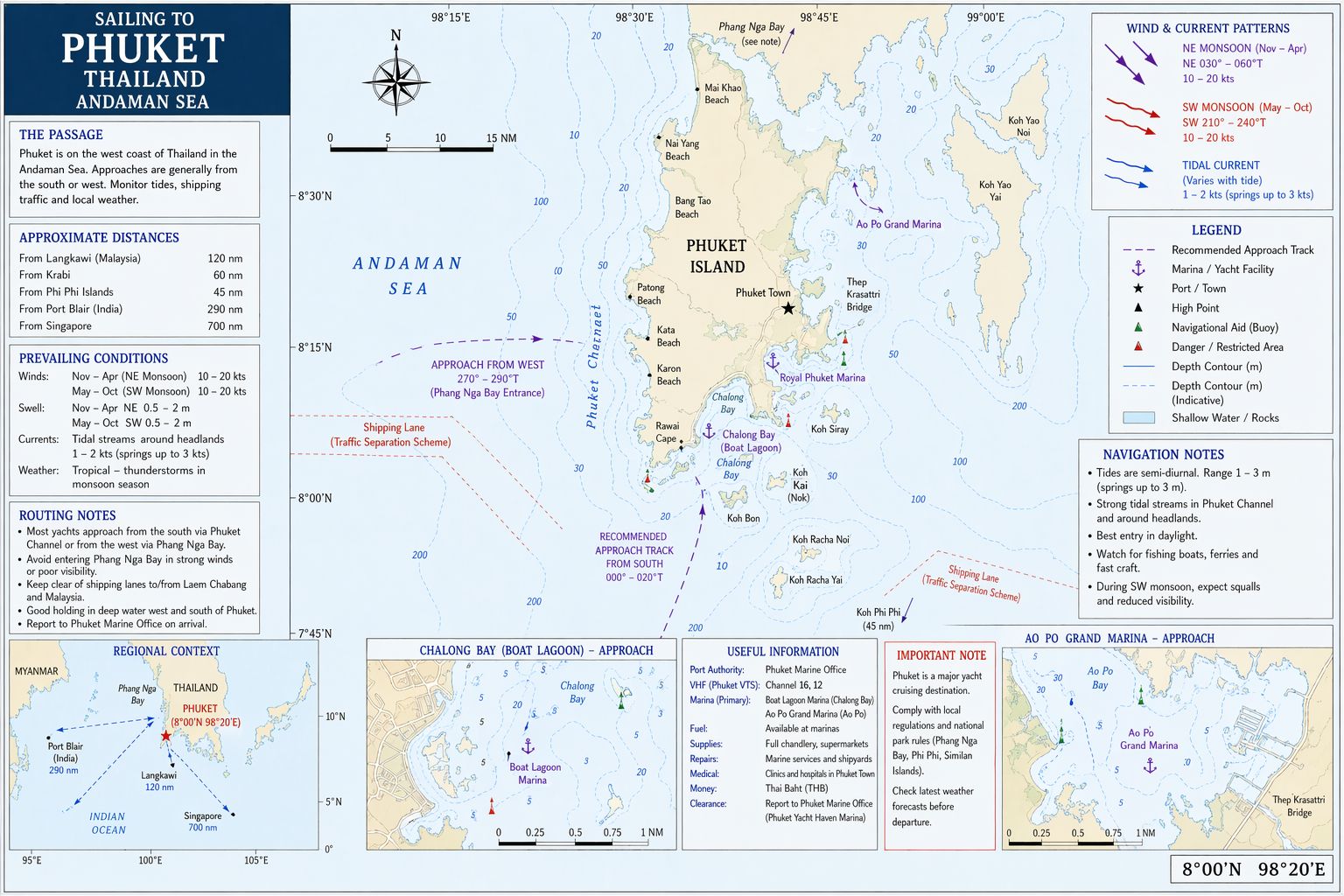
Phuket Sailing Guide for Yachts. Phuket is the primary yachting centre on Thailand’s Andaman Coast and the main service hub for vessels operating between the Similan Islands, Phang Nga Bay, Krabi, Langkawi, and the Mergui region. The island provides full‑service marinas, haul‑out facilities, provisioning, fuel, water, and marine engineering support. Approaches are straightforward in settled weather, with depths reducing from 25–40 m offshore to 8–15 m near the coast, and navigation shaped by reefs, headlands, tidal streams, and dense traffic.
The island’s infrastructure supports long‑range cruising, with reliable supermarkets, fresh markets, marine suppliers, and specialist contractors. Marinas on the east coast provide protected berthing in all seasons, while west‑coast anchorages are seasonal and exposed during the southwest monsoon. Phuket functions as the operational base for most yachts in the region due to its facilities, repair capacity, and predictable logistics. Nearby islands are Ko Racha, Ko Yao Yai, Ko Phi Phi, Similan Islands.
Phuket Sailing
Guide for Yachts - Approaches
Phuket’s offshore depths range from 25–40 m, reducing to 12–18 m on approach and 8–15 m inside the coastal shelf. The east coast is protected from swell and has fewer hazards, though shallow mudflats and drying banks extend into 2–4 m near marinas and river mouths. The west coast is open to swell, with reefs and shoals rising into 3–6 m close to headlands. Tidal streams in the north and east of the island run 1–2 knots, increasing near constricted channels. Traffic density is high, with ferries, tour boats, and fishing vessels operating throughout the day. Approaches to Ao Chalong require attention to mooring fields extending into 6–10 m and to shallow patches near the central anchorage.
Phuket Sailing
Guide for Yachts - Anchorage
Ao Chalong is the primary anchorage, with 6–12 m over mud and sand and good holding. The area is busy, with moorings and vessel movements throughout the day. The east coast offers additional anchorages in 6–10 m with mud bottoms, though depths reduce rapidly toward mangrove areas. West‑coast anchorages such as Kata and Nai Harn are usable only in the northeast monsoon, with 8–15 m over sand and exposure to swell outside the season. Yachts must avoid ferry lanes and marked exclusion zones.
Phuket Sailing
Guide for Yachts - Entry Formalities
Phuket is an official port of entry. Yachts clear Customs, Immigration, and Quarantine at Ao Chalong. Documents are processed at the one‑stop centre adjacent to the pier. Harbour inspections occur as required. Domestic movements within Thailand require no further clearance once entry is completed. Starlink and other satellite systems are permitted but must not interfere with local frequencies. Reporting requirements apply when moving to or from foreign ports. All marinas offer secure berthing, on‑site contractors, and access to provisioning and transport.
Phuket Sailing
Guide for Yachts - Marina Facilities
Phuket has four full‑service marinas on the east coast, all accessible in all seasons. Phuket International Airport (HKT) allows direct flights from Asia, Europe, and the Middle East.
- Ao Po Grand Marina has deepwater access with 5–7 m at the entrance and 4–6 m in berths. It provides fuel, water, power, haul‑out, hard‑stand, engineering, chandlery, and large‑vessel berthing.
- Royal Phuket Marina has 2.5–4 m at the entrance depending on tide and 2–4 m in berths. It offers fuel, water, power, haul‑out, hard‑stand, and full engineering services.
- Boat Lagoon is accessed via a dredged channel with 1.8–2.5 m depending on tide. Inside depths are 2–3 m. It provides haul‑out, hard‑stand, engineering, electrical and chandlery services.
- Yacht Haven in the north has 5–7 m at the entrance and 4–6 m in berths. It accommodates deep‑draft vessels and provides fuel, water, power, and engineering support.
Phuket Sailing Guide for Yachts - Local Weather
The northeast monsoon (Nov–Apr) provides settled conditions with light winds and minimal swell, making west‑coast anchorages usable. The southwest monsoon (May–Oct) brings stronger winds, swell, and reduced visibility, limiting operations on the west coast. The east coast remains sheltered year‑round. Afternoon sea breezes are common, and squalls occur during transitional periods.
Phuket Sailing
Guide for Yachts - Provisioning
Supermarkets: Phuket has reliable supermarkets with consistent stock levels. Villa Market (Boat Lagoon and Chalong), Central Food Hall (Floresta), Tesco Lotus’s and Lotus’s Go Fresh in Phuket Town, Chalong, and Patong. Big C Supercenter for produce and staples., and Makro carry vegetables, herbs, fruit, dairy, dry goods, bakery items, and imported products. Makro provides bulk quantities suitable for long‑range provisioning Villa Market and Central Food Hall maintain the widest range of Western goods. Tops Market (Central Festival) for premium and imported groceries. 7-Eleven and FamilyMart convenience stores for quick basics.
Markets: Banzaan Market (Patong), Phuket Town Fresh Market (Talad Kaset) and Rawai Market operate daily with high turnover. They supply local greens, herbs, tropical fruit, tofu, noodles, curry pastes, and prepared ingredients. Morning trading offers the best selection. Produce arrives from southern Thailand and local farms. Chalong Market for provisioning near the marina.
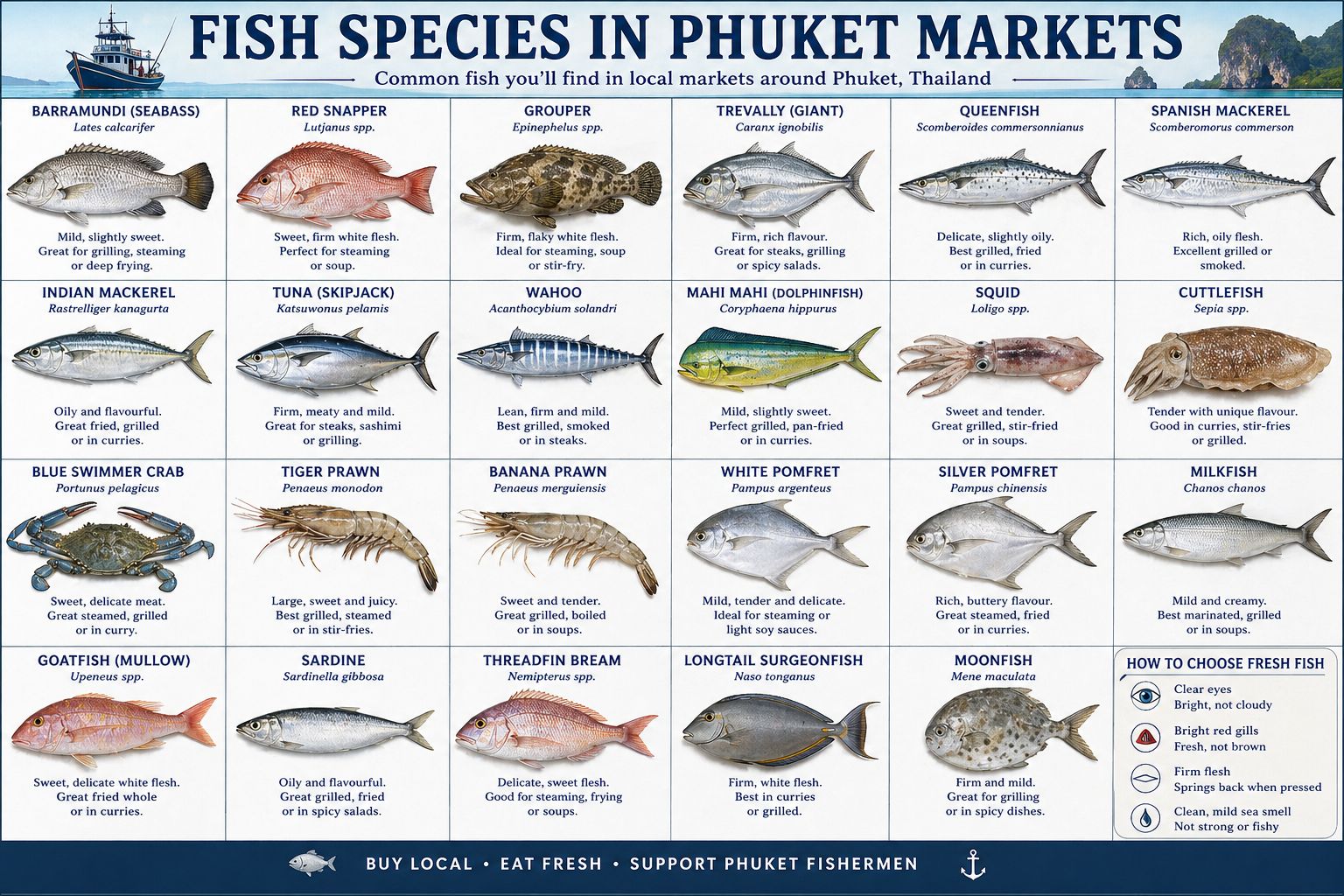
Fish Markets: Seafood reflects Andaman landings. Rawai Seafood Market, Phuket Town Fish Market, and Chalong Pier seafood stalls carry prawns, squid, reef fish, pelagic species, and shellfish. Supply is strongest in the morning, with rapid turnover due to local demand. Availability varies with weather and fishing conditions.
Phuket Sailing
Guide for Yachts - Local Cuisine
Cuisine is important and Phuket is a UNESCO Creative City of Gastronomy. Phuket’s cuisine reflects southern Thai flavours and Andaman seafood. Common dishes include pla neung manao (whole sea bass steamed with lime, garlic, and chilli), pla tod nam pla (fried fish with fish‑sauce glaze), yum talay (mixed‑seafood salad), and tom yum goong (hot‑and‑sour prawn soup). Markets prepare hoi tod, a crisp mussel or oyster omelette tied to local shellfish landings. Southern curries appear everywhere, including gaeng som (sour turmeric fish curry), gaeng khua (coconut curry with prawns or fish), and massaman (slow‑cooked coconut curry with beef or chicken). Phuket‑specific dishes include mee Hokkien noodles (stir‑fried yellow noodles with prawns and squid), moo hong (braised pork belly with soy and pepper), lo ba (fried pork offal and tofu), and oh tao (oyster, taro, and egg stir‑fry). Street stalls serve pad krapao (basil stir‑fry), khao pad (fried rice), khao man gai (poached chicken with broth‑cooked rice), and kuay teow noodle soups.
Phuket Sailing Guide for Yachts - Beverages
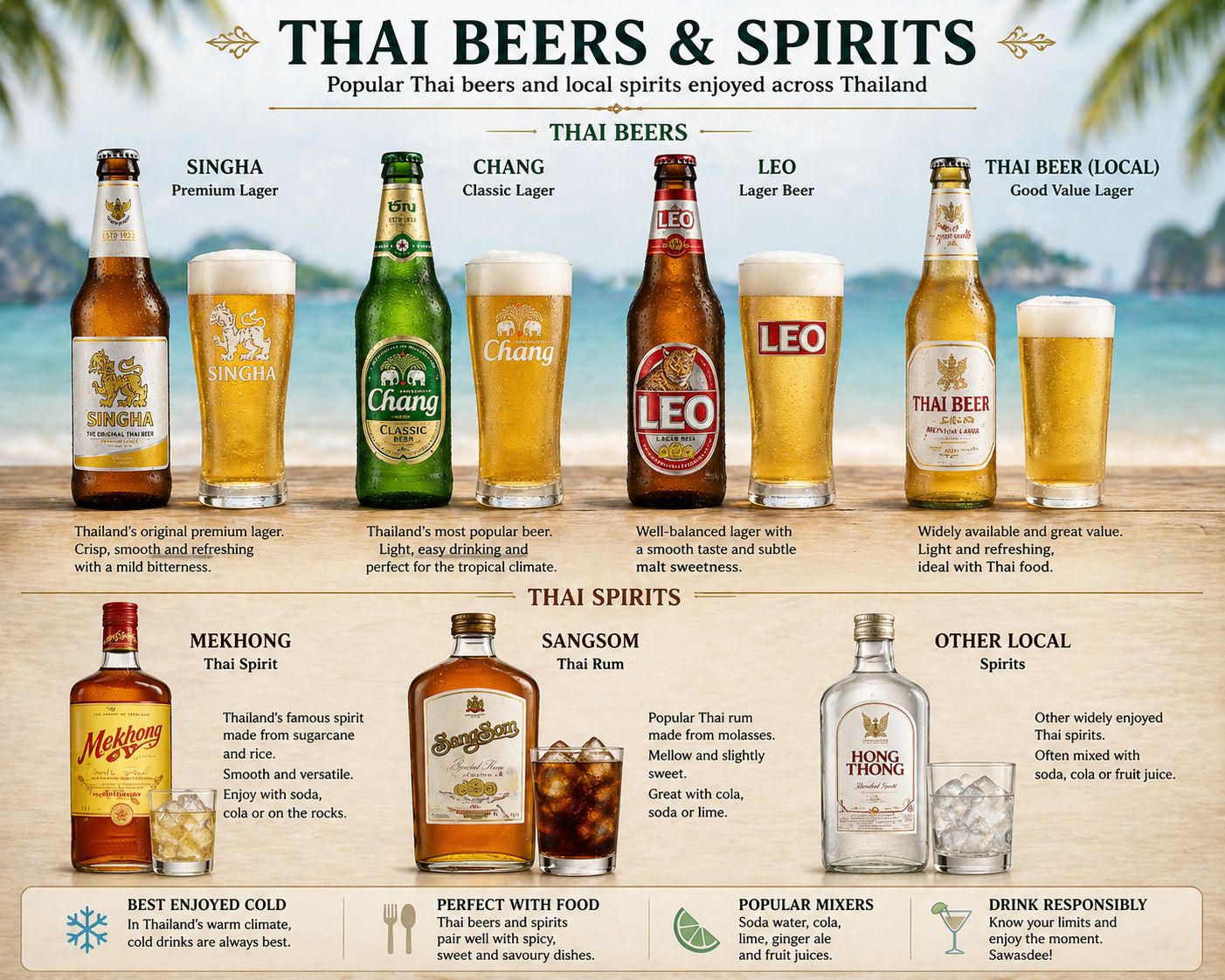
Beverages in Thailand are simple, widely available, and suited to the tropical climate, with a strong emphasis on cold beer and locally produced spirits. The dominant beers are light lagers such as Singha, Chang, and Leo, typically served well chilled and commonly consumed with food. Local spirits are led by Mekhong (a sugarcane- and rice-based spirit often referred to as Thai whisky) and SangSom (a widely consumed molasses-based rum), both usually mixed with soda, cola, or lime. In addition, fresh fruit shakes, coconut water, and iced teas are widely available and form an important part of daily refreshment, particularly in coastal areas such as Phuket where heat and humidity are consistently high.
The Thai word for “cheers” is chon gâew. Literally meaning “clink glasses” and is used when making a toast, similar to saying cheers in English. “chon gao” chon is like “chawn” (soft “ch”, short “o”) and gao is like “gow” (rhymes with “cow”). Said together: “chawn-gow”. In natural speech it’s quick and slightly rising in tone, but this will be well understood when making a toast in Thailand.
Phuket Sailing
Guide for Yachts - Fuel Supplies
All major marinas supply diesel at the dock with reliable turnover. Ao Po Grand Marina, Royal Phuket Marina, Boat Lagoon, and Yacht Haven provide fuel via pumps or fuel trucks. Outside marinas, fuel is obtained by jerry can from roadside stations. Quality is generally consistent, though checks for water or sediment are recommended when purchasing from smaller outlets.
Phuket Sailing
Guide for Yachts - Water Supplies
All marinas supply potable water at the dock. Water delivery is available through marina offices and local vendors. Quality is generally reliable, though onboard filtration is standard practice. Outside marinas, water is obtained by jerry can from municipal taps or roadside stations.
Mechanical and Electrical Repairs
Resource
If you are headed somewhere remote consider the need to expand your knowledge base or have an information resource on board. Why not get a copy of my book The Marine and Electrical and Electronics Bible 4th Edition. By and for yachties, with everything from batteries and charging, solar and wind, diesel engines and marine electronics and so much more. Your complete systems guide. 650 pages of practical advice. In Australia and New Zealand order a copy through Boat Books. UK and European boats can buy the UK Edition Here. US and Canadian boats can get the US Edition Order Here. Marine systems are my profession so let me help you. By a liveaboard boat owner for other boat owners



Phuket Sailing
Guide for Yachts - Marine Services
Phuket is the main marine‑service hub for the region. Engineering, electrical, electronics, rigging, fibreglass, sailmaking, and haul‑out services are available at Ao Po Grand Marina, Royal Phuket Marina, Boat Lagoon, and Yacht Haven. Authorised agents for Volvo Penta, Yanmar, Cummins, and major electronics brands operate on the island. Chandlery, hardware, gas refills, and specialist contractors are widely available.
Phuket Sailing
Guide for Yachts - Local Customs
Pattaya follows national norms shaped by Buddhism and strong reverence for the monarchy. Respectful behaviour is required near temples and religious sites. Lèse‑majesté laws apply. Public confrontation is discouraged. Alcohol sale hours are regulated. Waste disposal rules apply near beaches, resort zones, and marine‑protected areas. Politeness and calm behaviour are valued. Remove shoes before entering homes or temples. Dress modestly in government offices and religious sites. Public displays of anger are discouraged. English is widely spoken in tourist areas but less common in markets. Interactions with officials are generally straightforward, and patience is appreciated.
Phuket Sailing
Guide for Yachts - Summary
Phuket is the primary operational base for yachts on the Andaman Coast, offering full‑service marinas, haul‑out facilities, provisioning, fuel, water, and marine engineering. Navigation requires attention to reefs, tidal streams, and traffic, but conditions are manageable with conservative planning. The island supports long‑range cruising and serves as the main staging point for movements to the Similans, Phang Nga Bay, Krabi, Langkawi, and the Mergui region. The Phuket Sailing Guide for Yachts has useful information.