Thailand Sailing Guide for Yachts
Thailand sailing guide for yachts. Thailand is a major Southeast Asian cruising region with established yacht infrastructure on the Andaman Coast and developing facilities in the Gulf of Thailand. The coastline supports predictable movement patterns shaped by the monsoons, with deep‑water approaches, sheltered anchorages, and reliable marina facilities forming the backbone of the Thailand sailing guide and Thailand cruising guide framework.
Most visiting yachts use Thailand as a seasonal base due to its repair capacity, provisioning depth, and access to regional transport links. The Andaman Coast supports the strongest concentration of Thailand yacht services, while the Gulf provides sheltered island cruising and growing marina capability. The country’s waters are well charted, operationally predictable, and suitable for both short‑term and long‑term cruising.
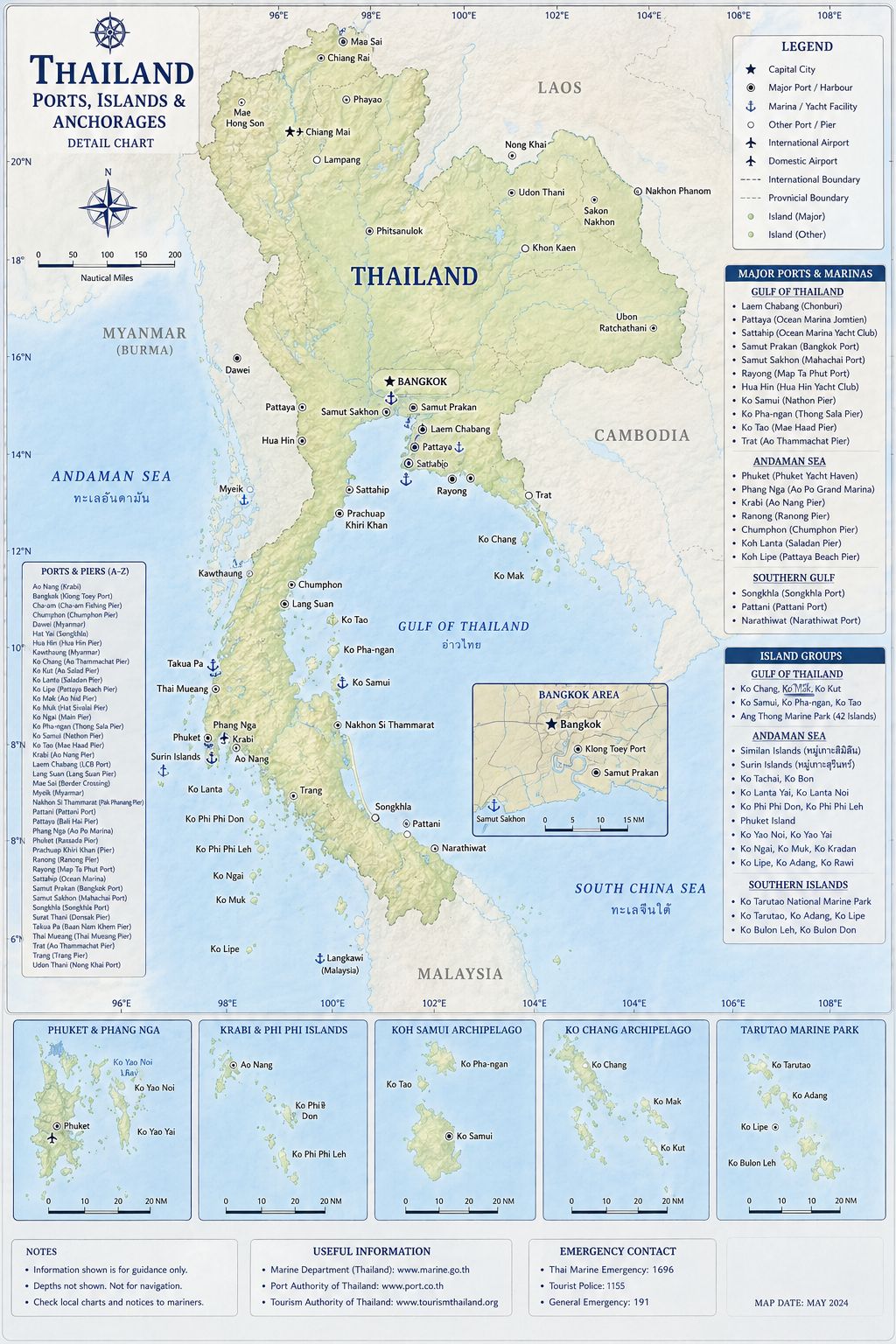
Thailand Sailing Guide for Yachts – Navigation
and Depths
Navigation along Thailand’s coasts is straightforward, with clear charting and consistent depths. The Andaman Coast carries deep water close to shore, with 20 to 40 metres common within a short distance of the coastline. Approaches to Phuket, Krabi, and Ao Chalong range from 5 to 15 metres depending on tide, with soft bottoms and reliable holding. The Gulf of Thailand is shallower, with broad areas between 5 and 12 metres and extended tidal flats near river mouths.
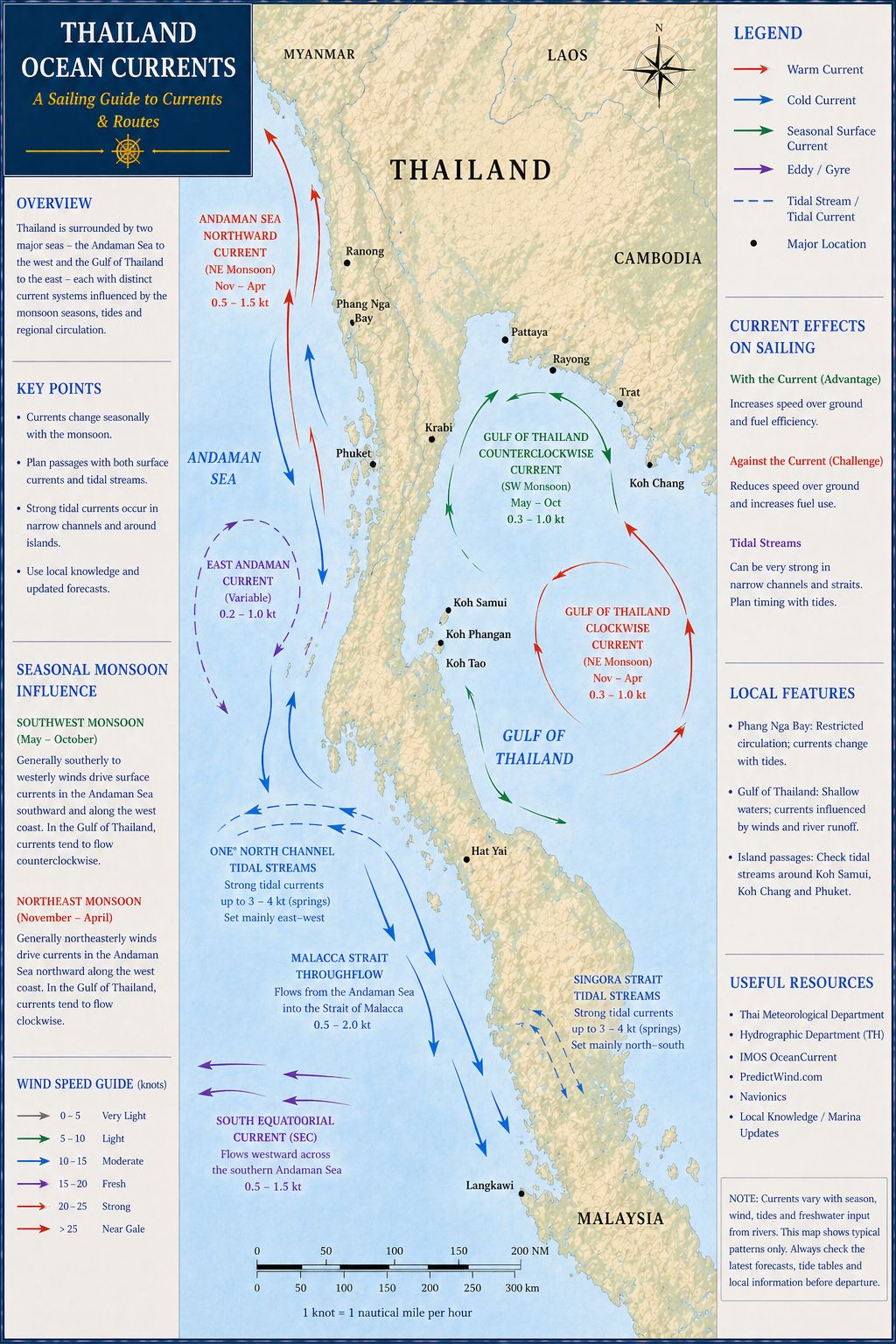
Thailand Sailing Guide for Yachts –
Tides and Currents
Tides follow a mixed semidiurnal pattern, with 1.5 to 3.0 metres typical on the Andaman Coast and 1.0 to 2.0 metres in the Gulf. Currents are generally weak, though the Andaman Coast experiences stronger set during the Southwest Monsoon, especially around headlands and island channels. The Gulf sees light currents except near river outflows and constricted passages. Seasonal visibility varies, with clearer conditions during the Northeast Monsoon and reduced visibility during the Southwest Monsoon.
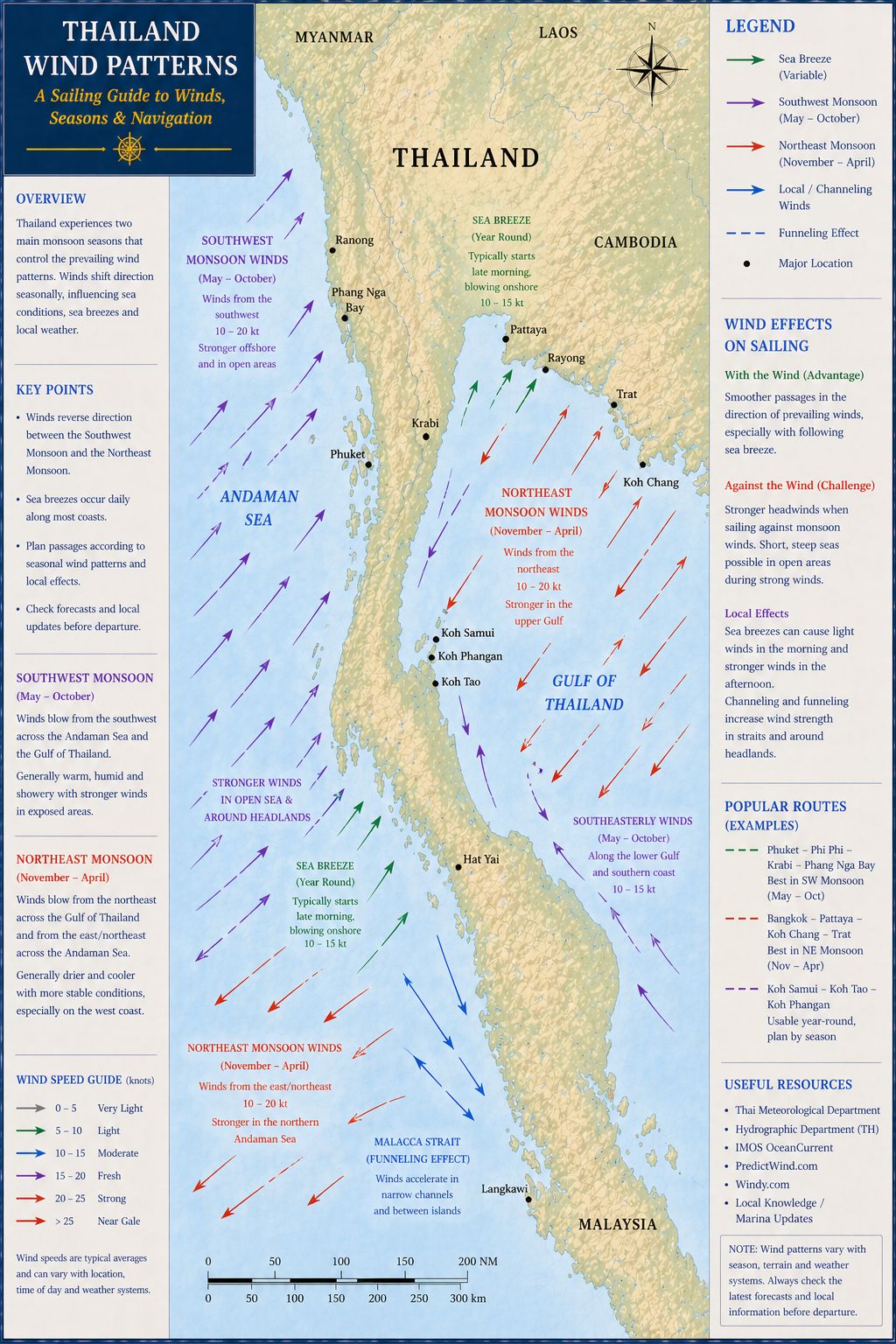
Thailand Sailing Guide for Yachts - Weather
Thailand’s weather is defined by the Northeast and Southwest Monsoons. The Northeast Monsoon (November to April) provides moderate winds and calm seas, forming the primary season for Andaman Coast sailing. The Southwest Monsoon (May to October) brings stronger winds, heavier rain, and a more active sea state, though sheltered anchorages remain usable. The Gulf of Thailand experiences similar patterns with shorter fetch and more variable wind strength. Thunderstorms occur year‑round and can produce strong gusts and reduced visibility.
Thailand Sailing Guide for Yachts - Entry
Formalities
Entry procedures are established at Phuket, Krabi, Koh Samui, Pattaya, and Bangkok. Yachts must clear with Immigration, Customs, and the Harbour Department, with documentation for crew, vessel registration, and equipment required. Most ports operate dedicated yacht‑clearance facilities, and processing is efficient when paperwork is complete. AIS must remain active, and movements between provinces may require reporting. These procedures form the basis of Thailand yacht entry requirements and remain consistent across the country.
Thailand Sailing Guide for Yachts -Andaman
Coast – Key Ports
- Phuket. This is Thailand’s primary yacht hub, with multiple marinas, haul‑out facilities, and direct access to the surrounding island groups.
- Ao Chalong. Functions as the main clearance port for the Andaman Coast, with deep water and a sheltered anchorage.
- Krabi: Provides marina access, haul‑out capability, and proximity to the Phang Nga and Lanta cruising grounds.
- Phang Nga Bay. Offers sheltered anchorages, deep water, and predictable holding throughout its island network.
- Koh Phi Phi. Provides deep‑water approaches and high‑turnover provisioning, though anchorages can be exposed in seasonal winds.
- Koh Lanta. Offers sheltered anchorages and access to the southern Andaman cruising grounds.
Thailand Sailing Guide -Andaman Coast
– Secondary Ports
- Ranong. Provides clearance capability and access to the Myanmar border region.
- Satun. Offers haul‑out facilities and access to the southern Andaman islands.
- Trang. Provides sheltered anchorages and provisioning through local markets.
- Koh Yao Yai. Offers sheltered anchorages and sits directly on the Phuket–Krabi transit route.
- Koh Yao Noi. Provides protected bays and reliable holding for short‑stay movements.
- Koh Rok. Offers seasonal anchorages suitable for fair‑weather stops.
- Tarutao. Provides remote anchorages and access to the southernmost Andaman cruising grounds.
Thailand Sailing Guide for Yachts - Gulf of Thailand – Key Ports
- Koh Samui. This serves as the main operational base in the Gulf, with marina access and reliable provisioning.
- Koh Phangan. Provides sheltered anchorages and access to the northern Gulf cruising grounds.
- Koh Tao. Offers deep‑water approaches and protected anchorages suitable for seasonal cruising.
- Pattaya. Supports marina berthing, haul‑out capability, and access to marine contractors along the eastern seaboard.
- Songkhla. A functional working port rather than a leisure destination, but its protected anchorage, strong provisioning.
- Bangkok. Functions as an administrative and logistical hub rather than a cruising destination.
Thailand Sailing Guide - Gulf of Thailand - Secondary Ports
- Chumphon. Serves as a staging point for movements between the Gulf and the Andaman Coast.
- Hua Hin. Offers marina berthing and access to local provisioning.
- Sattahip. Provides deep‑water access and limited yacht services along the eastern Gulf.
- Rayong. Offers sheltered anchorages and access to local markets and marine trades.
- Koh Chang. Provides seasonal anchorages and access to the eastern Gulf island group.
- Koh Mak. Offers sheltered bays and predictable holding during the Northeast Monsoon.
- Koh Kut. Provides quiet anchorages and access to the Cambodian border region.
Thailand Sailing Guide for Yachts - Provisioning
Supermarkets: Thailand has reliable supermarket coverage in major cruising centres. Phuket carries the strongest range, with Tesco Lotus, Big C, Villa Market, and Central Food Hall supplying fresh produce, dry goods, imported items, and yacht‑grade provisions. Krabi and Koh Samui offer similar options with consistent stock levels. Pattaya and Bangkok provide extensive supermarket networks with predictable availability of Western and Asian staples.
Markets: Fresh‑produce markets operate in all major towns and supply vegetables, herbs, spices, tofu, noodles, poultry, and regional ingredients with high turnover. Phuket Town Market and Banzaan Market in Patong provide consistent stock levels driven by local demand. Krabi Town Market offers reliable vegetables, greens, and seafood. Koh Samui’s Nathon Market supplies fresh produce and daily staples.
Thailand is a major rice producer, with large‑scale cultivation across the central plains and northeastern regions supplying domestic markets and export demand. The country also produces significant volumes of fruit, vegetables, herbs, spices, palm oil, rubber, and sugarcane, forming a stable supply chain that feeds directly into coastal markets used by visiting yachts. Tropical fruit production is extensive, with commercial output of mango, pineapple, banana, papaya, rambutan, mangosteen, longan, durian, and guava ensuring high‑turnover stock in markets on both the Andaman Coast and the Gulf of Thailand.
Fish Markets: Seafood supply is dependable along both coasts. Phuket’s fishing ports receive daily landings of coastal fish, prawns, squid, and crabs. Krabi’s riverside markets carry similar stock with high turnover. Koh Samui’s Nathon fish stalls provide smaller‑scale coastal seafood suitable for yacht provisioning. Pattaya and the eastern Gulf offer consistent seafood availability through local landing points and morning markets.
Thailand maintains a large commercial fisheries sector operating across both the Andaman Sea and the Gulf of Thailand, supplying coastal markets with high‑turnover seafood year‑round. Coastal fleets land fish, prawns, squid, crabs, and shellfish daily, with distribution moving quickly through municipal markets in Phuket, Krabi, Satun, Samui, and Pattaya. The scale of domestic production ensures consistent availability of fresh seafood for yacht provisioning without reliance on imports, and most coastal towns maintain predictable morning market cycles aligned with local landings.
Thailand Sailing Guide for Yachts - Local
Cuisine
Thailand’s cuisine varies across the Andaman Coast, the Gulf, and the central regions, with dishes built around local produce, coastal fisheries, and regional spice profiles. Southern provinces supply turmeric‑based curries and seafood dishes such as gaeng som, khao mok gai, kua kling, and turmeric‑grilled fish, which appear consistently in markets from Phuket to Satun. Central regions contribute national staples including pad thai, tom yum goong, green curry, massaman curry, and pad krapao, all widely available in coastal towns on both coasts. The Gulf region incorporates lighter broths and seafood dishes such as pla kapong neung manao (steamed fish with lime), yum talay (seafood salad), and squid‑based dishes tied to local landings. Markets and municipal food courts provide cooked meals with high turnover and predictable pricing, while fresh curry pastes, herbs, vegetables, noodles, and prepared ingredients support onboard cooking without reliance on imported products.
Street stalls in coastal towns specialise in a small number of fast‑turnover dishes prepared to order. Common options include pad krapao (stir‑fried basil with chicken or pork), pad thai, khao man gai (poached chicken and rice), kuay teow (noodle soup), khao pad (fried rice), and gai yang (grilled chicken). Seafood stalls often serve pla tod (fried fish), hoi tod (crispy mussel omelette), and squid stir‑fries tied to local landings. Stalls operate from late morning into the evening and provide predictable, low‑cost meals for crews provisioning or moving between marinas.
Thailand Sailing Guide for Yachts - Beverages
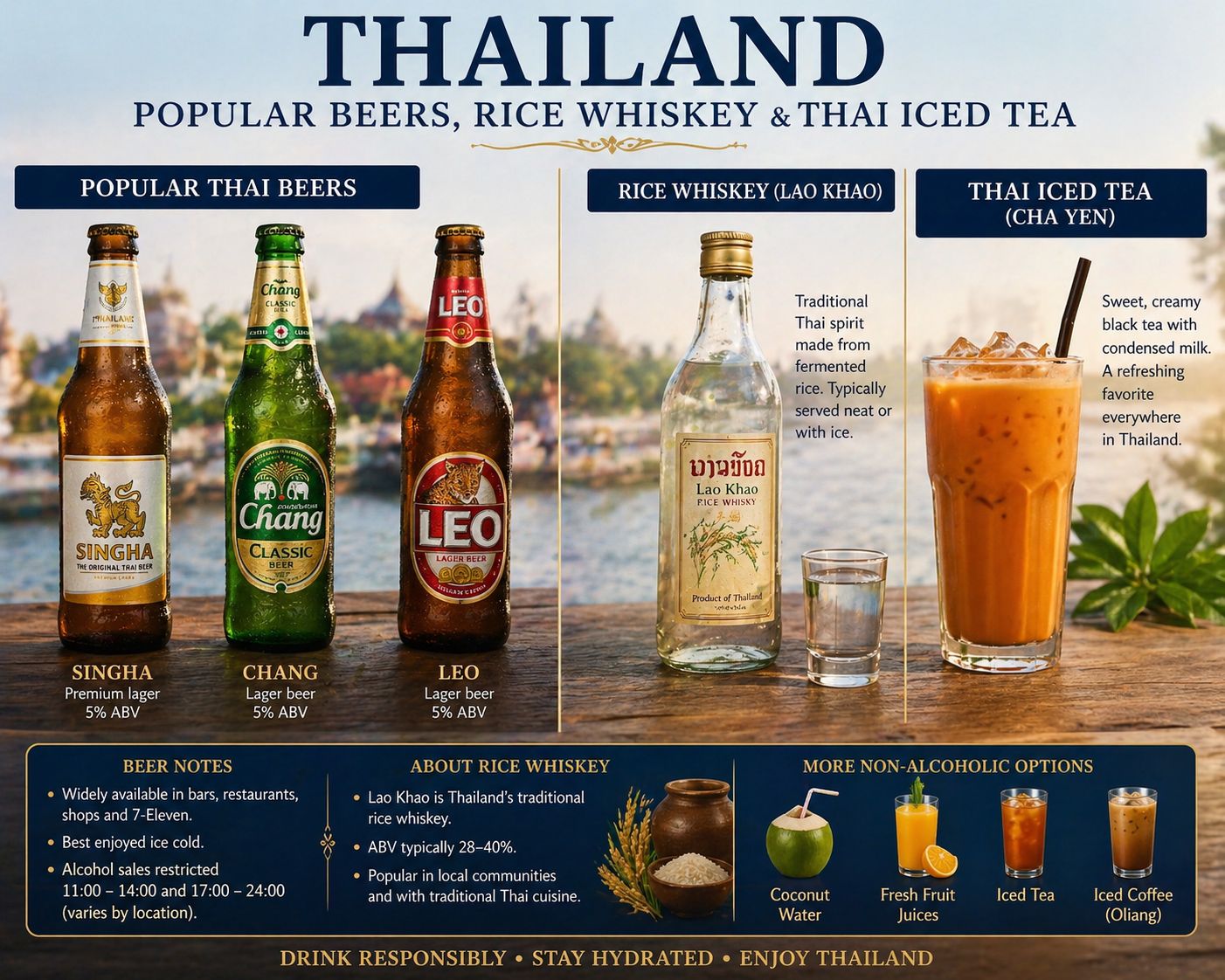
Beverages in Thailand range from locally brewed beers to a wide variety of refreshing non-alcoholic drinks suited to the tropical climate. Popular Thai beers include Singha, Chang, and Leo, typically light lagers served very cold, often over ice in casual settings. Regional and imported craft beers are increasingly available in tourist areas, though selection can be limited elsewhere. Traditional spirits such as rice whisky (lao khao) and sugarcane-based liquors are also common. On the non-alcoholic side, Thailand offers an abundance of options including fresh fruit juices, coconut water, iced teas, and sweetened drinks like Thai iced tea (cha yen) and iced coffee. Soft drinks are widely available, and in cruising areas, bottled water is essential. Street vendors and markets are excellent places to sample freshly prepared drinks, but hygiene and ice quality should always be considered.
Thailand Sailing Guide for Yachts - Fuel
Supplies
Diesel is available at all major marinas on the Andaman Coast and the Gulf of Thailand, with Phuket, Krabi, Pattaya, and Koh Samui providing the most reliable dockside refuelling. Marina fuel docks typically supply standard automotive‑grade diesel with predictable turnover, and most facilities maintain clear depth alongside for keelboats and multihulls. Outside marina fuel docks, yachts commonly refuel by jerry can from roadside stations, which are widespread and operate long hours. Delivery trucks are available in Phuket and Krabi for larger volumes, arranged through marina offices. Fuel quality is generally consistent, though yachts operating in smaller ports or fishing harbours should check for water or sediment before taking bulk quantities. Most crews refuel before offshore passages, as supply becomes limited in remote anchorages and island groups.
Thailand Sailing Guide for Yachts - Water
Supplies
Potable water is available at all major marinas on both the Andaman Coast and the Gulf of Thailand, with Phuket, Krabi, Pattaya, and Koh Samui providing the most reliable dockside supply. Marina water systems generally maintain stable pressure and consistent quality, though crews commonly use onboard filtration as standard practice. In Phuket and Krabi, bulk water delivery by truck can be arranged through marina offices for larger volumes. Outside the main centres, water is usually obtained by jerry can from municipal taps or roadside stations, with variable pressure and occasional sediment after heavy rain. Most yachts fill tanks before extended cruising, as supply becomes limited in remote islands and national‑park anchorages.
Thailand Sailing Guide for Yachts - Waste & Pump‑Out
Pump‑out facilities are limited in Thailand, with reliable services available only at major marinas in Phuket, Krabi, Pattaya, and Koh Samui. Most marinas accept sealed waste tanks by arrangement, but fixed pump‑out stations are not widespread, and visiting yachts should not rely on availability outside the main centres. Discharge is prohibited in marinas, harbours, and national‑park zones, and enforcement is strict in marine‑protected areas on both coasts. Solid waste disposal is available at all marinas, with predictable collection schedules and designated bins for general waste and recyclables. Yachts operating in remote islands should retain waste onboard until returning to a marina or town with formal disposal services. In marinas and anchorages, crews are expected to manage waste responsibly, avoid discharge in harbours or national‑park zones, and follow local instructions from harbour staff, marine‑park rangers, and port officials. These expectations apply consistently across both the Andaman Coast and the Gulf of Thailand.
Mechanical
and Electrical Repairs Resource
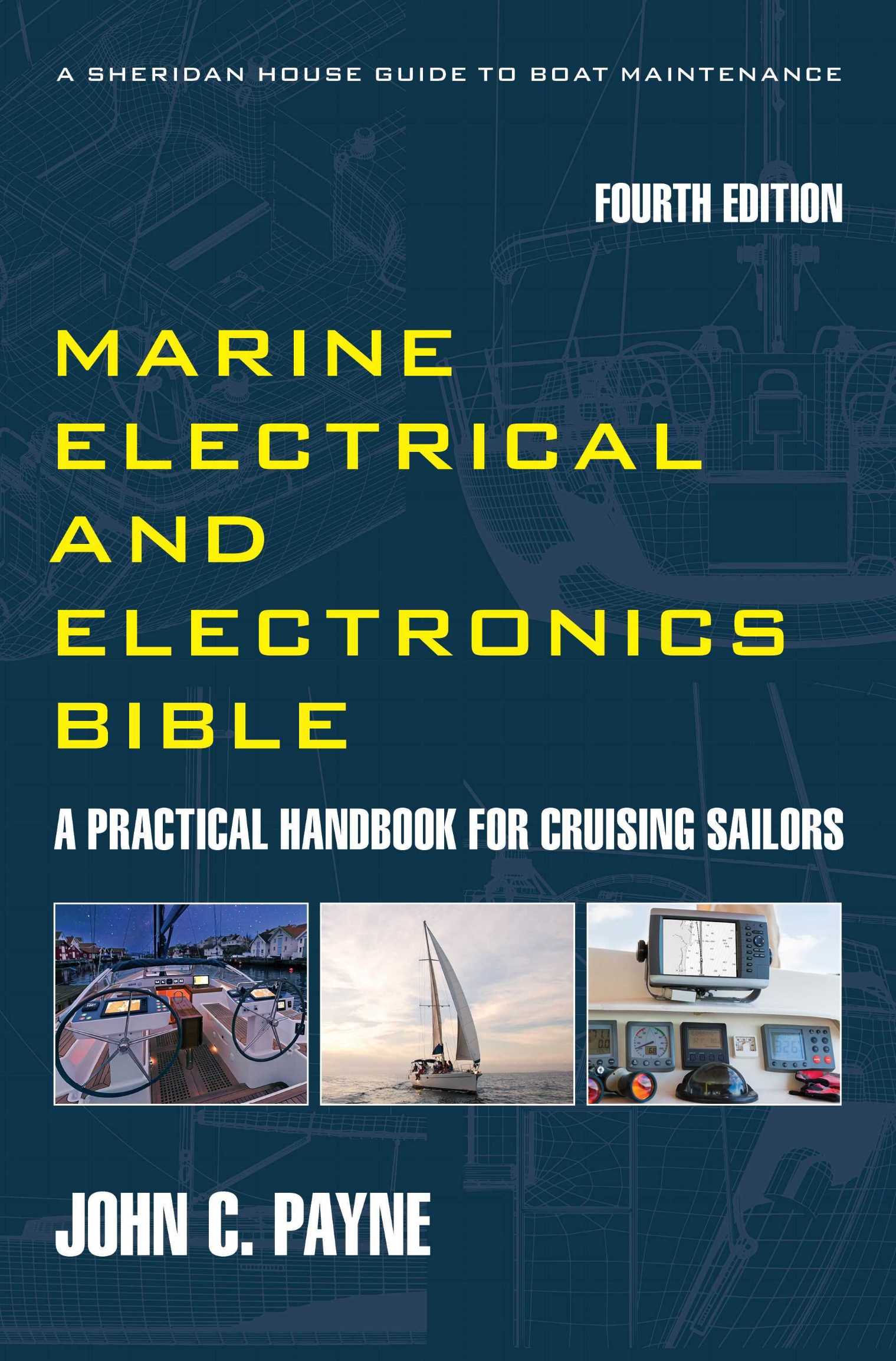
If you are headed to Thailand or perhaps somewhere remote then consider the need to expand your knowledge base or have an information DIY resource on board. Why not get a copy of my book The Marine and Electrical and Electronics Bible 4th Edition. By and for yachties, with everything from batteries and charging, solar and wind, diesel engines and marine electronics and so much more. Your complete systems guide. 650 pages of practical advice. In Australia and New Zealand order a copy through Boat Books. UK and European boats can buy the UK Edition Here. US and Canadian boats can get the US Edition Order Here. Marine systems are my profession so let me help you. By a liveaboard boat owner for other boat owners


Thailand Sailing Guide for Yachts - Marine
Services
Thailand offers comprehensive marine services, particularly on the Andaman Coast. Phuket supports mechanical, electrical, rigging, electronics, fabrication, and haul‑out services through established contractors. Chandlery supply is reliable, with stock levels maintained through regional distributors. Engine service agents for major brands operate in Phuket and Pattaya, providing diagnostics, servicing, and parts. Electronics support covers Raymarine, Garmin, Furuno, and Simrad systems, with technicians familiar with integrated navigation networks. Rigging services are available for both wire and synthetic systems, and stainless‑steel fabrication is widely supported through local workshops. Haul‑out capability is provided at Boat Lagoon, Ao Po Grand Marina, and selected facilities in Pattaya and the eastern Gulf.
Thailand Sailing Guide for Yachts - Local Customs
Thailand maintains clear behavioural expectations shaped by its Buddhist majority and strong reverence for the monarchy. Respectful conduct is required in all public settings, with particular care around temples, religious sites, and images of the Buddha; inappropriate dress, loud behaviour, or climbing on religious structures is not accepted. The monarchy is protected by strict lèse‑majesté laws, and any negative comments, gestures, or casual remarks about the King or royal family can result in legal action. Public displays of anger, raised voices, or confrontational behaviour are discouraged and can escalate situations unnecessarily. Alcohol consumption is regulated by fixed sale hours, and drinking in public spaces is restricted in some provinces.
Thailand Sailing Guide for Yachts - Summary
Thailand is a well‑established cruising region with reliable marina infrastructure, strong provisioning, and comprehensive marine services. With predictable seasonal weather and well‑charted waters, it provides a practical base for Thailand sailing, Andaman Coast cruising, and Gulf of Thailand yacht movements. Thailand Sailing Guide for Yachts for useful passage planning information. Thailand Sailing Guide for Yachts with all you need to know.