Paxos Greece
Sailing Guide
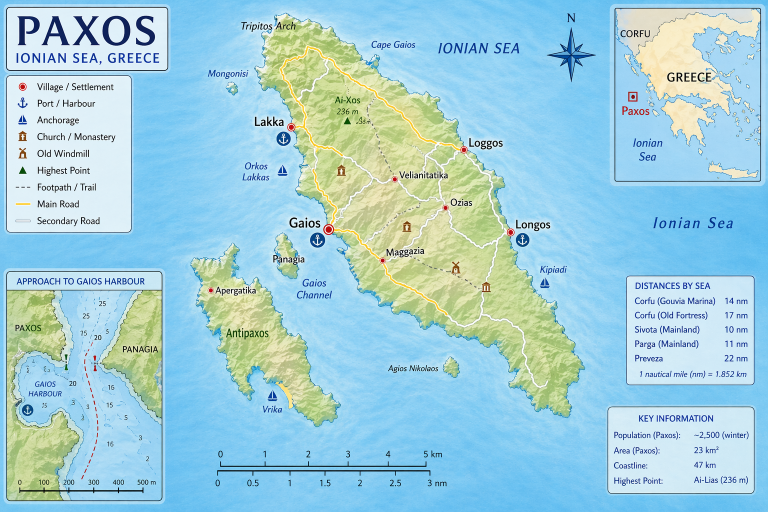
Paxos Greece Sailing Guide. Paxos is located in the Ionian Sea south of Corfu off the north-west coast of Greece at approximately 39°12′N 20°11′E. The island lies in relatively sheltered Ionian waters with the mainland to the east and open sea to the west. The principal ports are Gaios on the east coast and Lakka on the north coast.
The operating environment is semi-sheltered with minimal tidal range and generally moderate sea conditions compared to the open Aegean. Exposure varies significantly between the east coast, which is protected by mainland Greece, and the west coast, which is fully exposed to Ionian swell.
Paxos Greece
Sailing Guide – History
Paxos has a continuous maritime history linked to its position in the Ionian Sea within Greece, functioning as a small coastal settlement supporting regional trade and navigation routes. The island was successively controlled by ancient Greek states, Romans, Byzantines, Venetians, and later the British before union with Greece in 1864. Physical remains include Venetian-era structures, olive press sites, and harbour layouts at Gaios, reflecting its long-standing role as a small-scale agricultural and maritime community.
Paxos Greece
Sailing Guide - Approaches
Approach to Paxos is from open Ionian waters or via the channel between Paxos and the mainland. Depths offshore exceed 30–60 m, reducing to 5–15 m approaching harbours and bays. No constrained channels exist, but approaches to Gaios require attention to the narrow entrance. Gaios is approached via a channel between Paxos and the islet of Panagia, with depths generally 3–6 m in the entrance and marked navigation. The channel is narrow with limited manoeuvring space.
Sea state is generally moderate. Westerly winds generate swell affecting the west coast and wrapping into exposed bays. Easterly winds increase conditions along the east coast but are moderated by the mainland. Tidal range is typically 0.2–0.4 m with negligible tidal stream. Hazards include narrow harbour entrances, local traffic, and fishing activity near shore. Manoeuvring space is restricted within Gaios channel.
Paxos Greece
Sailing Guide - Navigation
Navigation to Paxos is conducted in Ionian conditions with generally moderate sea state compared to the Aegean, though exposure increases with northerly winds and longer fetch from the northwest. Approaches are clear with depths exceeding 50–100 m offshore, reducing to 10–20 m near the coast and 3–8 m in harbour areas. The primary entry is to Gaios Harbour via a narrow channel between Paxos and the islet of Panagia, requiring controlled speed, attention to traffic, and awareness of shallow edges outside the marked route. Lakka and Longos provide secondary harbours with depths of 3–6 m and good holding in sand, while the west coast is cliffed, deep, and unsuitable for anchoring. Fishing gear including nets and lines may be present near shore and is not always clearly marked.
Paxos Greece
Sailing Guide - Chart Accuracy
Charts issued by the Hellenic Navy Hydrographic Service are reliable for approaches and harbour areas. ENC data aligns with official charts. Uncharted moorings, laid lines, and dense anchoring fields are common in popular bays and may not be fully represented on charts.
Paxos Greece
Sailing Guide - Anchorages
Paxos provides multiple anchorages with generally good holding.
- Lakka Bay (north coast) provides depths of 4–10 m over sand with good holding and protection from most directions except northerlies.
- Gaios outer areas provide anchoring in 3–8 m over mud with good holding but limited space and traffic influence.
- Mongonissi Bay (south-east) provides depths of 3–6 m over mud with good holding and good shelter.
- West coast anchorages provide depths of 5–20 m but are exposed to swell and not suitable in westerly conditions.
Paxos Greece
Sailing Guide - Entry Formalities
Paxos operates under Greek national and Schengen procedures. Customs and immigration clearance is required for arrivals from outside Schengen areas. Vessel and crew documentation must be available for inspection. Harbour authority control applies where applicable. Drones are regulated under Greek aviation rules. Communications equipment must comply with national regulations. Waste discharge is controlled.
Paxos Greece
Sailing Guide - Marina Facilities
There is no large marina on Paxos. Berthing is primarily at town quays including Gaios and Lakka with depths generally 2–5 m. Stern-to mooring on laid lines is standard; handling of other vessels’ lines without permission is avoided. Quay space is limited and high seasonal demand affects availability. Facilities are basic with limited shore power and water availability. No major lift or repair yard exists on the island.
Paxos Greece
Sailing Guide - Local Weather
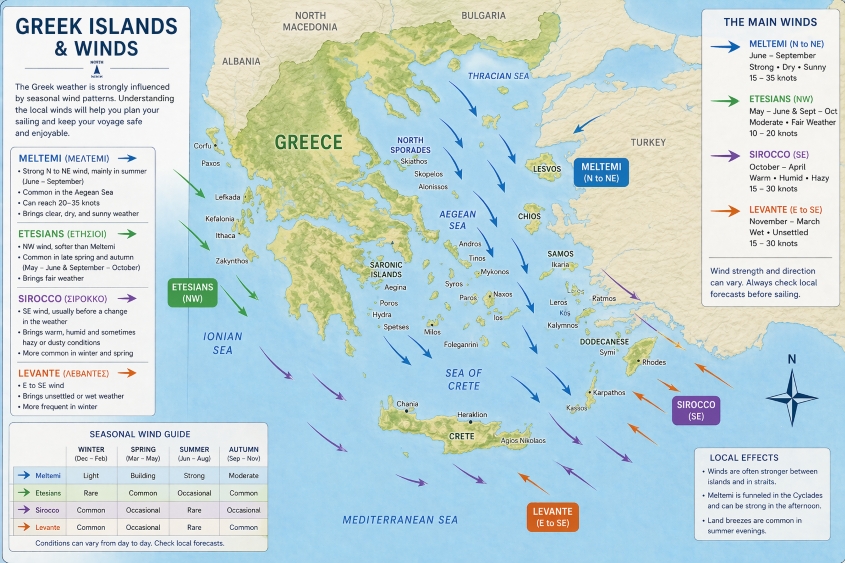
Paxos operates under Ionian Sea conditions with generally moderate winds and lower sea state compared to the Aegean. Summer is dominated by a north-westerly sea breeze cycle, typically 10–20 knots building through the afternoon and easing overnight, with relatively stable conditions and good visibility. Stronger winds occur with passing systems, particularly from the northwest or south, generating longer-period swell affecting exposed coasts, while winter brings more variable weather with frontal systems, rain, and increased wind strength; tidal influence is negligible.
The Marine Electrical and Electronics Bible has a complete list of Greek VHF Radio Channel information and weather forecast times for Greece along with NAVTEX UK and Europe and NAVTEX Mediterranean for 490kHz and 518kHz.
Paxos Greece
Sailing Guide - Local Winds
North-westerly winds (Maistro) dominate summer conditions, generally moderate and building during the day. Southerly winds occur with frontal systems and increase swell on exposed coasts. Local wind acceleration occurs near headlands and channel entrances.
Maistro (NW) is the prevailing summer wind, typically moderate and developing during the day. Easterly winds occur less frequently but can produce increased sea state along the east coast. Southerly winds may accompany frontal systems.
Maistro (Ionian Sea, Greek term) and Maestral (Adriatic, Croatian term) both describe a north-westerly thermal wind driven by daytime land–sea temperature differences. The behaviour is similar: develops late morning, strengthens through the afternoon, and weakens toward evening.
Paxos Greece
Sailing Guide - Provisioning
Supermarkets. Provisioning in Gaios is supported by identifiable outlets including Apostolos Supermarket, Nikos Supermarket, and Katerina Supermarket, all operating within or close to the harbour area with regular restocking via mainland supply. These provide sufficient range for full island-scale provisioning. Additional smaller supermarkets and grocery stores operate in Lakka and Longos with reduced stock suitable for routine resupply only.
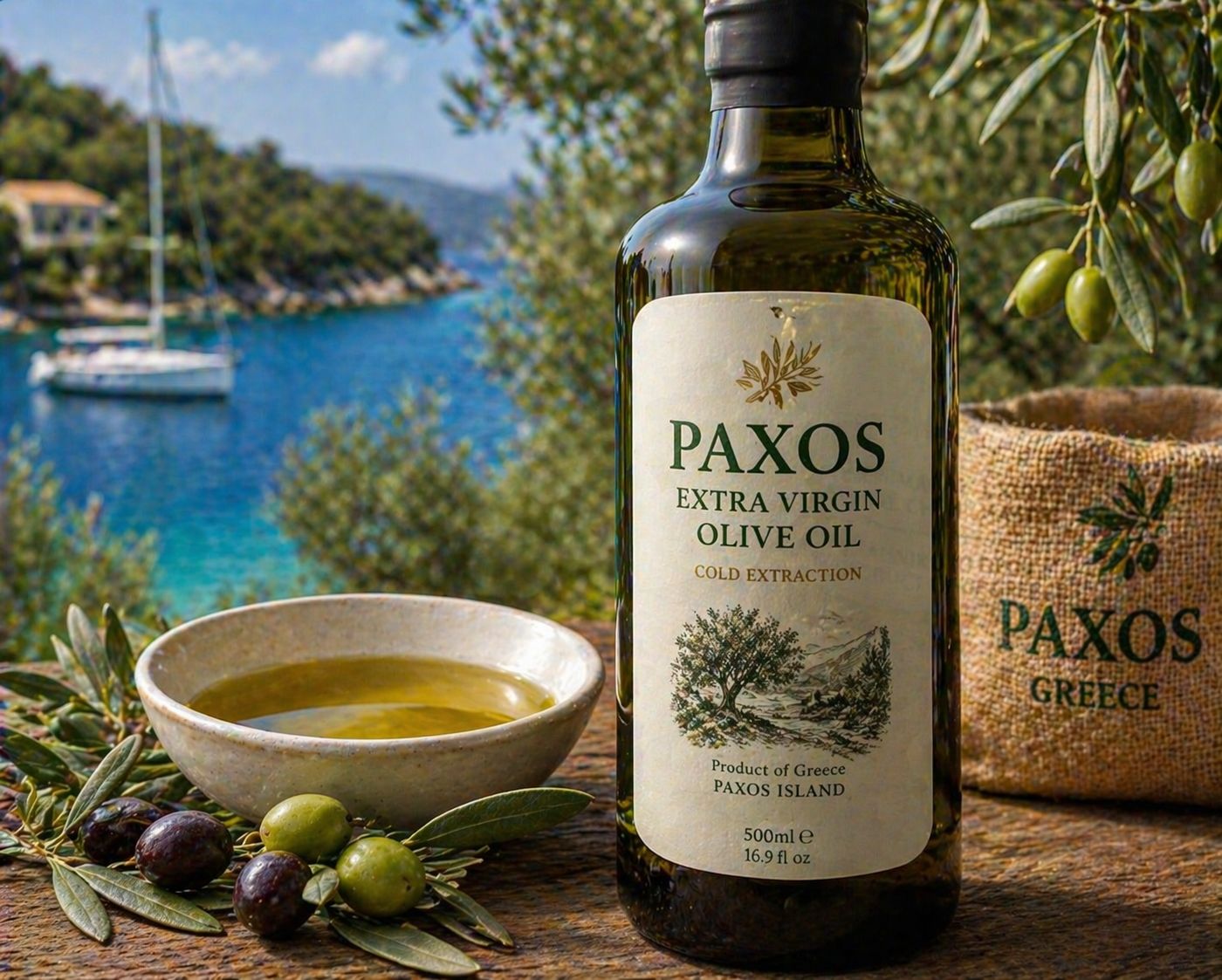
Markets. There is no central municipal market. Produce is distributed through greengrocers, bakeries, and small vendors in Gaios, with supply consisting of vegetables, fruit, herbs, olive oil, cheeses, and dry goods sourced from mainland Greece and local production. Paxos has established olive cultivation, and olive oil is widely available. Small-scale local produce including honey and seasonal vegetables is available through local vendors.
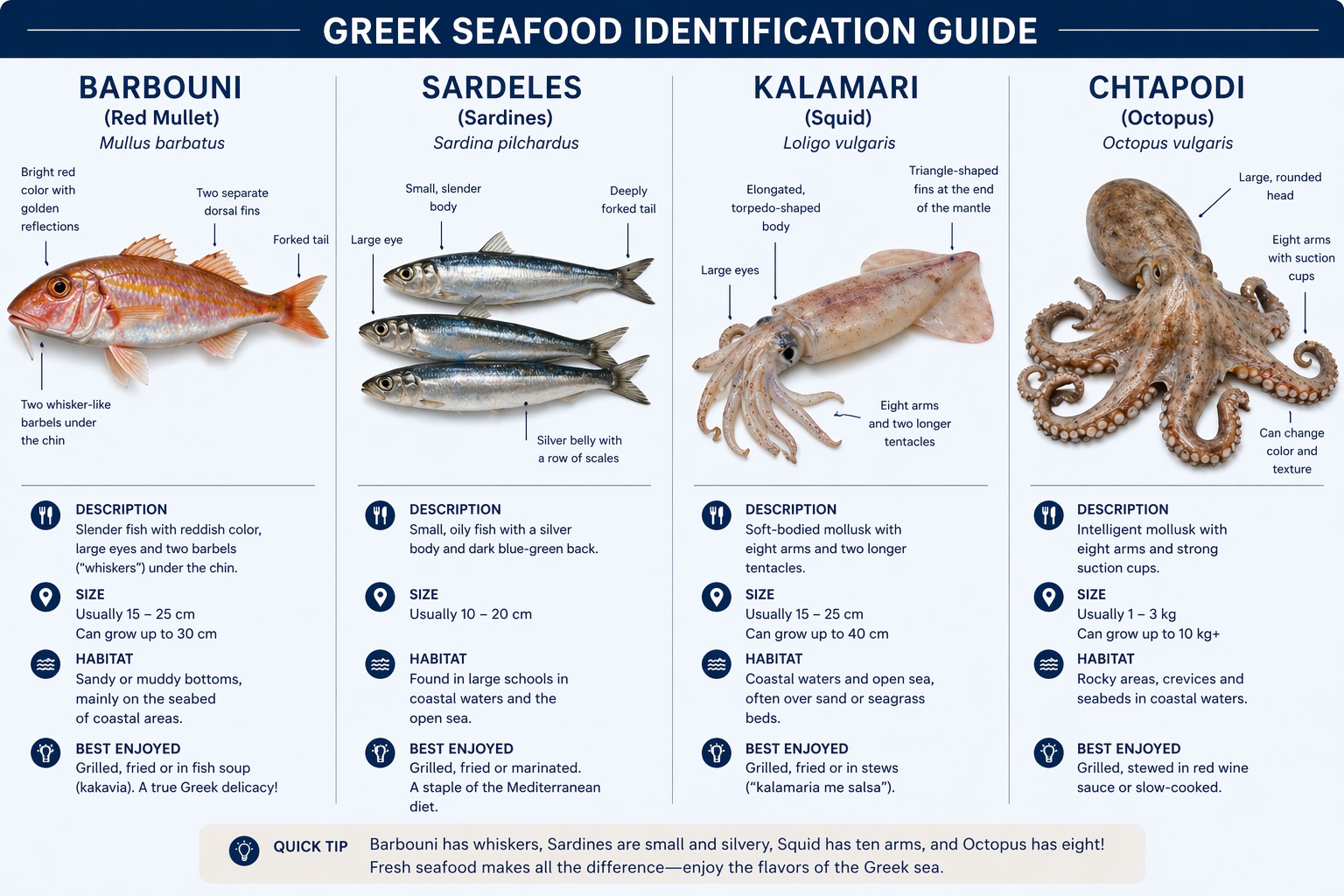
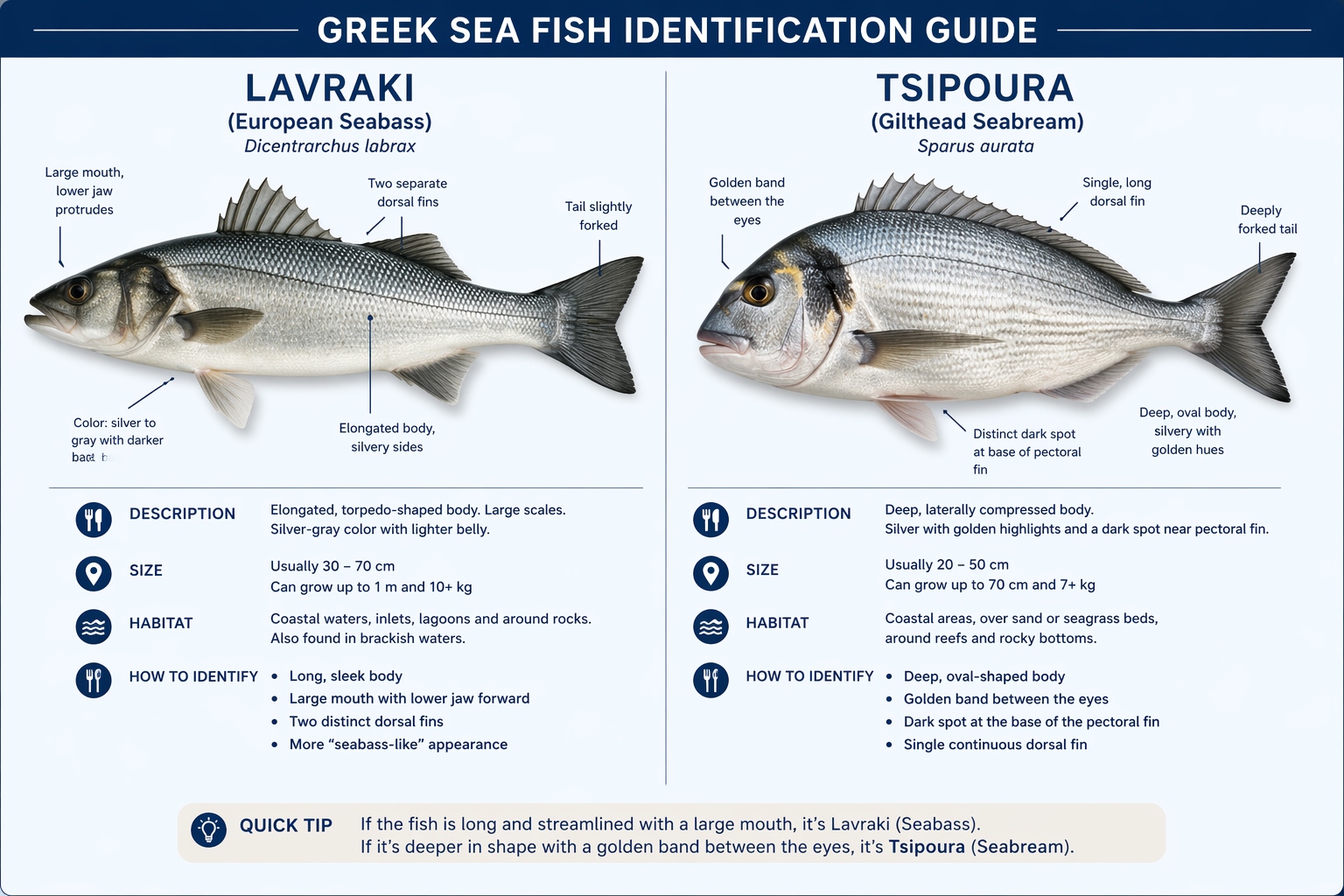
Fish Markets. Fish supply is available through fishmongers and quay-side vendors in Gaios with daily availability dependent on local catch and regional supply. Species include lavraki (European seabass), tsipoura (gilthead seabream), sardines, anchovies, squid, and octopus. Volume is limited but generally consistent, with additional small-scale supply in Lakka and Longos subject to weather and fishing activity.
Paxos Greece
Sailing Guide - Local Cuisine
Paxos cuisine is based on olive oil, vegetables, seafood, and simple meat dishes, reflecting small-scale agricultural production and Ionian influence. Signature dishes include bourdeto (fish stewed in a red pepper sauce), savoro (fried fish preserved in vinegar, rosemary, and garlic), and sofrito (beef slow-cooked with garlic, white wine, and herbs). Vegetable and pulse dishes include lentil soups, greens, and tomato-based preparations using olive oil.
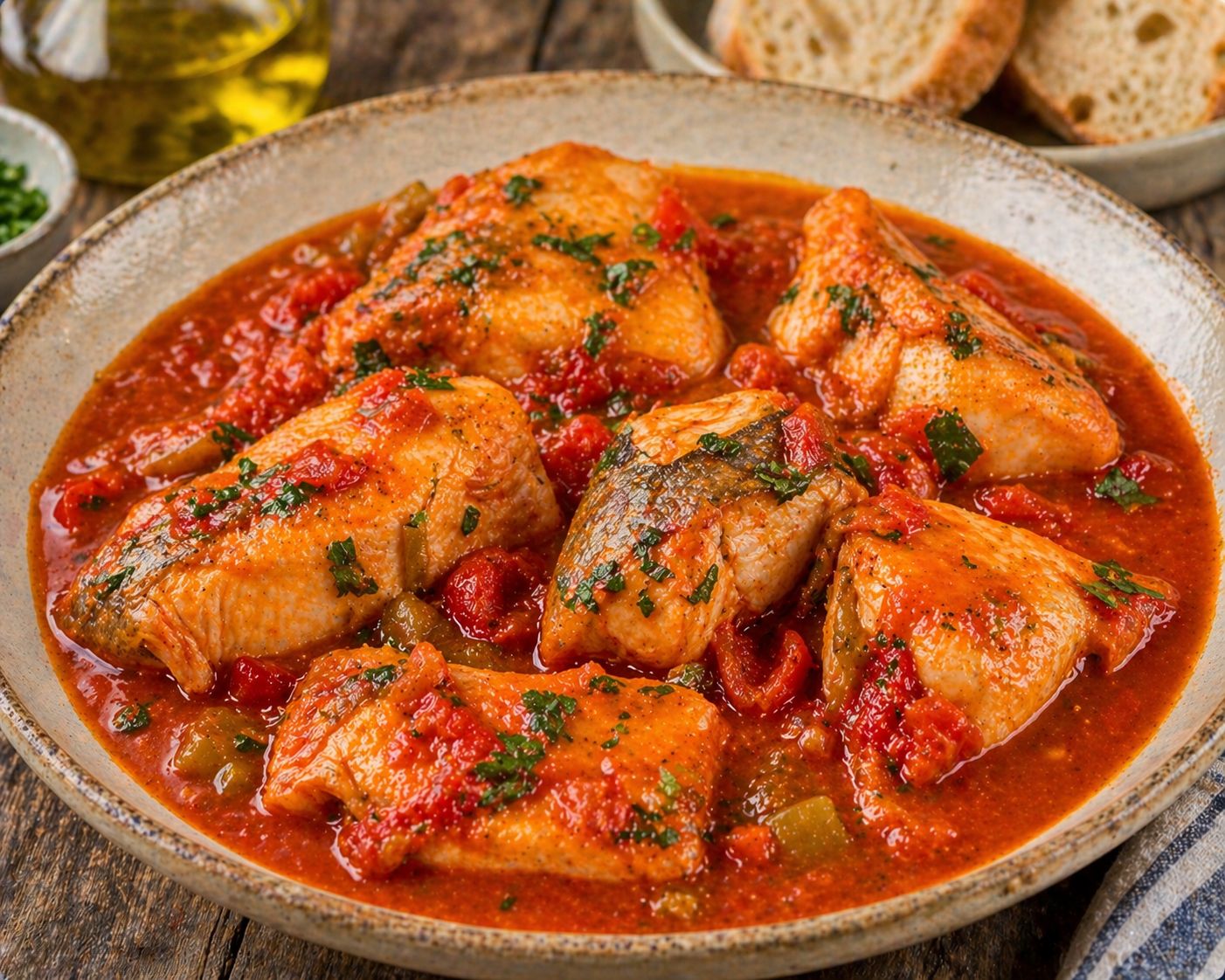
Seafood includes lavraki (European seabass), tsipoura (gilthead seabream), sardines, anchovies, squid, and octopus, prepared grilled, fried, or stewed. Meat dishes include pork, lamb, and goat, often slow-cooked or baked with herbs and olive oil
Paxos has defined local production of olive oil as its primary product, derived from extensive olive groves across the island. Additional products include small-scale honey from thyme and mixed flora, along with limited local wine production.
Paxos Greece Sailing Guide - Beverages
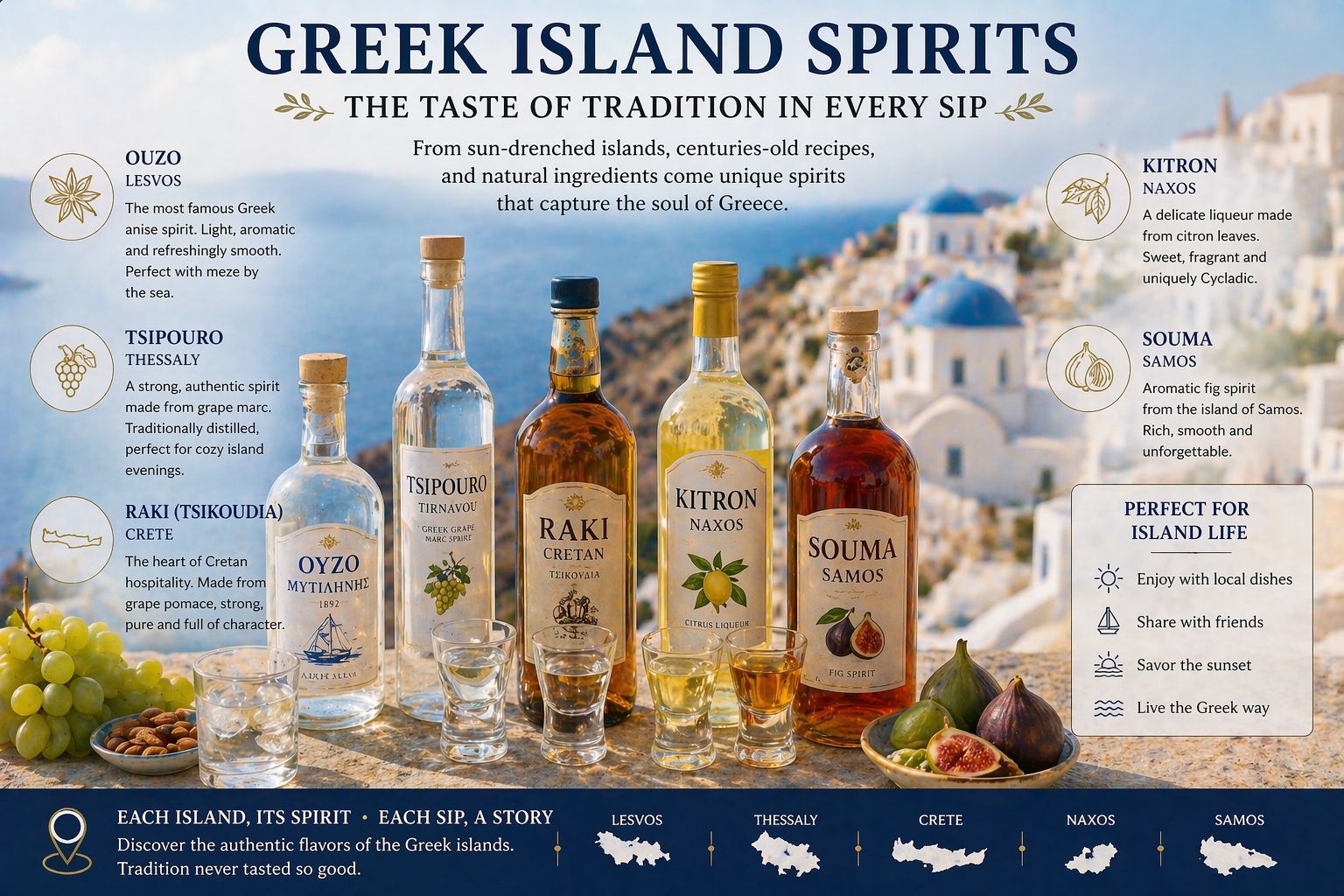
Beer, wine, and spirits across the Greek islands are locally produced and widely available through tavernas, small bars, and provisioning outlets. Beer is predominantly lager, with domestic brands including Mythos, Alfa, Fix, and Vergina alongside imported products; and over 100 microbreweries operate on several islands with limited distribution. Wine is region-specific, with white varieties dominant in the islands, including Assyrtiko, Moschofilero, and Roditis, alongside local table wines served in bulk; retsina remains in circulation as a resin-flavoured wine. Distilled products include ouzo (anise-based), tsipouro (grape marc distillate), raki or tsikoudia (Crete), souma (fig or grape distillate in eastern Aegean islands), and kitron (citrus liqueur from Naxos), with alcohol strength typically in the 37–45% range and higher for unregulated local distillations.
Paxos Greece
Sailing Guide - Fuel Supplies
Fuel on Paxos is available primarily at Gaios Harbour via road tanker delivery to quay berths, with marine diesel as the standard supply. Delivery is arranged locally with advance notice and is dependent on tanker availability and harbour access. Secondary locations such as Lakka and Longos have limited or irregular supply and may require jerry can transfer; no fuel is available at anchorages.
Paxos Greece
Sailing Guide - Water Supplies
Water is available at Gaios Harbour via quay connections with metered municipal supply. Pressure and availability are generally adequate but can vary during peak season, and hose fittings may require adapters. Secondary locations such as Lakka and Longos have limited or variable supply, and no water is available at anchorages
Mechanical and Electrical Repairs
Resource
If you are headed to Paxos or somewhere remote consider the need to expand your knowledge base or have an information resource on board. Why not get a copy of my book The Marine and Electrical and Electronics Bible 4th Edition. By and for yachties, with everything from batteries and charging, solar and wind, diesel engines and marine electronics and so much more. Your complete systems guide. 650 pages of practical advice. In Australia and New Zealand order a copy through Boat Books. UK and European boats can buy the UK Edition Here. US and Canadian boats can get the US Edition Order Here. Marine systems are my profession so let me help you. By a liveaboard boat owner for other boat owners.



Paxos Greece
Sailing Guide - Marine Services
Marine services on Syros are based in Ermoupoli and Finikas Marina with coverage for diesel engines, electrical systems, and marine electronics. Engine servicing, including support for Volvo Penta and Yanmar, is available through local contractors such as Gryparis Georgios (Cyclades Diesel Marine), while marine electronics and electrical support, including Raymarine systems, are provided by suppliers such as Maistrali Marine. Services are suitable for routine maintenance and fault repair; no haul-out or heavy refit facilities are available, and major works require relocation to Athens-area yards.
Paxos Greece
Sailing Guide - Local Customs
Interaction is direct and formal on first contact, with a greeting expected before any request or transaction. Conversation tone is measured and transactional, with limited small talk unless initiated locally. Personal space is closer than in northern Europe, but physical contact is minimal unless familiarity is established.
In working environments such as quays, chandlers, and fuel delivery, communication is concise and task-focused; instructions from port staff or line handlers are followed without negotiation. Assistance between skippers is common but not assumed, and consent is required before handling lines, equipment, or boarding another vessel.
Shore behaviour is conservative in non-tourist areas, particularly near churches and village centres where modest dress and low noise are expected. Meals are structured as shared dishes, with ordering and service paced rather than rapid; payment is typically requested rather than automatically presented.
Paxos Greece
Sailing Guide - Summary
Paxos provides multiple sheltered anchorages with generally good holding and moderate conditions. Harbour access requires attention in confined areas such as Gaios. Facilities are limited with reliance on nearby Corfu for major services. Conditions are generally less severe than the Aegean but remain wind dependent. Paxos Greece Sailing Guide for all you need to know.