Paros Greece
Sailing Guide
Paros Greece Sailing Guide. Paros lies in the central Cyclades between Naxos and Antiparos, at approximately 37°05′N 25°09′E positioned within a high-traffic sailing corridor linking northern and southern Aegean routes. The island presents multiple coastal operating environments with open bays, exposed headlands, and enclosed harbour basins. Primary yacht activity is concentrated at Parikia on the west coast, where harbour access, provisioning, and shore infrastructure are co-located.
The coastline is irregular with steep-to sections and rapid offshore depth increase. Anchoring is confined to defined bays with suitable seabed. Operational conditions are dominated by the Meltemi, which establishes sustained northerly flow and determines both sea state and harbour usability. The west coast, including Parikia, provides relative lee under northerly conditions, while the Paros–Naxos channel is exposed to full wind and sea.
Paros Greece
Sailing Guide - History
Paros has maintained continuous maritime relevance due to its central position and export of Parian marble in antiquity. Harbour activity developed at Parikia, providing access to inland resources and sheltered anchorage. Trade routes through the Cyclades reinforced its role as a staging and supply location. The present harbour reflects integration of historical quay use with modern ferry and commercial operations.
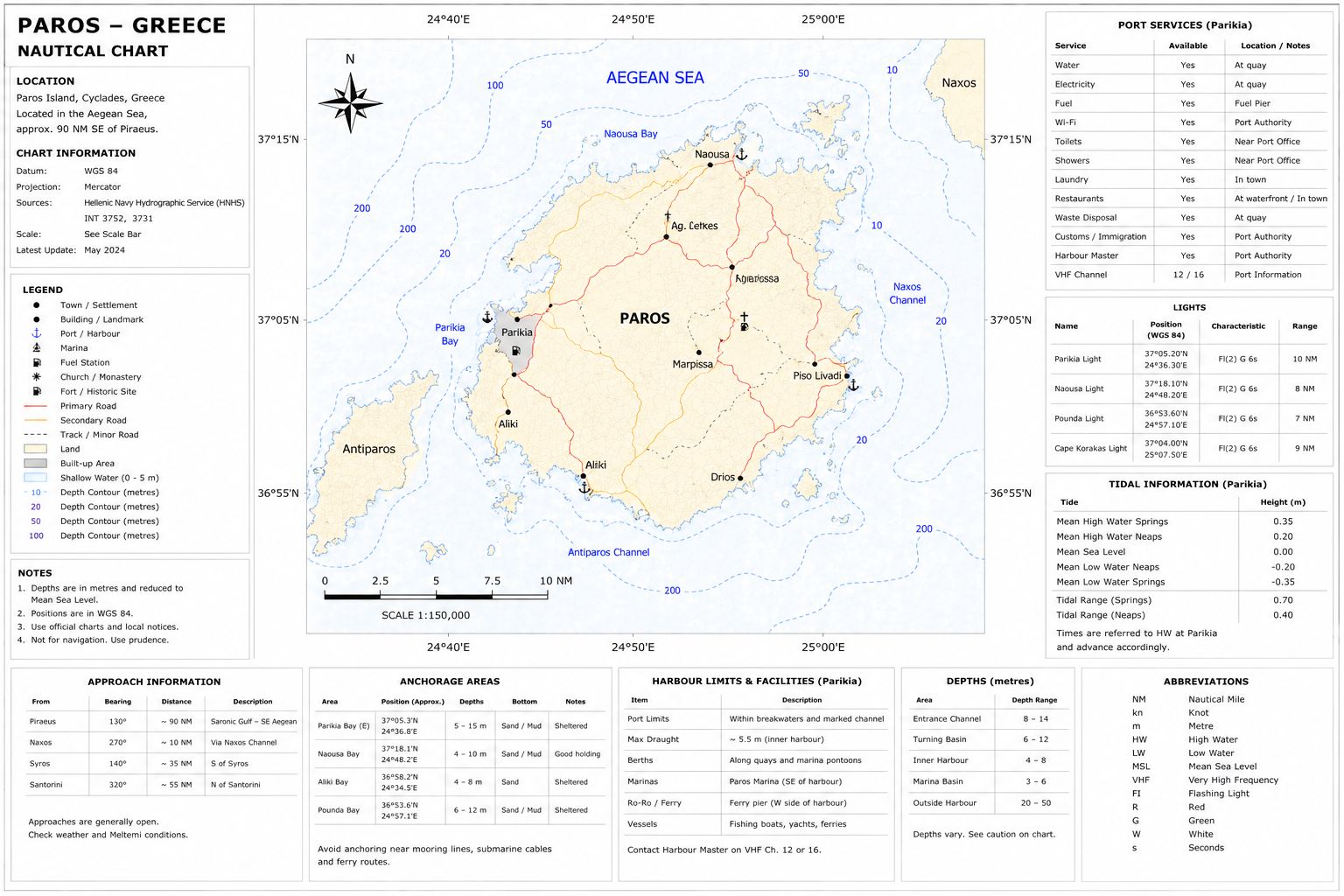
Chart Disclaimer. This chart is a schematic representation for illustrative purposes only and must not be used for navigation. Refer to official hydrographic charts for safe navigation. Be aware ENC charts may differ from official hydrographic charts. Both should be corrected and updated regularly.
Paros Greece
Sailing Guide - Ocean Currents and
Tides
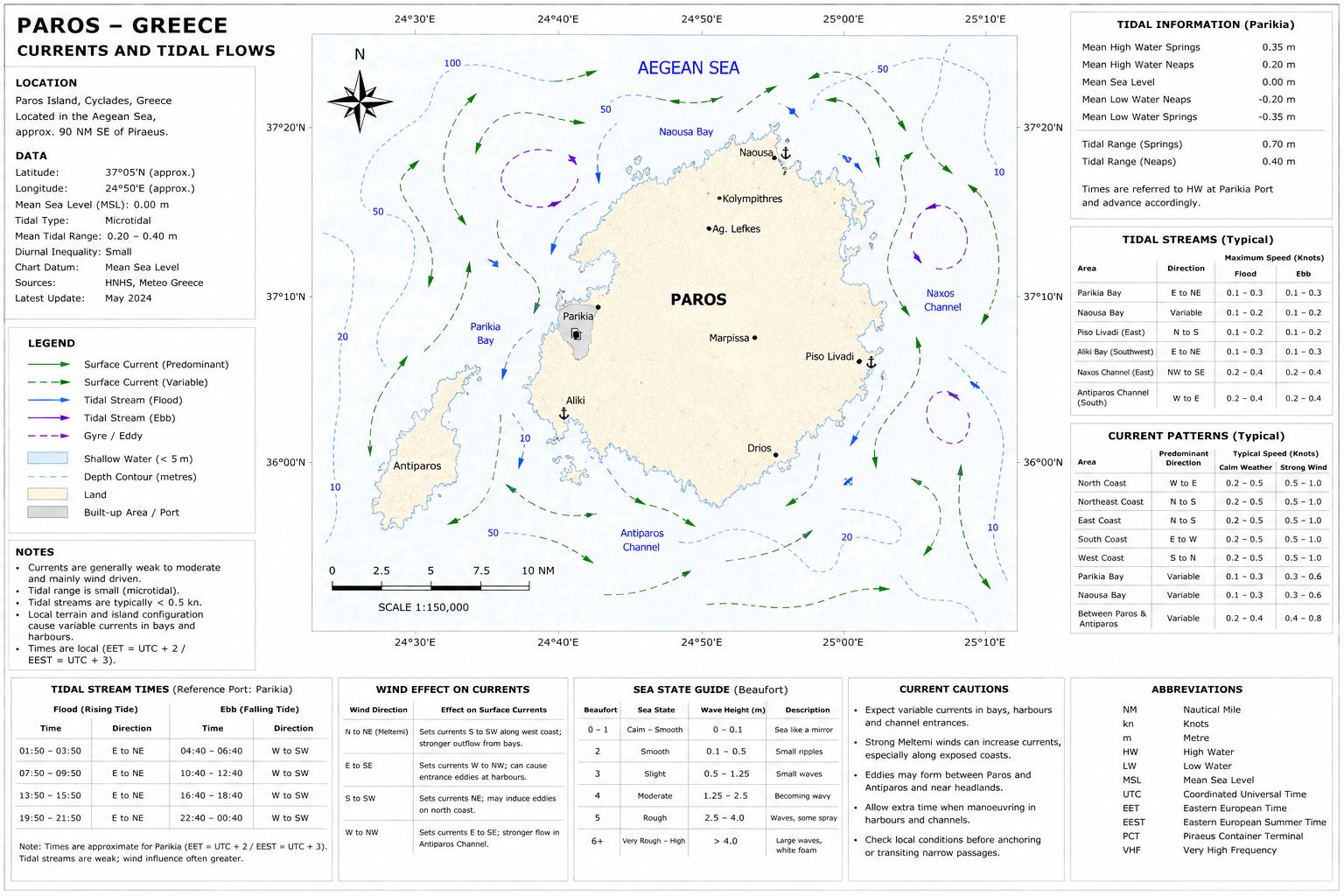
Tidal variation is negligible. Water movement is wind-driven. Between Paros and Naxos, sustained northerly wind generates southward set through the channel. Under strong Meltemi, current may reach approximately 1 to 1.5 knots with local acceleration. Sea state is typically the limiting factor rather than current. Within Parikia Bay, current is minimal and generally below 0.5 knots. Movement is influenced by wind and ferry wash.
Paros Greece
Sailing Guide - Weather
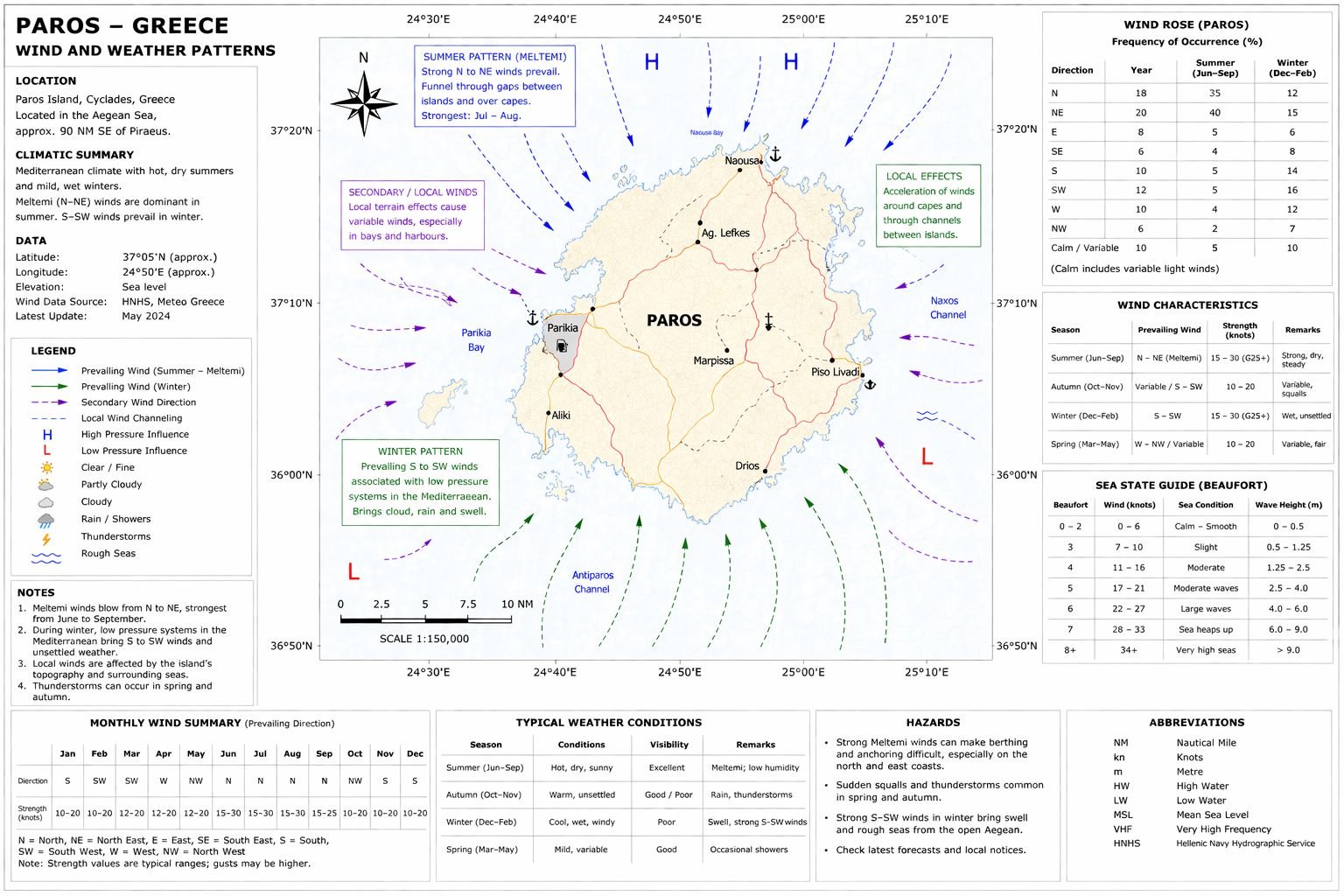
Summer conditions are stable with persistent northerly wind regimes, clear visibility, and no precipitation. Heat haze may develop during prolonged high temperature periods. Winter conditions involve low-pressure systems producing rainfall, reduced visibility, and variable wind. Southerly systems generate swell affecting west-facing coasts including Parikia.
The Marine Electrical and Electronics Bible has a complete list of Greek VHF Radio Channel information and weather forecast times for Greece along with NAVTEX UK and Europe and NAVTEX Mediterranean for 490kHz and 518kHz.
Paros Greece
Sailing Guide - Local Winds
The Meltemi dominates, typically north to north-west, frequently 20–30 knots. This produces strong sea state in exposed channels and along northern and eastern coasts. Parikia lies in lee under northerly conditions but experiences gusting due to terrain deflection. Wind acceleration occurs around headlands and through island channels. Southerly winds expose the west coast and Parikia harbour directly, creating surge within the basin.
The Meltemi is a strong, dry northerly wind that dominates the Aegean in summer, accelerating through channels and between islands to produce steep, short seas. It is most persistent in July and August, often blowing for several days with little diurnal variation, creating fast north‑to‑south passages and challenging return routes. Its strength is shaped by pressure gradients between the Balkans and Anatolia, with local acceleration zones around major island gaps.
Paros Greece
Sailing Guide - Approaches
Approach is from open water with offshore depths generally 50–100 m, reducing to 10–20 m within 1 NM of the coast and 5–10 m approaching harbour limits. No constrained pilotage channels exist. Sea state is dominated by Meltemi (N–NE), which accelerates significantly through the Paros–Naxos channel, producing strong winds and steep, short-period seas. Conditions in the channel are typically more severe than surrounding waters due to funneling.
Southerly winds occur less frequently and generate longer-period seas affecting south-facing coasts. Tidal range is typically 0.2–0.4 m with no operational tidal stream. Wind-driven drift is the primary factor affecting manoeuvring. Hazards include strong wind acceleration zones, ferry traffic, and local vessel movement. The Paros–Naxos channel presents increased wind strength and sea state relative to surrounding areas.
Paros Greece
Sailing Guide - Navigation
Navigation within Parikia harbour is constrained by ferry operations and basin geometry. Ferries occupy primary berths and generate wash during manoeuvre. Yacht berthing is conducted along quay sections with depths typically between 2.5 m and 5 m. Seabed near quay edges includes sand, mud, and debris. Mooring is stern-to using own anchor or laid lines. Anchor placement must consider limited swinging room and proximity to adjacent vessels. Anchoring in Parikia Bay is conducted in depths of 5 m to 10 m over sand or mud. Holding is generally reliable in sand. Naoussa harbour provides secondary berthing but has restricted entrance width, shallower depth, and limited manoeuvring space. Fishing gear including nets and lines may be present near shore and is not consistently marked.
Paros Greece
Sailing Guide - Chart Accuracy
Charts issued by the Hellenic Navy Hydrographic Service are accurate for approaches and harbour areas. ENC data aligns with official charts. Hydrographic charts accurately represent coastline and harbour structure. Electronic charts correspond closely to published data. Local variation occurs near quay edges and in smaller bays due to sediment movement and debris. Weed and rock patches are not consistently charted. Echo sounder verification is required. Local moorings, laid ground tackle, and seasonal anchoring density may not be fully represented.
Paros Greece
Sailing Guide - Anchorages
Parikia Bay provides the primary anchorage in depths of 5 m to 10 m over sand or mud. Holding is generally good. The bay provides shelter from northerly wind. Secondary anchorages exist around the island with depths between 5 m and 15 m. Seabed varies between sand, weed, and rock. Exposure changes with wind direction. No anchorage provides full protection under all wind conditions. Paros provides multiple anchorages with variable shelter depending on wind direction.
- Parikia outer areas provide anchoring in 5–10 m over sand with moderate holding and partial shelter from northerly winds.
- Naoussa Bay provides anchoring in 4–8 m over sand and mud with moderate holding but limited space and exposure depending on position.
- South coast bays including Alyki provide depths of 5–12 m over sand with good holding and improved shelter from northerlies.
- Antiparos channel areas provide anchoring in 4–10 m over sand with good holding and partial shelter depending on wind direction, but subject to current and traffic.
Paros Greece
Sailing Guide - Entry Formalities
Paros is not a primary port of entry. Clearance is completed at designated ports prior to arrival. Standard Greek requirements apply including documentation and TEPAI cruising tax. AIS transmission is required where applicable. Paros operates under Greek national and Schengen procedures. Customs and immigration clearance is required for arrivals from outside Schengen areas. Vessel and crew documentation must be available. Harbour authority control applies within port limits. Drones are regulated under Greek aviation rules. Communications equipment must comply with national regulations. Waste discharge is controlled.
Paros Greece
Sailing Guide - Marina Facilities
Parikia does not have a full-service marina. Berthing is along harbour quays. Depth alongside ranges from approximately 2.5 m to 5 m. Mooring is stern-to using own anchor or harbour lines. Water and power are available at selected quay points but are not continuous. Ferry operations take priority and affect berth availability. Naoussa provides limited quay berthing with reduced depth and restricted manoeuvring. No travel lift or haul-out facility exists in Parikia or Naoussa.
Paros Greece
Sailing Guide - Provisioning
Supermarkets. Supermarket provisioning in Parikia is concentrated within walking distance of the harbour, with multiple outlets distributed through the town grid rather than a single location. AB Vassilopoulos operates within approximately 500 m to 1 km of quay berthing. Masoutis, Proton, Kritikos Super Market, Melanitis Food Market, and Arsenis Super Market all operate within the same harbour-accessible area. These outlets are reached on foot from quay berths and provide the primary supply points for bulk and daily provisioning within Parikia.
Markets. Produce is supplied through greengrocers and vendors within Parikia. Supply includes vegetables, fruit, olive oil, legumes, herbs, and seasonal agricultural products. Paros supports over 300 mushroom varieties, both wild and cultivated, appearing seasonally and supplied through local vendors. Additional local produce includes olives, olive oil, capers, grapes, figs, citrus, and herbs.
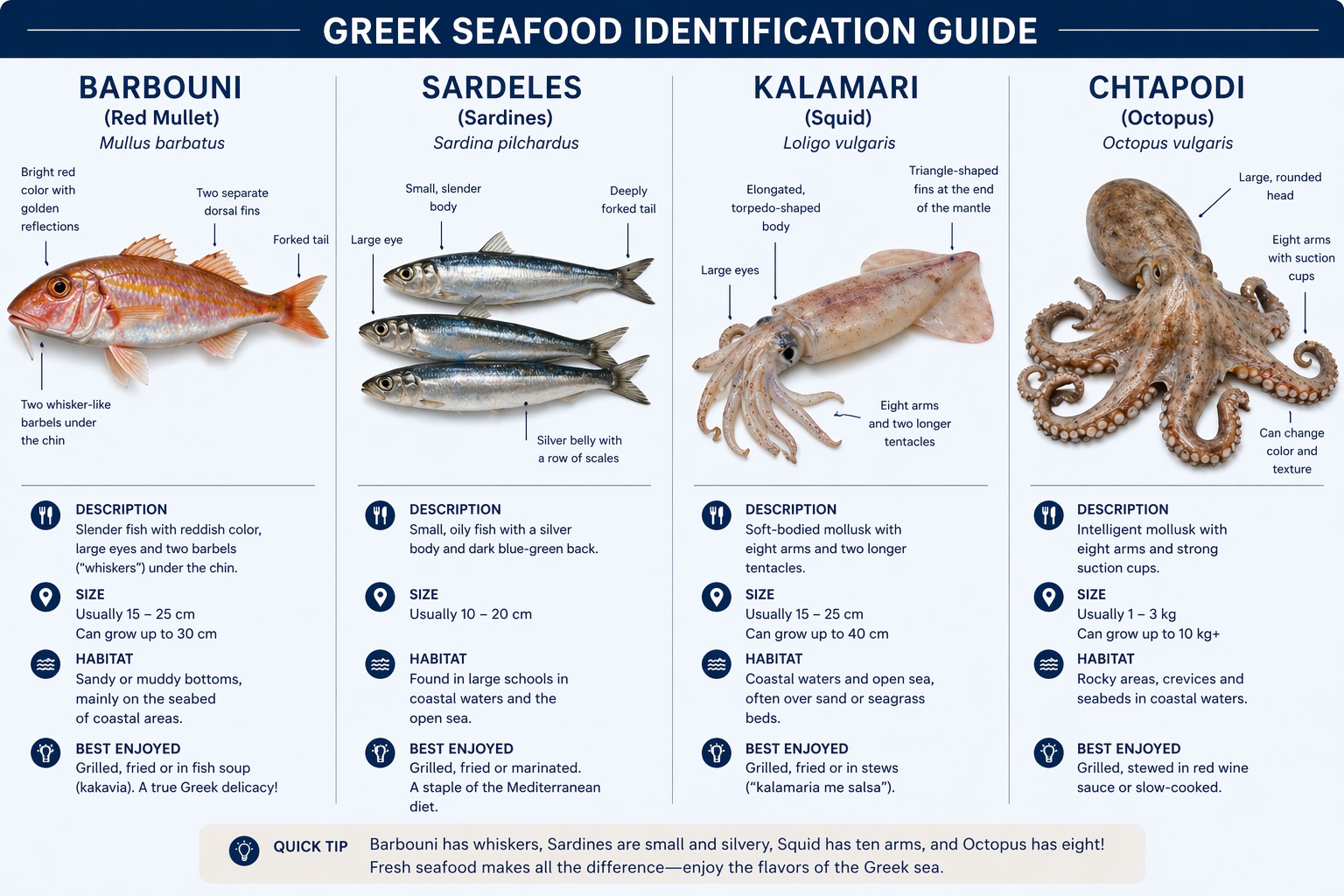
Fish Markets. Fish is supplied through fishmongers in Parikia and direct sale from fishing vessels in the harbour. Species include tsipoura, lavraki, sardela, gavros, barbouni, and cephalopods including squid and octopus. Availability depends on daily catch
Paros Greece
Sailing Guide - Local Cuisine
Local produce on Paros includes capers, olives and olive oil, grapes, figs, citrus, legumes, and a wide range of wild and cultivated mushrooms, with over 300 varieties identified on the island and used seasonally. Dairy production includes cheeses from sheep and goat milk, forming a base component of local food. Signature dishes include revithada, a slow-cooked chickpea dish prepared in a clay pot; gouna, sun-dried and grilled fish typically mackerel; and kakavia, a fish soup made from mixed catch. Cheese-based dishes include various pites, pastries filled with local cheese. Seafood preparation includes grilled fish such as tsipoura (gilthead bream) and lavraki (sea bass), and chtapodi psito, grilled octopus. Food reflects island agriculture, seasonal availability, and daily fish supply.
On Paros, the presence of hundreds of wild mushroom species does not translate into a defined or recognisable set of signature dishes. The island’s food culture developed around stable, repeatable ingredients suc as grains, legumes, goat, and seafood, so mushrooms have remained a seasonal addition rather than a central component of the cuisine.
When conditions are right, typically after autumn and winter rains, wild mushrooms appear in local cooking in a straightforward, utilitarian way. They are sautéed in olive oil with garlic and herbs, folded into egg dishes, or combined with onions and greens. In some cases they are incorporated into rustic pies alongside other foraged plants, following the same format used for mixed greens rather than standing alone as a featured ingredient. In village kitchens, they may also be added to slow-cooked meat dishes, particularly with goat or lamb, but again as a supplementary element rather than the focus. More recently, a small number of kitchens have begun to treat wild mushrooms with greater intent, using them in dishes that highlight their flavour more directly, sometimes paired with local cheeses or neighbouring products from Naxos.
Paros Greece
Sailing Guide – Beverages
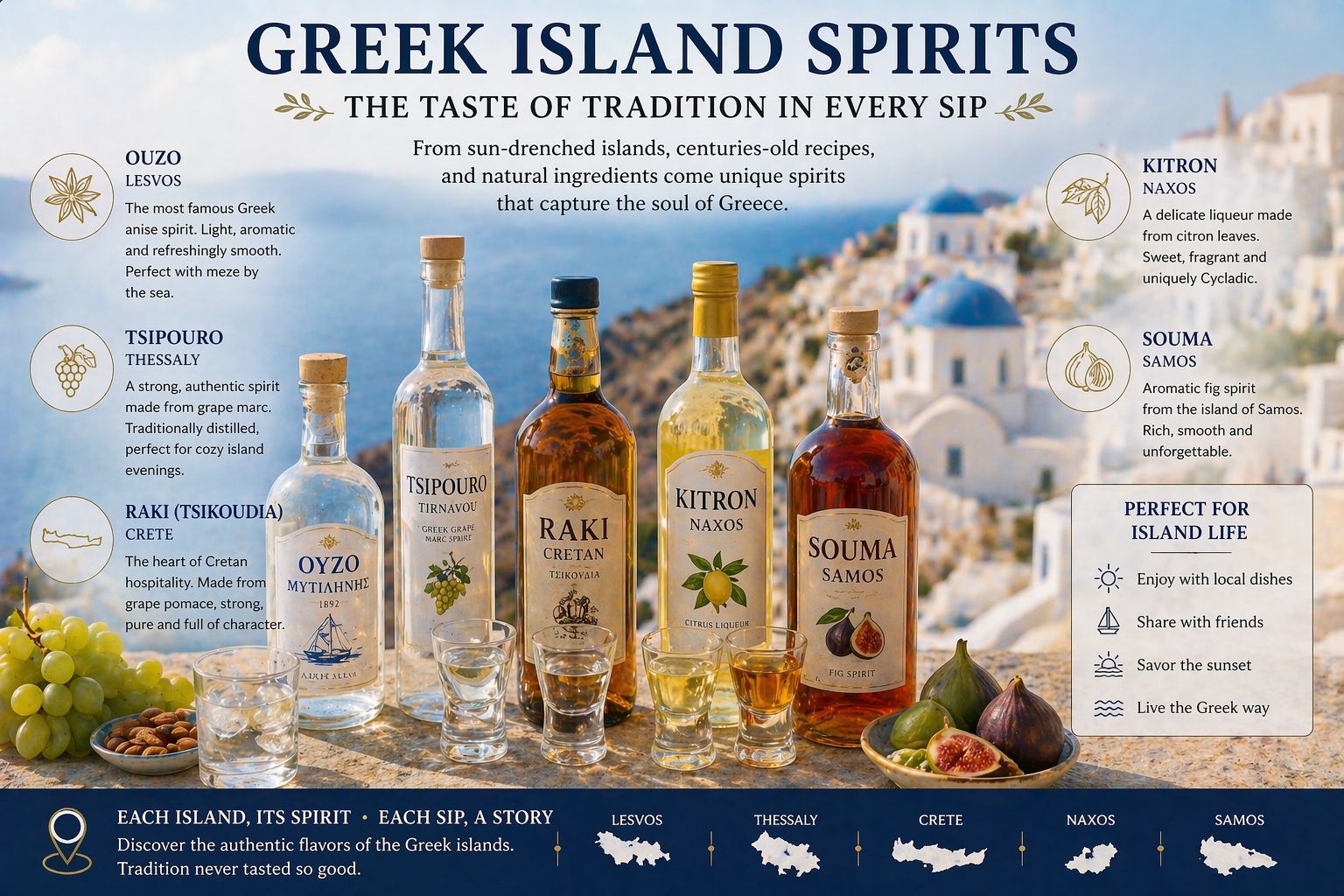
Beer, wine, and spirits across the Greek islands are locally produced and widely available through tavernas, small bars, and provisioning outlets. Beer is predominantly lager, with domestic brands including Mythos, Alfa, Fix, and Vergina alongside imported products; and over 100 microbreweries operate on several islands with limited distribution. Wine is region-specific, with white varieties dominant in the islands, including Assyrtiko, Moschofilero, and Roditis, alongside local table wines served in bulk; retsina remains in circulation as a resin-flavoured wine. Distilled products include ouzo (anise-based), tsipouro (grape marc distillate), raki or tsikoudia (Crete), souma (fig or grape distillate in eastern Aegean islands), and kitron (citrus liqueur from Naxos), with alcohol strength typically in the 37–45% range and higher for unregulated local distillations. There are no widely recognised protected or geographically unique spirits exclusive to Paros. The island’s identity in alcohol production is more strongly tied to wine, including modern Parian vintages and historical associations with Malvasia styles. Spirits exist as a secondary, localised practice rather than a defining regional product
Paros Greece
Sailing Guide - Fuel Supplies
Diesel supply in Paros is not provided from a dedicated fuel dock within Parikia harbour and is obtained from roadside fuel stations located in the immediate town area and along the access roads. Fuel is transferred to vessels by jerry can from nearby stations or arranged for delivery to the quay where local suppliers provide small tanker or van transfer depending on quantity. Fuel stations operate within short road distance of Parikia harbour and are accessible by foot for small quantities or by vehicle for bulk transfer. Delivery to the quay is arranged directly with station operators or through local contacts. No high-flow marine pump, bunker facility, or fuel pontoon is installed within Parikia harbour. Supplied fuel is standard automotive diesel and onboard filtration is required prior to use.
Paros Greece
Sailing Guide - Water Supplies
Potable water on Paros is supplied from the municipal network and is available at selected points along the Parikia harbour quay. Supply is not continuous along the full quay length and access depends on berth position and local arrangement with harbour personnel or adjacent connections. Pressure varies with demand and commonly reduces during peak summer periods. Hose fittings are not standardised and vessels are required to provide their own hose and connectors. No pedestal-based marina distribution system is installed along the harbour frontage. Water is treated municipal supply suitable for tank filling, with onboard filtration used as required.
Mechanical and Electrical Repairs
Resource
If you are headed somewhere remote consider the need to expand your knowledge base or have an information resource on board. Why not get a copy of my book The Marine and Electrical and Electronics Bible 4th Edition. By and for yachties, with everything from batteries and charging, solar and wind, diesel engines and marine electronics and so much more. Your complete systems guide. 650 pages of practical advice. In Australia and New Zealand order a copy through Boat Books. UK and European boats can buy the UK Edition Here. US and Canadian boats can get the US Edition Order Here. Marine systems are my profession so let me help you. By a liveaboard boat owner for other boat owners.



Paros Greece
Sailing Guide - Marine Services
Marine services on Paros are based around Parikia and the surrounding port area and provide routine support including diesel engine servicing, minor electrical work, battery replacement, and general mechanical repair carried out by local technicians. There is no travel lift or full-service yacht yard in Parikia harbour. Haul-out, antifouling, rigging, and major mechanical or electrical repair require relocation to larger service facilities on nearby islands or the mainland
Paros Greece
Sailing Guide - Local Customs
Interaction is direct and begins with a greeting before transactions. Dress ashore is standard day wear with beachwear limited to waterfront areas. Meal times are later with evening dining after 20:00 and alcohol is consumed over extended periods. Cash is commonly used in smaller vendors while cards are accepted in larger outlets.
Paros Greece
Sailing Guide - Summary
Paros provides a central Cyclades operating location with primary yacht activity at Parikia and secondary berthing at Naoussa. The island offers harbour access, anchoring, provisioning, and fuel supply within walking distance of quay berths. Navigation is controlled by Meltemi wind patterns and ferry operations within the harbour. The island functions as a staging and transit point consistent with a Paros Greece Sailing Guide and all you need to know.