Nafplio Greece
Sailing Guide
Nafplio Greece Sailing Guide. Nafplio is located on the eastern coast of the Peloponnese within the Argolic Gulf, providing a well-protected harbour and sheltered coastal waters. The town sits beneath steep terrain and fortified headlands, with the prominent offshore islet of Bourtzi Castle marking the centre of the bay. Surrounding waters are generally deep with a gradual shoaling toward the harbour, and approaches are clear, making Nafplio an accessible and frequently used stop for vessels operating in the Saronic and Argolic regions.
The harbour is formed by a combination of natural protection and constructed quays, offering secure berthing in most conditions, though exposure can occur under strong southerly winds. Nafplio functions as a regional port with established infrastructure, including ferry operations, fishing activity, and visiting yachts. Its position within the Argolic Gulf provides relatively moderate sea conditions compared to more exposed Aegean locations, making it a practical harbour for transit, shelter, and resupply.
Nafplio Greece
Sailing Guide History
The history of Nafplio spans antiquity to modern Greece and reflects its long-standing strategic importance. In ancient times, the area was associated with nearby Mycenaean centres, though Nafplio itself rose to prominence later. During the Byzantine period it developed as a fortified port, and in the medieval era it became a key stronghold contested between Franks, Venetians, and Ottomans.
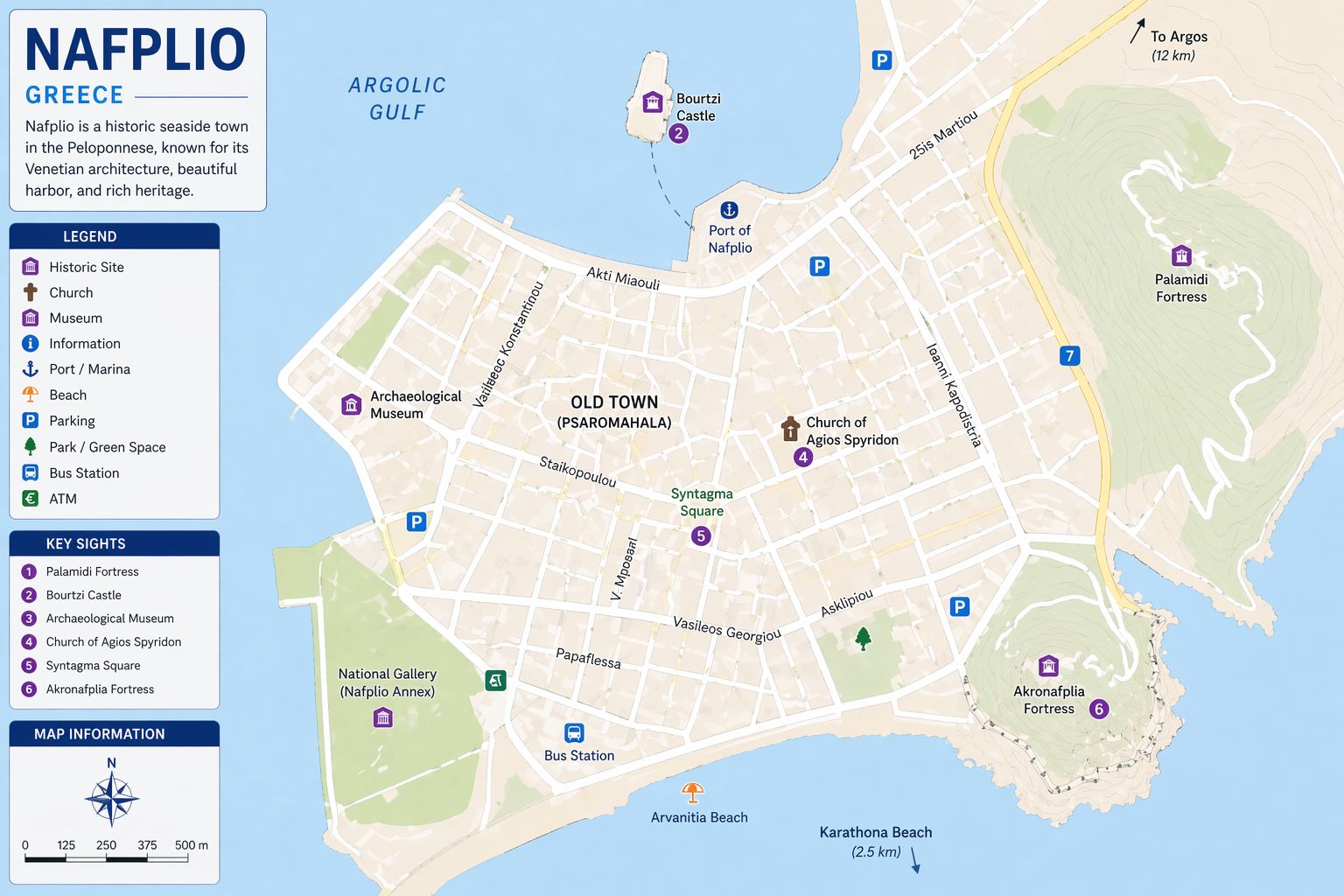
Under Venetian rule, Nafplio was heavily fortified, with major defensive works including the Palamidi fortress and harbour fortifications, establishing it as one of the most important ports in the region. It later fell to the Ottomans before being captured by Greek forces during the War of Independence in 1822. Nafplio became the first capital of modern Greece from 1828 to 1834, before the capital moved to Athens. Its historic architecture, combining Venetian, Ottoman, and neoclassical influences, reflects this layered history and its enduring maritime role.
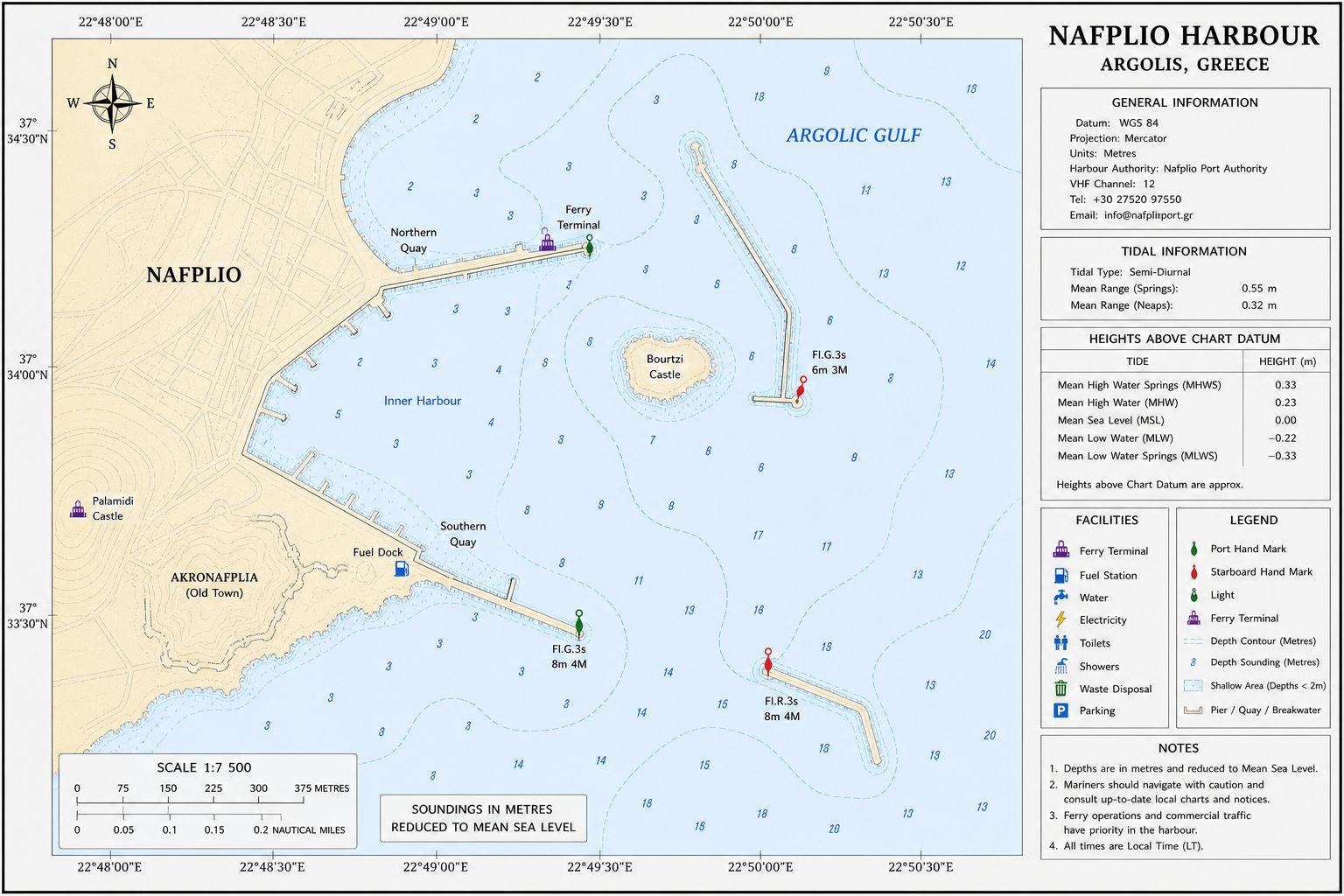
Chart Disclaimer. This chart is a schematic representation for illustrative purposes only and must not be used for navigation. Refer to official hydrographic charts for safe navigation. Be aware ENC charts may differ from official hydrographic charts. Both should be corrected and updated regularly.
Nafplio Greece
Sailing Guide - Approaches
Approach to Nafplio is via the head of the Argolic Gulf in clear water with depths 50–100 m offshore, shoaling gradually to 20–30 m within 1–2 NM of the coast. The approach is straightforward with no significant off-lying dangers on the main track. The town is easily identified by the prominent fortifications, including Palamidi Fortress on the hillside and Bourtzi Castle on the small island in the harbour. Approach is typically from the SE or S into the wide bay, with depths reducing to 10–15 m near the harbour area and 5–8 m closer inshore. The harbour is open and easy to enter, but care is required to avoid the area immediately around Bourtzi Castle. There are no major shoals, but shallow areas exist near the shoreline and harbour margins. Winds are generally moderate but can create crosswinds on final approach. Traffic is light to moderate, mainly local vessels and visiting yachts.
Nafplio Greece
Sailing Guide - Navigation
Approach is from the S or SE into the head of the Argolic Gulf in clear water with depths 30–80 m offshore, shoaling to 15–25 m within 1 NM. The coastline is open and well defined, with no significant off-lying hazards on the direct approach. The harbour is identified by Bourtzi Castle, which lies on a small islet off the town. Keep clear of the immediate area around the islet; depths around it are 5–10 m, with shallower patches closer in. The main harbour and quay are approached in 10–15 m, reducing to 5–7 m alongside. Berthing areas lie along the town front and outer quay.
No major shoals on the main approach, but shallows extend near harbour margins and close to shore. Wind is generally moderate but can create crosswinds during final approach. Traffic is light to moderate. Night entry is straightforward with standard navigation lights and good chart use
Nafplio Greece Sailing Guide - Currents and Tidal Flows
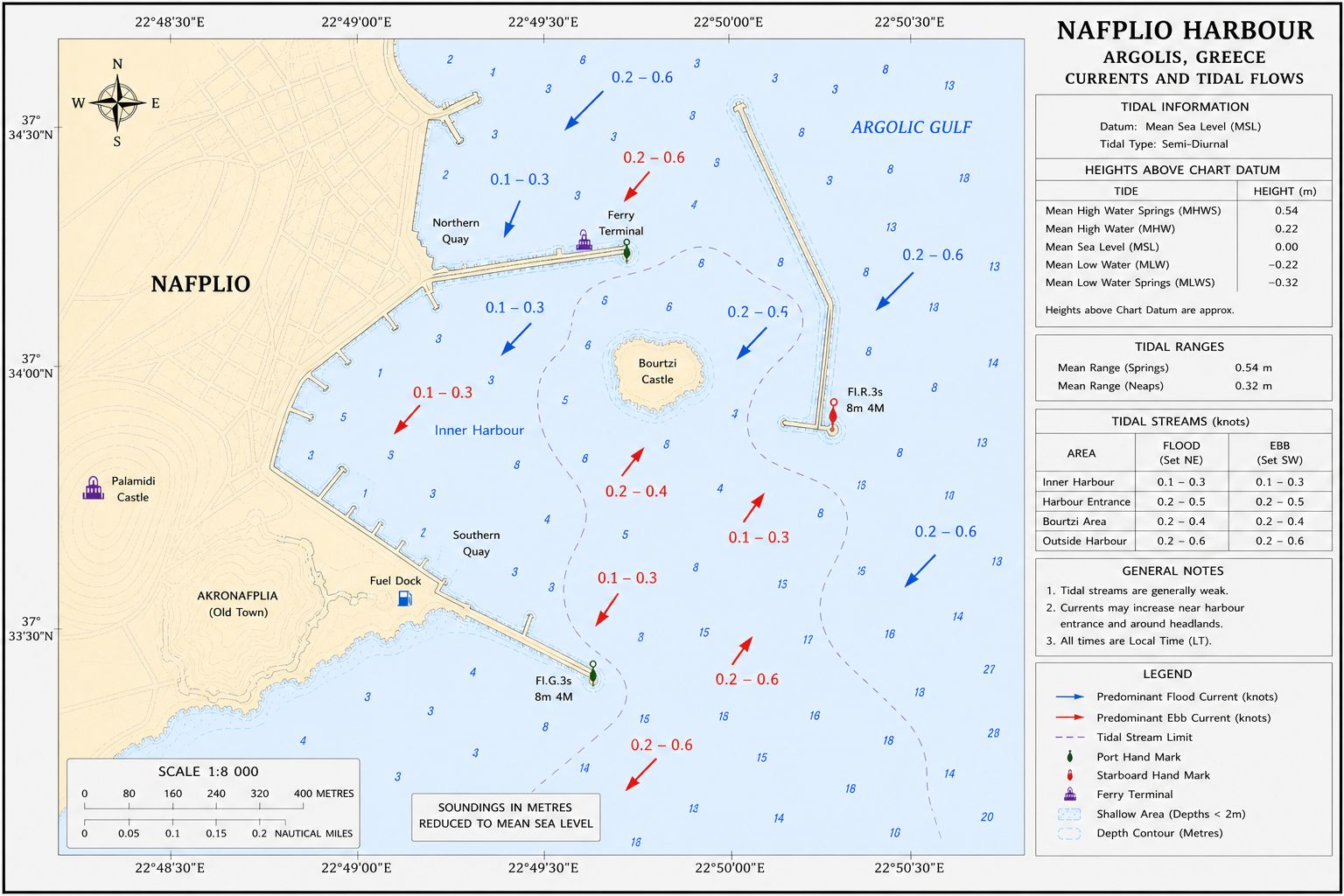
Currents in the Nafplio area are generally weak and predominantly wind-driven, with no significant tidal stream influence due to the minimal tidal range in the Argolic Gulf. Residual flow typically sets north–south along the axis of the gulf, reversing with prevailing wind conditions. Under strong northerlies, a southerly set may develop along the coast, while southerly winds can induce a northward drift toward the head of the gulf. Within Nafplio harbour itself, current is negligible, though localised eddies and short-period movement may occur around Bourtzi Castle and near quay structures, particularly when influenced by wind and vessel movement. Overall flow rates are typically less than 0.5 knots, with little operational impact except in strong wind conditions.
Nafplio Greece
Sailing Guide - Chart Accuracy
Charts issued by the Hellenic Navy Hydrographic Service are accurate for approaches, anchorage areas, and harbour. ENC data aligns with official charts. Local anchoring density and temporary moorings may not be fully represented.
Nafplio Greece
Sailing Guide - Anchorages
- Nafplio Harbour (main bay, around Bourtzi Castle) has anchoring in 5–10 metres over mud, good holding; suitable when quay space is unavailable, allow for swinging room and ferry movements
- South of main quay (inner harbour area) is limited anchoring in 4–8 metres, generally mud; used when space permits, but restricted by harbour traffic and manoeuvring space
- Karathona Bay (south-east of Nafplio) has anchoring in 5–12 metres over sand and mud, good holding; good shelter from N–W, exposed to S–E
- Arvanitia & Palamidi area (east of town) provides temporary anchoring in 8–15 metres, mixed holdin g; exposed and weather-dependent, not suitable in unsettled conditions
There are no organised mooring fields, and anchoring within the main harbour is often controlled or limited by port activity. For operational use, anchoring is practical in settled conditions, with Karathona Bay providing the most reliable alternative outside the harbour.
Nafplio Greece
Sailing Guide - Entry Formalities
Nafplio is the primary designated port of entry and supports full clearance procedures for visiting yachts. Vessels arriving from outside Greece or the Schengen Area may clear in directly at Nafplio, subject to standard Greek entry requirements. Clearance is conducted through the local Port Authority (Limenarchio), with customs and immigration formalities handled in accordance with national procedures. All vessels must ensure that the Greek cruising tax (TEPAI) is valid and paid prior to or on arrival. Required vessel documentation, including registration papers and insurance, must be available. Non-EU vessels must hold a DEKPA cruising log or Transit Log, completed and presented for endorsement as required. Passports and crew documentation are subject to inspection, and clearance procedures should be completed promptly after arrival. For departures to non-Schengen countries, exit formalities are also conducted at Nafplio. As with all Greek ports of entry, procedures are formal but straightforward, with compliance dependent on correct documentation and adherence to reporting requirements on arrival and departure.
Nafplio Greece
Sailing Guide - Marina Facilities
There is no full-service marina in Nafplio. Berthing is on the main town quay and outer harbour walls. Yachts berth stern-to or alongside, with depths typically 5–7 m alongside on the outer quay and slightly less in inner sections. Mooring is by own anchor laid from the bow with stern lines ashore; there are no laid moorings.
Additional space is sometimes available along secondary quay sections, but availability varies with local and visiting traffic. The harbour is well protected from most conditions, with minimal swell, though southerlies can introduce some movement. Facilities are basic, with water and electricity available in parts of the quay, but not consistently. There is no fuel dock, no travel lift, and no repair yard within the harbour.
Nafplio Greece
Sailing Guide - Local Weather
Weather is typical Argolic Gulf Mediterranean, with hot, dry summers and mild, wetter winters. From May to September, conditions are stable with temperatures 28–36°C, very low rainfall, and excellent visibility. Winds are generally lighter than the open Aegean, with light morning airs and NW–W sea breezes 10–20 knots developing in the afternoon.
Spring and autumn are transitional, with temperatures 18–28°C and more variable winds, including S–SW systems 15–25 knots bringing occasional showers and reduced visibility.
Winter (November–March) is mild, 10–18°C, with most annual rainfall occurring during this period. Weather is influenced by S–SW winds 20–35 knots associated with frontal systems, producing unsettled conditions, rain, and moderate seas outside the gulf.
The Argolic Gulf provides some shelter, so sea state inside the bay is generally slight to moderate, even when conditions are more active offshore.
The Marine Electrical and Electronics Bible has a complete list of Greek VHF Radio Channel information and weather forecast times for Greece along with NAVTEX UK and Europe and NAVTEX Mediterranean for 490kHz and 518kHz.
Nafplio Greece
Sailing Guide - Local Winds
Local winds are generally moderate and sheltered within the Argolic Gulf. In summer, conditions are dominated by a diurnal sea breeze, typically W–NW 10–20 knots, building from late morning and easing after sunset. Overnight winds are usually light or calm, with occasional weak E–SE land breezes 5–10 knots.
The surrounding land reduces exposure, so wind strength in Nafplio is lower than in the open Aegean. However, funnelling effects within the gulf can produce short-lived gusts, particularly on final approach to the harbour.
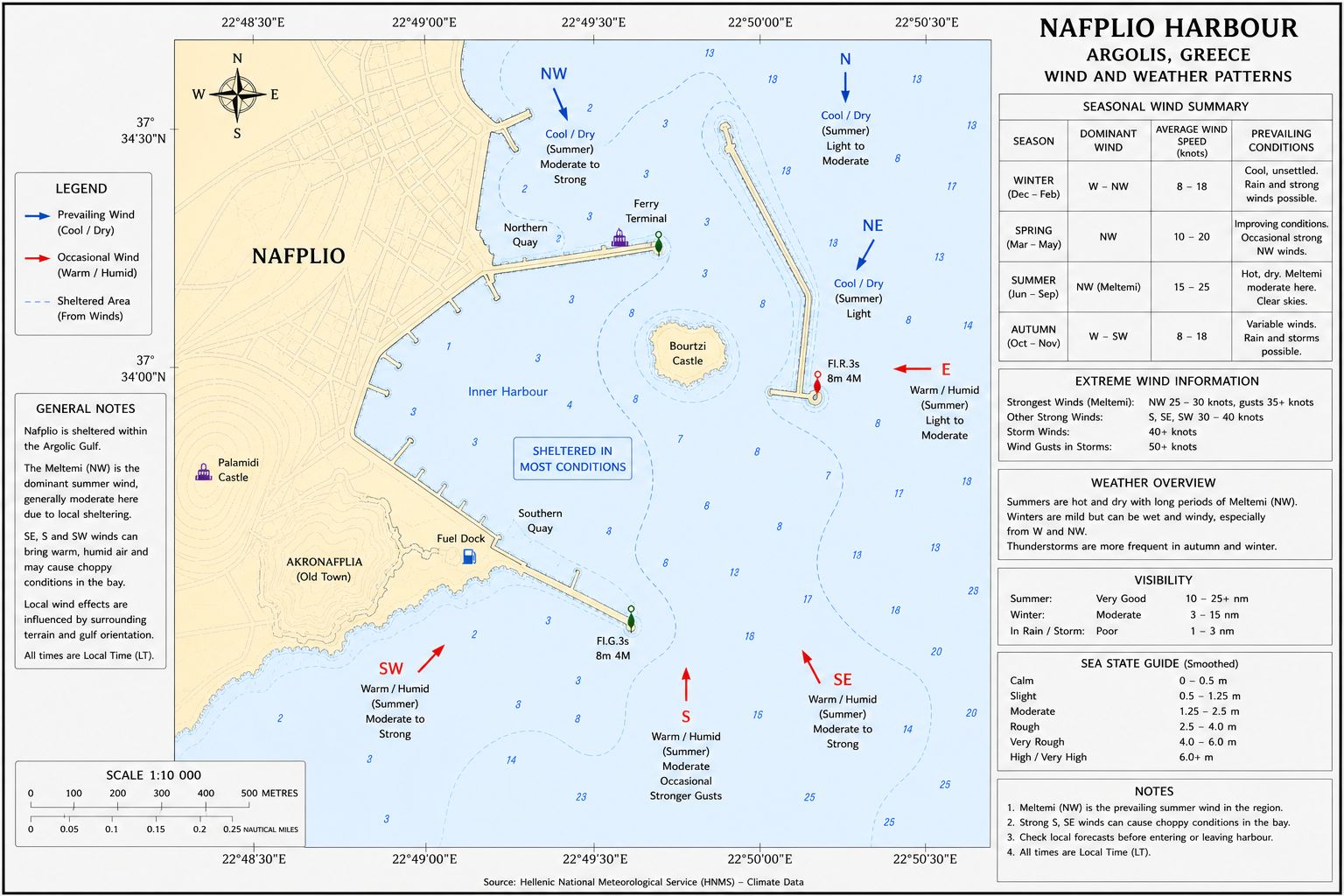
During strong northerly (Meltemi) conditions offshore, the gulf provides partial shelter, though fresh NW winds can still reach 15–25 knots inside the bay. Outside summer, winds are more variable, with S–SW systems 15–30 knots during frontal passages and occasional stronger northerly flows following fronts. Overall, conditions are relatively protected but influenced by local terrain and gulf geometry.
Nafplio Greece
Sailing Guide - Provisioning
Supermarkets. Provisioning in Nafplio is comprehensive and within easy reach of the harbour. The main outlets are AB Vassilopoulos Nafplio, My Market Nafplio, and Bazaar Supermarket Nafplio, all located within approximately 0.5–1.5 km of the quay. Additional smaller supermarkets and minimarkets operate throughout the town centre and along the waterfront.
Markets. Local produce is widely available through greengrocers in Nafplio. A weekly Laiki Agora (farmers’ market) operates in Nafplio, typically once per week (commonly mid-week, subject to seasonal variation). Local products include olive oil, citrus, vegetables, herbs (oregano, thyme), honey, and regional cheeses.
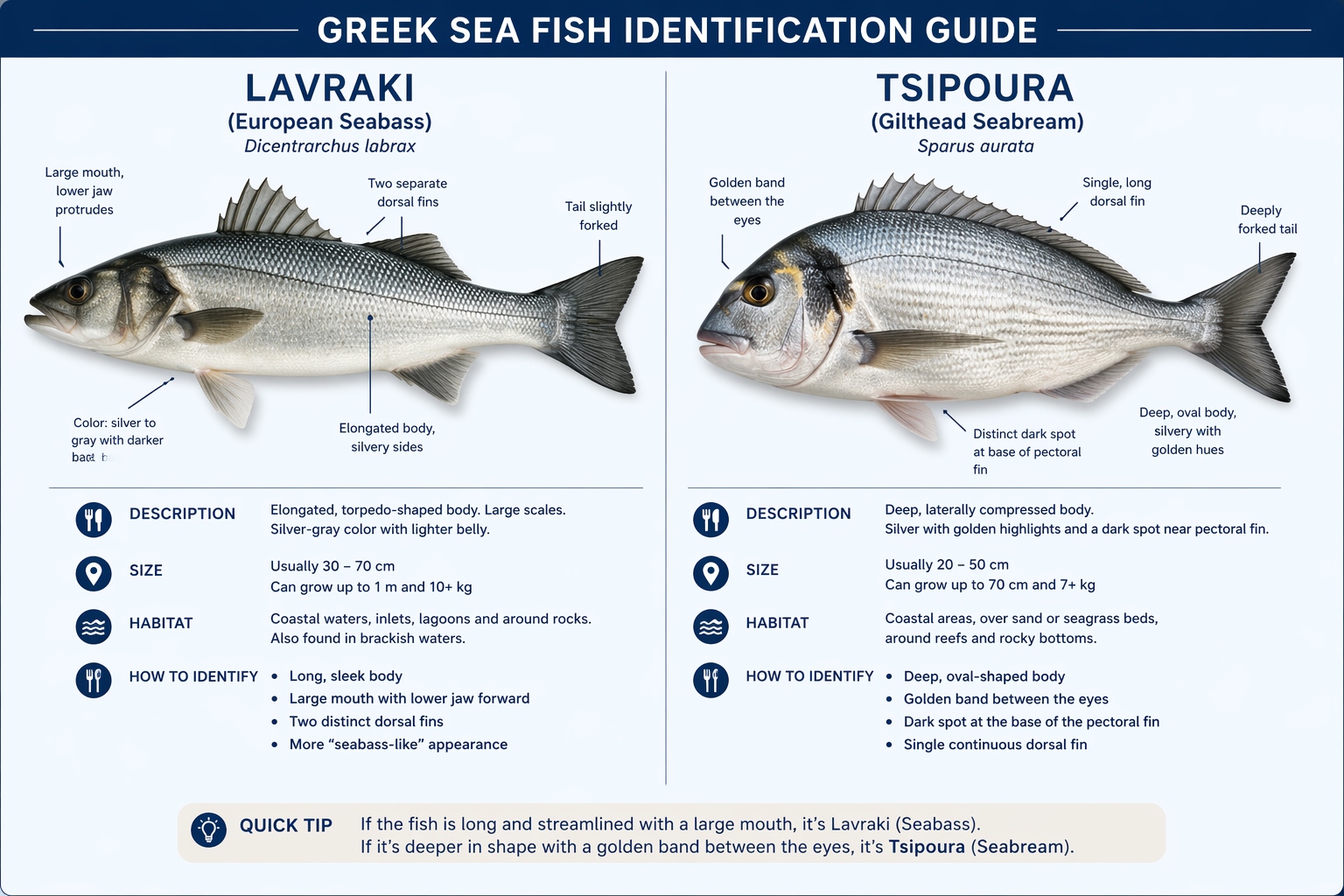


Fish Markets. There is no large central fish market. Fresh fish is sold through fishmongers in Nafplio near the harbour area, supplied by daily catch. Common seafood includes tsipoura (gilthead sea bream), lavraki (European sea bass), sardeles (sardines), gavros (anchovies), kalamari (squid), htapodi (octopus), garides (prawns), and barbouni (red mullet). Availability depends on weather and fishing activity.
Nafplio Greece
Sailing Guide - Local Cuisine
Cuisine in Nafplio reflects Argolis and Peloponnese traditions, combining coastal seafood with inland agricultural produce, influenced by Venetian and Ottoman history. Signature dishes include fresh grilled fish such as tsipoura (sea bream) and lavraki (sea bass), along with kalamari (squid) and htapodi (octopus) prepared simply. Regional specialities include arnaki (lamb) and goat dishes, slow-cooked or roasted, and stifado, a rich stew with onions and tomato. Local products from the Argolis plain feature prominently, including citrus fruits (notably oranges), olive oil, and vegetables, often served in salads and mezze. Seafood dishes such as kakavia (fisherman’s fish soup) and saganaki (shrimp or mussels in tomato and cheese) are common.
Nafplio Greece
Sailing Guide - Beverages
Beer, wine, and spirits across the Greek islands are locally produced and widely available through tavernas, small bars, and provisioning outlets. Beer is predominantly lager, with domestic brands including Mythos, Alfa, Fix, and Vergina alongside imported products; and over 100 microbreweries operate on several islands with limited distribution. Wine is region-specific, with white varieties dominant in the islands, including Assyrtiko, Moschofilero, and Roditis, alongside local table wines served in bulk; retsina remains in circulation as a resin-flavoured wine. Distilled products include ouzo (anise-based), tsipouro (grape marc distillate), raki or tsikoudia (Crete), souma (fig or grape distillate in eastern Aegean islands), and kitron (citrus liqueur from Naxos), with alcohol strength typically in the 37–45% range and higher for unregulated local distillations.
Nafplio Greece
Sailing Guide - Fuel Supplies
Fuel is available in Nafplio by road tanker delivery to the quay, not from a fixed fuel dock. Supply is arranged locally through fuel distributors in the town, typically associated with EKO, Shell, or BP, with delivery made directly alongside by hose. Diesel is readily available; petrol can be supplied on request. Delivery should be coordinated in advance due to quay access and traffic. Fuel quality is standard and generally reliable.
Nafplio Greece
Sailing Guide - Water Supplies
Water is available along sections of the main town quay and outer harbour walls via municipal supply points. Connection is made directly from shore taps; vessels must use their own hoses and fittings. Supply is not continuous along all berths, and pressure can be inconsistent, particularly during peak summer demand. Water is potable but commonly treated onboard before drinking. Availability is generally reliable where connections are provided, but should not be assumed at all berths.
Mechanical and Electrical Repairs
Resource
If you are headed somewhere remote consider the need to expand your knowledge base or have an information resource on board. Why not get a copy of my book The Marine and Electrical and Electronics Bible 4th Edition. By and for yachties, with everything from batteries and charging, solar and wind, diesel engines and marine electronics and so much more. Your complete systems guide. 650 pages of practical advice. In Australia and New Zealand order a copy through Boat Books. UK and European boats can buy the UK Edition Here. US and Canadian boats can get the US Edition Order Here. Marine systems are my profession so let me help you. By a liveaboard boat owner for other boat owners.

Nafplio Greece
Sailing Guide - Marine Services
Marine services in Nafplio are limited to moderate local support. Basic diesel engine servicing and general mechanical repairs can be arranged through local workshops, but there are no major authorised Volvo Penta or Yanmar agents permanently based in Nafplio. Electrical assistance and general marine maintenance are available, but there are no official Raymarine or major marine electronics service centres in the town. There are no haul-out facilities or travel lifts within the harbour itself. For lifting, yard work, or more complex repairs, vessels typically use nearby facilities in Kilada or larger centres such as Piraeus, where full marine services and authorised agents are available.
Nafplio Greece
Sailing Guide – Local Etiquette
Ashore, behaviour is more structured than smaller island ports, reflecting the town’s size and activity level. Noise should be minimised, especially at night near residential and harbour areas. Waste disposal should use designated facilities, and discharge within harbour limits is not acceptable. Dress is casual but appropriate attire is expected in town, restaurants, and churches, with swimwear covered. Overall, etiquette is based on strict adherence to port control, awareness of traffic, and respect for a busy mixed-use harbour environment.
Nafplio Greece
Sailing Guide - Summary
Nafplio provides semi-sheltered conditions within the Argolic Gulf with extensive anchorage and good holding. Harbour space is limited and can be congested. Wind conditions are reduced compared to open Aegean locations. Provisioning and basic services are available with regional support required for major work. Nafplio Greece Sailing Guide for all you need to know.