Meganisi Greece
Sailing Guide
Meganisi Greece Sailing Guide. Meganisi is located in the inner Ionian Sea east of Lefkada within Greece at approximately 38°40′N 20°47′E. The island lies inside a sheltered area bounded by Lefkada to the west and the Greek mainland to the east, forming a protected cruising ground with reduced exposure to open sea conditions. The coastline is highly indented with multiple bays and inlets providing anchorage and small harbour facilities.
The operating environment is sheltered with minimal sea state compared to open Ionian waters. Wind effects are moderated by surrounding landmasses, and swell penetration is limited. Depths increase rapidly outside bays but reduce predictably within anchorages. The seabed is predominantly mud and sand with areas of weed, providing generally reliable holding. Tidal range is negligible and has no operational impact.
Meganisi Greece
Sailing Guide History
The history of Meganisi is closely linked to the wider Ionian Islands and nearby Lefkada. In antiquity, the island was part of the Greek world and is traditionally associated with the kingdom of Odysseus, though this connection is more legendary than confirmed. Archaeological evidence indicates habitation from ancient times, with small settlements and maritime activity.
During the medieval and early modern periods, Meganisi came under Venetian rule along with the rest of the Ionian Islands, followed by brief French and then British administration. The island was united with modern Greece in 1864. Historically, Meganisi remained small and rural, with its economy based on fishing, agriculture, and seafaring. Its relative isolation preserved traditional village life, which continues to characterise the island today.

Chart Disclaimer. This chart is a schematic representation for illustrative purposes only and must not be used for navigation. Refer to official hydrographic charts for safe navigation. Be aware ENC charts may differ from official hydrographic charts. Both should be corrected and updated regularly.
Meganisi Greece
Sailing Guide – Currents and Tidal Flows

Meganisi Greece
Sailing Guide - Approaches
Approach is via the inner Ionian waters between Lefkada, Meganisi, and the mainland, with offshore depths generally 20–50 m reducing to 10–20 m within 1–2 NM of the island and 5–15 m within bay systems. There are no restricted channels for general approach, though navigation between islands requires attention to coastal contours and traffic. Sea state is generally low due to shelter from surrounding land. North-westerly winds produce limited sea development within the area, while southerly winds have reduced fetch and limited effect. Tidal range is typically 0.2–0.4 m with no operational tidal stream. Hazards include coastal shoals, unmarked fishing gear, and increased vessel density during peak periods.
Meganisi Greece
Sailing Guide - Navigation
Access is via the sheltered waters east of Lefkada in generally clear conditions with depths 30–80 m offshore, shoaling to 10–20 m within 0.5–1 NM of the coast. The area is well protected from open Ionian swell, making navigation comparatively straightforward. Primary approaches are from the N via the Lefkada Channel or from the S around the southern end of Meganisi. Waters between Meganisi and Lefkada are deep and free of major hazards, though care is required near headlands and in confined bays.
Main harbours include Vathi, Spartochori (Spilia), and Katomeri areas, where depths reduce to 5–10 m on approach and 3–6 m alongside or at anchor. Entrances are generally straightforward but can be narrow and require accurate alignment. Numerous bays and inlets provide anchorage in 5–15 m over sand and mud, with good holding. However, rocks and rapid depth changes occur close inshore, particularly along exposed edges and near points. Traffic is moderate with charter vessels common in season. Night navigation is possible but requires caution due to limited lighting in smaller bays. Fishing gear including nets and longlines may be present near shore and around headlands and is not always clearly marked.
Meganisi Greece
Sailing Guide - Chart Accuracy
Charts issued by the Hellenic Navy Hydrographic Service are accurate for coastal outlines and general depths. ENC data aligns with official charts. Local anchorage detail, mooring lines, and seabed variation are not fully represented and require visual assessment.
Meganisi Greece
Sailing Guide - Anchorages
Meganisi provides multiple anchorage locations with generally consistent holding.
- Vathy Bay provides anchoring in 5–10 m over mud with reliable holding and high shelter from prevailing winds.
- Spilia Bay provides anchoring in 5–10 m over mud and sand with good holding and protection from north-westerly winds.
- Abelike Bay provides anchoring in 5–10 m over mud with good holding and high shelter.
- Other bays around the island provide anchoring in 5–15 m over mud and sand with consistent holding and variable shelter depending on orientation.
Shelter is generally high across most anchorages due to enclosed geography

Meganisi Greece
Sailing Guide - Entry Formalities
Entry formalities follow standard Greece procedures for visiting yachts. This is not a designated port of entry for international clearance, and there are no customs or immigration facilities on the island. Vessels arriving from outside Greece or the Schengen Area must first clear into the country at an official port of entry before proceeding to this port. Direct arrival from a non-Schengen country is not permitted. The Greek cruising tax (TEPAI) must be valid and paid, and the vessel’s cruising log (DEKPA for non-EU vessels, or transit log where applicable) should be up to date and available for inspection if requested by port authorities or coastguard.
Meganisi Greece
Sailing Guide - Marina Facilities
There is no large full-service marina on Meganisi. Berthing is distributed between several small harbours. In Vathi, the main port, yachts berth stern-to or alongside on the town quay, with depths typically 3–6 m alongside. Mooring is by own anchor or laid moorings depending on berth location. The harbour is well sheltered and widely used. At Spilia (Spartochori), a smaller quay provides stern-to berthing in 3–5 m, also using own anchor. Space is limited and fills quickly in season. Additional small quays and mooring points exist around the island, but facilities are basic. Water and electricity may be available in some locations but are not consistent. There are no fuel docks, no travel lifts, and no dedicated repair yards on Meganisi.
Meganisi Greece
Sailing Guide - Local Weather
Weather is typical Ionian Mediterranean, with hot, dry summers and mild, wetter winters. From May to September conditions are stable, with temperatures 25–33°C, light winds in the morning and NW–W sea breezes 10–20 knots developing in the afternoon. Rainfall is minimal in summer and visibility is generally excellent.
Spring and autumn are transitional, with temperatures 15–25°C and more variable winds, including S–SW systems 15–25 knots bringing occasional showers and reduced visibility.
Winter (November–March) is mild, 10–18°C, with most annual rainfall occurring during this period. Weather is influenced by S–SW winds 20–35 knots associated with passing lows, producing unsettled conditions, rain, and moderate seas outside sheltered waters.
The Marine Electrical and Electronics Bible has a complete list of Greek VHF Radio Channel information and weather forecast times for Greece along with NAVTEX UK and Europe and NAVTEX Mediterranean for 490kHz and 518kHz.
Meganisi Greece
Sailing Guide - Local Winds
Local winds follow a diurnal NW–W sea breeze pattern in summer, typically 10–20 knots, building from late morning and easing after sunset, with light or calm conditions overnight. Morning winds are often weak or variable, occasionally light E–SE land breezes 5–10 knots.
The waters between Meganisi and Lefkada can produce local acceleration, particularly in stronger NW conditions, with short, choppy seas. Within bays and harbours such as Vathi and Spilia, wind strength is reduced but gusts and shifts occur near headlands and confined inlets. Outside summer, winds are more variable, with S–SW systems 15–30 knots during frontal passages and occasional stronger northerly flows following fronts. Overall conditions are moderate and generally sheltered compared to more exposed Ionian locations.

Meganisi Greece
Sailing Guide - Provisioning
Supermarkets. Provisioning on Meganisi is limited. Small supermarkets and minimarkets are located in Vathi and Spartochori, within walking distance of the quays. These outlets provide basic supplies only. For full provisioning, vessels typically use Lefkada (Nidri or Lefkada Town), where large supermarkets are available.
Markets. There is no regular Laiki Agora (farmers’ market) on Meganisi. Limited local produce is available through village greengrocers and seasonal outlets, including olive oil, vegetables, herbs, and small quantities of local products. Supply is variable and not comprehensive.
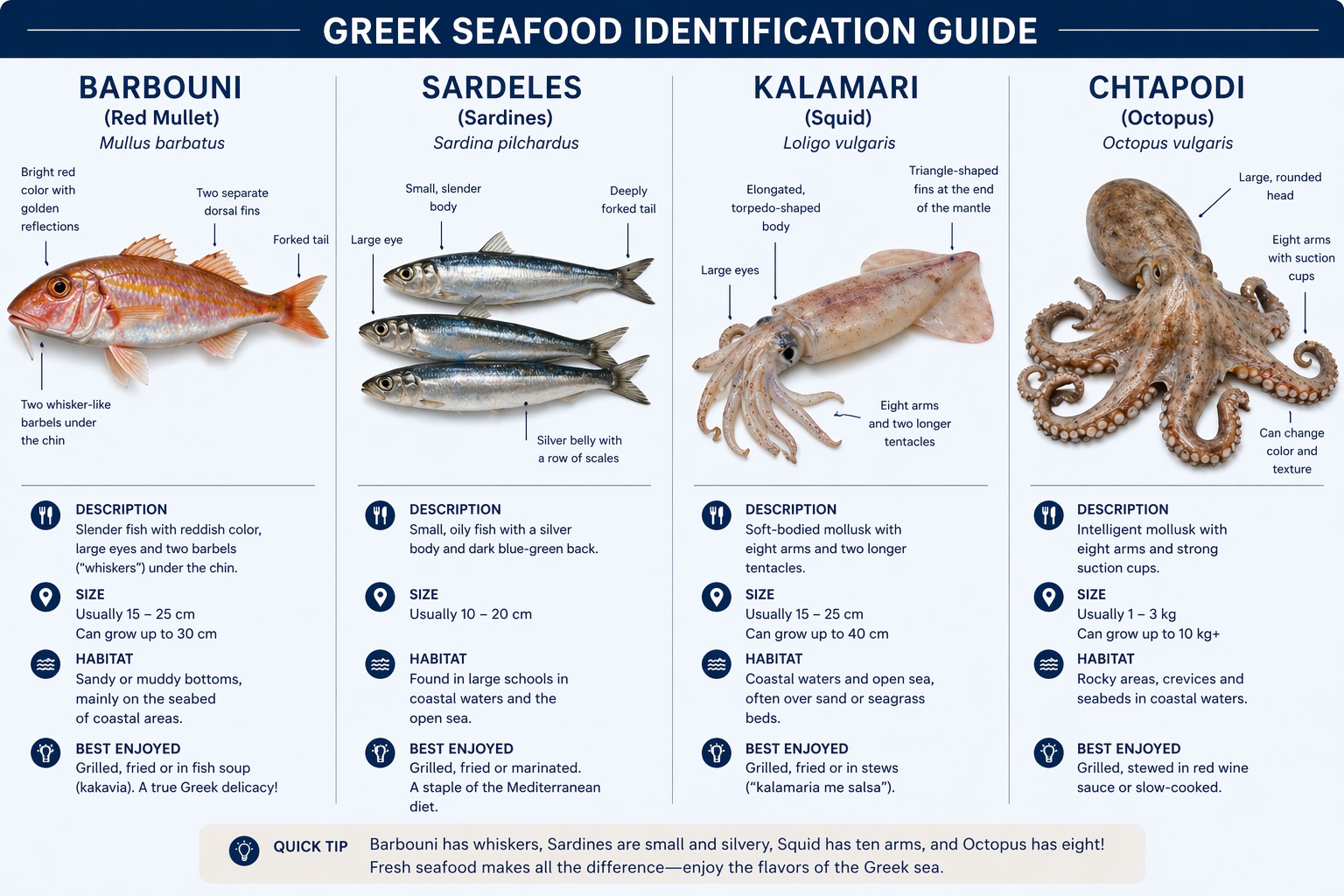
Fish Markets. There is no fish market on Meganisi. Fresh fish is occasionally available through local tavernas or small vendors, depending on daily catch. Common seafood (when available) includes tsipoura (gilthead sea bream), lavraki (European sea bass), sardeles (sardines), gavros (anchovies), kalamari (squid), htapodi (octopus), and garides (prawns), but availability is irregular and not suitable for full provisioning.
Meganisi Greece
Sailing Guide - Local Cuisine
Cuisine on Meganisi is simple Ionian island cooking, based on fresh seafood, olive oil, and locally grown produce, with influences from nearby Lefkada. Signature dishes include Fresh grilled fish – Tsipoura (sea bream), lavraki (sea bass), and other local catch, prepared simply. Octopus and squid dishes – Grilled or stewed (htapodi, kalamari). Kakavia – Traditional fisherman’s fish soup using mixed local fish. Sofrito (Ionian style) – Meat cooked with garlic, wine, and light sauce. Stifado – Slow-cooked meat stew with onions, tomato, and spices. Greek salads and mezze – Tomato, cheese, olive oil, and herbs.
Meganisi Greece
Sailing Guide - Beverages
Beer, wine, and spirits across the Greek islands are locally produced and widely available through tavernas, small bars, and provisioning outlets. Beer is predominantly lager, with domestic brands including Mythos, Alfa, Fix, and Vergina alongside imported products; and over 100 microbreweries operate on several islands with limited distribution. Wine is region-specific, with white varieties dominant in the islands, including Assyrtiko, Moschofilero, and Roditis, alongside local table wines served in bulk; retsina remains in circulation as a resin-flavoured wine. Distilled products include ouzo (anise-based), tsipouro (grape marc distillate), raki or tsikoudia (Crete), souma (fig or grape distillate in eastern Aegean islands), and kitron (citrus liqueur from Naxos), with alcohol strength typically in the 37–45% range and higher for unregulated local distillations.
Meganisi Greece
Sailing Guide - Fuel Supplies
There are no fuel supplies on Meganisi. No fuel dock, tanker delivery, or shore-side supply is available. All refuelling must be completed prior to arrival, typically in Lefkada (Nidri or Lefkada Town), where fuel docks and reliable supply are available. Vessels should plan fuel requirements accordingly, as no resupply is possible on the island.
Meganisi Greece
Sailing Guide - Water Supplies
Water is available in limited locations. In Vathi harbour, municipal supply points are present along sections of the quay, allowing connection by hose where fitted. At Spilia (Spartochori), water may also be available at the quay, but supply is less consistent. Coverage is not continuous, and pressure can be variable, particularly in peak summer periods. Water is potable but commonly treated onboard before drinking. Outside these points, there are no dedicated water supply facilities, so availability should not be assumed.
Mechanical and Electrical Repairs
Resource
If you are headed somewhere remote consider the need to expand your knowledge base or have an information resource on board. Why not get a copy of my book The Marine and Electrical and Electronics Bible 4th Edition. By and for yachties, with everything from batteries and charging, solar and wind, diesel engines and marine electronics and so much more. Your complete systems guide. 650 pages of practical advice. In Australia and New Zealand order a copy through Boat Books. UK and European boats can buy the UK Edition Here. US and Canadian boats can get the US Edition Order Here. Marine systems are my profession so let me help you. By a liveaboard boat owner for other boat owners.


Meganisi Greece
Sailing Guide - Marine Services
Marine services on Meganisi are very limited. Only basic assistance can be arranged locally, typically small-scale mechanical help or minor repairs through local operators. There are no authorised Volvo Penta or Yanmar agents on the island, and no Raymarine or major marine electronics service providers. There are no haul-out facilities, travel lifts, or repair yards on Meganisi. For engine servicing, diagnostics, electronics work, or any significant repair, vessels must use facilities in nearby Lefkada (Nidri or Lefkada Town), where full marine services, yards, and authorised agents are available.
Meganisi Greece
Sailing Guide - Local Customs
Interaction is direct and formal on first contact, with a greeting expected before any request or transaction. Conversation tone is measured and transactional, with limited small talk unless initiated locally. Personal space is closer than in northern Europe, but physical contact is minimal unless familiarity is established. Shore behaviour is conservative in non-tourist areas, particularly near churches and village centres where modest dress and low noise are expected.
Meganisi Greece
Sailing Guide - Summary
Meganisi provides multiple sheltered anchorages with reliable holding and low sea state. Navigation is straightforward within enclosed waters. Harbour facilities are limited with constrained quay space. Provisioning is basic with reliance on nearby Lefkada for full services. Meganisi Greece Sailing Guide for all you need to know.